
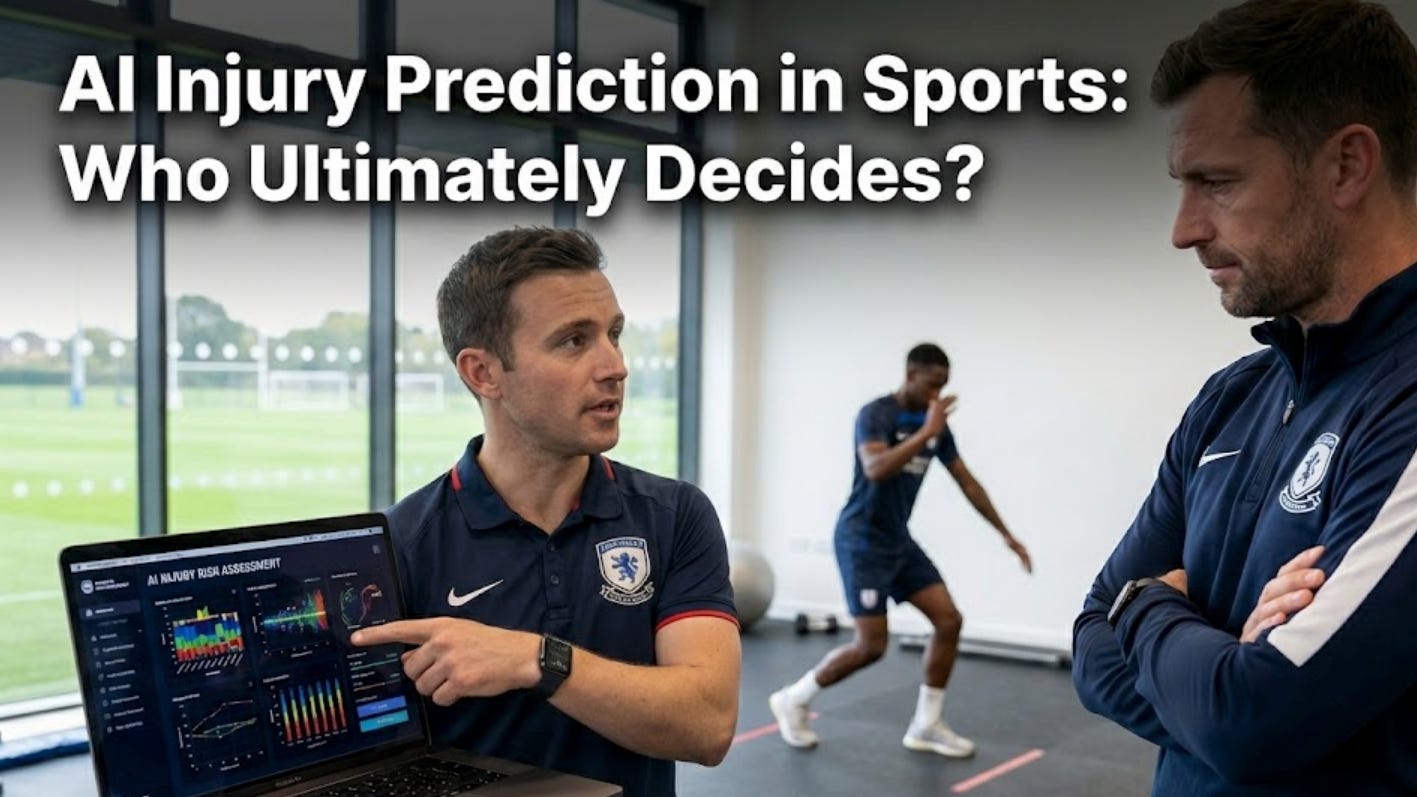
In elite sports, the difference between winning and losing often hinges on player health. Injuries can derail a season, affect team strategy, and impact player careers. Teams are increasingly turning to technology for an edge, and AI is emerging as a promising tool for injury prediction. Some startups now claim that, in the near future, AI could predict injuries in real time, potentially alerting teams before a player steps onto the field.
But even if AI predictions become highly accurate, the ultimate question remains: will coaches act on them? Practitioners can interpret AI data, flag risk, and recommend preventive actions, but coaches must balance these recommendations with short-term performance objectives, competitive pressures, and roster needs. The tension between AI insights, practitioner advice, and coaching priorities creates scenarios that reveal the challenges—and opportunities—of integrating AI into elite sports.
Scenario 1: Star Player in a Crucial Game
Use Case: AI predicts a high likelihood of hamstring strain in the team’s star player if they play tonight.
Practitioner Recommendation: Rest and rehab are strongly advised.
Coach Options:
Listen: Bench the player, protect long-term health.
Ignore: Play the player due to the importance of the game.
Potential Outcomes:
Listening: Player recovers, available for future key games; short-term sacrifice for long-term gain.
Ignoring: Player aggravates injury, sidelined for weeks or months.
Scenario 2: Mid-Season, Regular Game
Use Case: Moderate shoulder inflammation flagged in a key starter.
Practitioner Recommendation: Limit minutes or adjust load.
Coach Options: Listen or ignore.
Outcomes: Listening prevents escalation; ignoring increases risk of multi-game absence.
Scenario 3: Young Player, Long-Term Investment
Use Case: High likelihood of stress fracture in a young athlete.
Practitioner Recommendation: Scale back intensity, rest, and monitor closely.
Coach Options: Listen or push for immediate results.
Outcomes: Listening preserves long-term career potential; ignoring risks sidelining a future star.
Scenario 4: Low-Risk Situations
Use Case: Minor 10% risk of ankle sprain.
Practitioner Recommendation: Minor adjustments, e.g., taping or reduced intensity.
Coach Options: Listen or play normally.
Outcomes: Listening adds caution without impacting performance; ignoring carries minimal risk.
Scenario 5: Multiple Players Flagged Simultaneously
Use Case: Moderate injury risk across several starters mid-season.
Practitioner Recommendation: Rotate players and adjust workload.
Coach Options: Listen or ignore.
Outcomes: Listening reduces cumulative injuries; ignoring increases risk of multiple absences.
How AI Could Improve Over the Next 5 Years
AI injury prediction is still evolving, but capabilities are likely to expand significantly:
Integration of multi-source data: AI will increasingly combine GPS, heart rate variability, biomechanics, sleep, nutrition, and wellness questionnaires into a single predictive model.
Real-time risk monitoring: Predictions will move from pre-game analytics to continuous, real-time risk assessment during training and matches.
Personalized injury profiles: Models will account for individual biomechanics, genetics, prior injuries, and even psychological stressors.
Predictive simulations: AI could simulate “what-if” scenarios, showing the potential impact of different workloads or substitutions before they happen.
Enhanced interpretability: AI models will become more transparent, providing actionable recommendations in clear language for practitioners and coaches.
These advances could make AI a trusted, actionable part of day-to-day sports decision-making, but the technology’s value still depends on human judgment and organizational buy-in.
Recommendations to Teams
Integrate AI with practitioner expertise: Use AI as a complement to human judgment, not a replacement. Practitioners must interpret predictions in context.
Build trust through gradual adoption: Start with low-stakes scenarios, track outcomes, and demonstrate reliability before relying on AI for high-pressure decisions.
Focus on communication: Ensure coaches and practitioners are aligned on risk thresholds, player priorities, and decision-making protocols.
Document outcomes: Collect data on AI predictions, practitioner advice, coach decisions, and results to refine models and improve trust.
Prepare for multi-player scenarios: Use AI to manage cumulative load across the roster and prevent cascading injuries.
Plan for long-term athlete development: Prioritize decisions that protect young or high-potential players to maximize career longevity.
Conclusion
AI has the potential to transform injury prevention in sports, but its success depends on how organizations integrate it into decision-making. Practitioners interpret AI data and contextualize risk, while coaches ultimately decide whether to act. Teams that effectively combine AI insights, practitioner expertise, and strategic coaching will likely see meaningful reductions in injuries, better player availability, and long-term performance gains.
AI may predict the risk—but humans still call the shots. The challenge lies not in the technology itself, but in how teams choose to trust, interpret, and act on it.
You may also like:
📈 Upside Analysis: Enhancing, Not Replacing: How AI Empowers Practitioners in Elite Sports

Artificial Intelligence (AI) is rapidly transforming elite sports, offering tools that elevate training, recovery, performance analysis, and tactical planning. Yet, one major misconception persists: that AI threatens to replace human practitioners. In reality, AI’s true value lies in its ability to
🤖 Upside Analysis: Generative AI in Sports: Key Stats, Trends, Drivers, Challenges, Vendors, Recommendations to Pro Teams

Gen AI has been one of the most talked about topics in the world, including the world of elite sports. It is impacting the world of elite sports at many levels: Fan engagement, injury reduction, ticket sales, customer experience, etc. So what are the main drivers, challenges for Gen AI? How big is the market likely to be? So what are the main underlayin…
🔥Upside Chat: Adam Cheyer, Co-Founder of Siri (Apple) & Viv Labs on ChatGPT & Generative AI

Over the past few months there has been so much hype about ChatGPT or what people refer to as generative AI. In fact, ChatGPT reached 1 million users in 5 days and 100 million daily active users in just two months beating popular messaging applications such as WhatsApp and Twitter.
Brillant analysis of the human decision layer in sports AI! The star player dilemma is where I've seen this tension play out most intensely. One thing that could accelearte adoption is what-if simulatins showing cumulative team impact over a season rather than single-game scenarios. When I was consulting with a sports org, coaches were way more receptive when models showed how preserving one player's health rippled through rotation optimalilty across 20+ games.