

Introduction: A crisis at the center of the AI revolution
For years, NVIDIA has been one of the biggest beneficiaries of the artificial intelligence revolution. Under the leadership of co-founder and CEO Jensen Huang, the company transformed itself from a graphics-chip manufacturer into a central supplier of the computing infrastructure powering modern AI.
Its technology supports everything from large language models and autonomous vehicles to scientific research, robotics, and increasingly, sports performance analytics.
Now NVIDIA faces a potentially defining leadership crisis.
Reports that its board is considering removing Huang following revelations about his personal relationships and potential national-security concerns have created uncertainty around one of the world’s most strategically important technology companies.
The controversy has already contributed to substantial market volatility. Reuters reported that approximately $600 billion in market capitalization had been erased since the investigation began, although that market movement should not be attributed exclusively to the scandal without further analysis.
Meanwhile, Elon Musk has publicly expressed interest in hiring Huang, while speculation is growing about who could replace him.
This situation raises questions extending well beyond NVIDIA itself.
What happens when the future of a company central to the AI economy becomes tied to the fate of one individual? And could this crisis accelerate a shift in the competitive landscape of the semiconductor industry?
What is the controversy surrounding Jensen Huang?
The controversy involves two separate reported relationships, with different corporate-governance and national-security implications.
First: An alleged relationship involving national-security concerns.
Huang has acknowledged a personal relationship with a woman who has reportedly been investigated over suspicions involving Chinese intelligence. Reporting has linked the investigation to questions about sensitive information and the movement of advanced NVIDIA chips into China.
Associated Press reported that Megaspeed International, a Singapore-based company connected to the controversy, said it would cooperate with US investigations and denied allegations of illicit chip shipments. NVIDIA said it had no reason to believe national-security information or company secrets had been compromised.
This distinction is important: an investigation and intelligence suspicions do not establish that Huang knowingly disclosed sensitive information or participated in wrongdoing.
Second: A reported relationship with an NVIDIA executive.
Additional reporting has described an alleged relationship involving a direct report, raising questions about workplace power dynamics, conflicts of interest, disclosure obligations, and corporate governance.
Such relationships can create governance problems even in the absence of criminal conduct, particularly when they involve senior executives and potential reporting-line conflicts.
Third: The board’s response.
Reuters reported that NVIDIA’s board met on November 11 to consider Huang’s future. The company has faced mounting pressure to conduct an independent review and demonstrate that its governance processes can function independently of its founder.
Reuters+1
As of this analysis, Huang’s removal has not been confirmed.
Elon Musk enters the conversation
In response to a social media suggestion that he hire Huang, Elon Musk replied:
“That would be an honor.”
Bloomberg reported the exchange on November 12. Musk’s businesses, including Tesla and his AI ventures, have significant interests in NVIDIA’s technology.
The comment is notable, but it is not a formal job offer or evidence that Huang plans to join a Musk-controlled company.
It also highlights an unusual dimension of the crisis: even if NVIDIA were to lose Huang, his expertise and industry relationships could remain enormously valuable to another AI company.
Who could replace Jensen Huang?
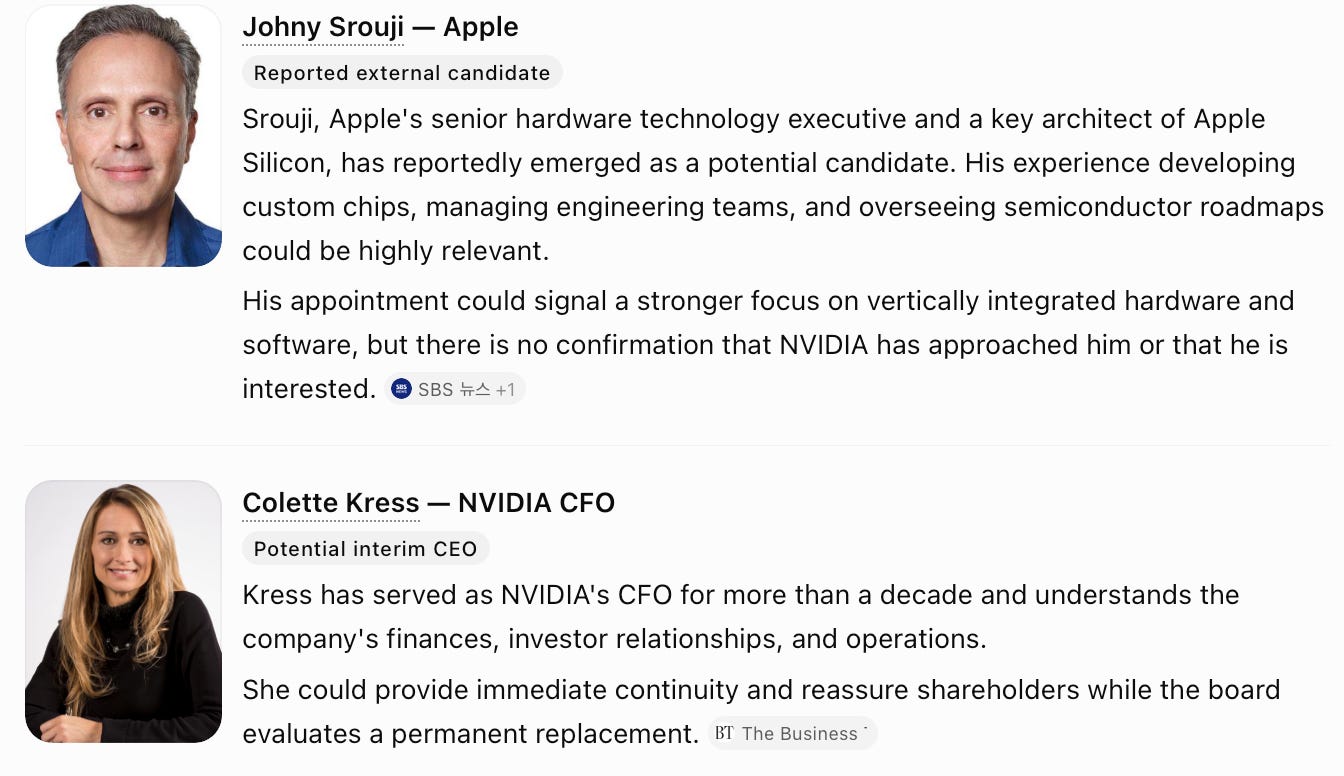
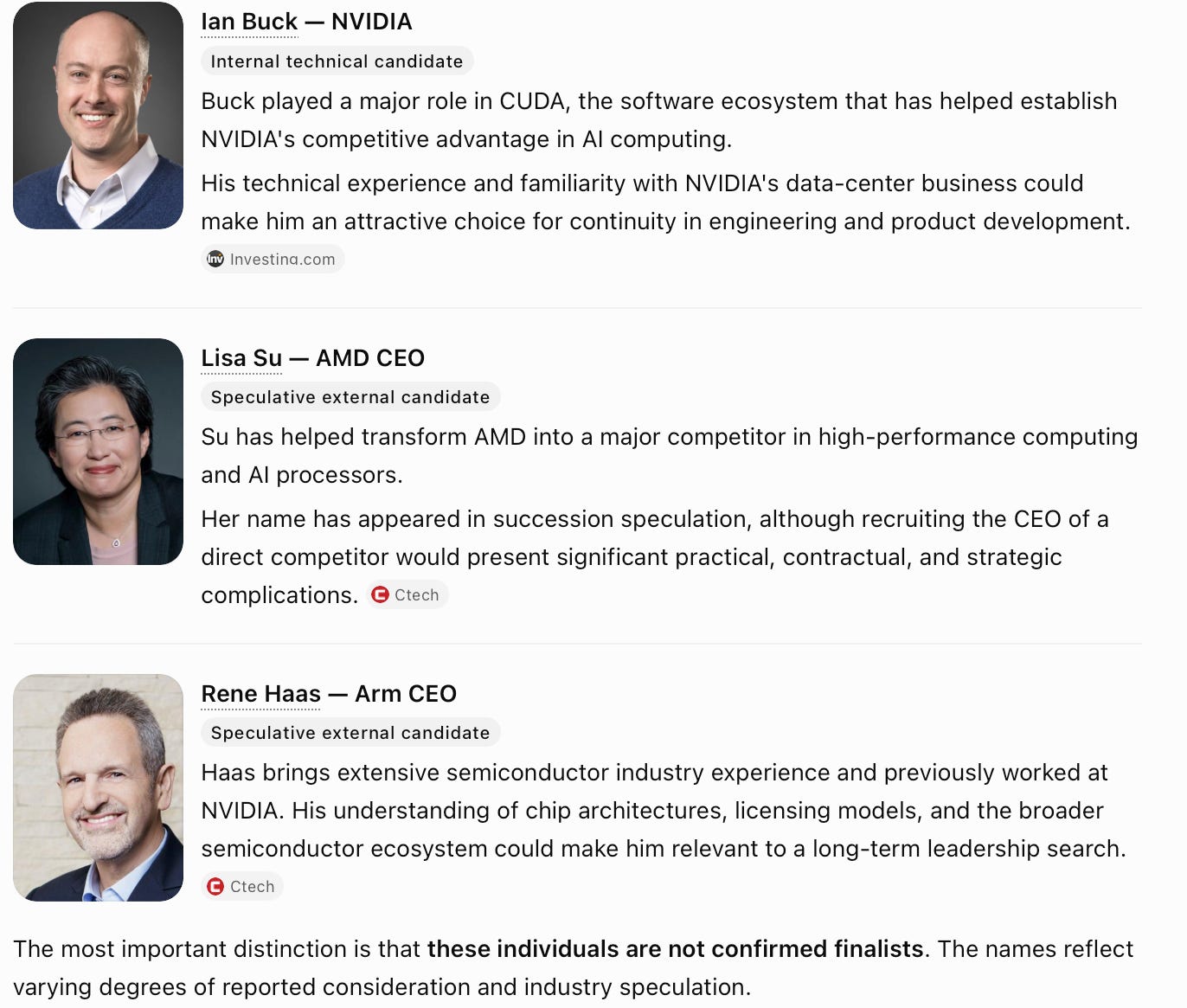
One of NVIDIA’s biggest vulnerabilities is the apparent absence of an obvious successor.
Huang co-founded the company in 1993 and has remained deeply involved in its technology strategy, commercial relationships, and long-term vision.
According to Reuters and Bloomberg, the board has been considering both internal and external candidates, including the possibility of appointing an interim CEO while conducting a broader search.
Our analysis
NVIDIA may need more than one executive to replace Huang’s influence.
His role combines three distinct responsibilities: technical vision, global commercial relationships, and corporate leadership.
An interim CEO could stabilize operations, while a permanent CEO would need to establish credibility with engineers, hyperscale customers, investors, and governments.
A technically strong leader might be better positioned to preserve the company’s innovation culture. A financially experienced leader might prioritize governance, capital allocation, and investor confidence.
The board’s challenge is finding someone capable of doing both.
Potential impact on the US economy and the AI industry
NVIDIA’s importance extends beyond the semiconductor sector.
Its GPUs are used in AI infrastructure deployed by companies including Microsoft, Amazon, Google, Meta, and numerous AI startups.
The United States has made AI infrastructure a strategic economic priority, with substantial investment flowing into data centers, electricity generation, networking equipment, and advanced semiconductor manufacturing.
A prolonged leadership crisis at NVIDIA could affect this ecosystem through several channels.
A. Financial markets and investor confidence
NVIDIA’s large market capitalization and weight in major equity indexes mean significant share-price movements can affect retirement portfolios, institutional investors, and technology-sector valuations.
Reported market impact since the investigation began
~$600 billion
Market capitalization decline reported by Reuters, not a confirmed economic loss or a measure attributable solely to the scandal.
The bigger risk would be a sustained loss of confidence that increases the cost of capital for NVIDIA and companies closely tied to its ecosystem.
B. AI infrastructure investment
Large technology companies plan infrastructure investments years in advance. NVIDIA’s leadership plays a significant role in communicating product roadmaps, supply commitments, and the economics of new computing platforms.
If leadership uncertainty delays purchasing decisions or creates doubts about future products, it could affect the timing of AI infrastructure projects.
However, leadership uncertainty does not automatically mean chip shortages. Manufacturing capacity, component availability, and supply-chain contracts remain separate operational factors.
C. US-China technology competition
The national-security dimension makes this controversy particularly sensitive.
Advanced AI chips are strategically important because they support commercial AI development as well as technologies with potential military and intelligence applications.
If investigators uncover export-control violations or security failures, the consequences could include increased scrutiny of semiconductor distribution networks, customers, and cross-border transactions.
Conversely, an investigation that finds no compromise could help reduce uncertainty.
D. Innovation and the startup ecosystem
NVIDIA is not simply a chip supplier. Through its software platforms, developer programs, and investments, it helps shape the broader AI startup ecosystem.
A leadership transition could change the company’s approach to acquisitions, startup investments, partnerships, and developer support.
For early-stage AI startups, the practical issue is whether NVIDIA’s product and ecosystem commitments remain predictable.
What does this mean for the sports tech industry?
This is an important question that has received far less attention than the immediate financial-market implications.
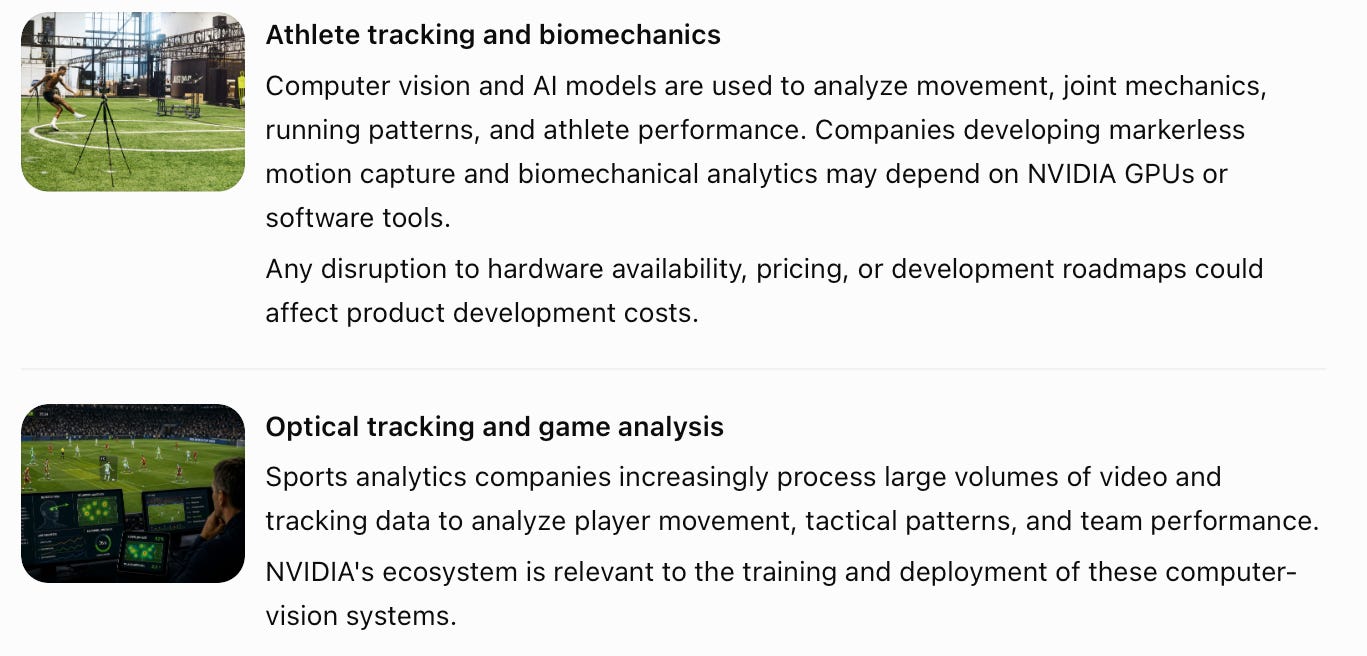
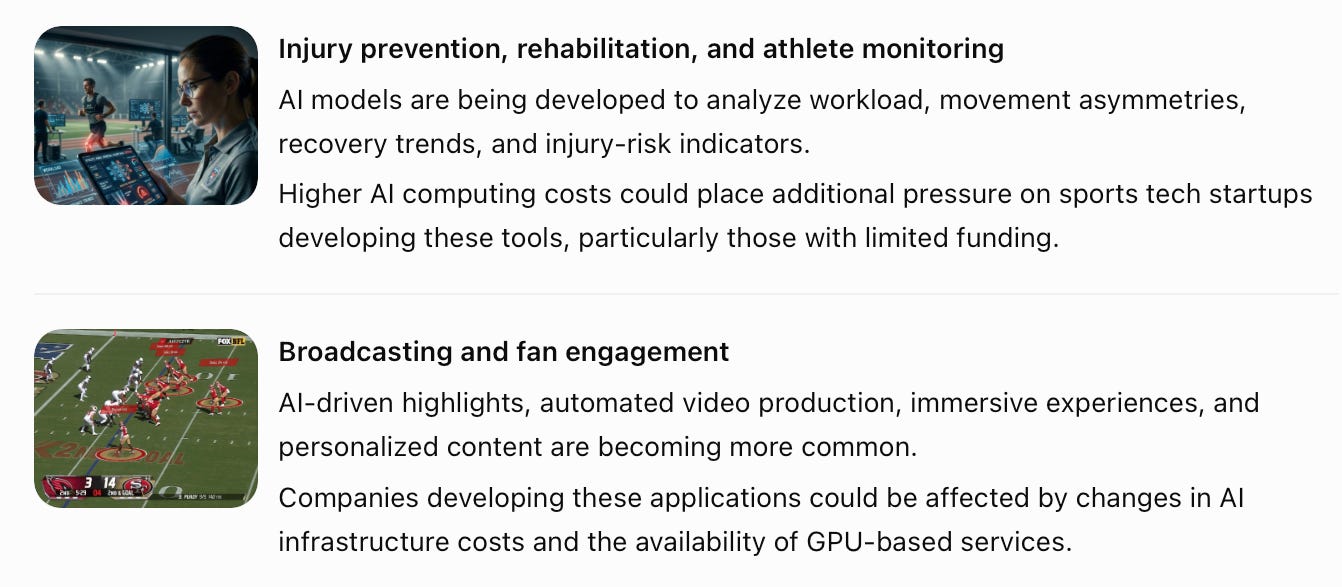
AI is becoming increasingly important across elite sports, and NVIDIA technology supports many of the underlying computing workloads.
The Upside perspective
For NBA, NFL, NHL, MLS, NCAA, and European soccer organizations, the immediate impact is likely to be limited.
Teams are unlikely to see their existing performance analytics systems suddenly stop working because of a change in NVIDIA’s leadership.
The more relevant question is what happens over the next 12–24 months.
If uncertainty affects AI computing prices, cloud infrastructure investment, or product development, sports tech vendors may face higher costs or longer development timelines.
On the other hand, stronger competition among NVIDIA, AMD, and alternative AI chip providers could eventually make advanced AI tools more affordable.
For sports tech startups, diversifying computing infrastructure and avoiding unnecessary dependence on a single hardware or software ecosystem could become increasingly important.
Past technology scandals: What can NVIDIA learn?
Technology history provides several examples of powerful executives leaving their companies following governance controversies.
Although the circumstances differ, three cases are particularly relevant.
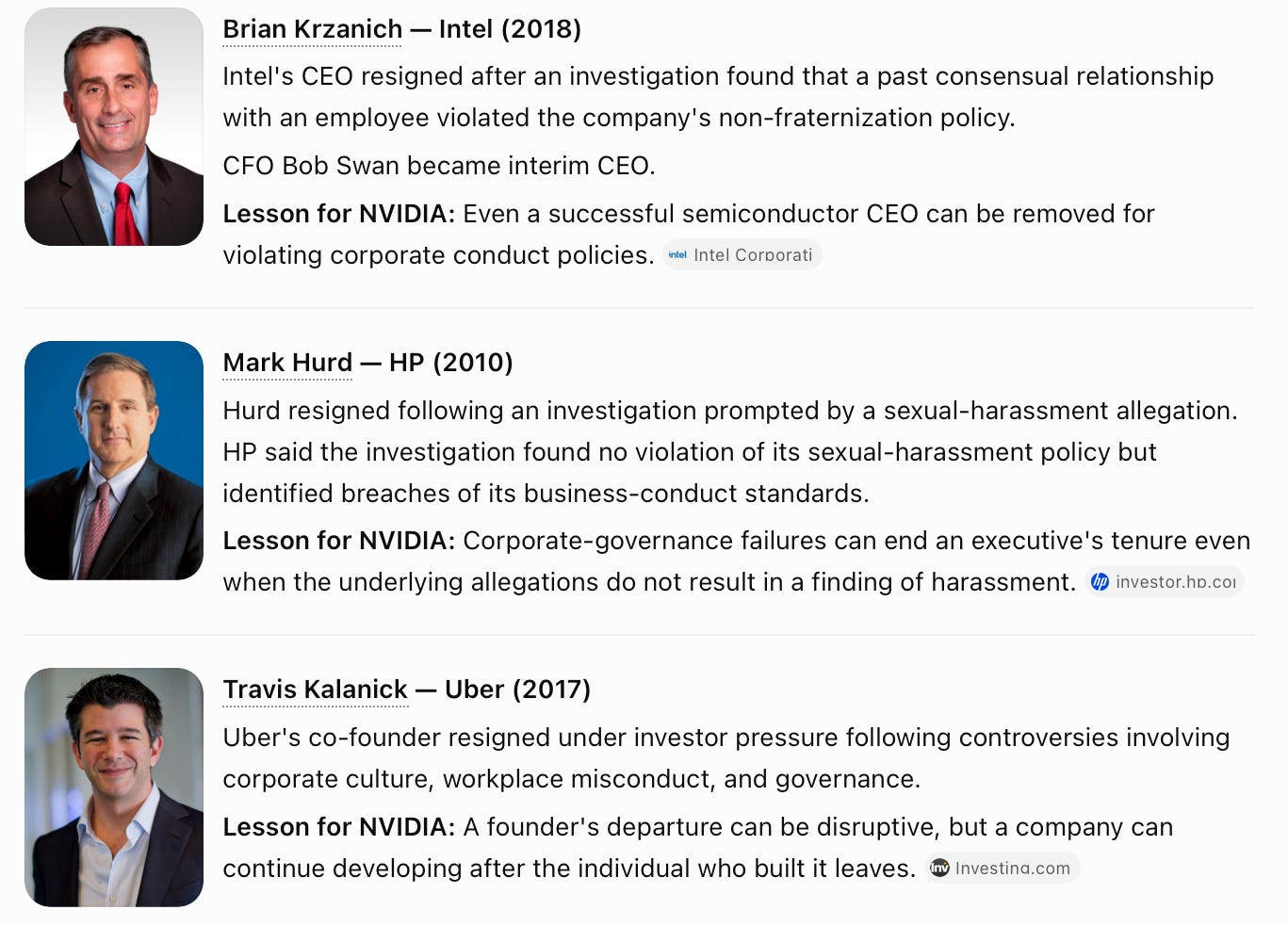
There is also a historical comparison worth considering: Steve Jobs leaving Apple in 1985 following a power struggle.
Jobs later returned, helping transform Apple into one of the world’s most valuable technology companies.
The lesson is not that Huang would necessarily follow the same path. It is that losing a visionary founder can change a company’s trajectory in ways that may not be immediately apparent.
What happens to NVIDIA’s future?
NVIDIA’s long-term future depends on more than its CEO.
The company has significant competitive advantages, including its CUDA software ecosystem, relationships with major AI customers, advanced GPU architectures, and established developer community.
However, Huang’s departure could create uncertainty around strategic decisions, talent retention, and the company’s relationships with customers and partners.
Three scenarios deserve consideration.
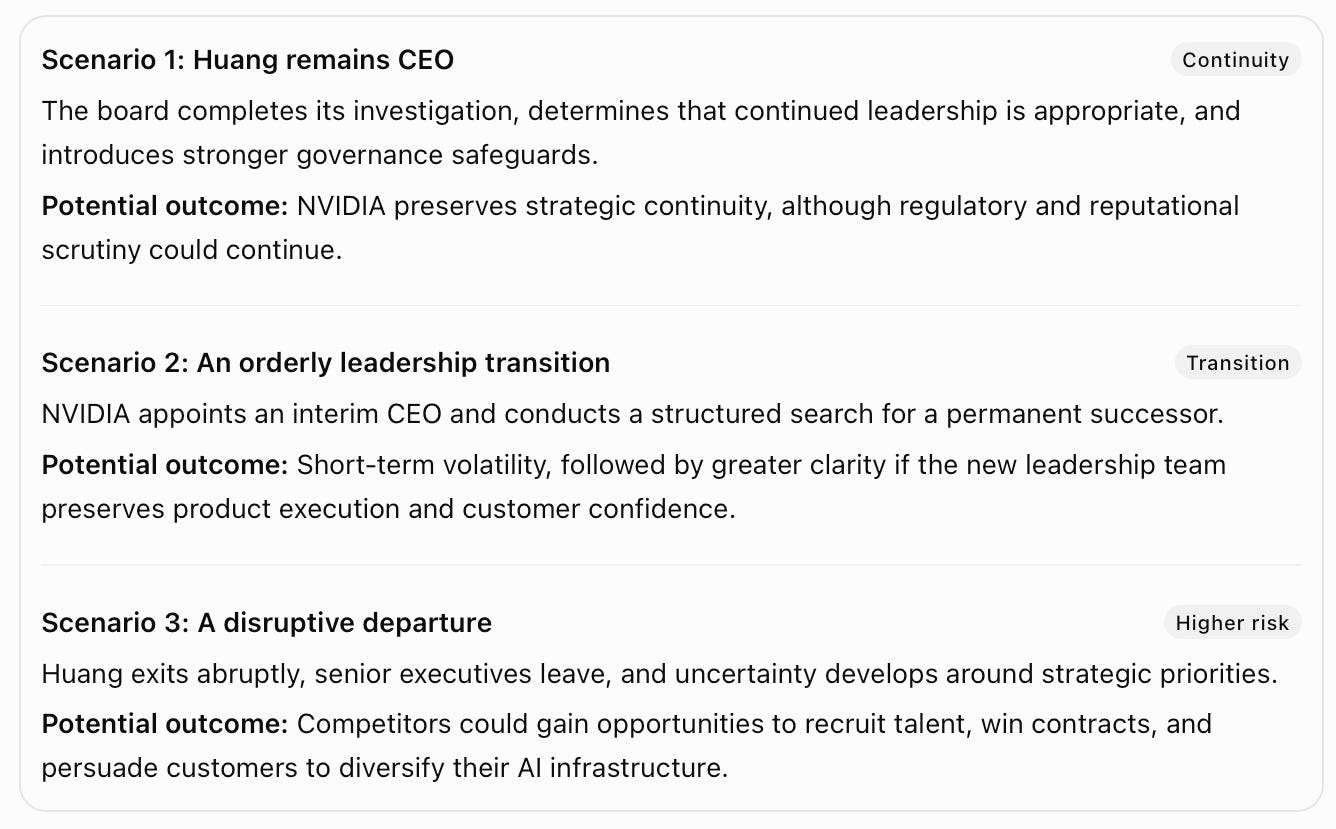
What investors should watch
NVIDIA’s November 17 earnings report is an important near-term milestone. Investors will be watching not only revenue and margins, but also management’s ability to explain the company’s leadership plans and reassure customers.
The most important indicators over the coming months will be the outcome of the investigations, any board announcement, executive retention, product roadmap execution, and whether large AI customers change their purchasing commitments.
Impact on NVIDIA’s competitors
A leadership crisis at NVIDIA could create opportunities for other semiconductor and AI infrastructure companies. However, not every competitor would benefit equally.
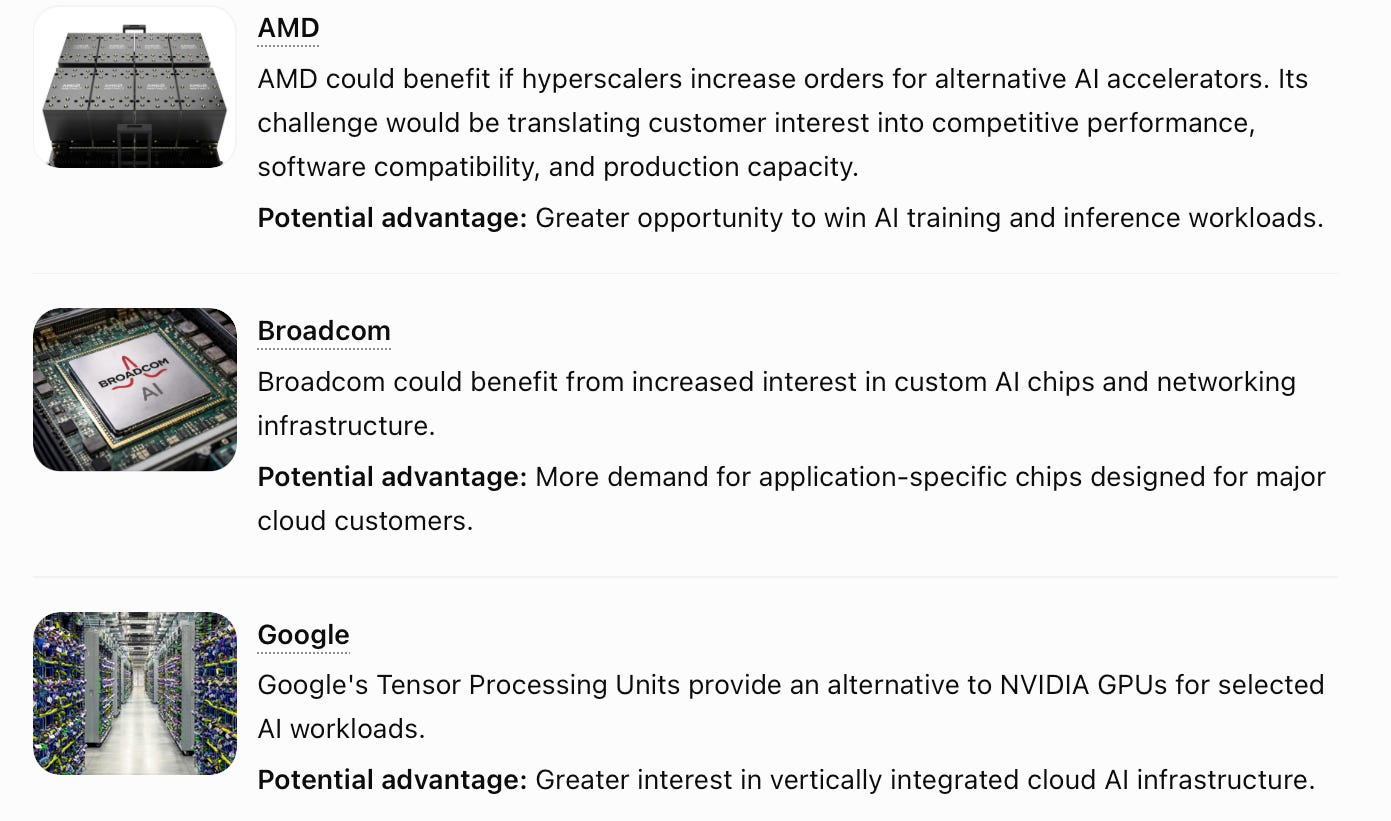
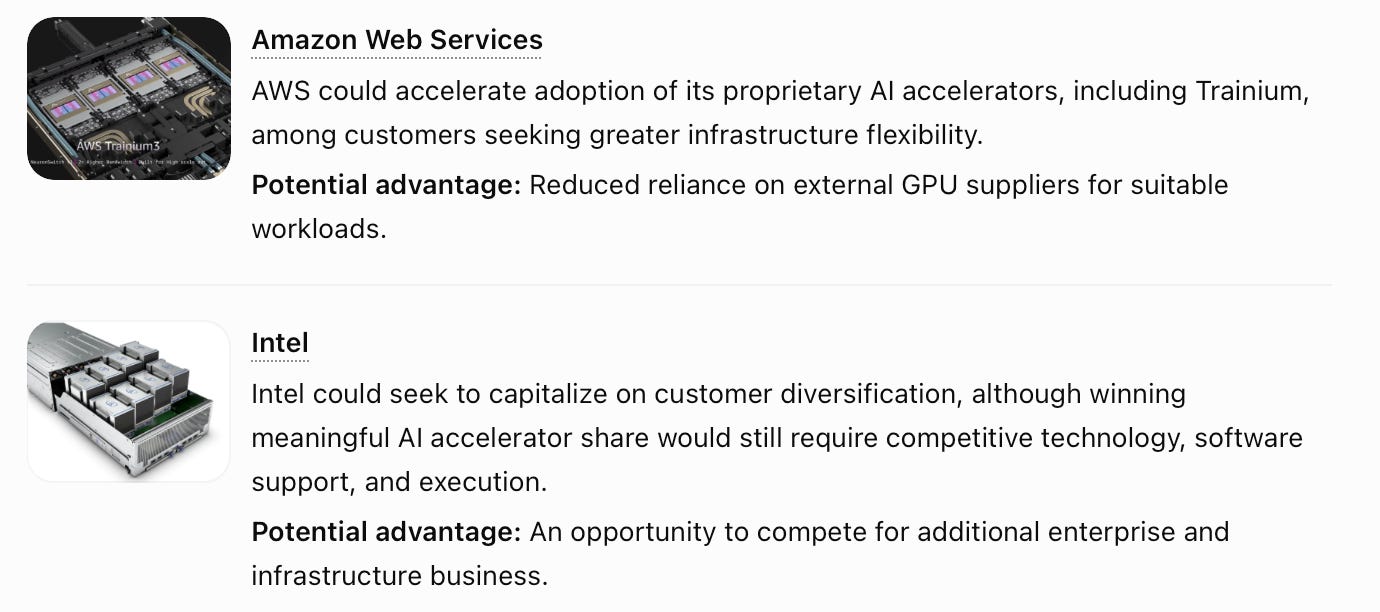
Competitive implications
The opportunity for competitors is not simply that NVIDIA could lose its CEO.
It is that large AI customers already have strong incentives to avoid depending on one semiconductor supplier.
A leadership crisis may reinforce those incentives.
The biggest potential beneficiaries would be companies capable of delivering not just chips, but complete and reliable computing solutions with competitive software ecosystems.
That is a difficult challenge. NVIDIA’s CUDA ecosystem and installed base cannot be replicated overnight.
There is also an important distinction between NVIDIA losing market share and the AI market continuing to grow while competitors capture a larger portion of new demand. The latter could occur even if NVIDIA remains a highly successful business.
Conclusion: NVIDIA’s biggest challenge may not be technological
The controversy surrounding Jensen Huang is about much more than one executive’s personal conduct.
It exposes the risks associated with building a strategically important technology company around a founder whose leadership, relationships, and vision are deeply embedded in the business.
Huang deserves significant credit for helping transform NVIDIA into a central player in the global AI economy.
But a company’s technological achievements do not eliminate the need for independent governance, effective succession planning, and accountability.
For the US economy, the stakes are considerable. NVIDIA plays a critical role in the development of AI infrastructure, and prolonged uncertainty could affect investor sentiment and strategic planning across the technology industry.
For competitors, the crisis presents a potential opening to accelerate innovation, attract customers, and expand their share of the AI computing market.
For the sports tech industry, the implications are more indirect but still important. The next generation of athlete tracking, biomechanics, sports medicine, automated video analysis, and AI-powered performance tools will depend increasingly on affordable and reliable computing infrastructure.
Ultimately, the question is not whether NVIDIA can survive without Jensen Huang. It almost certainly has the technological assets and engineering talent to continue operating.
The question is whether NVIDIA can maintain its extraordinary pace of innovation, execution, and growth without the individual who helped create its competitive advantage.
One thing is clear: the AI revolution is now too important to depend on the leadership of any single individual.
And this crisis could become a defining test of whether NVIDIA has matured from a founder-led technology powerhouse into an institution capable of sustaining its leadership for decades.