
Introduction
Today LIV Golf filed for Chapter 11 bankruptcy protection in New Jersey, marking the most consequential moment in the breakaway league’s turbulent four-year history.
The filing does not mean that LIV Golf is immediately shutting down. Chapter 11 allows an organization to continue operating while renegotiating its debts, contracts and ownership structure. LIV listed estimated assets of between $100 million and $500 million and liabilities of between $500 million and $1 billion. Fifty-seven affiliated debtors are included in the proceedings. Check out the Official bankruptcy case information).
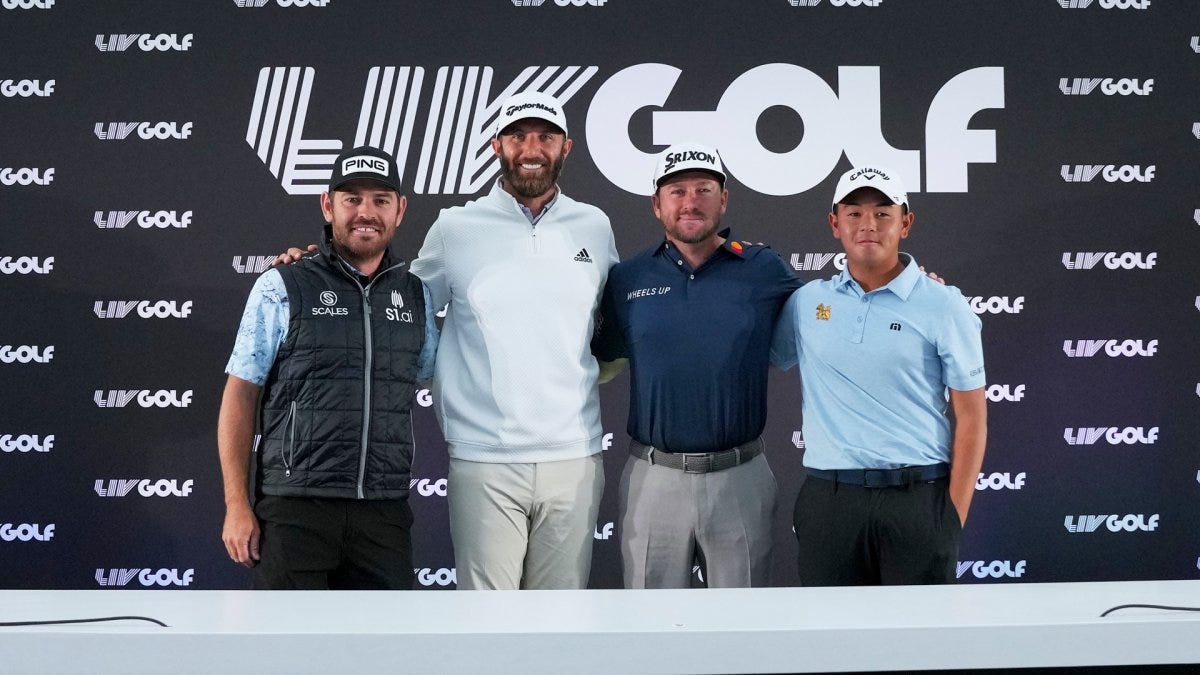
Saudi Arabia’s Public Investment Fund, or PIF, has invested more than $5 billion in LIV since its 2022 launch. It is now providing approximately $49.6 million in bankruptcy financing but plans to end its long-term financial support after the 2026 season. LIV hopes to emerge from bankruptcy under a smaller, more sustainable model backed by private-equity firm BC Partners. (Source: Reuters)
The filing raises major questions about LIV’s future, the stability of player contracts, the balance of power in professional golf and whether some of the game’s biggest stars will attempt to return to the PGA Tour.
How Did LIV Golf Get Here?
LIV Golf launched in 2022 with an ambitious strategy: use unprecedented financial resources to recruit elite golfers, challenge the PGA Tour and introduce a new team-based format.
The league offered enormous guaranteed contracts and record purses to attract players such as Phil Mickelson, Dustin Johnson, Brooks Koepka, Bryson DeChambeau, Cameron Smith and, later, Jon Rahm. It promoted shorter 54-hole tournaments, shotgun starts, no cuts and franchised teams.
The strategy successfully disrupted professional golf. It forced the PGA Tour to increase purses, reconsider its tournament structure and provide more financial benefits to its leading players.
However, LIV’s spending was built around continued financial support from PIF rather than revenue generated organically through media rights, sponsorships, ticket sales and team franchises.
A proposed framework agreement announced by the PGA Tour, DP World Tour and PIF in June 2023 initially appeared to offer a path toward reunifying professional golf. That transaction was never completed, leaving LIV and the PGA Tour operating as competing organizations.
In April 2026, PIF reportedly determined that continued investment in LIV no longer aligned with its strategy and decided to stop funding the league after the season. LIV subsequently sought outside capital and announced that it had reached an agreement with a new lead investor for its next phase. LIV Golf
The Chapter 11 process is intended to facilitate that transition—but on considerably less favorable terms than LIV enjoyed under PIF.
The Main Issues Faced by LIV Golf
1. An unsustainable cost structure
LIV spent heavily on guaranteed player contracts, prize money, event production, international travel and entertainment. That spending helped the league secure recognizable players, but it created a business whose costs substantially exceeded the revenue it was producing.
A challenger can operate at a loss while building an audience. The problem arises when the gap between expenses and commercial revenue remains exceptionally large several years after launch.
2. Dependence on one financial backer
PIF reportedly owns 100% of LIV Golf and provided the financial foundation for virtually every part of the league’s growth.
That gave LIV unusual freedom to spend aggressively, but it also created concentration risk. Once PIF decided to stop providing long-term support, LIV did not have enough diversified revenue or investment to sustain its existing structure.
3. Limited media-rights economics
Media rights are the economic engine of most major sports leagues. LIV struggled to build a television audience and secure media agreements capable of supporting its spending.
The league attracted some dedicated fans and recorded success in individual international markets, particularly Australia. However, it did not consistently convert its expensive player roster into the broad, recurring audience required to produce major media-rights revenue.
4. Difficulty establishing valuable team franchises
LIV envisioned its teams becoming commercially valuable global franchises with their own sponsors, investors, identities and fan bases.
That concept had potential, but most teams remained closely associated with individual captains rather than deeply rooted communities. Creating meaningful franchise value without local markets, permanent home venues or mature fan bases proved difficult.
5. Uncertainty surrounding ranking points and major championships
LIV events historically did not receive Official World Golf Ranking points. As a result, several players fell in the rankings and became increasingly dependent on existing major-championship exemptions or qualifying pathways.
This weakened LIV’s ability to promise players consistent access to the tournaments that still define careers and legacies.
6. Player contracts became major liabilities
Several prominent golfers are listed among LIV’s largest unsecured creditors. Jon Rahm, Bryson DeChambeau and Dustin Johnson are each reportedly owed more than $5 million. (Source: Reuters)
During the restructuring, LIV may attempt to renegotiate guaranteed payments and replace some cash compensation with equity in the reorganized league. Players must determine whether that equity represents a valuable long-term opportunity or a substitute for money they were contractually promised.
Impact on Professional Golf
LIV’s bankruptcy could eventually help reunify the world’s best players, but the immediate outlook is likely to be more complicated.
The PGA Tour now enters any negotiations from a much stronger position. The threat of a permanently expanding, PIF-funded rival has diminished, reducing the PGA Tour’s incentive to make major concessions.
At the same time, LIV’s influence will not disappear. The league changed the economics of professional golf by pushing the PGA Tour to offer higher purses, more limited-field events and greater financial rewards for elite players. Those changes will be difficult to reverse.
The bankruptcy could produce several additional effects:
Sponsors and broadcasters may become more cautious about making long-term commitments to LIV.
Tournament hosts will seek assurances that scheduled events will proceed.
LIV players may pursue unpaid compensation through the bankruptcy process.
The reorganized league may reduce purses, events, staffing and production costs.
Golf fans could see more leading players return to traditional tours.
The PGA Tour may face pressure to develop a fair pathway for players who are not covered by its previous return program.
LIV’s proposed “2.0” model reportedly includes a smaller operation, new investors and greater player ownership. If it succeeds, LIV may survive as a complementary international competition rather than a direct, fully funded challenger to the PGA Tour.
Implications for Players Seeking to Return to the PGA Tour
Bankruptcy does not automatically release every LIV player from every contractual obligation. The treatment of each agreement will depend on its language and what LIV chooses to assume, reject or renegotiate during Chapter 11.
Players whose contracts are rejected could potentially become unsecured creditors and seek opportunities elsewhere. However, contractual freedom from LIV would not automatically restore PGA Tour membership.
In January 2026, the PGA Tour created a limited Returning Member Program for players who won a major championship or The Players Championship between 2022 and 2025. The eligibility group consisted of Brooks Koepka, Bryson DeChambeau, Jon Rahm and Cameron Smith.
The program included several conditions:
A five-year forfeiture of participation in the PGA Tour’s player-equity program
No FedExCup bonus payments during the return year
A $5 million charitable contribution
A minimum of 15 PGA Tour events
No simultaneous participation in LIV events
No automatic entry into every signature event
The application window closed on February 2, 2026, and the PGA Tour explicitly described it as a one-time opportunity rather than a precedent. (Check out the PGA Tour Returning Member Program)
The PGA Tour will now need to decide whether to reopen that program, establish a broader pathway or require most LIV players to regain status through traditional routes.
Leading players with major-championship exemptions and strong commercial appeal are likely to possess more negotiating leverage. Lower-ranked players could face a much harder route involving sponsor exemptions, qualifying school, the Korn Ferry Tour or the DP World Tour.
The most significant question is whether the PGA Tour prioritizes punishment and accountability or reunification and the commercial benefits of bringing recognizable stars back into its tournaments.
Which Major Sports League Could File for Bankruptcy Next?
There is no credible evidence currently establishing that another major sports league is preparing to file for bankruptcy. Naming one as “next” would therefore be speculation rather than analysis.
The NFL, NBA, MLB, NHL and leading European soccer competitions have diversified media, sponsorship and ticketing revenue, established franchises and long-term commercial ecosystems. Individual clubs can still experience financial distress, but a bankruptcy filing by an entire major league remains unlikely.
The leagues facing the greatest structural risk are generally newer challenger competitions that share some of LIV’s characteristics:
Heavy dependence on one owner or investor
Large operating losses
Limited media-rights revenue
High player and production costs
Unproven franchise values
Uncertain audience growth
No clear path to profitability
Among nationally visible American competitions, spring-football and other emerging leagues deserve close monitoring because their economics have historically been difficult. However, insufficient public financial information makes it impossible to state responsibly that any specific league is likely to file next.
The broader lesson from LIV is more valuable than an unsupported prediction: access to substantial capital can launch a league and recruit talent, but it cannot permanently replace product-market fit, recurring revenue and a sustainable cost structure.
Conclusion
LIV Golf succeeded in disrupting professional golf, increasing player compensation and forcing the PGA Tour to evolve. But disruption is not the same as building a sustainable business.
The league’s dependence on PIF allowed it to spend at a level its commercial revenue could not support. Once that funding commitment changed, LIV’s structural weaknesses became impossible to ignore.
Chapter 11 gives LIV an opportunity to reorganize rather than disappear. A smaller league with lower costs, outside investment and meaningful player ownership could survive. But “LIV Golf 2.0” will be fundamentally different from the organization that attempted to challenge the PGA Tour through almost unlimited spending.
For the players, bankruptcy creates both risk and opportunity. Some could lose portions of the compensation they were promised. Others may gain leverage to renegotiate their contracts or return to traditional tours.
For the broader sports industry, LIV offers a powerful lesson: even billions of dollars cannot guarantee that a new league will build the audience, media rights, sponsorship revenue and fan loyalty required for long-term survival.
The real failure here wasn't spending too much, it was spending that depended entirely on one backer's mood. LIV had zero pressure to build actual revenue because the checks never stopped coming - until they did. Any athlete-led business needs to ask early: if our biggest funder walked away tomorrow, does this still work? If the answer is no, you don't have a business, you have a subsidy.