
November 17, 2026 | Cybersecurity, Artificial Intelligence, Sports Technology & Investment

Introduction: A Growing Concern Across the United States
Over the past several days, the United States has experienced a series of major technology disruptions affecting financial institutions, airlines, government agencies and some of the world’s largest technology providers. Microsoft, United Airlines, JPMorgan Chase and the Federal Aviation Administration (FAA) have all experienced operational problems, raising questions about the resilience of the digital infrastructure on which millions of people and businesses depend.
These incidents have also fueled speculation about whether the United States is experiencing a coordinated wave of cyberattacks, potentially involving foreign governments, organized cybercriminals or increasingly sophisticated artificial intelligence systems.
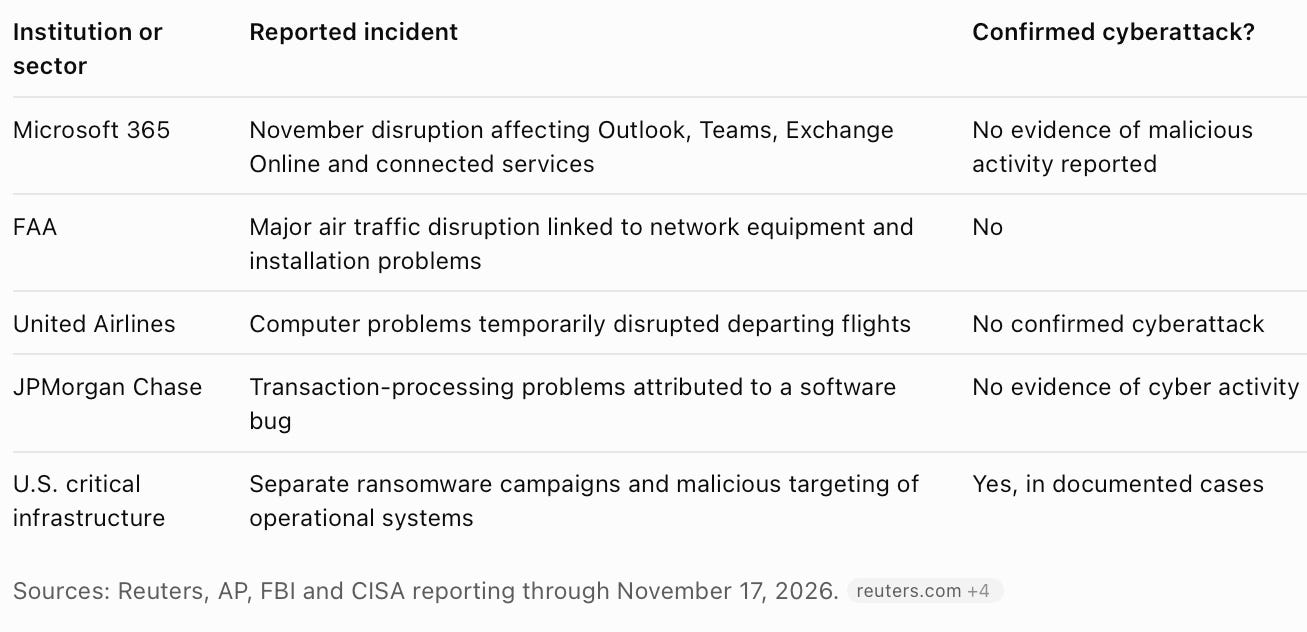
However, an important distinction needs to be made. As of November 17, U.S. officials have stated that the recent disruptions involving Microsoft, United Airlines, JPMorgan Chase and the FAA do not appear to be connected to cyberattacks. The available evidence points primarily to infrastructure failures, software problems and technology maintenance issues.
That does not mean the cybersecurity threat is exaggerated. On the contrary, ransomware, credential theft, phishing, cyber espionage and attacks against critical infrastructure remain serious concerns. The FBI and cybersecurity agencies have continued issuing warnings about increasingly sophisticated threats affecting businesses and essential services.
For the sports industry, these developments raise an important question: What would happen if a major professional sports organization, its technology providers or the infrastructure supporting its operations were compromised?
Professional teams in the NBA, NFL, NHL, MLB, MLS, NCAA and European soccer have invested heavily in digital transformation. Athlete management systems, performance analytics, medical records, wearable technologies, video analysis, AI assistants and cloud-based platforms are now central to daily operations.
At the same time, sports-tech startups are collecting increasingly sensitive information, while venture capital firms are investing in businesses whose value depends on proprietary technology, intellectual property and customer data.
The next phase of sports technology innovation must therefore address not only what technology can accomplish, but also how organizations protect it and maintain operations when systems fail.
2. What Is Happening With Hackers?
Cybercrime has evolved considerably over the past decade. Rather than focusing exclusively on stealing passwords or compromising individual computers, attackers increasingly target organizations whose operations depend on interconnected digital systems.
These attacks can be financially motivated, politically motivated or intended to collect sensitive intelligence. Some are conducted by organized criminal groups, while others are associated with state-sponsored actors.
Three developments deserve particular attention.
A. Ransomware and data extortion are becoming major business risks
Ransomware attacks can prevent organizations from accessing critical systems, while data-extortion attacks threaten to publish confidential information unless victims pay.
In October 2026, CISA, the FBI and international partners issued an advisory concerning the SafePay ransomware group, which they reported had affected approximately 600 victims across multiple sectors and countries. Attackers commonly exploited compromised credentials and vulnerabilities in internet-facing systems.
For a professional sports organization, a successful attack could disrupt athlete-management systems, ticketing, internal communications, business operations or access to confidential documents.
B. Attackers are increasingly targeting identities rather than infrastructure alone
One of the most concerning trends is the growing use of stolen credentials and impersonation.
Microsoft’s 2026 Digital Defense Report highlights how compromised accounts and human behavior remain central to cyber intrusions. Attackers do not always need to break through sophisticated security systems if they can convince an employee to reveal credentials or approve a fraudulent request.
This is particularly relevant to professional sports, where executives, agents, coaches, medical practitioners, sponsors and technology vendors communicate frequently across organizational boundaries.
C. Third-party technology providers create additional vulnerabilities
A sports organization may have strong internal cybersecurity controls but still be exposed through a software vendor, cloud provider or external service provider.
This is becoming increasingly important as professional teams integrate multiple platforms for athlete monitoring, performance analysis, rehabilitation, medical documentation and business operations.
The concern is no longer limited to whether a team’s own infrastructure is secure. Teams must also understand the cybersecurity practices of every technology provider connected to their systems.
The Impact of Artificial Intelligence on Cyberattacks
Artificial intelligence is changing cybersecurity in two directions. It is helping attackers operate more efficiently while also providing defenders with new capabilities to identify suspicious activity, automate investigations and respond to threats.
AI is making attacks more convincing
AI tools can help criminals generate realistic phishing emails, impersonate executives, produce fraudulent audio or video, and tailor messages to specific organizations.
Consider a sports-tech startup receiving an urgent email that appears to come from the Head of Sports Performance at an NBA team, requesting access to confidential product information or asking the startup to open an attachment.
A well-crafted impersonation attempt could appear legitimate, particularly if it references real meetings, employees or commercial relationships.
AI-generated voice and video impersonation introduce additional risks during financial transactions, contract negotiations and investor communications.
AI can accelerate vulnerability discovery and exploitation
AI-assisted tools can help identify software weaknesses, analyze code and automate portions of an attack. These capabilities may reduce the time required for criminals to identify vulnerable systems.
However, not every sophisticated cyberattack involves AI, and claims about fully autonomous hacking operations should be evaluated carefully.
AI also creates new security challenges inside sports organizations
As teams deploy AI assistants connected to email, athlete management systems, documents and performance databases, they must consider how much information those assistants can access.
An improperly configured AI system could expose sensitive information or perform actions beyond what its users intended.
A June 2026 Darktrace survey found that 84% of surveyed professional sports organizations had experienced a cyber incident during the previous 12 months. It also reported that 72% expected AI to increase cybersecurity risk over the following year. These are vendor-reported survey findings, not a census of every professional sports organization (see full report here).

The key lesson is that AI adoption and cybersecurity investment must progress together. An AI assistant that saves practitioners hours of administrative work can still introduce unacceptable risk if it has unrestricted access to sensitive athlete information.
Major Institutions Impacted: What We Know
Recent incidents illustrate two different but related problems: malicious cyberattacks and operational failures involving critical technology infrastructure.
Microsoft: The danger of depending on a single provider
The November Microsoft disruption affected email, calendars, collaboration tools and connected services across numerous organizations. Microsoft attributed the incident to server problems and reported no evidence of malicious activity.
Reuters reported that Downdetector recorded more than 7.4 million user-submitted outage reports during the incident. This is a count of reports, not unique affected users.
For professional sports teams, the lesson is particularly relevant. Even without a cyberattack, losing access to a central cloud platform can interrupt communication between performance departments, medical staff, executives and external partners.
Aviation: The consequences of infrastructure failures
The FAA disruption demonstrated how technical problems in critical infrastructure can cascade across a national transportation network.
This matters to sports because professional teams depend on airlines, airports and transportation providers to maintain tightly scheduled competition calendars.
A disruption during an NFL game weekend, an NBA road trip or an international soccer competition could create substantial logistical challenges even if the team’s own technology systems were functioning normally.
Financial institutions: A different form of operational exposure
The JPMorgan Chase processing incident was attributed to a software bug rather than malicious activity.
Nevertheless, financial institutions remain important dependencies for sports organizations and startups. Payroll, sponsorship payments, vendor invoices, investment transfers and commercial transactions all depend on reliable financial infrastructure.
Confirmed cyberattacks in the sports industry
The threat is not hypothetical.
In August 2026, French rugby club Stade Français Paris confirmed a cyberattack that disrupted part of its information systems. The club restored its environment from clean backups and investigated allegations of stolen data.
Other documented incidents include attacks affecting Ajax, Bologna FC and Paris Saint-Germain in previous years.
More recently, a November 2026 breach involving Dutch sports administration provider AllUnited prompted more than 350 sports clubs to report potential exposure of member information. The incident illustrates how compromising one technology supplier can affect numerous sports organizations simultaneously.
These examples demonstrate why cybersecurity should be viewed as a sports business issue rather than solely an IT responsibility.
Potential Impact on Professional Teams, Sports-Tech Startups and VCs
The consequences of a major cyberattack would vary depending on the organization, the systems affected and the type of information compromised. However, three segments of the sports industry deserve particular attention.
A. Professional teams and leagues: Athlete data is becoming a critical asset
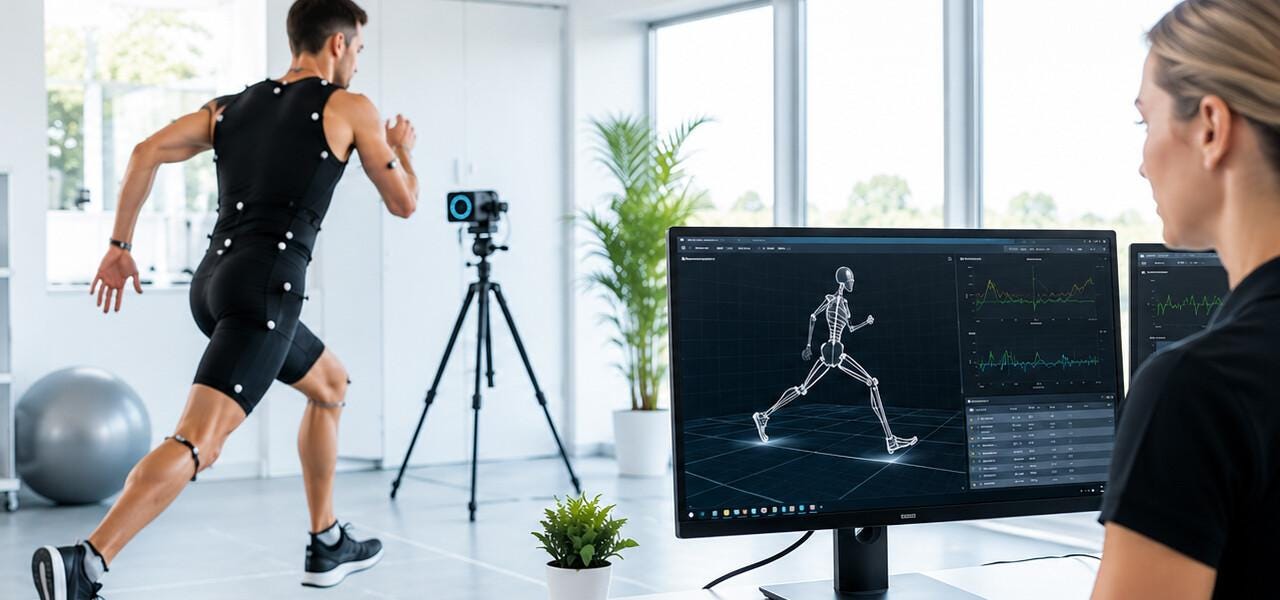
Professional sports organizations collect enormous amounts of information about their athletes, including GPS tracking data, workload measurements, biomechanics assessments, injury histories, rehabilitation plans, sleep information and other physiological metrics.
Much of this information is stored in cloud-based platforms and shared among sports scientists, athletic trainers, team physicians, rehabilitation specialists, strength coaches and technology providers.
A successful cyberattack could create several problems:
Athlete medical privacy: Confidential medical records, injury histories or rehabilitation information could be stolen or exposed.
Competitive intelligence: Opposing organizations or other unauthorized parties could potentially gain access to proprietary performance data, scouting reports and tactical information.
Daily operations: Teams could temporarily lose access to athlete management systems, performance dashboards, video platforms or internal communications.
Financial losses: Incident response, system recovery, legal expenses, business interruption and reputational damage could generate significant costs.
Athlete trust: Players may become increasingly concerned about how their personal and medical information is stored, shared and protected.
There is also a particularly sensitive issue surrounding athlete availability.
Imagine an NFL team preparing for an important playoff game. If confidential injury reports, rehabilitation assessments or internal discussions about player readiness were compromised, the consequences could extend beyond privacy concerns to competitive and contractual matters.
This is a hypothetical scenario, but it illustrates why sports organizations should treat athlete information as a strategically important asset.
The issue becomes even more complex when teams work with multiple technology providers. A performance department might use one platform for GPS tracking, another for force plates, a third for athlete management and several additional applications for rehabilitation, video analysis and AI-powered reporting.
Every integration creates another relationship that needs to be secured.
Upside Take: I expect cybersecurity, data ownership and business continuity to become increasingly important criteria when professional teams evaluate sports technology vendors. Product accuracy, scientific validation and usability will remain essential, but they may no longer be sufficient on their own.
B. Sports-tech startups: Cybersecurity could become a competitive advantage
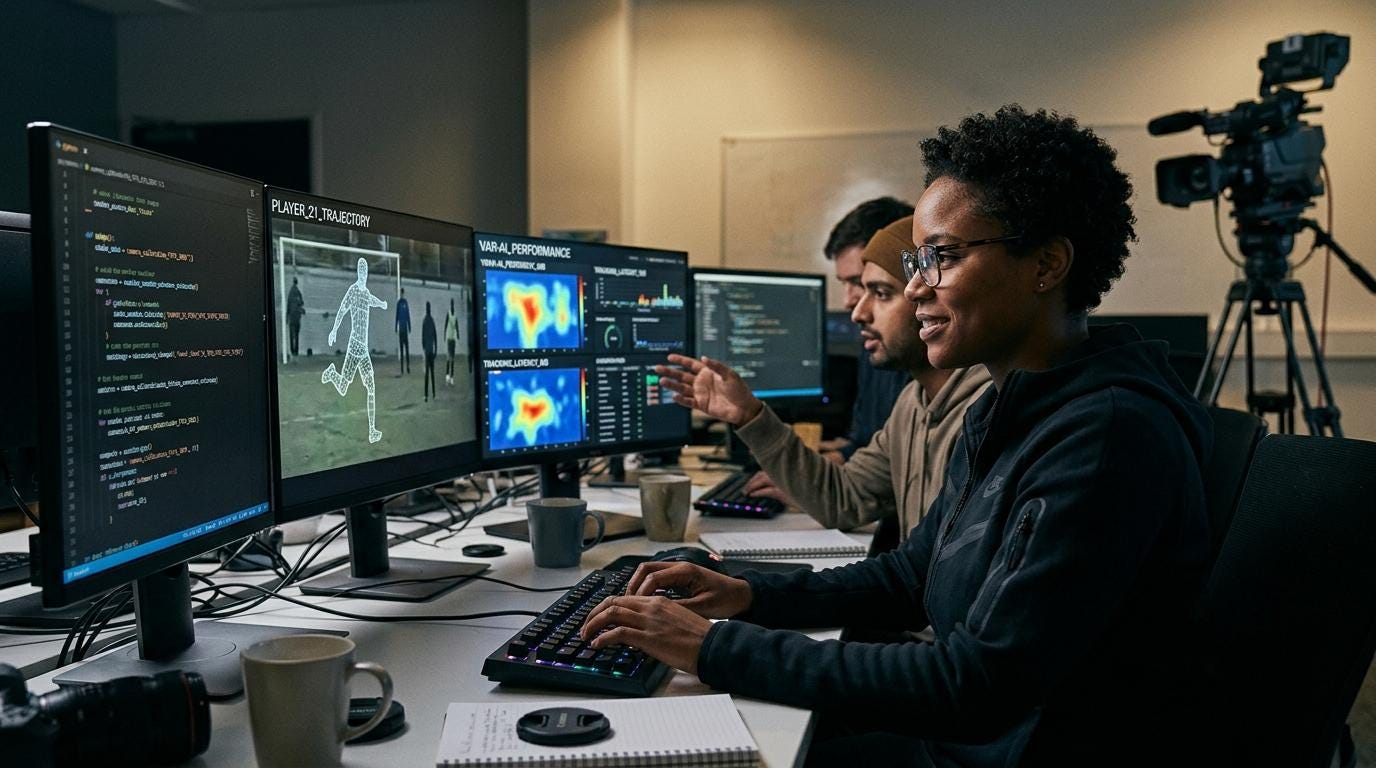
For sports-tech startups, the implications are particularly significant because many early-stage companies operate with limited budgets and small engineering teams.
A startup developing a wearable device, AI assistant, athlete management platform or computer vision solution may spend years building its technology while allocating relatively few resources to cybersecurity.
That approach could become increasingly risky.
1. Greater scrutiny during technology procurement
Professional teams may begin asking startups more detailed questions about where their data is stored, who can access it, whether it is encrypted and what happens if the platform becomes unavailable.
Startups could also face growing expectations around independent security assessments, penetration testing, incident response plans and certifications such as SOC 2 or ISO 27001.
These requirements will differ by customer and product. A platform processing sensitive medical information will generally require more stringent safeguards than a simple public-content application.
2. Increased development and operating costs
Implementing stronger cybersecurity controls requires investment. Startups may need to budget for security engineers, external audits, insurance, monitoring tools and additional cloud infrastructure.
For early-stage companies already managing limited cash reserves, these expenses could become a meaningful financial burden.
3. Risk of losing customer trust
A data breach involving a professional sports team’s confidential information could seriously damage a startup’s reputation.
Unlike a large technology company with substantial financial resources, a small startup may struggle to recover from a major security incident, particularly if it loses several important customers.
4. Opportunities for cybersecurity-focused sports-tech startups
There is also an opportunity here.
Startups developing secure data-sharing platforms, privacy-preserving analytics, AI security tools, identity management solutions and automated threat detection could find new commercial opportunities in professional sports.
The same applies to companies offering secure integration between athlete management systems, wearable devices and medical platforms.
Upside Take: Cybersecurity could become a meaningful differentiator for sports-tech startups. A company that can demonstrate both strong product capabilities and responsible data protection practices may have an advantage over competitors that treat security as an afterthought.
C. Venture capital firms: Cybersecurity becomes part of investment due diligence

Venture capital firms investing in sports technology also face growing exposure to cybersecurity risks.
A startup’s valuation depends partly on its technology, intellectual property, customer relationships and ability to generate future revenue. A serious security incident can threaten all four.
For investors, cybersecurity should therefore become an important component of technical and commercial due diligence.
Key considerations include:
Technology infrastructure: Does the startup understand the security risks associated with its cloud infrastructure, software architecture and third-party integrations?
Data protection: Is sensitive customer information adequately protected, and does the company have clear contractual rights to collect, process and use it?
Financial exposure: Could a major breach create liabilities or recovery costs that materially affect the company’s cash runway?
Customer concentration: Would losing one major professional team or league contract threaten the company’s financial stability?
Exit opportunities: Could unresolved cybersecurity weaknesses complicate an acquisition, strategic investment or future financing round?
There is another important consideration: AI.
VCs investing in AI-powered sports technology should examine how companies protect their models, training data, customer information and connected systems.
For example, an AI startup offering an assistant to professional sports teams may have access to proprietary documents, performance databases and internal communications. Investors need to understand what security controls prevent inappropriate access or unauthorized use of that information.
Upside Take: I expect cybersecurity due diligence to become more important in sports-tech investing, particularly for startups developing AI agents, athlete management systems, medical technologies and connected devices.
Investors should not necessarily expect every seed-stage startup to have enterprise-level certifications. However, they should expect founders to understand their security risks and have a credible plan to address them as the company grows.
What Is Likely to Happen Next?
Several developments appear plausible over the next two to three years. These are forecasts based on current trends, not confirmed future outcomes.
1. Cybersecurity spending could increase across professional sports
As teams become more dependent on digital platforms, cybersecurity is likely to receive greater attention from IT departments, senior executives and ownership groups.
This could include investment in identity security, endpoint protection, data monitoring, backup systems and incident response capabilities.
2. Sports organizations may demand stronger security from technology vendors
Procurement processes could become more demanding, particularly for vendors handling medical, physiological or commercially sensitive information.
Startups may need to demonstrate not only that their products work but also that they can protect customer data and maintain service continuity.
3. AI-related security risks will become more prominent
The increasing adoption of AI assistants and automated workflows will create new security questions involving system permissions, sensitive information and the ability of AI tools to interact with other applications.
At the same time, AI-powered cybersecurity tools may help organizations detect threats and respond more quickly.
4. Third-party technology risk will become a major concern
Recent outages and documented supplier breaches highlight the risks of depending on interconnected platforms.
Teams will need better visibility into their vendors’ infrastructure, security practices and recovery procedures.
5. Cybersecurity could attract more sports-tech investment
I see potential opportunities for startups developing security solutions tailored to sports organizations, including secure athlete data platforms, AI governance, fraud detection, identity protection and stadium cybersecurity.
However, this does not necessarily mean the sports industry will develop a large standalone cybersecurity market. Many teams may continue purchasing solutions from established enterprise cybersecurity providers.
Major sporting events could face increasing cyber threats
The 2027 and 2028 sports calendar includes major international competitions that will depend heavily on digital ticketing, transportation, broadcasting, payment systems and event operations.
The Canadian Centre for Cyber Security has warned that major international sporting events are attractive targets for cybercriminals, particularly through phishing, ransomware, business email compromise and attacks against event-related organizations.
I expect event organizers to place greater emphasis on cybersecurity planning, vendor coordination and operational resilience.
Recommendations for Professional Teams, Sports-Tech Startups and VCs
Cybersecurity strategies should reflect each organization’s responsibilities, resources and exposure.
Recommendations for professional teams and leagues
1. Conduct a comprehensive cybersecurity assessment. Review the systems used by performance, medical, scouting, commercial and operational departments, including third-party integrations.
2. Protect sensitive athlete information. Implement appropriate encryption, access controls, multifactor authentication and clear data retention policies.
3. Develop business continuity plans. Teams should know how to continue essential operations if email, cloud services or athlete management platforms become unavailable.
4. Include practitioners in cybersecurity decisions. Heads of Sports Performance, Head Athletic Trainers, Medical Directors and Rehabilitation Specialists should help identify critical workflows and operational risks.
5. Evaluate technology vendors more carefully. Ask about data storage, security testing, incident notification, recovery procedures and independent security assessments.
6. Test emergency procedures. Conduct realistic exercises involving ransomware, unavailable cloud systems, compromised accounts and attempted data theft.
Recommendations for sports-tech startups
1. Build security into the product from the beginning. Do not wait until a professional team requests stronger safeguards.
2. Understand the sensitivity of the data you collect. Medical information, physiological measurements, personal identifiers and proprietary team information require appropriate protections.
3. Secure AI integrations. Limit AI assistants to the information and actions they genuinely need, and monitor their activity.
4. Prepare for enterprise procurement. Maintain documentation covering security policies, data handling, incident response and relevant compliance obligations.
5. Budget for cybersecurity. Include realistic security expenses in financial forecasts rather than treating them as unexpected costs.
6. Have a recovery plan. Maintain tested backups, clear incident-response responsibilities and procedures for notifying affected customers.
Recommendations for VCs and strategic investors
1. Incorporate cybersecurity into due diligence. Evaluate the startup’s technology architecture, data protection practices and major dependencies.
2. Assess the financial consequences of a breach. Consider potential legal exposure, recovery expenses, customer losses and effects on future fundraising.
3. Examine AI-related risks. Understand how portfolio companies protect proprietary models, customer data and connected AI systems.
4. Encourage portfolio companies to develop security roadmaps. Security investment should evolve with customer requirements and company growth.
5. Identify investment opportunities. Evaluate startups developing cybersecurity technologies that address genuine needs in sports, healthcare, connected devices and AI infrastructure.
6. Consider cybersecurity during exit planning. Weak security practices or unresolved data liabilities can complicate acquisitions and reduce investor confidence.
Conclusion: Sports Technology Innovation Must Be Accompanied by Cybersecurity
The recent disruptions affecting major U.S. institutions have raised understandable concerns about the reliability and security of critical technology infrastructure.
While the latest incidents involving Microsoft, the FAA, United Airlines and JPMorgan Chase have not been attributed to cyberattacks, they have exposed an important reality: organizations across nearly every industry depend on increasingly complex and interconnected digital systems.
Professional sports is no exception.
Over the past decade, teams have invested heavily in wearables, AI, biomechanics, athlete management systems, performance analytics and connected technologies. These innovations have created tremendous opportunities to improve athlete performance, support medical decisions and make organizations more efficient.
But the more dependent teams become on technology, the more important it becomes to protect their systems, their data and their ability to operate during a disruption.
For sports-tech startups, cybersecurity should be viewed as an important part of product development and customer trust. For venture capital firms, it should become a meaningful component of investment due diligence. And for professional teams, it needs to extend beyond the IT department to the practitioners and executives who rely on these technologies every day.
At Upside, we work with professional sports organizations, technology startups and investors across the global sports industry. I believe cybersecurity and operational resilience will become increasingly important topics in technology evaluation and adoption over the next several years.
The industry should not wait for a major breach involving sensitive athlete information or a critical sporting event to recognize these risks.
The question is no longer simply whether a technology can help a team perform better. It is also whether that technology can be trusted, protected and maintained when something goes wrong.
And that is a question every sports organization, startup and investor should be asking today.