
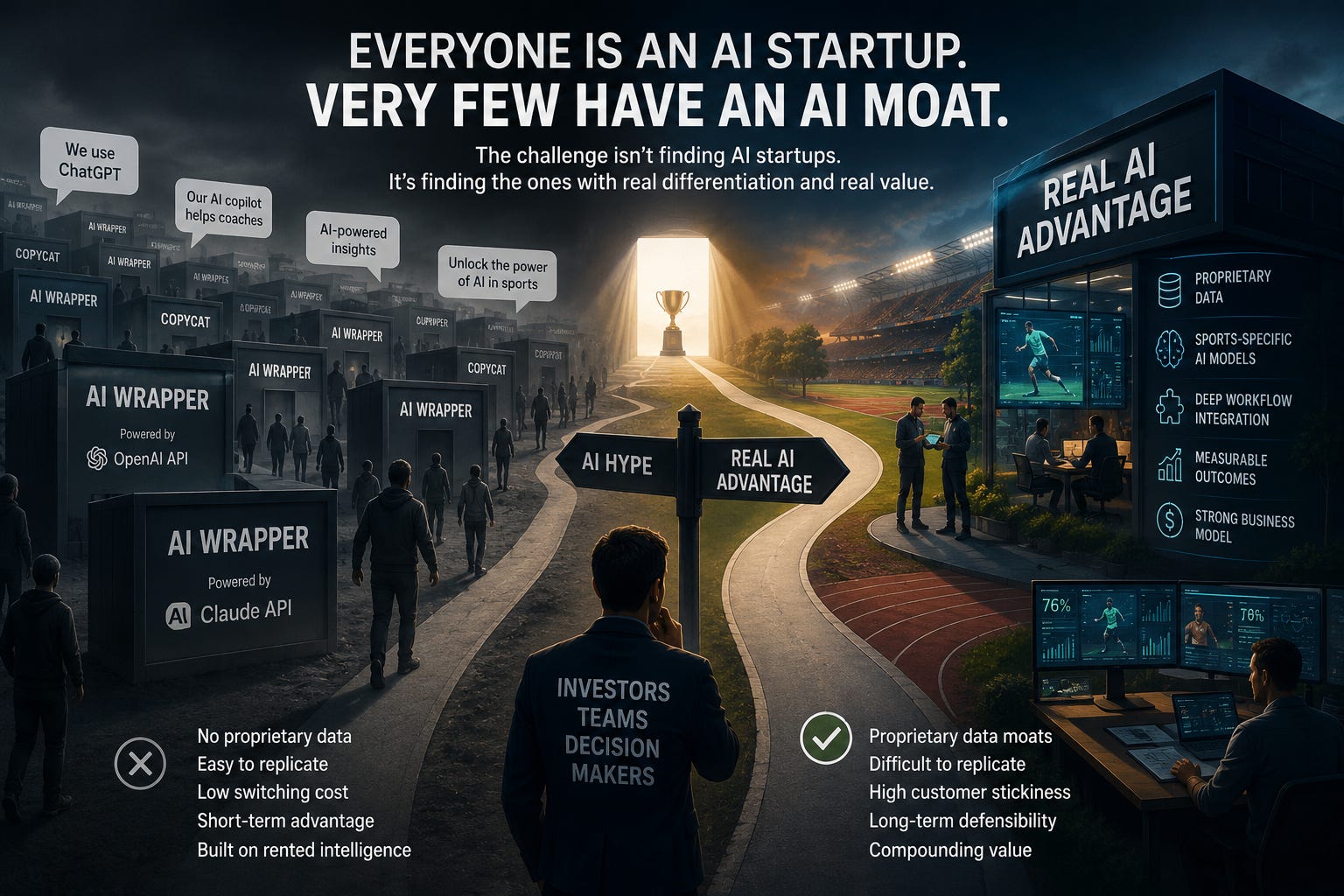
Yesterday I had a fascinating conversation with one of the leading investors in sports technology.
During our discussion, they shared a statistic that immediately caught my attention:
“Around 70% of the sports tech startups we’re currently evaluating are AI startups.”
That number says a lot about the current state of our industry.
Artificial Intelligence has become the dominant narrative in sports technology. Whether it’s coaching, scouting, athlete performance, fan engagement, ticketing, sponsorship analytics, or media production, nearly every new company entering the market positions itself as an AI company.
This is exciting. AI has the potential to fundamentally transform the sports industry.
But it also creates a new challenge for everyone involved in the ecosystem.
How do we distinguish between companies creating genuine technological innovation and companies simply riding the latest technology wave?
AI is becoming the entry ticket—not the competitive advantage
One reality is becoming increasingly clear.
Many sports AI startups today are not developing proprietary AI technologies. Instead, they are building applications on top of foundation models such as OpenAI, Anthropic’s Claude, Google’s Gemini, Meta’s Llama, or Perplexity. They package these powerful models into sports-specific workflows and user experiences.
There is absolutely nothing wrong with that.
In fact, some outstanding companies will be built this way.
The problem arises when founders confuse using AI with creating defensible AI.
Connecting to an LLM API is relatively straightforward. Hundreds of companies can access the same underlying models. As these foundation models continue improving, many of today’s technical advantages will inevitably become commodities.
If your only differentiation is the prompt you send to an existing model, competitors can often replicate much of your product in a surprisingly short period of time.
The difficult part is not adding AI.
The difficult part is creating something that competitors cannot easily reproduce.
We’ve been here before
The sports technology industry has always followed cycles of technological enthusiasm.
Ten years ago, almost every startup was building wearables.
Then the conversation shifted toward virtual reality and augmented reality.
A few years later, blockchain and NFTs became the hottest investment themes.
Today, AI occupies that position.
Every major technological wave follows a remarkably similar pattern. New technology creates enormous excitement. Investors search aggressively for opportunities. Entrepreneurs naturally reposition themselves around the emerging trend. Capital flows rapidly into the sector. New companies appear almost overnight.
Many of these companies disappear just as quickly.
The technology itself is rarely the problem.
The problem is that hype lowers the barrier for storytelling while increasing the difficulty of identifying genuine differentiation.
History suggests that the companies which ultimately define an industry are rarely the ones that simply adopt the newest technology first. They are the companies that solve meaningful customer problems, execute consistently, and build advantages that become stronger over time.
AI is rapidly becoming infrastructure
I believe we’re reaching a point where AI itself is no longer the story.
Just as cloud computing became expected rather than exceptional, AI is gradually becoming part of the standard technology stack.
Five years from now, customers probably won’t ask whether a platform uses AI.
They will simply assume it does.
The real questions will become far more interesting.
Who owns the proprietary sports data?
Who has developed the deepest understanding of coaches, athletes, executives, and fans?
Who has built workflows that customers rely on every day?
Who has earned enough trust to become embedded within sports organizations?
Those are significantly harder advantages to build—and far harder for competitors to copy.
Recommendations for investors
For venture capital firms, evaluating AI startups will increasingly require moving beyond product demonstrations.
An impressive demo is no longer sufficient evidence of a durable business.
Instead, investors should spend more time understanding what remains valuable if the underlying foundation models become dramatically better or dramatically cheaper over the next two years.
Does the company possess proprietary datasets that competitors cannot access? Has it created unique intellectual property? Does every new customer make the platform smarter? Are customers deeply integrated into the workflow, making switching costly? Most importantly, is the company solving a painful problem that customers are willing to pay for repeatedly?
Business fundamentals matter just as much as technology. Strong customer retention, recurring revenue, healthy unit economics, and a scalable go-to-market strategy often tell a more compelling story than AI architecture diagrams.
The best AI investments will likely be companies whose competitive advantage extends well beyond AI itself.
Recommendations for sports teams, leagues, and federations
Sports organizations face a different challenge.
Every week they receive demonstrations from vendors claiming to have revolutionary AI platforms. Every product promises better performance, more efficient operations, improved fan engagement, or smarter commercial decisions.
The pressure to adopt AI is real.
However, organizations should be careful not to mistake impressive demonstrations for sustainable value.
Instead of asking, “Does this company use AI?”, decision-makers should ask, “Does this solution measurably improve our organization?”
Can the company demonstrate real results with comparable customers? Is its technology built on proprietary sports knowledge or simply general-purpose AI? Will the platform integrate seamlessly into existing workflows? Can the vendor clearly quantify return on investment? Does the company have the financial stability and long-term vision to become a strategic partner rather than a short-term supplier?
Sports organizations should evaluate AI startups with the same discipline they apply to signing athletes: potential matters, but consistent performance matters even more.
Recommendations for founders
For entrepreneurs, the opportunity has never been greater.
But the bar is also rising faster than ever.
Founders should spend less time asking, “How can we add AI to our product?” and more time asking, “What can we build that nobody else can?”
That differentiation may come from proprietary data collected over years, unique computer vision models trained specifically for sports, exclusive partnerships, deep workflow integration, or domain expertise that cannot be replicated by simply calling an API.
Ultimately, AI should amplify a company’s unique strengths—not become its only strength.
The startups that will define the next decade of sports technology won’t simply have the best prompts or the latest models.
They will combine AI with unique data, deep industry expertise, exceptional execution, and business models that create lasting value for customers.
The sports technology industry is entering one of its most exciting periods.
But excitement alone doesn’t build enduring companies.
Differentiation does.
And in the long run, that is what both investors and customers will reward.
If you are a startups looking to get traction with pro teams, raise money, or get guidance on your product, feel free to contact me at julien@upsideglobal.co
Best,

You may also like:
🔥Upside: 13 Most Common Mistakes Made by Sports Tech Startups

In the past 10 years we have worked with a large number of sports tech startups across various sports tech subsectors (GPS, AMS, Biomarkers, AI, rehab tech, sleep tech, AR, VR, NFT, Metaverse..). We have worked with startups that had amazing technologies with great founders, but for the most part there is no perfect startups out there. In this analysis …
⭐ Best Practices On How To Best Create VC Decks & Pitch Sports Tech Startups To VCs

For the past 10 years I have worked and helped many sports tech startups raise money, meaning helped them put together VC decks and connect them with potential investors (VCs, angels, Teams’ VC arms..). Now I never guarantee startups that I can help them raise money. However what I can do is help these startups be best positioned for success with a VC d…
Good frame.
I’d add one filter to the “does every new customer make the platform smarter” question: does the platform know when it’s wrong?
A lot of AI-wrapper products in sports tech will confidently output a bad read on a movement or a play with no way to flag it. The moat isn’t just proprietary data, it’s whether the system can tell the difference between a resolved answer and a guess dressed up as one.