
Introduction
Strength training has become a fundamental component of elite-sport performance. But the question facing elite teams is no longer simply “Should athletes lift?”
It is increasingly:
When should they lift, how much should they lift, and how should strength training be adapted to the competitive schedule, travel demands and individual recovery status?
Across the NBA, NFL, NHL, MLS, NCAA, MLB and EPL, there is a broad shift away from rigid weight-room programs toward individualized, load-managed and competition-centered strength training.
The objective during a long competitive season is usually not to maximize strength or muscle mass. It is to preserve the physical qualities developed during the offseason—particularly maximal strength, rate of force development, power, tendon capacity and tissue resilience—while minimizing residual fatigue.
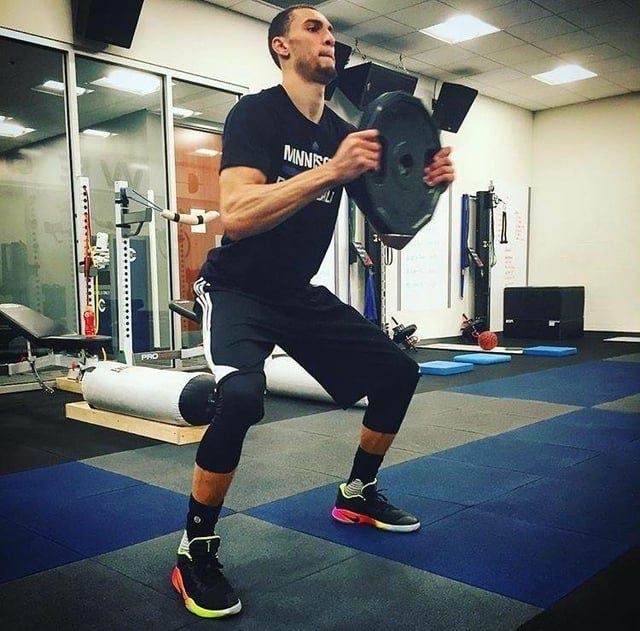
A 2024 systematic review and meta-analysis of 35 studies involving 777 elite athletes found that resistance training produced a large overall positive effect on sport-specific performance, although responses varied by athlete, sport and outcome. The authors emphasized the importance of individualized resistance-training programs.
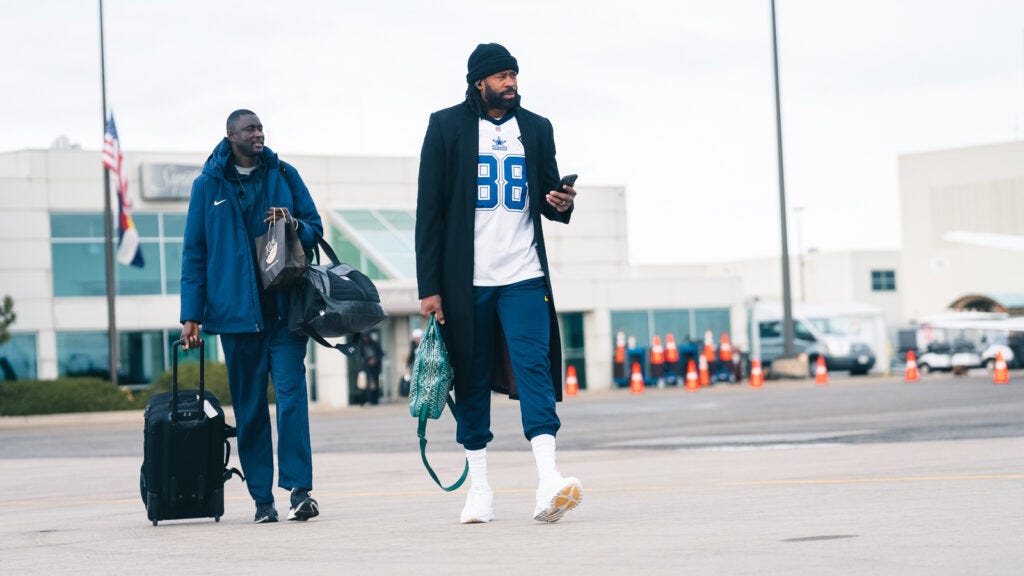
This has important implications for travel. Elite teams can spend hundreds of hours traveling during a season, while repeated flights, time-zone changes, disrupted sleep, dehydration and prolonged sitting can negatively affect strength, power, coordination and cognitive performance.
A 2026 systematic review of 89 studies examining long-haul travel in athletes found that travel was associated with sleep disruption, fatigue, reduced physical performance, impaired cognition and changes in strength and anaerobic power. The effects were influenced by travel direction, number of time zones crossed and individual susceptibility.
The result is a new paradigm:
The weight room should move with the competition schedule—not operate independently from it.
1. Is There Scientific Evidence That Lifting During a Road Trip Is Beneficial?
The short answer: yes indirectly, but direct evidence is limited.
There is surprisingly little research directly comparing lifting during a road trip versus not lifting during a road trip in professional team-sport athletes.
Therefore, teams should be careful about claiming that a specific lift directly counteracts travel fatigue.
However, there is substantial scientific evidence supporting the underlying rationale.
1.1 Travel can reduce strength and power
Research on transmeridian travel has demonstrated reductions in dynamic strength, anaerobic power and work capacity following rapid time-zone changes. Effects can persist for several days depending on the direction and magnitude of travel.
The 2026 systematic review reaches a similar conclusion: long-haul travel can affect strength, velocity, anaerobic power, coordination and aerobic performance.
This creates a potential role for appropriately dosed movement and resistance training during travel periods.
1.2 Maintaining exposure to resistance training is important
Resistance training produces substantial performance benefits in elite athletes. The 2024 meta-analysis found a large overall effect on sport-specific performance and concluded that resistance training should be individualized according to the athlete and competitive context.
The key distinction is therefore:
Road-trip lifting should generally be about maintaining the athlete—not creating a new training stimulus.
A 20–40-minute session with low volume and high quality may therefore be preferable to a conventional 60–90-minute strength workout.
1.3 Resistance training may also support sleep
Sleep is one of the biggest challenges associated with professional sports travel.
A systematic review of randomized controlled trials found that chronic resistance exercise can improve several aspects of sleep, particularly sleep quality. Evidence regarding the acute effects of resistance exercise on sleep is less consistent.
Therefore, a properly timed lift could potentially contribute to the overall recovery strategy—but it should not be viewed as a substitute for sleep extension or circadian management.
1.4 Movement may be particularly important after flights
Long-haul travel involves prolonged sitting, reduced physical activity and other physiological stresses.
This supports a broader concept:
The goal after travel may not be “training” in the traditional sense. It may be restoring movement quality, joint range of motion, neuromuscular readiness and normal daily activity.
That distinction is important.
2. What Should a Road-Trip Lift Look Like?
The modern approach should generally follow five principles.
1. Reduce volume
Travel is already a physiological stressor.
The objective is usually to provide a sufficient stimulus without generating substantial muscle damage or soreness.
2. Maintain intensity
Strength can be maintained with relatively low volumes when intensity remains sufficiently high.
Teams may therefore favor:
2–4 sets
2–5 repetitions on primary lifts
explosive movements
moderate accessory work
substantial recovery between sets
minimal training to failure
3. Prioritize movement quality
Travel sessions increasingly emphasize:
mobility
activation
unilateral strength
posterior-chain work
trunk control
tendon capacity
isometrics
jumps and throws
explosive movements
rather than simply accumulating weight-room volume.
4. Individualize the session
A starter who played 38 minutes is not in the same physiological state as a player who did not play.
Similarly, an athlete who slept six hours after crossing three time zones should not automatically receive the same program as an athlete who slept nine hours.
5. Protect the next competition
The most important question should be:
Will this session improve readiness for the next game, or simply add fatigue?
3. Post-Game Lifting: Why Some NBA Teams Lift After Games
One of the more interesting developments in professional basketball is the use of post-game lifting sessions, particularly for selected NBA players.
At first glance, lifting immediately after a game may seem counterintuitive. Players have already accumulated substantial physical and neuromuscular stress, and the priority would appear to be recovery.
However, a carefully designed post-game session can serve a very different purpose from a conventional strength workout.
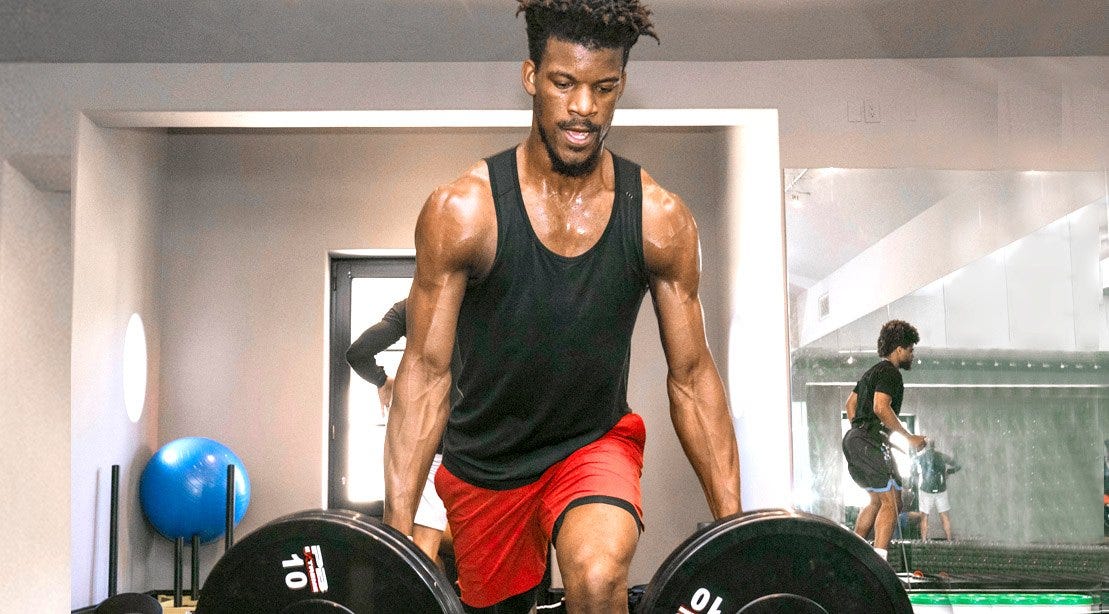
The objective is generally not to build strength or create additional fatigue. Instead, it can be used as a short maintenance stimulus for selected players, particularly when the following day is likely to be dominated by recovery.
3.1 Why lift immediately after a game?
The primary advantage is that the athlete has already completed the day’s major physical workload.
Rather than asking the player to return to the weight room the following day—when they may be sore, traveling or trying to recover—the team can attach a small strength stimulus to an already demanding day.
This creates a potential stress-consolidation model:
Game + short lift → recovery day → next game
rather than:
Game → recovery → separate lift → recovery → next game
For players with low playing time, the rationale can be even stronger. A player who only played 10 minutes may require substantially more training stimulus than a starter who played 38 minutes.
3.2 The post-game session should be short
A post-game lift is fundamentally different from an offseason strength session.
A typical approach might involve:
10–25 minutes
1–3 primary exercises
low volume
high-quality repetitions
limited eccentric damage
no training to failure
individualized exercise selection
Potential exercises include:
trap-bar or squat variations
split squats
Romanian deadlifts
isometrics
upper-body pressing/pulling
core work
selected power exercises
The prescription should depend on the player’s game load and upcoming schedule.
3.3 Starters versus non-starters
This is particularly important in the NBA.
A 35-minute starter and a player who did not play should not necessarily receive the same post-game program.
High-minute player
The objective may be:
maintenance + tissue quality
with very low volume.
Low-minute player
The player may need a substantially greater stimulus:
strength + power + additional conditioning
In this case, the post-game session can effectively become that athlete’s primary training session of the day.
This allows the performance staff to individualize training without requiring the entire team to follow the same schedule.
3.4 Potential benefits of post-game lifting
1. Strength maintenance
During an 82-game NBA season, players may go several days without performing a meaningful strength stimulus if every training session is dominated by basketball and recovery.
Short post-game sessions can provide regular exposure to high-force movements.
2. Better use of the following day
The day after a game is often used for:
recovery
treatment
mobility
shooting
film
travel
Moving some strength work to immediately after the game can preserve the following day for recovery.
3. Reduced interference with basketball preparation
A traditional lifting session before practice or on a game-preparation day can potentially interfere with:
shooting
speed
practice quality
tactical preparation
Post-game lifting removes much of this conflict.
4. Individualized workload
Perhaps the biggest benefit is the ability to give each player a different prescription.
A team can effectively operate:
One game → multiple individualized strength programs.
5. Maintaining consistency during road trips
Post-game lifting is particularly attractive during road trips.
Instead of trying to find a suitable training window around:
flights
hotel check-in
meals
recovery
sleep
practice
the player can complete a short session before leaving the arena.
This can be especially useful when the team has an early flight the following morning.
4. Is Post-Game Lifting Scientifically Proven?
The evidence base is much smaller than the evidence supporting resistance training in general.
There is strong evidence that resistance training can improve and maintain strength and performance in athletes, but there is not yet strong evidence demonstrating that lifting immediately after an NBA game is superior to lifting the following day.
Therefore, post-game lifting should currently be considered an elite-practice strategy supported by training theory and practical experience, rather than a universally proven superior protocol.
The scientific evidence does, however, support the broader principles behind the strategy:
resistance-training exposure is important for maintaining physical qualities;
training frequency and volume can be manipulated to manage fatigue;
elite athletes require individualized programs;
competition load needs to be integrated with strength programming.
The NBA therefore represents an important real-world laboratory for determining whether these principles can be optimized further.
5. NBA: High Frequency, Extremely Individualized
The NBA represents one of the most difficult environments for strength training because teams can play multiple games per week, travel across time zones and sometimes play on consecutive days.
Historically, NBA strength programs have ranged from multiple weekly lifting sessions for younger players to substantially lower frequencies for veterans.
One NSCA account describing NBA strength-and-conditioning practice reported young players lifting up to four times per week while veterans were generally targeted for at least two sessions, with frequency adjusted according to the schedule.

The modern trend is toward even greater individualization.
Typical NBA approach
Offseason
3–5 strength sessions/week
hypertrophy and strength development
force production
movement quality
tissue capacity
individual weaknesses
Early season
approximately 2–3 exposures/week for many players
progressive reduction in volume
Heavy schedule
1–2 short maintenance exposures
micro-doses
greater emphasis on power and movement quality
Game day
Some players may perform short activation or potentiation sessions rather than conventional lifting.
Post-game
Selected players may perform short individualized strength or recovery work.
Recent NBA practice increasingly resembles a menu of individualized interventions, rather than one team-wide lifting program.
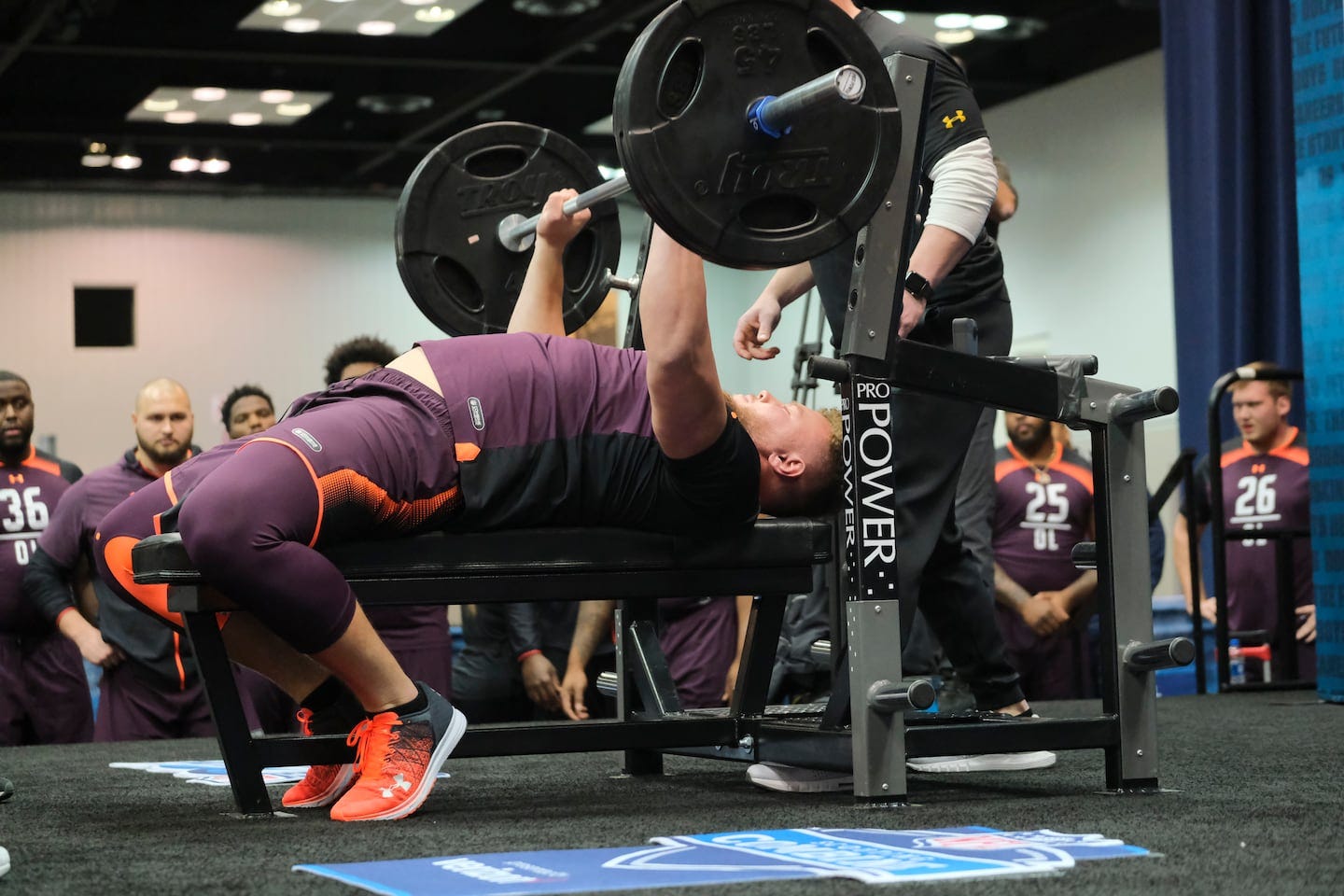
6. NFL: Lower Frequency, Higher Force, Greater Recovery Windows
The NFL is fundamentally different. Teams have approximately one regular-season game per week, creating a very different strength-training opportunity.
The primary challenge is not maintaining strength through 82 or 162 games. It is recovering from extremely high-intensity collisions and preparing for the next Sunday.
Typical NFL philosophy
Monday: recovery
Tuesday: recovery/regeneration
Wednesday: high-intensity practice and often significant strength stimulus
Thursday: moderate workload
Friday: lower workload/readiness
Saturday: activation
Sunday: game
Exact schedules vary by team.
Compared with NBA or NHL players, NFL athletes can generally tolerate more concentrated strength sessions because they have more time between competitions.
The NFL therefore remains one of the environments where high-force lifting remains central to performance development, particularly for collision-position athletes.
However, the trend is toward separating:
strength development → power → readiness
rather than attempting to maximize all three simultaneously.
Travel changes the equation
International games create additional challenges.
The NFL’s increasingly international schedule has made travel, sleep and circadian adaptation part of the performance equation.
For international games, lifting should therefore be integrated with:
circadian adjustment
light exposure
sleep
nutrition
hydration
practice timing
recovery
game-time adaptation
7. NHL: High Game Density Makes Maintenance Critical
The NHL combines some of the challenges of the NBA with the demands of a collision sport.
Players regularly face:
multiple games per week
travel
short recovery windows
high-speed collisions
repeated accelerations
upper-body contact
NHL teams therefore commonly emphasize low-volume strength maintenance during the season.
In a conventional NHL schedule, a team can play Monday, practice Tuesday and play again Wednesday, leaving little time for traditional strength sessions.
Typical approach
Offseason
High volume:
hypertrophy
maximal strength
power
unilateral strength
skating-specific development
Preseason
Progressive loading and conditioning.
In-season
Approximately 2–3 resistance exposures can be sufficient for maintenance depending on the player and schedule, with lower volume becoming particularly important during congested stretches.
Road trips
NHL road trips create an opportunity for:
recovery + mobility + short strength stimulus
rather than a complete training day off.
Teams should distinguish between:
travel day
travel + game
travel + off day
back-to-back games
three games in four nights
Each requires a different lifting dose.
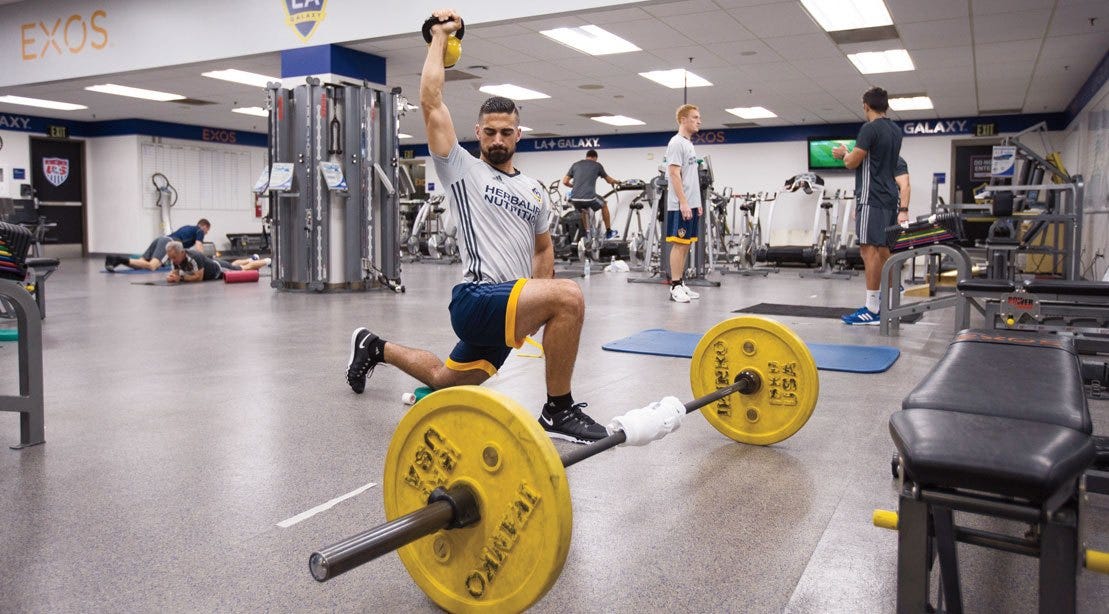
8. MLS: Strength Training Around Match Load
Soccer presents a different challenge because players accumulate substantial running loads in addition to strength requirements.
Professional soccer strength programs increasingly emphasize:
eccentric strength
hamstring capacity
adductor strength
calf/soleus capacity
single-leg strength
acceleration/deceleration
power
High-intensity resistance training appears effective for developing strength qualities in soccer players.
Typical match-week structure
For a Saturday match, a simplified model could be:
MD+1: recovery
MD+2: strength/regeneration
MD-4/-3: larger strength stimulus
MD-2: power/lower volume
MD-1: activation
MD: match
During congested periods, the strategy changes substantially.
A professional soccer environment may move toward:
one primary strength exposure
short micro-doses
isometrics
hamstring/adductor work
power maintenance
This is especially relevant for MLS because travel can involve significant domestic and international distances.
9. EPL: The Most Extreme Match-Density Problem
The EPL faces perhaps the most complicated strength-training environment of all the leagues considered.
A top club can compete in:
Premier League
Champions League
FA Cup
League Cup
international competitions
A player may therefore play every three days for extended periods.
A Rangers FC case study illustrates the problem: during the 2021–22 season the club played 65 competitive matches across four competitions. The authors describe the challenge of maintaining performance when players repeatedly compete every three days.
EPL strength philosophy
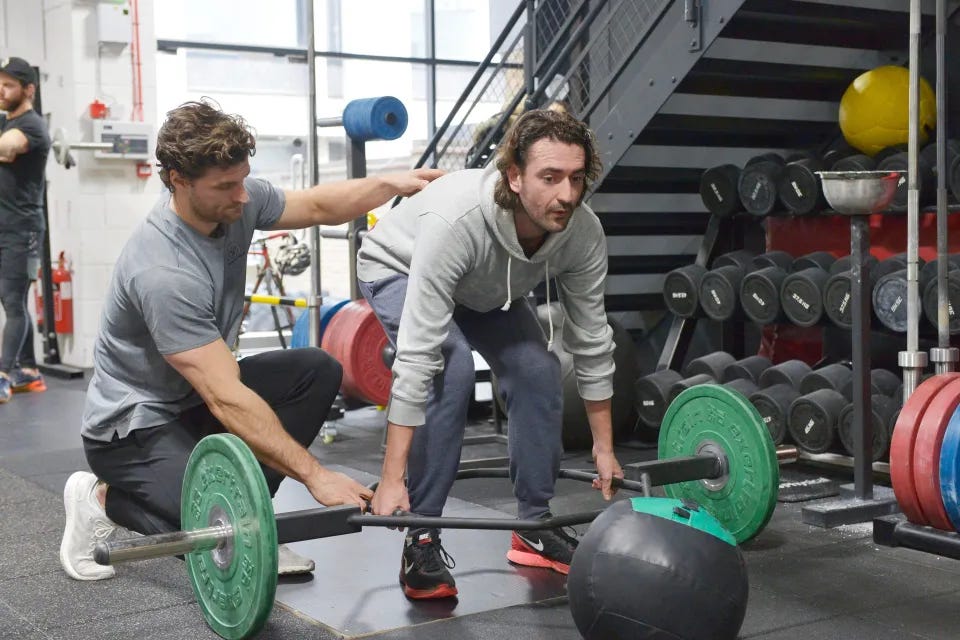
The weight room increasingly becomes a maintenance laboratory rather than a bodybuilding environment.
The priorities are:
Maintain strength
Maintain power
Maintain tissue capacity
Reduce injury risk
Minimize soreness
Protect match performance
This means:
Less volume + sufficient intensity + more individualized programming.
Premier League clubs are also increasingly combining strength programming with GPS, optical tracking, wellness, physiological monitoring and individualized recovery.
10. MLB: A Completely Different Model
MLB deserves separate treatment because the schedule is dramatically more demanding from a volume perspective.
Players may compete almost every day for six months.
Consequently, traditional bodybuilding-style lifting is incompatible with the competitive calendar.
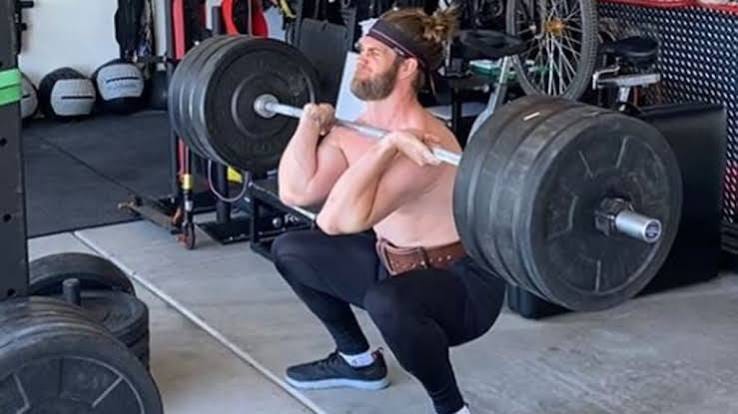
The modern MLB strength model emphasizes:
maintaining strength
maintaining rotational power
shoulder health
scapular function
hip mobility
lower-body strength
tissue resilience
individual positional demands
Pitchers require a fundamentally different program from position players.
Pitchers
Strength training must be coordinated with:
throwing volume
bullpen
game day
recovery day
shoulder/elbow status
Position players
The program can place greater emphasis on:
rotational power
sprinting
lower-body strength
acceleration
general athleticism
MLB therefore provides an important lesson for every other league:
Strength training should be organized around the athlete’s highest-stress activity—not around the weight room.
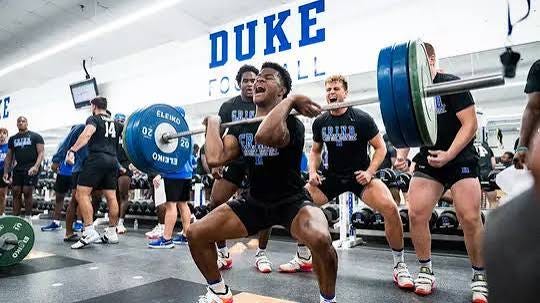
11. NCAA: The Most Variable Environment
The NCAA is particularly interesting because there is no single model.
A Division I football program can look dramatically different from:
basketball
soccer
hockey
baseball
tennis
track and field
The collegiate environment also involves younger athletes who may still be developing their strength base.
Research has demonstrated that in-season resistance training can improve explosive qualities in basketball players, while broader evidence supports resistance training as a method of improving physical performance throughout the season.
NCAA road trips
College teams often have more constrained travel and recovery resources than professional teams.
Therefore, the optimal road-trip strategy may be simpler:
20–30-minute maintenance session + mobility + activation + recovery
rather than trying to reproduce a full home weight-room session.
The NCAA environment also presents a major opportunity for athlete education:
teaching athletes how to train independently
monitoring recovery
teaching travel routines
educating athletes about sleep
teaching appropriate lifting volume
12. Cross-League Comparison
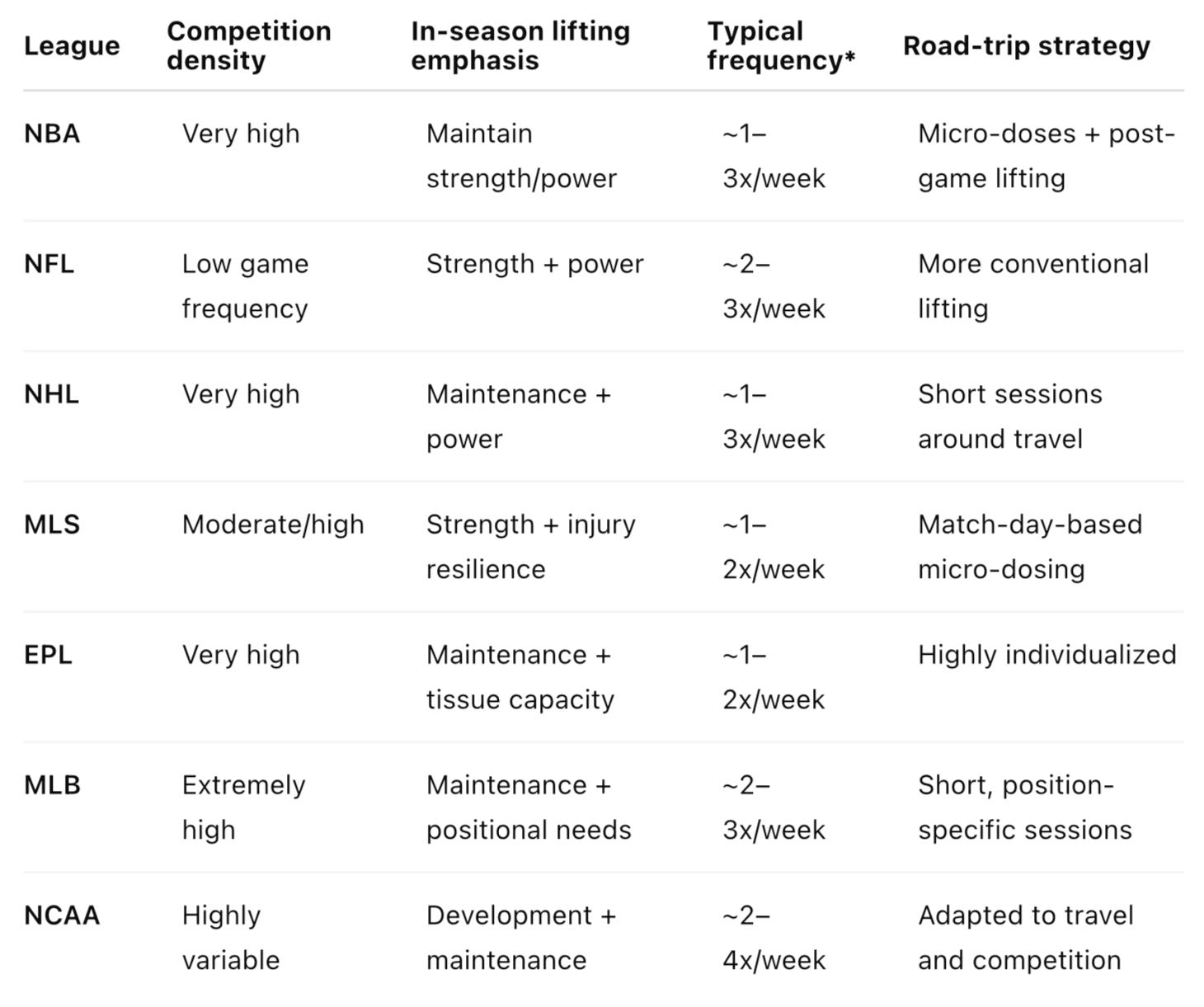
*These are practical ranges rather than league-wide mandates. There is no standardized lifting frequency across every team in a league.
13. The Biggest Difference Between the Leagues
The fundamental difference is how much time exists between competitions.
NFL
Competition → recovery → training → competition
There is enough time to generate meaningful training adaptations.
NBA/NHL
Competition → recovery → competition → travel → competition
The goal shifts toward maintenance.
EPL/MLS
Match → recovery → training → match
Strength must be integrated with running load.
MLB
Competition → competition → competition
The weight room becomes a continuous maintenance and injury-management environment.
NCAA
Development + competition
Young athletes need to develop physical capacity while simultaneously surviving the competitive schedule.
14. The Biggest Emerging Trend: Micro-Dosing
One of the most important trends across elite sport is the move toward micro-dosed strength training.
Instead of one large lifting session, coaches may distribute smaller exposures throughout the week.
Traditional model
Monday: 75-minute strength session
Emerging model
Monday: 25 minutes strength
Wednesday: 15 minutes power
Friday: 15 minutes activation/tissue capacity
The second model may allow teams to maintain strength while reducing soreness and interference with sport-specific training.
This is particularly attractive for:
NBA
NHL
EPL
MLS
MLB
15. Post-Game Lifting as “Stimulus Consolidation”
The emergence of post-game lifting in basketball represents a broader concept that could spread to other sports:
stimulus consolidation.
Instead of spreading physical stress across several days, teams can sometimes consolidate compatible stimuli into the same day.
For example:
Game → short strength stimulus → recovery day
This may be particularly attractive when:
the following day is a recovery day;
the athlete has low playing time;
the team is traveling;
there is a long gap before the next competition;
the athlete needs strength maintenance.
The concept could potentially translate to other sports.
NHL
A player with limited ice time could perform a short post-game strength session.
Soccer
A substitute who played 10 minutes could receive a more substantial post-match training stimulus.
NFL
A non-starter could potentially receive additional strength or conditioning work after a game.
MLB
A position player with limited game involvement could receive additional strength/power work after the game.
The underlying principle is:
Competition load should determine the training dose—not simply the calendar.
16. The Next Trend: Readiness-Based Lifting
The next evolution is likely to be moving from:
calendar-based lifting
to:
readiness-based lifting.
Instead of saying:
“Everyone lifts Tuesday.”
The performance staff asks:
“Who needs a high stimulus today, who needs maintenance, and who needs recovery?”
Potential inputs include:
sleep duration
sleep quality
HRV
resting heart rate
wellness questionnaires
GPS load
accelerations/decelerations
minutes played
force production
countermovement jump
asymmetry
muscle soreness
travel history
upcoming competition
previous injury
17. From “Load Management” to “Stimulus Management”
The next conceptual shift may be even more important.
Teams historically asked:
How much load did the athlete receive?
The more sophisticated question is:
What stimulus did the athlete receive, and what adaptation are we trying to create?
For example:
Strength stimulus
Heavy squat, 3 × 3
Power stimulus
Trap-bar jump, 3 × 3
Tendon stimulus
Isometric calf/patellar loading
Hamstring stimulus
Nordic/eccentric work
Neuromuscular stimulus
Jump or sprint exposure
Recovery stimulus
Low-intensity movement
These can all be programmed independently.
This allows a team to preserve an important physical quality without necessarily generating the fatigue associated with a traditional full-body lifting session.
18. Future Trend: AI-Optimized Weight-Room Programming
AI could eventually combine:
training history
force-plate data
wearable data
GPS
sleep
travel
injury history
player minutes
match schedule
exercise history
and generate an individualized daily recommendation.
For example:
Player A: 38 minutes last night + 5 hours 45 minutes sleep + 3 time zones → recovery + upper-body micro-dose.
Player B: DNP + 8 hours sleep → full lower-body strength session.
Player C: high hamstring load + reduced eccentric force → hamstring-focused maintenance session.
This is much more sophisticated than simply prescribing:
“Lift Monday, Wednesday and Friday.”
19. Future Trend: The Road Gym
Teams will increasingly expect hotels and training facilities to provide consistent performance infrastructure.
A road gym could eventually include:
standardized racks
force plates
velocity-based training devices
pneumatic resistance
portable EMG
jump monitoring
blood-flow restriction
recovery technology
automated exercise tracking
The objective would be to make the road environment as measurable as the home facility.
This is particularly relevant as teams travel internationally more frequently.
20. Future Trend: Travel as a Training Variable
Travel should increasingly be treated like another form of training load.
A player’s performance profile could incorporate:
Game load + training load + travel load + sleep debt + circadian disruption.
The 2026 research on long-haul travel strongly supports this direction: travel can affect sleep, fatigue, strength, power, coordination and cognition.
The implication is significant:
A player who has just crossed five time zones should not necessarily receive the same lifting prescription as the same player after spending five days at home.
21. Recommendations to Professional and Collegiate Teams
1. Stop treating lifting as a fixed weekly appointment
Build strength training around:
competition
travel
sleep
sport load
player status
rather than simply assigning fixed days.
2. Maintain intensity while reducing volume
During congested periods, teams should generally prioritize:
quality > quantity.
A short, high-quality stimulus can be more appropriate than a large-volume session.
3. Create a formal road-trip lifting protocol
Teams should define protocols for:
domestic travel
cross-country travel
international travel
one-game road trips
multi-game road trips
back-to-backs
long-haul flights
4. Consider post-game lifting strategically
Post-game lifting should not become a universal rule.
Instead, identify:
low-minute players
players needing strength maintenance
athletes with sufficient recovery time
players facing travel the following day
and prescribe the minimum effective dose.
5. Monitor the athlete before prescribing the session
Use available information such as:
sleep
wellness
minutes
GPS
CMJ/force data
soreness
travel duration
time zones
to modify the session.
6. Separate starters from non-starters
A starter who accumulated substantial game load should not automatically receive the same strength prescription as a player who barely played.
7. Use micro-dosing more aggressively
Particularly in:
NBA
NHL
EPL
MLS
MLB
short sessions can preserve key adaptations while minimizing fatigue.
8. Individualize by position
An NFL lineman, NBA center, NHL defenseman, EPL winger and MLB pitcher should not have identical strength programs.
9. Measure the outcome
Teams should track whether their lifting strategy actually produces:
maintained strength
maintained power
fewer injuries
improved availability
improved sprint/jump performance
better recovery
better competition performance
The weight room should be judged by outcomes—not by how hard the session looked.
22. What Teams Should Avoid
Several traditional approaches are increasingly difficult to justify during congested competition periods.
Avoid:
Heavy lifting immediately before competition
when it produces unnecessary soreness or fatigue.
High-volume bodybuilding sessions during congested schedules
when the objective is maintenance.
One-size-fits-all programs
because players have different game loads and recovery profiles.
Ignoring travel
because a player may have completed no formal training while still experiencing substantial physiological stress.
Using wellness data without changing training
If a team collects sleep, HRV, force-plate and GPS information but everyone receives the same workout, the monitoring system has limited practical value.
23. Conclusion
Strength training remains one of the most important tools available to elite sports teams—but its role is changing.
The modern performance department is moving away from:
“How much can we make this athlete train?”
toward:
“What is the minimum effective stimulus required to keep this athlete strong, powerful, resilient and available for competition?”
The answer differs substantially between leagues.
The NFL has enough recovery time to use relatively substantial strength sessions.
The NBA and NHL must constantly balance strength maintenance against an enormous competition and travel schedule.
MLS and EPL teams must coordinate lifting with running load and match congestion.
MLB must manage strength around an almost continuous competitive calendar and position-specific demands.
NCAA programs must balance athlete development with competition and travel.
The NBA’s growing use of short post-game lifting sessions illustrates an important evolution: teams are increasingly looking at the entire 24–72-hour period around a competition and deciding when the most appropriate training stimulus can be delivered, rather than automatically assigning a lifting session to a particular day.
The evidence also makes one point increasingly clear: travel itself is a performance stressor. Long-haul travel can negatively affect sleep, strength, power, coordination and cognitive performance, making travel management an increasingly important part of performance programming.
There is not yet strong direct scientific evidence proving that a specific lifting protocol during a road trip—or immediately after an NBA game—is superior to every alternative. The stronger evidence supports the components of the strategy: maintaining resistance-training exposure, managing training load, preserving sleep and minimizing the physiological consequences of travel.
The future therefore belongs to individualized, data-driven, low-fatigue strength training.
The most advanced teams will increasingly treat every lifting session as a prescription:
Right exercise.
Right athlete.
Right dose.
Right time.
Right place.
And increasingly, that place may be the road, the hotel—or even immediately after the game.
You may also like:
🔥Upside Chat: Dr Bill Burgos, Experienced NBA S&C Coach and Adjunct Professor at Mississippi State and Austin Peay State University.

This week we interviewed Dr Bill Burgos an experienced NBA Strength & Conditioning coach. He has worked for many NBA teams (Orlando Magic, NY Knicks, Timberwolves..). He also worked in the MLB with the Pittsburgh pirates. He is also an adjunct professor at 2 universities in the US: Mississippi state and Austin Peay State university.
🎙️ Upside Chat with Ryan Petersen, Assistant S&C coach, Chicago Bulls (NBA) on His Background, Approach Towards Training, Innovation, Recovery, and More.

Today we have the honor of interviewing Ryan Peterson the assistant S&C coach for the Chicago Bulls, a top NBA team.

🎙️ Upside Chat with Dr Stefan Valdes, An Experienced NFL & NBA S&C Coach

Today we have the honor of interviewing Dr. Stefan Valdes, a Doctor of Physical Therapy (DPT), Board-Certified Sports Specialist (SCS), and Certified Strength & Conditioning Coach (CSCS).