
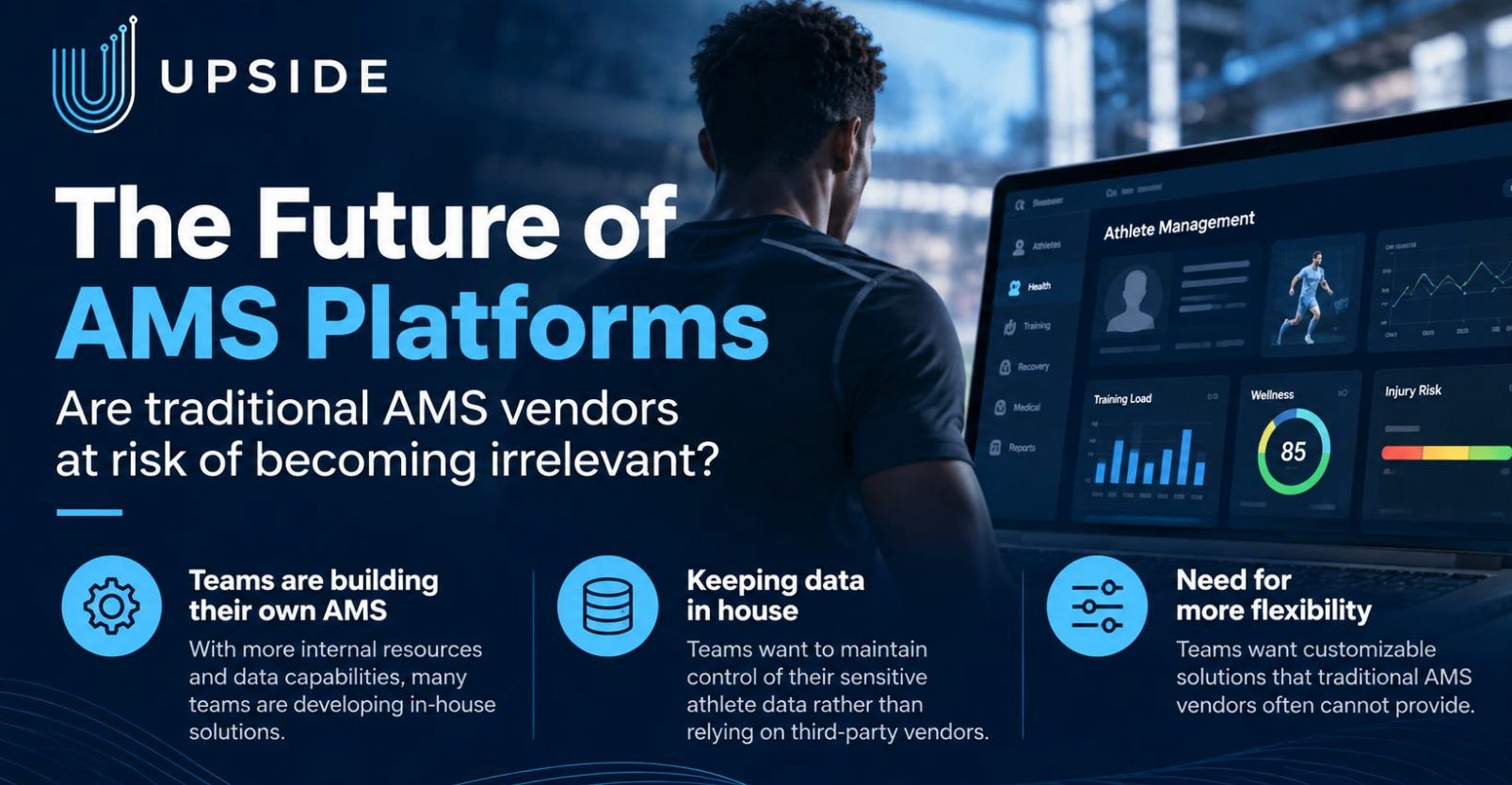
“AMS platforms will go away in the coming years.”
That’s what someone at a major U.S. professional sports team told me 2 weeks ago. I’m not convinced Athlete Management Systems will disappear entirely, but after many conversations with teams over the past few years, I do think we are going to see a significant shift in the AMS market.
For a long time, the vision was relatively straightforward: put everything into one centralized AMS. Medical information, wellness, training load, GPS, testing, strength data, injury information, return-to-play data and reporting could all live within one central platform used by the medical and performance departments.
But the technology environment inside elite sports organizations is changing quickly, and that could challenge the traditional AMS model.
1️⃣ More teams are developing their own systems
Professional teams are hiring more data scientists, engineers, developers and analytics staff. As those internal capabilities grow, some organizations are becoming less dependent on third-party platforms and more capable of building technology around their own workflows.
Not every organization has the resources—or the desire—to build an entire AMS internally. But larger and more technologically sophisticated teams can increasingly build certain components themselves, create their own practitioner interfaces and integrate multiple technologies through their internal data infrastructure.
The question is therefore changing from “Which AMS should we use?” to “Which parts should we build ourselves, and which parts should we buy?”
2️⃣ Teams increasingly want to control their own data
Athlete data is becoming one of the most valuable and sensitive assets inside a professional sports organization. Teams now collect enormous amounts of medical, GPS, force plate, strength, sleep, wellness, biomechanical, biomarker and training data.
As the amount and value of this data increases, teams are paying more attention to where it sits, who controls it, how easily it can be accessed and how it can be connected to other technologies.
This raises an important question: Why should all of a team’s athlete data sit primarily inside a third-party platform?
For some organizations, the preferred model may increasingly be for the team’s own data infrastructure to become the source of truth, while external applications connect to that infrastructure when necessary.
3️⃣ Teams want significantly more flexibility
Every organization operates differently. Medical departments have different philosophies, performance departments use different models, return-to-play processes vary, and teams have different technologies, KPIs, reporting requirements and terminology.
A workflow that works perfectly for one NBA or NFL organization may make little sense for another. Traditional AMS platforms therefore face the difficult challenge of serving many organizations while simultaneously providing the level of customization each team increasingly expects.
Teams don’t necessarily want to change their processes to fit their software anymore. They increasingly want the software to adapt to their processes.
4️⃣ The technology stack inside teams is changing
This may ultimately be the biggest structural shift. Many teams now have cloud infrastructure, data warehouses, APIs, BI tools, internal analytics capabilities, machine-learning models and AI tools that either didn’t exist or weren’t widely deployed when many traditional AMS platforms were originally adopted.
As a result, the AMS may no longer need to be the place where everything physically lives. Instead, it could become one application within a much broader technology ecosystem controlled by the organization.
Teams are also using more specialized, best-of-breed technologies across GPS, force plates, motion capture, wearables, sleep, biomarkers, medical systems, video and strength training. Rather than sending all of this information into one centralized AMS, teams may increasingly prefer to maintain their own data layer and allow different applications to access the information they need through APIs.
5️⃣ AI could accelerate this transition
This is where I think things become particularly interesting.
Historically, one of the major benefits of an AMS has been helping practitioners organize, visualize and retrieve athlete information. But AI could fundamentally change the way practitioners interact with that data.
Instead of navigating multiple dashboards, reports and athlete profiles, a practitioner could eventually ask questions such as: “What has changed with this athlete over the past seven days?” or “Compare today’s force plate results with his preseason baseline and previous return-to-play.”
An AI layer could potentially pull information from medical, GPS, wellness, strength and biomechanical datasets and present the practitioner with the information that matters at that moment.
If that happens, the competitive advantage may shift away from who owns the dashboard toward who can securely connect, contextualize and make sense of the organization’s data.
So does the AMS disappear?
I don’t think so. But I think the role of the AMS could change dramatically.
We could gradually move away from a model where the third-party AMS is the central system where everything lives, toward an ecosystem built around team-owned data infrastructure → best-of-breed applications → APIs → analytics and AI → customized practitioner interfaces.
That doesn’t necessarily make AMS vendors less important. In fact, it could create an opportunity for the best vendors to become even more valuable, but their products may need to evolve.
The successful AMS platforms of the future may need to be much more open, modular, API-first, interoperable, customizable and AI-enabled. Some could remain systems of record, while others could evolve into workflow platforms, visualization layers or orchestration systems connecting multiple technologies.
And some organizations, particularly teams with significant internal engineering and data resources, may ultimately decide that they don’t need a traditional AMS at all.
That creates what I think is one of the most important strategic questions for AMS vendors over the next several years:
👉 Do you continue trying to own the team’s data ecosystem, or do you become the flexible layer that makes a team-owned ecosystem easier for practitioners to use?
The AMS probably isn’t going away anytime soon. But the traditional definition of what an AMS is, and what role it should play inside an elite sports organization, may be changing quickly.
I think this will be one of the more interesting developments to watch in the elite sports technology market over the next 3–5 years.
Curious to hear from practitioners, data scientists and performance leaders: Are you seeing the same shift inside your organization?
If you are a startup looking to get traction with pro teams, raise money, or get guidance on your product, feel free to contact me at julien@upsideglobal.co
Best,

You may also like:
