

Upside Global | Investment & Sports Business Analysis | October 2026
Introduction: Professional Sports Have Become a Major Investment Asset Class
For decades, professional sports teams were primarily owned by wealthy individuals, families and business entrepreneurs. Owning a franchise was often considered a prestigious investment, driven as much by passion and personal ambition as financial returns.
That model is changing rapidly.
Today, some of the world’s largest private equity firms, institutional investors, sovereign wealth funds and investment groups are acquiring stakes in professional sports organizations.
Companies such as Apollo Global Management, KKR, RedBird Capital Partners, Ares Management, Sixth Street and Silver Lake are increasingly treating professional sports as a strategic investment category.
The numbers illustrate the scale of this transformation.

Sources: S&P Global Market Intelligence and Dakota, using their respective deal and franchise samples.
This trend is particularly visible across the NFL, NBA, MLB, NHL, MLS, European soccer, Formula 1 and women’s professional sports.
One of the most significant recent transactions occurred in March 2026, when Apollo Sports Capital completed its acquisition of a majority stake in Atlético de Madrid, one of Europe’s leading soccer clubs.
Another major development came when KKR acquired Arctos Partners in February 2026, expanding its exposure to professional sports franchises around the world.
These investments raise several important questions.
Why are private equity firms investing billions in professional sports? Which firms are building the largest portfolios? And what does this growing institutional ownership mean for teams, athletes, fans and the sports technology industry?
Why Private Equity Firms and Investment Groups Are Buying Sports Teams
A. Scarcity and rising franchise valuations
Unlike most businesses, professional sports franchises are extremely scarce assets.
There are only 32 NFL franchises, 30 NBA franchises and 30 MLB franchises. Investors cannot simply create another team in an established league without approval and an expansion opportunity.
This scarcity, combined with global demand, helps support franchise valuations.
The 2026 sports M&A market demonstrates how far investors are willing to go to acquire ownership of these assets.
B. Predictable and diversified revenue
Professional sports organizations generate revenue through multiple channels:
National and international broadcasting rights
Sponsorship and commercial partnerships
Ticketing, hospitality and premium seating
Merchandise and licensing
Stadium events and entertainment
Digital content and international brand expansion
Centralized league media contracts can provide a degree of revenue visibility that is attractive to long-term investors.
C. Global expansion opportunities
A professional sports team is no longer simply a local organization.
Major European soccer clubs have millions of supporters across Asia, North America, Africa and the Middle East. NFL and NBA organizations are also pursuing international audiences.
Investment firms see opportunities to monetize these global communities through sponsorships, streaming, licensing, international events and digital platforms.
D. Sports franchises as long-term assets
Private equity investors increasingly view sports franchises as assets that can appreciate over extended periods.
Unlike traditional leveraged buyouts, many sports investments involve minority equity positions where investors have limited operational control.
The financial thesis often combines franchise appreciation, revenue growth, infrastructure development and an eventual sale of the ownership stake.
However, rising valuations do not guarantee attractive returns. Limited liquidity, high acquisition multiples, player payrolls, debt and league restrictions all create risks.
E. Stadiums and real estate
Stadium development is becoming a major part of the investment thesis.
Modern venues can generate revenue far beyond game days through concerts, conferences, restaurants, hotels, retail and mixed-use real estate.
Apollo’s investment in Atlético de Madrid is a particularly interesting example. Its strategy includes supporting the Ciudad del Deporte development surrounding the club’s stadium.
F. Technology, data and operational efficiency
Investment groups are also attracted by opportunities to modernize sports organizations.
These include AI-powered analytics, ticketing optimization, personalized fan engagement, commercial data platforms, athlete performance technologies and improved business operations.
For sports-tech startups, this creates a potentially important new category of customers and strategic partners.
Private equity-backed ownership groups may be able to introduce technologies across multiple teams, although investment decisions remain dependent on each organization’s sporting priorities and management structure.
The Major Private Equity Firms and Investment Groups Buying Sports Teams
The investment landscape includes several distinct models: majority-control acquisitions, minority franchise investments, multi-club ownership platforms and investments in leagues, media rights or sports infrastructure.
It is important to distinguish direct team ownership from indirect stakes held through a parent company, and from loans or commercial partnerships that do not confer ownership.
A. Apollo Global Management — A major new investor in European soccer
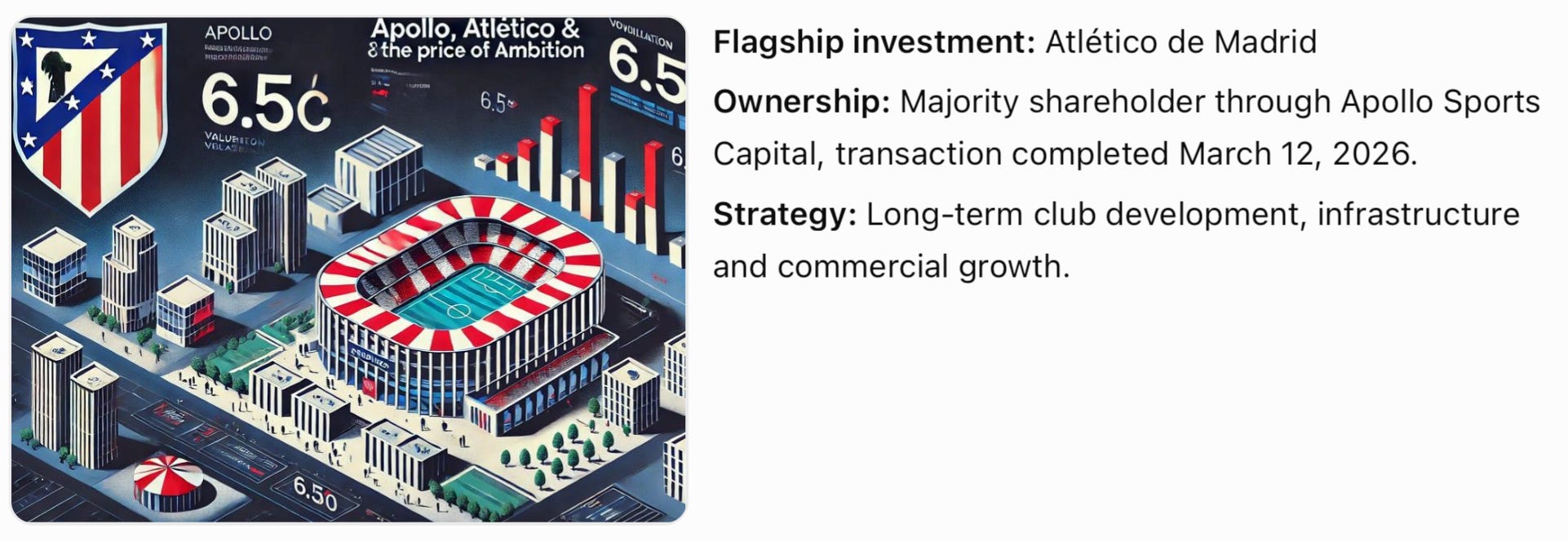
Apollo’s acquisition of Atlético de Madrid represents one of the most important recent private equity investments in European soccer.
Through Atlético’s club structure, the transaction also encompasses Atlético de San Luis in Mexico and Atlético Ottawa in Canada.
The firm’s broader sports investments include interests in the Mutua Madrid Open and Miami Open tennis tournaments, although these are event investments rather than soccer-team acquisitions.
Upside Take: Apollo’s investment illustrates how private equity is moving beyond minority financial investments toward majority ownership of globally recognized sports brands.
Its emphasis on stadium development and commercial infrastructure also suggests that future returns may come from activities extending far beyond matchday revenues.
B. Arctos Partners / KKR — One of the largest portfolios of minority team investments

Arctos has become one of the most prominent institutional investors in professional sports.
Its investment model generally focuses on acquiring minority stakes in established franchises rather than taking operational control.
In February 2026, KKR acquired Arctos, creating a powerful combination of sports-investment expertise and global institutional capital.
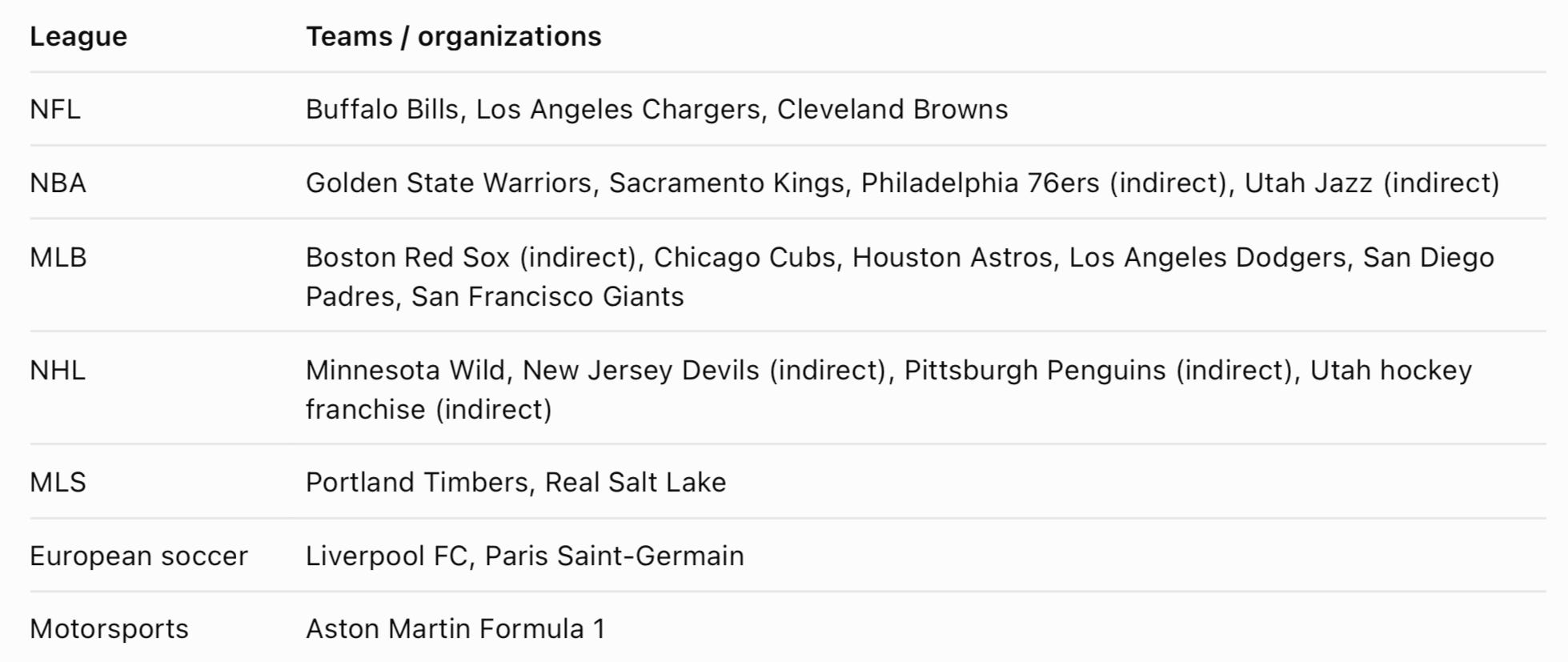
These are selected reported investments across different dates and ownership vehicles; the table is not a representation that every position is unchanged or directly held as of October 2026.
Upside Take: Arctos is particularly interesting because of its diversified exposure across American professional sports and international soccer.
Rather than betting on the success of a single team, its portfolio provides exposure to multiple leagues, media markets and commercial ecosystems.
KKR’s acquisition could accelerate this strategy by providing additional capital, institutional relationships and distribution capabilities.
C. RedBird Capital Partners — Building a global sports and entertainment ecosystem

RedBird Capital has pursued a different approach, combining team ownership with investments in media, entertainment, technology and commercial infrastructure.
Selected investments:
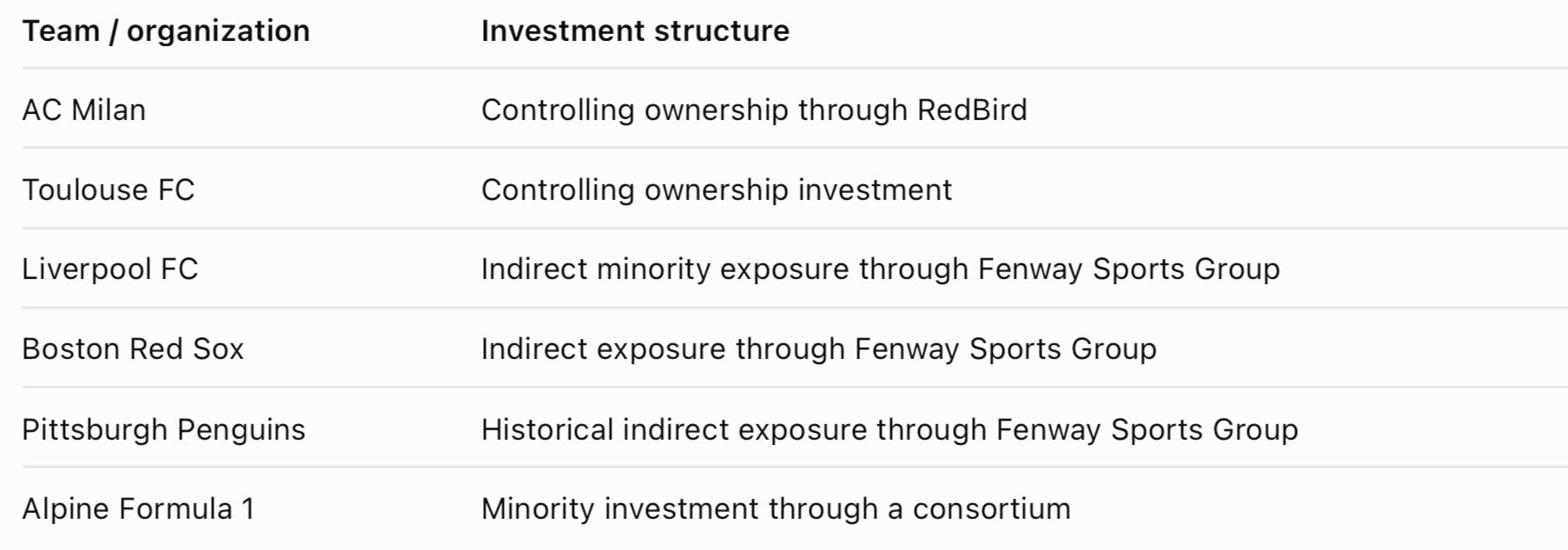
RedBird has also developed investments across sports media, distribution and entertainment.
Upside Take: RedBird’s strategy is not simply to acquire sports teams. It aims to connect sports franchises with media, content distribution and commercial opportunities.
This approach could become increasingly important as clubs seek to monetize international audiences and build direct relationships with fans.
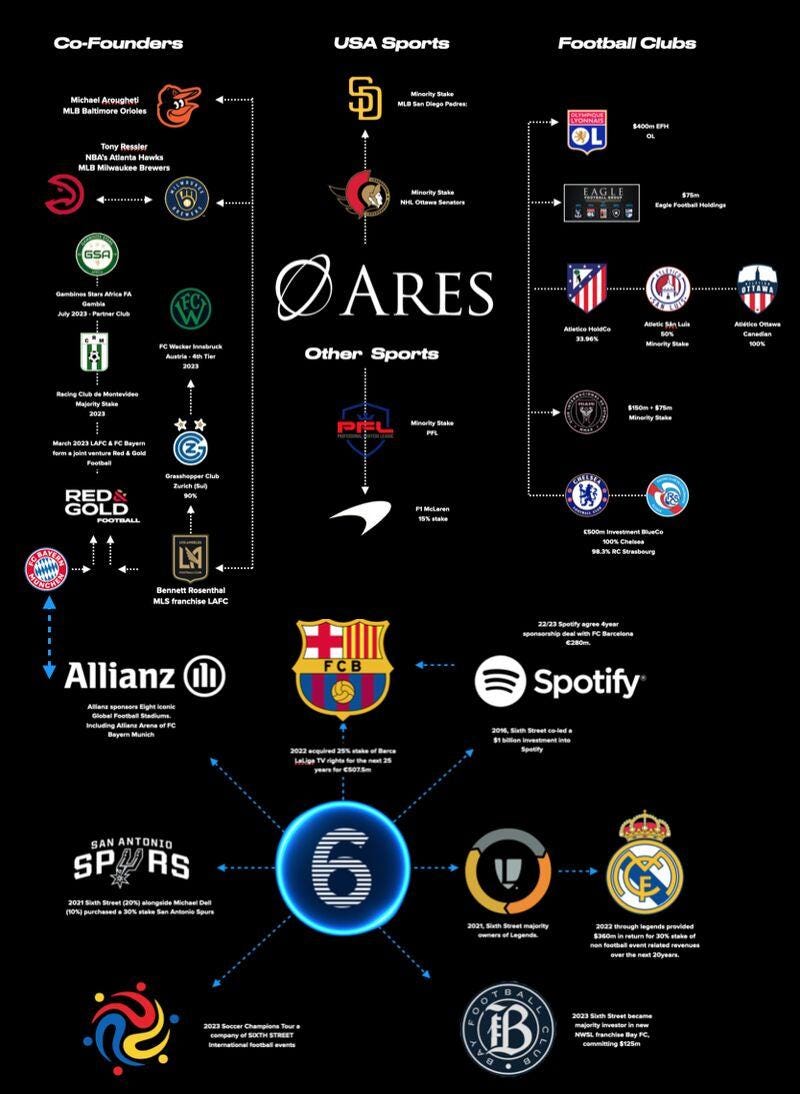
D. Ares Management — Expanding across American and European sports
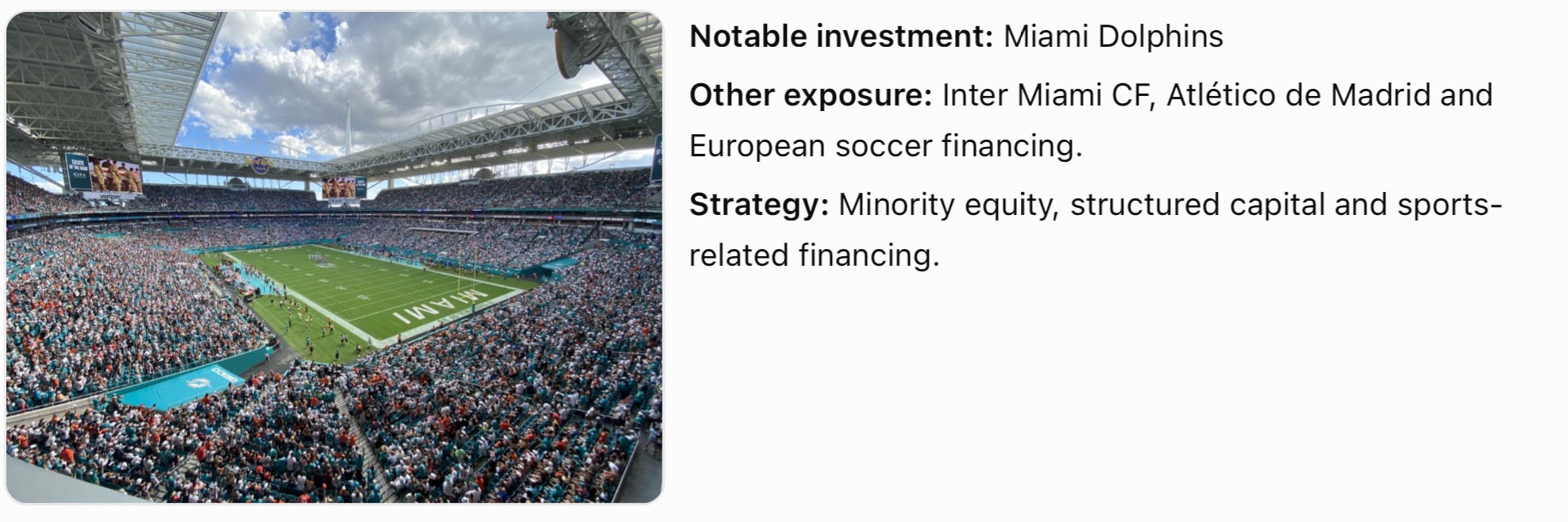
Ares has built a diversified sports investment business spanning team ownership, financing and related assets.
Its reported investments include:
Miami Dolphins (NFL): Minority investment of approximately 10%.
Inter Miami CF (MLS): Institutional investment.
Atlético de Madrid: Retained minority exposure following Apollo’s majority acquisition.
European soccer: Additional financing and investment relationships, including Chelsea-related exposure.
Ares has also invested in motorsports-related assets.
Upside Take: Ares illustrates how private equity firms can participate in sports without necessarily controlling teams.
For many existing franchise owners, minority investments offer access to capital while allowing them to retain management control.
E. Sixth Street — Teams, media rights and women’s sports

Sixth Street has emerged as an important sports investor with exposure to professional franchises, stadium financing and media rights.
Selected investments and relationships:

The Real Madrid and Barcelona transactions are not equivalent to owning equity in those soccer clubs.
Upside Take: Sixth Street demonstrates that institutional investment in sports extends well beyond franchise ownership.
Its investments in women’s soccer are especially noteworthy, as women’s professional sports continue to attract greater institutional attention.
F. Clearlake Capital — Majority ownership and multi-club strategies
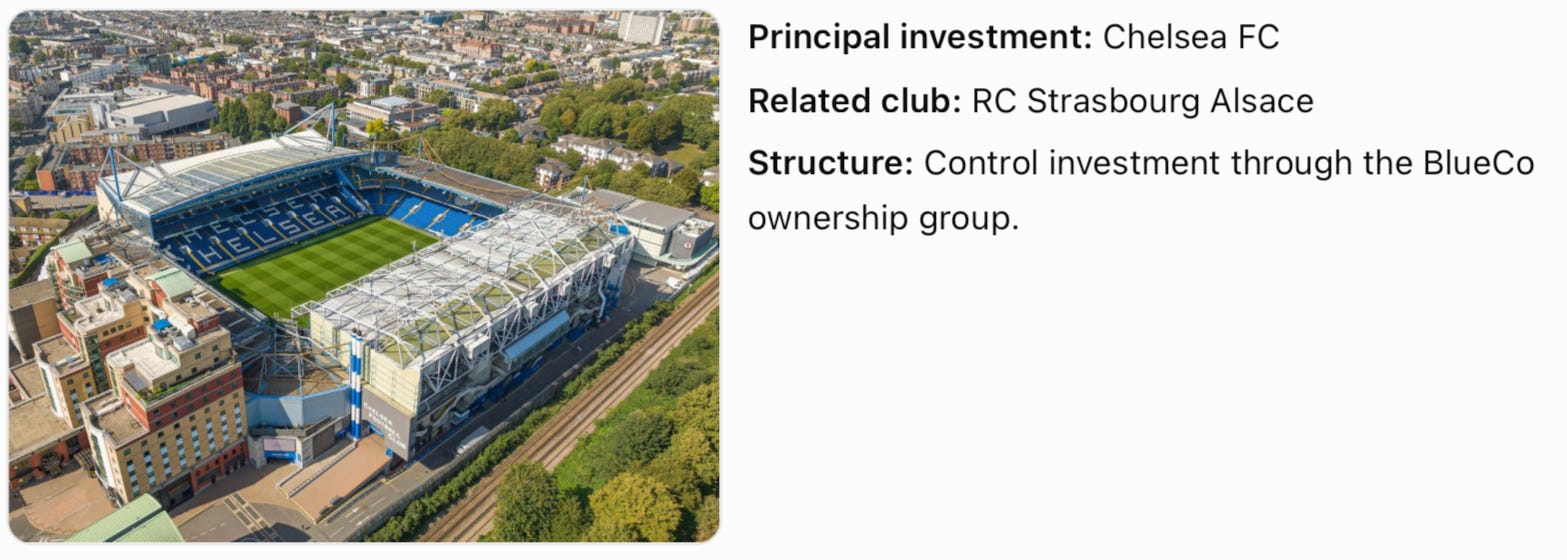
Clearlake Capital partnered with investors led by Todd Boehly to acquire Chelsea FC in 2022.
The ownership platform subsequently expanded into French soccer through RC Strasbourg.
This strategy offers potential opportunities to coordinate scouting, recruitment, player development and business operations across clubs.
Upside Take: Multi-club ownership could become an increasingly important investment model, particularly in European soccer.
However, conflicts of interest, competitive balance, supporter opposition and UEFA ownership regulations present significant challenges.
G. Silver Lake — Investing in global sports platforms

Silver Lake has pursued a broader technology-driven sports investment strategy.
Its reported investments and exposures include:
City Football Group: Minority investment in the ownership platform associated with Manchester City and other soccer clubs.
New Zealand Rugby: Minority commercial investment associated with the All Blacks and wider New Zealand rugby business.
Madison Square Garden Sports: Investment exposure to the company associated with the New York Knicks and New York Rangers.
Sports-related businesses: Investments across sports media, technology and commercial platforms.
These positions differ significantly in structure. In particular, an investment in New Zealand Rugby’s commercial business is not equivalent to owning the All Blacks national team.
Upside Take: Silver Lake represents the intersection of sports, technology, media and institutional investment.
Its strategy demonstrates how investors can seek exposure to sports economics through commercial platforms as well as franchise ownership.
H. Other important investors to watch
Several other investment groups are helping reshape the sports ownership landscape.
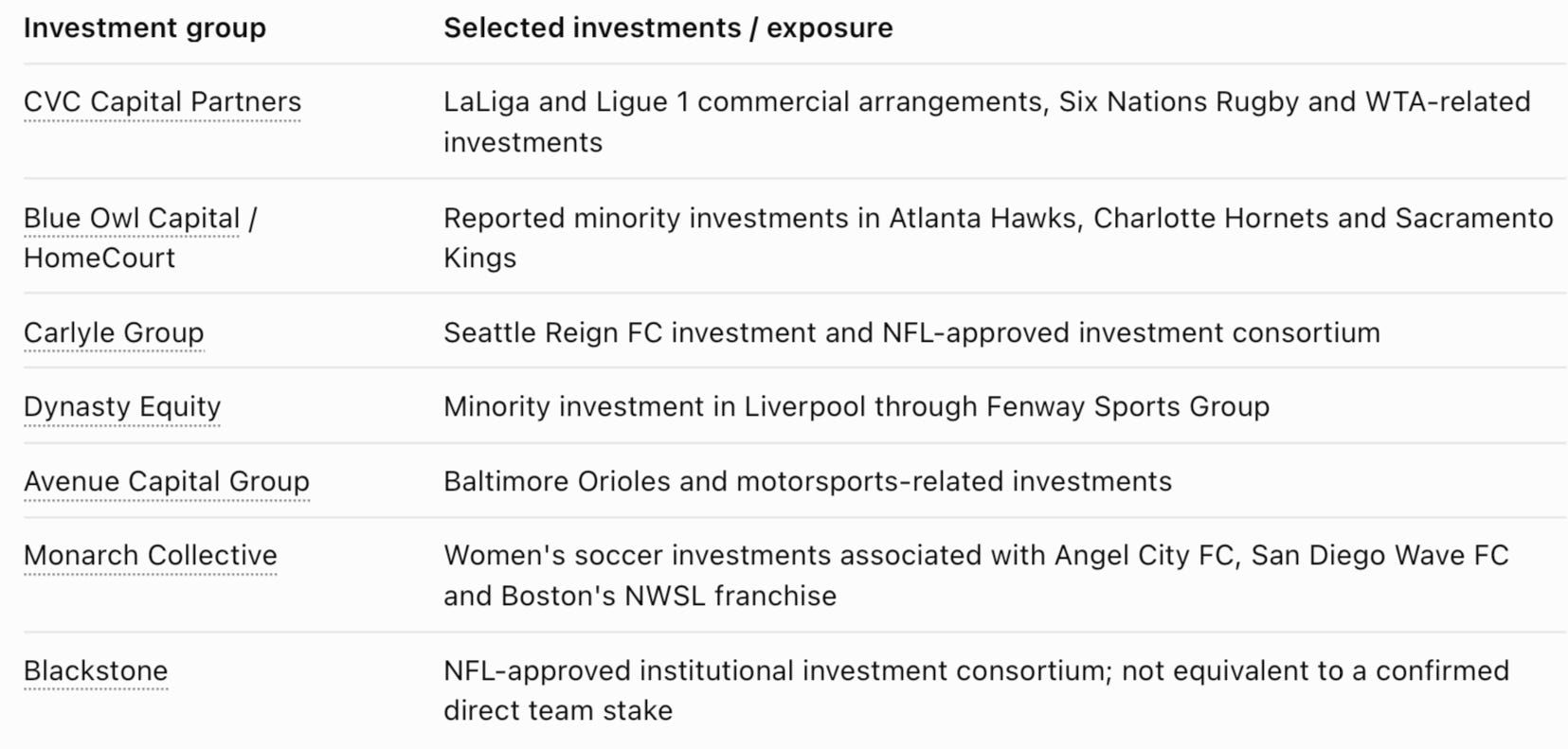
The table combines reported equity holdings, indirect exposures and league-approved investment vehicles. CVC’s league-level commercial investments, for example, should not be interpreted as direct ownership of every club in those competitions.
How the Major Sports Leagues Regulate Private Equity Ownership
Not all professional leagues allow investment firms to buy teams under the same conditions.
In North America, institutional investors generally face restrictions on ownership percentages, governance rights and investment holding periods.
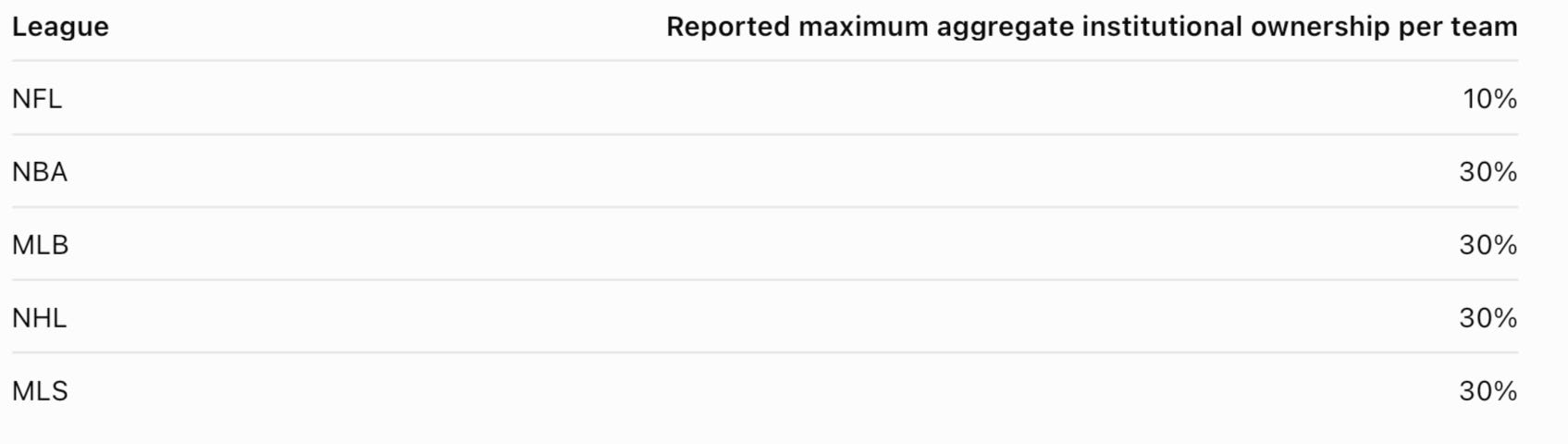
The NFL is especially conservative. Its framework limits institutional investment to minority positions and maintains strong protections for controlling owners.
The league’s decision to admit institutional investors in 2024 nevertheless opened a major new market for private capital.
In European soccer, controlling acquisitions are more common, although league rules, competition regulations and financial oversight create different constraints.
Upside Take: The differences between leagues will influence where private equity firms deploy capital.
The NFL offers exposure to highly valuable franchises through restricted minority positions, while European soccer provides more opportunities for investors seeking majority control and operational influence.
Future Trends: Where Is Private Equity Investment in Sports Heading?

Trend 1: More NFL franchises will attract institutional capital
The NFL’s decision to permit private equity investment represents a significant structural change.
As franchise valuations continue rising, minority stake sales could become increasingly attractive to owners seeking liquidity without surrendering control.
More investment firms may also seek approval to participate.
Prediction: Institutional minority ownership could become a standard feature of NFL franchise capital structures over the next decade.
Trend 2: Women’s sports will become an increasingly important investment target
Women’s professional sports represent one of the most compelling growth opportunities for institutional investors.
Investment activity is expanding across the NWSL, WNBA and other women’s competitions.
According to the CFA Institute’s May 2026 analysis, global elite women’s sports revenues reached approximately $2.35 billion in 2025, with further growth expected.
Investors are attracted by opportunities in media rights, sponsorships, facilities, franchise expansion and international growth.
Prediction: More investment funds will create dedicated strategies for women’s professional sports, particularly where commercial development and infrastructure remain underfunded.
Trend 3: Multi-club and multi-sport ownership will continue expanding
Investment groups are increasingly interested in building portfolios rather than owning individual franchises.
These portfolios could combine soccer clubs, basketball teams, motorsports organizations and other sports businesses.
Deloitte’s 2026 Sports Industry Outlook identifies this convergence as an important structural trend.
Potential benefits include shared commercial relationships, centralized technology platforms, scouting networks and operational expertise.
However, multi-club ownership will face growing scrutiny over competitive integrity, conflicts of interest and governance.
Trend 4: AI and sports technology will become important value-creation tools
One of the most interesting implications for the sports technology industry is the opportunity for investment groups to accelerate innovation within their portfolios.
Private equity-backed organizations may increasingly invest in:
Athlete performance: GPS, wearables, biomechanics, workload monitoring and recovery technologies.
Sports medicine: Injury-risk assessment, rehabilitation platforms and return-to-play technologies.
AI and analytics: Computer vision, video analysis, predictive models and decision-support systems.
Business operations: Dynamic ticket pricing, fan engagement, sponsorship analytics and revenue optimization.
Infrastructure: Smart stadiums, connected facilities and energy management.
Upside Take: This could create new opportunities for sports-tech startups.
A technology company that successfully demonstrates value within one team might be introduced to other organizations in the same investment portfolio.
However, shared ownership does not automatically translate into centralized purchasing. Performance directors, medical departments and coaching staffs will still need evidence that a technology solves a meaningful problem.
Trend 5: More investment will flow into sports infrastructure and media
Investors are likely to expand beyond direct franchise ownership into adjacent assets.
These include stadiums, training facilities, media-rights businesses, data companies, sports technology platforms and live-event operations.
This approach can offer exposure to the economics of professional sports without requiring investors to acquire a multibillion-dollar franchise.
It may also provide different liquidity, governance and return characteristics.
Trend 6: Investment groups will face greater pressure to deliver returns
Rising franchise valuations create opportunities but also introduce challenges.
Investors purchasing teams at historically high multiples must eventually demonstrate how those assets will generate acceptable returns.
Potential risks include:
Slower growth in media-rights revenues.
Increasing player salaries and transfer costs.
Expensive stadium and infrastructure projects.
Limited opportunities to exit large ownership positions.
Fan resistance to aggressive commercialization.
Governance conflicts between investors and club management.
A recent analysis by Morrison Foerster highlights ownership restrictions, regulatory complexity and stakeholder concerns as important considerations for private capital entering global sports.
Prediction: The next phase of investment will increasingly distinguish firms capable of creating sustainable operating value from those relying primarily on rising franchise valuations.
What This Means for the Sports Technology Industry
For sports-tech founders and investors, the growing involvement of private equity creates several important opportunities.
First, access to capital could expand. Investment firms building sports portfolios may also invest in technology companies serving those organizations.
Second, commercial opportunities could become more scalable. Multi-team ownership platforms may facilitate introductions, pilot programs and technology adoption across their portfolios.
Third, due diligence requirements could become more demanding. Institutional owners may increasingly expect vendors to demonstrate measurable financial, operational or sporting outcomes.
Fourth, technology companies may become acquisition targets. Firms investing in teams, media, analytics and performance infrastructure could seek strategic acquisitions that complement their broader portfolios.
At Upside, we believe this convergence between institutional investment and sports technology is particularly important.
For years, sports technology companies have focused primarily on selling products directly to performance directors, sports scientists, rehabilitation specialists and coaching staffs.
Those relationships remain essential.
However, investment groups and ownership platforms may become an additional channel for technology adoption, financing and strategic partnerships.
The opportunity is not simply to sell more technology. It is to demonstrate how innovation can create measurable value across professional sports organizations.
Conclusion: A New Era of Sports Ownership
The growing presence of Apollo, KKR, Arctos, RedBird, Ares, Sixth Street, Clearlake and Silver Lake illustrates a fundamental transformation in professional sports.
Teams are no longer viewed exclusively as prestigious assets owned by wealthy individuals and families.
They are increasingly part of sophisticated global investment portfolios encompassing franchises, media, entertainment, technology, infrastructure and commercial rights.
The investment thesis is compelling: scarce assets, loyal audiences, international growth opportunities and the potential for long-term value appreciation.
But there are important challenges.
Investors must balance financial performance with sporting success, fan expectations and the cultural identity of teams.
They must also recognize that professional sports organizations are fundamentally different from traditional portfolio companies.
For the sports technology industry, this shift could be significant.
The next major wave of sports-tech adoption may be influenced not only by coaches, performance directors and sports scientists, but also by the investment groups that increasingly own and finance professional sports organizations.
The firms that successfully combine financial resources, operational expertise, technology and respect for sporting culture could be among the most influential players in the next decade of professional sports.
And for sports-tech startups, understanding these ownership groups may become just as important as understanding the teams themselves.