
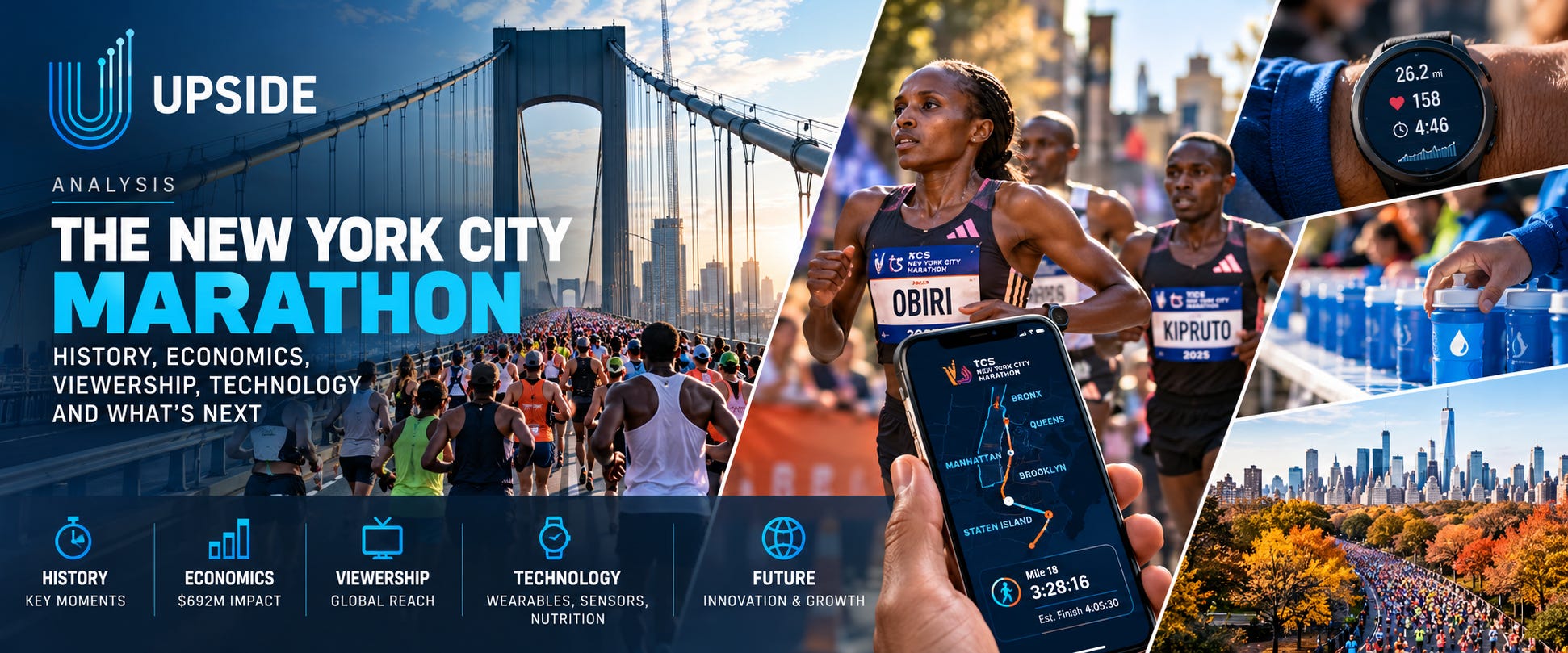
October 2026 | Sports Business, Sports Science & Technology

Introduction
Every year, on the first Sunday of November, New York City becomes the stage for one of the world’s most iconic sporting events: the TCS New York City Marathon.
What started in 1970 as a relatively small running event in Central Park has evolved into a global phenomenon attracting elite runners, recreational athletes, sponsors, broadcasters, technology companies and millions of spectators.
The numbers illustrate its extraordinary growth.
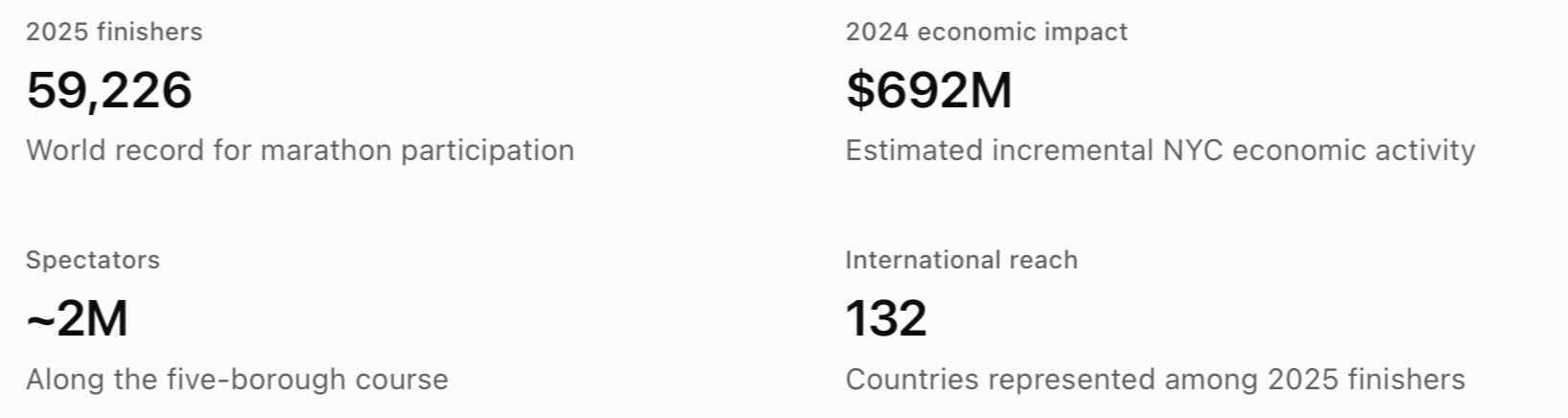
Sources: NewYork Road Runners’ 2025 race results and FY 2025 economic impact study.
But beyond the impressive participation numbers, the NYC Marathon represents something much bigger.
It is a major tourism engine, a global marketing platform, a showcase for endurance innovation and a real-world environment where emerging sports technologies can be tested.
For Upside, the marathon is particularly interesting because it sits at the intersection of several rapidly evolving industries: sports science, wearable technology, biomechanics, nutrition, artificial intelligence, digital broadcasting and athlete health.
The 2026 edition, scheduled for Sunday, November 1, also marks the 50th anniversary of the marathon’s historic move to a five-borough course in 1976.
This analysis examines how the marathon became a global sporting institution, the economic value it generates, its media reach, the growing influence of technology and the opportunities that could shape its future.
Key Moments in New York City Marathon History
The NYC Marathon’s evolution is a remarkable story of vision, innovation, internationalization and resilience.
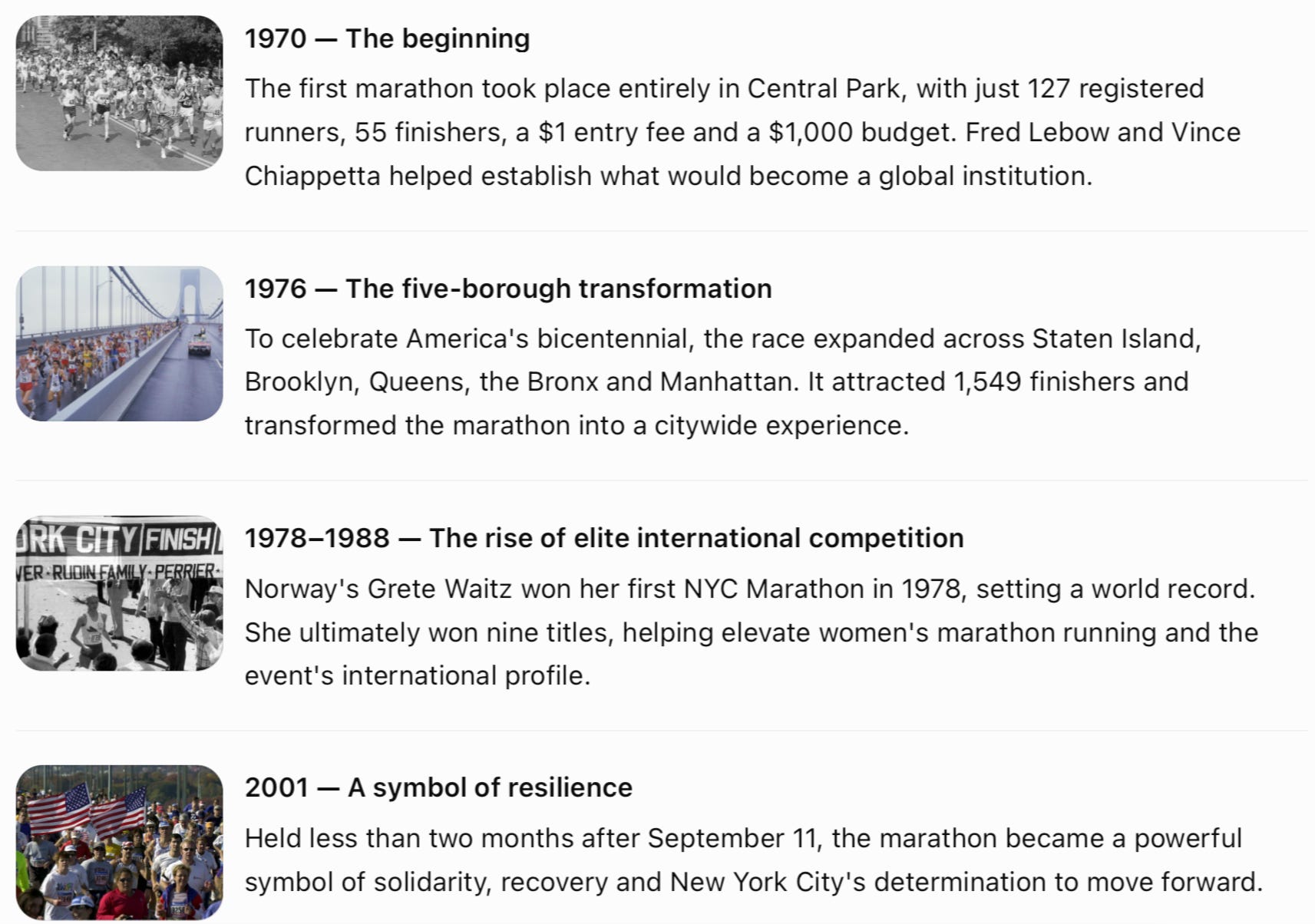
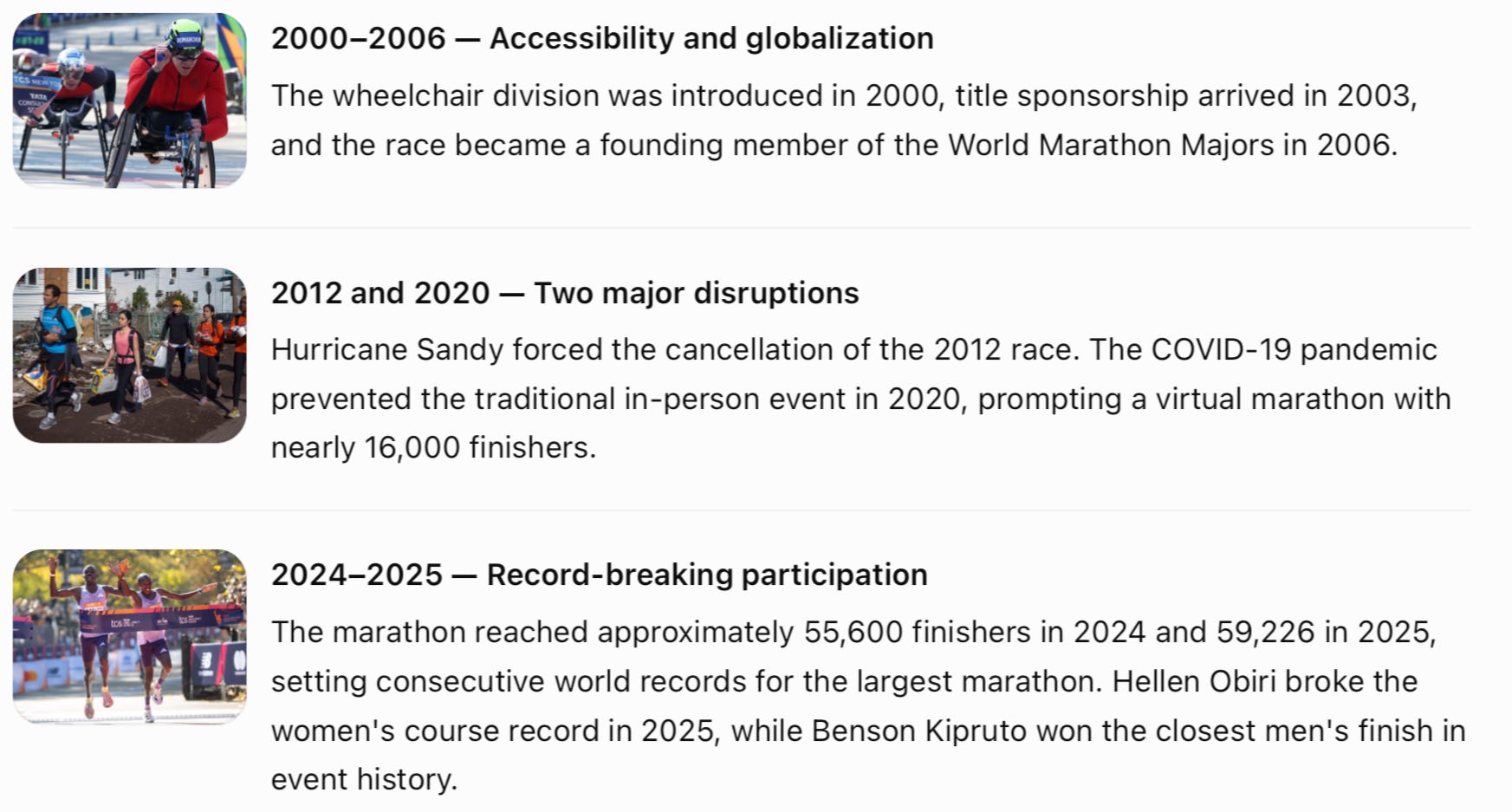
Historical milestones documented by NewYork Road Runners.
The growth of the NYC Marathon
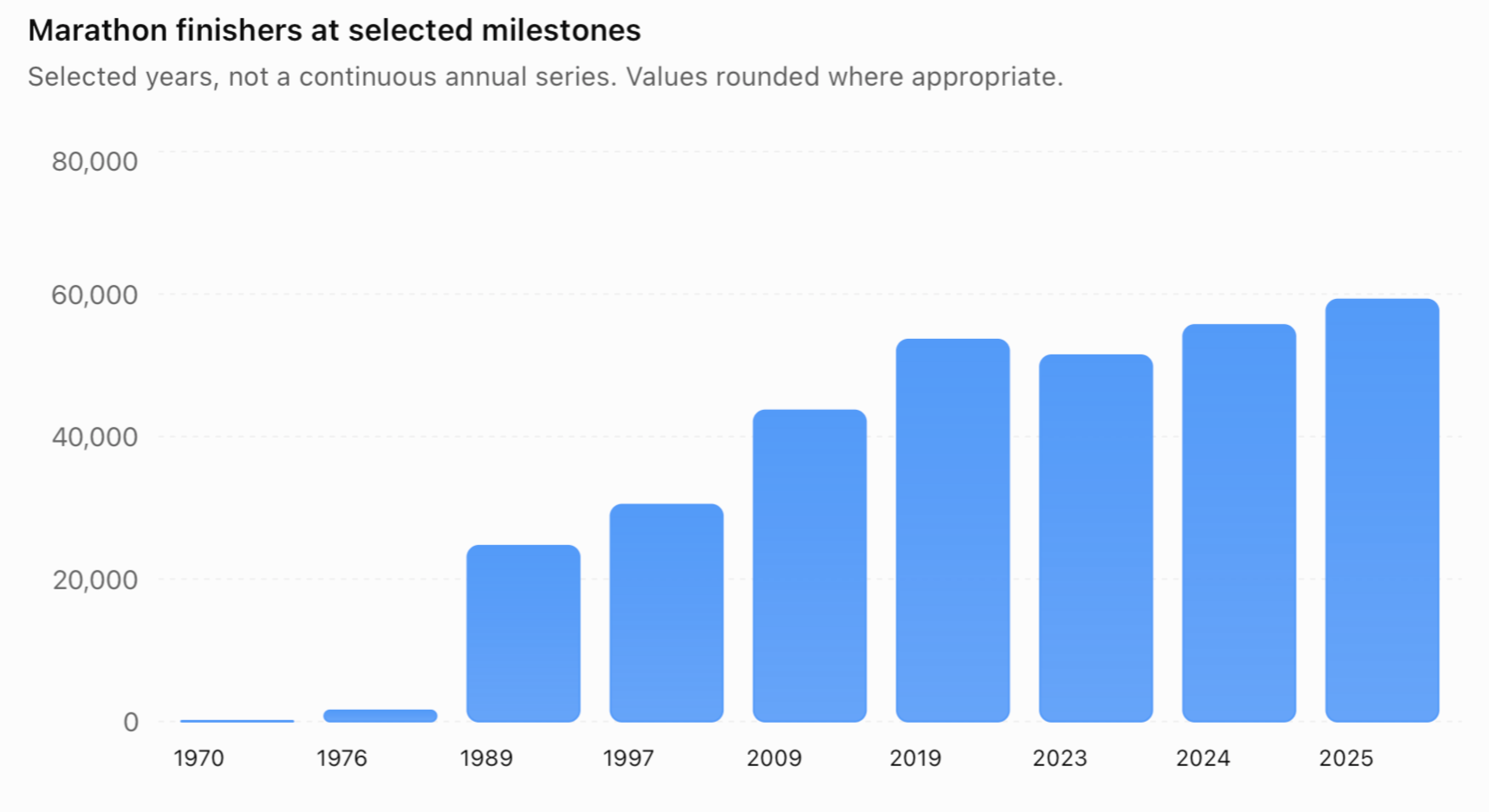
The marathon’s growth has been driven by more than running participation. Its five-borough identity, international appeal, strong organization and ability to connect ordinary runners with elite athletes have created a distinctive sports property.
Unlike most professional sporting events, the marathon allows thousands of paying participants to become part of the event itself.
That is a powerful differentiator.
The Economics of the New York City Marathon
The NYC Marathon is not simply a sporting competition. It is one of the city’s most important annual sports-tourism events.
Its economic model is particularly interesting because the event generates spending across multiple sectors, including hospitality, transportation, retail, food services, tourism and sports equipment.
1. A $692 million economic engine
According to the economic impact study released by New York Road Runners (NYRR) in September 2025, the 2024 NYC Marathon generated approximately $692 million in incremental economic impact, an increase of 139% compared with 2019.
The broader NYRR portfolio of races generated approximately $934 million in citywide economic activity in fiscal year 2025. The marathon’s impact is included in that total, rather than being additional to it.
Where marathon visitors spent their money
2024 NYC Marathon | Selected out-of-town spending categories, USD millions
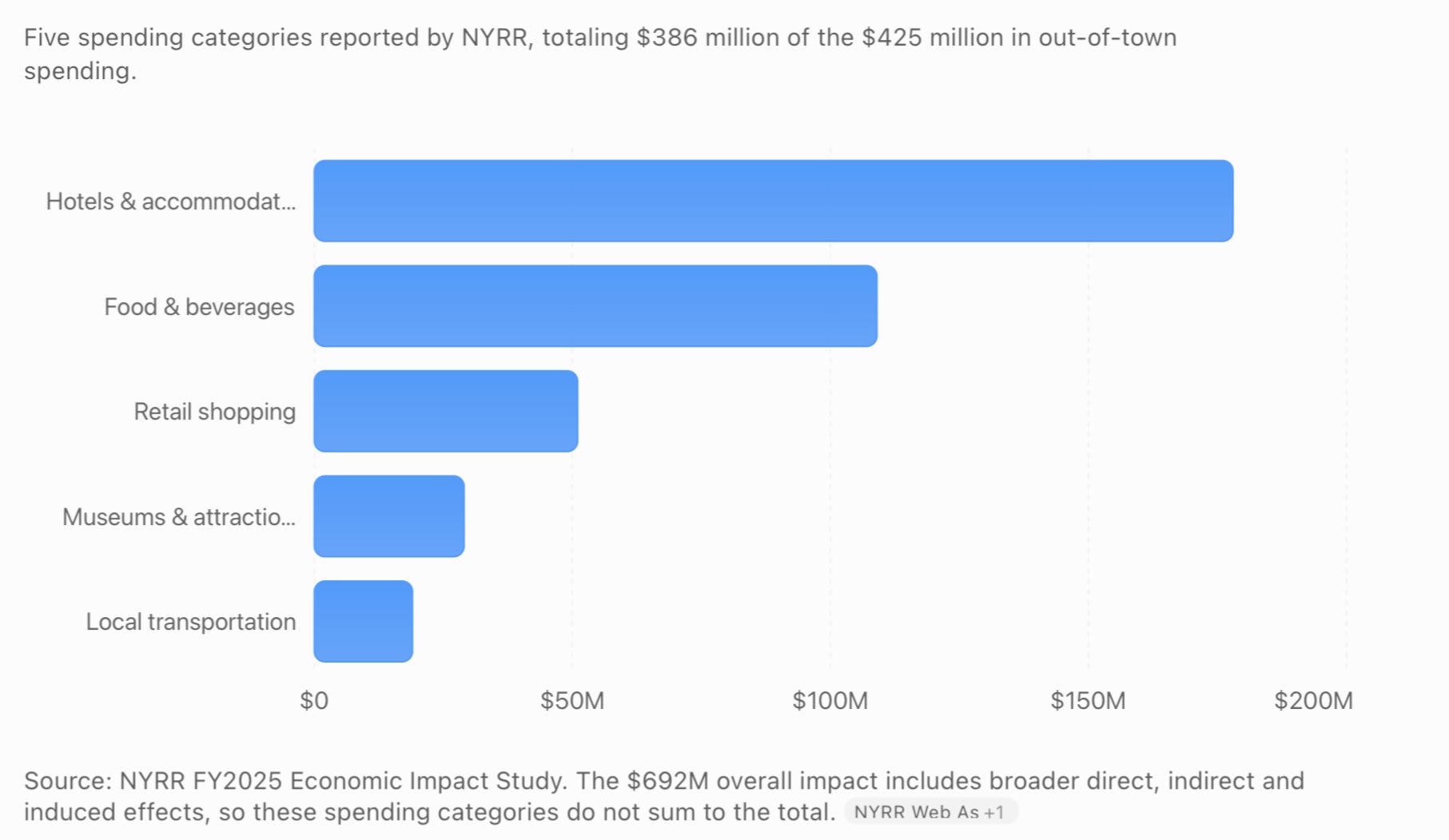
Hotel spending alone reached $178 million, while restaurants and food businesses benefited from an estimated $109 million.
This illustrates why the marathon matters far beyond the sports industry. It creates demand for hotel rooms, restaurants, retail stores, local transportation and tourist attractions.
For New York City, it is an opportunity to attract visitors who might otherwise travel elsewhere.
2. A diversified business model
The event also operates within a broader commercial ecosystem supported by several revenue and funding channels.
Race registrations: Participants pay to enter through eligible entry pathways, with substantial demand for a limited number of places.
Corporate sponsorships: TCS holds the title sponsorship, while brands across apparel, nutrition, mobility, healthcare and other categories support the event.
Media rights and partnerships: Television and digital distribution provide global brand exposure and commercial value.
Merchandising and the race expo: Running shoes, apparel, watches, nutrition products and commemorative merchandise create sales opportunities.
Charitable fundraising: Official charity entries connect participation with fundraising for nonprofit organizations.
These are distinct revenue or funding mechanisms. Public information does not establish how much each contributes to NYRR’s marathon-specific operating budget.
3. The importance of sponsors
New York City Marathon 2024 Event Calendar | Hypebeast

Unlike traditional sports sponsorships, where fans primarily watch professional athletes, marathon sponsors can become part of the participant’s preparation and race-day experience.
A hydration brand might provide products at aid stations. A technology company can power the tracking application. A healthcare organization can support recovery services.
That creates opportunities for meaningful product engagement rather than simply logo visibility.
4. The charity economy
Another major component is fundraising.
NYRR’s official charity programs enable participants to raise money for approved nonprofit organizations in exchange for guaranteed-entry opportunities, subject to fundraising commitments.
For the 2026 marathon, NYRR has set a goal of raising $100 million through its Official Charity Partner Program, which is celebrating its 20th anniversary. This is a fundraising target, not an amount already raised.
The combination of athletic achievement, community involvement and charitable fundraising makes the marathon an unusual hybrid of professional sport and mass participation.
5. The wider economic implications
From a sports business perspective, the NYC Marathon demonstrates that a major sporting event does not need a stadium, franchise ownership model or traditional ticketing structure to generate substantial economic value.
Its participants are simultaneously athletes, customers, tourists, content creators and ambassadors.
However, economic impact should not be confused with event profit. The $692 million figure represents modeled incremental activity across the city, not revenue retained by NYRR. Event operating costs, public services, disruption to businesses and the distribution of economic benefits also matter when evaluating its net contribution.
Television Viewership, Global Reach and Media Evolution
The NYC Marathon is one of the most unusual broadcasting properties in sports.
Unlike an NFL or NBA game, the marathon unfolds across 26.2 miles, with tens of thousands of participants competing simultaneously and different stories developing across the course.
Broadcasters must capture the elite men’s and women’s competitions, wheelchair racing, mass participation and the atmosphere of the five boroughs.
1. The marathon’s global broadcasting footprint
According to NYRR’s October 26, 2026 announcement, this year’s marathon will be distributed to nearly 500 million television households across more than 160 countries and territories.

Important distinction: This is potential household reach through broadcast distribution, not the number of people who actually watch the event.
International distribution partners include Eurosport, Fox Sports Australia, TSN in Canada, L’Équipe in France, TV Asahi in Japan and several other broadcasters.
That reach is particularly valuable for global sponsors interested in markets beyond the United States.
2. Television and streaming coverage
For the 2026 race, the announced U.S. schedule includes:

3. What do we know about actual viewership?
This is where it is important to separate three different measurements.
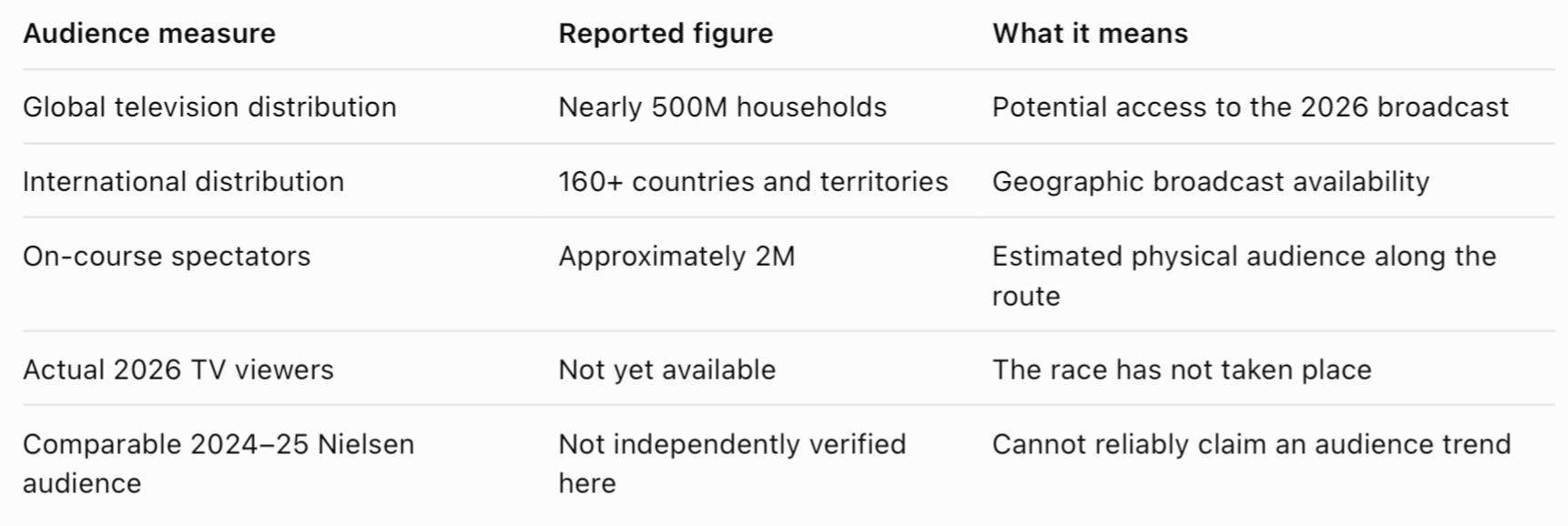
NYRR and ESPN provide extensive broadcast distribution information, but I could not verify a comparable series of audited television audience totals for recent editions from the sources reviewed.
Consequently, it would be misleading to suggest that 500 million people watch the race.
The event’s commercial reach is significant, but the distinction between potential distribution, actual television viewersand digital engagement matters.
4. Digital audiences are changing the experience
The marathon is particularly well positioned to benefit from digital engagement.
Families and friends often care more about following a specific participant than watching the elite race from beginning to end.
Through the official NYRR app, spectators can track individual runners, monitor their progress, access live race coverage and follow leaderboards.
TCS has previously described its marathon app infrastructure as supporting approximately half a million users, alongside bib tracking and multiple live camera feeds. That figure is a technology-platform scale reference, not an independently audited 2026 live audience total.
Tata Consultancy Services
This is an important development for sponsors and broadcasters.
The future media experience may increasingly combine traditional race coverage with personalized digital experiences in which fans follow the athletes who matter most to them.
5. Opportunities for future broadcasting
Several technologies could further transform marathon coverage:
Personalized streams showing a runner’s progress, estimated finish time and relevant camera views.
AI-generated race highlights for individual runners and their supporters.
More advanced live analytics, including pacing trends, gaps between elite runners and projected finishing times.
Interactive sponsor experiences integrated into official race applications.
These are future opportunities rather than confirmed features of the 2026 broadcast.
For Upside, this illustrates how AI and data visualization could make endurance events more engaging for audiences who traditionally have limited ways to follow the action.
The Impact of Technology on the NYC Marathon

One of the most interesting aspects of the NYC Marathon is how it has become a platform for sports technology innovation.
Over the past two decades, the preparation and racing experience of marathon runners has changed significantly.
Today, athletes can measure their training loads, monitor heart rate, evaluate sleep, analyze running biomechanics, optimize fueling strategies and receive real-time feedback from connected devices.
Technology is also transforming race operations, spectator engagement and sustainability.
1. Wearables: From basic watches to advanced athlete monitoring
GPS watches and connected wearables have become increasingly important tools for marathon preparation.
Companies such as Garmin, COROS, Polar, WHOOP and Apple offer products that help runners monitor aspects of training and recovery.
The most relevant applications include:
Training-load monitoring: Tracking running distance, duration, pace, heart rate and estimated training stress.
Recovery monitoring: Evaluating sleep, resting heart rate, heart rate variability and subjective readiness.
Race execution: Using GPS pacing, lap splits and heart-rate information to manage effort across 26.2 miles.
For elite athletes, these data can complement coaching observations and laboratory testing. For recreational runners, they make some aspects of structured endurance training more accessible.
However, not all wearable metrics have the same level of scientific validation. Estimates of fatigue, recovery or injury risk should not be treated as definitive physiological measurements.
2. Biomechanics and smart sensors
Running biomechanics is another area where technology could make a significant difference.
Traditional gait analysis often requires specialized laboratory equipment, force plates and high-speed cameras.
Today, wearable sensors, pressure-sensitive insoles and computer-vision technologies are creating opportunities to collect movement data outside the laboratory.
Potential applications include measuring cadence, ground-contact characteristics, foot-pressure distribution, movement asymmetry and changes in running mechanics during fatigue.
For a marathon runner, understanding how biomechanics change between the first and last 10 kilometers could be particularly valuable.
Imagine comparing an athlete’s movement at mile 5 with their movement at mile 22.
Does their cadence change? Does their loading pattern become less symmetrical? Are they maintaining their normal running mechanics as fatigue develops?
These questions create opportunities for sports technology companies developing smart insoles, wearable motion sensors and AI-powered movement-analysis systems.
The opportunity: Better understand individual running mechanics and potentially improve training decisions.
The limitation: A biomechanical difference does not automatically indicate an injury risk, and reliable outdoor measurements require validation.
3. Advanced footwear and carbon-plated running shoes
Perhaps no technology has attracted more attention in elite marathon running than modern racing footwear.

Where should governing bodies draw the line between legitimate innovation and an unfair technological advantage?
Footwear regulations now form an important part of the competitive landscape, making compliance a consideration for elite athletes and equipment manufacturers.
Looking ahead, more individualized footwear design, 3D printing and data-informed shoe selection could become important areas of development.
4. Hydration, sports drinks and fueling technologies
Hydration and carbohydrate fueling are critical elements of marathon performance.
As athletes compete over several hours, they must manage fluid intake, carbohydrate availability and gastrointestinal tolerance.
The NYC Marathon offers a useful example of how nutrition science has become integrated into event operations.
NYRR’s race guidance identifies Gatorade and water stations throughout the course, along with Maurten energy-gel stations at miles 12 and 18.

The opportunities for sports technology extend beyond conventional sports drinks.
Emerging areas include sweat-sensing technologies, hydration assessment, individualized sodium and carbohydrate strategies, and AI-assisted nutrition planning.
For example, a runner might use information about expected weather, sweat rate, gastrointestinal tolerance and target race duration to prepare a personalized fueling plan.
However, sweat sensors and hydration algorithms still require careful validation. They should not be assumed to provide precise, individualized hydration prescriptions without supporting evidence.
5. Race timing, sensors and athlete tracking
Technology also plays a major role in organizing the marathon itself.
The 2025 event used 57 ChronoTrack timing systems across race operations, including timing locations along the course and key logistical checkpoints.
These systems help generate official timing data, which can be integrated into results platforms and spectator applications.
For 2026, the official NYRR app provides runner tracking, leaderboards, live professional race feeds and event information.
This is an important distinction: runner tracking through timing checkpoints and predictive software is not necessarily the same as continuous GPS tracking of every participant.
For organizers, the potential benefits include better visibility into participant progress, improved operational coordination and more personalized spectator experiences.
6. Sustainability and hydration innovation
One of the most interesting developments for 2026 is the introduction of new water-refill stations.
NYRR has announced a partnership with Culligan to provide filtered self-service refill locations at miles 8, 14, 17, 20 and 23, complementing 25 traditional fluid stations.
The organization is also working with HydraPak on reusable hydration products.

This reflects a broader trend in endurance sports: organizers are increasingly exploring ways to improve participant services while reducing the environmental footprint of large-scale events.
The challenge is balancing sustainability with accessibility, safety and convenience for tens of thousands of runners.
The Future of the New York City Marathon
The next decade could bring significant changes to how runners prepare, compete and experience the NYC Marathon.
In my view, six trends deserve particular attention.
1. The rise of personalized marathon preparation
Today, runners have access to large amounts of data, but translating that information into meaningful training decisions remains difficult.
AI-powered training systems could increasingly combine GPS running data, training history, sleep, heart rate, race goals and athlete feedback to recommend individualized training adjustments.
The biggest opportunity is not simply collecting more information. It is making training guidance more useful and accessible.
At the same time, these systems must account for uncertainty, medical considerations and the limitations of consumer wearable data.
2. More advanced sports science
I expect more research into the relationship between endurance training, muscle fatigue, biomechanics, nutrition and recovery.
Particularly interesting areas include how individual runners respond to comparable training loads, how fatigue changes movement mechanics and whether emerging physiological measurements provide useful information beyond conventional monitoring.
Universities, research laboratories and sports technology companies could collaborate to investigate these questions using large, carefully designed studies.
3. The marathon as a living laboratory for innovation
With nearly 60,000 finishers in 2025, the NYC Marathon offers access to an exceptionally diverse running population.
That creates potential opportunities for observational research and voluntary product evaluations involving different ages, performance levels, training histories and running styles.
Possible areas of investigation include wearable accuracy, running economy, hydration strategies, footwear comfort, movement analysis and post-race recovery.
For sports tech startups, the marathon could be an attractive environment for product research, provided organizers and researchers address consent, data privacy, scientific quality and participant safety.
4. The evolution of the digital fan experience
I believe one of the largest opportunities is in personalized broadcasting.
Imagine opening the marathon app and following five friends simultaneously, with their estimated finishing times, pacing trends, course positions and relevant camera feeds.
Or imagine an AI-generated video after the race showing a runner’s progress through the five boroughs, combining timing data with available event footage.
For sponsors, this could create new forms of digital engagement beyond conventional broadcast advertising.
For participants, it could make the experience even more memorable.
5. Sustainability will become a major priority
Large endurance events generate substantial logistical and environmental demands.
Transportation, waste, water distribution, apparel and event infrastructure all contribute to the overall footprint.
NYRR has set a goal of reaching net-zero emissions by 2040 and is expanding reusable hydration initiatives for the 2026 event.
Future innovations could include lower-waste aid stations, more sustainable race materials, improved transportation planning and better measurement of event emissions.
The challenge will be demonstrating measurable environmental improvements rather than relying on sustainability marketing alone.
6. Continued growth — but with operational limits
The NYC Marathon has experienced extraordinary participation growth, but further expansion is not unlimited.
Road capacity, medical resources, start-wave logistics, transportation and the impact on local communities all place constraints on the number of participants.
Future growth may therefore come as much from digital participation, international engagement, sponsorship and community programming as from increasing the number of runners on the streets.
The event’s ability to maintain a safe, high-quality experience will be more important than pursuing participation records every year.
Recommendations for Sports Technology Companies and Event Organizers
From Upside’s perspective, the NYC Marathon presents opportunities for startups, established technology companies, researchers and sports organizations.
I would prioritize three areas.
1. Develop technologies that solve real problems for runners.
Rather than introducing another dashboard with dozens of metrics, companies should focus on practical questions: How can a runner train more effectively? How can they manage fueling? How can they understand recovery? How can technology improve the race-day experience?
Products should demonstrate reliable measurements and meaningful benefits.
2. Build stronger collaborations between researchers, brands and event organizers.
The marathon could support carefully designed studies involving biomechanics, nutrition, wearable accuracy and endurance performance.
Partnerships with universities and sports science laboratories could help establish which innovations genuinely benefit runners.
3. Invest in personalized digital experiences.
Race organizers have an opportunity to turn tracking data into better experiences for athletes, families, broadcasters and sponsors.
AI, data visualization and connected applications could create substantial value, provided privacy, accessibility and reliability remain priorities.
Conclusion: More Than a Marathon
The New York City Marathon has evolved into one of the most remarkable sporting events in the world.
What began with 55 finishers in Central Park in 1970 has become an international event with nearly 60,000 finishers, millions of roadside spectators and an estimated $692 million economic impact in its 2024 edition.
Its influence extends well beyond competitive running.
The marathon supports New York City’s economy, attracts global brands, connects communities, raises money for charitable causes and provides a platform for technological innovation.
For me, one of the most exciting aspects is the role that sports science and technology could play in its future.
We are seeing significant innovation in wearables, advanced footwear, running biomechanics, nutrition, hydration and AI-powered athlete monitoring.
Some technologies are already changing how runners prepare and compete. Others remain at an early stage and require more scientific validation.
At Upside, we believe the next major opportunity in endurance sports will come from combining better technology with better scientific understanding and more personalized athlete experiences.
The future of the NYC Marathon is not simply about attracting more runners or breaking more records.
It is about making the event safer, more engaging, more sustainable and more accessible while helping athletes at every level prepare and perform more effectively.
And that is what makes the New York City Marathon such a fascinating event to follow.