

Introduction: From Playing the Game to Owning the Business
For decades, professional athletes generated enormous value for sports franchises through their performances, global influence, and commercial appeal. Yet most of the financial benefits associated with the long-term appreciation of these franchises went to team owners rather than the athletes themselves.
That dynamic is beginning to change.
Some of the world’s most recognizable athletes, including Tom Brady, LeBron James, Michael Jordan, David Beckham and Serena Williams, have moved beyond endorsement agreements and traditional business investments to acquire ownership interests in professional sports teams.

This shift reflects a broader transformation in the sports industry.
Athletes are increasingly viewing team ownership as an opportunity to build long-term wealth, diversify their investments, strengthen their personal brands, and remain influential in sports after retirement.
At the same time, team owners and investment groups recognize the strategic value that high-profile athletes can bring to a franchise through their global audiences, commercial relationships, competitive experience, and ability to attract sponsors.
The trend also coincides with rising franchise valuations, increasing institutional investment in professional sports, and growing interest in women’s sports, emerging leagues, and international soccer.
The key question is no longer simply how much athletes can earn during their playing careers, but how much value they can create and retain through ownership after those careers end.
This analysis examines why athletes are becoming team owners, the most notable investments, examples of financial and strategic success, and how this trend could reshape the future of professional sports.
Why Are Athletes Investing in Professional Teams?
There are several reasons why athletes are increasingly transitioning from players to franchise owners.
A. Long-term wealth creation
Professional sports franchises have become highly desirable investment assets.
While player salaries and endorsement contracts generate substantial income, franchise ownership offers exposure to long-term enterprise value appreciation.
For example, Michael Jordan acquired control of the Charlotte Bobcats, now the Hornets, in 2010 when the franchise was valued at approximately $275 million. In 2023, he sold his majority stake in a transaction reportedly valuing the franchise at approximately $3 billion.
This illustrates the wealth-building potential of ownership, although the increase in franchise valuation should not be confused with Jordan’s actual investment return, which depends on his ownership percentage, subsequent investments, financing, and sale proceeds.
B. Diversifying beyond playing careers
Athletes face relatively short earning careers compared with traditional business executives.
Ownership provides an opportunity to build assets that can generate value for decades.
Rather than relying exclusively on salaries, endorsements, and personal investments, athletes can build portfolios of sports franchises across different leagues and markets.
LeBron James is a notable example, having moved from an initial investment in Liverpool FC to an ownership interest in Fenway Sports Group, exposing him to multiple professional sports businesses.
C. Leveraging personal brands and global audiences
An athlete’s brand can be particularly valuable to a sports organization.
High-profile athletes often bring millions of social media followers, relationships with global sponsors, extensive media exposure, and access to other influential athletes and investors.
For a team seeking to expand internationally, bringing a globally recognized athlete into its ownership group can be an effective commercial strategy.
David Beckham’s involvement in Inter Miami is one of the clearest examples of an athlete whose personal brand has become closely associated with a franchise’s identity and international positioning.
D. Remaining involved in sports after retirement
Many athletes want to remain connected to competition, talent development, and organizational leadership.
Ownership allows them to influence areas such as sporting strategy, recruitment, athlete development, facilities, and organizational culture, depending on their contractual role.
For athletes who spent decades competing at the highest level, this can represent a natural next step.
E. Influencing the future of sports
Athletes are also investing to influence how sports organizations operate.
This can include supporting women’s sports, improving athlete welfare, developing youth academies, modernizing training facilities, and encouraging the adoption of new technologies.
Serena Williams’ investment in Angel City FC illustrates the growing interest among elite athletes in helping build the commercial future of women’s professional sports.
F. Access to exclusive investment opportunities
Historically, professional sports ownership was largely reserved for extremely wealthy individuals and families.
Today, minority ownership structures and investment consortiums make participation possible without requiring an athlete to acquire an entire franchise.
However, league ownership rules, minimum equity requirements, and restrictions on institutional investors continue to influence who can invest and how deals are structured.
Top Athletes Who Have Become Professional Team Owners
The following table highlights some of the most prominent athlete-investors and their sports ownership portfolios.
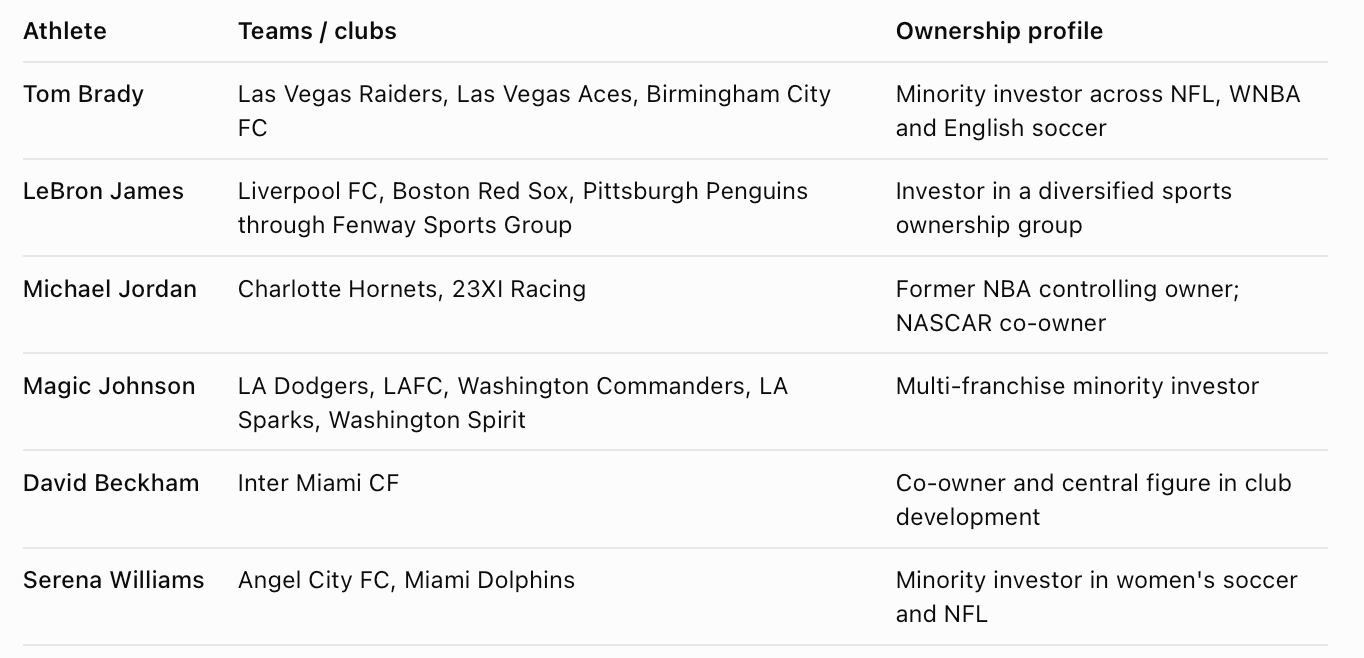
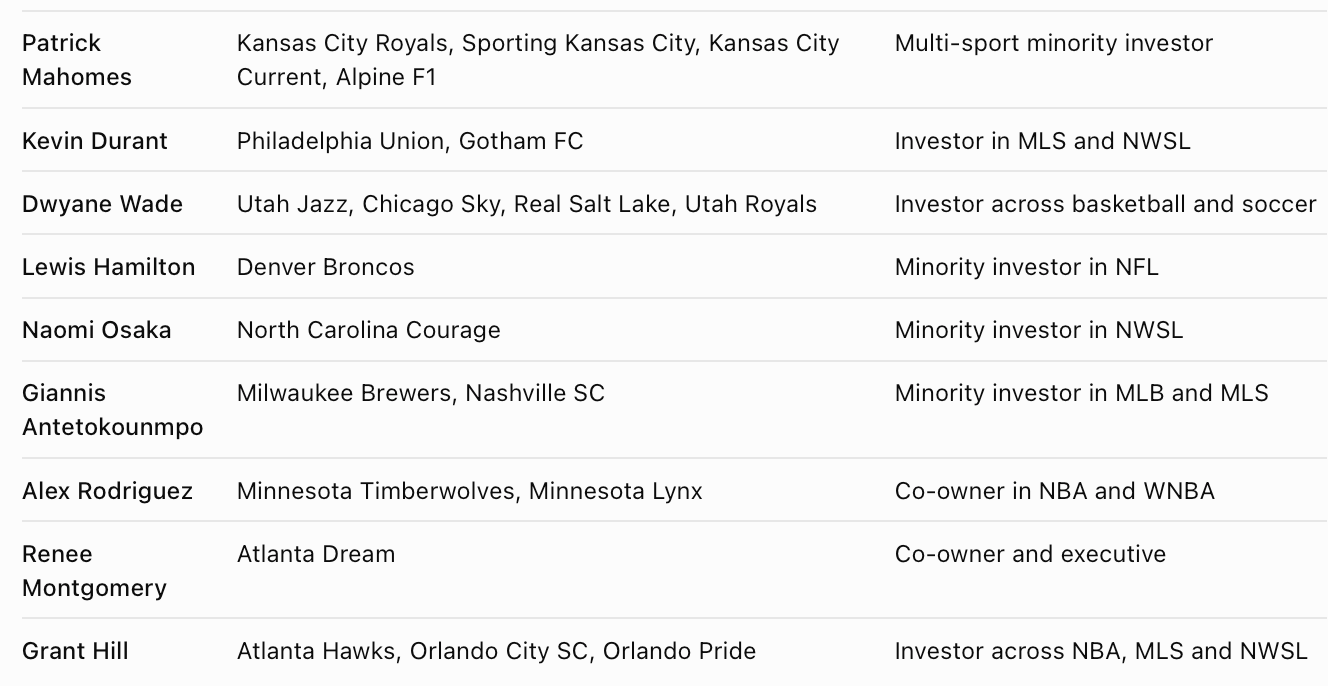
Three trends stand out.
First, athlete ownership is no longer limited to the sport in which an athlete competed. NBA players are investing in soccer, NFL quarterbacks are investing in women’s basketball, and tennis stars are acquiring stakes in football clubs.
Second, the model is expanding internationally. Athletes increasingly view European soccer and Formula One as opportunities to access global audiences and new markets.
Third, women’s sports have become an important investment category, particularly the WNBA and NWSL.
Case Studies: Athletes Who Successfully Transitioned Into Ownership
Case Study 1: Michael Jordan — Charlotte Hornets
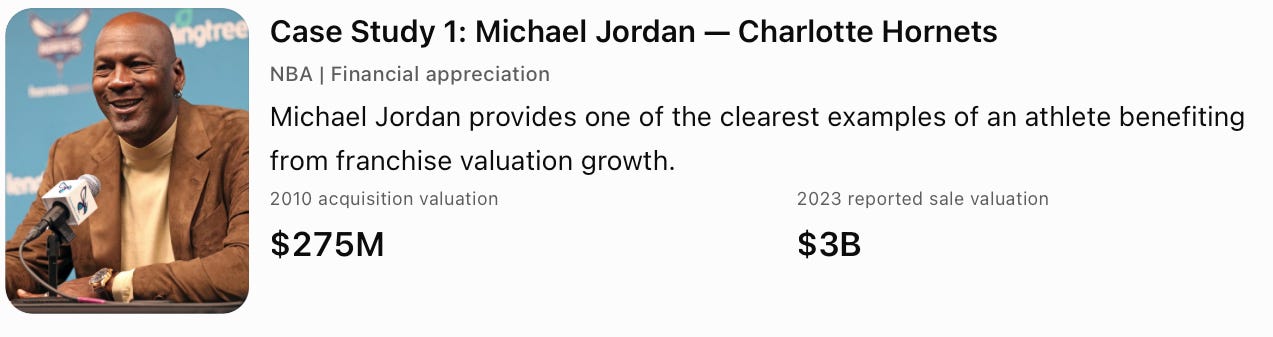
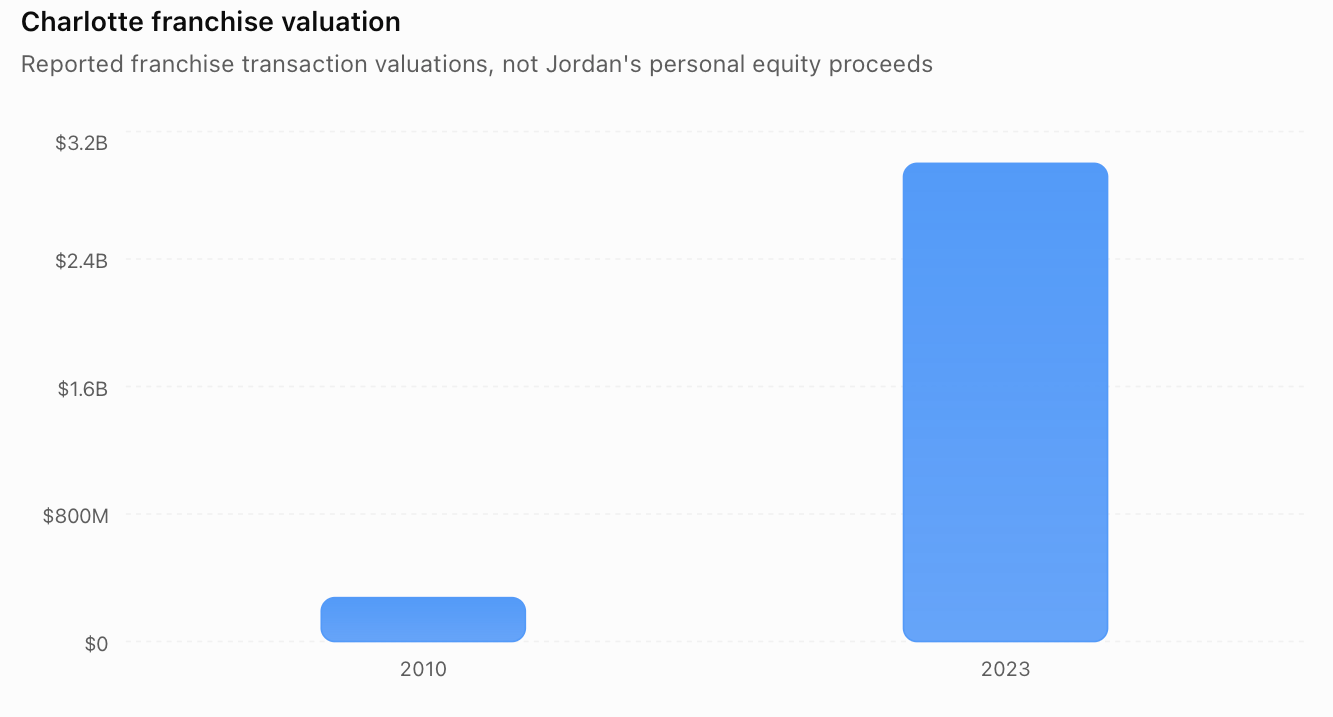
Jordan acquired control of the then-Charlotte Bobcats in 2010 and sold his majority stake in 2023. The reported franchise valuation increased approximately 10.9 times over that period.
However, the team’s basketball performance was considerably less successful. Charlotte did not win a playoff series during his tenure as controlling owner.
Key takeaway: A franchise can deliver substantial financial appreciation even without sustained competitive success. Ownership performance must therefore be evaluated through both financial and sporting outcomes.
Case Study 2: David Beckham — Inter Miami CF

As part of his original MLS agreement, Beckham secured an option to acquire an expansion franchise for $25 million.
Inter Miami began competing in 2020 and subsequently achieved major milestones, including signing Lionel Messi in 2023 and winning its first MLS Cup in 2025.

The club’s rise demonstrates how an athlete’s brand, combined with experienced investors, player recruitment, commercial partnerships, and long-term infrastructure investment, can contribute to building a globally recognized sports property.
The $1.45 billion estimate is the valuation of the entire club, not Beckham’s personal stake or investment return.
Key takeaway: Athletes with global recognition can help build entirely new franchises and accelerate their international visibility, particularly when paired with experienced operational partners.
Case Study 3: Magic Johnson — Los Angeles Dodgers and Multi-Team Ownership
In 2012, Johnson joined the investment group that acquired the Los Angeles Dodgers for approximately $2 billion.
By March 2026, Forbes estimated the franchise’s value at approximately $7.8 billion.

Johnson has also invested in the Washington Commanders, LAFC, Los Angeles Sparks, and Washington Spirit.
His strategy demonstrates the benefits of participating in well-capitalized ownership groups rather than attempting to control every franchise independently.
Key takeaway: A former athlete can become a sophisticated sports investor by partnering with experienced financial operators, diversifying across leagues, and maintaining a long-term investment horizon.
Case Study 4: Mario Lemieux — Pittsburgh Penguins

In 1999, the Pittsburgh Penguins were facing serious financial difficulties. Lemieux, who was owed deferred salary, converted part of that obligation into equity and joined an ownership group that acquired the franchise.
Under Lemieux and Ron Burkle’s ownership, the Penguins achieved three Stanley Cup championships and developed a new arena.
In 2021, Fenway Sports Group agreed to acquire a controlling interest in the franchise in a transaction reportedly worth approximately $900 million.
Reports at the time estimated Lemieux’s proceeds at more than $350 million, while he retained a minority interest.
Key takeaway: Athlete ownership can extend beyond passive investment. Under the right circumstances, an athlete’s competitive knowledge, credibility, and leadership can become part of a successful organizational turnaround.
Case Study 5: Serena Williams — Angel City FC

Angel City developed a distinctive ownership model involving professional athletes, entrepreneurs, entertainment executives, and other investors.
In 2024, a controlling stake was sold to Willow Bay and Bob Iger in a transaction valuing the club at approximately $250 million.
The club also established a strong commercial position through sponsorships, attendance, and brand partnerships.

The transaction provided a significant valuation benchmark for women’s professional soccer, although individual investors’ returns have not been publicly established.
Key takeaway: Women’s sports can offer meaningful growth opportunities for athlete-investors, particularly where strong branding, commercial execution, and expanding fan demand intersect.
Tom Brady: A Different Athlete-Ownership Model

Tom Brady deserves special attention because his ownership strategy is different from simply investing in teams with strong financial prospects.
His investments span three distinct sports properties:
Las Vegas Raiders (NFL): Brady personally acquired a 5% ownership stake, approved in 2024.
Las Vegas Aces (WNBA): He acquired a minority stake in 2023.
Birmingham City FC (English soccer): He became a minority investor in 2023, with an advisory role involving performance, nutrition, wellness, and recovery.
Birmingham City represents an especially interesting case.
Brady’s involvement has been associated with ambitions to improve player development, health, recovery, and global marketing. The club earned promotion back to the Championship in 2025 after winning League One.
However, it would be premature to attribute that sporting success directly to Brady’s ownership or performance advisory role.
Why Brady’s approach matters
Brady is not simply investing in the commercial side of sports. His background in elite performance creates opportunities to contribute to how organizations approach training, recovery, and athlete development.
This raises a broader question:
Could athlete-owners become important drivers of innovation in sports science and performance technology?
Former athletes who understand the demands of elite competition may be particularly well positioned to champion investments in biomechanics, wearable sensors, AI-powered analytics, rehabilitation, and recovery technologies.
But the value they create will depend on whether they help organizations adopt solutions that are scientifically validated and useful to practitioners.
Future Trends: How Athlete Ownership Could Evolve Over the Next 5–10 Years
I expect several developments to accelerate this trend.
Trend 1: More athletes will invest while still competing
Historically, many athletes entered team ownership after retirement.
Today, players such as Patrick Mahomes, Kevin Durant, and Giannis Antetokounmpo have demonstrated that ownership can become part of an athlete’s investment strategy during their active career.
This trend could become more common as athlete salaries, endorsement revenues, and access to sophisticated financial advisers continue to grow.
Trend 2: Athlete ownership and private equity will become increasingly interconnected
Sports investment funds are becoming more prominent participants in franchise ownership.
In 2024, the NFL approved private equity investment in franchises under specific restrictions, including a 10% aggregate team ownership limit for approved funds.
The NBA has also expanded its institutional ownership framework, allowing eligible investment firms to hold interests in up to eight teams as of December 2025.
This creates opportunities for athletes to partner with investment firms, family offices, and institutional investors.
An athlete could contribute capital, commercial relationships, brand recognition, and sporting expertise while a financial partner supplies acquisition financing and operational experience.
However, the financial rights and influence of an athlete-investor will vary significantly from one transaction to another.
Trend 3: Women’s sports will attract more athlete-investors
The growth of the WNBA and NWSL is likely to encourage additional investment from current and former athletes.
Women’s sports franchises may offer opportunities to participate in an earlier stage of commercial development compared with established NFL or NBA franchises.
Athletes could contribute to sponsorship growth, audience development, and increased media visibility.
Angel City FC offers an important example of this approach, although future investment returns remain uncertain.
Trend 4: International soccer will remain a major investment target
European soccer offers opportunities that differ from the North American franchise model.
Athletes can invest in clubs with global audiences, established academies, and potential promotion-related growth.
However, the risks can be substantially greater because of relegation, transfer spending, operating losses, and financial regulations.
Tom Brady’s investment in Birmingham City and other athlete investments in English soccer illustrate growing interest in this market.
Trend 5: Athlete-owners could accelerate sports technology adoption
This is one of the most interesting developments from a sports technology perspective.
As more former athletes acquire ownership stakes, they could influence how clubs approach innovation.
Potential investment priorities include:
AI and performance analytics: Integrating data from multiple systems to support coaching and performance decisions.
Biomechanics and motion capture: Improving movement assessments, technical development, and rehabilitation monitoring.
Wearables and athlete monitoring: Supporting workload management and recovery.
Sports medicine and rehabilitation: Evaluating new technologies that can improve clinical and performance workflows.
Fan engagement: Using AI, digital platforms, and personalized experiences to develop new revenue opportunities.
Athlete-owners may also become investors in sports technology startups, creating potential partnerships between the companies in their portfolios and the franchises in which they hold equity.
There are important governance considerations, however. Any startup investment or vendor partnership involving an owner should be evaluated for conflicts of interest, scientific validity, data protection, and procurement fairness.
Trend 6: Athletes could build multi-club ownership portfolios
Another potential development is the emergence of athlete-led investment groups acquiring stakes in multiple sports organizations.
Such groups could benefit from shared commercial relationships, centralized technology infrastructure, scouting networks, and cross-club expertise.
This model is already familiar in international soccer through multi-club ownership groups, but athlete-led versions could become more prominent.
The challenge will be balancing financial opportunities with league regulations, competitive integrity, and the operational complexity of managing multiple sports businesses.
What This Means for Sports Technology Startups and Investors
The growth of athlete ownership could create opportunities beyond traditional franchise investments.
Athletes increasingly have three valuable assets: financial capital, industry relationships, and firsthand experience with elite performance.
For sports technology startups, an athlete-owner could potentially become more than a financial investor.
An athlete-owner might help a startup secure introductions to professional teams, provide product feedback, facilitate appropriately governed pilot programs, and develop relationships with commercial partners.
For example, a former NFL player investing in a biomechanics startup could help its management understand the practical requirements of a professional football training facility.
Similarly, an athlete-owner with experience in rehabilitation could help a sports medicine startup identify relevant clinical research partners.
However, access to a famous athlete does not guarantee product-market fit or adoption by a professional team.
The most valuable athlete-investors will likely be those who combine capital and credibility with meaningful operational involvement and access to experienced professionals.
For investors, athlete ownership also raises interesting possibilities around combining sports franchise investments with venture capital investments in sports technology.
This could create ecosystems in which teams, athletes, startups, and investors collaborate to develop and validate new technologies.
Conclusion: The Athlete Is Becoming an Investor, Owner, and Business Builder
The emergence of athlete-owners represents a structural change in professional sports.
For decades, athletes were primarily compensated for their performances and commercial appeal.
Today, a growing number are acquiring equity in the organizations that benefit from the long-term growth of the sports industry.
Michael Jordan demonstrated the potential financial upside of owning an NBA franchise.
Magic Johnson has shown how athletes can build diversified ownership portfolios across major professional leagues.
David Beckham helped establish a globally recognized soccer franchise in Miami.
Mario Lemieux demonstrated how an athlete could play an important role in a franchise turnaround.
And Tom Brady is pursuing an ownership strategy that spans multiple sports, with particular interest in performance, recovery, and organizational development.
These examples also show that not all athlete ownership investments are equally successful. Financial appreciation, competitive success, governance influence, and measurable commercial contributions should be assessed separately.
Looking ahead, I expect athlete ownership to expand through minority investments, partnerships with institutional capital, investment in women’s sports, and international expansion.
For the sports technology industry, this trend could create a new category of influential investors who understand the needs of professional athletes and sports organizations.
My prediction is that over the next five to ten years, we will see more elite athletes building investment portfolios that combine professional sports franchises, sports technology startups, media businesses, and other sports-related assets.
The next generation of sports superstars may not simply be remembered for the championships they won.
They may also be remembered for the franchises they helped build, the companies they invested in, and the innovations they brought into professional sports.
The future of elite sports may increasingly be shaped by the athletes who become its owners.
You may also like:
💸 🏃Upside Analysis: Billionaire athletes club

Over the last decade, due to the emergence of bigger sponsorship deals, we have seen the emergence of a billionaire athletes club with pro athletes reaching the $1B mark in cumulative earnings. Those include Michael Schumacher ($1B), Jack Nicklaus ($1.15B), Arnold Palmer ($1.35B), Michael Jordan ($1.7B), Tiger Woods ($1.65B), Floyd Mayweather ($1B).
Upside Analysis: The Top 52 Sports Tech Investors (VCs, Family Offices)

In the past 10 years we have worked with some of the most prevalent sports tech investors (VCs, family offices, angel investors..) out there. We have essentially brought deal flow to those investors on a regular basis. Investors are always looking for sports tech startups to invest in. They are looking to invest in startups led by experienced founders, …