

November 21–22, 2026 | Sports Business, Technology & Human Performance
Introduction: Four Sporting Events, Four Different Business Models
This weekend offers an interesting opportunity to examine how professional sports are evolving across four major markets: Formula 1’s Las Vegas Grand Prix, the NFL’s Sunday Night Football matchup between the Minnesota Vikings and San Francisco 49ers in Mexico City, Major League Soccer’s playoffs, highlighted by Inter Miami against Columbus Crew, and the NWSL Championship between Washington Spirit and Kansas City Current.
Although these competitions operate under different economic structures, they share several important characteristics. All four are increasingly influenced by media rights, premium sponsorships, international expansion, technology-driven fan engagement, and the growing importance of data analytics. At the same time, teams and athletes are relying more heavily on advanced performance monitoring, artificial intelligence, biomechanics, and recovery technologies to gain a competitive advantage.
The Las Vegas Grand Prix illustrates how Formula 1 has transformed a sporting competition into a global entertainment and tourism property. Sunday Night Football demonstrates the NFL’s ability to monetize premium live content while expanding internationally, while the MLS playoffs highlight the opportunities and challenges facing a soccer league seeking to build a stronger domestic and international audience following the 2026 FIFA World Cup.
Meanwhile, the NWSL Championship highlights the rapid commercialization of women’s professional sports, driven by growing investment in club infrastructure, media rights, sponsorships, and athlete development. It also underscores the increasing importance of sports science and performance technology specifically designed to address the needs of female athletes, particularly in injury prevention, rehabilitation, and recovery.
Beyond the sporting results, these four events provide valuable insights into the future of sports economics, technology adoption, and elite athlete performance. They also demonstrate how leagues, teams, investors, and sports technology companies are adapting to an industry where commercial innovation, global audience development, and data-driven decision-making are becoming essential to long-term success.
1. Formula 1 Las Vegas Grand Prix: The Evolution of Sports Into Global Entertainment

The Las Vegas Grand Prix is one of the most ambitious examples of combining professional sports with entertainment, hospitality, and destination tourism. Unlike traditional racing circuits, the event takes place on a temporary street circuit incorporating the famous Las Vegas Strip, turning one of the world’s most recognizable entertainment districts into a global motorsports venue.
The 2026 race is particularly interesting because Formula 1 is navigating a new technological era, including major changes to power-unit and aerodynamic regulations. It also provides an opportunity to evaluate how Formula 1’s expanding relationship with Apple could transform the viewing experience for American audiences.
Key moments in history
Las Vegas first hosted Formula 1 in 1981 and 1982, when races took place on a temporary circuit in the parking lot of Caesars Palace. The event was discontinued after two editions, but Formula 1 returned to the city in November 2023 after more than four decades.
The modern Las Vegas Grand Prix immediately became a major commercial property. Max Verstappen won the inaugural 2023 race, demonstrating Formula 1’s ability to create a premium sporting spectacle in the heart of a major entertainment destination.
The 2026 edition marks another significant chapter. Apple is now the U.S. home of Formula 1, while the championship is operating under a new technical framework. The race provides an opportunity to evaluate how the latest regulations are influencing competition and how new broadcasting arrangements could expand the sport’s American audience.

The Las Vegas Grand Prix has become one of the city’s most important annual sporting events. Its economic contribution extends beyond ticket sales to hotel bookings, restaurants, casinos, luxury hospitality, transportation, corporate entertainment, and sponsorship activation.
The inaugural 2023 race was estimated to have generated approximately $1.5 billion in economic impact, while the 2024 edition generated approximately $934 million, according to event-related economic studies. The 2024 analysis also estimated approximately $45 million in tax revenue and thousands of jobs supported by race-related activity.
These figures illustrate the potential economic scale of destination-based sporting events, although they should not be confused with organizer revenue or profit. The economic benefits must also be considered alongside infrastructure investments, road closures, operational expenses, and disruption to local businesses.
From a commercial perspective, Formula 1 is increasingly positioning its major races as luxury entertainment destinations rather than conventional sporting competitions. Las Vegas demonstrates how a sporting event can generate value across hospitality, tourism, media, sponsorship, and premium fan experiences.
Impact of technology
Formula 1 has historically been one of the most technology-intensive sports, with teams investing heavily in aerodynamics, computational fluid dynamics, simulation, telemetry, and engineering optimization.
The 2026 regulations place additional emphasis on energy management, hybrid power units, and active aerodynamics. These changes require teams to reconsider how they optimize performance, manage electrical energy deployment, and balance straight-line speed against cornering efficiency.
Technology is also transforming the broadcasting experience. Apple’s U.S. Formula 1 coverage includes multiple live feeds, driver tracking, real-time timing information, and personalized viewing features. This represents an important evolution from traditional television broadcasts toward more interactive and data-rich experiences.
From a sports performance perspective, Formula 1 provides an interesting laboratory for monitoring human performance under demanding conditions. Drivers must manage physical fatigue, heat exposure, hydration, cognitive workload, and reaction times while operating vehicles at extremely high speeds.
Potential areas for innovation include physiological monitoring, driver fatigue analysis, predictive race strategy, and AI-assisted simulation.
Future trends
AI-driven race strategy: Advanced predictive models could improve tire management, energy deployment, and pit-stop decisions.
Personalized broadcasting: Fans will increasingly expect customized camera angles, live telemetry, and interactive race information.
Premium hospitality: Luxury experiences and corporate partnerships will remain important commercial growth opportunities.
Sustainability: New power-unit regulations and sustainable fuel technologies will shape engineering investment.
Destination-based events: Formula 1 will continue exploring how races can generate economic value for host cities beyond ticketing.
The central business question is whether Formula 1 can sustain the Las Vegas Grand Prix’s premium commercial positioning while delivering consistent economic benefits to the host city.
2. NFL Sunday Night Football: Vikings vs. 49ers — The International Expansion of America’s Most Valuable Sports League

The matchup between the Minnesota Vikings and San Francisco 49ers is particularly significant because it represents the first international Sunday Night Football game. Rather than taking place in Minnesota or San Francisco, the game will be played in Mexico City, illustrating the NFL’s broader strategy of expanding its international audience and transforming American football into a more global entertainment property.
The matchup also carries sporting significance, with both teams competing for playoff positioning. Beyond the outcome, the event provides an opportunity to evaluate how the NFL’s most valuable television properties can be exported internationally while maintaining the competitive and operational standards expected by its teams.
Key moments in history
The NFL’s international expansion has developed over several decades. One of the most important milestones came in 2005, when the Arizona Cardinals and San Francisco 49ers played a regular-season game in Mexico City, demonstrating the potential demand for NFL football outside the United States.
The league subsequently launched its International Series in London in 2007, establishing a recurring international presence that has expanded into additional markets.
Another major milestone came in 2006, when NBC began broadcasting Sunday Night Football. The program subsequently became one of the most valuable properties in American television, consistently attracting large audiences and commanding premium advertising rates.
This weekend’s game combines those developments: the NFL’s international expansion and the commercial strength of its premier Sunday evening broadcast.

The NFL remains one of the most commercially powerful sports leagues in the world, generating more than $23 billion in reported annual revenue and benefiting from media-rights agreements valued at approximately $110 billion over 11 years.
Sunday Night Football is particularly valuable because it consistently delivers large live audiences in an increasingly fragmented television market. NBCUniversal reported that the program averaged approximately 23.5 million viewers during the 2025 season, making it one of the most attractive properties for national advertisers.
The Mexico City game introduces additional commercial opportunities through local sponsorships, hospitality, tourism, merchandise sales, and international media distribution. It also provides an opportunity to strengthen relationships with Mexican consumers and commercial partners.
However, the financial success of international games depends on more than stadium attendance. The NFL must account for international travel, venue preparation, logistics, security, and the operational demands placed on participating teams.
For the league, the strategic value of this game may ultimately be measured less by its immediate profitability than by its contribution to international fan development and long-term media-rights growth.
Impact of technology
Technology is increasingly central to how NFL teams prepare for games, evaluate athletes, and manage injuries. Player-tracking systems, video analysis, wearable technologies, and advanced performance analytics provide coaching and medical staff with information about athlete movement, workload, and physical readiness.
In a game involving international travel, these technologies become particularly relevant. Teams must consider changes in travel schedules, sleep, recovery, and environmental conditions, including Mexico City’s altitude.
Several applications are particularly important:
Player tracking: Measuring speed, acceleration, positioning, and movement patterns.
Biomechanics: Evaluating movement efficiency and identifying changes in physical performance.
AI-assisted video analysis: Helping coaches identify tactical patterns and improve preparation.
Recovery monitoring: Supporting individualized strategies for sleep, fatigue, and post-game recovery.
Injury risk management: Using workload and medical information to inform practitioner decisions.
Broadcasting technology is also transforming the NFL’s commercial model. Streaming platforms such as Peacock provide additional opportunities for personalized advertising, audience analytics, interactive features, and alternative viewing experiences.
The key challenge is translating increasing amounts of data into decisions that genuinely improve performance without overwhelming coaches and medical practitioners.
Future trends
More international games: Additional markets could support regular-season games and expanded commercial partnerships.
Streaming expansion: Digital platforms will become increasingly important alongside traditional television.
AI-powered coaching: Teams will continue evaluating how artificial intelligence can support scouting, video analysis, and game preparation.
Advanced athlete monitoring: Performance and medical departments will seek better ways to combine tracking, wellness, and recovery information.
International fan monetization: Localized content, merchandise, sponsorships, and digital memberships could create additional revenue streams.
The Mexico City game represents an important test of how the NFL can export its premium television experience while maintaining the competitive and operational standards expected by its teams.
3. MLS Playoffs: Inter Miami vs. Columbus Crew — Soccer’s Growing Commercial Opportunity in North America

The MLS playoff matchup between Inter Miami CF and Columbus Crew provides another opportunity to examine the evolution of professional soccer in North America.
Inter Miami enters the postseason as the defending MLS Cup champion and the Eastern Conference’s No. 2 seed, while Columbus enters as the No. 7 seed. Beyond the competitive implications, the matchup highlights several important business questions: Can MLS sustain the international attention generated by Lionel Messi? How effectively can the league monetize its growing fan base? And how will technology influence the next stage of MLS development?
Key moments in history
Major League Soccer began play in 1996, following the United States’ hosting of the 1994 FIFA World Cup. Since then, the league has expanded from a relatively small domestic competition into a 30-club organization with an increasingly international audience.
Several milestones have helped shape that growth, including the introduction of the Designated Player Rule in 2007, which enabled clubs to attract internationally recognized players such as David Beckham.
Another major turning point came in 2023, when Lionel Messi joined Inter Miami. His arrival significantly increased global attention toward MLS, creating new commercial opportunities for the league, its clubs, sponsors, and media partners.
The 2026 season is especially important because it follows the FIFA World Cup hosted across the United States, Canada, and Mexico. MLS now has an opportunity to convert heightened attention surrounding soccer into sustainable growth in attendance, viewership, sponsorship, and youth participation.
The 2026 playoffs also precede the league’s planned transition to a new competition calendar in 2027, making this postseason part of a broader period of structural change.

MLS continues to benefit from growing interest in soccer across North America. According to league-reported figures, the 2026 regular season attracted approximately 11.25 million spectators, averaging 22,063 fans per match.
The league also reported approximately 7.2 million gross weekly viewers, representing a 93% increase compared with 2025. These figures reflect aggregate audience consumption across platforms rather than unique individual viewers.
Inter Miami represents an important example of how global star power can influence the commercial value of a sports organization. Messi’s presence has created opportunities for premium ticketing, sponsorships, international merchandise sales, and expanded media exposure.
The MLS postseason creates additional opportunities to monetize that attention through high-stakes matches, premium hospitality, sponsorship activation, and digital engagement.
However, the league faces an important long-term challenge: converting interest in individual stars into lasting loyalty toward clubs and the competition itself.
MLS must also balance commercial growth with competitive investment, stadium development, player salaries, and the financial sustainability of its clubs.
Impact of technology
Technology is playing an increasingly important role in MLS, particularly in athlete performance, medical operations, scouting, and fan engagement.
Professional soccer clubs rely on GPS and optical tracking systems to evaluate player movement, high-speed running, acceleration, deceleration, and physical workload. These technologies provide performance and medical practitioners with information that can support training decisions and return-to-play planning.
AI and machine learning are also creating opportunities to improve video analysis, opponent scouting, player recruitment, and tactical evaluation.
Several areas are particularly relevant:
Athlete management systems: Integrating training, medical, wellness, and performance information into more unified workflows.
Optical tracking: Measuring player movement and tactical positioning without relying exclusively on wearable devices.
AI-powered scouting: Evaluating players across domestic and international competitions.
Injury rehabilitation: Combining strength testing, movement analysis, and workload information to support return-to-play decisions.
Fan engagement: Using streaming, personalization, and digital content to connect with younger audiences.
An important development to watch is whether MLS clubs increasingly build their own athlete management and data platforms rather than relying entirely on third-party vendors. In-house development can provide greater control over workflows and data integration, but it also introduces engineering, cybersecurity, and maintenance costs.
For performance and medical practitioners, the challenge will be ensuring that new technologies improve decision-making rather than simply generating additional dashboards and data.
Special Focus: 2026 MLS Cup Playoffs — Who Are the Favorites to Win the Championship?

The 2026 MLS Cup playoffs are shaping up to be particularly interesting, with three clubs emerging as the leading contenders: Nashville SC, Vancouver Whitecaps FC, and Inter Miami CF.
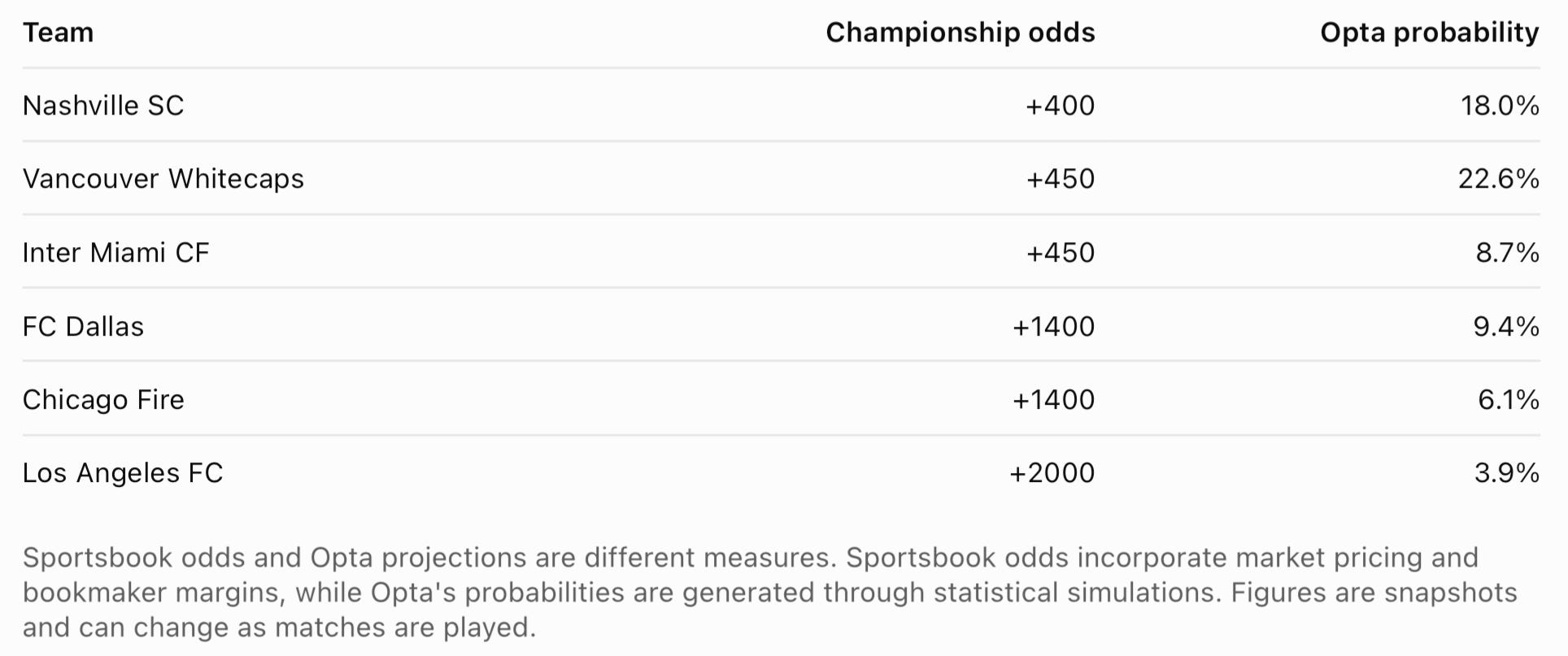
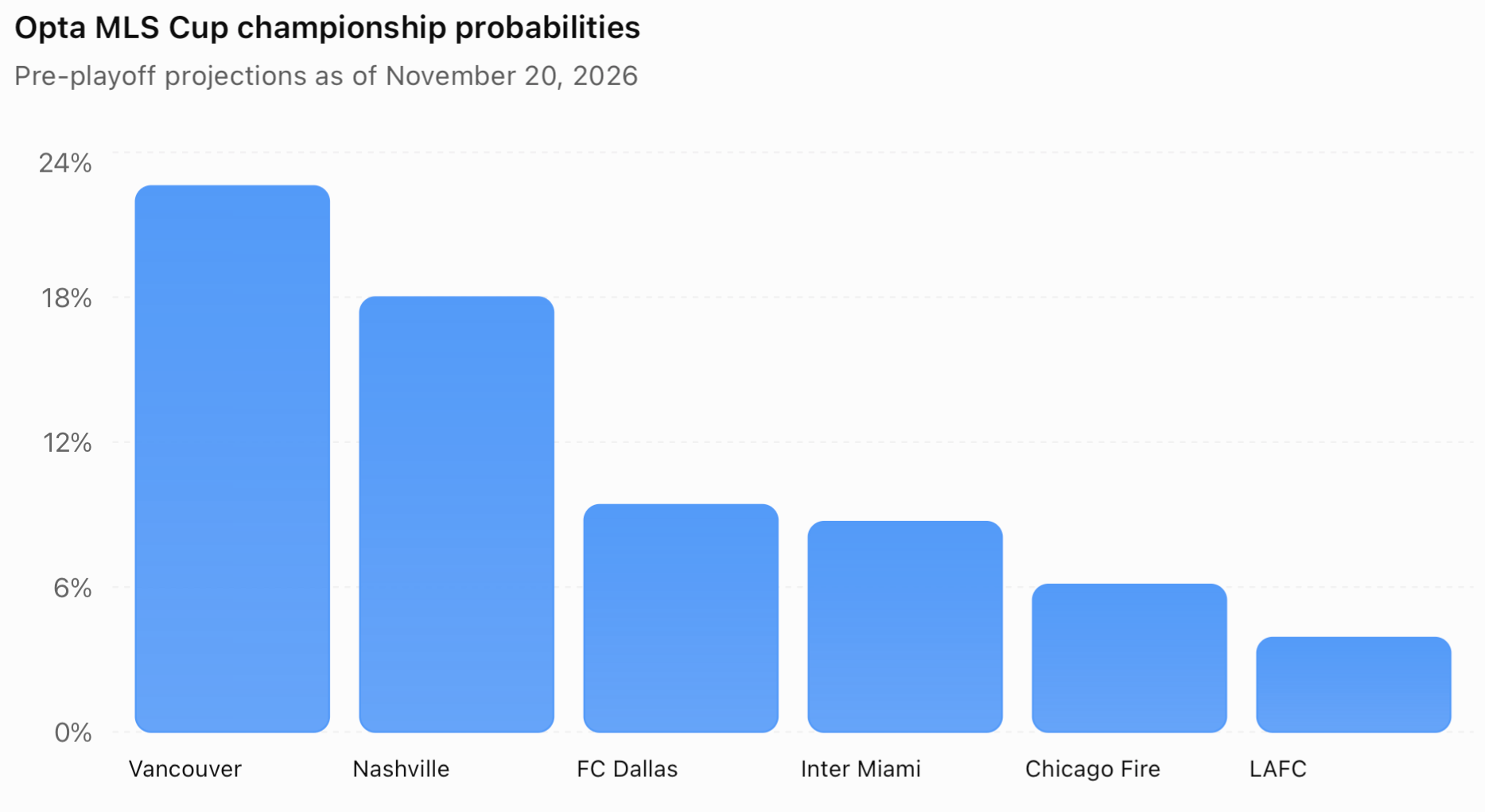
However, an important distinction has emerged between betting-market expectations and data-driven performance models. While Nashville enters the playoffs as the betting favorite after an exceptional regular season, Opta’s statistical model gives Vancouver the highest probability of winning the championship.
Latest odds to win the 2026 MLS Cup
DraftKings championship odds reported November 17, 2026, and Opta projections published November 20, 2026.
Nashville SC: The betting favorite
Nashville enters the postseason following an exceptional regular season in which the club accumulated 77 points and suffered only three defeats. Its consistency and ability to secure results have established it as the leading contender in the betting market, with championship odds of +400.
However, there is an interesting statistical warning sign. Opta calculated Nashville’s expected points at approximately 54.3, considerably below its actual total. This suggests the club performed substantially better than its underlying chance creation and defensive metrics would ordinarily predict.
While that does not diminish Nashville’s achievements, it raises questions about whether the team can maintain the same level of efficiency throughout the playoffs, where individual mistakes and narrow margins can determine results.
Vancouver Whitecaps: The statistical favorite
Vancouver enters the playoffs with one of the strongest statistical profiles in MLS. The club finished first in the Western Conference with 64 points, while striker Brian White scored 20 regular-season goals.
Opta gives Vancouver a 22.6% probability of winning MLS Cup, the highest among the contenders in its November 20 projections. The model favors Vancouver because its underlying performance metrics were more consistent with its actual results than those of several competing clubs.
Having lost the 2025 MLS Cup final to Inter Miami, Vancouver also enters the postseason with recent championship experience. The club’s combination of attacking quality, defensive organization, and statistical consistency makes it a serious contender.
Inter Miami: The defending champion
Inter Miami remains among the leading betting favorites, with championship odds of +450. The club enters the playoffs attempting to defend its 2025 MLS Cup title, supported by the attacking quality and international experience of Lionel Messi.
Messi finished the 2026 regular season with 26 goals and 13 direct assists, reinforcing his importance to Miami’s offensive production. His ability to influence high-pressure matches remains one of the team’s greatest competitive advantages.
However, Opta assigns Miami an 8.7% probability of winning the championship, considerably lower than the betting market’s implied assessment. This difference illustrates how star power, market expectations, and statistical performance models can produce contrasting views of a team’s championship prospects.
Miami’s success will depend not only on Messi’s performances but also on defensive consistency, squad availability, and its ability to manage the demands of postseason competition.
Other contenders worth watching
FC Dallas and Chicago Fire also deserve attention. Both are listed at +1400 in the referenced betting market, while Opta gives Dallas a 9.4% championship probability and Chicago a 6.1% chance.
Los Angeles FC, meanwhile, remains an interesting outsider at +2000. Although Opta gives LAFC a relatively modest 3.9% probability, the club has experience competing in high-pressure postseason environments.
These teams illustrate why the MLS playoffs can be difficult to predict. Regular-season performance provides an important foundation, but injuries, individual performances, tactical adjustments, and short-term momentum can substantially influence postseason outcomes.
Why the MLS playoffs matter beyond the championship
The postseason presents an important test for MLS’s broader commercial strategy. A deep Inter Miami run could generate substantial international attention because of Messi’s global profile, while a Nashville or Vancouver championship would demonstrate that the league’s competitive appeal extends beyond its most recognizable international star.
From a technology perspective, the contrast between Nashville’s regular-season dominance and Vancouver’s stronger underlying statistical profile illustrates the growing importance of predictive analytics in professional sports.
Clubs increasingly rely on expected goals, player-tracking data, tactical models, and athlete availability information to evaluate performance beyond traditional standings. However, predictive models are not guarantees, particularly in knockout competitions where relatively small differences can determine outcomes.
My assessment: Nashville is the betting favorite, Vancouver is the strongest contender according to Opta’s statistical model, and Inter Miami remains a serious championship threat because of its attacking quality and postseason experience. FC Dallas could also emerge as a surprise contender.
For MLS, the bigger opportunity is to turn a competitive and commercially attractive postseason into sustained audience growth, stronger club valuations, and increased investment in player development and performance technology.
Future trends
Post-World Cup growth: MLS will seek to convert increased soccer interest into sustained attendance and media consumption.
Calendar transformation: The league’s 2027 transition will affect scheduling, player workload, competition planning, and commercial operations.
AI-powered performance platforms: Clubs may invest further in integrating medical, training, and scouting information.
Global player development: MLS clubs could expand investment in academies, international scouting, and player transfers.
Streaming innovation: Digital distribution will remain central to reaching domestic and international fans.
Predictive analytics: Advanced statistical models will increasingly influence recruitment, tactical preparation, and performance evaluation.
For Inter Miami, the challenge is to translate its global visibility into a sustainable club business. For MLS more broadly, the challenge is to establish a stronger commercial foundation that remains attractive long after the current generation of international stars retires.
4. NWSL Championship: Washington Spirit vs. Kansas City Current — The Next Chapter in Women's Sports Growth

The 2026 NWSL Championship between Washington Spirit and Kansas City Current is arguably one of the most important sporting events of the weekend, not only because it determines the league champion but also because it represents the accelerating commercial development of women’s professional sports in North America.
For the NWSL, the championship is an opportunity to showcase the quality of its competition, attract new audiences, strengthen relationships with corporate sponsors, and demonstrate the long-term investment potential of women’s soccer.
The matchup is also particularly relevant for sports technology companies and performance practitioners. As NWSL clubs increase their investment in sports science, medical departments, athlete monitoring, and training infrastructure, the league is becoming an increasingly attractive market for performance and health technology providers.
Key moments in history
The NWSL began play in 2013, providing a more durable professional structure for women’s soccer in the United States following the collapse of previous leagues.
Several milestones have shaped its development. The United States women’s national team’s 2015 and 2019 FIFA World Cup victories helped increase attention toward the domestic professional game, while the league’s expansion and growing investment in dedicated training facilities have contributed to its commercial development.
A particularly important milestone came in 2023, when the NWSL announced new media-rights agreements with CBS Sports, ESPN, Amazon Prime Video, and Scripps Sports. The agreements, which began in 2024, were widely reported to be worth approximately $240 million over four years, representing a major increase over the league’s previous broadcasting arrangements.
Kansas City Current also made history in 2024 by opening CPKC Stadium, a venue developed specifically for a professional women’s soccer team. The project demonstrated how dedicated infrastructure can support stronger fan experiences, premium hospitality, sponsorship activation, and long-term commercial growth.
For Washington Spirit, reaching the championship provides another opportunity to reinforce the club’s position as an important property in the rapidly expanding women’s sports market.

The NWSL’s economic development illustrates a broader shift in how investors, broadcasters, and sponsors evaluate women’s professional sports. Historically, women’s leagues operated with substantially smaller commercial resources than their male counterparts. However, growing attendance, stronger media distribution, and increasing institutional investment are changing those economics.
The championship represents a particularly valuable commercial asset because it concentrates national attention on a single event. This creates opportunities for premium advertising, sponsorship activation, merchandise sales, and audience acquisition.
Kansas City Current provides an important example of infrastructure-led investment. CPKC Stadium was developed at a reported cost of approximately $120 million, illustrating the willingness of ownership groups to invest significant capital in dedicated women’s sports facilities.
Washington Spirit, meanwhile, benefits from operating in a major metropolitan market with access to corporate partners, government institutions, and a diverse potential fan base.
Nevertheless, the NWSL faces challenges. Clubs must continue growing recurring revenues while managing increasing player salaries, travel expenses, training infrastructure investments, and medical and performance staffing costs.
The central economic question is whether rising valuations and investor enthusiasm can be supported by sustainable growth in broadcasting, sponsorship, ticketing, and other operating revenues.
Impact of technology
Technology is becoming increasingly important to NWSL clubs as they seek to improve athlete performance, reduce avoidable injuries, and manage the physical demands of professional soccer.
Women’s soccer presents specific opportunities for research and innovation in athlete health, including ACL injury prevention, menstrual-cycle-related considerations, strength development, recovery, and individualized training programs. These areas require evidence-based approaches rather than assumptions that all female athletes respond identically to training or recovery interventions.
For performance and medical departments, several technologies are particularly relevant:
ACL injury risk assessment and rehabilitation: Biomechanical analysis, strength testing, and movement screening can help practitioners identify modifiable factors and support return-to-play decisions.
GPS and optical tracking: Clubs can monitor high-speed running, accelerations, decelerations, and overall training loads.
Athlete management systems: Integrated platforms can help medical and performance teams coordinate training, rehabilitation, wellness, and availability information.
AI-powered video analysis: Teams can evaluate tactical patterns, individual player movements, and opponent tendencies.
Women’s health research: More individualized approaches to nutrition, recovery, and training may emerge as higher-quality evidence becomes available.
One particularly important opportunity is the development of technology and research specifically validated in female athlete populations. Many sports performance products and training protocols have historically been developed using predominantly male research participants.
As women’s professional sports continue to attract investment, clubs and technology providers have an opportunity to address those research gaps through better data collection, longitudinal studies, and more individualized approaches to athlete health.
The NWSL championship provides a visible platform for demonstrating the importance of these investments.
Future trends
Several developments are likely to influence the NWSL’s next phase of growth:
Increasing club valuations: Continued interest from institutional investors, private capital, and high-profile ownership groups could support further appreciation in franchise values.
Dedicated stadiums and training facilities: More clubs may invest in infrastructure designed specifically for women’s professional sports.
Stronger media-rights economics: Audience growth and improved distribution could support higher-value future broadcasting agreements.
Female-specific sports science: Greater investment in research on injury prevention, recovery, nutrition, and athlete health could improve evidence-based performance practices.
AI and athlete monitoring: Clubs will increasingly explore integrated data platforms to support training, scouting, and medical decision-making.
International competition for talent: The NWSL will face growing competition from European women’s soccer leagues for elite players, coaches, and performance practitioners.
An important question is whether the NWSL can maintain its competitive advantage as European clubs increase their investment in women’s soccer. The league’s future success will depend on its ability to attract and retain elite players while continuing to strengthen its commercial and operational foundations.
Why the NWSL Championship matters for sports technology startups
For sports technology companies, the NWSL represents a potentially attractive growth market. Compared with more mature leagues, some clubs may have greater flexibility to introduce new technologies, establish research partnerships, and develop innovative approaches to athlete monitoring and recovery.
However, startups must demonstrate measurable value. Performance and medical practitioners are increasingly looking for solutions that integrate into existing workflows, provide actionable insights, and are supported by credible scientific evidence.
The most promising opportunities may emerge in injury rehabilitation, biomechanical assessment, athlete management, female-specific health research, and AI-powered performance analysis.
The NWSL Championship is therefore more than a title match. It is an important showcase for the commercial, technological, and competitive future of women’s professional sports.
Conclusion: The Future of Sports Will Be Defined by Technology, Media, and Global Expansion
The Las Vegas Grand Prix, NFL Sunday Night Football in Mexico City, the MLS playoffs, and the NWSL Championship illustrate four different approaches to building valuable sports properties.
Formula 1 is demonstrating how a race can become a global entertainment destination, generating substantial economic activity through tourism, hospitality, sponsorships, and premium experiences. The NFL is leveraging the extraordinary commercial value of live football to expand internationally, while MLS is attempting to convert growing interest in soccer into a sustainable long-term business. Meanwhile, the NWSL is demonstrating how investment in women’s professional sports is creating new opportunities for broadcasters, sponsors, investors, and sports technology companies.
Despite their differences, all four competitions are being transformed by technology. AI, data analytics, streaming platforms, athlete monitoring systems, and personalized fan experiences are becoming increasingly important to their operations and commercial strategies.
From an Upside Global perspective, five conclusions stand out:
Media rights and streaming are reshaping sports economics. The ability to reach audiences directly and offer differentiated viewing experiences is becoming a competitive advantage.
International expansion creates new commercial opportunities. Sports organizations increasingly view events as platforms for developing global audiences, attracting sponsors, and building international partnerships.
AI and performance technology will continue to influence competitive success. Teams are investing in technologies that support better preparation, athlete monitoring, injury rehabilitation, recovery, and decision-making.
Women’s professional sports represent a significant growth opportunity. The NWSL illustrates how increasing investment in broadcasting, infrastructure, athlete health, and performance technology can strengthen the commercial foundations of women’s sports.
Data integration will become increasingly important. The next competitive advantage may come less from collecting additional information and more from connecting existing systems and turning that information into actionable insights.
The MLS playoffs provide an additional illustration of how data-driven models are influencing expectations in professional sports. The contrast between Nashville’s betting-market position and Vancouver’s stronger statistical championship probability demonstrates that traditional results, underlying performance indicators, and market expectations do not always tell the same story.
Similarly, the NWSL Championship highlights the growing importance of investing in female athlete health, sports science, and dedicated performance infrastructure. As women’s professional sports continue to attract institutional investment, the demand for technologies that can improve athlete availability, performance, and recovery is likely to increase.
For teams, leagues, investors, and sports technology startups, these four events provide an opportunity to observe where the industry is heading. The future of professional sports will not be determined solely by what happens on the field or track. It will also be shaped by how effectively organizations combine technology, commercial innovation, and human performance expertise to create sustainable competitive advantages.
This weekend, Las Vegas, Mexico City, Miami, and Washington, D.C., will offer four compelling examples of that transformation.
Other Key Sports Events to watch on TV this weekend:
Beyond the Las Vegas F1 Grand Prix, Vikings vs. 49ers, and Inter Miami vs. Columbus Crew, there are several other major sporting events worth watching this weekend, November 21–22, 2026.
I’d pay particular attention to the NWSL Championship, college football’s playoff race, and the Premier League. All three offer compelling storylines for an Upside Global analysis, especially around media rights, technology, and the economics of professional sports.
Our additional must-watch events
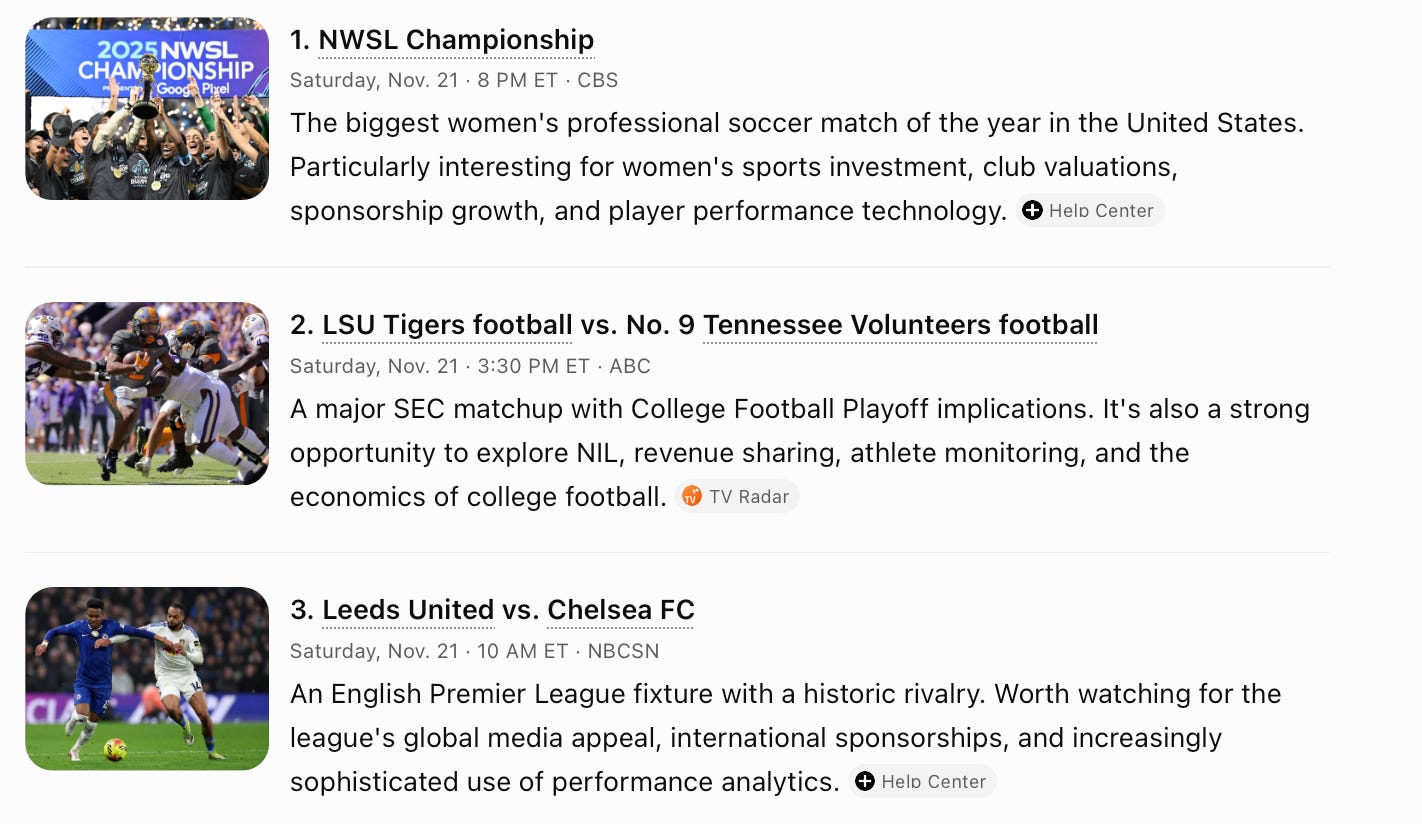
Other events worth watching
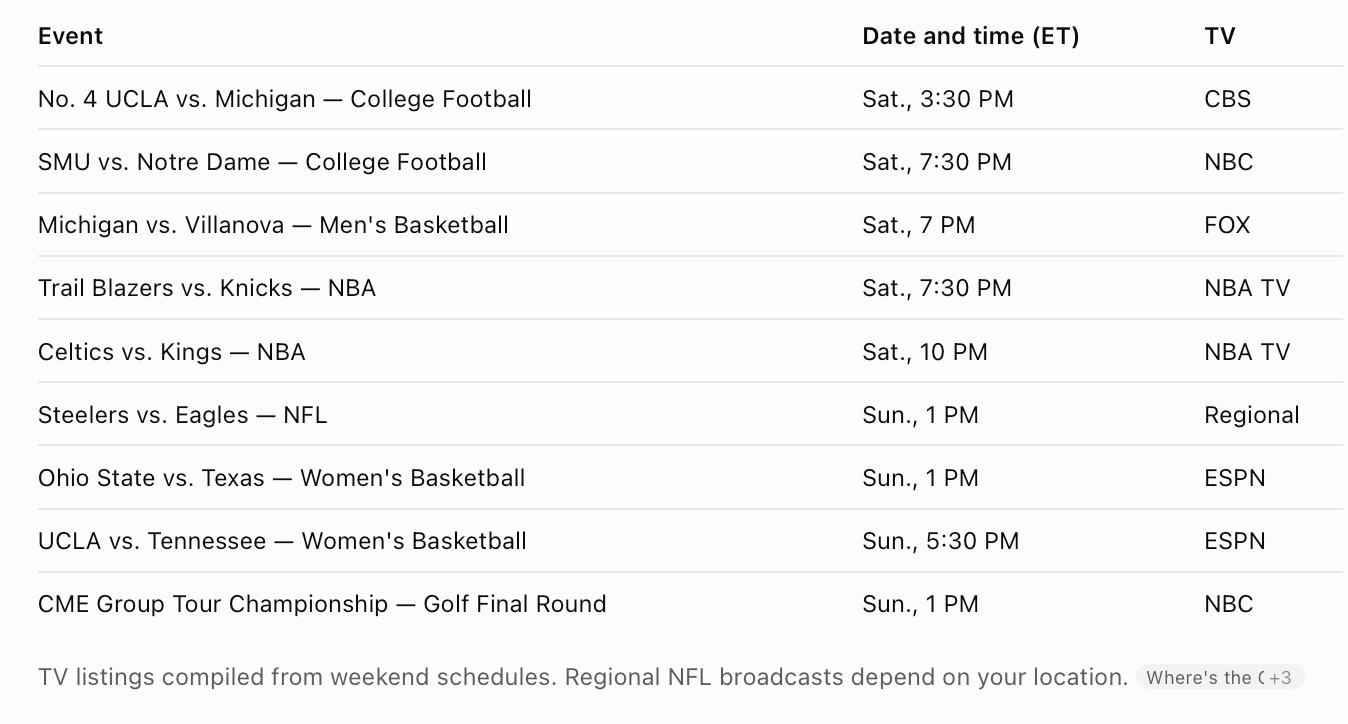
NWSL Championship matchup
