
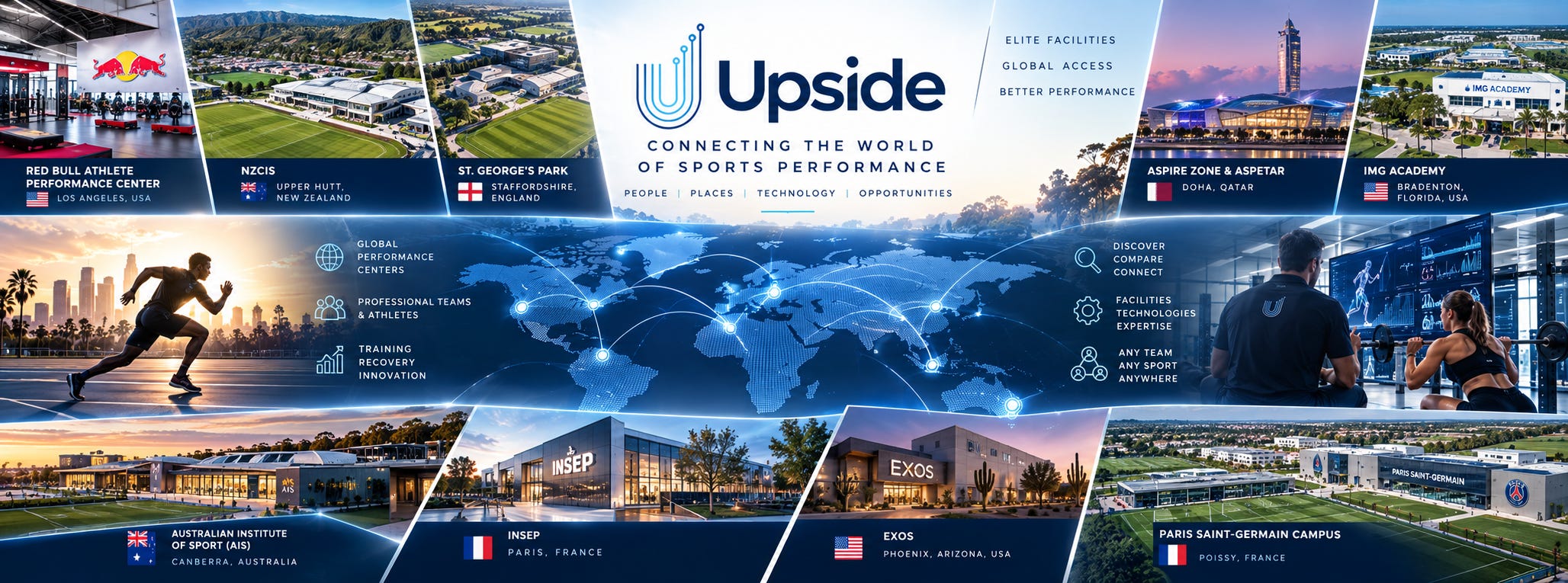
Upside Global | Sports Performance & Technology Analysis | October 2026
Introduction: Performance Centers Are Becoming Strategic Assets
As professional sports become increasingly global, access to high-quality training facilities away from home is becoming an important operational advantage.
From the Red Bull Athlete Performance Center in Los Angeles to the New Zealand Campus of Innovation and Sport (NZCIS), leading performance centers combine strength and conditioning, sports science, rehabilitation, recovery, nutrition and athlete monitoring under one roof.
For decades, professional sports teams have invested heavily in their own training facilities, performance laboratories, recovery centers and medical infrastructure.
Today, many elite organizations operate integrated performance environments where coaches, sports scientists, physiotherapists, nutritionists and medical staff work together to optimize athlete performance.
However, when teams travel domestically or internationally, maintaining access to the same level of infrastructure can become challenging.
An NBA team traveling to Los Angeles, an NHL team playing several consecutive road games, an MLS club visiting New York, or an international rugby team preparing for a competition in Europe may need access to specialized training equipment, rehabilitation facilities, recovery technologies and appropriate training spaces.
Finding these facilities is often a manual, time-consuming process involving calls, emails and personal introductions.
This creates an opportunity to build a more connected global ecosystem of sports performance centers, making it easier for professional teams to discover, evaluate and access the facilities they need wherever they compete.
Importantly, not all leading performance centers are commercially accessible. Some are privately operated by professional clubs or sports organizations, while others actively welcome visiting teams and athletes.
This analysis explores the world’s leading performance centers, why they matter, the technologies shaping their evolution, and how teams can make better decisions when selecting facilities while traveling.
Why Professional Teams Need Access to Performance Centers When Traveling
Professional sports organizations increasingly operate across multiple cities, countries and continents.
Whether competing in domestic leagues, international tournaments, preseason tours or training camps, teams must maintain consistent approaches to physical preparation, rehabilitation and recovery.
Several factors explain why access to high-quality performance centers is becoming increasingly important.
Maintaining training continuity
Professional athletes follow carefully designed training programs throughout the season.
However, hotel gyms rarely provide the space, equipment or specialized technologies required by professional sports teams.
Access to a nearby performance center allows practitioners to maintain strength and conditioning programs, conduct training sessions and manage individual athlete workloads.
For example, an NBA team on a five-game road trip may need a facility equipped with squat racks, free weights, resistance machines and force plates to maintain its normal training protocols.
Supporting rehabilitation and return to play
Injured athletes often require specialized rehabilitation equipment, treatment rooms and assessment technologies.
When traveling, teams may need access to facilities that support rehabilitation without disrupting the athlete’s recovery program.
This can include isometric strength assessment, movement analysis, neuromuscular testing and progressive loading.
Optimizing recovery between games
Teams competing in congested schedules need appropriate recovery infrastructure.
Hydrotherapy pools, cold-water immersion, compression systems, physiotherapy areas and dedicated recovery spaces can support established recovery routines.
This is particularly relevant for NBA, NHL, MLS and rugby teams managing frequent travel and limited recovery time.
Reducing logistical complexity
Travel time is an important consideration.
A performance center located 15 minutes from a team’s hotel or stadium may be considerably more practical than one located an hour away.
Reducing transportation time can create additional opportunities for treatment, recovery, meetings and rest.
Accessing specialized technologies
Some performance centers provide access to technologies that may not be available in hotels or temporary training facilities.
These include force plates, GPS systems, biomechanics laboratories, velocity-based training devices and recovery technologies.
Supporting international training camps
National teams and professional clubs traveling overseas may require integrated facilities for several days or weeks.
A center combining training fields, gyms, accommodation, nutrition, medical services and recovery infrastructure can significantly simplify camp logistics.
Main Use Cases for Teams Using Performance Centers
Performance centers can support a wide range of operational and performance requirements.
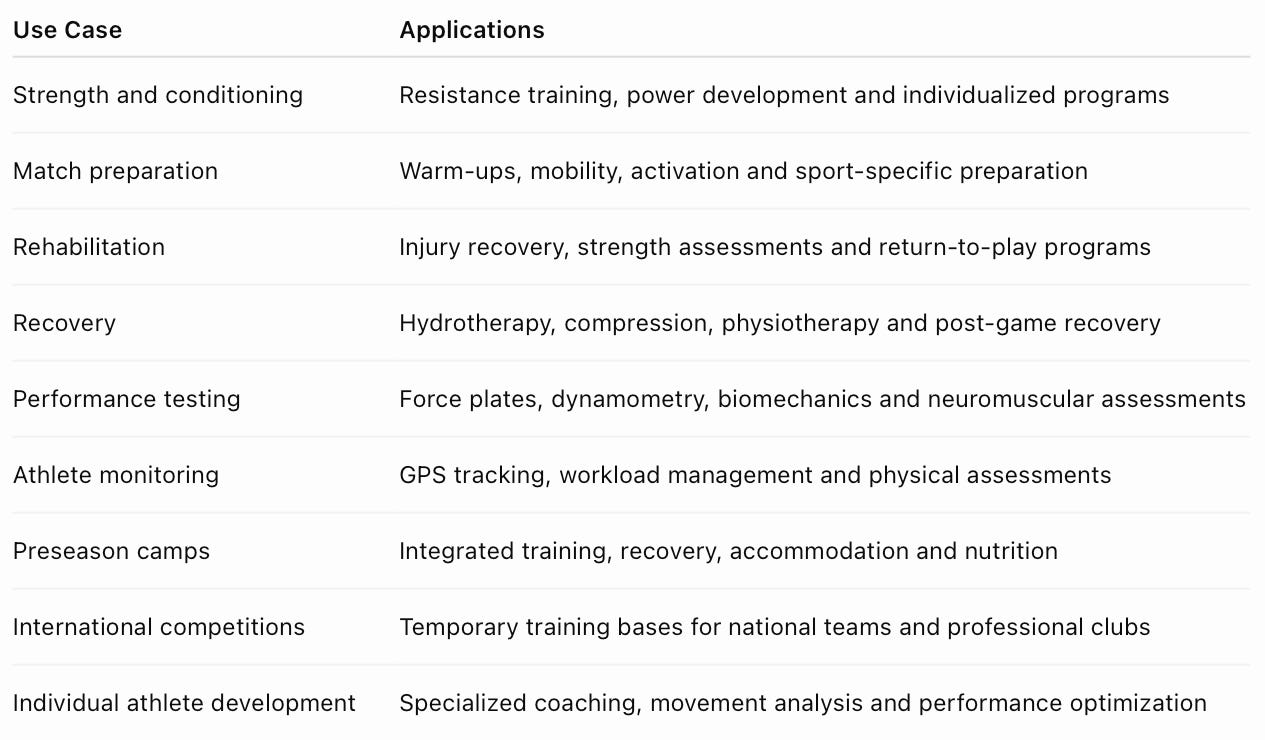
The requirements vary considerably depending on the sport.
An MLS team may prioritize access to training pitches, an NBA team may need a regulation basketball court, while an NHL team may require ice time in addition to strength and conditioning facilities.
Therefore, selecting the right performance center requires understanding both the team’s sporting needs and the facility’s capabilities.
Leading Sports Performance Centers Around the World
The following facilities represent notable examples of elite sports performance infrastructure.
They have been selected based on their facilities, sports-science capabilities, reputation, integrated services and relevance to professional teams.
This is an editorial selection rather than a definitive ranking. Access, pricing and availability should be confirmed directly.
1. Red Bull Athlete Performance Center — Los Angeles, USA
Website: Red Bull Performance
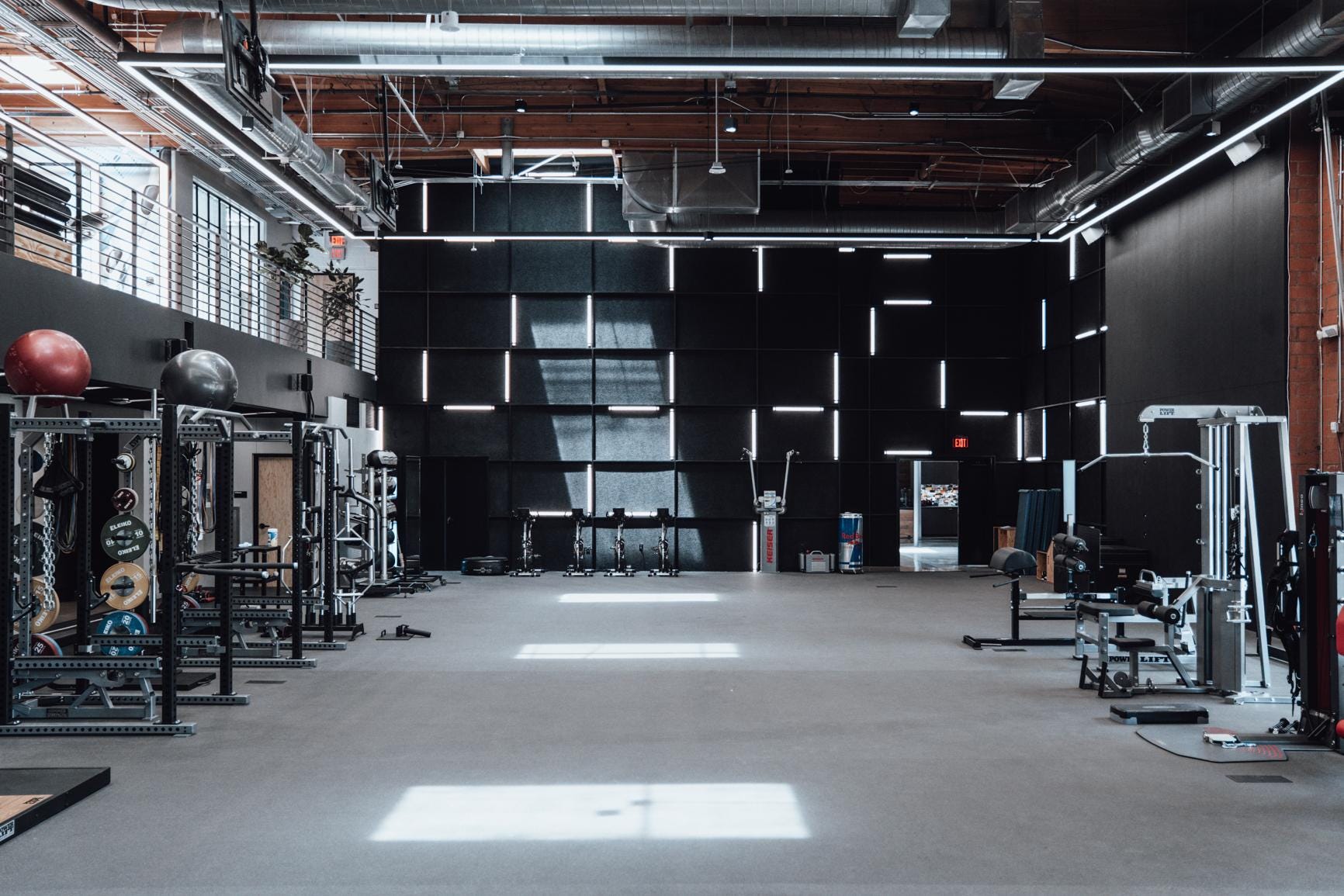
Red Bull’s Athlete Performance Center in the Los Angeles area is an example of an integrated elite-performance environment.
The facility brings together strength and conditioning, sports medicine, physiotherapy, performance profiling, nutrition, mental performance and recovery services.
Its multidisciplinary approach emphasizes individualized athlete development and collaboration between performance specialists.
Red Bull also operates a wider high-performance ecosystem, including facilities and expertise in Europe.
Key capabilities:
Strength and conditioning
Sports medicine and physiotherapy
Performance assessments
Nutrition and recovery support
Mental performance
Individualized athlete development
Best suited for: Elite athletes requiring integrated performance services.
Access: Primarily serves Red Bull-affiliated athletes and teams. External commercial access should not be assumed.
2. New Zealand Campus of Innovation and Sport (NZCIS) — Upper Hutt, New Zealand
Website: NZCIS
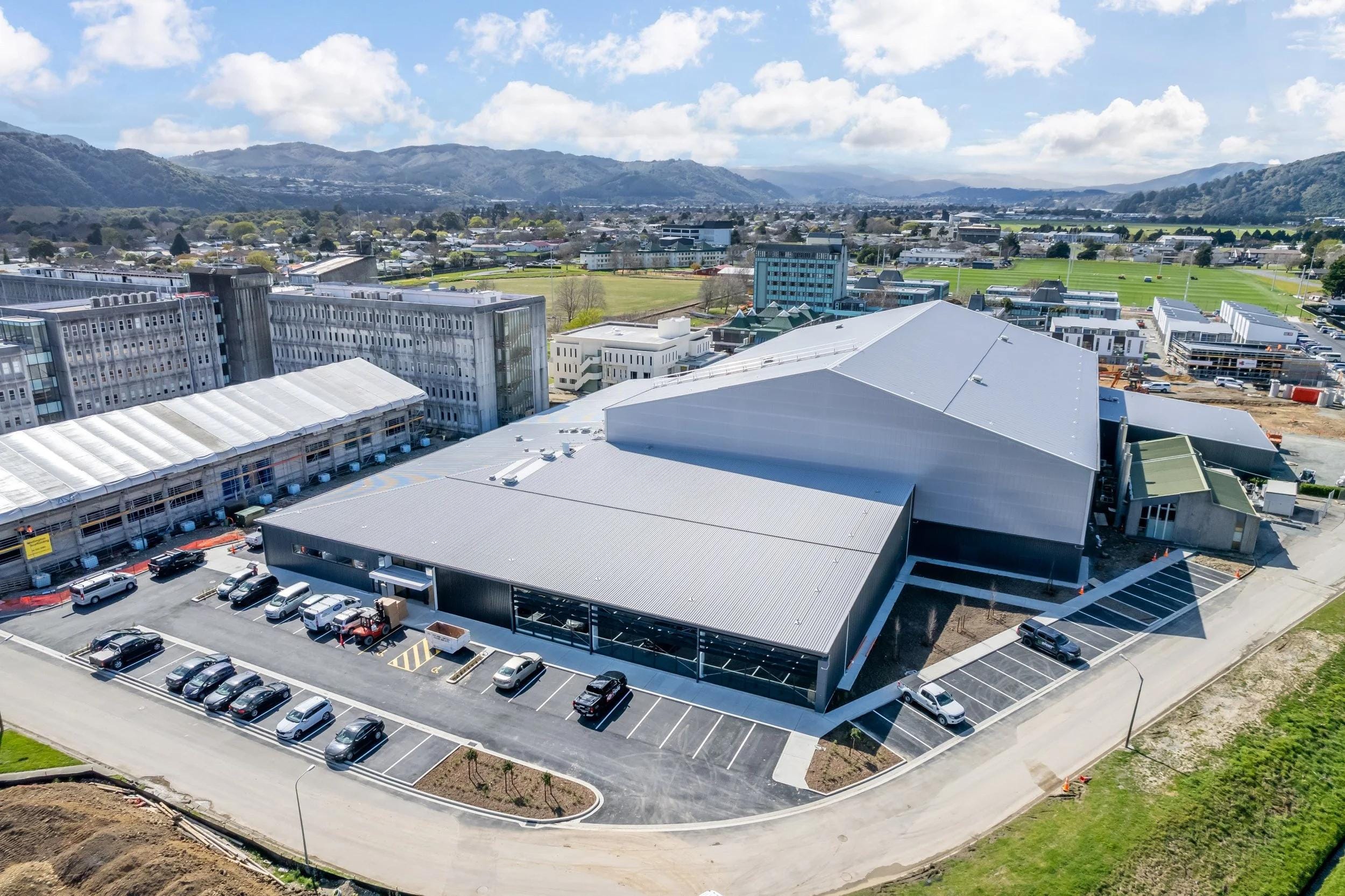
NZCIS is one of the most relevant examples of a modern performance campus designed to support professional teams, international training camps and athlete development.
Located near Wellington, the campus combines extensive training infrastructure with accommodation, nutrition, sports science and recovery facilities.
Its integrated approach makes it attractive for professional rugby teams, football clubs, national teams and other elite sporting organizations.
NZCIS has worked with leading sports organizations, including New Zealand Rugby.
Key capabilities:
High-performance strength and conditioning facilities
Outdoor training fields
Recovery and rehabilitation areas
Hydrotherapy and other recovery technologies
Performance analysis and sports-science infrastructure
Accommodation and dining
Meeting and conference facilities
Best suited for: International rugby teams, football clubs, AFL teams and organizations planning extended training camps.
Access: NZCIS welcomes visiting teams and offers integrated training arrangements.
3. St. George’s Park — England
Website: England Football – St. George’s Park
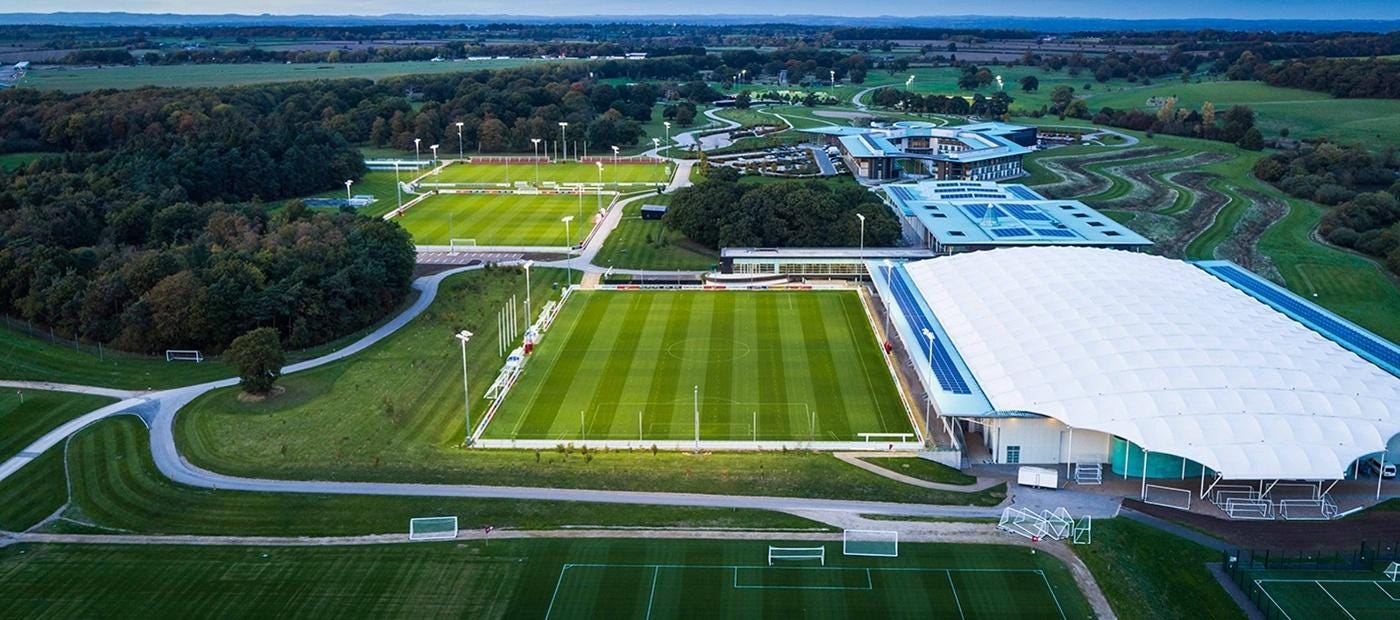
St. George’s Park is the home of England’s national football teams and one of Europe’s leading football performance campuses.
Located in Staffordshire, the facility combines football pitches, indoor training areas, sports science, rehabilitation, strength and conditioning and accommodation.
The campus has also hosted professional football clubs preparing for domestic and international competitions.
Key capabilities:
Outdoor and indoor football pitches
Strength and conditioning
Sports medicine
Rehabilitation and recovery
Performance analysis
Accommodation and catering
Team meeting facilities
Best suited for: Professional football clubs, national teams and preseason training camps.
Access: Offers training packages for visiting teams, subject to availability.
4. Aspire Zone and Aspetar — Doha, Qatar
Websites: Aspire Zone | Aspetar
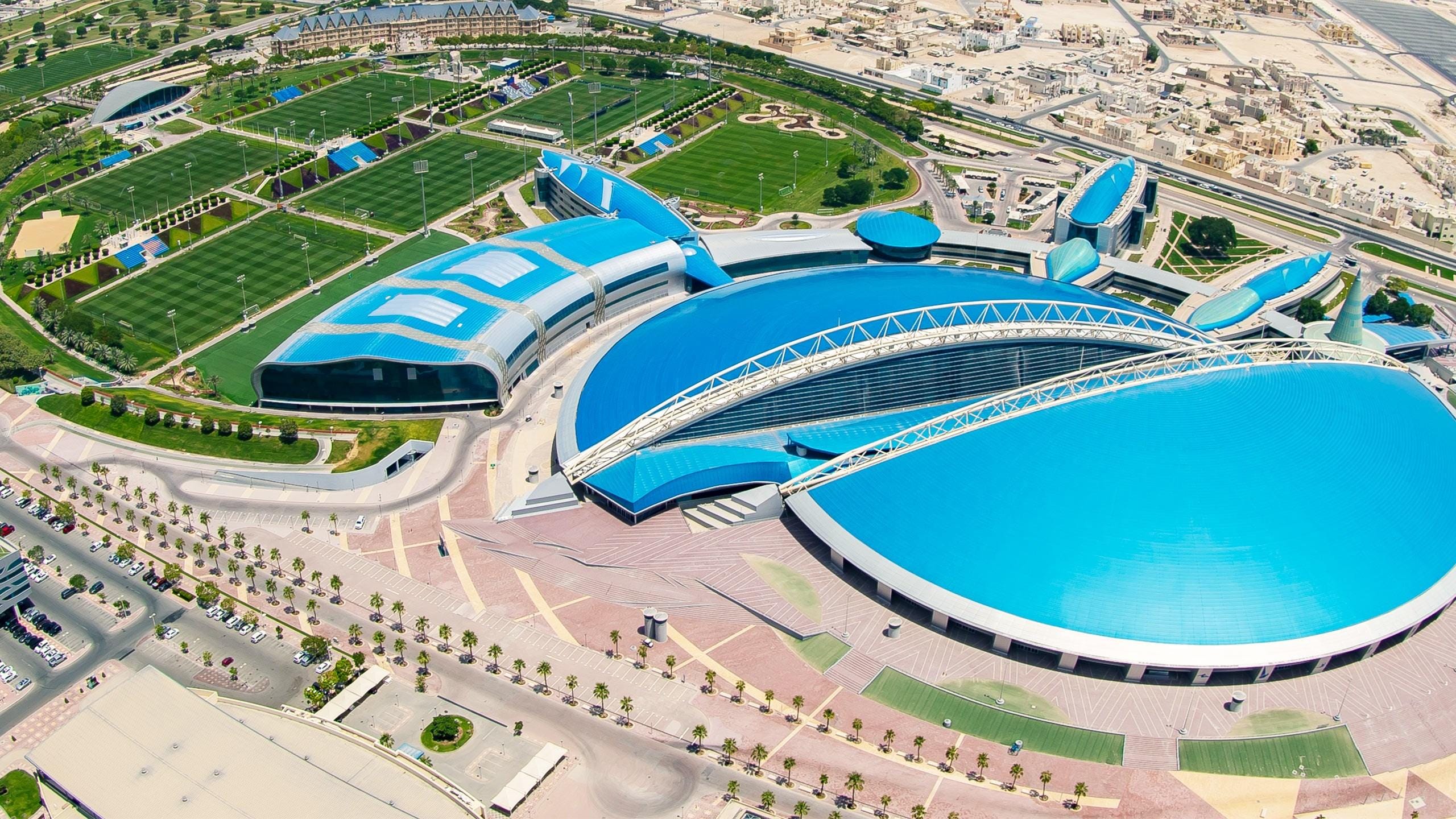
Aspire Zone is an extensive sports performance ecosystem combining training facilities, sports science, education and specialized medical services.
Aspire Academy provides elite training infrastructure across multiple sports, while Aspetar is internationally recognized for its focus on sports medicine, rehabilitation and athlete performance.
The wider campus has supported international teams and major sporting events.
Key capabilities:
Strength and conditioning
Football training facilities
Biomechanics and performance assessment
Sports medicine and rehabilitation
Recovery services
Training camps
Sports-science expertise
Best suited for: International teams, elite athletes, rehabilitation programs and major-event preparation.
Access: Training camp and international athlete services are available through relevant operators, subject to eligibility and arrangements.
5. IMG Academy — Bradenton, Florida, USA
Website: IMG Academy
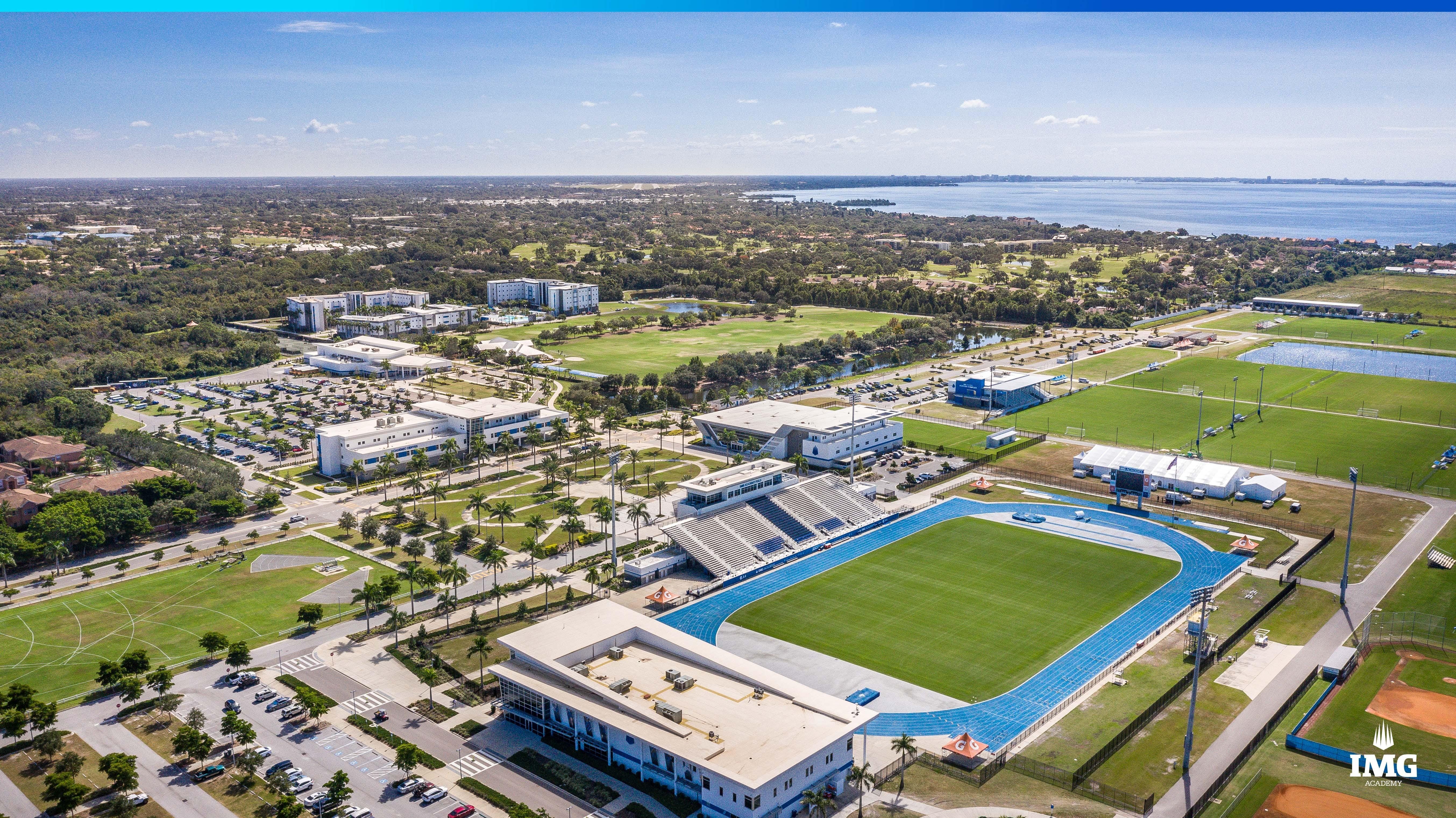
IMG Academy is a major multisport training campus supporting athlete development across basketball, football, soccer, tennis, baseball and other sports.
Its facilities include sport-specific training environments, strength and conditioning spaces, performance services and accommodation.
IMG Academy has also hosted professional teams and training camps.
Key capabilities:
Multisport training facilities
Strength and conditioning
Sports performance services
Athlete development
Accommodation
Team training camps
Best suited for: Professional and collegiate teams, preseason preparation and individual athlete development.
Access: Team training and camp opportunities are available, depending on scheduling and requirements.
6. Australian Institute of Sport (AIS) — Canberra, Australia
Website: Australian Institute of Sport
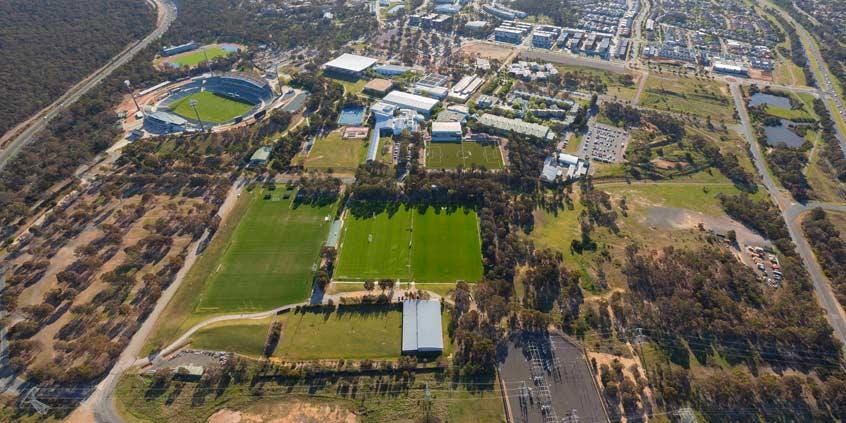
The Australian Institute of Sport is a major component of Australia’s elite sports performance ecosystem.
Its Canberra campus combines training facilities, athlete services, sports science and recovery infrastructure.
The institute supports national sporting organizations and Olympic and Paralympic performance programs.
Key capabilities:
High-performance training
Sports science
Strength and conditioning
Recovery and rehabilitation
Multisport infrastructure
Athlete accommodation
Best suited for: National teams, Olympic sports and multisport training camps.
Access: Selected sporting groups can access facilities through appropriate booking arrangements.
7. INSEP — Paris, France
Website: INSEP
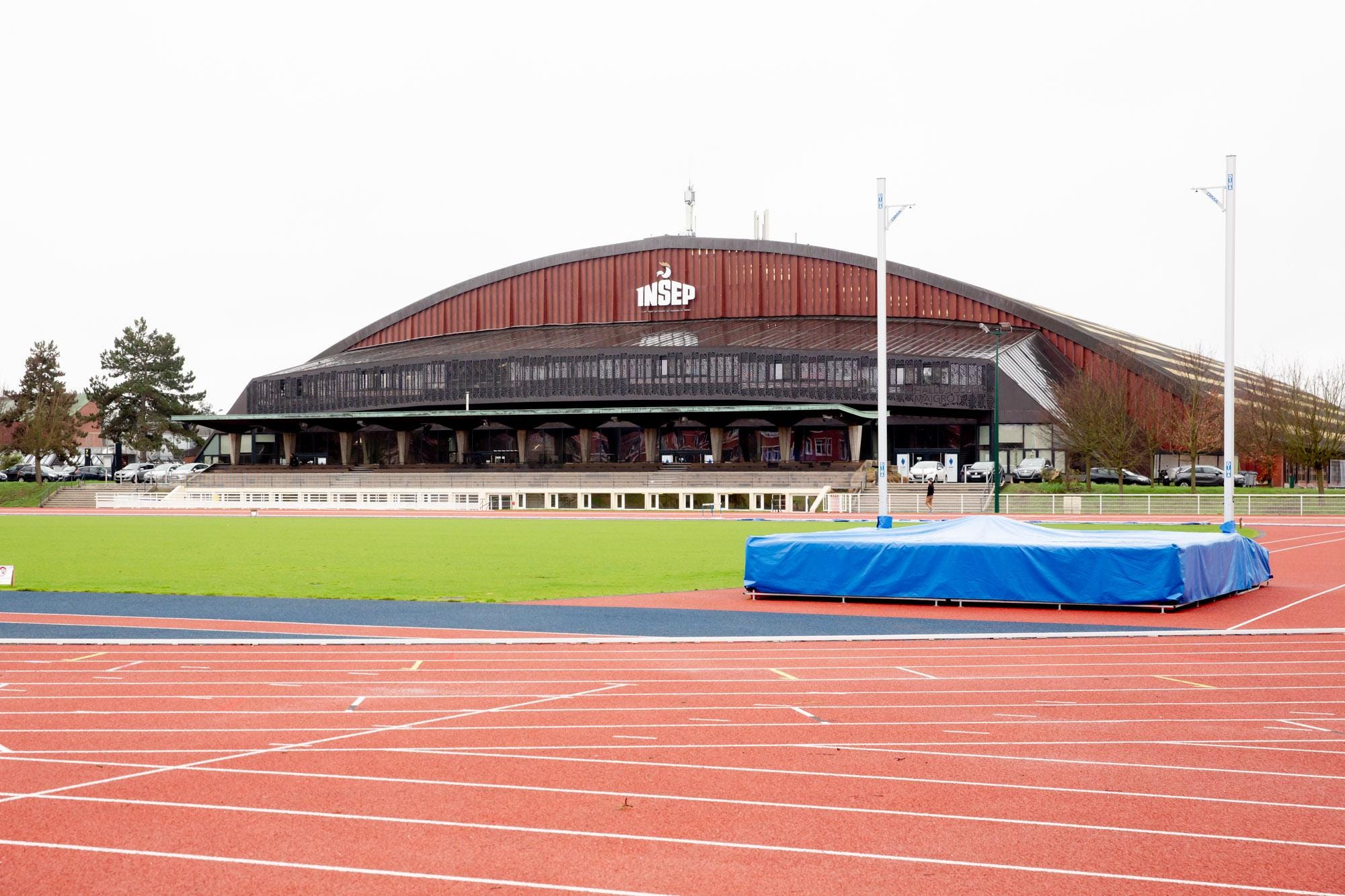
France’s National Institute of Sport, Expertise and Performance is one of Europe’s leading elite-sport institutions.
Located in Paris, INSEP integrates athlete development, performance science, sports medicine, research and specialized training infrastructure.
The institute plays an important role in preparing French athletes for major international competitions.
Key capabilities:
Elite athlete development
Sports science and research
Strength and conditioning
Rehabilitation
Biomechanics
Olympic and Paralympic preparation
Best suited for: National federations, Olympic programs and specialized athlete development.
Access: Primarily supports elite-sport programs. Visiting-team access requires direct coordination.
8. EXOS — Phoenix, Arizona, USA
Website: EXOS
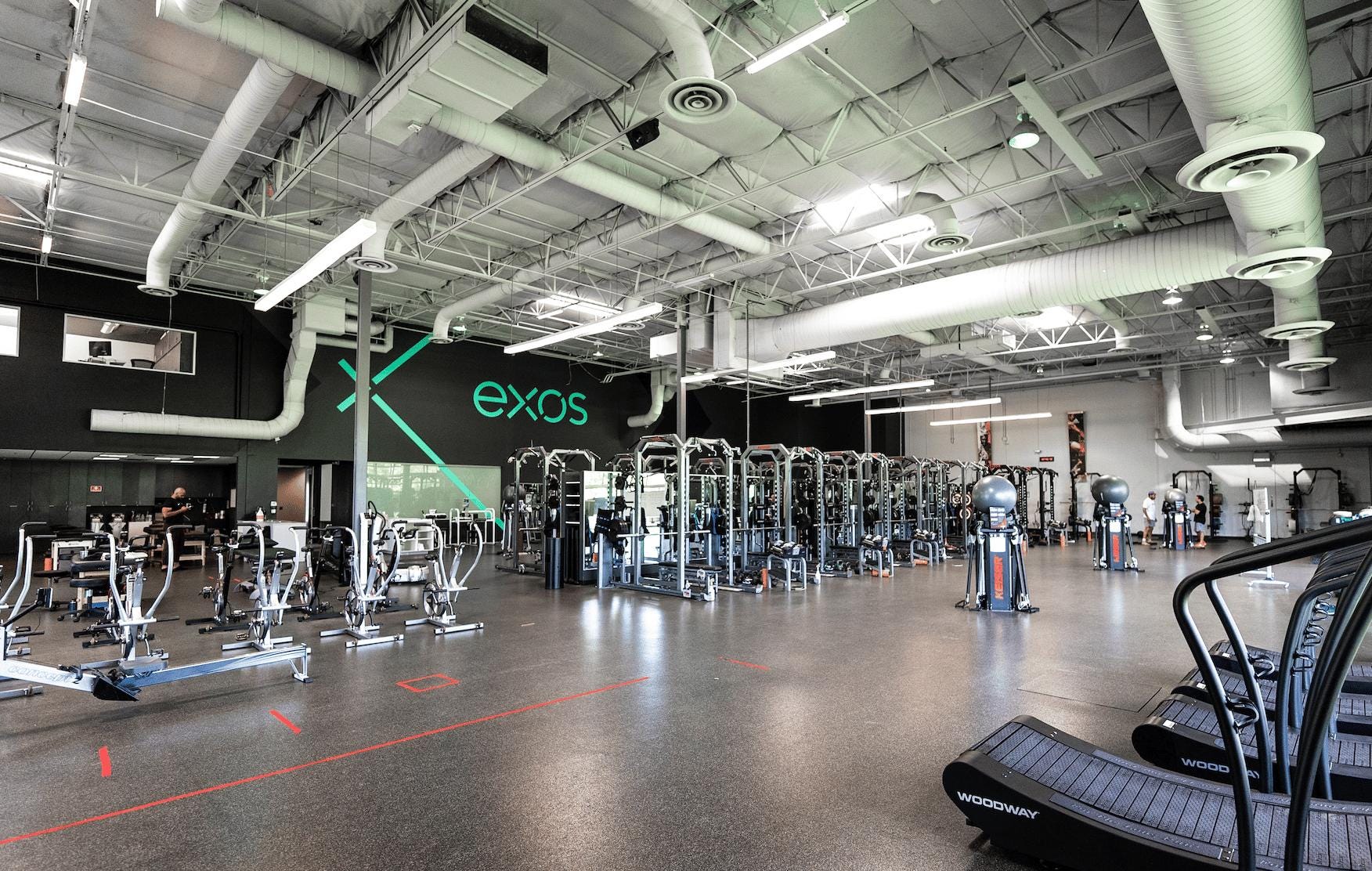
EXOS is known for its integrated approach to human performance, combining strength and conditioning, movement development, physical therapy, nutrition and performance coaching.
Its facilities and services have supported professional athletes across multiple sports.
Key capabilities:
Strength and conditioning
Movement assessment
Physical preparation
Rehabilitation
Nutrition
Individualized performance programs
Best suited for: Individual athletes, offseason preparation and specialized training programs.
Access: Team and athlete arrangements should be confirmed directly.
9. Paris Saint-Germain Campus — Poissy, France
Website: PSG Campus
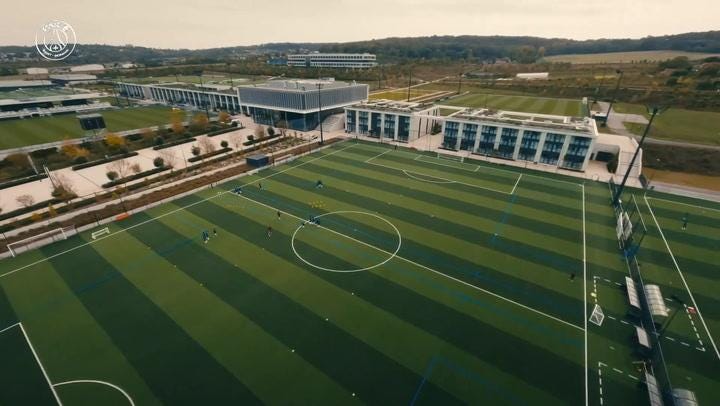
Paris Saint-Germain’s training campus demonstrates how major professional clubs are investing in integrated performance infrastructure.
The campus brings together football training, sports medicine, recovery, strength and conditioning and player development.
Its design supports collaboration between coaching, medical and performance departments.
Key capabilities:
Football training pitches
Strength and conditioning
Medical and rehabilitation facilities
Recovery infrastructure
Player development
Integrated performance services
Best suited for: Benchmarking elite club infrastructure and multidisciplinary performance environments.
Access: Primarily a private club facility rather than a publicly advertised rental center.
Comparing the Leading Performance Centers
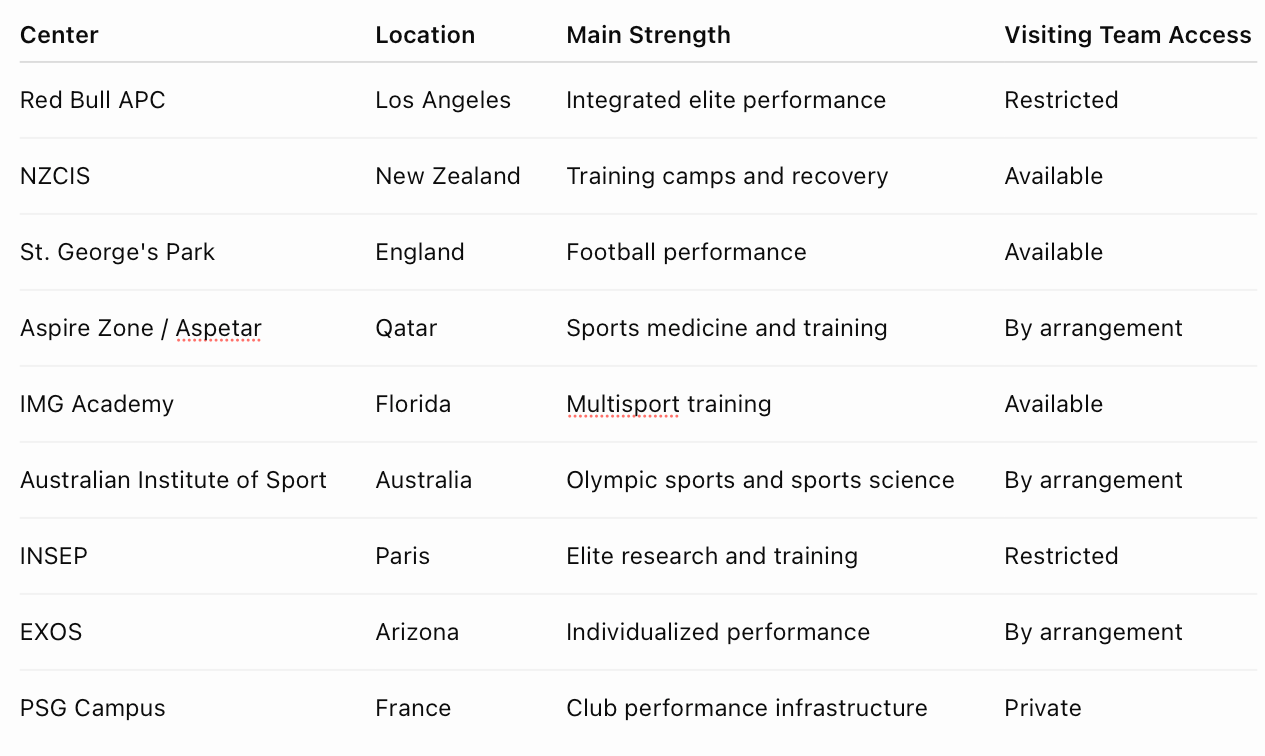
The Growing Importance of Technology in Elite Sports Performance Centers
One of the biggest transformations in elite sports performance centers over the past decade has been the integration of advanced technologies into training, rehabilitation, recovery and athlete monitoring.
Today, the best performance centers are no longer simply facilities equipped with weights, training fields and treatment rooms.
They are increasingly becoming technology-driven performance hubs, where coaches, sports scientists, physiotherapists and medical teams collect objective data, evaluate athletes and make more informed decisions.
For professional teams traveling domestically or internationally, access to these technologies can be particularly valuable.
Rather than interrupting their normal assessment and monitoring routines, visiting teams can potentially maintain continuity by using compatible equipment available at local performance centers.
5.1 Force Plates and Strength Assessment Technologies
Solutions from companies such as VALD, Hawkin Dynamics and Kistler allow practitioners to assess force production, asymmetries, jump performance and other neuromuscular characteristics.
These technologies can help teams monitor physical capabilities, evaluate rehabilitation progress and support training decisions.
Example: An NBA team traveling for several consecutive games could use compatible force plates at a local performance center to conduct its established jump-testing protocol.
This could help practitioners maintain consistency in their monitoring processes without transporting additional equipment.
5.2 GPS Tracking and Athlete Monitoring Systems
Wearable technologies from companies such as Catapult and STATSports help practitioners monitor external training loads, movement demands and physical performance.
Access to appropriate training spaces and compatible monitoring infrastructure can help visiting teams continue collecting performance data.
For example, a professional rugby team training overseas may need access to outdoor fields where its GPS tracking systems can operate effectively.
5.3 Velocity-Based Training (VBT) and Strength Monitoring
VBT solutions from companies such as Perch, Vitruve and DetecFit allow coaches to monitor movement velocity during resistance training.
These technologies can support individualized training prescriptions, track performance changes and provide immediate feedback during strength sessions.
Portable VBT devices are especially relevant for traveling teams because they can be used in different training environments.
Example: An NHL team on a road trip could use a portable VBT device at a local performance center to monitor selected strength exercises without requiring permanent installation.
5.4 Biomechanics and Motion Capture Technologies
Technologies from companies such as Qualisys, Vicon and Theia Markerless support detailed movement assessments.
Applications include:
Running mechanics and gait analysis
Movement screening
Rehabilitation assessments
Return-to-play evaluations
Sport-specific skill development
Movement efficiency and technique analysis
Some advanced performance centers operate dedicated biomechanics laboratories, while others use portable or markerless motion capture systems.
For visiting teams, access to these technologies may be particularly useful when evaluating injured athletes or conducting specialized assessments.
5.5 Recovery and Rehabilitation Technologies
Recovery is another area where technology is playing an increasingly important role.
Performance centers may provide access to hydrotherapy, compression systems, cryotherapy, neuromuscular stimulation and specialized rehabilitation equipment.
Technologies from companies such as Normatec and Game Ready are examples of solutions used in recovery and rehabilitation settings.
For teams managing congested schedules, access to appropriate recovery infrastructure can help maintain established post-game routines.
However, teams should distinguish between the availability of a recovery technology and the scientific evidence supporting its use for a specific outcome.
5.6 Athlete Management Systems (AMS) and AI-Powered Analytics
Platforms such as Smartabase, Kitman Labs and TeamBuildr help organizations manage training information, athlete monitoring, performance assessments and strength programs.
As performance centers become more digitally connected, an important opportunity is to facilitate secure data exchange between facilities and visiting teams.
For example, a visiting team could conduct a strength assessment at an external facility and integrate the results into its existing athlete monitoring workflow, provided the equipment, software and data-sharing arrangements are compatible.
AI could further support practitioners by helping analyze performance trends, organize assessment results and identify information requiring closer review.
5.7 Why Technology Matters When Selecting a Performance Center
For professional teams, the availability of advanced technologies can influence which performance center they choose when traveling.
Consider two facilities located 15 minutes from a team’s hotel.
The first offers a traditional gym with free weights, resistance machines and basic recovery equipment.
The second provides similar equipment but also offers force plates, VBT systems, rehabilitation technology, movement assessment tools and dedicated sports-science support.
Depending on the team’s objectives, the second facility could offer significantly more value, particularly if players require physical assessments, individualized rehabilitation or monitoring during a road trip.
However, having more technology does not automatically make a facility better.
The equipment must be appropriate for the team’s needs, properly maintained and supported by qualified personnel.
Measurement consistency, calibration, data security and compatibility with the team’s existing systems are equally important.
5.8 Technology as a New Selection Criterion for Traveling Teams
As part of the global performance-center database we are exploring for the Upside AI Assistant, we believe technology availability should become a major searchable category.
In addition to location, pricing, facility size and amenities, teams could search for centers based on specific technologies.
For example:
“We’re playing in Los Angeles this weekend. Which performance centers near LAX have VALD force plates and recovery facilities?”
“Our rugby team is traveling to Paris. Which facilities offer indoor training areas, GPS-compatible training spaces and hydrotherapy?”
“We’re visiting Melbourne next month. Can you recommend a performance center with VBT equipment, a biomechanics lab and rehabilitation facilities?”
“Our NHL team needs a strength and conditioning facility near our hotel with sufficient equipment for 25 players. Which facilities can accommodate us?”
The AI Assistant could identify relevant centers, compare their capabilities and connect the visiting team directly with the facility’s management to discuss availability, pricing and booking arrangements.
To support this capability, a useful database should capture not only the technology category but also the equipment manufacturer, model, available quantity, calibration status, software compatibility and whether visiting teams can use the equipment independently or require on-site staff.
5.9 A New Opportunity for Performance Centers and Technology Vendors
This evolution also creates potential opportunities for sports-tech companies.
Performance centers can become demonstration and testing environments where practitioners experience new technologies firsthand.
For example, a visiting professional team could use a force plate system, portable VBT device or biomechanics solution during a training session and subsequently explore whether that technology would be useful at its own facility.
For technology vendors, partnerships with performance centers could provide additional opportunities for product exposure, practitioner feedback and commercial introductions.
For facility operators, investing in the right technologies could help differentiate their services and attract more professional teams, provided the investment aligns with customer demand and operating costs.
The next generation of performance centers will not be defined simply by how much equipment they own, but by how effectively they combine technology, expertise and actionable data to support athlete performance.
Future Trends Shaping Sports Performance Centers
Several trends are likely to influence the development of performance centers over the coming years.
Trend 1: Greater Integration of Sports Science and Technology
Performance centers will increasingly combine strength and conditioning equipment with advanced assessment technologies.
Force plates, VBT systems, motion capture, wearable sensors and AI-powered analytics could become more common components of high-performance facilities.
The objective will be to generate more actionable insights rather than simply collect additional data.
Trend 2: Training, Rehabilitation and Recovery Under One Roof
Facilities such as NZCIS and Aspire demonstrate the benefits of integrating multiple services.
Teams increasingly value environments where athletes can train, recover, receive treatment and access performance expertise without traveling between multiple locations.
This approach can improve operational efficiency and simplify coordination between departments.
Trend 3: AI-Powered Facility Discovery and Matching
Finding an appropriate performance center remains a fragmented process.
Teams often rely on personal networks, online searches and direct introductions.
AI-powered discovery platforms could simplify this process by matching teams with facilities based on location, sport, equipment, services, availability and pricing.
Trend 4: More Flexible Access for Visiting Teams
Performance centers may increasingly offer short-term rentals, team packages and specialized services for visiting professional organizations.
This could create additional revenue opportunities for facility operators while giving traveling teams more flexibility.
Trend 5: Greater Collaboration Between Facilities and Sports-Tech Vendors
Performance centers could become important partners for technology vendors seeking to demonstrate their products to professional practitioners.
These partnerships may include product testing, research collaborations, equipment demonstrations and commercial introductions.
Trend 6: More Connected Performance Data
As athletes train across multiple locations, interoperability between technologies and athlete management systems will become increasingly important.
Teams may place greater emphasis on facilities that support standardized testing protocols, secure data transfer and integration with existing monitoring platforms.
Upside AI Assistant: Helping Teams Find and Connect with Performance Centers Worldwide
At Upside, we plan to soon launch a new capability for our Upside AI Assistant designed to help professional and collegiate teams discover, compare and connect with leading performance centers worldwide.
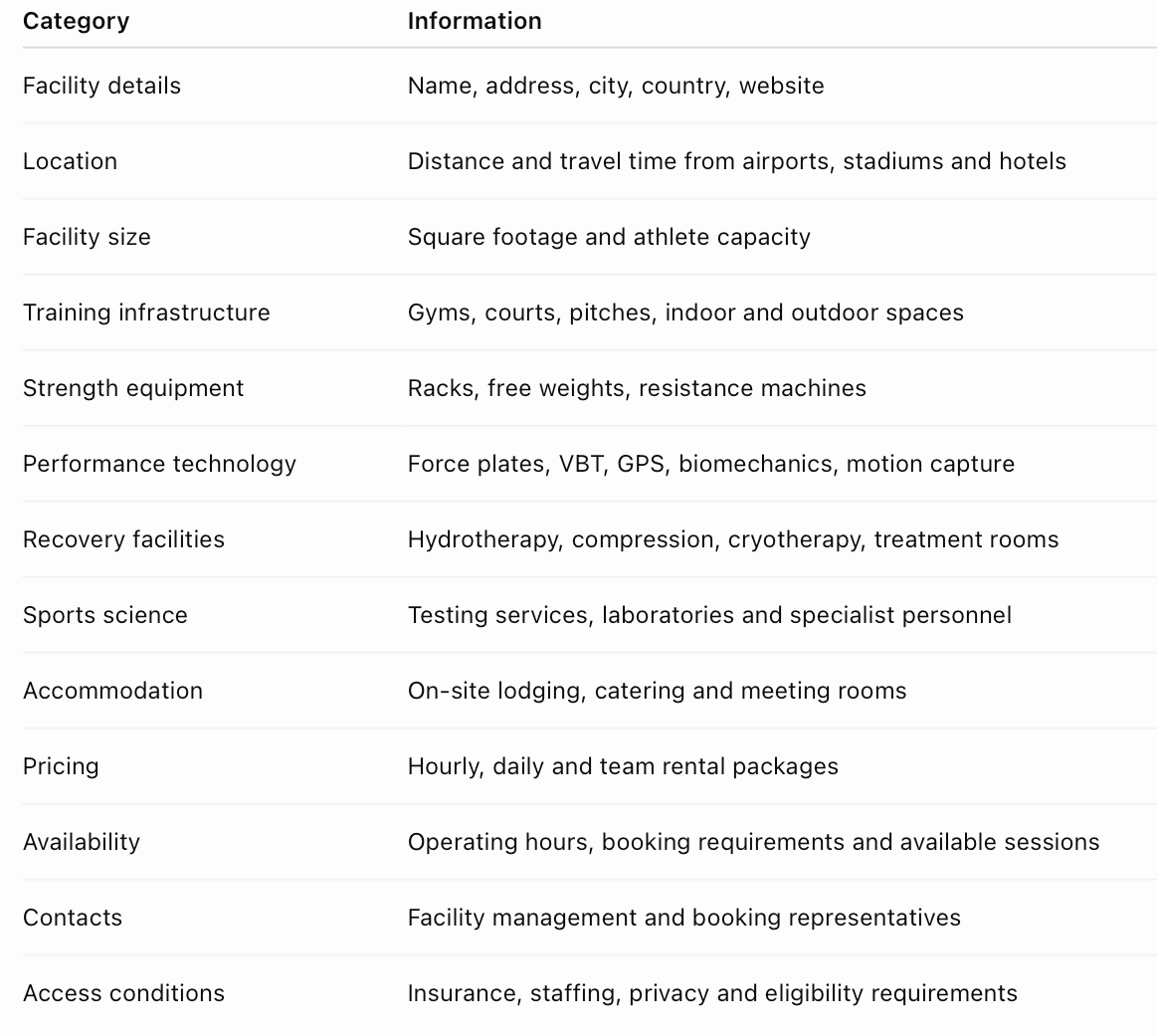
The concept is to build a global database of facilities, including information about their locations, amenities, equipment, technologies, pricing and availability.
The goal is to make it easier for teams to find suitable training environments when traveling for games, tournaments and training camps.
How It Would Work
Imagine an MLS team traveling to Los Angeles for a weekend game.
A performance director could ask:
“We’re playing in Los Angeles this weekend and need a performance center near LAX with strength-training equipment, recovery facilities and enough space for 25 players. Which facilities would you recommend?”
The AI Assistant could then:
Identify suitable performance centers based on the team’s requirements.
Compare available facilities based on location, travel time, amenities, technology and pricing.
Provide relevant facility information, including websites, equipment and booking contacts.
Connect the team directly with the selected performance center to discuss availability and arrange access.
This would move the experience beyond searching for facilities and toward helping teams coordinate their actual training needs.
Building a Global Performance Center Database
We envision including the following parameters:
Potential Benefits for Teams
Reduce the time spent searching for training facilities.
Identify centers that match sport-specific requirements.
Compare amenities and technologies before booking.
Maintain training and rehabilitation routines while traveling.
Access appropriate facilities in unfamiliar cities.
Connect directly with facility operators.
Potential Benefits for Performance Centers
Increase visibility among professional and collegiate teams.
Generate introductions to visiting organizations.
Promote specialized technologies and services.
Attract potential new customers.
Build relationships with practitioners and performance departments worldwide.
This represents a potential new direction for the Upside AI Assistant, extending its existing focus on sports technology scouting into performance infrastructure discovery.
Recommendations for Professional Teams
Based on the facilities examined and the operational requirements of traveling teams, several recommendations emerge.
1. Build a Database of Trusted Performance Centers
Teams should maintain a shortlist of reliable training facilities in cities they visit regularly.
This database should include locations, contacts, amenities, technologies, pricing and access requirements.
2. Prioritize Travel Time and Logistics
Distance alone is not enough.
Teams should consider traffic, proximity to hotels and stadiums, transportation arrangements and available training windows.
3. Evaluate Technology Availability
Before booking, teams should verify whether the facility offers the specific technologies required for their training and assessment protocols.
This may include force plates, VBT devices, GPS systems, biomechanics equipment and rehabilitation technologies.
4. Confirm Equipment Compatibility
Not all systems produce directly comparable measurements.
Teams should verify equipment models, testing protocols, software compatibility and data-export capabilities before relying on an external facility for performance monitoring.
5. Consider the Entire Performance Environment
A facility with excellent strength equipment may lack treatment rooms, recovery areas or sufficient space for a full team.
Teams should evaluate the complete range of services rather than focusing on one feature.
6. Verify Pricing and Availability
Teams should confirm rental rates, staffing requirements, exclusive-use options, cancellation policies and additional service charges.
7. Establish Relationships with Facility Operators
Building relationships with local performance centers can simplify future travel arrangements and provide access to trusted contacts when unexpected needs arise.
8. Prioritize Data Security and Athlete Privacy
When using external technologies, teams should establish clear procedures for collecting, storing, accessing and transferring athlete data.
Confidentiality and control over sensitive performance information should be considered during facility selection.
9. Consider Integrated Training Camp Facilities
For longer stays, facilities combining training, accommodation, nutrition, recovery and medical services may offer logistical advantages.
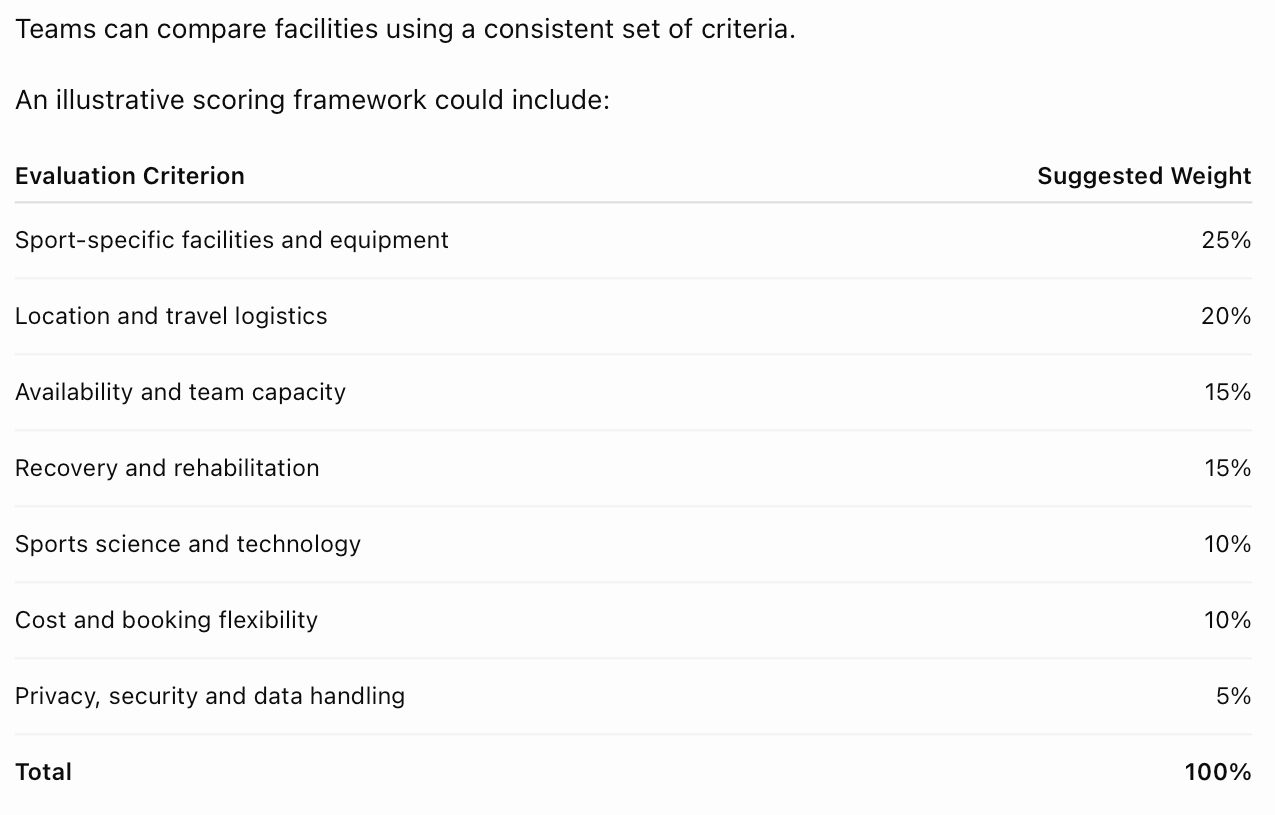
10. Use a Structured Facility Evaluation Framework
Conclusion: Toward a More Connected Global Performance Ecosystem
The world’s leading sports performance centers demonstrate how much elite training infrastructure has evolved.
Facilities such as Red Bull’s Athlete Performance Center, NZCIS, St. George’s Park, Aspire Zone, IMG Academy and the Australian Institute of Sport illustrate different approaches to integrating physical preparation, sports science, rehabilitation, recovery and athlete development.
Technology is becoming an increasingly important part of this evolution.
Force plates, wearable sensors, VBT systems, biomechanics technologies, athlete management platforms and AI-powered analytics are helping practitioners collect objective data and make more informed decisions.
However, the next major opportunity may not be building larger or more technologically advanced facilities. It may be making existing performance infrastructure easier for professional teams to discover, evaluate and access.
For an MLS team visiting another city, an NHL club on a road trip, an international rugby squad preparing for a test match, or an NBA team organizing offseason training, quickly identifying a suitable performance center could reduce logistical complexity and help maintain training continuity.
Looking ahead, a connected global ecosystem of performance centers, supported by better facility data, technology integration, AI-powered discovery and direct introductions, could transform how teams organize training and recovery away from home.
At Upside, we believe there is an opportunity to help build that ecosystem through our AI Assistant, connecting professional teams with the right performance centers, technologies and people wherever they compete.
Ultimately, the future of elite sports performance will depend not only on the technologies and facilities teams own, but also on their ability to access the right expertise and infrastructure anywhere in the world.