

Upside Weekend Analysis | October 24–25, 2026
Three major events. Three different business models. One common theme: technology is reshaping elite sports.
Introduction
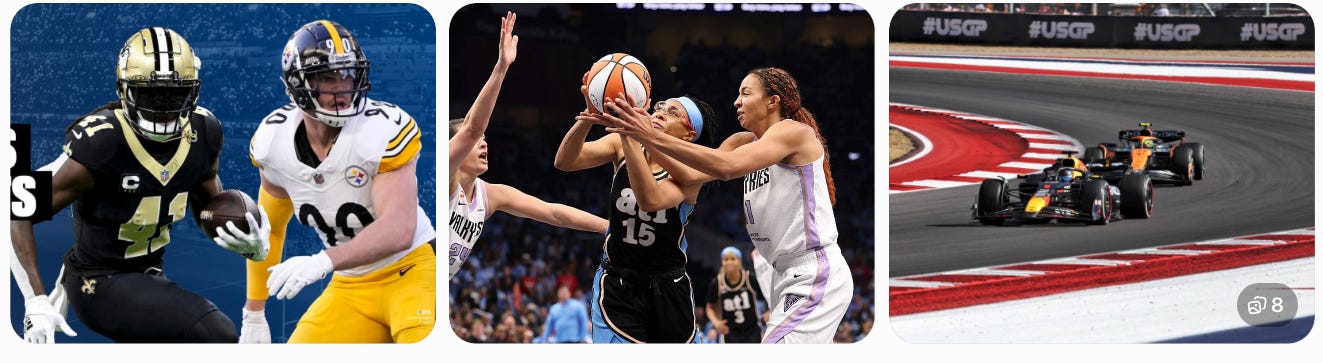
This weekend, three major sporting events will capture the attention of millions of fans around the world: the NFL’s historic first regular-season game in Paris, Game 4 of the WNBA Finals, and the Formula 1 United States Grand Prix in Austin, Texas.
While these events represent very different sports, they share several important characteristics. All three are becoming increasingly international, attracting investment, developing new commercial opportunities, and adopting advanced technologies to improve performance, athlete health, and the fan experience.
For sports executives, investors, technology companies, and performance practitioners, there is much more to watch than the final scores.
The NFL’s expansion into France illustrates how professional leagues are developing new international markets. The WNBA Finals highlight the commercial growth of women’s sports and the need for more investment in female athlete performance and health. Formula 1 remains one of the most technologically sophisticated sports in the world, offering lessons in data analytics, engineering, and real-time decision-making.
At Upside, we believe these events offer a useful perspective on the future of elite sports, sports technology, and the business of sports.
NFL in Paris: A Historic Moment for American Football and International Expansion

Sunday, October 25
9:30 AM ET · Stade de France, Paris
The Pittsburgh Steelers will face the New Orleans Saints in the first NFL regular-season game ever played in France.
The game will take place at the Stade de France, one of Europe’s most recognizable sporting venues, with a capacity of approximately 80,000 spectators.
Why people should watch
1. A historic milestone for the NFL
For decades, the NFL has worked to expand its presence beyond the United States through international games, media partnerships, grassroots programs, and commercial initiatives.
The Paris game represents another major step in that strategy.
France is particularly interesting because of its strong sporting culture, large consumer market, and international visibility.
The Saints also have a natural historical connection to France through New Orleans, making this matchup an attractive opportunity for the NFL to introduce its product to French fans.
2. The economics of NFL international expansion
The NFL’s international strategy is about much more than selling tickets for one game.
It creates opportunities across several revenue streams:
International media and broadcasting rights.
Corporate sponsorships and partnerships.
Merchandise and licensing.
Ticketing, hospitality, and tourism.
Long-term fan development and grassroots participation.
According to Associated Press reporting, approximately 70% of tickets for the Paris game were purchased locally, with roughly 20% of attendees expected to travel from the United States. The NFL also arranged free-to-air coverage in France, underscoring its ambition to develop a broader audience.
This matters because successful international expansion requires local demand rather than relying exclusively on American fans traveling overseas.
For the NFL, Paris could become an important European market alongside its established international destinations.
3. An unusual performance and recovery challenge
From a sports performance perspective, international NFL games create significant logistical and physiological challenges.
Traveling from the United States to Europe can involve changes in sleep schedules, circadian rhythms, meal timing, training routines, and recovery strategies.
Practitioners must balance travel logistics with player readiness, particularly when athletes are expected to compete at maximum intensity shortly after crossing multiple time zones.
Relevant technologies include sleep-monitoring wearables, athlete management systems, GPS tracking, physiological monitoring, and recovery assessment tools.
One particularly interesting detail this weekend is the playing surface. Preparations for the Paris game involved producing grass near Milan and installing a hybrid field at Stade de France, illustrating the engineering involved in adapting a major European venue for American football.
The impact of technology
NFL teams already operate in highly data-intensive environments, but international competition increases the importance of translating information into practical decisions.
Sleep and readiness monitoring can help staff identify changes in athletes’ routines. GPS and workload data can help coaches manage training intensity. Biomechanics and medical assessments can inform return-to-play decisions.
However, no single technology can reliably determine whether an athlete will perform well after international travel. Teams still need to interpret data alongside individual athlete responses, medical assessments, and practitioner judgment.
An additional factor: Event security and operational resilience
This year’s Paris game also comes amid reports of civil unrest and increased security measures. The NFL has continued its preparations, while some other sporting activities in Paris have been disrupted.
For league executives, the situation highlights another challenge of international expansion: ensuring that venue operations, transportation, security, and contingency planning meet the demands of a major live sporting event.
Upside Take
The NFL’s international expansion is creating new opportunities for sports technology companies specializing in sleep, recovery, athlete monitoring, travel management, and performance optimization.
As leagues schedule more international games, performance departments will increasingly need practical solutions to manage travel demands while protecting athlete readiness.
The Paris game is an opportunity to examine how teams prepare athletes for international competition—and which technologies genuinely help.
WNBA Finals: Women’s Basketball, Commercial Growth, and the Future of Female Athlete Performance

Saturday, October 24
1:00 PM ET · State Farm Arena, Atlanta
The Atlanta Dream will host the Golden State Valkyries in Game 4 of the 2026 WNBA Finals.
Atlanta enters the game with a 2–1 series lead following a commanding 97–71 victory in Game 3. Both teams are pursuing their first WNBA championship.
Why people should watch
1. A potentially defining moment in the championship series
Game 4 could dramatically change the direction of the Finals.
Atlanta has an opportunity to move within one victory of the championship, while Golden State is trying to even the series before returning home.
The matchup is particularly compelling because the teams represent two different stories: Atlanta’s pursuit of a long-awaited title and Golden State’s rapid emergence as a championship contender.
The series also showcases the growing depth and competitiveness of women’s professional basketball.
2. The economics of women’s sports are changing
The WNBA’s commercial development is one of the most important stories in professional sports.
For years, women’s sports were often evaluated primarily through traditional television audiences and sponsorship arrangements.
Today, investors and team owners increasingly recognize opportunities across franchise ownership, media rights, corporate partnerships, merchandise, premium hospitality, and direct-to-consumer engagement.
The league’s new labor agreement has also changed its financial structure. The 2026 salary cap increased substantially, from approximately $1.5 million in 2025 to $7 million in 2026, according to CBS Sports.
That represents a significant shift in how the league allocates resources to players.
But the broader economic question extends beyond compensation.
As women’s sports become more valuable, organizations will need to invest more in the infrastructure that supports elite athletes: performance departments, sports science, rehabilitation, nutrition, facilities, and medical technology.
3. Women’s sports represent an important growth market for sports technology
Historically, much of the sports performance technology industry has developed products, datasets, and research programs around male athletes.
That creates an important opportunity—and a responsibility—for companies serving women’s professional sports.
Performance technologies should account for relevant physiological, anatomical, and training differences while avoiding assumptions that every female athlete requires the same approach.
Areas of particular interest include:
Strength and conditioning and individualized workload monitoring.
ACL injury research, rehabilitation, and return-to-play.
Sleep, recovery, and fatigue assessment.
Nutrition, energy availability, and athlete health.
Biomechanical assessment and movement analysis.
Menstrual-cycle-related research and athlete-led symptom tracking, where clinically appropriate.
The important distinction is that a product marketed specifically to women is not automatically more scientifically valid.
Teams should expect rigorous validation, transparent limitations, and evidence that the technology supports meaningful decisions.
The impact of technology
The WNBA Finals offer a useful opportunity to examine the relationship between performance technology and athlete availability.
During a playoff series, teams must manage limited recovery time, tactical preparation, accumulated fatigue, and potentially changing player roles.
GPS and indoor tracking systems can help quantify movement demands. Force plates and biomechanical assessments may contribute information about neuromuscular function. Athlete management platforms can consolidate medical, training, and wellness information.
Computer vision and AI-powered video analysis could also help teams evaluate movement patterns and tactical performance.
However, technologies should complement—not replace—the expertise of medical and performance practitioners.
There is also a commercial technology story.
As the WNBA attracts larger audiences, teams and sponsors have opportunities to develop more sophisticated digital experiences, personalized content, fan analytics, and commercial partnerships.
Upside Take
The growth of women’s professional sports could become one of the most important catalysts for innovation in athlete health and performance technology over the next decade.
Sports technology companies that invest in research involving female athletes, build relationships with WNBA practitioners, and develop scientifically credible products may be particularly well positioned.
This is also one reason we’re excited about our planned 2027 Upside WNBA VIP Dinner in Miami, bringing together performance and medical representatives from WNBA teams to exchange best practices and explore emerging technologies.
The opportunity is not simply to sell more technology to women’s teams. It is to develop better solutions through direct collaboration with female athletes and the practitioners supporting them.
Formula 1 United States Grand Prix: The Ultimate Laboratory for Performance Technology and Data Analytics

Sunday, October 25
4:00 PM ET · Circuit of The Americas, Austin, Texas
The Formula 1 United States Grand Prix takes place this Sunday at Circuit of The Americas (COTA), one of the most recognizable tracks in North America.
The race will cover 56 laps of the 5.513-kilometer circuit. Qualifying takes place Saturday, with the Grand Prix scheduled for Sunday at 3:00 PM local time.
Why people should watch
1. An important weekend in the championship race
Formula 1 is entering a crucial stage of the season.
Young driver Kimi Antonelli arrives in Austin with a potential opportunity to secure the world championship, while competitors are looking to challenge his position.
Meanwhile, Charles Leclerc led Friday’s practice sessions, adding another interesting storyline ahead of qualifying.
Fans should watch how qualifying, tire management, race strategy, and execution influence the outcome.
Unlike many sports, Formula 1 makes the relationship between engineering, technology, human performance, and competitive results unusually visible.
2. The economics of Formula 1 extend far beyond racing
Formula 1 has evolved into a global sports and entertainment business built around multiple revenue streams.
These include broadcasting and streaming rights, race-hosting agreements, sponsorships, premium hospitality, licensing, merchandising, and commercial partnerships.
For host cities, a Grand Prix can also create demand for hotels, restaurants, transportation, entertainment, and tourism.
Austin is an example of how a sporting event can become part of a city’s broader international identity.
For corporate sponsors, Formula 1 offers a combination of global visibility, technological sophistication, premium hospitality, and access to influential commercial audiences.
The sport is particularly attractive to technology, automotive, financial services, and enterprise software companies because its competitive product is closely connected to engineering and innovation.
3. Formula 1 demonstrates the commercial value of advanced analytics
In Formula 1, small improvements can produce meaningful competitive advantages.
Teams use extensive sensor systems, simulation, engineering models, and race-strategy software to evaluate performance.
The objective is not simply to collect data. It is to make better decisions under pressure.
That is an important lesson for professional sports teams and technology startups.
A performance department with dozens of technologies is not necessarily more effective than one with fewer, better-integrated systems.
The key is understanding which information is reliable, which variables matter, and how to translate data into action.
The impact of technology
Formula 1 offers several particularly relevant technology applications.
Driver biometrics and physiological monitoring
Drivers experience significant physical and cognitive demands, including heat exposure, high gravitational forces, muscular fatigue, and sustained concentration.
Physiological monitoring and driver conditioning can help support preparation and recovery, although access to detailed individual biometric data varies by team and application.
Real-time data analytics
Cars generate large quantities of telemetry that engineers use to evaluate vehicle behavior, tire performance, mechanical systems, and race strategy.
The lesson for sports performance departments is the importance of turning complex information into timely, practical decisions.
Digital twins and simulation
Formula 1 teams rely heavily on simulation and modeling to explore different vehicle setups and race scenarios.
Similar principles could support emerging applications in sports biomechanics, training simulation, rehabilitation, and skill acquisition.
However, modeling a race car is not the same as modeling a human athlete. Biological variability, uncertainty, and the limits of current measurement systems make athlete digital twins a more complex proposition.
AI and predictive analytics
AI and machine learning can help identify patterns in large datasets, support scenario analysis, and improve engineering workflows.
In professional sports, related approaches may eventually support athlete monitoring, video analysis, training personalization, and operational planning.
The challenge remains validation: a sophisticated prediction is only valuable if it is sufficiently accurate and improves real-world decisions.
Technology is also changing how fans watch Formula 1
An especially interesting development this weekend is the evolution of F1’s U.S. broadcast experience.
Apple TV is offering coverage of the United States Grand Prix with English and Spanish commentary and access to multiple additional feeds, including driver tracking, onboard cameras, timing data, and race-position information.
This reflects a broader trend toward personalized sports broadcasting.
Instead of watching a single television feed, fans can increasingly select data-rich viewing experiences and follow the competitors or storylines that interest them most.
For sports leagues, that creates potential opportunities in audience engagement, digital subscriptions, sponsorship integration, and interactive media products.
Upside Take
Formula 1 remains one of the best examples of how engineering, data analytics, human expertise, and technology can work together to improve competitive performance.
For NBA, NFL, NHL, MLS, and other professional sports organizations, there are lessons in how F1 teams organize information, coordinate multidisciplinary staff, and make decisions under pressure.
For sports-tech startups, Formula 1 also reinforces an important principle: collecting large amounts of data is not enough.
The real competitive advantage comes from converting that data into accurate, timely, and actionable information.
The Bigger Picture: Five Trends Connecting These Events
Although the NFL, WNBA, and Formula 1 operate in different markets, their evolution highlights five important trends.
1. Sports are becoming increasingly global. The NFL’s Paris debut and Formula 1’s international calendar demonstrate how leagues use live events to reach new fans, attract sponsors, and expand media opportunities.
2. Women’s sports represent a significant commercial and innovation opportunity. The WNBA’s growth is creating greater demand for specialized performance services, scientific research, and technologies developed and validated with female athletes.
3. Data integration is becoming more important than data collection. Formula 1 illustrates the value of coordinating complex datasets and expert judgment. Professional sports teams face similar challenges when combining information from wearables, biomechanics, medical assessments, and athlete management systems.
4. Athlete health and availability remain central priorities. Whether managing transatlantic travel in the NFL, playoff fatigue in the WNBA, or physical demands in Formula 1, teams need reliable approaches to preparation, monitoring, and recovery.
5. Technology is transforming both competition and the fan experience. Advanced analytics, AI, interactive broadcasts, and digital platforms are creating new opportunities for sports organizations and technology companies.
Conclusion: Three Events, One Important Message for the Sports Technology Industry
This weekend provides an interesting snapshot of where professional sports are heading.
The NFL’s historic game in Paris highlights the opportunities and complexities of international expansion. The WNBA Finals demonstrate the growing economic importance of women’s sports and the need for greater investment in athlete health and performance. Formula 1 illustrates how technology, data, and human expertise can be combined to create a competitive advantage.
For sports technology startups, these events also reinforce an important lesson.
The most promising opportunities are not necessarily about creating more data, more sensors, or more AI-powered dashboards. They are about helping teams solve meaningful problems.
Whether that means improving athlete readiness after international travel, supporting female athlete health, enhancing biomechanics analysis, or making complex information easier to interpret, the objective should remain the same: deliver measurable value to practitioners and athletes.
At Upside, we’ll continue following these developments, connecting with practitioners across professional leagues, and identifying innovations that can make a difference in elite sports.
Which of these three events are you most excited to watch this weekend? And which technologies do you believe will have the biggest impact on the future of professional sports?