
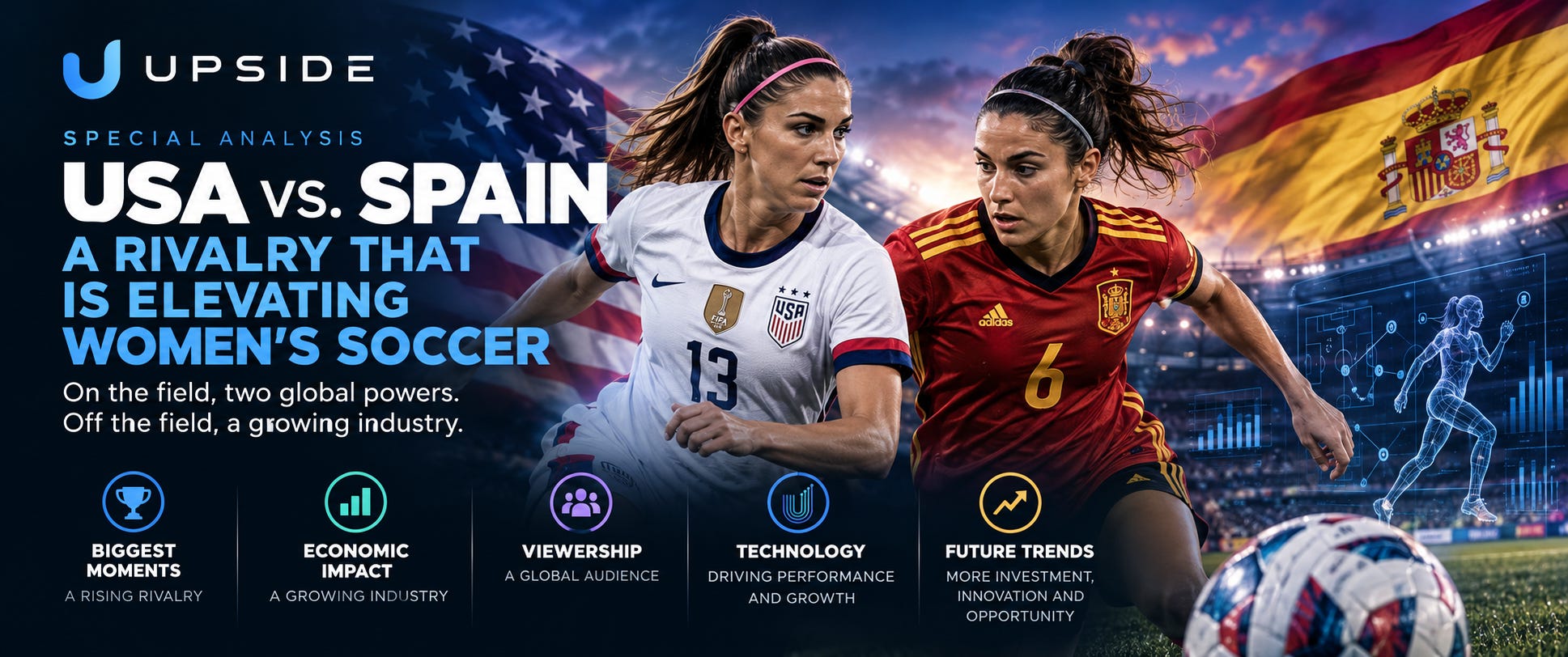
Upside Special Analysis | October 2026
Two Global Powers, Two Different Soccer Philosophies

Few matchups illustrate the evolution of women’s soccer better than the United States versus Spain.
For decades, the United States Women’s National Team (USWNT) represented the global benchmark in women’s soccer, combining athleticism, physical conditioning, competitive intensity and a deeply established development system.
Spain, meanwhile, has emerged as one of the most technically sophisticated national teams in the world, built around possession-based soccer, positional intelligence, technical development and a generation of exceptional players.
The contrast is fascinating.
The United States has historically emphasized speed, physicality, transitional play and competitive resilience. Spain has become associated with intricate passing, ball retention, tactical organization and intelligent movement.
But this rivalry is about more than competing playing styles.
It reflects fundamental changes taking place across women’s professional soccer:
Increasing investment in women’s professional leagues and national teams.
Rising commercial valuations, sponsorship opportunities and media rights.
Growing global audiences and digital engagement.
Greater use of sports science, performance technology and advanced analytics.
Increasing recognition of the specific physiological and medical needs of female athletes.
For Upside, the USA–Spain matchup provides an opportunity to examine not only what is happening on the field, but also how women’s soccer is evolving into a more sophisticated global sports business.
The Biggest Moments in the USA–Spain Rivalry
Unlike the USA’s historic rivalries with Germany, Canada or Japan, the rivalry with Spain is relatively young.
Before October 2026, the two national teams had met only four times. The United States won the first three matches, while Spain won the most recent encounter.

2019 Women’s World Cup: The USA survives Spain’s challenge

The most significant competitive meeting between the two countries took place during the 2019 FIFA Women’s World Cup in France.
The United States entered the tournament as defending champion and one of the favorites to win.
Spain, however, demonstrated that it could challenge the Americans with its technical quality and tactical organization.
Megan Rapinoe scored twice from the penalty spot, helping the United States secure a 2–1 victory.
The Americans eventually went on to win their fourth Women’s World Cup title.
Upside Take: This match offered an early indication of Spain’s emergence as a serious international contender. Although the United States prevailed, Spain demonstrated the technical foundation that would eventually help it become world champion.
2020 SheBelieves Cup: Another narrow American victory
In March 2020, the two teams met at Red Bull Arena in New Jersey.
The United States won 1–0 thanks to a late Julie Ertz header.
Once again, Spain proved difficult to break down.
The game reinforced the idea that Spain was closing the competitive gap with established women’s soccer powers.
2022: Spain earns its first victory
In October 2022, Spain defeated the United States 2–0 in Pamplona.
It was Spain’s first victory over the Americans and marked a significant moment in the rivalry.
The result reflected Spain’s continued progress, even as its national team faced considerable organizational challenges.
2023: Spain becomes world champion
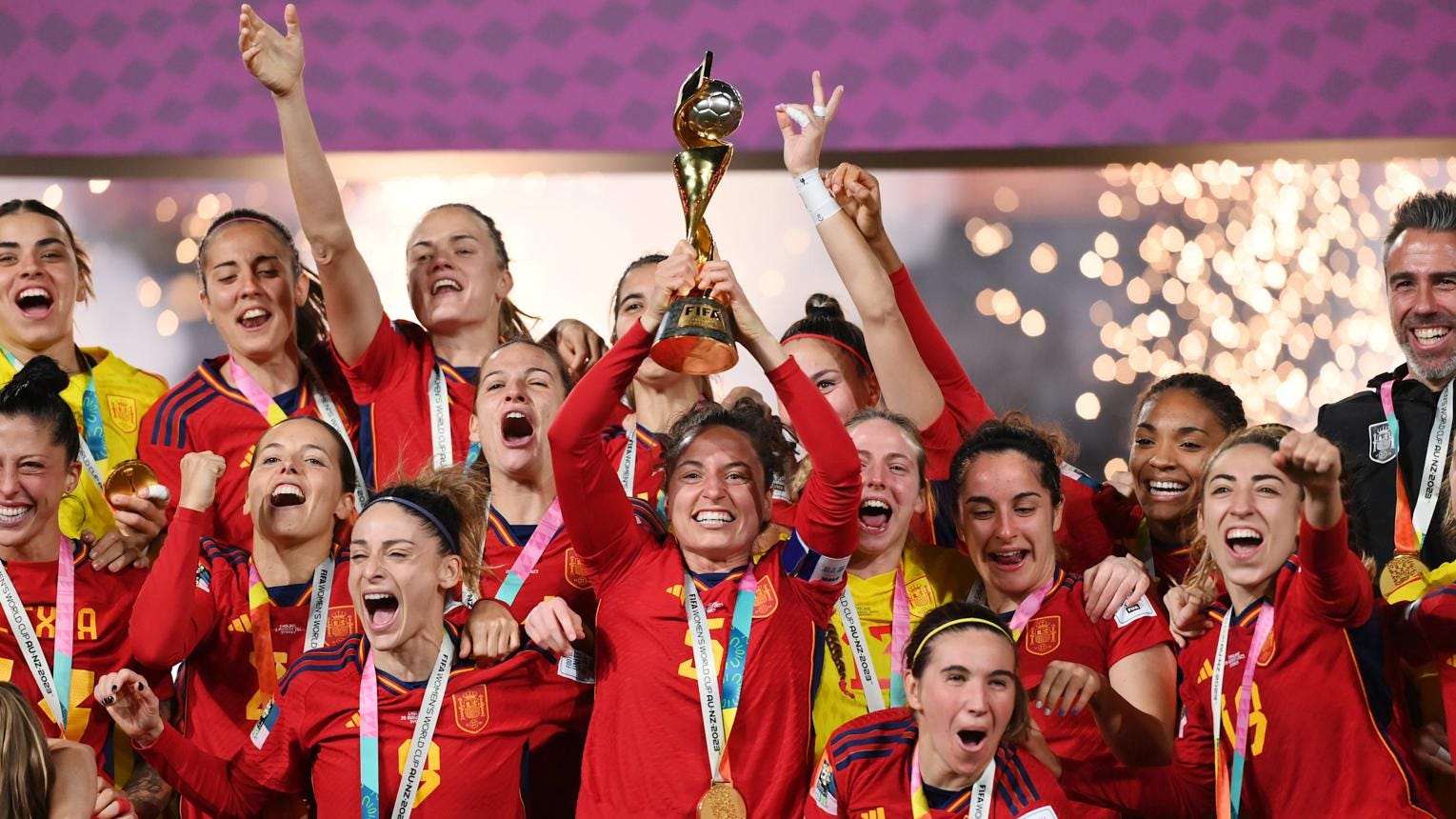
Although the two countries did not meet at the 2023 World Cup, the tournament dramatically changed their relative positions.
Spain defeated England 1–0 in the final to win its first Women’s World Cup.
The United States, meanwhile, exited in the Round of 16 after losing to Sweden on penalties.
For Spain, the victory validated years of technical development and investment in elite women’s soccer.
For the United States, the tournament highlighted the increasing competitiveness of international women’s soccer.
2024–2026: Two champions prepare for another encounter
The United States responded to its 2023 disappointment by winning Olympic gold at Paris 2024 under Emma Hayes.
Spain continued to establish itself among the world’s strongest national teams, including winning the 2025 UEFA Women’s Nations League.
As of October 2026, Spain is ranked No. 1 in the world and the United States No. 2.

These matches are particularly important because both countries are preparing for the 2027 Women’s World Cup in Brazil.
For Emma Hayes, the games provide an opportunity to evaluate the American team’s tactical development, player combinations and ability to compete against a possession-oriented opponent.
For Spain, they provide another high-level test against an elite team with a different playing philosophy.
The rivalry has evolved from the United States defending its historical dominance to two world-class teams competing to establish the next standard in women’s soccer.
Economic Impact: Women’s Soccer Is Becoming a Major Business
The commercial transformation of women’s soccer is one of the most important developments in the global sports industry.
Historically, women’s national teams and professional clubs operated with smaller budgets, limited media exposure and fewer sponsorship opportunities than their male counterparts.
That is changing.
Major international tournaments, increasing investment in professional leagues and the growing popularity of female athletes have helped create a much larger commercial ecosystem.
The Women’s World Cup has become an economic engine
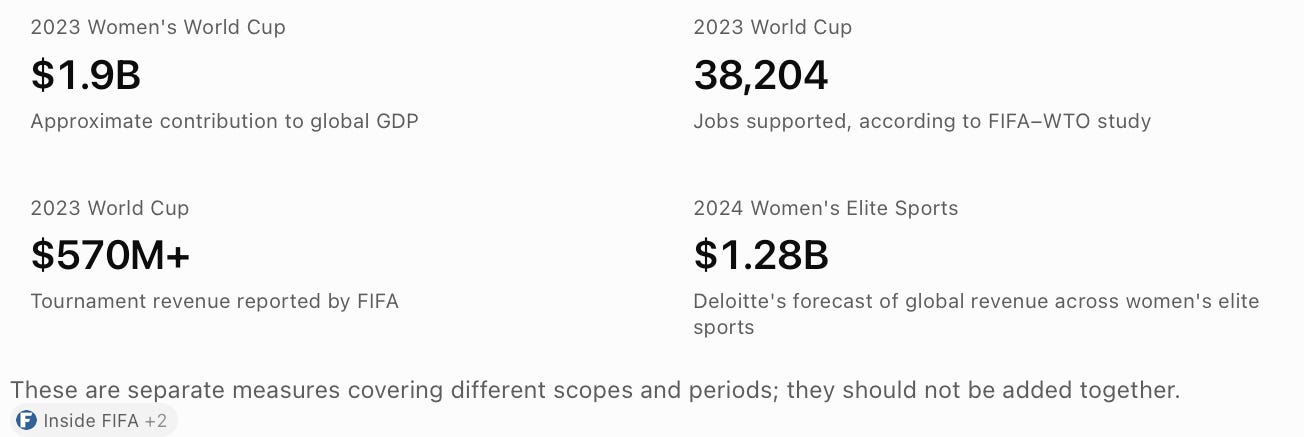
According to a FIFA–World Trade Organization study, the 2023 Women’s World Cup contributed approximately $1.9 billion to global GDP, supported more than 38,000 jobs and generated an estimated $932 million in additional household income.
These figures reflect the economic activity generated by the tournament, including tourism, hospitality, operations and related industries. They are not equivalent to FIFA’s direct tournament revenue.
The growing popularity of women’s soccer is also creating new opportunities for global brands.
The 2023 Women’s World Cup generated approximately $308 million in sponsorship revenue, according to Deloitte, as FIFA expanded its ability to sell commercial rights specifically associated with the women’s tournament.
This distinction matters.
Women’s soccer is increasingly being marketed as a valuable commercial property in its own right, rather than as an extension of men’s soccer.
Brands can connect with a growing audience through national team partnerships, player endorsements, grassroots programs, digital campaigns and stadium activations.
What is the economic impact of USA vs. Spain specifically?
The October 10 and October 13 matches offer several potential sources of commercial value:
Ticket sales, premium seating and hospitality.
Sponsorship activation for U.S. Soccer’s commercial partners.
Broadcast advertising and streaming engagement.
Merchandise sales and athlete-related licensing.
Visitor spending on hotels, restaurants and transportation.
Additional visibility for women’s professional soccer in the United States.
However, no independently verified economic-impact estimate for these two specific matches is available yet.
Their actual impact will depend on attendance, ticket pricing, visitor spending, broadcast audiences and sponsorship performance.
Upside Take: The significance of USA–Spain extends beyond the immediate revenue from two international friendlies. High-profile matchups can help attract new fans, reinforce commercial partnerships and increase the long-term value of women’s soccer properties.
Viewership: How Big Is the Audience for Women’s Soccer?
Perhaps the strongest evidence of women’s soccer’s commercial growth is its ability to attract substantial television and streaming audiences.
Major international tournaments have repeatedly demonstrated that women’s soccer can generate audiences comparable to other major sporting events.
The United States: A proven television audience
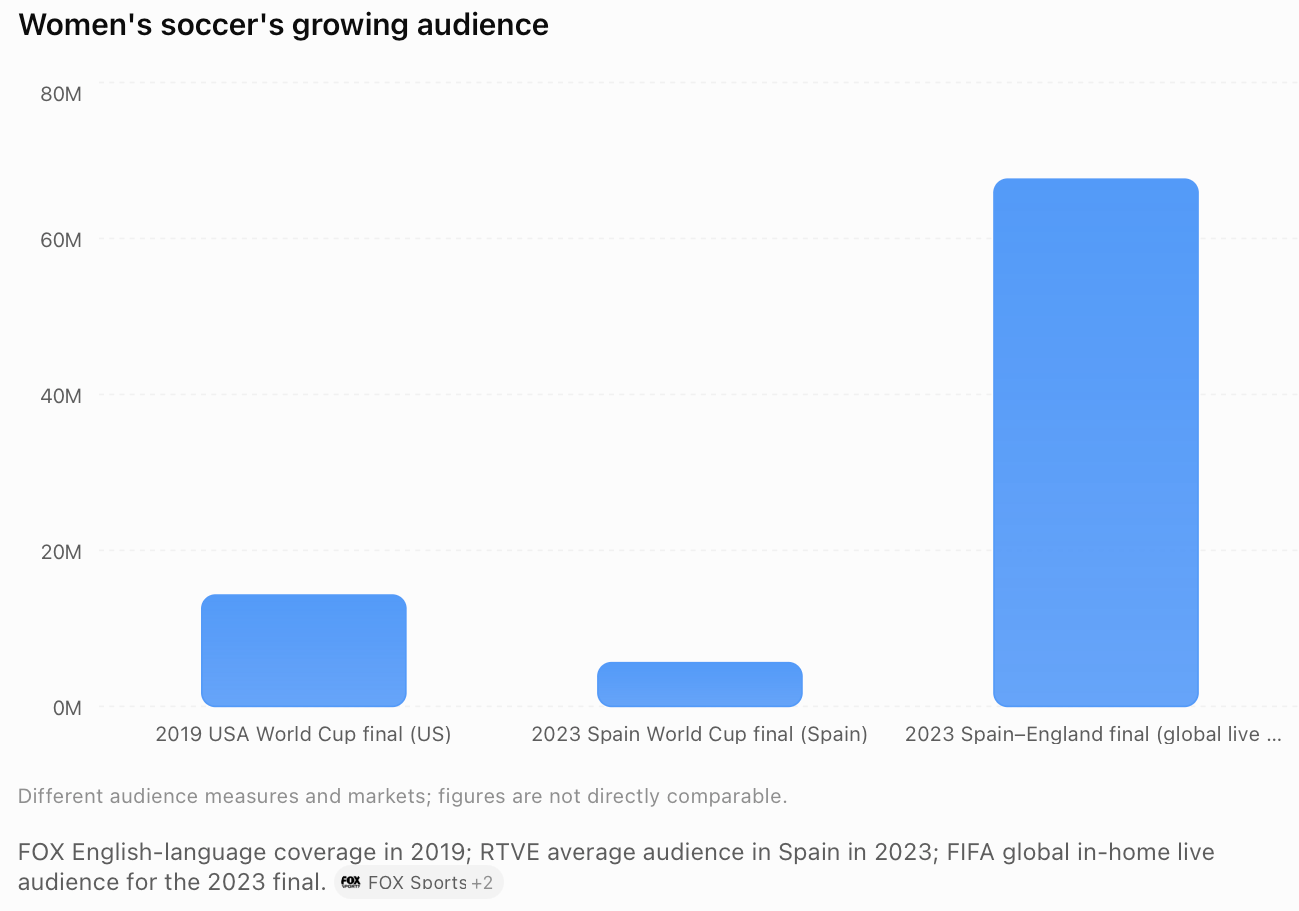
The 2019 Women’s World Cup final between the United States and the Netherlands attracted approximately 14.27 million viewers across FOX’s English-language television and streaming coverage.
The audience peaked at nearly 20 million viewers.
These figures demonstrated the national appeal of the USWNT when competing on the biggest stage.
Spain: A national television phenomenon
Spain’s 2023 Women’s World Cup victory over England produced exceptional television numbers.
According to the Spanish Football Federation:
Approximately 5.6 million average viewers watched the final in Spain.
The broadcast achieved a 65.7% audience share.
Nearly 8.9 million unique viewers watched at least part of the match.
Peak concurrent viewership exceeded 7.3 million.
For women’s soccer in Spain, these figures represented a major commercial and cultural milestone.
Global viewership: The international opportunity
FIFA reported that the 2023 Women’s World Cup generated approximately 2 billion in total media engagement across different viewing channels and platforms.
The Spain–England final alone recorded approximately 67.6 million average global in-home live viewers, while its broader live reach across television, digital and out-of-home viewing was considerably higher.
The distinction between average audience, unique reach, streams and engagement is important when comparing these numbers.
Professional league viewership is growing
In the United States, the NWSL has benefited from substantial investment in television distribution.
The league’s four-year domestic media rights agreements, beginning in 2024, were reportedly worth $240 million.
In 2025, ESPN reported that its NWSL audience across ABC, ESPN and ESPN2 increased by 72% compared with the previous year, based on the measurement period used in its announcement.
The league subsequently expanded its broadcast arrangements for the 2026 and 2027 seasons.
How many viewers will watch USA vs. Spain in October 2026?
That remains to be determined.
As of October 9, the games have not taken place, and verified viewership figures are therefore unavailable.
Several factors could influence the audience:
Positive factors: The matchup features the world’s top two ranked national teams, the reigning world champion and Olympic champion, recognizable players, and broad English- and Spanish-language distribution.
Potential constraints: These are friendlies rather than World Cup elimination matches. Saturday afternoon also places the first game in competition with other live sports programming.
The important question is whether USA–Spain can attract not only dedicated women’s soccer supporters but also casual sports fans.
Upside Take: The next stage of women’s soccer’s media growth will depend on its ability to build consistent audiences outside major tournaments. International friendlies, professional league matches and club competitions must become commercially valuable properties in their own right.
The Impact of Technology on Women’s Soccer

One of the most exciting developments in women’s soccer is the increasing use of performance technology, sports science and data analytics.
Historically, many sports technology products were developed and validated primarily using male athlete populations.
As investment in women’s soccer grows, teams and technology companies have an opportunity to develop more sophisticated approaches that account for female athletes’ health, physiology and performance needs.
This could become one of the most important areas of innovation in professional sports.
A. GPS wearables and athlete monitoring
GPS and inertial sensor technologies allow sports science departments to monitor external workload and movement demands.
Companies such as Catapult Sports and STATSports provide technologies used across elite soccer.
These systems can measure:
Total distance covered.
High-speed running and sprinting exposure.
Accelerations and decelerations.
Training intensity and changes in workload.
Positional movement demands.
For teams, the challenge is not simply collecting more data. It is understanding how that information should influence training, recovery and player availability.
Upside Take: As women’s soccer becomes faster and more physically demanding, individualized workload management will become increasingly important. However, thresholds and models should be validated for the relevant athlete population rather than automatically borrowed from men’s soccer.
B. Injury prevention and rehabilitation technology
Anterior cruciate ligament (ACL) injuries remain a major concern in women’s soccer.
Several technologies could help practitioners assess movement, monitor rehabilitation progress and support return-to-play decisions.
Examples include:
Force plates: Hawkin Dynamics and VALD technologies can help quantify force production, asymmetries and neuromuscular performance.
Motion analysis: Qualisys and markerless computer-vision platforms can help assess biomechanics and movement patterns.
Strength assessment: Isometric and dynamic testing systems can support rehabilitation monitoring.
AI analytics: Emerging platforms are attempting to combine workload, injury history, movement and physiological information to identify potentially meaningful risk patterns.
Importantly, measuring a risk factor is not the same as accurately predicting an injury.
Teams should demand prospective validation, clinically meaningful performance metrics and evidence that interventions improve outcomes.
C. Female-specific health and performance monitoring
This may represent one of the most significant opportunities for innovation.
Female athletes can benefit from individualized monitoring that considers menstrual symptoms, energy availability, iron status, recovery and other relevant health factors.
In April 2026, U.S. Soccer’s Kang Women’s Institute announced research initiatives focused on female athlete health, including a study examining how menstrual cycle tracking could be integrated into real-world soccer performance environments.
This is particularly significant because research on female athlete physiology has historically been underrepresented.
However, the science must be interpreted carefully.
A UEFA consensus statement published in 2025 emphasized that evidence linking menstrual cycle phases to specific performance changes or injury risk remains inconclusive.
Tracking can still support symptom management, athlete education and the identification of health concerns, provided it is voluntary, private and athlete-centered.
Upside Take: The opportunity is not to create simplistic algorithms claiming that every female athlete should train differently during a particular cycle phase. It is to build individualized, scientifically credible tools that help practitioners understand each athlete’s health and performance.
D. AI, computer vision and tactical analytics
AI-powered video analysis is transforming how soccer teams evaluate performance.
Companies such as Hudl, SkillCorner and other video analytics providers offer tools that can support tactical analysis, player evaluation and scouting.
Potential applications include:
Automatically identifying important match events.
Tracking player positioning and movement.
Evaluating pressing structures and defensive organization.
Analyzing passing patterns and attacking sequences.
Supporting opposition scouting and recruitment.
For a matchup such as USA–Spain, analysts could use tracking and event data to examine how the Americans respond to Spain’s possession game and how Spain handles the USA’s speed in transition.
The greatest value comes when analysts translate these outputs into practical coaching decisions.
E. Technology is also transforming officiating and broadcasting
The 2023 Women’s World Cup featured technologies including VAR, semi-automated offside technology, goal-line technology and connected-ball systems.
FIFA’s semi-automated offside system used dedicated cameras to track player positions and sensors in the match ball to support officials’ decisions.
These technologies illustrate how innovation can improve the accuracy and presentation of major women’s soccer competitions.
For broadcasters, richer tracking data can also create new storytelling opportunities, from tactical visualizations to interactive player statistics.
As media rights become more valuable, the presentation of women’s soccer is likely to become increasingly sophisticated.
Future Trends: What Comes Next for Women’s Soccer?
Over the next five years, I expect several developments to reshape the women’s soccer industry.
1. More investment in female-specific performance technologies
Women’s soccer represents an important growth opportunity for companies developing solutions in athlete monitoring, injury rehabilitation, nutrition, recovery and women’s health.
The opportunity extends beyond adapting products originally developed for men.
It includes collecting more representative datasets, conducting research specifically involving female athletes and designing tools around their needs.
2. AI will become increasingly integrated into team operations
Rather than operating multiple disconnected technologies, teams will increasingly look for platforms capable of integrating:
GPS and tracking data.
Biomechanics and strength assessments.
Medical and rehabilitation information.
Match video and tactical analysis.
Recovery and wellness indicators.
The objective will be to give practitioners a more complete view of athlete readiness and performance.
For vendors, interoperability, scientific credibility and ease of use could become important competitive advantages.
3. Injury prevention and athlete availability will receive more investment
As professional women’s soccer calendars expand, managing training loads, travel, recovery and injury rehabilitation will become more challenging.
Technologies that can help practitioners make better decisions about athlete availability could become attractive investments.
However, teams should distinguish between technologies that measure relevant variables and those that have demonstrated an ability to improve injury outcomes.
4. Women’s soccer media rights and sponsorship values could continue rising
The NWSL’s media rights agreements and the strong audiences generated by major international tournaments demonstrate growing commercial interest.
I expect broadcasters, sponsors and investors to continue exploring women’s soccer as a distinct commercial category.
The challenge will be translating major tournament audiences into consistent engagement throughout the year.
5. More investment in women’s soccer academies and development pathways
As professional clubs compete for talent, youth development will become increasingly important.
Technologies supporting player assessment, skill development, scouting and injury prevention could become more accessible to academies and grassroots organizations.
This could help expand the talent pool while improving long-term athlete development.
6. The 2027 Women’s World Cup could accelerate investment

The next FIFA Women’s World Cup will take place in Brazil in 2027.
It will provide another major opportunity to evaluate the growth of women’s soccer in viewership, sponsorship, attendance and international participation.
FIFA has also publicly discussed ambitions for Women’s World Cup revenue to reach $1 billion, although that remains a target rather than a confirmed outcome.
For sports technology companies, the tournament could provide an important showcase for innovations in athlete performance, officiating, broadcasting and fan engagement.
Conclusion: USA vs. Spain Is About More Than Soccer
The upcoming USA–Spain matches represent an important moment for women’s soccer.
On the field, they bring together two of the world’s strongest national teams with different playing philosophies and exceptional talent.
The United States remains a historic powerhouse, while Spain’s emergence as world champion demonstrates how quickly the international competitive landscape has evolved.
Off the field, the matchup highlights a broader transformation.
Women’s soccer is attracting greater commercial investment, stronger television audiences, more sophisticated sponsorship partnerships and increasing interest from technology companies.
For professional teams, that growth creates opportunities to invest further in sports science, medical support, performance analytics and player development.
For sports-tech startups, women’s soccer represents an increasingly important market — particularly for companies developing technologies that address the specific needs of female athletes.
For investors, the sport offers exposure to a growing global industry spanning professional clubs, media rights, athlete health, digital platforms and fan engagement.
My Upside Take
I believe the next stage of women’s soccer’s growth will be defined by three interconnected developments:
1. Greater commercialization: Increasing investment in teams, players, leagues and media properties.
2. Greater professionalization: More resources dedicated to sports science, rehabilitation, coaching and athlete development.
3. Greater innovation: Technologies designed, tested and validated specifically for female athletes.
But this growth also presents an important responsibility.
Women’s soccer should not simply inherit the technologies, assumptions and research models developed for men’s sports.
It deserves its own scientific research, product innovation and investment ecosystem.
The USA–Spain rivalry is a compelling example of how far women’s soccer has progressed.
And the next major breakthrough in women’s soccer may come not only from what happens on the field, but also from the investments, technologies and scientific advances supporting the athletes who play the game.
Major Sports Events on TV This Weekend
Saturday, October 10 – Sunday, October 11, 2026 | All times Eastern (ET)
It’s a packed sports weekend, with NFL football, major college football rivalries, the MLB playoffs, WNBA semifinals, NHL hockey and Formula 1.
Here are the biggest events worth watching, including their scheduled TV and streaming coverage.
Saturday, October 10

The college football slate is particularly strong, with Texas–Oklahoma and two major prime-time matchups. The White Sox–Guardians game is a winner-take-all playoff decider.
Sunday, October 11

Other major events worth watching
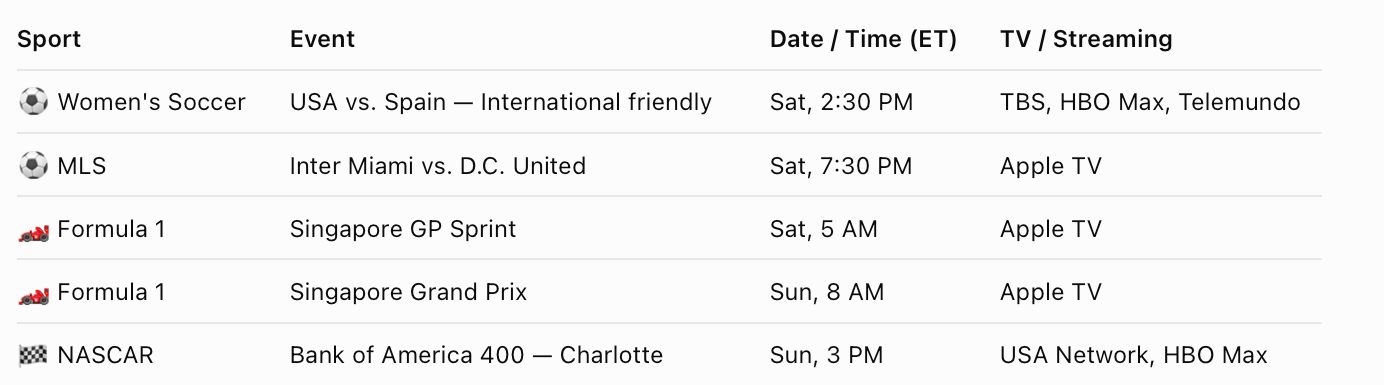
The USA–Spain match is particularly compelling, featuring two of the world’s leading women’s national teams. Formula 1 also returns to Singapore for its famous night race.
My top five must-watch events
Georgia vs. Alabama — Saturday’s major SEC showdown.
USA vs. Spain — A high-profile international women’s soccer matchup.
Singapore Grand Prix — One of Formula 1’s most distinctive races.
49ers vs. Seahawks — An important NFC West matchup.
Dodgers vs. Brewers — The opening game of the NLCS.