
Introduction
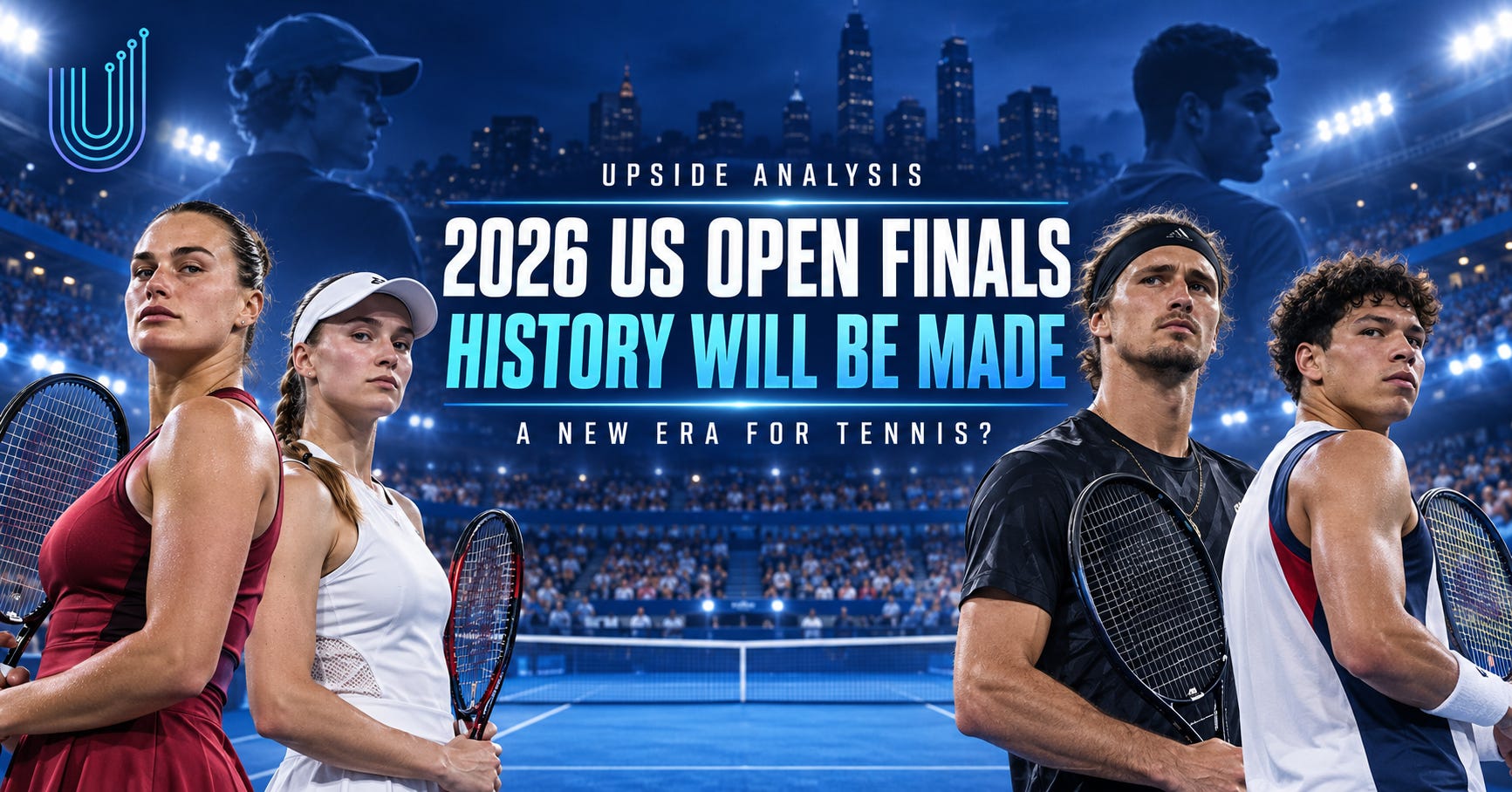
The 2026 US Open concludes this weekend with two finals carrying unusually significant historical implications:
Women’s final: Aryna Sabalenka vs. Elena Rybakina
Men’s final: Alexander Zverev vs. Ben Shelton
These matches are about much more than determining the final Grand Slam champions of the year.
Sabalenka is attempting to become the first woman since Serena Williams to win three consecutive US Open titles. Rybakina is preparing to become the new world No. 1 and could begin her reign by defeating the player she is replacing.

On the men’s side, Shelton could end a 23-year Grand Slam drought for American men’s tennis. Zverev, meanwhile, has an opportunity to complete the best season of his career and avenge one of the most painful defeats of his professional journey.

The tournament may also have introduced a new dynamic into the rivalry between Jannik Sinner and Carlos Alcaraz. Sinner missed the tournament through injury, Alcaraz was eliminated by Shelton, and two different players will contest the men’s final.
Each possible outcome would create a different chapter of tennis history. That is what makes these finals so compelling: history will be made regardless of who lifts the trophies.
Key Moments of the 2026 US Open
The 2026 US Open has already produced several unforgettable moments.
The tournament’s defining match may have been Shelton’s five-set upset of defending champion Alcaraz. It lasted four hours and 28 minutes and ended at 3:33 a.m.—the latest finish in US Open history.
Shelton defeated Alcaraz 6–7, 6–1, 6–3, 1–6, 7–6, overcoming dramatic momentum swings to claim the biggest victory of his career. The result ended Alcaraz’s 18-match Grand Slam winning streak and guaranteed that a new men’s champion would be crowned in New York. (Source: The Guardian)
Shelton then defeated Frances Tiafoe in four sets in the first US Open men’s semifinal contested by two Black players. He became the first Black American man to reach the US Open final since Arthur Ashe in 1972 and the first American man overall to reach the championship match since Andy Roddick in 2003.
The women’s tournament also made history when its top four seeds reached the semifinals for the first time in 51 years.
Sabalenka defeated Jessica Pegula to reach her fourth consecutive US Open final, while Rybakina came from behind to beat Coco Gauff in three sets. By advancing deep into the tournament, Rybakina also secured the world No. 1 ranking for the first time and ended Sabalenka’s 99-week reign at the top.
Serena and Venus Williams provided another emotional moment by returning to compete together in women’s doubles. The sisters lost an extraordinary three-hour match to Chan Hao-ching and Maya Joint after holding a 5–0 lead in the deciding tiebreak.
Taylor Townsend and Kateřina Siniaková captured the women’s doubles championship. For Townsend, the victory carried particular significance after the obstacles and criticism she faced earlier in her career.
Karolína Muchová and Jakub Menšík also produced a remarkable run to the mixed-doubles title. They saved two match points in the semifinals before defeating Belinda Bencic and Flavio Cobolli in the championship match.
Together, these moments have made the 2026 US Open a celebration of established champions, emerging stars, American tennis and the continued evolution of the sport.
Women’s final: Aryna Sabalenka vs. Elena Rybakina
The women’s final brings together two of the most powerful and accomplished players in tennis.
Sabalenka and Rybakina have developed one of the defining rivalries of this generation. Sabalenka leads their head-to-head series 10–7, but that record does not fully capture how competitive their matches have been.
This will be their 18th meeting and third encounter in a Grand Slam final. They split their first two major finals against one another and have repeatedly met during the latter stages of the sport’s biggest tournaments.
Their rivalry is also compelling because of their contrasting personalities.
Sabalenka plays with visible emotion, intensity and energy. She celebrates loudly, expresses frustration openly and frequently feeds off the atmosphere surrounding a major match.
Rybakina is almost the opposite. Her body language tends to remain calm regardless of the score. She rarely reveals whether she is confident, frustrated or under pressure.
Their personalities may differ, but their tennis is built around similar principles.
Both players possess:
Powerful first serves
Aggressive returns
Deep and penetrating groundstrokes
The ability to shorten points
The confidence to attack under pressure
The physical tools required to dominate on hard courts
This is not merely a final between two players having excellent tournaments. It is a confrontation between the outgoing world No. 1, the incoming world No. 1 and perhaps the two most consistently dangerous hard-court players in women’s tennis.
Sabalenka’s opportunity to complete a rare three-peat
If Sabalenka wins, she will capture her third consecutive US Open title.
No woman has accomplished that since Serena Williams won three straight championships from 2012 through 2014. Before Serena, the women who dominated the tournament for multiple consecutive years included some of the greatest players in tennis history.

A three-peat at any Grand Slam is difficult. Achieving it at the US Open can be particularly challenging because of the environment.
New York presents players with:
Loud and unpredictable crowds
Late-night matches
Humid summer conditions
Constant media attention
Intense pressure
A long season already accumulated in the body
Limited recovery time between demanding matches
Sabalenka has not merely survived those conditions. She has learned how to thrive in them.
She has reached four consecutive US Open finals and enters this championship match with a 19-match winning streak at the tournament. Her ability to reproduce elite performances year after year in New York has become one of the defining achievements of her career.
Winning a third straight title would give Sabalenka a fifth Grand Slam singles championship. It would also strengthen the argument that she has become the dominant hard-court player of this period.
There would be an additional twist: Sabalenka could lose the world No. 1 ranking and still leave New York holding the trophy.
That would create an unusual contrast between the rankings and the immediate competitive result. Rybakina would officially become the world’s top-ranked player, but Sabalenka would remain the three-time defending US Open champion.
A victory would therefore do more than add another major to Sabalenka’s résumé. It would reinforce her status as one of the most consistent champions the US Open has seen in the modern era.
Rybakina’s opportunity to begin a new era
Rybakina has already achieved something historic during this tournament.
By advancing deep enough in New York, she secured the world No. 1 ranking for the first time and ended Sabalenka’s 99-week reign at the top.
Becoming No. 1 is a major achievement by itself. Winning the US Open, however, would give that transition far greater symbolic importance.

Rybakina would not simply move ahead through ranking calculations. She would take the top position while defeating the player she is replacing in the final of a Grand Slam.
This is only the third time in the 21st century that a Grand Slam final has coincided with a change at world No. 1. That makes the match a rare direct confrontation for leadership of the women’s game. (Source: The Guardian)
Rybakina also began the 2026 Grand Slam season by winning the Australian Open. A victory in New York would mean she opened and closed the major season by winning its two hard-court championships.
That would be a powerful statement about her consistency, durability and ability to adapt over the course of a long season.
It would also further validate her resilience.
Rybakina entered the US Open following health and injury challenges, including an Achilles issue. She nevertheless navigated a demanding draw and defeated Gauff in three sets after losing the opening set in their semifinal.
Her path to the final has therefore required more than serving power and clean ball-striking. It has required physical resilience, tactical adjustment and composure under pressure.
If she wins, Rybakina will leave New York as the US Open champion, a two-time Grand Slam winner in 2026 and the new world No. 1.
That combination would mark the beginning of a new era at the top of women’s tennis.
A final that could define the leading women’s rivalry
The historical importance of this final extends beyond rankings and trophies.
Women’s tennis has featured significant depth in recent years, with Iga Swiatek, Gauff, Pegula and other leading players consistently competing for major titles. But Sabalenka and Rybakina have developed a particularly compelling rivalry because their matches repeatedly occur on the biggest stages.
If Sabalenka wins, she will reinforce her dominance in New York and protect her position as the leading major champion in this rivalry.
If Rybakina wins, she will have defeated Sabalenka in two Grand Slam finals during the same season while taking over the No. 1 ranking.
Either result could reshape how the rivalry is viewed.
The final is therefore not simply about who is better on one particular day. It could influence how this entire period of women’s tennis is remembered.
Men’s final: Alexander Zverev vs. Ben Shelton
The men’s final offers a very different historical storyline.
Zverev represents experience, patience and eventual breakthrough. Shelton represents youth, explosive potential and the possibility of ending one of American tennis’s longest periods without a men’s Grand Slam champion.
Zverev has won all five of his previous meetings with Shelton. Several of those matches have been competitive, but Shelton has yet to cross the finish line against him.
The matchup will also feature two of the biggest servers in the sport. Both players are tall, powerful and capable of controlling games without allowing an opponent to enter the point.

Their broader games, however, are at different stages of development.
Zverev has spent years competing near the top of the rankings. He has experienced major finals, Olympic competition, deep tournament runs, serious injuries and the pressure associated with being expected to win a Grand Slam.

Shelton is only beginning that phase of his career. His athleticism and serving power have never been in question, but his progress in consistency, returning, shot selection and emotional control has turned him into a genuine major contender.
The final is therefore a meeting between a player seeking to consolidate his legacy and one attempting to begin his own.
Shelton’s opportunity to end a 23-year American drought
Shelton is the first American man to reach the US Open final since Roddick won the tournament in 2003.
That illustrates how difficult the past two decades have been for American men at the Grand Slam level.

The United States has continued to produce highly ranked players, deep tournament runs and occasional semifinalists. However, no American man has won a Grand Slam singles title since Roddick’s victory in New York 23 years ago.
During much of that period, Roger Federer, Rafael Nadal and Novak Djokovic dominated the sport. Younger champions subsequently emerged, but the American drought continued.
Shelton now has an opportunity to change that narrative in front of his home crowd.
If he wins, he would become:
The first American man to win a Grand Slam singles title since Andy Roddick in 2003
The first American man to win the US Open in 23 years
The first Black American man to win the US Open singles title since Arthur Ashe in 1968
A Grand Slam champion in his first major final
The significance would extend well beyond Shelton’s individual career.
American tennis has invested heavily in player development, coaching, facilities, analytics and the search for its next men’s major champion. A Shelton victory would provide a visible return on that investment and potentially inspire a new generation of American players.
His style could make that impact even more significant.
Shelton is athletic, expressive and charismatic. He plays with visible enthusiasm and connects naturally with crowds. His left-handed serve is one of the most recognizable weapons in tennis, while his background as an NCAA champion gives him an unusual development story compared with players who entered the professional system much earlier.
His rise demonstrates that college tennis can still provide a legitimate pathway to the highest levels of the professional game.
A victory would therefore create history in several ways: for Shelton, for American men’s tennis, for Black American representation and for the credibility of the collegiate development pathway.
Zverev’s opportunity to complete his greatest season
Zverev enters the final from a very different position.
For years, he was considered one of the best players of his generation not to have won a Grand Slam. He reached major semifinals and finals, won significant tour titles and earned an Olympic gold medal, but the defining Grand Slam victory remained missing.
That changed when he won the 2026 French Open.

He then reached the Wimbledon final and has now advanced to the US Open championship match. This means he has appeared in three consecutive Grand Slam finals during the same season.
If he wins in New York, Zverev will finish this stretch with two major titles from three finals. It would confirm his transformation from perennial contender into consistent Grand Slam champion.
The victory would also carry significant personal meaning because of what happened at this tournament in 2020.
Zverev led Dominic Thiem by two sets in that US Open final and came within two points of winning the championship. He ultimately lost in a fifth-set tiebreak.
That defeat became one of the central stories of his career.
Returning to the same tournament six years later and finally winning the title would complete a long redemption arc. It would demonstrate the mental resilience required to revisit the site of a devastating defeat and produce a different ending.
He would also have to do it against an American opponent supported by the Arthur Ashe Stadium crowd.
The atmosphere is likely to favor Shelton heavily. Zverev will have to manage the crowd, the occasion and the pressure of competing against a first-time finalist carrying the hopes of American tennis.
If he succeeds, the victory would provide evidence of his growth—not simply as a tennis player, but as a competitor capable of handling the emotional demands of the sport’s biggest moments.
A potential generational turning point
The men’s final could also become a generational marker.
A Zverev victory would reinforce the position of an established star who has spent more than a decade on the professional tour.
A Shelton victory would introduce a new American Grand Slam champion at a moment when men’s tennis continues searching for the players who will shape its future.
The contrast is particularly striking because of the different paths they followed.
Zverev became a professional as a teenager and spent years being identified as a future major champion. Shelton developed through American college tennis before accelerating rapidly on the professional tour.
One path represents early specialization and long-term development within the international professional system. The other demonstrates the potential value of allowing a player to mature physically, technically and emotionally within the NCAA environment.
That makes the final relevant not only to tennis fans but also to coaches, performance specialists and development programs.
It raises an important question:
Is there one ideal pathway to producing a Grand Slam champion—or can fundamentally different development systems lead athletes to the same stage?
Sunday’s result will not answer that question completely, but it will give one pathway a historic validation.
Has This US Open Changed the Sinner–Alcaraz Rivalry?
Over the past few years, the central storyline in men’s tennis has been the rivalry between Sinner and Alcaraz.
Their contrasting styles, ages, athleticism and repeated meetings in major finals created the impression that they could dominate the sport together for the foreseeable future.

The 2026 US Open did not end that rivalry, but it introduced a potentially important new dynamic.
Sinner’s absence changed the tournament
Sinner was unable to compete in New York because of a right knee injury that had kept him out since his Wimbledon victory.
This was the first Grand Slam tournament he had missed since making his major debut at the 2019 US Open.
Before his withdrawal, Sinner had won six titles and compiled a 44–3 record in 2026, demonstrating that he remained one of the sport’s dominant players. His absence, however, showed how quickly physical availability can reshape the hierarchy at a major tournament. (Source: NBC Sports)
Availability may now become a more important part of the Sinner–Alcaraz rivalry.
Both players have demonstrated the ability to dominate when healthy, but both have also experienced physical interruptions during 2026. The player who manages his body and schedule most effectively may ultimately gain as much of an advantage as the player who wins their direct matchups.
Sinner’s withdrawal opened one side of the draw and removed one of the tournament’s leading contenders before the first ball was struck.
That opportunity allowed other players—particularly Zverev—to move deeper into the tournament without having to defeat Sinner.
Shelton demonstrated that Alcaraz can be disrupted
Alcaraz returned after being sidelined for more than four months because of a wrist injury. He still reached the quarterfinals, but Shelton ended his title defense and his 18-match Grand Slam winning streak.
The significance of Shelton’s victory went beyond a single upset.
Before that match, Shelton had reportedly lost all 17 of his previous encounters against players ranked inside the world’s top three. Defeating Alcaraz under extreme pressure suggested that Shelton may be developing the consistency, tactical variety and emotional control required to challenge the sport’s leading players.
His serve has always made him dangerous. The more important development was his ability to remain composed through five sets, recover from significant momentum shifts and finish the match against one of the best competitors in tennis.
One victory does not make Shelton an equal member of the Sinner–Alcaraz rivalry. But it established that he possesses the weapons to beat one of them on a Grand Slam stage.
If he can reproduce that level consistently, the conversation surrounding men’s tennis may begin to expand beyond two players.
Zverev has become a consistent Grand Slam factor
Zverev’s season has added another layer to the changing competitive picture.
After winning the French Open, reaching the Wimbledon final and advancing to the US Open final, he has now appeared in three consecutive Grand Slam championship matches.
That level of consistency demonstrates that the men’s game may not belong exclusively to Sinner and Alcaraz.
Zverev is also operating on a different timeline. At 29, he is older and more experienced than both players. He may not represent the next generation in the same way as Shelton, but he has developed into a more complete and resilient Grand Slam competitor.
He has turned the Sinner–Alcaraz rivalry from a potential two-player monopoly into, at minimum, a three-player championship conversation.
Is it a permanent shift or a temporary opening?
That remains the central question.
Sinner missed the US Open. Alcaraz was returning from a long absence. Djokovic also exited before the final. Those circumstances helped open the draw, but Zverev and Shelton still had to capitalize on the opportunity.
That distinction is important.
A new competitive era is not created simply because the leading players are absent or physically limited. It begins when other contenders repeatedly defeat them and reach major finals even when the field is healthy.
Shelton’s victory over Alcaraz provides the first part of that evidence. Zverev’s run of three consecutive major finals provides another.
The next test will be whether they can reproduce those results when Sinner and Alcaraz are both healthy and competing at their best.
This tournament may therefore have shifted the men’s tennis conversation from:
“Will Sinner or Alcaraz win?”
to:
“Who is capable of disrupting their rivalry?”
Sinner and Alcaraz remain the defining rivalry in men’s tennis. However, the 2026 US Open has shown that they may not control every major uncontested.
Zverev is becoming a more consistent Grand Slam champion, while Shelton has demonstrated that his athleticism and serving power can translate into victories over the sport’s very best.
The rivalry has not been replaced. But for the first time in this new era, the field around it may be beginning to take shape.
Conclusion
The 2026 US Open finals offer four distinctly historic possibilities.
Sabalenka could become the first woman since Serena Williams to win three consecutive US Open titles, extending one of the most dominant runs New York has seen in modern women’s tennis.
Rybakina could begin her reign as world No. 1 by defeating the player she is replacing, while completing a season in which she won both the Australian Open and US Open.
Shelton could end the 23-year Grand Slam drought in American men’s tennis, become the first Black American man to win the US Open since Arthur Ashe and validate college tennis as a pathway to the highest level of the professional game.
Zverev could complete his transformation into a multiple-time Grand Slam champion, win two majors during a season featuring three consecutive major finals and finally overcome the memory of his painful 2020 defeat in New York.
The tournament may also have expanded the wider conversation in men’s tennis. Sinner and Alcaraz remain its defining rivalry, but Zverev’s consistency and Shelton’s breakthrough suggest that other players may be ready to challenge their control of the majors.
This is what makes the weekend so compelling: its historical importance does not depend on one particular outcome.
The women’s final could either extend a dynasty or formally begin a new era.
The men’s final could either produce the breakthrough American tennis has awaited for more than two decades or complete one of the sport’s most significant redemption stories.
There will be two champions—but every possible result carries a legacy much larger than a single trophy.

Next week at Upside, we will host a new series of group podcasts and one-on-one interviews exploring the latest trends, best practices and future direction of sports, health and human performance.
Our upcoming conversations will focus on:
🏥 The Future of Sports Medicine
A group discussion with practitioners from the MLS and NBA examining how sports medicine is evolving.
🧠 Leadership and Skill Development
Practitioners from the NBA, MLS and international soccer will discuss how elite organizations develop better athletes, leaders and people.
🎾 The Future of Tennis
ATP and WTA practitioners and coaches will explore player development, performance, technology and the evolution of the sport.
🧬 One-on-One with the CEO of Tiny Health
A conversation about the microbiome, health innovation and the company’s vision for the future.
We look forward to bringing together leading practitioners, coaches and founders to discuss what is working today—and where the industry is heading next.
Stay tuned!
What to watch on TV this weekend
No. 1 Ohio State vs. No. 4 Texas
Angle: How NIL, the transfer portal and escalating football budgets are transforming college programs into professional-style organizations.
Saturday, 7:30 p.m. ET on ABC. (Source: College football schedule)Formula 1’s first race at Madrid’s new Madring circuit
Angle: How teams use simulators, digital twins and live telemetry to prepare for a completely unfamiliar track.
Sunday, 9 a.m. ET on F1 TV. (Source: Official Formula 1 preview)The opening Sunday of the NFL season
Angle: Are NFL teams doing enough to prepare players for game intensity following limited preseason participation? This connects well with your analysis of preseason acclimation and soft-tissue injuries.
The national Sunday-night game is Cowboys–Giants at 8:20 p.m. ET on NBC/Peacock. (Source: Sunday NFL schedule)FIBA Women’s World Cup final weekend
Angle: The narrowing international performance gap and how countries are developing deeper women’s basketball pipelines. Team USA faces Spain in Saturday’s semifinal.
Saturday, 2 p.m. ET on TNT, truTV and HBO Max. (Source: Semifinal details)The Subway Series: Mets vs. Yankees
Angle: With the MLB postseason approaching, how teams balance winning now with fatigue, pitching workloads and player availability.
Saturday and Sunday at 1:35 p.m. ET. Saturday is on MLB Network; local coverage is on YES and SNY.