
This week we had the honor to interview a group of ATP/WTA sports performance experts in pro tennis.
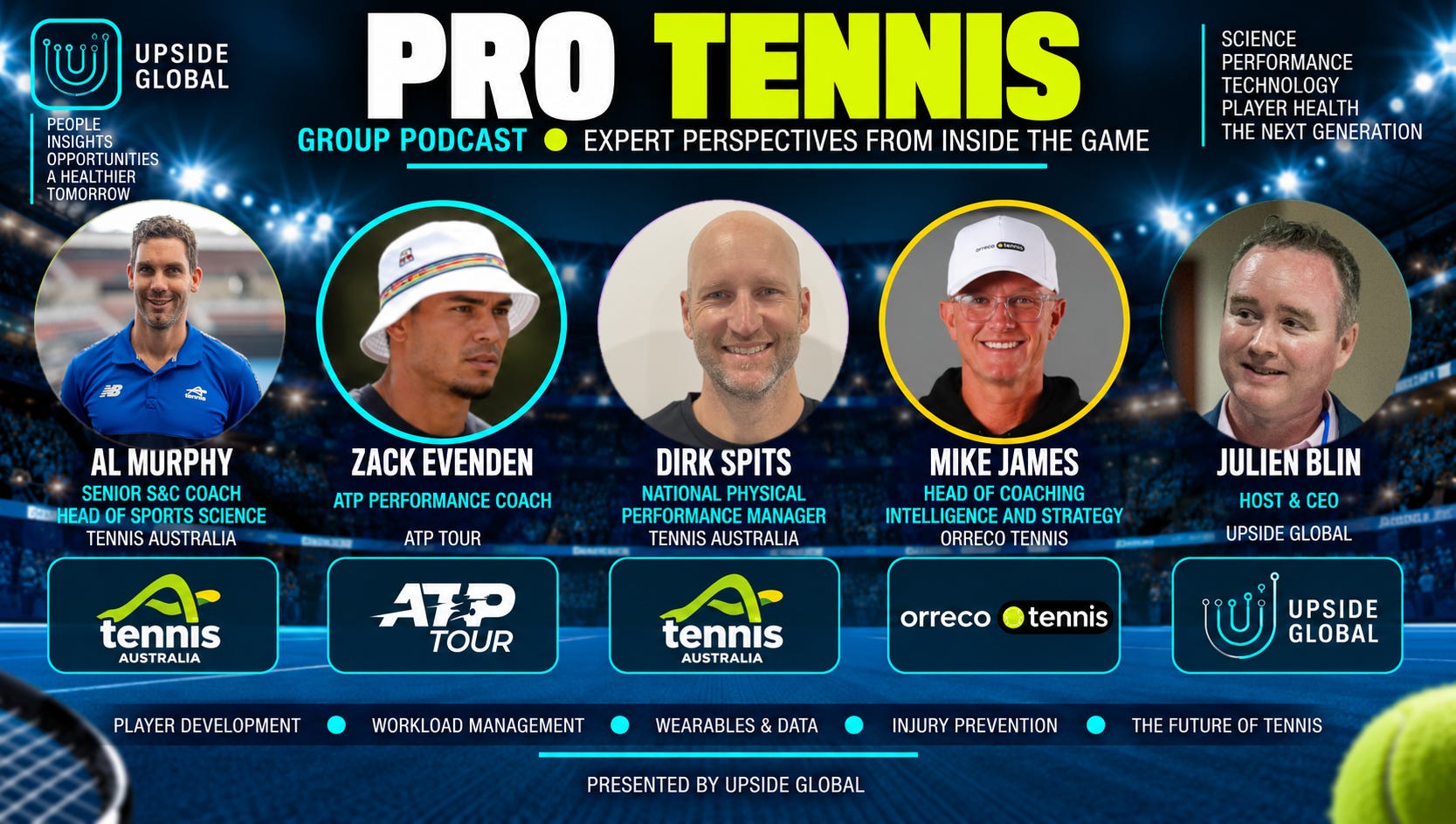
Al Murphy, senior S&C coach at Tennis Australia. Al works with tennis players such as Rinky Hijikata, Emerson Jones and Aleks Vukic. He is also the head of sports science at Tennis Australia.
Zack Evenden, an experienced performance coach. Zack has worked with top tennis players like Frances Tiafoe, and Michael Mmoh.
Dirk Spits, National Physical Performance Manager at Tennis Australia. Dirk works with tennis players such as James Duckworth, Ajla Tomljanovic, and Tristan Schoolkate.
Mike James, head of coaching intelligence and strategy at Orreco tennis. He has worked with top players such as Holger Rune, Kostyuk, CoCo Gauff, to name a few.
📝Show Notes: Through this interview, we touched on the following questions and topics:
Q1. The evolving rules governing wearables in professional tennis
When will greater in-competition use of wearables be permitted? How will the ITF-approved product list work, how should the industry address concerns from media partners, and who should ultimately own and control player data?
Q2. Scheduling, extreme heat and player welfare
How are increasingly demanding calendars and changing environmental conditions affecting top players? What can tours, tournaments and performance teams do to protect player health while maintaining competitive standards?
Q3. Lessons from the 2026 US Open
Looking back at this year’s US Open, what stood out from a physical-performance and player-health perspective? Were there any trends in preparation, recovery, injury patterns or match demands that practitioners should pay attention to?
Q4. Developing the next generation of professional players
As more young players break through at the highest level, how should coaches and performance teams balance immediate performance with long-term development? What can be done to manage workload, reduce overuse injuries and build athletes who can sustain successful careers?
Q5: The future of tennis intelligence
What will tennis intelligence look like five years from now? Will most professional players be using wearables that allow their teams to monitor physical and cognitive fatigue in real time? How could this information change the way coaches make decisions about training, recovery, match preparation and in-match strategy?
You can read the full transcript of the podcast interview located at the top of this blog post.
You can also watch the full video interview below:
Here are some of the best quotes of our conversation with them:
1. The evolving rules governing wearables
Al Murphy on the ITF-approved product list:
“The ITF approval does not mean that a product is valid, reliable or accurate. It simply means that the technology has gone through the proposal process, has been approved to be worn and does not allow athletes to use the data live during matches.”
Dirk Spits on data ownership:
“More data does not automatically mean better decisions. Ultimately, the players need to own their data. From there, it should be permission-based, with clear decisions about what can be used, how it can be used and how player privacy will be protected.”
Zach Evenden on the slow adoption of wearables:
“I’m surprised it has taken so long to work through the fine print. We were experimenting with wearables at the Next Gen Finals in 2019 and thought the sport was moving in that direction. Then we were told, ‘This is our data—it is not even your data if you wear it.’ What is the point of using the technology if the player does not control the data?”
Mike James on using live data to prevent injuries:
“The value of having this information on the court is incredibly important from an injury-prevention perspective. But the education within player teams is not yet high enough to utilize the data properly and act on it.”
2. Scheduling, extreme heat and player welfare
Mike James on who must address the schedule:
“It is not the teams that need to protect the players—it is the tours. The extended Masters events are creating more weeks on the road, along with greater physical and mental fatigue. I think the mental burnout is arguably bigger than the physical burnout.”
Dirk Spits on creating conditions for elite performance:
“We are not trying to make tennis easier. It is about creating an environment in which players have the opportunity to repeatedly express their best performance. We have to start examining the cost of competition, and that cost varies from player to player.”
Zach Evenden on how scheduling affects players differently:
“Players use the schedule however they see fit. It favors some players and does not favor others. The changes are being implemented for the tour generally, rather than creating an environment that consistently produces the elite level of tennis we saw five years ago.”
Al Murphy on preparing for extreme heat:
“There are certain tournaments where it is always hot, and players generally arrive prepared for those conditions. The bigger challenge may be having consecutive hot weeks or entering those conditions after a demanding period of competition.”
3. Lessons from the 2026 US Open
Dirk Spits on preparing athletes late in the season:
“At the back end of the year, many players are carrying something into the final Grand Slam. It has been a long season with cumulative travel and competition. We need to get the preparation right several weeks in advance and stay on top of any physical issues the players are carrying.”
Al Murphy on the increasing movement demands:
“The movement on the men’s side was incredible. I have not seen better movers at any tournament. Similar to the increase in ball speeds, it is almost scary how the level of movement continues to rise.”
Zach Evenden on Alexander Zverev’s progression through the tournament:
“In the first round, Zverev was hunched over with his hands on his knees and having to dig incredibly deep. But as the tournament continued, he got better and better. His movement was amazing, especially when you consider his size and how physically demanding the game has become.”
Mike James on movement and footwear innovation:
“Movement is going crazy. It is no longer only Novak sliding on both sides on a hard court; now Jannik is sliding on both sides on grass, and many other players are doing it. Shoe brands are looking closely at the optimal shoe for each player and how to make footwear robust enough to support these athletes.”
4. Developing the next generation of professional players
Mike James on improving standards within player teams:
“A lot of the tour is still like the Wild West—a traveling circus every week. You see practices with top-100 players that you should not see at a tennis club with a four-year-old. The sport must examine how it certifies and upskills practitioners so every player team has qualified people.”
Dirk Spits on confusing junior success with professional preparation:
“A lot of people confuse junior success with preparation for a professional career. They fast-track players through repetitive competition schedules, media demands and excessive training without considering growth, physical capabilities or the gap between where the player is now and where they need to be.”
Al Murphy on players’ ability to build stronger teams:
“Players can now afford to have good people around them. Top-100 players can hire a coach and a physical trainer for most weeks of the year, which was not always possible. There is now a real opportunity to bring better-skilled practitioners onto the tour.”
Zach Evenden on expertise and communication:
“You can have very smart people around, but the players may not want to listen to them. Delivery matters—how the person is introduced, how the message is communicated and how that expert is integrated into the team all need to be carefully considered.”
5. The future of tennis intelligence
Mike James on creating connected performance teams:
“My hope is that everything becomes connected—the physiotherapist, physical trainer, biomechanist, head coach and mental coach. Tennis contains so many unknowns: you do not know when the player will compete, how long the match will last or when they will travel. The information must be connected and simplified so teams can improve performance and keep players on the court.”
Dirk Spits on remaining data-informed:
“Hopefully, we remain data-informed rather than data-driven. We must continue to value coach observation and player feedback and place the data into context. We run the risk of becoming too data-heavy, listening to too much noise and losing the coaching eye.”
Al Murphy on combining art and science:
“There will still be a major reliance on both art and science. The science will become faster and more connected, allowing us to analyze information in real time. But the art of coaching will always be necessary. The best coaches will combine intuition with better data to test what they are seeing.”
Zach Evenden on understanding the individual athlete:
“The technology will put more responsibility on teams to know their players. You cannot throw large amounts of information at an athlete without understanding how they will internalize it. Teams will need to communicate effectively and understand how each individual operates.”
You may also like:
🎙️ 🎾 Upside Chat with Mike James and Shane Liyanage at Orreco Tennis, One of the Market Leaders in Performance Analysis in Tennis.

Today we have the honor of interviewing Mike James, head of coaching intelligence and strategy. Mike is joined by Shane Liyanage, the VP & head of tennis and Computer Vision at Orreco Tennis, one of the market leaders in performance analysis in tennis.
🔥Upside ATP/WTA Group Chat with Al Murphy (Tennis Australia), Abdul Sillah & Zack Evenden on Training, Rehab, Sleep management, Mental Toughness & Innovation in Pro Tennis.

This week we had the honor to interview a group of ATP/WTA sports performance experts in pro tennis.