
VALD’s Acquisition of BridgeAthletic: The Performance-Technology Market Enters Its Platform Era
Today VALD acquired BridgeAthletic, marking its second acquisition in approximately one week following its acquisition of GymAware. Although each transaction is strategically important on its own, their significance becomes clearer when viewed together. VALD appears to be building an integrated human-performance platform that connects objective assessment, real-time training monitoring and program delivery.
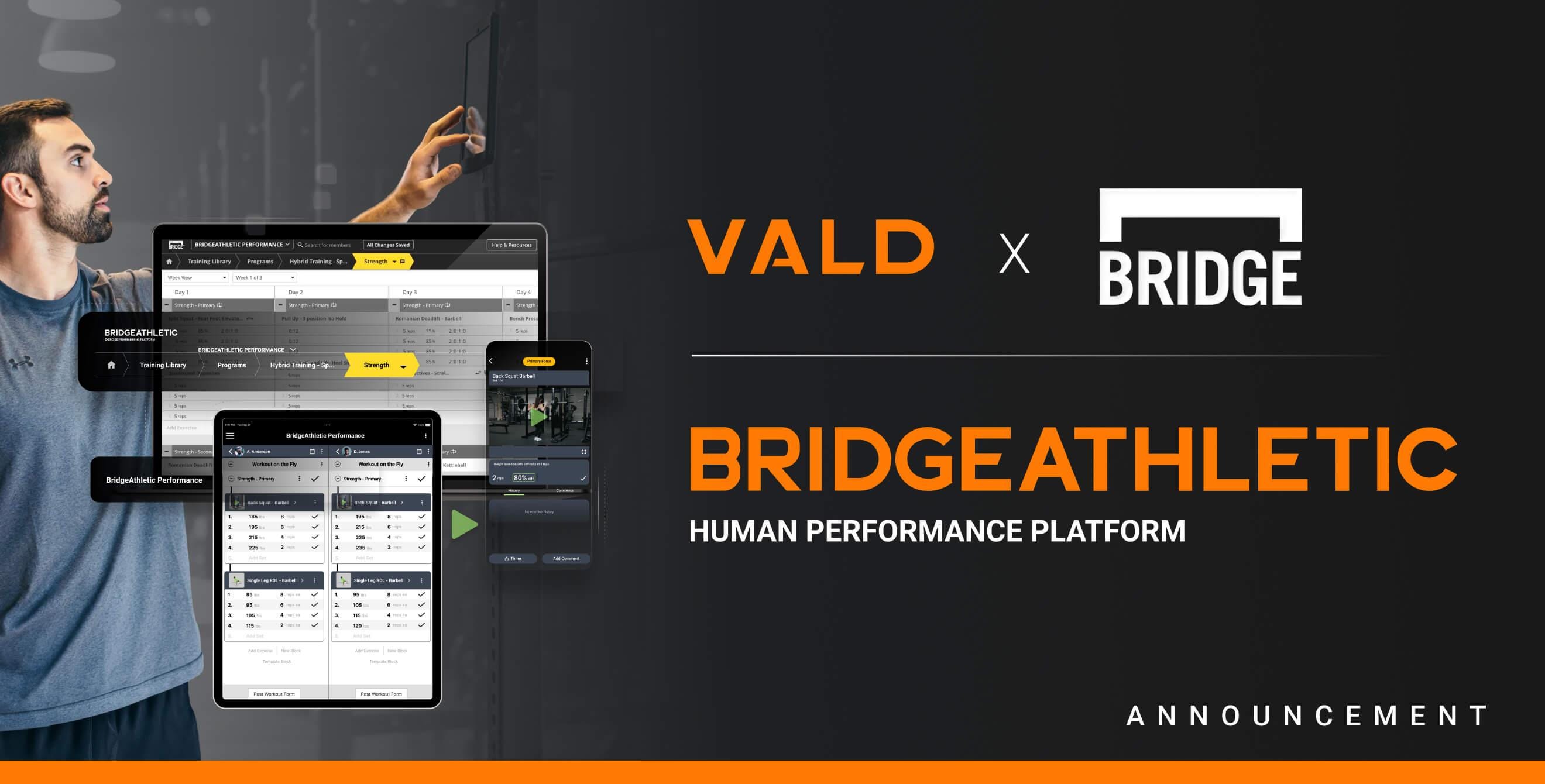
Rather than remaining primarily a provider of measurement technology, VALD is positioning itself to participate in nearly every stage of the performance workflow:
Measure athletes using objective testing technology
Monitor training through real-time velocity data
Prescribe individualized programs
Deliver and track training sessions
Analyze results and adjust interventions
This acquisition also reflects a broader change in the performance-technology industry. For years, teams have assembled their technology environments using several specialized vendors. That approach provides flexibility, but it can also create fragmented athlete records, duplicate data entry and inefficient workflows. VALD’s recent acquisitions suggest that the industry may now be moving toward more vertically integrated platforms.
Why the acquisition makes sense for VALD
VALD has established a strong position in objective performance measurement through technologies that assess strength, movement, balance, speed, neuromuscular performance and rehabilitation outcomes. These systems help practitioners understand what an athlete can produce and identify potential limitations. However, assessment represents only one stage of athlete development.
Once a need has been identified, practitioners must still select an intervention, deliver the training program, monitor its completion and determine whether it produced the intended adaptation. BridgeAthletic addresses this programming and delivery layer by giving coaches tools to design programs, prescribe sessions, communicate with athletes and analyze completed work.
Most importantly, BridgeAthletic fills a clear gap in VALD’s portfolio. VALD has historically been strongest at the point of assessment, providing practitioners with objective information about an athlete’s strength, movement, balance and neuromuscular performance. However, it did not own a comprehensive programming platform through which coaches could translate those findings into daily training plans and deliver them directly to athletes.
BridgeAthletic provides that missing prescription and execution layer. When combined with GymAware’s real-time velocity data, VALD can now address the full performance cycle—from identifying an athlete’s needs to prescribing an intervention, monitoring its execution and measuring the resulting adaptation. This moves VALD beyond being primarily a measurement-technology provider and closer to becoming the operating system through which performance departments manage the complete athlete-development process.
If VALD integrates all three organizations effectively, it could create a closed performance loop:
VALD identifies the athlete’s needs
BridgeAthletic converts those needs into a structured program
GymAware monitors how the athlete performs the prescribed training
New data informs the next program adjustment or assessment
The strategic goal is therefore not simply to expand VALD’s product catalogue. It is to connect testing, decision-making and training execution within one ecosystem. This would allow VALD’s measurement data to influence daily coaching decisions rather than remain information that practitioners review only during periodic assessments.
Why the transaction makes sense for BridgeAthletic
BridgeAthletic has developed a strong position as a strength-and-conditioning and athlete-development platform, supporting thousands of teams and hundreds of thousands of athletes. Like many software providers in this market, however, it has depended on manual input and third-party integrations to access much of the objective data generated by testing and training hardware.
Joining VALD gives BridgeAthletic access to a global customer base, a larger distribution and client-success infrastructure and an established portfolio of measurement technologies. It also creates an opportunity for BridgeAthletic to differentiate itself from standalone programming platforms.
Instead of requiring coaches to move data manually between several products, BridgeAthletic could eventually receive testing and training information directly from VALD and GymAware systems. This would make the platform more valuable across elite sport, rehabilitation, tactical performance and private training environments.
Benefits for VALD and BridgeAthletic customers
For existing VALD customers, the most important potential benefit is workflow efficiency. Practitioners often export testing results, interpret them in spreadsheets or dashboards and then manually transfer their conclusions into a programming system. A well-integrated ecosystem could reduce these steps and allow assessment results to influence exercise selection, workload targets and progression decisions more directly.
Potential customer benefits include:
Fewer disconnected systems and athlete profiles
Less manual data entry and duplication
Faster translation of assessment results into training programs
More individualized exercise and workload prescription
Better tracking from testing through intervention and reassessment
More consistent collaboration across performance and rehabilitation teams
One commercial relationship covering a larger portion of the technology stack
BridgeAthletic customers could gain easier access to objective strength, asymmetry, movement, readiness and velocity information within the programming environment they already use. This could help coaches make more informed adjustments while reducing the time spent moving between different systems.
These benefits are not guaranteed simply because the companies now share ownership. The acquisition’s value will depend on the quality of the technical integration, consistent athlete identities across products and the ability of practitioners to configure workflows without losing flexibility. Poorly integrated acquisitions can add complexity rather than remove it, so execution will matter more than the announcement itself.
Impact on the industry and VALD’s competitors
The acquisition increases competitive pressure across several areas of the performance-technology market. Athlete-management providers such as Teamworks, Kitman Labs and Smartabase increasingly position themselves as central platforms connecting performance, medical and operational information. VALD is approaching the same platform opportunity from a different direction: it is beginning with proprietary measurement hardware and adding monitoring and programming capabilities around it.
That distinction is strategically important. Traditional athlete-management platforms generally integrate information from external technologies, while VALD now owns several of the systems generating the underlying data. Ownership could allow VALD to build tighter integrations, create faster data flows and provide more standardized experiences than platforms that depend entirely on third-party connections.
The acquisition also affects smaller testing, velocity-tracking and programming companies. VALD may eventually be able to bundle products, combine support services and offer enterprise pricing across multiple categories. This could make it more difficult for standalone competitors to win business based on a single product, even when that product offers technically superior capabilities.
At the same time, VALD’s strategy creates an opening for competitors that emphasize interoperability and vendor independence. Some organizations may not want assessment, programming and training data concentrated within one commercial ecosystem. Competing platforms could therefore position open APIs, flexible integrations and customer control of data as alternatives to VALD’s vertically integrated approach.
How competitors are likely to respond
Competitors are likely to respond in several ways:
Pursue acquisitions that fill gaps in testing, programming or athlete engagement
Invest more heavily in APIs and third-party integrations
Bundle multiple products under broader enterprise agreements
Emphasize open ecosystems and data portability
Develop stronger proprietary analytics and AI capabilities
Focus on specialized categories where they can outperform larger platforms
Further consolidation appears likely. Companies with strong athlete-management or analytics platforms may seek proprietary testing or programming capabilities, while hardware providers may pursue software assets that allow them to control more of the workflow surrounding their devices.
Competitors that do not pursue acquisitions will probably accelerate integration partnerships. Their message will be that teams can create connected workflows without committing themselves to a single vendor’s complete ecosystem.
Recommendations for teams
Teams should not interpret the acquisition as an immediate reason to replace their current technology. Instead, they should use it as an opportunity to evaluate how information moves from assessment to decision and from decision to intervention.
Performance leaders should:
Map their complete workflow from testing through reassessment
Identify where staff manually transfer or duplicate information
Request a detailed integration roadmap from VALD
Evaluate data ownership, export rights and API access
Clarify migration support, pricing and contract implications
Compare integration benefits against vendor-lock-in risks
Include coaches, medical staff and sports scientists in purchasing decisions
Define measurable outcomes before adopting additional products
The most important consideration is whether integration creates meaningful operational value. Teams should measure staff time saved, athlete compliance, data completeness, decision-making speed and collaboration across departments. A larger product ecosystem is only beneficial if it improves the work practitioners perform every day.
Conclusion
VALD’s acquisition of BridgeAthletic, following its acquisition of GymAware, is one of the clearest indications that performance technology is entering a new phase of platform consolidation. VALD is assembling a portfolio that could connect objective testing, real-time training monitoring and program delivery within one ecosystem.
The strategic rationale is strong because the combination fills a meaningful gap between collecting performance data and acting on it. For VALD, the acquisition expands its role from measuring athletes to influencing how they train. For BridgeAthletic, it provides global scale and access to objective data that could make its programming platform more intelligent and differentiated.
However, ownership alone does not create integration. VALD’s success will depend on whether it can make these products operate as one coherent system while preserving the flexibility, data access and usability practitioners require. Competitors will respond through acquisitions, integrations, product bundling and greater specialization, accelerating the transformation of the wider market.
The industry’s next competitive battle will be about more than who produces the best device or software application. It will be about who can connect data, decisions and daily practice most effectively without taking control away from the teams and practitioners using the technology.
For performance organizations, that creates an important strategic question: Is the operational simplicity of an integrated platform more valuable than the flexibility of a best-of-breed technology stack?
You may also like:
