
Introduction
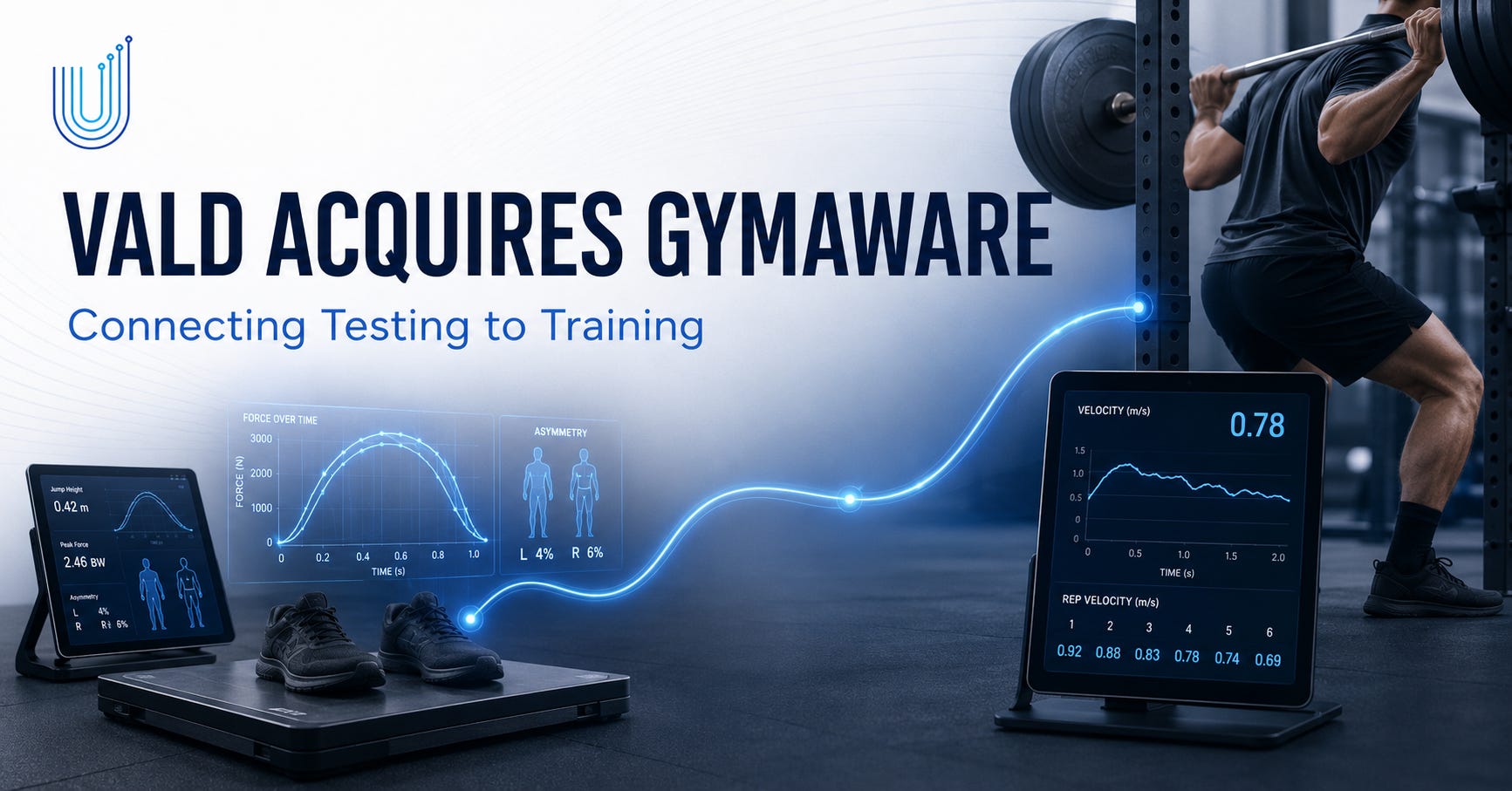
Yesterday’s VALD’s acquisition of GymAware is more than the purchase of a velocity-based training device company. It represents a strategic effort to connect athlete assessment, monitoring, rehabilitation and daily strength training within one performance-technology ecosystem.
Before the acquisition, VALD’s products were primarily used to measure qualities such as strength, power, balance, asymmetry, range of motion and movement. Products including ForceDecks, ForceFrame, NordBord, HumanTrak and DynaMo help practitioners understand an athlete’s physical condition at particular points in time.
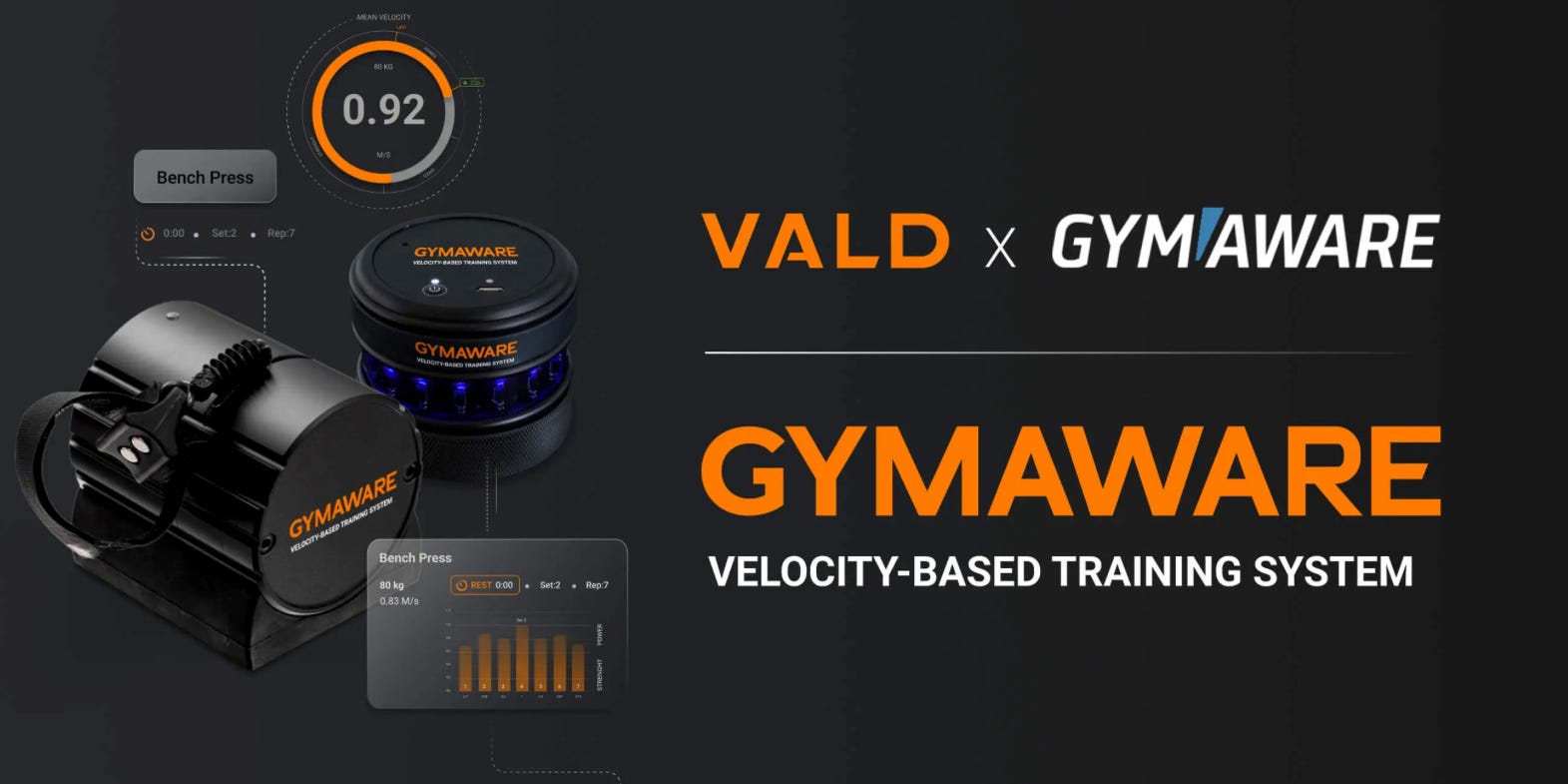
GymAware extends that measurement capability into the execution of training. Its technology measures barbell velocity, power, fatigue and performance during individual repetitions, allowing coaches to prescribe loads, provide immediate feedback and modify training in real time.
In simple terms, VALD could already help answer:
How strong or powerful is the athlete?
Is the athlete improving?
Is there an asymmetry?
Is the athlete ready to progress through rehabilitation?
GymAware adds another set of questions:
How is the athlete performing during today’s training?
Is the prescribed load appropriate?
Is velocity declining because of fatigue?
Should the athlete continue, reduce the load or end the set?
Is training producing the intended adaptation?
The acquisition therefore moves VALD from primarily measuring athletes to becoming more involved in managing how they train.
The transaction’s financial terms were not disclosed. VALD said GymAware’s products, software and services will continue to be supported and that co-founder and CEO Evan Lawton and his team will join VALD.
The strategic rationale
The central rationale is the opportunity to connect testing with training.
Sports-performance departments often operate through fragmented workflows. Force plates may be used for neuromuscular testing, dynamometers for isolated strength assessment, athlete-management systems for wellness and medical information, separate software for exercise programming, and VBT devices for weight-room monitoring.
Even when each product works well independently, practitioners must manually connect the information. An athlete might produce a lower countermovement-jump score in the morning, complete a modified strength session in the afternoon and record slower bar velocities, but those results may live in separate systems.
VALD’s acquisition of GymAware creates the potential for that workflow to become continuous:
Assess the athlete.
Compare the result with the athlete’s baseline.
Adjust the training prescription.
Monitor every repetition.
Measure the athlete’s response.
Use the results to inform the next assessment and session.
That closed loop is strategically valuable because it brings the assessment and intervention sides of sports performance together.
The deal also combines two companies with strong scientific positioning. GymAware has operated for more than 20 years, has been used extensively in research and maintains a large historical repository of strength-training data. Its technology includes the GymAware RS linear-position transducer and the more accessible FLEX laser system. The company serves professional teams, universities, high schools, private facilities and individual athletes.
For VALD, acquiring an established VBT company is faster and less risky than developing a comparable product internally. A credible VBT solution requires more than hardware. It needs reliable measurement, coach-friendly workflows, exercise libraries, real-time feedback, athlete profiles, reporting, cloud infrastructure and years of validation.
GymAware already possesses those capabilities, along with customer trust and domain expertise.
Why the acquisition makes sense for VALD
1. It fills a significant gap in the product portfolio
VALD has built a strong position in objective physical assessment. GymAware gives the company a meaningful presence inside the weight room, where training decisions are implemented every day.
This expands VALD’s potential role in the customer workflow. Assessment may occur weekly, monthly or at specific rehabilitation milestones. Strength training can occur several times per week and generate data from every exercise, set and repetition.
The acquisition could therefore increase both the frequency with which practitioners use VALD’s ecosystem and the volume of data collected.
2. The products are complementary
GymAware does not substantially duplicate VALD’s existing systems. Instead, it connects naturally with them.
For example:
ForceDecks can assess neuromuscular performance and jumping ability.
ForceFrame and DynaMo can measure specific strength qualities.
NordBord can assess eccentric hamstring strength.
HumanTrak can evaluate movement.
GymAware can monitor how the athlete applies strength and power during training.
The commercial logic is stronger when an acquisition adds a complementary workflow instead of merely adding another version of an existing product.
3. The companies share customers
VALD stated that the two businesses already serve many of the same organizations. This should reduce the cost and difficulty of cross-selling.
A VALD customer using ForceDecks or ForceFrame can now purchase a VBT solution from an existing vendor rather than introduce another supplier. Similarly, GymAware customers can be introduced to VALD’s broader testing and rehabilitation portfolio.
This overlap also reduces customer-education requirements. Organizations already using one of the companies are likely to understand objective performance measurement and may already have staff capable of applying the technology.
4. It strengthens VALD’s platform strategy
VALD’s strategic advantage increasingly depends on the breadth and connectivity of its ecosystem—not only the performance of each individual device.
VALD Hub provides centralized administration, reporting and analysis across VALD systems. Adding GymAware creates the potential to bring daily training information into that environment alongside assessment data.
The resulting platform could provide a more complete athlete record spanning testing, monitoring, rehabilitation and training.
However, this opportunity will only be realized if the integration extends beyond shared ownership. A true platform will require common athlete profiles, unified authentication, consistent reporting, interoperable data models and workflows that allow information from one product to influence decisions in another.
5. It expands VALD’s addressable market
GymAware serves customer groups that align with VALD’s expansion beyond professional sport, including universities, high schools, private performance centers, researchers, military organizations and individual athletes.
VALD can use its international sales and customer-success infrastructure to expand GymAware into more markets. GymAware, in turn, gives VALD a product that can be relevant to organizations whose immediate priority is training rather than clinical testing.
The acquisition announcement says VALD technology is used across more than 130 countries and that its global team has approximately 400 employees. That infrastructure should give GymAware greater distribution and support capacity than it could likely build independently.
6. It adds a valuable performance-data asset
GymAware says its cloud contains more than 15 years of strength-related information. While the commercial value depends on data rights, consent, governance and comparability, this history could support improved benchmarks, individualized load–velocity profiles and more advanced predictive models.
VALD already emphasizes normative data across its ecosystem. GymAware’s dataset could eventually help VALD develop stronger norms around bar velocity, power, fatigue and strength progression—provided the information can be responsibly standardized and used.
Impact on the VBT and sports-performance markets
VBT is moving from a specialist category into the broader performance stack
Velocity-based training was historically a specialist method used primarily by sports scientists, strength coaches, researchers and well-resourced elite programs. It is increasingly becoming part of mainstream strength-and-conditioning practice.
Instead of prescribing training only through percentages of an athlete’s one-repetition maximum, VBT allows practitioners to adjust the session according to how quickly the athlete moves the load that day. It can also provide immediate feedback, estimate strength, monitor fatigue and establish velocity-loss thresholds.
Research (see here, here) supports the potential value of VBT, although outcomes depend on the protocol, population and quality of implementation. A systematic review reported positive effects on strength and power in elite athletes, while device studies have examined GymAware’s reliability and validity across different exercises.
The acquisition gives VBT greater strategic importance because one of the largest physical-performance technology companies has now made it a core part of its platform.
The market is consolidating around connected ecosystems
VALD–GymAware is part of a broader consolidation trend. Catapult acquired Perch in June 2025 to connect its on-field athlete-monitoring capabilities with camera-based weight-room data. Catapult paid $18 million upfront, with an additional earn-out of up to $10 million linked to growth milestones.
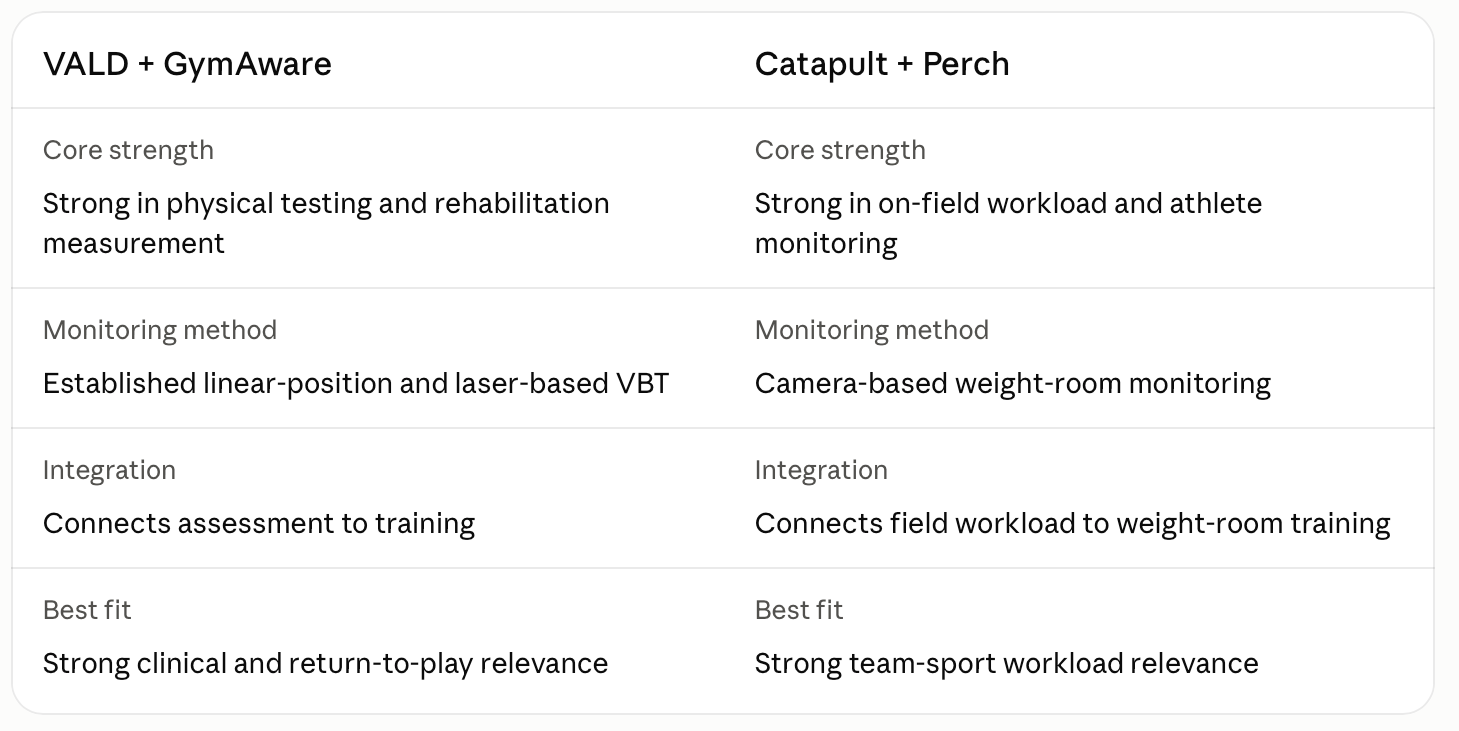
The strategic similarity is important:
Catapult combines on-field workload monitoring with Perch’s weight-room technology.
VALD combines physical assessment and rehabilitation measurement with GymAware’s weight-room technology.
Both transactions reflect the same market thesis: customers want fewer disconnected systems and a more complete view of athlete performance.
The competitive battleground is consequently shifting. Vendors will still compete on device accuracy, but they will increasingly compete on:
Workflow integration
Data interoperability
Quality of analytics
Athlete and coach experience
Breadth of measurement
Normative datasets
Implementation support
Platform pricing
Ability to translate information into decisions
Standalone VBT vendors face new pressure
Independent VBT companies such as Output Sports, Vitruve and other sensor- or camera-based providers must now compete against products supported by larger platform companies.
This does not mean standalone vendors cannot succeed. They may differentiate through portability, lower pricing, open integrations, specialized workflows, faster product development or support for exercises beyond traditional barbell movements.
Output Sports, for example, positions its wearable sensor as a multifunctional system covering VBT, jump testing, strength, mobility, balance, speed and rotational power. These broader use cases may appeal to customers that want portability or do not want to enter a larger closed ecosystem.
Nevertheless, the acquisition raises customer expectations. A VBT company may increasingly need to explain not only why its device is accurate, but also how its information connects with the rest of the athlete’s performance record.
Accuracy will remain important, but workflow may become decisive
GymAware’s reputation is built partly on measurement accuracy and research validation. That remains valuable, particularly among elite teams, universities and researchers.
However, many purchasing decisions will be determined by operational considerations:
How quickly can multiple athletes use the system?
Does the technology interrupt the session?
Can coaches create and assign programs?
Is feedback immediate?
Can the data be exported?
Does it integrate with the organization’s existing systems?
Can the staff see testing and training information together?
How much onboarding and support are required?
The winning platform may not always be the one with the most precise individual device. It may be the one that delivers sufficient accuracy within the simplest and most connected workflow.
Impact on VALD and GymAware customers
Potential benefits for VALD customers
VALD customers may gain access to a more complete physical-performance workflow. Instead of using VALD primarily for testing, they could use the platform to connect assessment results with daily training.
Possible benefits include:
Using ForceDecks results to inform weight-room intensity
Comparing isometric strength assessments with dynamic lifting performance
Monitoring rehabilitation progress from isolated testing through loaded exercise
Connecting return-to-play criteria with training execution
Creating longitudinal profiles spanning testing and training
Reducing manual data entry between systems
Consolidating suppliers and support relationships
GymAware is already displayed as part of VALD’s product portfolio, and its subscription listing includes access to VALD Hub, onboarding, support and VALD Academy. This suggests commercial packaging is beginning even before deeper technical integration is complete.
Potential benefits for GymAware customers
GymAware customers should benefit from VALD’s global distribution, implementation and product-development resources.
The immediate commitment is continuity: VALD says existing devices, software and services will remain supported, while GymAware’s team will continue working on the product.
Over time, customers may gain:
Greater investment in hardware and software
Faster development of cloud capabilities
Improved international support
Integration with VALD Hub
Access to VALD’s education and customer-success resources
Easier adoption of complementary testing products
More sophisticated reporting and benchmarking
For smaller organizations, the association with VALD could also increase confidence in GymAware’s long-term viability.
Customer risks and unanswered questions
The transaction also introduces legitimate concerns.
First, customers will want clarity on pricing. Platform integration can create additional value, but it can also result in bundling, subscription changes or higher total costs.
Second, customers using GymAware with a non-VALD athlete-management system will want assurance that existing APIs and exports remain supported. An acquisition should not make an established product less interoperable.
Third, integration can create disruption if athlete profiles, historical records or workflows need to migrate. VALD should avoid forcing customers to change before the integrated experience is demonstrably better.
Fourth, customers may be concerned about vendor concentration. Purchasing more of the performance stack from one provider can simplify operations, but it also increases switching costs and dependence on that provider.
Finally, data governance will require attention. Combining assessment, rehabilitation and training datasets can produce more valuable insights, but it also creates a more sensitive and comprehensive athlete record. Permissions, ownership, consent, security and secondary use of data will become increasingly important.
What is likely to come next?
The following expectations are informed inferences rather than announced commitments.
1. Identity and data integration
The first major step will likely be connecting athlete identities between GymAware Cloud and VALD Hub. Without a common athlete record, the companies cannot create a continuous testing-to-training workflow.
Customers should expect gradual movement toward:
Single sign-on
Shared athlete profiles
Automatic synchronization
Unified reports
Cross-product dashboards
Consistent team and user administration
2. Testing results will begin informing training decisions
The most valuable integration will not simply display two datasets on the same screen. It will translate assessments into training actions.
For example, the system could eventually:
Recommend a training zone using recent testing data
Flag unusual bar-velocity reductions following readiness assessments
Compare training performance with an athlete’s established baseline
Adjust volume according to velocity loss
Track progress from rehabilitation testing into loaded exercise
Identify discrepancies between an athlete’s measured capacity and training output
VALD will need to introduce these features carefully. Coaches generally want decision support, not algorithms that prescribe sessions without context.
3. VALD may create broader performance subscriptions
GymAware may be packaged with ForceDecks, ForceFrame or other VALD systems according to customer type.
Possible packages could include:
Elite team performance
Collegiate strength and conditioning
Rehabilitation and return to play
High-school athlete development
Private performance facilities
Tactical and military readiness
Bundling could reduce purchasing complexity and increase adoption, although pricing will determine whether these packages expand access or primarily increase account value.
4. Normative and predictive analytics will become more important
A combined dataset could help VALD develop reference standards for bar velocity, power and fatigue across sports, positions, ages and competitive levels.
Over time, machine-learning models may attempt to connect changes in assessment and training data with outcomes such as readiness, adaptation or rehabilitation progress.
The value of these models will depend on data quality, population relevance and transparency. Performance professionals will require more than a proprietary score; they will need to understand what changed and how the information should influence a decision.
5. Catapult will intensify the Perch integration
Catapult is the most obvious strategic comparator. Its current positioning already connects Perch’s weight-room analytics with Catapult’s on-field GPS and inertial data.
VALD’s acquisition is likely to increase pressure on Catapult to accelerate unified workflows between Perch and its athlete-monitoring platform. Conversely, VALD may feel pressure to demonstrate that its GymAware integration produces practical value rather than simply adding another product to its catalogue.
The two companies now approach the same problem from different directions:
Source: Upside Global, confidential, 2026
6. Other competitors may pursue partnerships or acquisitions
Smaller VBT and athlete-testing companies may react in several ways:
Strengthen integrations with athlete-management systems
Emphasize open APIs and customer data portability
Partner with programming or coaching platforms
Compete more aggressively on price
Focus on schools, private facilities or individual athletes
Expand beyond VBT into multifunctional testing
Seek acquisition by larger sports-technology companies
The deal may also encourage athlete-management and strength-programming platforms to acquire measurement technology rather than remain software-only.
7. VALD may continue expanding toward training delivery
GymAware moves VALD closer to the daily prescription and execution of training. The next logical capabilities could include exercise programming, session planning, athlete communication, adherence monitoring and automated longitudinal reporting.
VALD will need to decide how far it wants to move into this territory. Building a complete training-management platform could create substantial value, but it could also bring the company into competition with established programming and athlete-management providers.
Conclusion
VALD’s acquisition of GymAware is strategically coherent because it connects two complementary parts of the performance process.
VALD has built a strong position in assessing how athletes move, produce force and progress through rehabilitation. GymAware measures how they perform during strength training. Bringing the two together creates the potential for a continuous workflow from assessment to prescription, execution, monitoring and reassessment.
For VALD, the acquisition fills a product gap, increases usage frequency, expands its addressable market and adds an established VBT brand with significant data and scientific credibility.
For GymAware, the transaction provides global distribution, investment, support and an opportunity to become part of a broader performance ecosystem without immediately abandoning its existing customers or identity.
For the wider market, the acquisition reinforces three trends:
VBT is becoming a central component of the sports-performance technology stack.
Competition is shifting from individual devices toward connected ecosystems.
Data integration and workflow design are becoming as important as measurement accuracy.
The acquisition’s ultimate success will not be determined by the announcement or by the number of products VALD owns. It will be determined by execution.
If VALD can connect athlete identities, unify data, preserve interoperability and turn assessment information into better training decisions, the acquisition could materially strengthen its position in global human-performance technology.
If GymAware remains a largely separate product with a VALD logo and limited data integration, the strategic value will be much smaller.
The opportunity is significant: create a system in which every test informs training and every training session improves the next decision. The next several years will show whether VALD can convert that vision into a workflow that practitioners genuinely use.
You may also like:
💪 Upside Analysis: Velocity Training Vendor Ecosystem: Key Drivers, Challenges, Use Cases, Vendors, Recommendations to Teams

Velocity-based training (VBT) represents a paradigm shift in strength and conditioning—from static percentages to dynamic, real-time feedback. By measuring the speed at which an athlete moves a load (typically a barbell), coaches can infer intent, fatigue, neuromuscular readiness, and training adaptations. VBT allows practitioners to move beyond guesswo…
🎙️ Upside Video Chat with Martin O'Reilly, CEO of Output sports, a Leading Performance Company using One Sensor (VBT and Jump Tracking).

Today we have the honor of interviewing Martin O'Reilly, CEO of Output sports, a leading performance company using one sensor including VBT and jump tracking.