
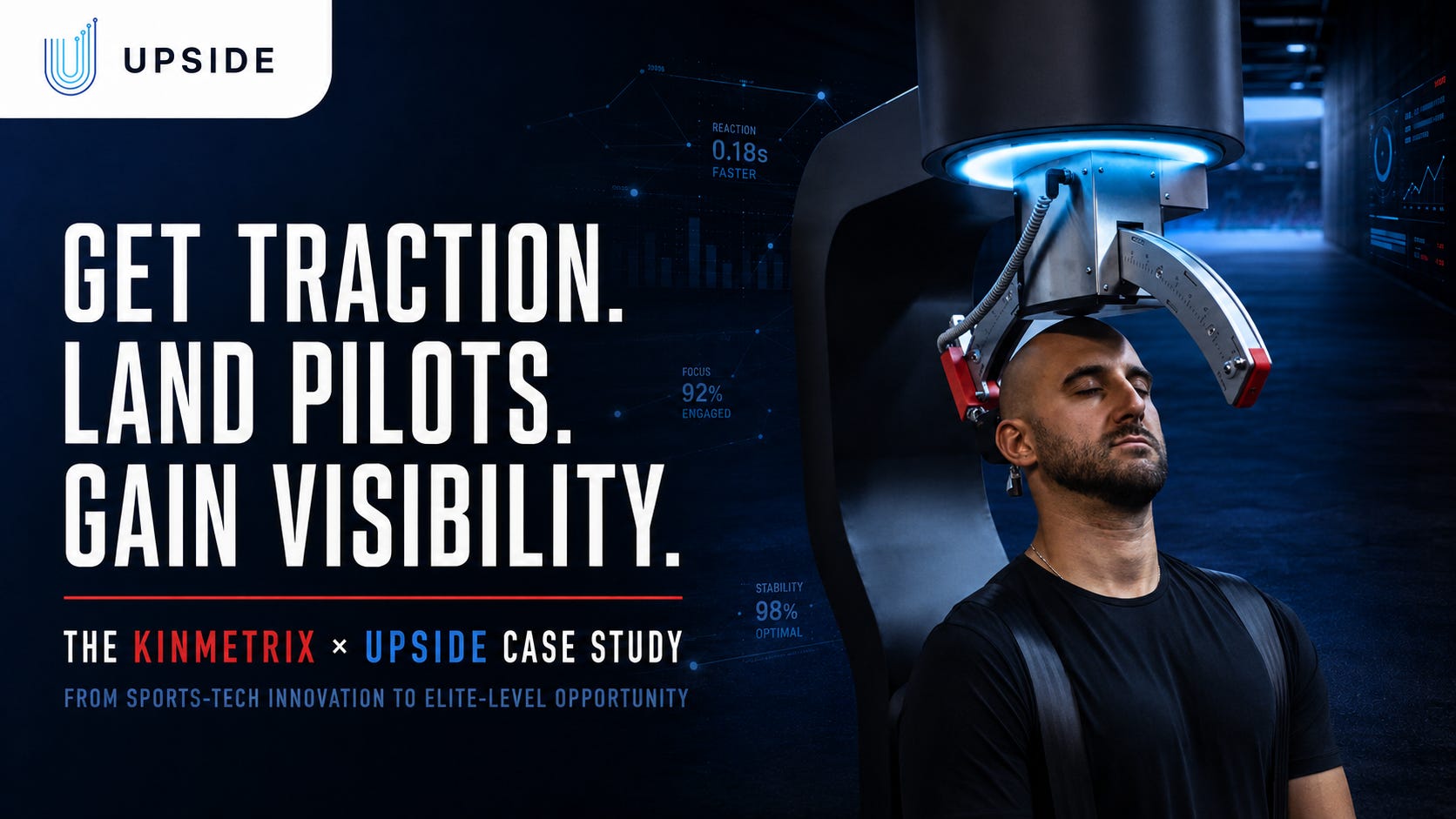
We’re launching a new series of Upside case studies illustrating how Upside has helped sports-technology startups gain traction with professional teams, land pilot programs, connect with venture capital firms, and build the credibility needed to scale.
Our first case study features Kinmetrix, a Canadian sports-technology company focused on neck performance, athlete safety, and data-driven training.
Get Traction, Land Pilots, Gain Visibility: The Kinmetrix Case Study
Introduction: About Kinmetrix
Kinmetrix is a Canadian sports-technology startup focused on neck performance, athlete safety and data-driven training.
Its flagship product, the Kinmetrix Arc, is a digital neck-strengthening and assessment system that combines adjustable resistance, advanced sensors and software. The technology allows sports organizations and performance professionals to measure neck strength, identify muscular imbalances, monitor athlete development and create more individualized training programs.

Picture: Kinmetrix Arc, used by NHL player Nick Foligno (Chicago BlackHawks/NHL).
The Arc offers up to 300 pounds of resistance and a 360-degree range of motion. It was developed for athletes, strength and conditioning coaches, athletic trainers, sports-medicine professionals and clinical practitioners.
Its potential applications extend across football, hockey, mixed martial arts, motorsports, rugby and other environments in which neck strength, stability and head control can influence athletic performance and safety.
Unlike traditional neck-training methods that may rely on manual resistance, bands or weighted harnesses, the Kinmetrix system is designed to provide objective and measurable information. Practitioners can use this data to understand an athlete’s starting point, develop an appropriate training program and monitor changes over time.
This is particularly relevant as sports organizations search for more evidence-informed approaches to athlete preparation and injury-risk reduction.
Research into the relationship between neck strength and concussion risk continues to develop. Neck training should not be positioned as a guarantee against concussion. However, stronger and better-conditioned neck muscles may help athletes control head movement and potentially reduce certain forces experienced during contact.
Kinmetrix had developed a compelling product addressing a meaningful challenge in sports. Creating the technology, however, was only one part of the company’s journey.
Like many early-stage sports-technology companies, Kinmetrix faced a significant commercial challenge: gaining access to professional sports organizations and earning the trust of the people responsible for athlete health and performance.
Sports teams receive a constant stream of pitches from technology companies. Even when a product is innovative, it can be difficult for a startup to identify the right decision-makers, communicate its value and secure an opportunity to demonstrate its technology.
Kinmetrix needed more than general market awareness. It needed targeted access, credible pilot opportunities, investor connections and visibility within the professional communities most likely to understand and adopt its product.
Upside helped Kinmetrix bridge the gap between developing an innovative technology and gaining meaningful traction in the sports industry.
The Challenge
Kinmetrix was entering a highly specialized market.
Although the sports industry has become more receptive to technology, teams remain understandably cautious when evaluating products connected to health, safety and athletic performance. New technologies must fit into established training environments, support the work of existing staff and provide meaningful benefits without disrupting team operations.
Kinmetrix needed to overcome several barriers.
First, the company had to educate potential users about the importance of neck assessment and training. Neck strength is not always given the same attention as lower-body strength, speed, power or cardiovascular conditioning. Kinmetrix therefore needed to explain both the performance problem and the value of its solution.
Second, the company needed to demonstrate how the Arc could be used in practice. Product specifications alone would not be enough. Coaches and clinicians needed to see how the system could fit into assessment protocols, training sessions, athlete monitoring and return-to-performance programs.
Third, Kinmetrix needed credibility. Early-stage companies often lack the customer history, published case studies and recognizable partnerships that make decision-makers comfortable with a new solution.
Fourth, the company needed visibility among the right audiences. General publicity might create awareness, but it would not necessarily generate adoption. Kinmetrix needed to be seen by sports executives, athletic trainers, medical professionals, strength and conditioning coaches and innovation leaders.
Finally, Kinmetrix needed access to potential investors and venture capital firms. Developing and commercializing a hardware-enabled technology requires capital for manufacturing, product development, software, research, hiring, marketing and distribution.
Kinmetrix needed investors who could understand both the company’s technology and its long-term commercial potential.
These challenges shaped Kinmetrix’s goals and Upside’s strategy.
Kinmetrix’s Goals
Kinmetrix approached Upside with four closely connected objectives: get traction, land pilots, gain visibility and develop relationships with potential investors.
Get Traction With Sports Organizations
The first goal was to establish meaningful relationships with professional and collegiate sports organizations.
Kinmetrix needed access to the people responsible for evaluating technologies connected to athlete health and performance, including:
Athletic trainers
Strength and conditioning coaches
Team physicians
Sports-medicine professionals
Physical therapists
Performance directors
Innovation executives
General managers and team leadership
League health and safety representatives
Reaching these individuals required a targeted approach.
A strength and conditioning coach might evaluate the Arc from a performance perspective, while a medical professional might focus on measurement, rehabilitation or injury-risk reduction. An innovation executive might examine scalability, data integration and organizational value.
Kinmetrix therefore needed to communicate the technology’s value in ways that were relevant to different stakeholders.
Traction also meant building familiarity and trust. Upside’s role was not simply to provide a list of contacts. It was to help Kinmetrix enter meaningful conversations with sports organizations and practitioners who had a genuine reason to evaluate the technology.
Land Pilot Programs
Kinmetrix’s second objective was to move beyond introductory discussions and secure practical pilot programs.
Pilots are often a critical step in the sports-technology sales process. They allow a team to evaluate a product within its own environment before considering wider implementation or a commercial relationship.
For Kinmetrix, pilot programs would provide opportunities to:
Demonstrate the Arc with elite athletes and practitioners
Test the technology within real training environments
Receive feedback from experienced performance professionals
Understand how the product fits into existing team workflows
Evaluate applications across different sports
Refine implementation and onboarding processes
Generate evidence of practical product-market fit
Build credibility with future customers
Develop pathways toward longer-term partnerships
The objective was not simply to place a device inside a training facility. A successful pilot needed to help the organization understand where the technology could add value while helping Kinmetrix learn what elite users required from the product.
Gain Industry Visibility
Kinmetrix’s third objective was to become more visible within the sports-technology, athletic-performance and player-safety communities.
Visibility would help Kinmetrix educate the market about the importance of neck performance. It would establish the company as a contributor to conversations about athlete safety and training innovation. It would also create opportunities for potential customers, partners, researchers and investors to discover its technology.
However, Kinmetrix did not need visibility for its own sake. The goal was to gain exposure in credible environments attended by relevant decision-makers.
Upside sought opportunities for Kinmetrix to participate in:
Sports-technology showcases
Professional conferences
Industry panels
Health and safety events
Podcasts with sports practitioners
Educational discussions about neck training
Events attended by teams, leagues and investors
Each opportunity was intended to reinforce Kinmetrix’s credibility while supporting its commercial objectives.
Connect With Potential Investors and Venture Capital Firms
Kinmetrix’s fourth objective was to develop relationships within the sports-technology investment community.
The company needed access to investors who understood areas such as:
Sports technology
Athlete health and safety
Connected fitness equipment
Performance analytics
Medical and rehabilitation technology
Hardware-enabled software
Professional and collegiate sports innovation
These relationships could support both immediate and future fundraising efforts.
Investor conversations could also provide Kinmetrix with feedback on its business model, market positioning, manufacturing strategy, pricing, distribution and long-term growth opportunities.
How Upside Supported Kinmetrix
Upside developed an ecosystem-based strategy combining market access, pilot development, thought leadership, investor connections and industry exposure.
Rather than relying on one introduction or event, Upside created multiple points of engagement. These opportunities allowed Kinmetrix to build awareness, educate the market, demonstrate the Arc and develop relationships with potential customers, strategic partners and investors.
Targeted Introductions
Upside used its network across professional and collegiate sports to connect Kinmetrix with organizations and practitioners for whom neck performance was a relevant concern.
The outreach extended beyond one league or sport. This was important because the Kinmetrix Arc had potential applications across several athletic and clinical environments.
The introductions allowed Kinmetrix to engage directly with people who understood the physical demands placed on athletes in football, hockey, combat sports and motorsports.
Upside also helped place the product within a broader performance and safety conversation. Instead of presenting the Arc merely as another piece of gym equipment, Kinmetrix could explain how objective measurement and individualized programming might improve current neck-training practices.
Pilot Development
Upside helped turn industry conversations into pilot opportunities.
This required more than introducing Kinmetrix to an organization. Pilot development involved identifying relevant use cases, engaging the appropriate stakeholders and creating enough confidence for teams and practitioners to evaluate the technology.
The pilots provided Kinmetrix with an opportunity to demonstrate:
How the Arc measures neck strength and movement
How assessments can identify potential imbalances
How practitioners can design individualized programs
How training progress can be measured over time
How the technology can be adapted to different athletic populations
The resulting feedback also gave Kinmetrix information that could support future product development and commercial conversations.
Thought Leadership and Market Education
Because neck training remains an emerging category, education was central to the strategy.
Upside created opportunities for Kinmetrix to participate in podcasts and discussions with professional-sports practitioners. These conversations allowed Kinmetrix to address the broader issues surrounding its product rather than focusing only on sales.
Topics included:
Why neck strength matters in contact and collision sports
Current neck-training practices
The limitations of subjective assessment
The value of collecting objective data
The role of neck stability in athletic performance
Emerging research related to concussion-risk reduction
How training programs can be individualized
Differences in neck-training requirements across sports
These discussions helped Kinmetrix build authority while giving audiences useful and practical information.
Industry Events and Visibility
Upside also helped Kinmetrix participate in respected sports-technology and athlete-safety events.
Events created several forms of value simultaneously. They gave Kinmetrix exposure, placed the company in contact with decision-makers and provided opportunities to demonstrate expertise.
Kinmetrix’s participation in these events also strengthened its position in future conversations. Presenting during the NFL Combine or participating in an NFL health and safety event provided valuable context when speaking with new organizations and potential partners.
Investor and Venture Capital Introductions
In addition to helping Kinmetrix connect with sports organizations, Upside introduced the company to potential investors, venture capital firms and other members of the sports-technology investment community.
Upside helped Kinmetrix engage with investors whose interests aligned with athlete safety, performance technology, connected equipment, healthcare innovation and sports data.
These introductions gave Kinmetrix opportunities to present:
Its technology and product roadmap
The problem the company was addressing
Its potential market across sports and clinical care
Its business and revenue model
Early pilot activity
Industry relationships
Commercialization plans
Long-term opportunities involving athlete-performance data
These conversations supported Kinmetrix’s development even when they did not result in immediate funding. Investor feedback could help the company strengthen its positioning, refine its growth strategy and prepare for future fundraising discussions.
Results
The collaboration produced results across pilot development, industry access, visibility, investor engagement and thought leadership.
Pilots Across Four Elite Sports Environments
Through its work with Upside, Kinmetrix conducted a series of pilots involving:
One NFL team
One major mixed martial arts organization
One prominent Formula 1 trainer and F1 training center
One leading NCAA athletic organization
These pilots represented meaningful progress for an early-stage company seeking validation in elite sports.
They also demonstrated the versatility of the Kinmetrix Arc across four distinct environments.
NFL Pilot
The NFL pilot gave Kinmetrix an opportunity to work within one of the world’s most demanding professional-sports environments.
Football players experience repeated physical contact, rapid changes in direction and forces transmitted through the head, neck and upper body. Strength and conditioning coaches and medical professionals must manage the needs of athletes who vary significantly by position, size and playing style.
The pilot allowed the team to consider how objective neck assessment and individualized training could fit within an established professional-football performance program.
For Kinmetrix, the opportunity provided valuable feedback from practitioners working with elite athletes. It also created a strong proof point when engaging with other football organizations.
Major MMA Organization
Mixed martial arts presents a different but equally relevant use case.
Combat-sports athletes experience direct strikes, grappling forces, clinch positions and sudden head movement. Neck strength and stability can affect performance during both striking and wrestling exchanges.
Working with a major MMA organization allowed Kinmetrix to explore how the Arc could support fighters and coaches seeking a more structured approach to neck conditioning.
The pilot also demonstrated that the product’s value extended beyond traditional team sports.
Formula 1 Trainer
Formula 1 drivers face extreme physical demands that are not always visible to spectators.
During braking, acceleration and cornering, drivers must control the weight of the head and helmet while exposed to sustained forces. Neck strength, endurance and control are therefore important components of driver preparation.
The opportunity to work with a prominent Formula 1 trainer gave Kinmetrix access to a highly specialized performance environment. It also allowed the company to examine how its technology could support athletes whose neck-training needs differ from those of football players or combat-sports competitors.
Leading NCAA Organization
The NCAA pilot provided Kinmetrix with access to a major collegiate athletic environment.
College athletic departments can include multiple teams, large athlete populations and integrated departments involving strength and conditioning, athletic training, sports medicine and performance science.
This pilot created an opportunity to evaluate the Arc at a potentially broader organizational scale. It also allowed Kinmetrix to consider how assessment and training protocols might be applied across different sports and athlete populations.
Together, the four pilots helped Kinmetrix demonstrate cross-sport relevance and gain real-world implementation experience.
Sports Tech HQ Showcase During the 2025 NFL Combine
Kinmetrix presented at the Sports Tech HQ Innovation Showcase during the 2025 NFL Scouting Combine in Indianapolis.
The NFL Combine is one of the most important annual gatherings in professional football. Team executives, coaches, scouts, medical personnel, agents, media representatives and technology companies travel to Indianapolis to evaluate prospects and conduct league business.

Picture: Kinmetrix Arc demoed at the Sports Tech HQ Innovation Showcase during the 2025 NFL Scouting Combine in Indianapolis.
The Sports Tech HQ event brought together startups, athletes, founders, investors, advisors and sports-industry leaders. Kinmetrix was among the companies given an opportunity to present an emerging solution connected to athletic training, performance and safety.
The showcase gave Kinmetrix an opportunity to:
Demonstrate the Arc to a relevant audience
Explain the importance of neck assessment and training
Meet sports-technology leaders and potential partners
Increase its credibility within professional football
Build relationships during a major industry gathering
Position itself alongside other emerging sports innovations
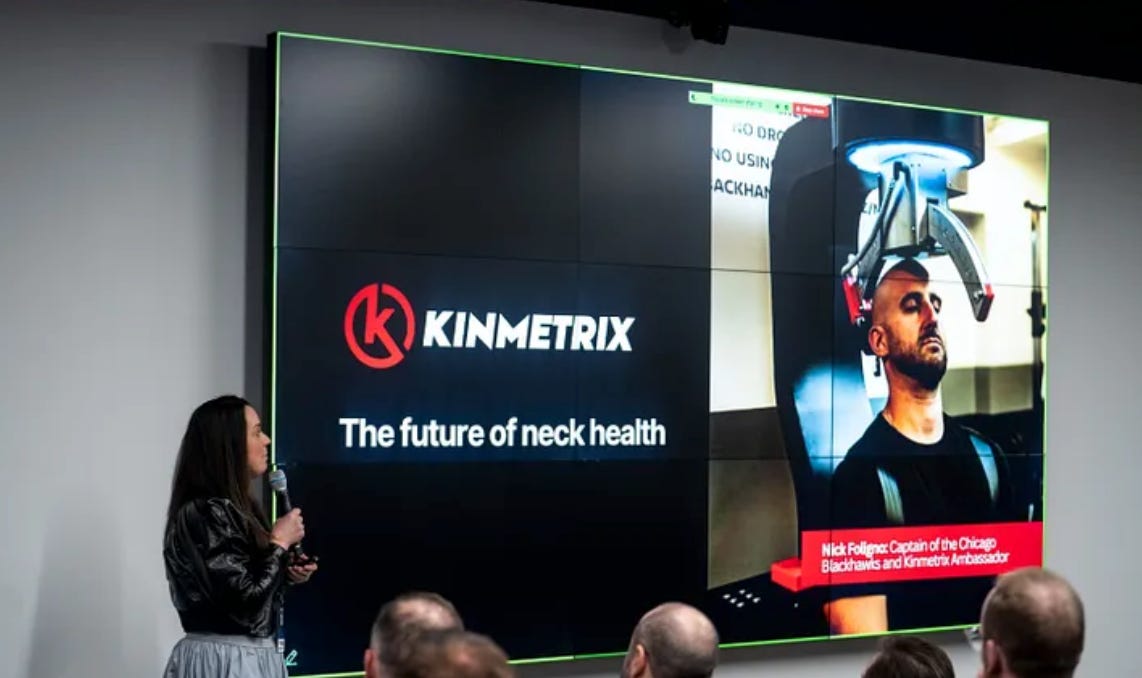
Picture: Kim Brouzes, Kinmetrix CEO, presented at the Sports Tech HQ Innovation Showcase.
This was more than a general promotional appearance. It placed Kinmetrix in an environment where many of its target customers, partners and potential investors were already gathering.
2025 Upside US Sports Tech Summit
Through Upside, Kinmetrix participated in a panel discussion at the 2025 Upside US Sports Tech Summit, held at the Florida Panthers’ arena in October 2025.
The summit brought together representatives from sports organizations, technology companies, investment groups and the wider innovation ecosystem.

Picture: The “Key Metrics The Science Of Comebacks” Panel featuring Kim Brouzes, Kinmetrix CEO at the 2025 Upside US Sports Tech Summit.
Kinmetrix’s participation allowed the company to move beyond a traditional product demonstration. During the panel, it could discuss the larger issues that inspired the development of the Arc.
These included:
The lack of consistent neck assessment in many sports
The importance of measurement before developing a training program
How technology can support individualized athlete preparation
Why neck performance is relevant across multiple sports
The developing relationship between neck strength and athlete safety
The challenges startups face when entering professional sports
The panel helped position Kinmetrix as a thought leader rather than simply a technology vendor. It also gave the company visibility among potential customers, partners and investors attending the summit. Here is below the panel featuring Kim Brouzes, Kinmetrix CEO.
Upside Group Podcast Appearances
Kinmetrix participated in several Upside Group podcast discussions alongside representatives from NFL and NHL teams.
These appearances supported both visibility and market education.
The conversations explored best practices and emerging trends involving:
Neck-strength assessment
Neck-conditioning methodology
Training across multiple planes of movement
Athlete-specific programming
Data collection and performance monitoring
Concussion awareness
Potential injury-risk-reduction strategies
Applications in football and hockey
The future of connected training equipment
Featuring NFL and NHL practitioners added credibility and practical context to the discussions. Listeners could hear how professional-sports organizations approach athlete preparation while learning where a technology such as the Kinmetrix Arc might fit.
⭐Upside Chat with Kim Brouzes, CEO of Kinmetrix, a Company that Built a Neck Strengthening Machine that Collects Data.

Today we have the honor of interviewing Kim Brouzes, CEO of Kinmetrix, a company that built a neck strengthening machine called the Kinmetrix Arc which collects data.
The podcasts also created reusable content that could be shared with potential customers, partners and investors.
Instead of relying only on private meetings, Kinmetrix was able to participate in public conversations that demonstrated its expertise and reinforced its market position.
Here is below an Upside Group podcast featuring Kinmetrix CEO alongside top practitioners in the NFL, and F1.
🔥Upside NFL/F1 Group Chat with Pieter Bulsink (Maverick Training/F1), Kim Brouzes (Kinmetrix), Ryan Juarez (Commanders/NFL) On Neck Training

This week we have the honor to interview a group of rehab and performance experts across the NFL and F1. We discussed neck training, their approach to neck training, the various modalities, best practices and trends that they are seeing in the market.
2025 NFL Health and Safety Summit
With Upside’s support, Kinmetrix also participated in the 2025 NFL Health and Safety Super Bowl Medical Summit.
The summit brought together NFL medical personnel, the NFL Physicians Society, Ochsner Health, University Medical Center New Orleans and members of the wider sports-medicine community.
The program addressed important topics including:
Concussion reduction and treatment
Injury prevention
Advances in sports medicine
Soft-tissue injuries
Multidisciplinary athlete care
Emerging health and safety technologies
For Kinmetrix, participating in this environment provided access to professionals directly involved in athlete health and player safety.
The event also placed the company’s work within a broader evidence-based conversation. This was strategically important because Kinmetrix operates in an area where scientific credibility, responsible communication and practitioner trust are essential.
Participation did not imply that neck training could eliminate concussion risk. Instead, it gave Kinmetrix an opportunity to contribute to discussions about how measurement, conditioning and technology may support a more comprehensive approach to athlete preparation and safety.
Connecting Kinmetrix With Potential Investors and Venture Capital Firms
Upside’s support extended beyond sports organizations and pilot development. It also helped Kinmetrix connect with potential investors, venture capital firms and strategic stakeholders.
Access to capital is an important part of the growth journey for an early-stage hardware and technology company.
Kinmetrix required more than funding alone. It needed investors who could understand the company’s technology, the problem it was addressing and the commercial opportunities available across professional sports, collegiate athletics, healthcare, rehabilitation and performance training.
Upside helped Kinmetrix engage with investors whose interests aligned with areas such as:
Sports technology
Athlete health and safety
Connected fitness equipment
Performance analytics
Medical and rehabilitation technology
Hardware-enabled software
Professional and collegiate sports innovation
These introductions gave Kinmetrix opportunities to present its business model, product roadmap, market potential and early industry traction to relevant investors.
Building a Stronger Investment Narrative
Upside’s support helped Kinmetrix strengthen the story it could present to investors.
Instead of positioning Kinmetrix solely as a company developing a neck-strengthening device, the investment narrative could highlight a broader technology platform focused on measurement, personalized training and athlete-performance data.
Kinmetrix could point to several indicators of early market validation:
Pilot activity across the NFL, MMA, Formula 1 and NCAA athletics
Engagement with professional-sports practitioners
Participation in respected sports-technology events
Thought-leadership appearances with NFL and NHL representatives
Exposure to the NFL’s health and safety community
Potential applications across sports, clinical care and rehabilitation
Opportunities to build a broader database of neck-performance information
This combination of technology, market access and pilot activity gave potential investors a clearer understanding of Kinmetrix’s progress and long-term potential.
Creating Opportunities for Investor Conversations
Upside facilitated opportunities for Kinmetrix to meet investors through direct introductions, industry events, private conversations and the wider Upside sports-technology ecosystem.
These connections allowed Kinmetrix to receive feedback on several areas of its growth strategy, including:
Market positioning
Product commercialization
Pricing and revenue models
Manufacturing and distribution
Expansion into additional sports
Clinical and rehabilitation applications
Data strategy
Future fundraising preparation
Even when an investor conversation did not lead immediately to funding, it could still provide Kinmetrix with useful market intelligence, strategic advice and relationships that might become valuable during a later fundraising round.
Increasing Investor Visibility Through Industry Validation
Upside’s pilot and visibility initiatives also supported Kinmetrix’s investor outreach.
For venture capital firms, early engagement from respected sports organizations can serve as an important indication that a startup is addressing a relevant problem. Kinmetrix’s pilots showed that professional teams, collegiate programs and elite trainers were willing to evaluate its technology in real performance environments.
Participation in the Sports Tech HQ Innovation Showcase, the Upside US Sports Tech Summit and the NFL Health and Safety Summit further strengthened Kinmetrix’s credibility.
These activities gave investors evidence that the company was developing relationships within its target market and gaining access to important industry stakeholders.
Connecting Commercial Traction With Fundraising Potential
Upside helped Kinmetrix connect two important parts of startup development: commercial traction and investor readiness.
Sports-industry introductions created pilot opportunities. The pilots generated practical experience and market validation. Events and podcasts increased visibility. Together, these outcomes gave Kinmetrix a stronger foundation for conversations with venture capital firms and strategic investors.
Upside did not simply introduce Kinmetrix to capital providers. It helped the company develop the traction and industry presence necessary to make those investor conversations more meaningful.
As a result, Kinmetrix could engage potential investors with a clearer value proposition, stronger industry validation and a more credible growth story.
Overall Impact
The Upside partnership helped Kinmetrix make progress across its primary objectives.
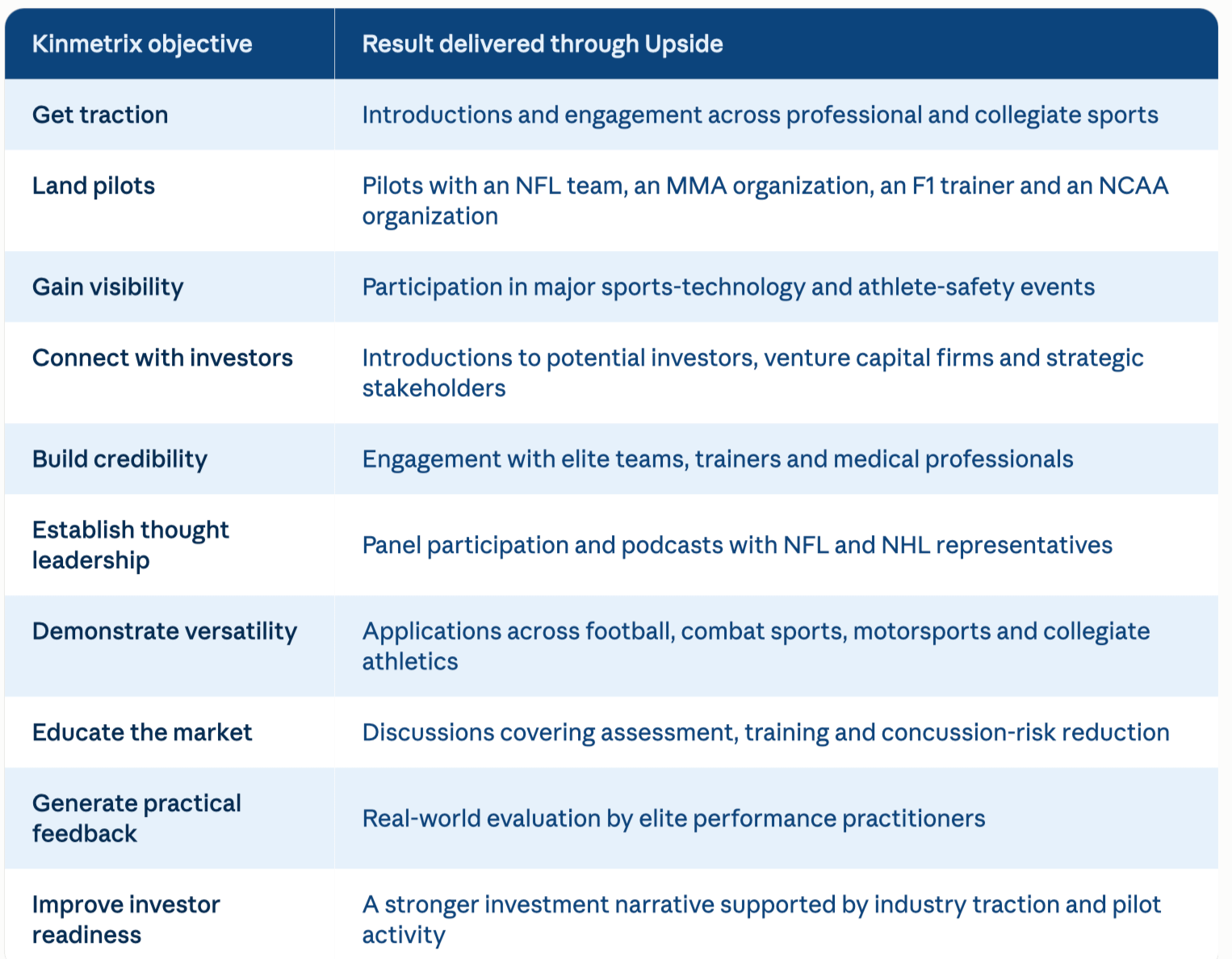
Picture: Confidential, Upside, 2026
Why the Results Matter
The value of the collaboration extended beyond the number of events, pilots or introductions.
For an early-stage sports-technology company, traction is built through a sequence of trust-building moments. A presentation can create awareness. A podcast can demonstrate expertise. An introduction can begin a relationship. A pilot can provide practical validation. An investor meeting can open a path toward the capital and strategic support required for growth.
Upside helped connect those individual moments into a larger market-development strategy.
The pilots gave Kinmetrix practical experience and credible reference points. The events increased visibility among relevant audiences. The podcasts helped educate the market. The investor introductions enabled the company to present a stronger growth story to potential capital partners.
The range of sports involved was also important. Kinmetrix demonstrated potential applications in professional football, mixed martial arts, Formula 1 and NCAA athletics. That diversity expanded the company’s market narrative and showed that neck performance is not limited to one athletic population.
Most importantly, Upside helped Kinmetrix connect commercial development with investor readiness.
The company could approach investors with more than a product concept. It could demonstrate pilot activity, practitioner engagement, industry visibility and access to some of the most influential environments in professional sports.
Conclusion
Kinmetrix began with an innovative product and a clear mission: make neck training more measurable, individualized and relevant to modern athlete performance.
Its challenge was gaining access to the organizations, practitioners and investors capable of helping the company move forward.
Upside helped create that access.
Through Upside’s sports-industry network and ecosystem-based approach, Kinmetrix secured pilot opportunities involving an NFL team, a major MMA organization, a prominent Formula 1 trainer and a leading NCAA athletic organization.
Kinmetrix also gained visibility through the Sports Tech HQ Innovation Showcase during the 2025 NFL Combine, the 2025 Upside US Sports Tech Summit, several Upside Group podcasts and the 2025 NFL Health and Safety Summit.
In parallel, Upside introduced Kinmetrix to potential investors, venture capital firms and strategic stakeholders. These relationships gave the company opportunities to present its technology, strengthen its investment narrative and receive feedback on its commercialization and growth strategy.
Together, these opportunities helped Kinmetrix educate the market, demonstrate its technology, gather feedback, build industry relationships and prepare for future growth.
The collaboration shows how Upside can support an emerging sports-technology company throughout its development—not only by making introductions, but by helping transform those introductions into pilots, visibility, credibility and investor conversations.
The Kinmetrix case study demonstrates Upside’s core value to startups seeking to enter the sports industry: helping them get traction, land pilots, gain visibility and connect with the capital required to scale.
Ready to Build Traction in Sports?
If you are a sports-technology startup looking to connect with teams, investors or venture capital firms, Upside can help.
Schedule a call with our team to discuss your goals, challenges and current needs. We would be pleased to learn more about your company and explain how Upside’s network, industry expertise and tailored approach can support your growth. You can email us at julien@upsideglobal.co
You may also like:
🔥Upside: 13 Most Common Mistakes Made by Sports Tech Startups

In the past 10 years we have worked with a large number of sports tech startups across various sports tech subsectors (GPS, AMS, Biomarkers, AI, rehab tech, sleep tech, AR, VR, NFT, Metaverse..). We have worked with startups that had amazing technologies with great founders, but for the most part there is no perfect startups out there. In this analysis …
⭐ Upside Analysis: Best Practices on How to Build & Sell Sports Performance Products to Pro teams

We have been working with pro teams in the MLS, NBA, NFL, NHL, MLB, European soccer, pro tennis, pro rugby as well as Olympic teams for 10 years, and oftentimes we come across great sports performance products (sleep tech, hydration assessment, neurotech, injury prevention tools, GPS..) but many of them do not get enough traction for many reasons. Somet…