
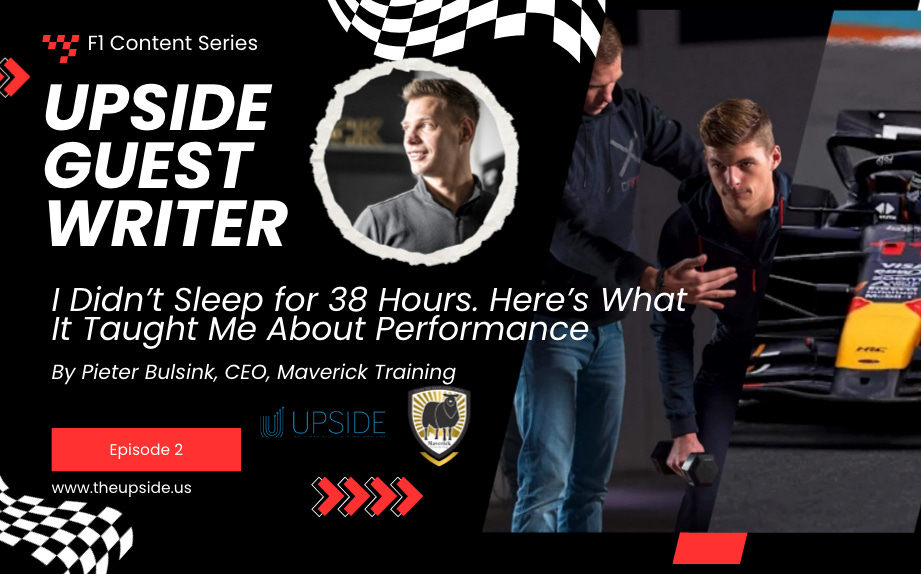
This week, as part of our content series on F1, our guest writer is Pieter Bulsink, CEO of Maverick Training, a sports performance company focused on elite athletes in F1 and other sports. Pieter has been working with top athletes such as 4 times world champion in F1 Max Verstappen (Red Bull). Pieter has also worked with top women drivers such as Emely De Heus, F1 Academy Driver and Red Bull - Ford Junior for the last 2 years.
Pieter’s 2nd article is called “I Didn’t Sleep for 38 Hours. Here’s What It Taught Me About Performance (and Why “Just Push Through” Is a Lie)”.
By Pieter Bulsink, CEO, Maverick Training
Not the glamorous Instagram version. The real one.
Where drivers rotate through night stints like fighter pilots. Where radios never shut up. Where adrenaline pretends to be recovery. And where, somewhere around 03:17, your brain quietly files a missing-person report… about itself.
And then, plot twist, you’re not done. Because once the chequered flag drops, you don’t get a medal and a nap.
You get planes. Meetings. Decisions. Invoices. Responsibility.
Welcome to the aftermath.
As a coach to drivers, and as a CEO/founder myself, I live in both worlds. One foot in elite sport. One foot in leadership under sleep debt.
And here’s what most people choose to ignore:
Sleep deprivation doesn’t just make you tired. It makes you stupid, impulsive, emotionally fragile, and falsely confident, at the same time.
That’s not mindset talk. That’s central nervous system physiology.
Let’s break it down.
The Real Cost of Sleep Deprivation (No Motivational Posters Allowed)
After a 24h race like Rolex 24 at Daytona, drivers and leaders show remarkably similar symptoms:
1. The Brain Loses Its Brakes
Sleep loss suppresses prefrontal cortex activity.
Translation:
Worse decision-making
Poor impulse control
Emotional overreactions
“This feels right” decisions that are… very wrong
You don’t lose motivation. You lose judgement.
That’s dangerous at 300 km/h. It’s equally dangerous when signing contracts or leading teams.
2. The CNS Goes Into Fake Survival Mode
Cortisol goes up. Sympathetic drive stays elevated. Parasympathetic recovery gets ghosted.
You feel:
Wired but exhausted
Alert but unfocused
Confident but sloppy
This is why sleep-deprived people overestimate their performance while underperforming.
Your brain is drunk, but convinced it’s sober.
3. Oxidative Stress Goes Through the Roof
Sleep is when the brain clears metabolic waste (hello, glymphatic system).
No sleep = more:
Neuroinflammation
Free radical damage
Slower synaptic transmission
This is why reaction times drop, memory fragments, and emotional regulation collapses.
Not because you’re weak. Because biology doesn’t negotiate.
“So What Do You Do?” (Because Sleeping 10 Hours Isn’t an Option)
Here’s where coaching replaces clichés.
You don’t “fix” sleep deprivation. You manage the damage, strategically.
1. Antioxidants That Actually Matter (Not Instagram Gummies)
After prolonged wakefulness, the goal is neuroprotection, not hype.
My non-negotiables:
Astaxanthin – crosses the blood-brain barrier, reduces CNS oxidative stress
Omega-3s (high DHA) – supports neuronal membrane stability
Magnesium (bisglycinate or threonate) – calms CNS excitability
Vitamin C – simple, boring, effective for cortisol modulation
This isn’t about “energy.” It’s about limiting neurological damage so recovery can happen later.
2. Strategic Sleep Scheduling (Forget 8 Hours)
After a 24h race or brutal founder stretch:
90-minute sleep blocks > long forced nights
Early afternoon naps (20–30 min) to restore alertness
No heroic late nights “because I’m already tired anyway”
Sleep debt compounds. Recovery stacks only if you respect circadian timing.
3. Light Is a Drug, Use It Like One
Bright light early in the day to reset rhythm
Dim lights at night, even if sleep is short
Screens are tolerated only with intention (and filters)
Your brain doesn’t care about your calendar. It cares about photons.
4. Train the Body, Not the Ego
Post-sleep-deprivation training is not the time to prove toughness.
Instead:
Zone 2 aerobic work
Light strength with perfect execution
Breath-controlled movement
The goal is parasympathetic re-entry, not PRs.
5. Decision Hygiene (This One Is for CEOs)
Here’s a rule I live by after extreme fatigue:
No irreversible decisions while sleep-deprived.
No:
Big financial calls
Emotional confrontations
Strategic pivots
Sleep deprivation narrows thinking. Leadership requires bandwidth.
The Big Reframe (Nike Would Whisper This, Not Shout It)
The strongest people I know don’t glorify sleep deprivation.
They respect it.
They know when to push, and when to protect the system that allows them to push again.
Drivers don’t win endurance races by going flat out for 24 hours. They win by managing stints, recovery, and damage control.
Leadership is the same sport. Just with different consequences.
Final Thought (From Coach to Human)
If you’ve just come out of a brutal race week, a launch, a crisis, or a sleepless stretch:
You don’t need motivation. You need strategy.
Your CNS is not a mindset problem. It’s an asset.
Treat it like one.
Cheers, Pieter
If this resonates, you’re my kind of reader. Subscribe to Pieter’s newsletter here. We don’t chase hype here, we engineer performance when it matters most.
You may also like:
🏎️ Upside F1 Guest Writer Series: Engineering a F1 driver, By Pieter Bulink, CEO, Maverick Training

This week, as part of our content series on F1, our guest writer is Pieter Bulsink, CEO of Maverick Training, a sports performance company focused on elite athletes in F1 and other sports. Pieter has been working with top athletes such as 4 times world champion in F1 Max Verstappen (Red Bull). Pieter has also worked with top women drivers such as Emely …
🔥Upside NFL/F1 Group Chat with Pieter Bulsink (Maverick Training/F1), Kim Brouzes (Kinmetrix), Ryan Juarez (Commanders/NFL) On Neck Training

This week we have the honor to interview a group of rehab and performance experts across the NFL and F1. We discussed neck training, their approach to neck training, the various modalities, best practices and trends that they are seeing in the market.