
When Performance Technology Becomes an Ecosystem
What consolidation means for practitioner judgment, data agency, and athlete-centered service
By Jordan Stewart-Mackie, PhD Researcher in Wearable Technology Implementation | August 2026
Sports performance technology is moving beyond selling individual devices. Increasingly, the strategic contest is about who can connect measurement, monitoring, program delivery, and decision support inside one high-performance environment.
VALD’s acquisitions of GymAware and BridgeAthletic are a timely example. In eight days, a company already established in strength, movement and rehabilitation assessment added real-time velocity-based training and a platform for designing, delivering and analyzing programs. VALD describes the intended pathway as one connected workflow: testing, prescription, execution, analysis and management.
The practitioner’s paradox: when capability outpaces capacity
The modern practitioner must hold the micro, mesco and the macro in view at all times while going deep enough to individualise support. Breadth keeps the system moving; depth changes performance outcomes. Both depend on finite time, attention and cognitive bandwidth.
Consolidation can reduce fragmentation and expand what a department can see and do. Yet as products, data pathways and workflows converge, wider technological capability does not automatically create greater practitioner capacity or better athlete service. If integration adds more information to manage without returning time or improving decisions, coverage may widen while interpretation, relationships and individualisation become thinner. The test is not how much the ecosystem can do, but whether it creates the space to understand what matters for this athlete, at this moment, and act with precision.
Practitioners have spent years stitching together specialist products, duplicated records and disconnected datasets. A well-integrated ecosystem could ease that burden, return time to practitioners and build a more coherent and holistic picture of the athlete. But it also changes the decision environment around them: product roadmaps, data pathways, metric definitions, support models and commercial incentives can begin to converge under one owner.
An acquisition, then, is more than a business event; for the organizations using the technology, it is a system-change event. The relevant question for practitioners is not whether consolidation is inherently good or bad. It is whether the organization can use it to solve the right problems, at the right level and at the right time, while preserving the judgment, data agency, and quality of service for their coaches, athletes, and senior management.
When technology becomes an ecosystem, the practitioner is no longer selecting only a tool. They are deciding how much of the performance workflow should depend on one company’s architecture.
Ownership rarely changes performance on its own. What happens between the announcement and the athlete is a chain of smaller decisions, each capable of helping or hindering high-performance outcomes.
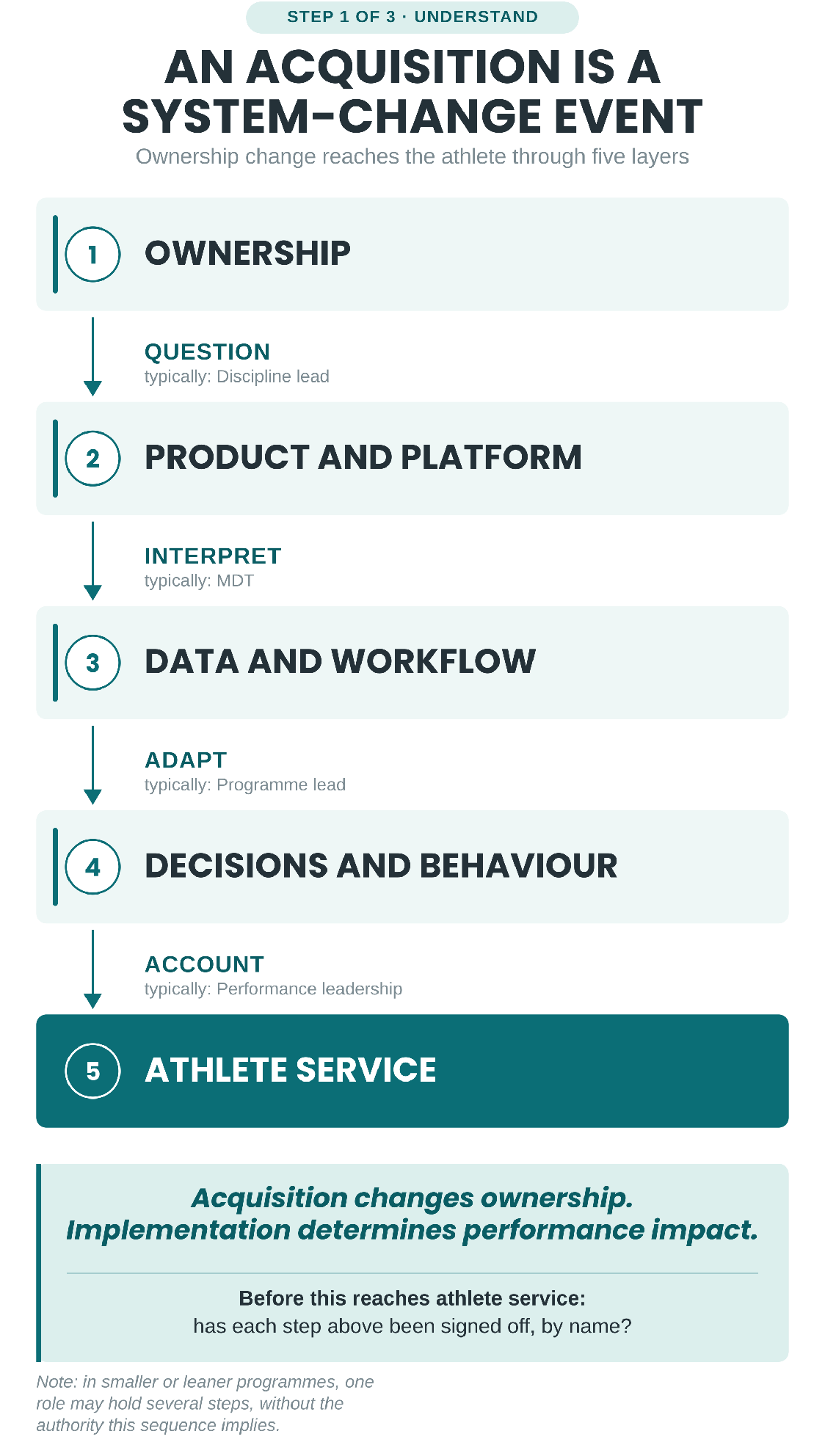
Figure 1. Ownership change reaches the athlete through product, data, and decision layers, with practitioner judgment mediating every stage. Acquisition changes ownership: implementation determines performance impact.
The opportunity: less friction, stronger connection
Performance departments routinely move between assessment, monitoring, medical, video, and program-delivery systems, exporting, cleaning, matching, and reformatting data before it becomes usable. This fragmentation carries a real operational cost across all major stakeholders. Too often, insight arrives after the practical decision has already been made. In those environments, highly skilled practitioners become human middleware, spending time and energy reconciling systems instead of connecting with athletes to support them, refine their craft, and build stronger relationships and understanding.
A connected ecosystem can shorten the path from assessment to intervention.
Assessment can inform session prescription.
Real-time data can drive intent and competition.
Seamless program delivery can preserve the planned dose or enable detailed adjustments.
Reassessment can help review responses and plan proactively.
When these elements genuinely communicate, staff spend less time deciphering information and more time strengthening the feedback loop with coaches and athletes.
This is the strongest case for consolidation: fewer repeated entries and avoidable handoffs, more context inside the decision window, and greater shared access to engineering, validation, security, education, and support. But connection is an opportunity, not an outcome. The strategic question is not how much can be connected, but which friction should disappear, and which human interactions must remain.
A unified dashboard does not automatically produce a unified understanding. More variables in one place do not correct weak validity, ambiguous definitions, or unclear decision rights. Integration creates value only when it improves the speed, quality, and usability of a real decision.
The responsibility: preserve the judgment layer
Tech companies consistently claim new metrics and platforms provide better decisions, better outcomes, better performance. But technology does not make the final performance decision. People do, drawing on more than the platform’s own data: professional knowledge, direct experience, and the instinct built from both, filtered through the context of this athlete, this moment, this level of risk.
That judgment is rarely exercised from a position of full authority. It looks like reading the right moment to raise a concern, noticing whose timeline you are actually working to, keeping enough distance from a system to leave without losing years of history, resolving disagreement with the least friction necessary to protect the athlete, and making a clear, ownable call without waiting for permission that may never arrive. Shared ownership should still not become collective ambiguity: problem, evidence, owner, and review point need to stay explicit. Practitioners should still inspect a recommendation’s variables and override its output when context demands it. A coach needs clarity about what changed; an athlete needs feedback that builds understanding, not a score that simply instructs them.
None of this positions practitioners against technology companies. The strongest relationship is reciprocal and contestable: vendors bring scale, engineering and product capability; practitioners bring contextual knowledge and implementation experience; coaches and athletes reveal whether the design holds up under real high-performance constraints. Trust should be earned through transparency, responsiveness and relevant evidence, not inferred from familiarity, confidence or polished marketing. The goal is not to defend old fragmentation. It is to ensure efficiency strengthens professional reasoning instead of quietly replacing it.
The technology cycle also moves faster than the conventional evidence cycle: product versions, algorithms and interfaces can change several times before an applied study reaches publication. That does not make evidence less important. It means durable science, real-world feedback, transparent versioning and practitioner judgment must operate on different clocks while informing the same decisions. That gap is not temporary. As one practitioner-researcher’s recent reflection on the field also argues, professional capability increasingly depends on working responsibly within it.
Integration is not interoperability
Integration means products work together inside a defined environment. Interoperability means data, definitions, and workflows can move across environments without losing essential meaning or function.
The distinction matters because an ecosystem can be highly integrated and still be difficult to navigate or leave. In our pursuit of a frictionless workflow, we trade the minor daily friction of managing specialized tools for the catastrophic paralysis of a consolidated ecosystem we can never afford to leave. The organization may retain access to its outputs but gradually become dependent on one vendor’s definitions, transformations, and composite scores to understand the athlete. This is more than technical lock-in. It can become an epistemic lock-in the system starts to shape not only where the data lives, but how the organization thinks.
Avoiding that dependency does not require rejecting a unified platform. It requires preserving the ability to reconstruct meaning outside it. Exported data should include units, timestamps, protocol details, field definitions, and relevant version information. Historical records should remain usable, and interfaces should support data movement in time for the decisions they serve. An organization’s own performance philosophy, thresholds, communication practices, and longitudinal athlete record should not exist only inside a vendor dashboard.
An integrated ecosystem is most valuable when participation is beneficial, but departure remains possible. Portability is not a rejection of partnership; it is what keeps the partnership chosen rather than inherited.
Measurement meaning must survive the merger
The common distinction between “raw measurement” and “proprietary estimate” is useful, but incomplete. Wearables and performance technologies do not offer unmediated access to physiological truth. They capture signals or proxies under defined conditions, then transform them:
Captured signal → processed signal → derived variable → model estimate → composite output → human decision
Each transition introduces assumptions and uncertainty. An R-R interval sits closer to the captured cardiac signal than a heart-rate-variability calculation. Sleep variables are model-based estimates. Bar velocity still depends on device, setup, sampling, and processing. A readiness score adds another layer through combination rules that may not be visible.
The practitioner’s question is therefore not simply, “Can we access the raw data?” It is: “What happened to the signal, what uncertainty entered, and is the resulting information adequate for this specific decision or performance question we are trying to answer?”
A prime example is OURA, currently facing a class-action lawsuit.
Weeks before a planned IPO at an $11 billion valuation, a class-action suit alleges Oura’s marketed “95% Sleep Staging Accuracy” can’t be substantiated by a ring measuring proxy signals, not the brain activity a clinical sleep lab requires. Oura disputes this and cites its own validation research.
This becomes especially important after acquisition. Firmware, filtering, feature extraction, reference populations, or scoring logic may change while a metric keeps the same name. Apparent historical continuity can conceal a genuine change in measurement meaning. The reverse is equally true: retaining a raw export does not guarantee comparability if the sensor, placement, sampling rate, or protocol has changed underneath it.
Emerging foundation models raise the stakes on this discipline rather than lowering them. Large models can learn useful representations across extensive wearable datasets, but transfer across device ecosystems is not yet demonstrated. Google’s SensorFM, for instance, was trained at population scale on one device family using one-minute aggregated signals; its own authors describe transfer to other hardware as further work, not a proven result. A recent review of sports digital-twin research reaches a parallel conclusion, naming standardization, interoperability, human expertise, governance and real-world validation as conditions for responsible adoption. As platforms become more intelligent, provenance cannot become less visible.
Athlete trust is part of data quality
Athletes experience consolidation through burden, feedback, access and consequence. They notice when another login appears, when a familiar metric disappears, when data collection expands, or when a score changes how staff respond.
Weak transparency and poor feedback can change reporting behaviour. In one qualitative study of elite Australian athletes, participants described uncertainty over who could see their data, and several said they had entered inaccurate figures rather than risk their performance being questioned. Trust, in other words, is not a soft cultural benefit layered on after implementation. It shapes the quality of the data entering the system in the first place.
Consolidation can reduce burden by eliminating repeated entry and disconnected interfaces. It can also connect increasingly sensitive layers of health, medical, behavioural, and performance information. Athlete-centredness should not be assumed to describe the acquisition itself; it must describe how the resulting ecosystem is implemented, governed and accepted.
Practitioners must be pragmatic and forward-thinking to keep the transition as seamless as possible and not cumbersome for key stakeholders. Operational disruption can be minimized while meaningful changes to data access, processing, purpose, or consequence remain ethically visible. Athletes should understand what is collected, who can see it, why it matters, what it can influence, and where human judgment stays in control.
A practical revalidation after acquisition
Technology is commonly evaluated at purchase and reviewed at renewal. A material acquisition should trigger a focused review in between. The purpose is not to presume failure; it is to verify continuity and surface new opportunities before workflows become dependent on untested assumptions. That review should hold across three horizons at once, because a change that helps this week can still cost the organization a season later.
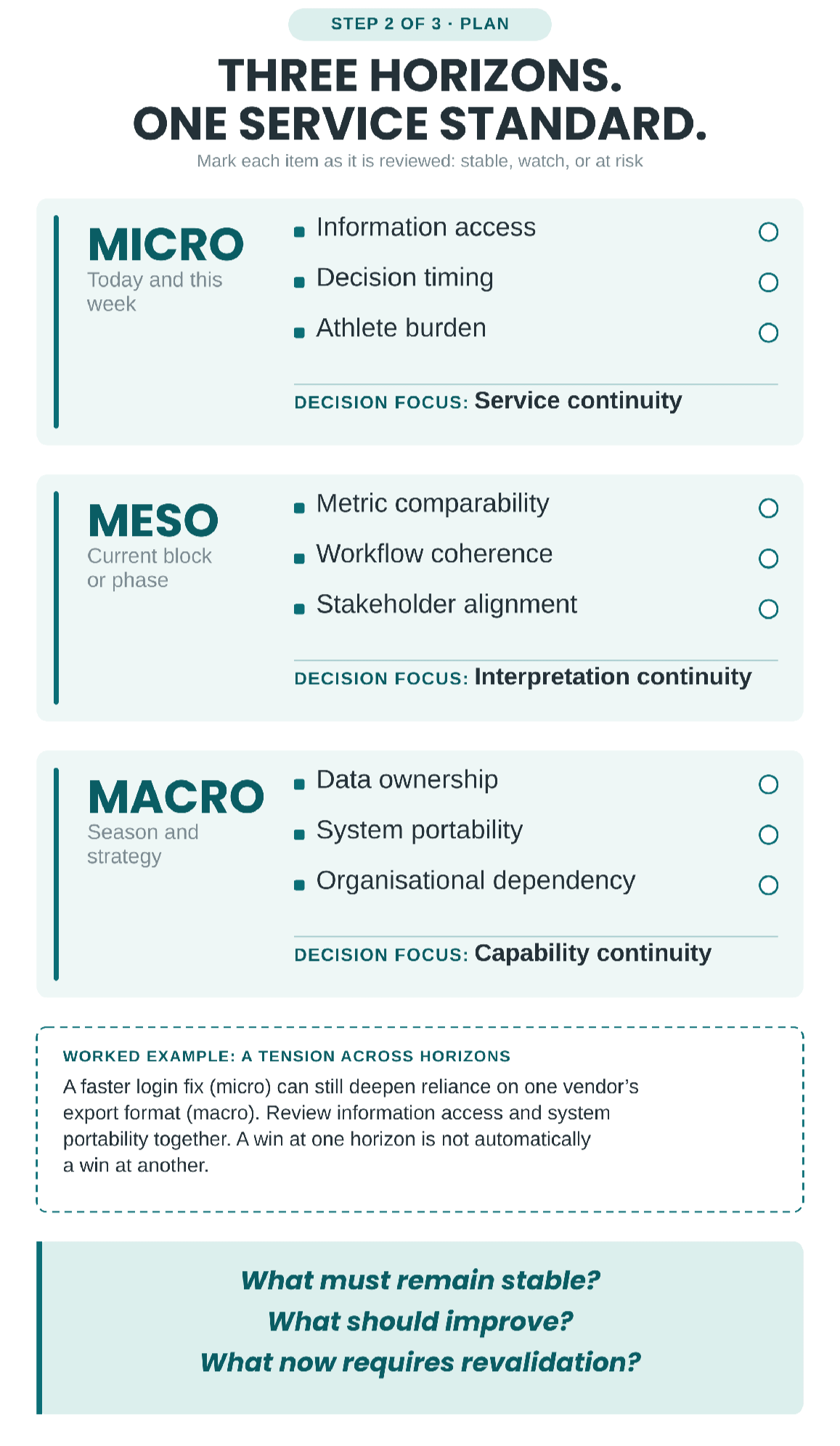
Figure 2. The same change can be beneficial at one planning horizon and costly at another: micro service, meso interpretation, macro capability.
Six checks turn that review into practice:
Start with the decision. Define which practical decision the connected workflow should improve, who owns it, when the information must arrive, and what action could change. If no decision becomes clearer or faster, added integration may only create more reporting.
Re-map provenance. Confirm whether the sensor, firmware, processing, metric definition, algorithm, reference data, or versioning practice will change. Record the method behind longitudinal variables rather than relying on a familiar label.
Test portability and reconstructability. Verify export completeness, API access, latency, historical downloads, data dictionaries, and a secondary route out. A spreadsheet backup is only useful if it preserves enough metadata to recover meaning.
Revisit governance with the athlete in view. Clarify any change in data control or processing, role-based access, retention, secondary use, model training, and athlete-facing explanation. Legal rights vary across jurisdictions; practical transparency should not.
Separate the service from the interface. Preserve internal reporting logic, coaching language, longitudinal baselines and communication routines outside the vendor’s presentation layer. If the interface changes, the quality of athlete support should not change.
Stress-test continuity. Ask what happens if a product is bundled, repriced, materially redesigned, unsupported, or discontinued. Define the minimum service that must continue, the information required to migrate, and the time and cost of doing so.
These questions belong in a constructive vendor conversation, not a defensive one. Companies that can explain lineage, portability, governance, and continuity clearly give practitioners stronger reasons to trust the ecosystem. Practitioners who can articulate the realities of use give companies better information to build with. Strong relationships accelerate learning, but they do not replace evidence; they help uncertainty become visible sooner.
Building a sustainable performance ecosystem
Sustainability in high performance is not simply maintaining a subscription or keeping every device connected. It is the capacity to preserve service quality as technologies, staff, athletes, and organizational priorities change. In a high-performance environment, change is a permanent operating condition rather than a phase to get through. The environments that thrive are not the ones that eliminate it, but the ones that get better at absorbing it without losing direction.
That takes more than technical resilience. It takes capability distributed across people: staff who understand the constructs being measured, coaches who know how information enters a decision, athletes who understand the purpose and consequences of monitoring, and leaders who can tell operational convenience apart from strategic dependency. Clear language, shared ownership, and explicit decision rights reduce coordination cost and protect performance momentum.
The strongest system is not necessarily the one with the most products under one logo. It is the one that can use connected technology while retaining the ability to question it, adapt it, and replace a component without losing the history or reasoning that supports the athlete. Innovation is not the accumulation of new capability; it is the disciplined conversion of capability into better decisions and better service.
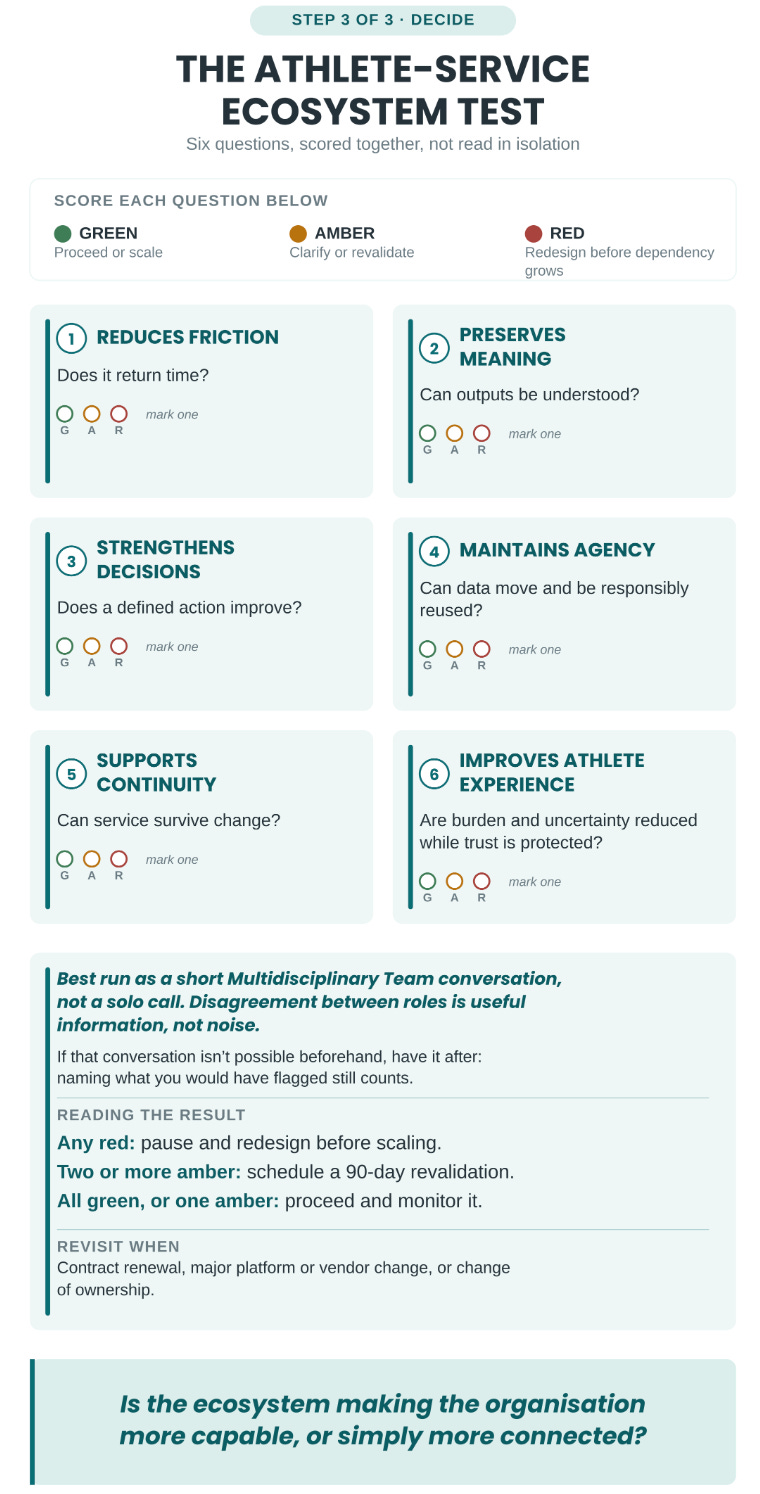
Figure 3. Six questions for evaluating a consolidated technology ecosystem. Green, amber, and red are starting points for a conversation, not a verdict.
The test: for whom is the ecosystem optimized?
Commercial scale, cross-selling and platform growth are legitimate company objectives. They are not automatically the same as the objectives of a high-performance program. That is why the final test is not the size of the dataset, or the number of products connected. It is whether the ecosystem improves decisions under pressure while strengthening the service the athlete actually experiences.
Practitioners do not need to resist consolidation to protect their role. They need to become more deliberate stewards of the relationship between signal, context, and action: keeping information interpretable, uncertainty visible, and technology accountable to the decision it’s been authorized to support.
Progress is the ability to adapt without losing purpose, judgment, or service quality.
Integration should reduce friction without reducing freedom. If a smarter data stack leaves the organization less able to understand, challenge, or change it, performance has not advanced. Dependency has simply become more convenient.
That question will only sharpen as the market keeps consolidating. Some organizations will rationally choose to stay modular, not from resistance to change but because depth, portability and control sometimes matter more than convenience, and which dependencies to accept is now as strategic a question as which ecosystem to join. Staying solo, chosen deliberately and reviewed as rigorously as any acquisition, is sometimes the more sophisticated choice, not the more cautious one.
The Practitioner’s Failsafe: True operational fluency isn’t the absence of friction; it is the presence of optionality. As a practitioner, you can reap the benefits of a low friction consolidated ecosystem as long as you have engineered a failsafe exit strategy or backup.
Selected sources
VALD, acquisition of GymAware, 11 August 2026, and acquisition of BridgeAthletic, 19 August 2026.
Garmin, acquisition of TrainingPeaks and TrainHeroic, 22 July 2026 (related consolidation activity elsewhere in the sector).
Surber v. Oura, class-action complaint reported by Inc., filed N.D. California, 20 August 2026.
Coventry, M. et al., “I lied a little bit”: elite Australian athletes’ perspectives on self-reported data, Physical Therapy in Sport, 2023.
Robertson, S. et al., Development of a sports technology quality framework, Journal of Sports Sciences, 2024.
Behrens, M. et al., Global insights on wearable technology adoption by coaches, Sports Medicine – Open, 2025.
Liu, X. & McDuff, D. (Google Research), SensorFM: towards a general intelligence and interface for wearable health data, 2026.
Sédiri, A. et al., Digital twins in sports science: a comprehensive narrative review, Biology of Sport, 2026.
Windt, J. et al., “To tech or not to tech?” A critical decision-making framework for implementing technology in sport, Journal of Athletic Training, 2020.
Dunne, D., Introducing Phronesis: practical wisdom for the AI era of performance science, Hexis, 2026.
You may also like:
✍️ Upside Guest Writer: The Trust Architecture in Performance Innovation, By Jordan Stewart-Mackie

This week our guest writer is Jordan Stewart-Mackie, a high-performance Scientist and PhD researcher with expertise in wearable technology integration and performance intelligence systems across elite football (Leicester City FC, West Bromwich), basketball (NBA), rugby, swimming, and academy environments.
✍️ 🧠 Upside Guest Writer: The Power of Your Breath, By Leonard Zaichkowsky

This week our guest writer is Dr Len Zaichkowsky, PhD. Len is a world-class expert in biofeedback, psychophysiology, and cognitive fitness, specializing in the application of neuroscience and psychology to elite sports performance. With decades of experience as a professor, researcher, and consultant, he has worked with top professional teams across the…