
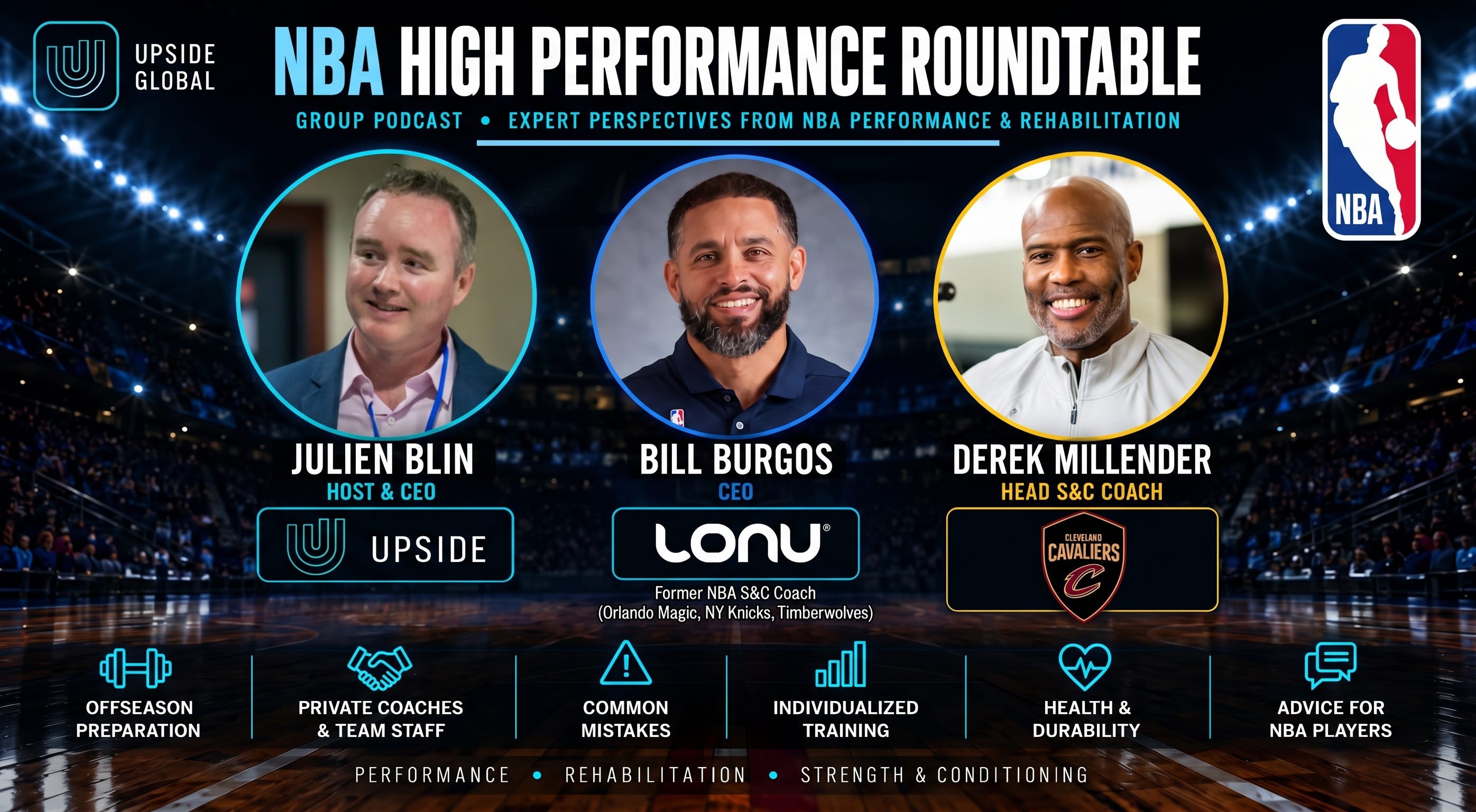
Today we have the honor of interviewing a group of NBA sports performance experts.
Bill Burgos is an experienced NBA Strength & Conditioning coach. He has worked for many NBA teams (Orlando Magic, NY Knicks, Timberwolves..). He also worked in the MiLB with the Pittsburgh pirates. He is also the CEO of LONU a next generation AI based nutrition platform.
Derek Millender, the head S&C coach of the Cleveland Cavaliers, a top NBA team.
📝Show Notes: Through this interview, we touched on the following questions and topics:
Q1. With training camp already done, what should an ideal final few weeks of the offseason look like for an NBA player—physically, technically, and mentally?
Q2. Many players work with private coaches during the offseason. What does strong collaboration between a player’s private coach and NBA team staff look like, and where can problems arise?
Q3. What are the biggest offseason mistakes you see players make—such as overtraining, playing too much live basketball, chasing social-media workouts, or neglecting recovery?
Q4. How should offseason preparation be individualized based on a player’s age, injury history, role, expected minutes, and the way their team plans to use them?
Q5. When you look at players who consistently have successful, healthy seasons, what habits or decisions during the offseason separate them from everyone else?
Q6. If you could give every NBA player one piece of advice before the season begins, what would it be?
You can also watch the full video interview below:
Here are some of the best quotes of our conversation with them:
Q1. What should the ideal final weeks of offseason preparation look like?
Derek Millender — Cleveland Cavaliers
For me, it’s definitely an interdepartmental focus. As a strength and conditioning coach, I’m collaborating with our sports science group, reviewing baseline testing and analyzing how players are trending. If it’s a returning player, how do they compare to where they were last year? Do they have the capacity they need? We’re also communicating with basketball coaches to understand whether there are conditioning, agility or other physical limitations affecting their performance. Ultimately, all that feedback needs to get back to the player so they understand exactly what we’re working on and why.
Bill Burgos — LONU
Training camp in the NBA is quite short. It’s enough to expose players to high loads, but I don’t think it’s enough to create significant physical changes. Some guys come prepared and some don’t. It’s our job to develop programs that mitigate those challenges and reduce injury risks. That’s why, during the offseason, we travel and stay connected with players to make sure they’re prepared. Strength coaches, physical therapists, athletic trainers, sports scientists and dietitians all collaborate to make sure what players are doing during the offseason prepares them for training camp.
Recommendations for NBA teams
Establish offseason readiness benchmarks: Compare preseason testing with historical performance data to identify physical limitations and areas requiring attention.
Create integrated performance plans: Align strength coaches, sports scientists, medical staff and basketball coaches around shared player objectives.
Monitor workload progression: Track training loads, particularly for players with previous injuries or lower training capacity.
Communicate individualized priorities: Give each player a clear understanding of their development goals for the opening weeks of the season.
Q2. How should private coaches and NBA team staff collaborate?
Bill Burgos — LONU
When I’m working privately with a player, I’m there all the time. I’m traveling with him, so I get to see what’s happening and can make adjustments and progressions throughout the offseason. When collaborating with an NBA team’s staff, I just need to know their goals and what they expect from the player. They have access to testing and resources, like force plates, that I might not have. All that information is beneficial for programming. I’m really trying to be an extension of the performance staff of whichever team the player is with. At the end of the day, we’re all trying to help the player succeed.
Derek Millender — Cleveland Cavaliers
It’s great when you have harmony. Players have the opportunity to choose who they want to work with during the offseason, and I’m interested in understanding why they chose that professional. Ideally, we have conversations with that person throughout the summer, or we visit the player and observe how they’re training. I think it’s important that team strength coaches support the professionals these athletes choose and work together. If they don’t have access to certain testing equipment, we can bring it or share specific goals. Different coaches have different experiences, and there’s always something we can learn from them.
Recommendations for NBA teams
Establish regular communication with private coaches: Schedule offseason check-ins to align training objectives and monitor player progress.
Share relevant performance data: Provide private trainers with testing results, injury considerations and development priorities, with appropriate player consent.
Visit players during the offseason: Observe their training environments and evaluate how private programs complement team objectives.
Build collaborative relationships: Treat private coaches as potential partners rather than competitors, while maintaining clear responsibilities.
Q3. What are the biggest offseason mistakes NBA players make?
Bill Burgos — LONU
I personally think the biggest issue is structure. I’m used to working with periodized programs, and it takes time to gain power, strength and other physical qualities. If there’s no structure and players keep traveling, getting tired and recovering from travel, suddenly three or four weeks have gone by. Then it’s August and they’re trying to rush everything. I think that’s where injuries can happen. If players maximize their time and stay consistent, even dedicating a few hours in the morning to training, it can make a significant difference. If I had to sum it all up in one word, it would be structure.
Derek Millender — Cleveland Cavaliers
During the season, everything is organized for the players. The court is available, the weight room is there, the chef is at the facility and recovery services are scheduled. During the offseason, players have to think ahead. If you’re going on vacation for ten days, have you planned where you’re going to do your basketball work? Are you taking a deload? What equipment is available at your hotel? A lot of younger players aren’t used to organizing those things themselves. We’re not saying vacations are bad, but you need to plan ahead so you can maintain your training routine and the progress you’ve made.
Recommendations for NBA teams
Provide structured offseason programs: Develop periodized training plans with clear objectives, progression and recovery periods.
Support players during travel: Help identify suitable training facilities and adapt programs based on available equipment.
Monitor training consistency: Maintain regular communication to identify missed sessions, disrupted routines or sudden workload increases.
Educate younger players: Teach offseason planning, training logistics and recovery management to encourage greater independence.
Q4. How should offseason preparation be individualized?
Derek Millender — Cleveland Cavaliers
It starts with a discussion with the player. At the end of the season, we have exit meetings where we reflect on what went well and what needs improvement. Those conversations lay the foundation for the offseason program. We also need to understand what’s happening in the player’s personal life. Maybe they’re getting married, traveling or playing for their national team. A young player preparing for Summer League will have a completely different program from a veteran who’s been in the league for six or seven years. You have to consider their injury history, goals, culture and circumstances. There’s not just one way to approach it. The program needs to be built around the individual player.
Recommendations for NBA teams
Conduct comprehensive exit meetings: Review each player’s performance, injury history, development needs and personal objectives.
Differentiate programs by player profile: Adjust preparation based on career stage, expected basketball demands and competition schedules.
Integrate injury-specific monitoring: Reassess previously injured areas throughout the offseason and preseason to guide training progression.
Account for personal circumstances: Adapt training schedules around international competition, travel and other commitments.
Q5. What separates players who consistently have successful, healthy NBA seasons?
Derek Millender — Cleveland Cavaliers
Players have to make that software upgrade every offseason. Just like when you update software to fix bugs and improve performance, athletes need to identify what they can improve and commit to doing the work. Maybe a coach tells you your defensive capacity isn’t good enough or your second and third efforts need improvement. Is it a basketball understanding issue or a conditioning issue? You have to listen to that feedback and make the decision to improve. The other thing is that successful players genuinely love basketball. When you combine that passion with a willingness to improve their physical limitations, nutrition and habits, you have an athlete who can continue getting better.
Recommendations for NBA teams
Promote year-round consistency: Encourage sustainable training habits rather than isolated periods of excessive intensity.
Educate players on workload management: Help athletes understand when to increase intensity, reduce loads and prioritize recovery.
Build individual development plans: Identify specific physical and technical weaknesses after each season and establish measurable improvement goals.
Strengthen athlete education: Teach players how nutrition, recovery, training and daily habits influence performance and career longevity.
Q6. What’s the one piece of advice every NBA player should hear?
Bill Burgos — LONU
I’ve always said to make sure you’re doing the right thing at the right time, no matter where you are. That’s been my biggest message. A lot of players work with outside trainers and the training itself might be good, but sometimes it’s happening at the wrong time. They might peak too soon or follow a program that doesn’t match where they should be in their preparation. It’s not just about training hard or choosing the right exercises. It’s about understanding when to do certain things so you’re ready when it matters most.
Derek Millender — Cleveland Cavaliers
The few things you can control, make sure you control them. Being on time, eating the quality food the team provides, your attitude and the energy you bring to your teammates every day. Sometimes players get frustrated because they’re doing everything right but aren’t getting the playing time they expected. You can’t always control that. But you can control how you show up and how you support your teammates. Even if you’re not playing, find a way to bring positive energy and help the team win. When your opportunity comes again, you need to be physically and mentally ready for it.
Recommendations for NBA teams
Align training with the competitive calendar: Ensure strength, conditioning and recovery programs reflect each stage of the season.
Develop player accountability: Reinforce consistent habits around nutrition, punctuality, preparation and professionalism.
Support psychological readiness: Help players manage frustration, changing roles and uncertainty around playing time.
Maintain readiness for non-rotation players: Implement individualized training and conditioning plans so athletes remain prepared when opportunities arise.
You may also like:
🏀Upside NBA Video Chat with Dr Andrew Paul (OKC), Dr Andy Barr (Quantum Movement), Ryan Petersen (Chicago Bulls) on NBA Offseason Preparation, Best practices and More.

This week we have the honor to interview again a group of NBA sports performance executives to talk about the latest trends in the world of sports performance and rehabilitation.
🔥Upside NBA Video Chat with Dr Marco Nunez (Ex LA Lakers/NBA), Derek Millender (Cavs/NBA), Ryan Petersen (Chicago Bulls / NBA) on The Life after the NBA, Technology Adoption, Performance Optimization

This week we have the honor to interview again a group of NBA sports performance executives to talk about the latest trends in the world of sports performance and rehabilitation.