
November 15, 2026 | Sports Technology, Team Operations & Business Continuity
Introduction: When a Critical Communication Tool Stops Working
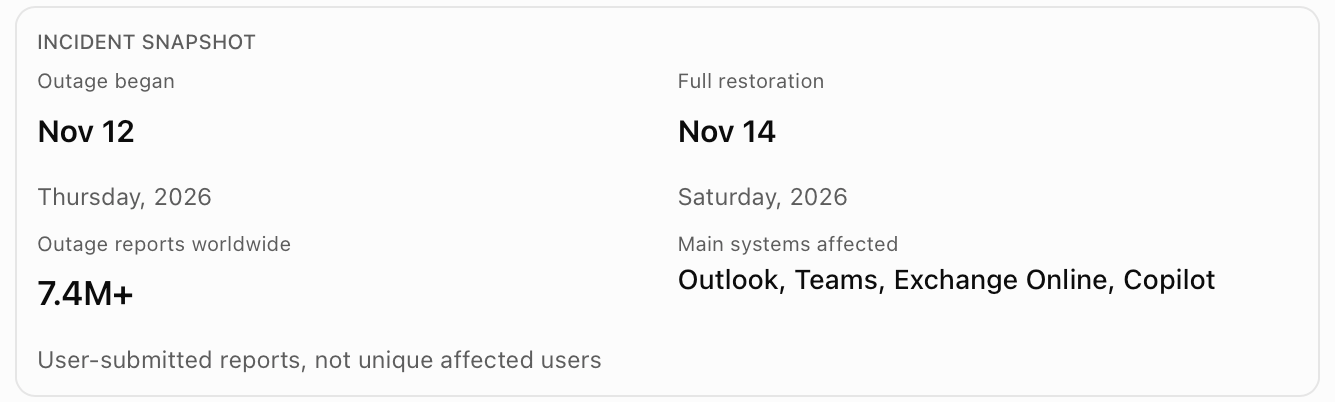
Over the past few days, Microsoft experienced one of its most significant service disruptions in recent years, affecting Outlook, Microsoft Teams, Exchange Online and other Microsoft 365 services. The outage began on Thursday, November 12, 2026, and continued into Friday, with Microsoft confirming full service restoration on Saturday, November 14.
According to Reuters, Downdetector recorded more than 7.4 million user-submitted outage reports worldwide during the incident. The disruption affected businesses, government agencies and other organizations that depend heavily on Microsoft’s cloud infrastructure. Microsoft attributed the problems to server availability and infrastructure issues, with no indication that a cyberattack or AI system caused the outage.
For professional sports organizations, this raises an important question: What happens when a critical communication platform becomes unavailable during a training session, a matchday, a player transfer negotiation or an important medical decision?
At Upside, several professional sports teams we work with told us they were unable to check their Outlook emails during the disruption. This was particularly concerning because email remains a fundamental communication tool for performance directors, athletic trainers, sports scientists, rehabilitation specialists, team executives and other practitioners.
Although professional sports organizations have invested heavily in athlete monitoring systems, AI platforms, performance analytics and other technologies, many still depend on a relatively small number of cloud providers for everyday communication.
The recent Microsoft outage illustrates a broader operational vulnerability: sophisticated sports organizations can have advanced performance technology infrastructures while remaining exposed to the failure of a basic communication service.
What Happened During the Microsoft Outlook Outage?
The outage initially affected users attempting to access Exchange Online mailboxes and subsequently disrupted other services within the Microsoft 365 ecosystem.
Microsoft identified a problem involving servers becoming unavailable after automated health checks, placing additional pressure on the remaining infrastructure. Restoration was gradual, and some customers experienced delayed email delivery and intermittent access even after initial recovery efforts began.
This was not simply an Outlook desktop application malfunction. Because Exchange Online provides the underlying cloud email and calendar infrastructure for many organizations, switching from the Outlook desktop application to Outlook on the web would not necessarily resolve the problem.
The incident highlights the risks associated with having multiple operational services depend on the same cloud infrastructure.
Which Professional Sports Clubs Reported Outlook Problems?
The most relevant information for the sports industry comes from direct feedback received by Upside.
Several teams in our professional sports network reported that staff members using Microsoft Outlook were unable to check their emails during the disruption. However, we have not independently verified or obtained permission to publish the names of those clubs, and the publicly available reporting reviewed does not establish a confirmed list of affected professional teams.
For that reason, it would be inappropriate to attribute the incident to specific NBA, NFL, NHL, MLB, MLS or European soccer clubs without direct confirmation.
The reports received by Upside nevertheless raise concerns for organizations across these leagues, particularly in departments where communication is time-sensitive.
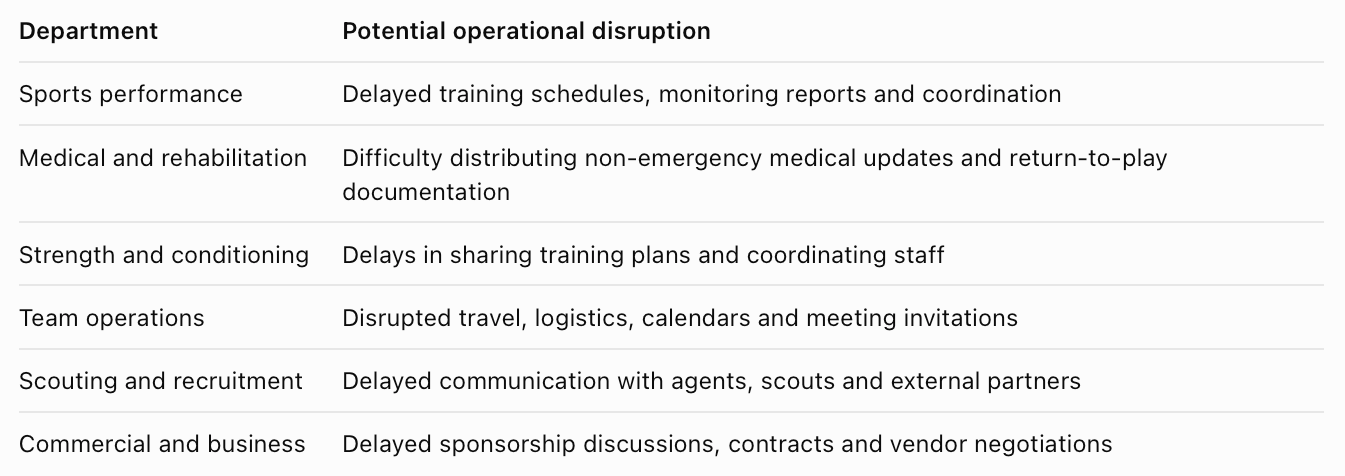
These are potential consequences of losing access to email and connected services, not confirmed outcomes at every club.
How Did the Outlook Outage Impact Professional Sports Clubs?
The consequences of an email outage depend on when it occurs, which departments are affected and whether an organization has alternative communication channels.
For professional teams, the potential impact extends well beyond employees being unable to read or send emails.
A. Disruption to performance and medical departments
Performance and medical practitioners increasingly rely on digital communication to coordinate their daily activities. A head of sports performance may need to communicate with athletic trainers, physiotherapists, strength coaches, team physicians, external consultants and technology providers throughout the day.
During a typical training week, these interactions can include injury updates, athlete availability reports, rehabilitation schedules, monitoring data, medical appointments and changes to training plans.
An Outlook outage could delay the distribution of these updates, particularly when teams depend on email attachments, shared calendars or Microsoft-hosted documents. Even when practitioners can communicate through WhatsApp, phone calls or dedicated athlete management systems, the disruption can create additional administrative work and increase the risk of inconsistent information.
For sensitive medical information, alternative channels must remain compliant with applicable privacy and data-security requirements. Teams should not respond to an outage by moving confidential athlete records into unapproved personal messaging accounts.
B. Matchday and travel logistics
Professional teams operate on demanding schedules involving training sessions, flights, hotels, equipment transportation, venue coordination and communication with league officials.
Consider an NFL team preparing for a Sunday game, an NBA team traveling between cities, or a European soccer club coordinating an away fixture.
If email and calendars become unavailable, staff may struggle to retrieve travel confirmations, communicate last-minute schedule changes or coordinate with external suppliers. The impact can be especially significant when staff are traveling and cannot access information stored elsewhere.
Teams with dedicated travel platforms and offline copies of essential documents may be better positioned to continue operating.
C. Recruitment, transfers and commercial negotiations
Email is also important for communication between clubs, agents, scouts, investors and commercial partners.
A prolonged outage could delay contract reviews, sponsorship proposals, recruitment discussions, purchase orders or other time-sensitive decisions. During a transfer window, free-agency period or commercial deadline, these delays could have consequences beyond ordinary productivity losses.
There is no verified evidence that the November outage caused a professional sports team to lose a player transaction or commercial agreement. However, these scenarios demonstrate why teams should treat communication infrastructure as a business-continuity issue.
D. Technology vendors and external service providers
The outage also exposed dependencies between cloud services and other software platforms. Reports indicated that integrations connecting AI assistants to Microsoft services were affected, including connectors used by OpenAI and Anthropic.
For sports organizations increasingly deploying AI assistants, automated workflows and integrated technology platforms, this is an important consideration.
An AI system that depends on Outlook, SharePoint or Exchange Online for retrieving documents, sending notifications or accessing scheduling information may become partially unavailable even when the AI application itself is functioning.
Teams need to understand not only whether their technology vendors are reliable, but also which third-party services those vendors depend upon.
What Were the Financial Implications?
There is currently no verified estimate of the financial losses incurred specifically by professional sports organizations during the November 2026 Microsoft outage.
However, the broader economic implications were significant. Reuters reported that Morningstar DBRS estimated global insured losses associated with the incident at approximately $300 million to $500 million. This is an estimate of insured losses across industries, not the total worldwide economic cost or the amount paid in claims.
For sports organizations, the potential financial exposure can be divided into several categories:
Lost staff productivity: Employees unable to complete routine tasks or forced to use manual alternatives.
Operational delays: Additional time spent coordinating travel, training and business activities.
Commercial exposure: Delayed proposals, contracts, sponsorship discussions or transactions.
IT and recovery expenses: Additional support hours, incident response and post-outage reconciliation.
Reputational consequences: Reduced responsiveness to partners, sponsors, agents or other stakeholders.
Illustrative cost scenarios for a professional team
The following estimates demonstrate how quickly productivity losses could accumulate. They are hypothetical scenarios, not measured losses from the November incident.
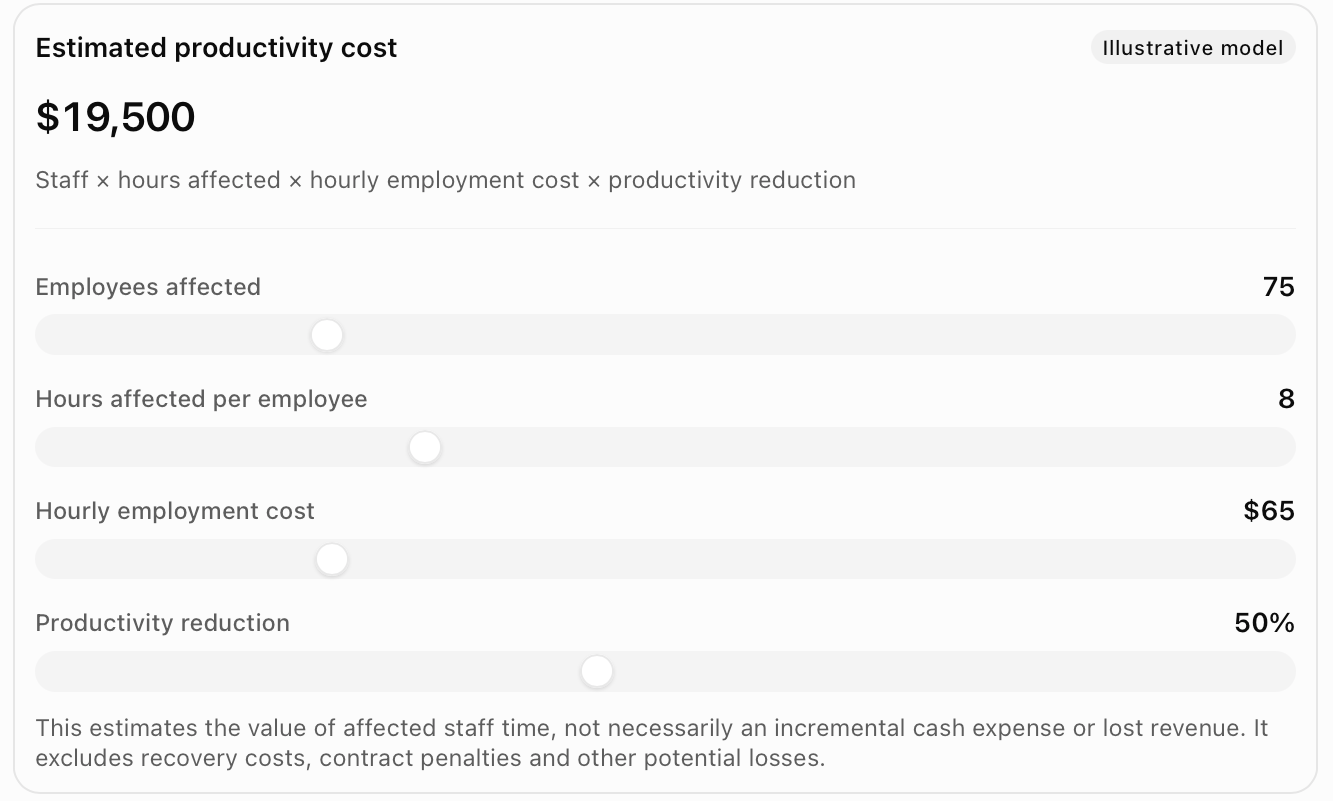
For a club employing 75 affected staff members, an eight-hour disruption, a $65 fully loaded hourly employment cost and a 50% productivity reduction would imply approximately $19,500 in affected productivity value.
For larger organizations, or incidents involving multiple days, this figure could increase considerably. Nevertheless, it is important not to equate productivity exposure automatically with realized financial losses.
The wider lesson is that teams should quantify their dependence on critical technology systems before an outage occurs.
Have Similar Outages Happened Before?
The November incident was not an isolated example of cloud-service disruption. Professional sports organizations should consider several historical incidents when evaluating their technology infrastructure.
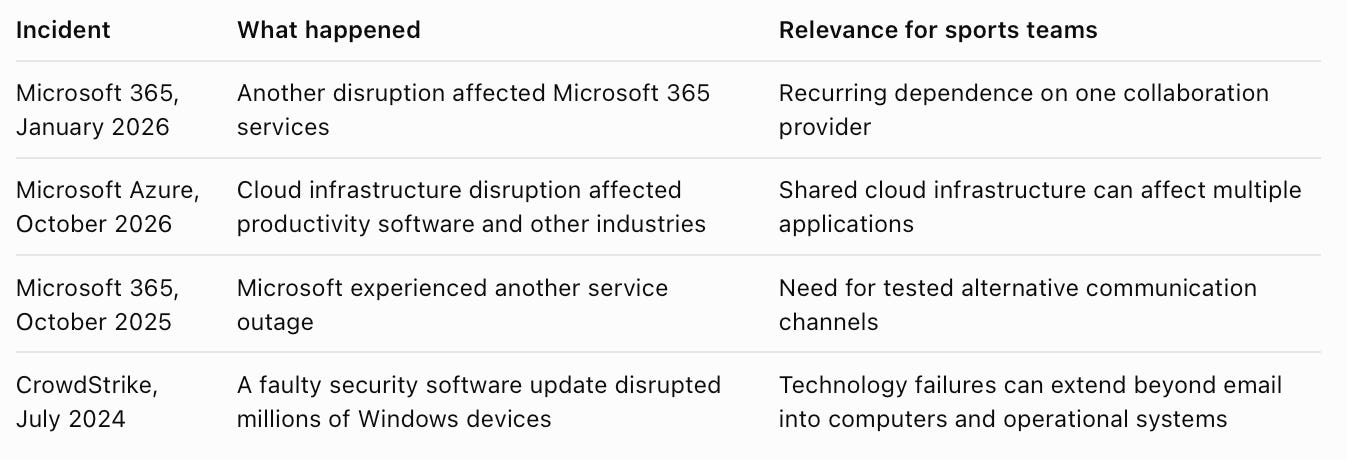
Reuters identified the January 2026, October 2025 and October 2026 Microsoft incidents when reviewing the latest disruption. It also cited an estimated $400 million to $1.5 billion financial impact associated with the 2024 CrowdStrike incident.
The CrowdStrike incident was not an email-provider outage, and its technical cause differed substantially from Microsoft’s November problems. Nevertheless, it provides a useful comparison because it demonstrated how a single technology failure can cascade across organizations and industries.
There is insufficient publicly verified evidence to establish which specific professional sports clubs experienced operational losses during these earlier incidents.
The broader pattern, however, is clear: cloud infrastructure, cybersecurity software and enterprise collaboration platforms have become critical components of organizational operations, including within professional sports.
Recommendations for Professional Sports Teams
The most important lesson from this incident is not that teams should abandon Microsoft Outlook or immediately switch to another email provider.
Microsoft 365 remains a widely used enterprise platform, and switching providers does not eliminate the possibility of future outages. Google Workspace and other cloud-based services also depend on infrastructure that can fail.
Instead, professional sports organizations should build greater resilience into their operations.
Recommendation 1: Establish an emergency communication protocol
Every professional sports organization should have an alternative communication process that does not depend on Microsoft 365.
Teams should identify which communication channels remain available when Outlook, Exchange Online and Teams are inaccessible.
This could include approved mobile messaging applications, phone calls, SMS notifications or independent emergency communication services.
For performance and medical departments, the protocol should establish who contacts whom, how urgent information is escalated and how sensitive athlete information is protected.
Recommendation 2: Reduce dependence on a single technology provider
Teams should conduct a comprehensive assessment of their technology infrastructure to identify dependencies on Microsoft, Google, Amazon Web Services and other cloud providers.
The objective should not necessarily be to operate multiple email systems simultaneously. That could introduce additional costs, administrative complexity and cybersecurity risks.
Instead, organizations should identify critical processes that require independent backup capabilities, such as emergency contact directories, travel information, operational schedules and essential medical escalation procedures.
Recommendation 3: Develop department-specific business continuity plans
A professional sports team should not rely exclusively on a generic IT disaster recovery plan.
The needs of a head athletic trainer are different from those of a commercial director or a team travel coordinator.
Each department should document its most important workflows, identify the systems required to execute them and establish alternative procedures.
For example, a performance department should know how to communicate athlete availability and training changes if its usual email and document-sharing platforms become unavailable.
Recommendation 4: Evaluate the reliability of sports technology vendors
As teams adopt more AI-powered platforms, athlete management systems and performance technologies, they should ask vendors more detailed questions about operational resilience.
Important considerations include:
Which cloud providers and third-party services does the platform depend on?
Can essential information remain accessible during an internet or cloud-service outage?
Does the vendor have a documented business continuity and disaster recovery plan?
What are its service-level commitments, recovery objectives and incident notification procedures?
Can teams securely export their data and continue critical operations if the vendor becomes unavailable?
These questions should become part of the technology procurement process, alongside product functionality, scientific validation, integration capabilities and pricing.
Recommendation 5: Test emergency procedures before an outage occurs
One of the most effective ways to prepare for a disruption is to simulate it.
Teams could conduct a quarterly exercise in which key staff members temporarily lose access to Outlook, Teams and shared Microsoft documents.
The exercise should evaluate whether the organization can continue communicating with practitioners, coordinating travel, distributing important updates and contacting external partners.
The findings should then inform improvements to internal processes and staff training.
Recommendation 6: Quantify the cost of technology downtime
Professional teams regularly evaluate the return on investment of performance technologies, but they should also measure the financial exposure associated with technology failures.
IT and finance departments can estimate the productivity impact of an outage, identify time-sensitive business activities and determine which services justify additional resilience investments.
Organizations should also review applicable Microsoft service-level agreements, potential service credits and cyber or business interruption insurance policies. Service credits, where available, do not necessarily compensate for the full financial consequences of an outage.
Recommendation 7: Give performance and medical practitioners a voice in technology decisions
Technology procurement is often driven by IT departments, finance executives or senior management. However, the people who depend on these systems every day should participate in decisions about resilience and business continuity.
Heads of sports performance, medical directors, athletic trainers, rehabilitation specialists and strength coaches can identify operational risks that may not be obvious to other departments.
Their involvement is particularly important when evaluating athlete management platforms, communication systems and AI tools that connect multiple sources of information.
Conclusion: Technology Innovation Must Be Accompanied by Operational Resilience
The November 2026 Microsoft Outlook outage should serve as a reminder to professional sports organizations that digital transformation brings both opportunities and operational risks.
Over the past decade, teams have invested heavily in sports science, wearable sensors, biomechanics, AI, athlete management systems and performance analytics. These innovations have helped organizations collect more information, improve workflows and support decision-making.
However, the growing sophistication of sports technology does not eliminate the need for reliable communication infrastructure.
At Upside, the feedback we received from teams unable to access their Outlook emails reinforced an important point: even organizations operating at the highest levels of professional sports remain vulnerable to disruptions involving technology providers they depend on every day.
The financial consequences of this particular outage for professional clubs have not been quantified, but the potential impact on team operations, medical communication, travel coordination, commercial activities and staff productivity deserves serious consideration.
I expect technology resilience to become an increasingly important consideration for professional sports organizations over the next several years, particularly as teams adopt more AI agents, automated workflows and interconnected cloud applications.
The next phase of sports technology innovation should not focus exclusively on what new tools can accomplish. It should also address what happens when those tools suddenly stop working.
The question every professional sports organization should be asking is simple: If our primary email and collaboration platforms stopped working tomorrow, could our team continue operating effectively?
For many organizations, the events of November 12–14 may have provided an unexpected opportunity to find out.