
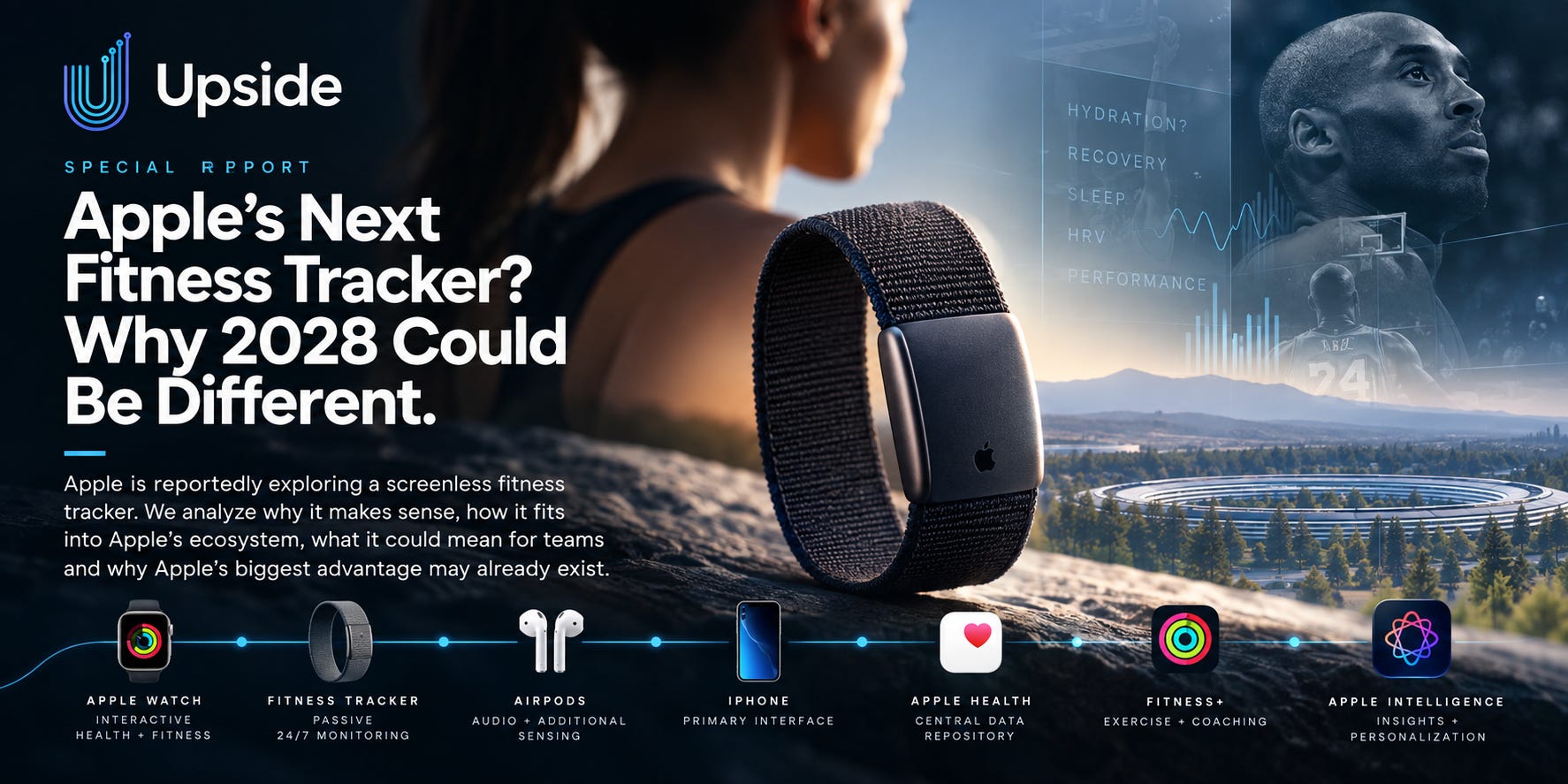
Apple may be preparing to make another significant move in health and wearable technology.
According to a September 22 report from Bloomberg, Apple is exploring the development of a screenless health and fitness tracker that could eventually put the company into more direct competition with Whoop. Apple is reportedly conducting what it calls a “technology investigation”, an exploratory process designed to determine whether the concept should ultimately become a commercial product. Multiple prototypes have reportedly already been developed, including a device described as a thin fabric band containing a sensor-equipped computing module.
If Apple moves forward, Bloomberg reports that the device would not reach the market before 2028 at the earliest. That distinction is important. Apple has not announced the product, there is no confirmed launch date, and we don’t yet know which physiological measurements the device would actually capture.
The immediate comparison is naturally Whoop. The company has demonstrated significant demand for a wearable that doesn’t behave like a smartwatch. Instead of putting another screen on the wrist, Whoop focuses on continuous physiological monitoring and translates that information into insights around sleep, strain and recovery.
But we think looking at Apple’s potential device simply as a “Whoop competitor” misses the more interesting story.
Apple has spent more than a decade building an increasingly sophisticated health ecosystem around the Apple Watch, iPhone, Apple Health, AirPods, Fitness+ and, increasingly, artificial intelligence. It has also spent years researching physiological measurements and sensor technologies that have not yet reached consumers.
A screenless band could potentially become another important component of that ecosystem—not replacing the Apple Watch, but giving Apple something different: a passive, always-on physiological sensor designed primarily to collect continuous health information.
And this isn’t the first time Apple has explored much more ambitious wearable health technologies.
We Have Heard This Before
One reason to approach the latest report cautiously is Apple’s long history of experimenting with technologies that don’t necessarily become commercial products.
Long before today’s conversations around readiness scores, recovery algorithms and continuous physiological monitoring, Apple was already investigating how wearable devices could capture much more information about the human body.
Before the original Apple Watch was introduced, reports emerged in 2014 that Apple had been working with professional athletes to test its wearable technology. One of the most prominent athletes associated with those efforts was Kobe Bryant, who reportedly visited Apple’s Cupertino campus during development of what would eventually become the Apple Watch.
Other professional athletes were reportedly involved as Apple attempted to understand how wearable technology could operate during high-level training and competition.
That history is important because Apple’s ambitions were already extending beyond counting steps or recording workouts. The company was exploring whether devices worn continuously on the body could eventually provide much richer physiological information.
Over the following decade, some of those ambitions became commercial Apple Watch features. Others remained patents, research programs or technologies that Apple continued developing behind the scenes.
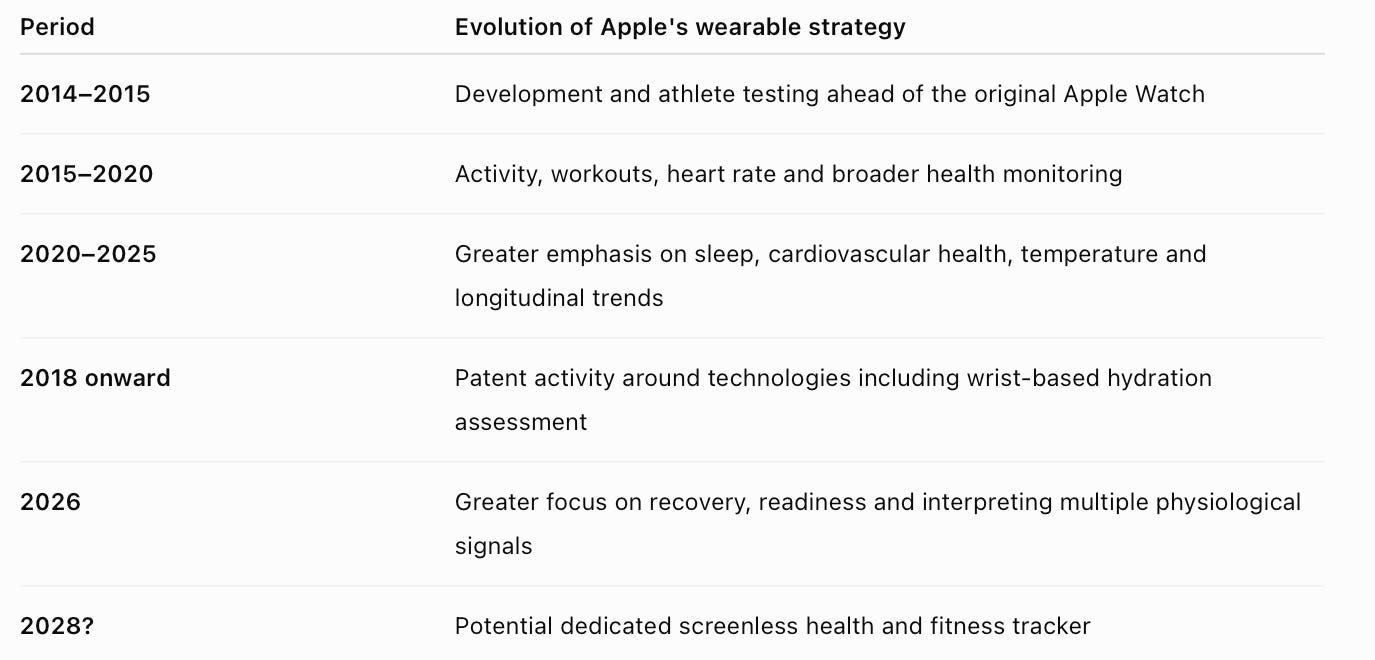
The important takeaway from this timeline isn’t any individual feature. It is the direction in which Apple has been moving.
Apple’s wearable strategy has gradually evolved from measuring what someone does toward understanding what is happening physiologically while they do it.
That distinction could define the next generation of Apple health products.
Apple’s Hydration Research Is an Important Part of the Story
One particularly interesting example is hydration.
Apple has pursued intellectual property around technologies designed to estimate hydration from a wrist-worn device. Its work has described using electrodes positioned on a watch or watch band to measure electrical properties associated with perspiration and electrolyte concentration, potentially allowing hydration to be assessed repeatedly and non-invasively.
This is especially interesting when placed alongside Apple’s early work with elite athletes.
Kobe Bryant was reportedly involved in Apple’s early athlete testing, although there is no evidence that he specifically tested the later patented hydration technology. Those should be viewed as separate but related examples of Apple’s long-running interest in understanding how advanced wearable sensing could apply to athletes and consumers.
Hydration remains one of the more compelling unsolved opportunities in wearable technology.
For an athlete, reliable hydration information could potentially provide additional context around training, heat exposure, travel and recovery. For a consumer, it could become another physiological signal that helps explain why the body is responding differently from one day to another.
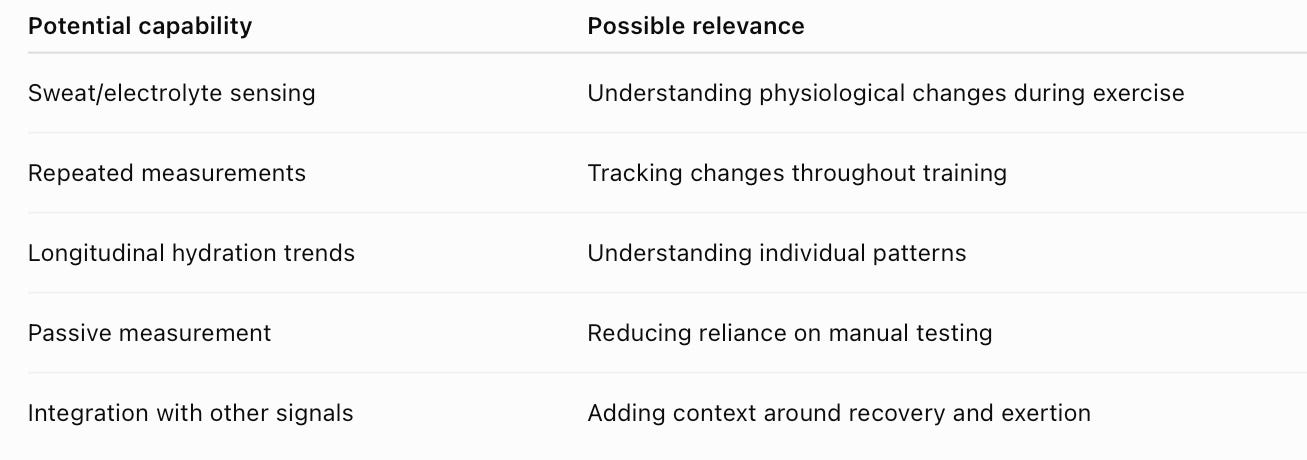
There is currently no evidence that Apple’s rumored 2028 device will measure hydration, and we should be careful not to make that assumption.
What Apple’s hydration work demonstrates is something broader: the company has been thinking for years about turning the wrist—and potentially the band itself—into a much richer physiological sensing platform.
That makes Bloomberg’s description of the new prototype as a fabric band containing a sensor-equipped computing module particularly interesting.
Why a Screenless Fitness Tracker Would Make Sense for Apple
At first glance, another Apple wrist-based device seems redundant.
Apple already has one of the world’s most successful wearable products. The Apple Watch can record workouts, heart rate, sleep, activity and a growing range of health measurements. Apple has also spent years encouraging users to wear the device for increasingly long periods.
Why introduce another wearable?
Because the Apple Watch and a screenless fitness band could ultimately serve two very different purposes.
The Apple Watch has evolved into a small computer on the wrist. Its health capabilities are important, but it also handles notifications, apps, communications, music, payments, navigation and many other functions.
A screenless tracker could reverse that relationship. Instead of being a computer that also collects health information, it could be a health sensor first.
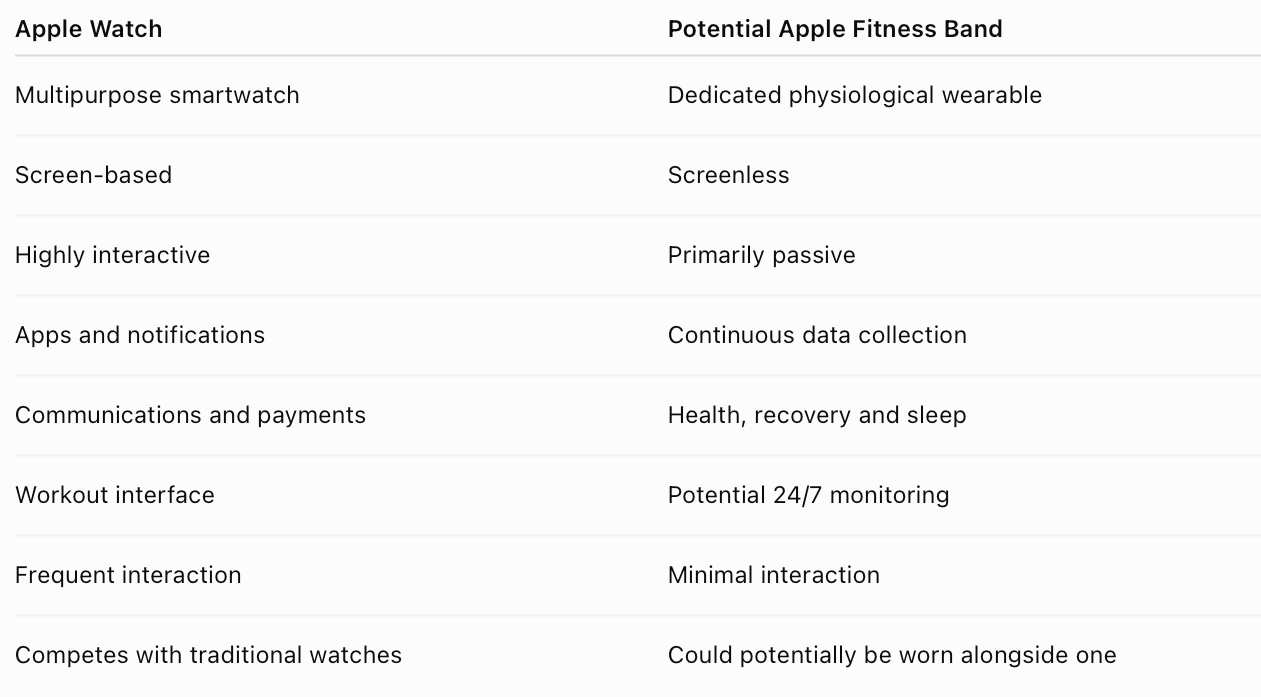
This could allow Apple to address consumers who want sophisticated health monitoring without necessarily wanting another screen.
It could also help solve one of the fundamental challenges in wearable technology: wear time.
Physiological information becomes more useful when it is collected consistently. A device optimized around comfort, battery life and passive monitoring could theoretically generate a more complete dataset than a device users frequently remove.
That is one of the core principles behind Whoop’s approach.
Apple Doesn’t Need to Be First
There is another reason Apple’s potential entry should matter to Whoop, Oura and the broader wearable industry.
Apple has often chosen not to be first into a new product category.
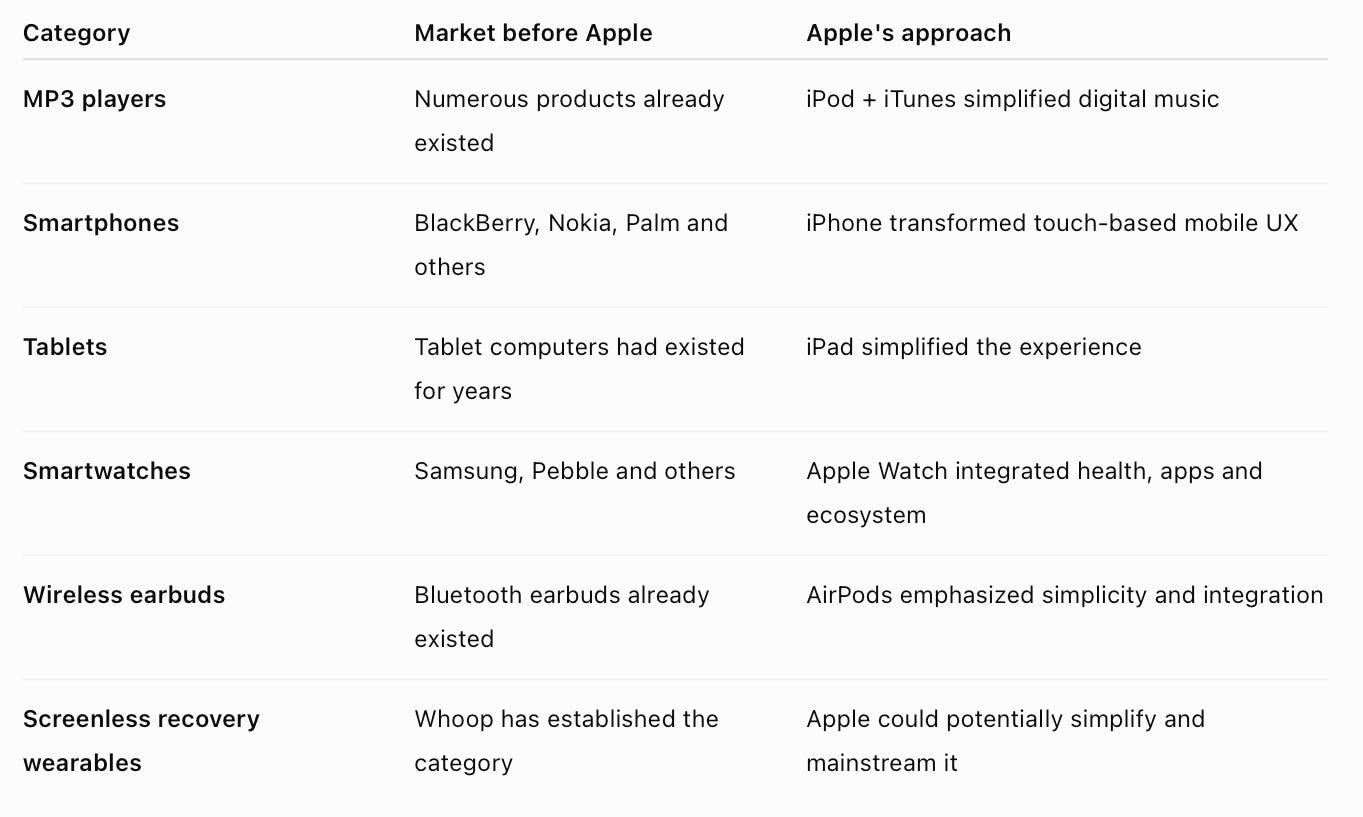
Apple didn’t invent the portable MP3 player, smartphone, tablet, smartwatch or wireless earbuds. In several of its most successful categories, other companies had already established the market and demonstrated consumer demand.
Apple’s approach has frequently been to enter later and rethink the overall experience.
The company tends to combine hardware, software, industrial design and ecosystem integration with a strong emphasis on simple and intuitive UI/UX. Instead of necessarily inventing a new category, Apple often attempts to make an existing technology significantly easier for mainstream consumers to understand and use.
That doesn’t mean Apple automatically builds a better product simply because it enters later.
Whoop and Oura have spent years developing algorithms, proprietary datasets, communities and specialized expertise. Apple would have to compete with companies that understand these categories extremely well.
But Apple doesn’t necessarily need to invent a better heart-rate sensor or another recovery score.
Its opportunity may be to create a better overall experience around the information.
Imagine putting on an Apple band and having it automatically connect with your iPhone, Apple Watch, Apple Health and AirPods. There could be virtually no setup process and potentially much less need for the consumer to understand concepts such as HRV or navigate complicated dashboards.
Instead, Apple could focus on explaining what has changed physiologically and what that information means.
That would be a very Apple-like way to enter this market.
Why 2028 Could Be Different
The market Apple could enter in 2028 is also fundamentally different from the wearable market that existed when the Apple Watch launched.
Early fitness trackers were primarily designed to tell users what they had done: steps taken, calories burned, distance traveled and workout duration.
The emerging generation of wearables is increasingly attempting to answer a different question:
What should you do next?
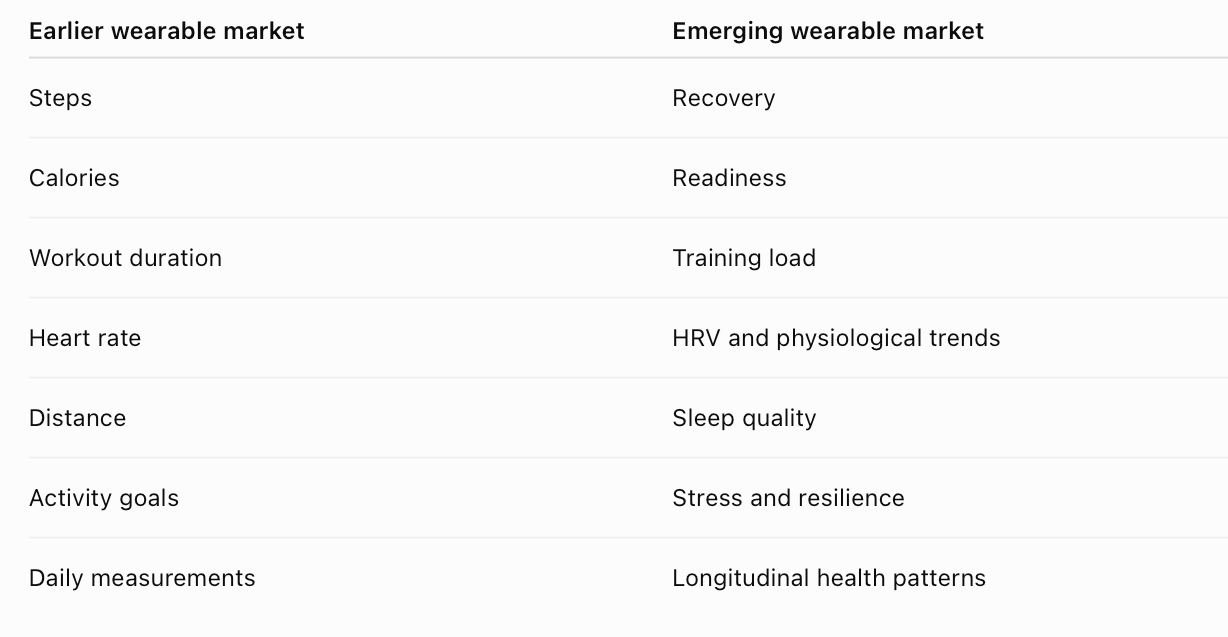
This change is crucial.
As the market shifts toward sleep, recovery, readiness and long-term physiology, the screen itself becomes less important.
What increasingly matters is whether a device can be worn comfortably for long periods, whether the sensors produce reliable information and whether the software can translate that information into something people can understand and act upon.
How It Could Fit Within the Apple Ecosystem
This is where Apple’s opportunity becomes significantly larger than simply competing with Whoop.
Apple doesn’t need a screenless band to operate as a completely independent product.
The ecosystem already exists.
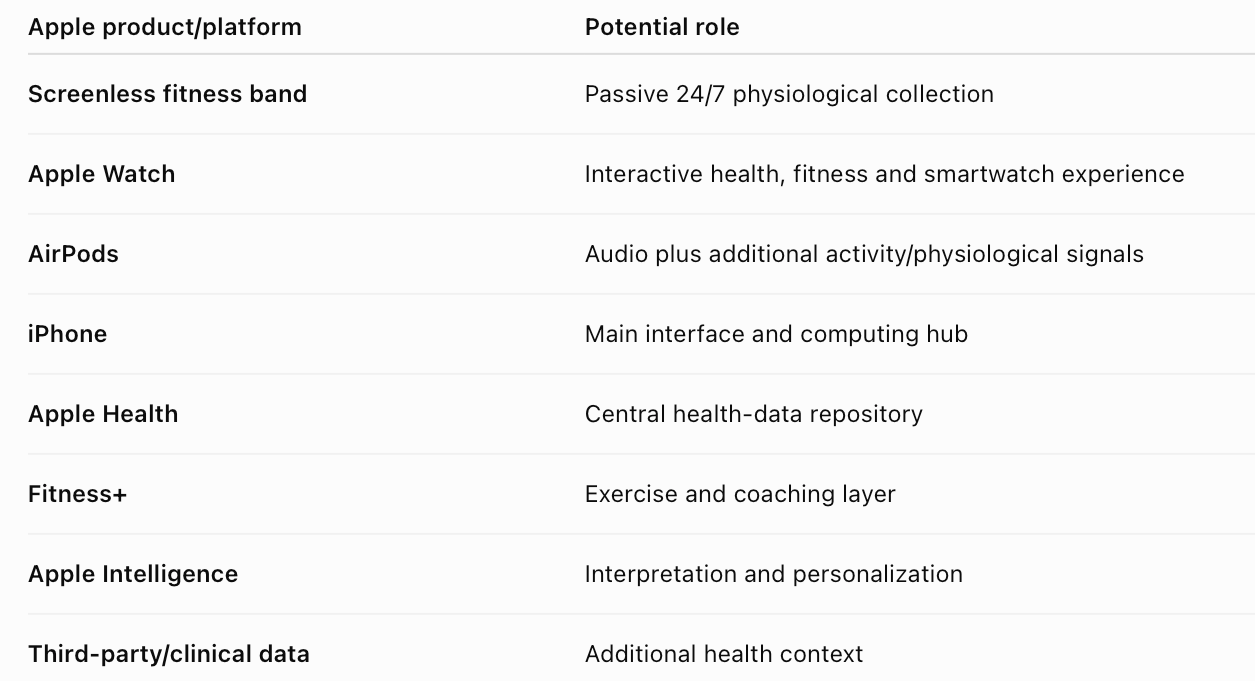
Viewed through this lens, Apple doesn’t necessarily need consumers to choose between an Apple Watch and an Apple fitness band.
Some consumers could potentially use both.
The Watch could remain the interactive device for workouts, communications and immediate feedback. The band could potentially be optimized for sleep, recovery, travel and periods when the user wants continuous monitoring without a display.
For people who prefer traditional watches, the band could also offer access to Apple’s health ecosystem without requiring them to wear an Apple Watch.
That could significantly increase the number of hours each day during which Apple collects useful physiological information.
Apple’s Biggest Advantage: An Existing Apple Watch User Base
One of Apple’s biggest advantages in entering the screenless fitness-tracker category would be something Whoop and Oura could never easily replicate: Apple already has an enormous installed base of Apple Watch users who are familiar with tracking their health and fitness through Apple.
Of note, Apple does not disclose an exact number of active Apple Watch users, so there isn’t an official current figure.
The best evidence suggests the installed base is comfortably above 100 million active users globally, but we have to take this with a grain of salt. That being said Apple has said the Apple Watch installed base reached an all-time high, while third-party estimates suggest roughly 39–41 million Apple Watches shipped in 2025 alone. Counterpoint says Apple accounted for 23% of global smartwatch shipments in 2025, and shipments continued growing strongly in 2026—up 21% YoY in Q1 and 14% in Q2.
The point here is that Apple would not be starting from zero.
Millions of Apple Watch users already track workouts, heart rate, sleep, activity and other health information through Apple Health. They already have historical data stored within Apple’s ecosystem, understand Apple’s interface and, perhaps most importantly, already trust Apple devices to monitor aspects of their health and fitness.
That creates a potentially powerful customer-acquisition advantage.
Instead of convincing consumers to adopt an entirely new health platform, Apple could potentially offer existing Apple Watch users another way to collect their physiological information.
Some Apple Watch owners could switch to the screenless tracker, particularly users who primarily use their Watch for health and fitness and don’t value the screen, apps or communications features.
Others could own both devices.
An athlete might use the Apple Watch during workouts but wear the screenless band for sleep and recovery. Another consumer might use the band during the week while wearing a traditional watch. Some users might eventually move entirely from the Apple Watch to the lighter screenless device.
That gives Apple multiple potential conversion paths.
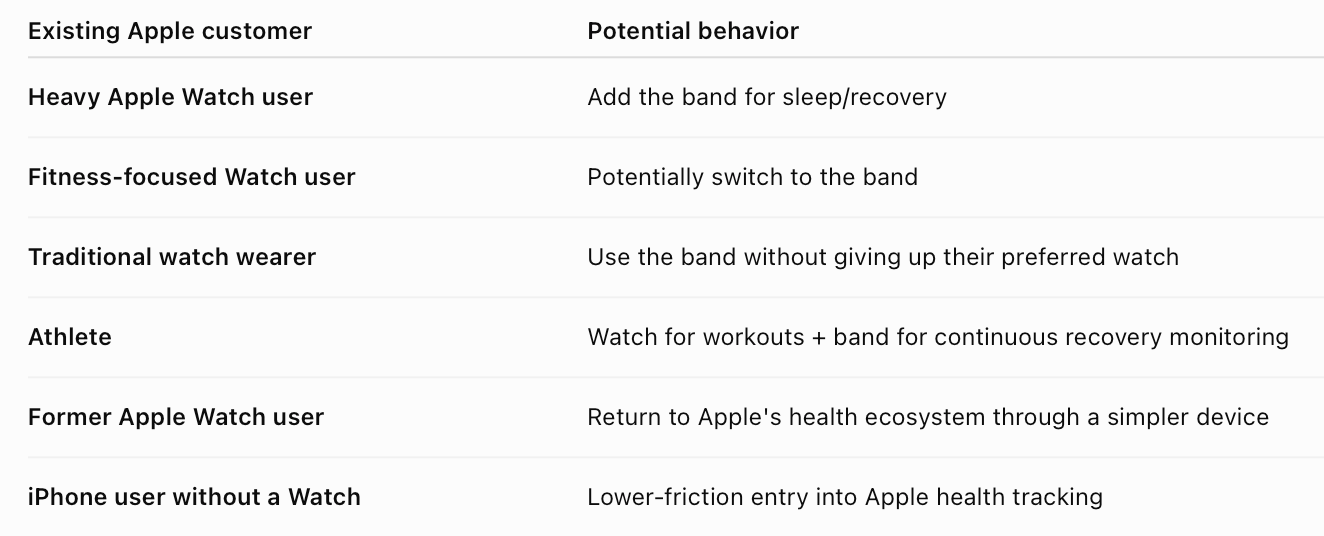
This could dramatically change the economics of entering the category.
Whoop and Oura need to acquire customers and convince them not only to purchase a new device but also to adopt a new platform, build a new physiological baseline and regularly engage with another app.
Apple could potentially place the new device directly in front of existing Apple Watch and iPhone users.
The onboarding experience could also be remarkably simple. An existing Apple Watch user could theoretically purchase the band, pair it with an iPhone and immediately connect it to years of historical information already stored in Apple Health.
That historical data could be extremely valuable.
Instead of starting with a blank profile and spending several weeks establishing baselines, Apple’s algorithms could potentially already understand aspects of the user’s activity, workouts, heart rate, sleep and other historical patterns.
The Competitive Advantage Could Be Distribution + Data + Ecosystem
This gives Apple a combination of advantages that extends well beyond hardware.
Existing Apple Watch users → existing Apple Health data → simple device setup → familiar UI/UX → Apple ecosystem integration → lower friction to adoption.
This is one of the reasons Apple would not necessarily need to build a radically superior device to become a significant player in the category.
It could potentially convert even a relatively small percentage of its existing Apple Watch population and immediately create a substantial user base for the new product.
And that creates an important strategic risk for Whoop and other specialized wearable companies.
Apple wouldn’t necessarily have to convince consumers that recovery, sleep and physiological monitoring are valuable. Whoop, Oura, Garmin and the rest of the wearable industry have already spent years educating the market.
Apple could arrive later, simplify the experience and then distribute the product into an enormous existing ecosystem.
The Bigger Opportunity Isn’t Hardware. It’s Data.
This may ultimately be the strongest strategic reason for Apple to explore the category.
The value of health wearables increasingly comes from longitudinal information.
A single HRV measurement tells us relatively little. One night’s sleep score provides limited context. A resting heart-rate measurement taken once isn’t particularly useful.
But combine thousands of measurements collected over months or years and compare them against an individual’s baseline, and the value changes considerably.
Apple could potentially combine information around heart rate, HRV, sleep, respiratory rate, temperature, activity, workouts and eventually additional biomarkers.
The objective becomes less about producing individual measurements and more about understanding how those measurements interact.
The potential flywheel becomes:
More wearable time → more physiological data → stronger individual baselines → better algorithms → better insights → greater engagement → more wearable time.
That is much more strategically significant than selling another fitness tracker.
Apple Intelligence Could Become the Most Important Layer
The next competitive battle in wearables may therefore have relatively little to do with hardware.
Many leading wearables already measure heart rate, HRV, sleep, respiratory rate, temperature and activity.
The harder problem is explaining what all of that information actually means.
Consumers don’t necessarily need another dashboard displaying 20 physiological metrics. They increasingly need technology that explains what changed, why it might matter and what they should consider doing about it.
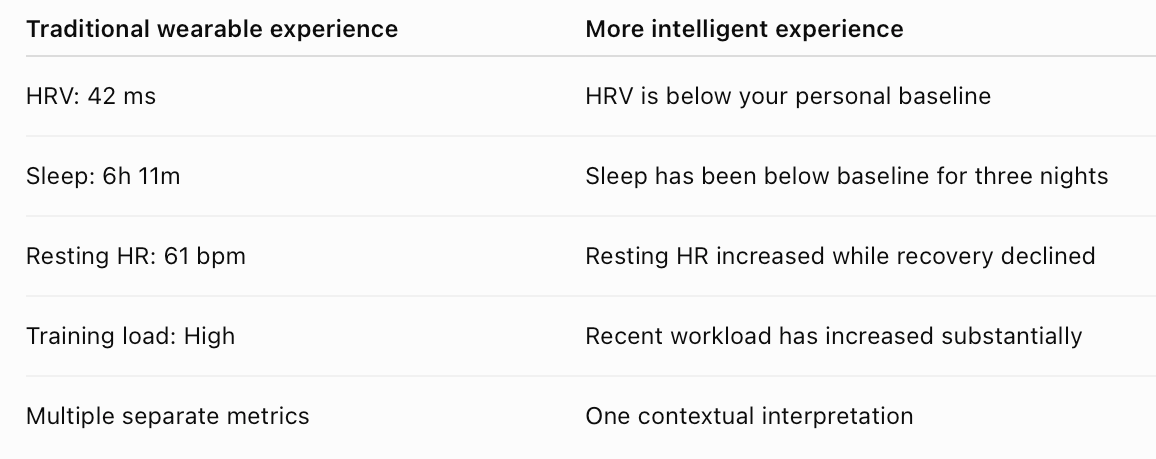
Rather than requiring users to interpret multiple measurements themselves, an Apple health system could potentially synthesize them.
For example, it could explain that recovery indicators are below the user’s normal range because HRV has declined, resting heart rate has increased, sleep duration has fallen and recent training load has increased.
That is far more valuable than another graph.
And this is where Apple Intelligence could potentially become one of Apple’s most important advantages.
What Would This Mean for Professional Teams?
For professional sports teams, Apple’s potential entry into the category could be more significant than it initially appears.
Performance departments currently operate across two different technology environments. Inside the training facility, athletes may use GPS/LPS systems, force plates, motion capture, athlete-management systems, medical technologies and laboratory testing. Away from the facility, consistently capturing physiological information becomes considerably more difficult.
That is one reason consumer wearables have become increasingly interesting to professional sports.
Athletes can wear devices while sleeping, traveling, recovering at home or moving between games. A comfortable screenless Apple wearable could potentially make that passive monitoring even more accessible.
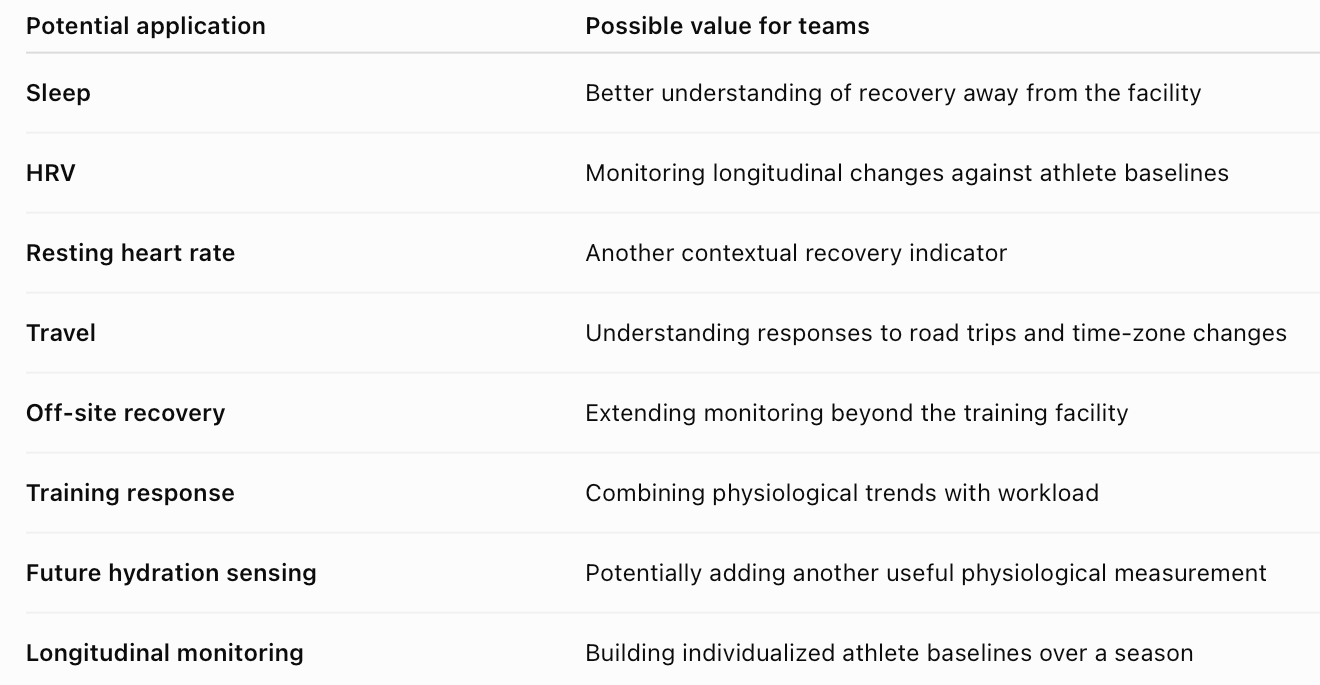
But the biggest impact for teams could actually come from consumer adoption rather than team adoption.
Imagine an athlete arriving at an NBA, NFL, NHL, MLB or European football club having already worn an Apple health device for several years. Instead of the team giving that athlete another wearable and trying to establish a new baseline, the athlete could potentially arrive with an extensive longitudinal health dataset already stored within the Apple ecosystem.
That could fundamentally change the relationship between athletes, teams and health data.
Adherence is one of the most underestimated challenges in sports technology. The theoretically best wearable has limited value if athletes don’t consistently use it.
Apple could potentially solve part of that problem simply because athletes may already be using the product in their personal lives.
For Teams, Data Access Would Be the Critical Question
There is an important caveat.
Professional teams don’t simply need another wearable.
They need usable access to the data.
A performance director isn’t monitoring one athlete. Sports scientists need to analyze entire rosters, combine multiple data streams and integrate information from wearables with GPS, force plates, wellness questionnaires, medical records, training schedules and internal athlete-management systems.
That means Apple’s relevance to elite sports would ultimately depend on what it allows teams and athletes to do with the information.
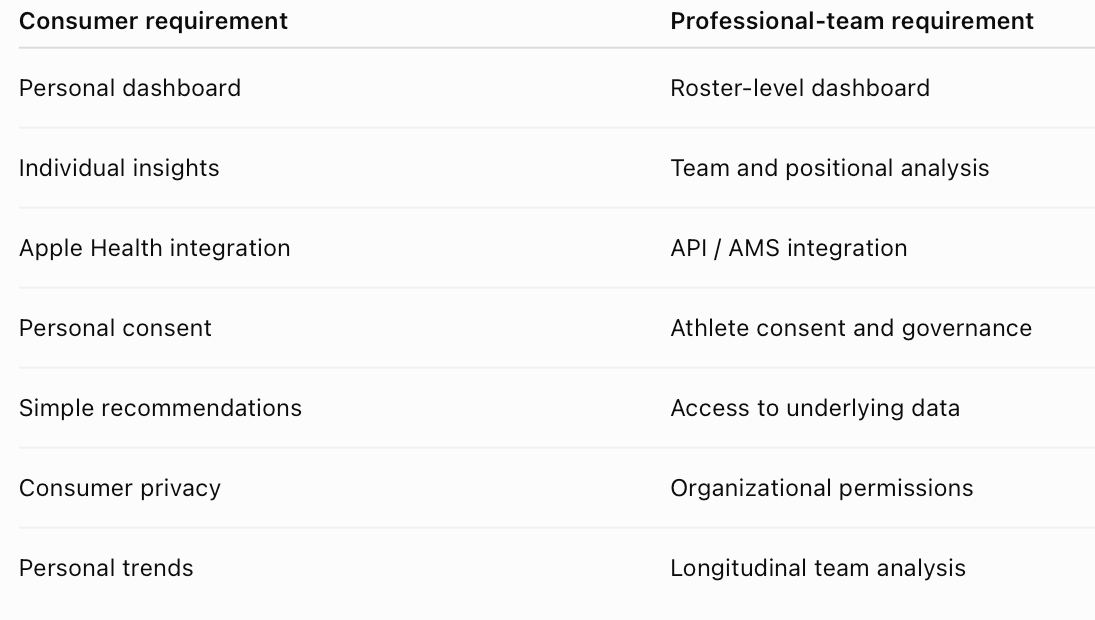
This could determine whether Apple creates a popular wearable among professional athletes or an actual performance technology adopted by professional teams.
Those are not necessarily the same thing.
If Apple keeps most information inside a consumer-facing ecosystem, teams may have limited ability to use it.
If Apple eventually provides robust APIs, athlete-controlled data sharing and integrations with team systems, however, the implications become considerably larger.
Apple Could Raise the UI/UX Expectations for Sports Technology
There is another potential consequence for the sports-tech industry.
Apple entering this market could raise athletes’ and practitioners’ expectations around user experience.
Elite-performance technology has traditionally been built primarily around functionality. Many platforms contain enormous amounts of valuable information but require considerable expertise, configuration and interpretation.
Apple typically approaches technology differently.
If athletes become accustomed to receiving sophisticated physiological information through a highly intuitive Apple interface, they may become less tolerant of complicated sports-performance platforms.
Practitioners may eventually expect the same thing.
That could put pressure on sports-tech companies to compete not simply on sensor accuracy but also on how effectively they turn their data into usable information.
The next generation of athlete technology could increasingly compete on three dimensions:
Sensor accuracy + interpretation + UI/UX.
Historically, sports technology has focused heavily on the first.
The next battle could increasingly be fought around the second and third.
What Would This Mean for Whoop, Oura and Other Wearable Companies?
The immediate competitive narrative will naturally focus on Whoop.
That makes sense. A screenless fabric band centered around continuous health monitoring would overlap much more directly with Whoop than today’s Apple Watch does.
But Apple’s potential entry would have implications across a much broader section of the wearable market.
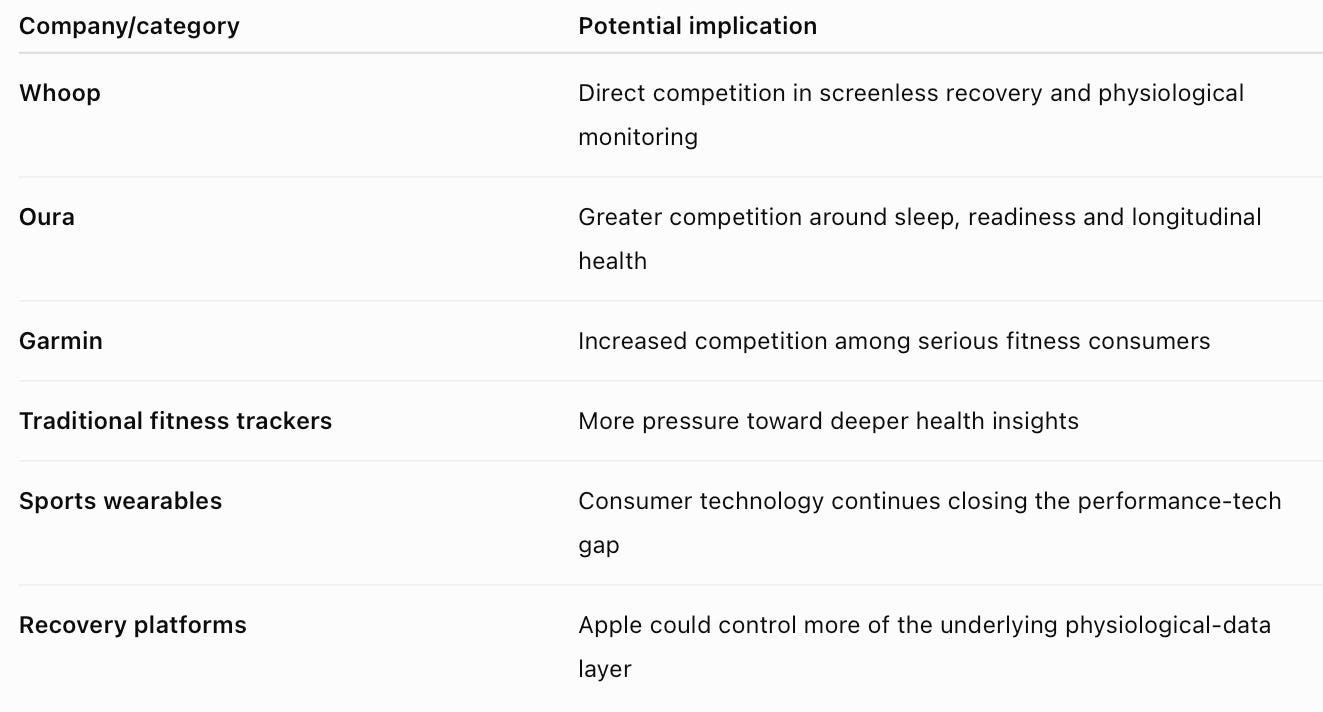
Whoop and Oura still have important advantages. Both have spent years building specialized algorithms, datasets, user communities and expertise around recovery and sleep.
Apple doesn’t necessarily need to beat those companies on every individual feature.
Its advantage could come from integration.
The fitness band becomes more powerful because it connects to the Watch. Both become more powerful because they connect to the iPhone. Those devices feed Apple Health. Apple Intelligence interprets the information.
That ecosystem effect could ultimately be much more difficult for specialized wearable companies to replicate.
There Are Still Major Reasons to Be Skeptical
Despite the strategic logic, it would be premature to assume an Apple fitness band will arrive in 2028.
Bloomberg’s terminology is important. Apple is reportedly conducting a technology investigation. Multiple prototypes may exist, but Apple has not committed to releasing the product.
Several important questions therefore remain unanswered.
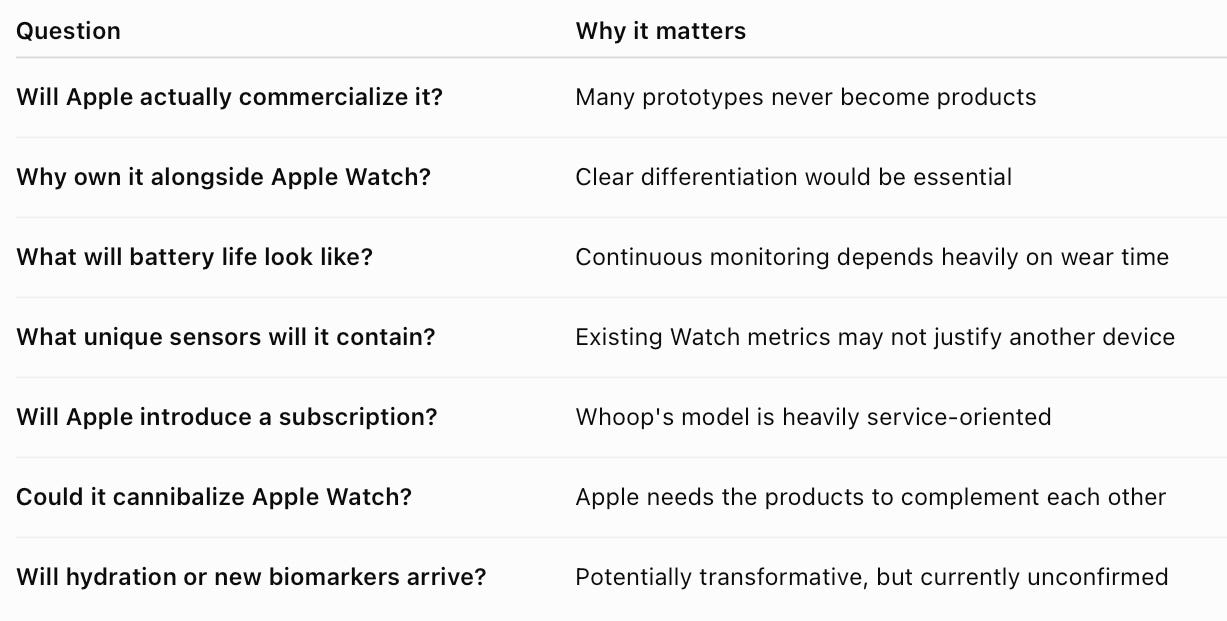
These uncertainties are why the Bloomberg report should not be interpreted as confirmation of Apple’s next major product.
But it does tell us something about where Apple is looking.
And that may ultimately be more important.
Conclusion: The Band May Not Be the Real Product
The obvious headline from the Bloomberg report is that Apple could launch a Whoop competitor in 2028.
We think the more interesting interpretation is much broader.
Apple has spent more than a decade building an increasingly sophisticated health ecosystem. The Apple Watch provides one sensing platform. The iPhone provides behavioral and contextual information. AirPods could provide another sensing location. Apple Health aggregates information. Fitness+ provides the exercise layer. And Apple Intelligence creates the possibility of interpreting increasingly complex physiological datasets.
A screenless fitness tracker could become another important piece of that architecture.
Apple also doesn’t need to invent this category. That is an important part of the company’s history. Apple has often entered established product segments after other companies demonstrated consumer demand, then attempted to differentiate through hardware, software, ecosystem integration and a more intuitive UI/UX experience.
Whoop has already helped establish continuous recovery monitoring. Oura has helped establish readiness and sleep monitoring. Garmin and others have spent years educating consumers about physiological data.
Apple can learn from all of them.
But Apple would also enter this market with another major advantage that shouldn’t be underestimated: its enormous existing Apple Watch and iPhone user base.
Apple would not have to build a wearable customer base from scratch. It could potentially convert a meaningful portion of existing Apple Watch users to the new tracker—or convince them to use both devices for different purposes.
Some users might continue wearing an Apple Watch during workouts and use the screenless tracker for sleep and recovery. Others who primarily use their Apple Watch for health and fitness could eventually migrate toward the lighter device. And consumers who prefer wearing a traditional watch could potentially use the screenless tracker while remaining inside Apple’s health ecosystem.
More importantly, many of those users already have years of health and fitness information stored within Apple Health.
That could create a significant advantage. A new Whoop or Oura customer needs to begin establishing a physiological baseline within a new ecosystem. An existing Apple user could theoretically connect a new tracker to an already substantial history of workouts, heart rate, activity, sleep and other health information.
The potential conversion funnel is therefore extremely powerful:
Existing iPhone users → Apple Watch users → Apple Health data → screenless tracker → more continuous physiological data → Apple Intelligence → increasingly personalized health insights.
Apple doesn’t need to convert every Apple Watch user for this strategy to matter. Even converting a relatively small percentage of its existing wearable customer base could quickly give Apple a substantial position in the screenless fitness and recovery category.
For Whoop, Oura and other specialized wearable companies, this may ultimately represent one of the biggest competitive threats.
Apple doesn’t have to convince consumers that sleep, recovery, HRV and readiness matter. The wearable industry has already spent years educating consumers about those concepts.
Apple could arrive later, simplify the experience, integrate it into products consumers already own and distribute it through an enormous existing ecosystem.
For professional sports teams, the implications could extend beyond another wearable as well. Athletes could increasingly arrive at NBA, NFL, NHL, MLB, MLS or European football organizations with years of longitudinal physiological information already collected within their personal Apple ecosystem. If Apple eventually provides sufficient APIs, athlete-controlled data sharing and integration capabilities, some of that information could become another layer within the team’s broader performance technology stack.
Apple’s previous work around technologies such as hydration makes the longer-term opportunity even more intriguing. There is no evidence that hydration will be included in this particular device, but Apple’s research demonstrates how much further physiological sensing could eventually go.
That is why the real story may not be the hardware at all.
The next generation of wearable technology may not be won by the company that builds the best watch, ring or band. It could be won by the company that develops the most complete longitudinal understanding of an individual’s physiology and then makes that information incredibly easy to understand and act upon.
Whoop and Oura have demonstrated the demand.
Apple potentially has the ecosystem, installed user base, distribution, historical health data and UI/UX expertise to pursue the same opportunity at an entirely different scale.
So yes, we have heard rumors about ambitious Apple health technologies before, and many of those ideas never reached consumers.
But if Apple ultimately launches this screenless tracker, we would not think of it simply as an Apple version of Whoop.
The band itself may be the least interesting part of the story. The bigger opportunity is what happens when Apple combines another continuous stream of physiological information with hundreds of millions of existing users, years of Apple Health data, the Apple Watch, iPhone, AirPods and Apple Intelligence.
That could move Apple another step closer to something it has seemingly been building toward for more than a decade: a continuously evolving digital picture of the human body.