
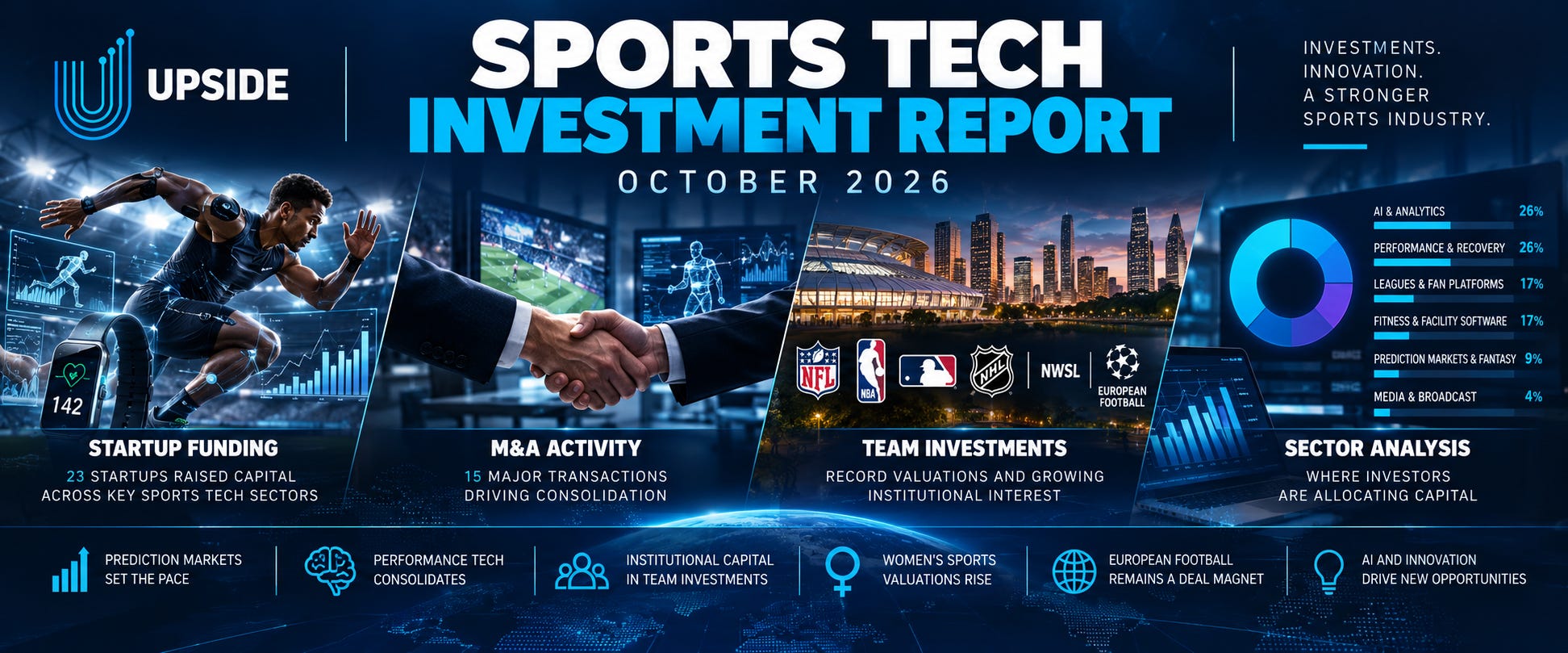
Introduction: A Month of Major Investments, Consolidation and Global Expansion
October 2026 was another significant month for the global sports technology and sports investment industries. We saw major funding rounds, strategic acquisitions, growing institutional investment in professional sports teams, and continued interest in emerging technologies such as artificial intelligence, biomechanics, wearables, sleep and recovery.
One of the biggest headlines was Kalshi’s reported $1 billion funding round at a $40 billion valuation. Beyond prediction markets, investors backed companies developing technologies for athlete performance, movement analysis, mental preparation, sports analytics, fitness management and fan engagement.
We also saw further consolidation across sports technology. Teamworks’ $170 million acquisition of Atrium Sports and Oxford Metrics/Vicon’s acquisition of Move AI assets illustrate how established technology companies are strengthening their platforms through acquisitions.
Meanwhile, institutional investors continued pursuing ownership stakes in professional sports franchises, with significant activity across the NFL, NBA, NHL, NWSL and European football.
For Upside, the most interesting question is not simply how much money was invested, but where capital is flowing, what types of technologies investors are prioritizing, and what these developments mean for sports tech founders, investors and professional teams.
This report examines the major transactions reported during October 2026, including 15 M&A transactions, 23 startup investment transactions and numerous professional sports ownership deals. It also includes our analysis of the sectors attracting investment and the broader trends shaping the industry.
Key Takeaways
Prediction markets attracted enormous capital. Kalshi’s reported $1 billion funding round dominated the month’s startup investment activity, while Betr and Matchbook pursued strategic acquisitions.
Sports performance technology continues to consolidate. Teamworks acquired Atrium Sports for $170 million, while Oxford Metrics/Vicon acquired Move AI assets.
AI and athlete performance attracted investor interest. Companies developing AI software, biomechanics, sleep, recovery and athlete monitoring solutions featured prominently among the reported investments.
Institutional investment in professional teams continues to grow. NFL minority transactions reached reported valuations exceeding $10 billion, while private equity participation expanded across major leagues.
Women’s sports valuations continue to climb. Columbus and Atlanta NWSL expansion fees reached $205 million and $165 million, respectively, while the LA Sparks were reportedly marketed at a valuation exceeding $700 million.
European football remains an investment destination. Transactions involving Valencia CF, Bayern Munich, FC Nantes and Serie A’s media-rights business illustrate continued interest from global investors.
Major M&A Transactions — October 2026
October saw significant acquisition activity across sports analytics, performance technology, betting, sports marketing and fan engagement.
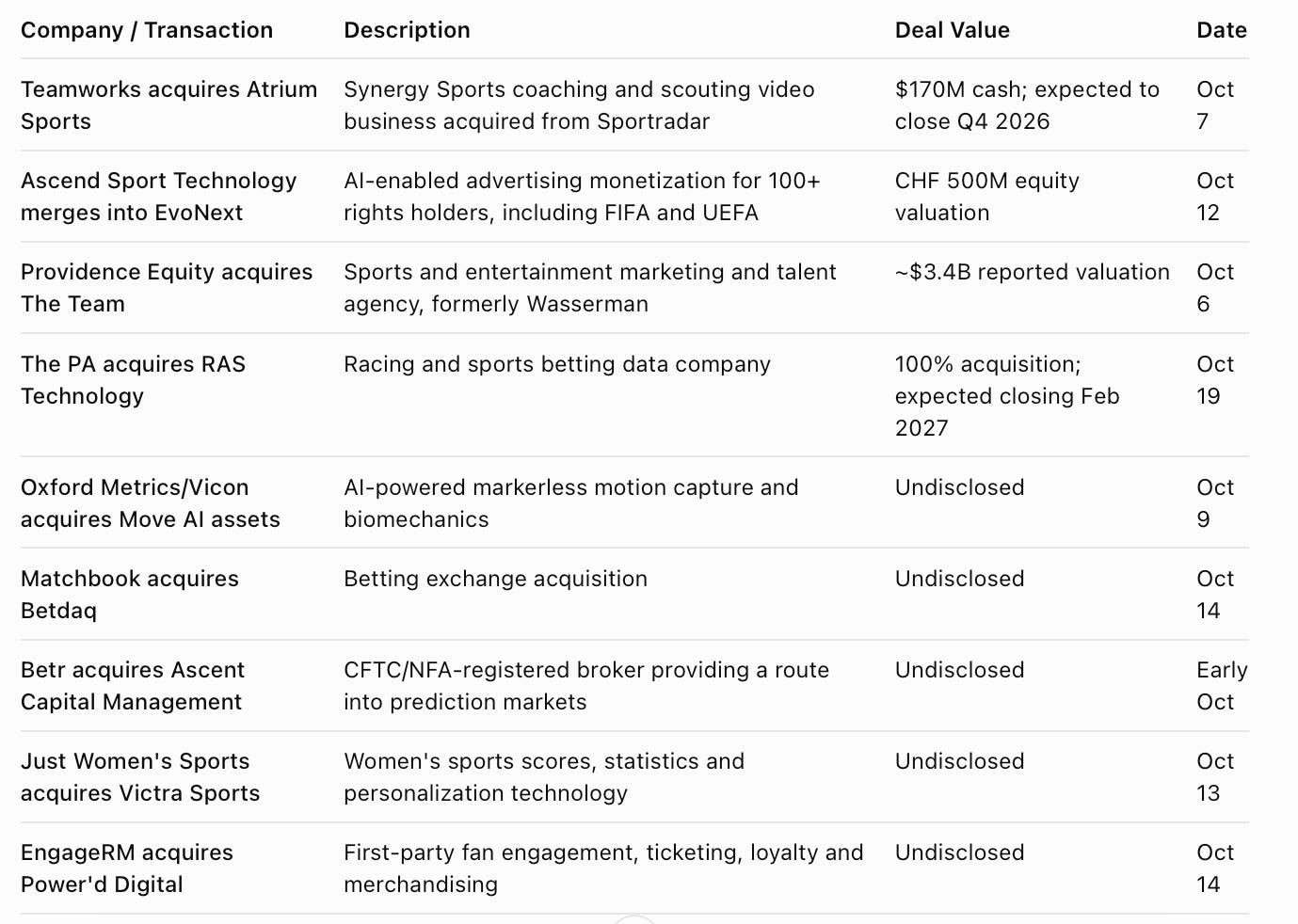
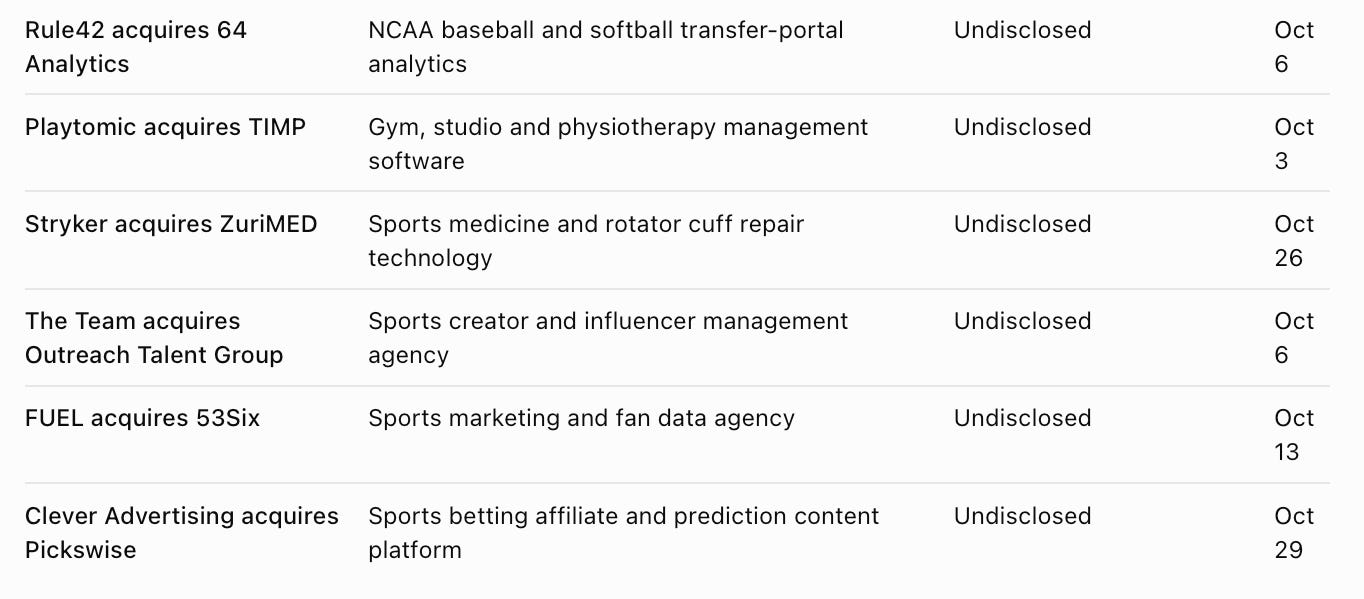
Upside Analysis: What These Acquisitions Tell Us
Three trends stand out.
First, sports technology consolidation is accelerating. Established companies are acquiring specialized technologies to expand their offerings rather than developing every capability internally. Teamworks’ acquisition of Atrium Sports is an example of this strategy.
Second, biomechanics and movement intelligence are becoming strategically important. The acquisition of Move AI assets by Oxford Metrics/Vicon illustrates the commercial interest in markerless motion capture and AI-assisted movement analysis.
Third, fan engagement and sports data remain attractive acquisition targets. Transactions involving EngageRM, Rule42 and Just Women’s Sports suggest that companies see value in owning specialized data, distribution channels and customer relationships.
Deal to Watch: NBA Europe vs. EuroLeague
The NBA reportedly offered approximately $581 million to acquire EuroLeague outright, or approximately $447 million per club to join NBA Europe.
EuroLeague owners responded with a 10-year plan targeting an $8.98 billion valuation.
The discussions remain unresolved, but the potential creation of NBA Europe could reshape professional basketball’s commercial landscape, media rights and investment opportunities across the continent.
Sports Tech Startups That Raised Capital — October 2026
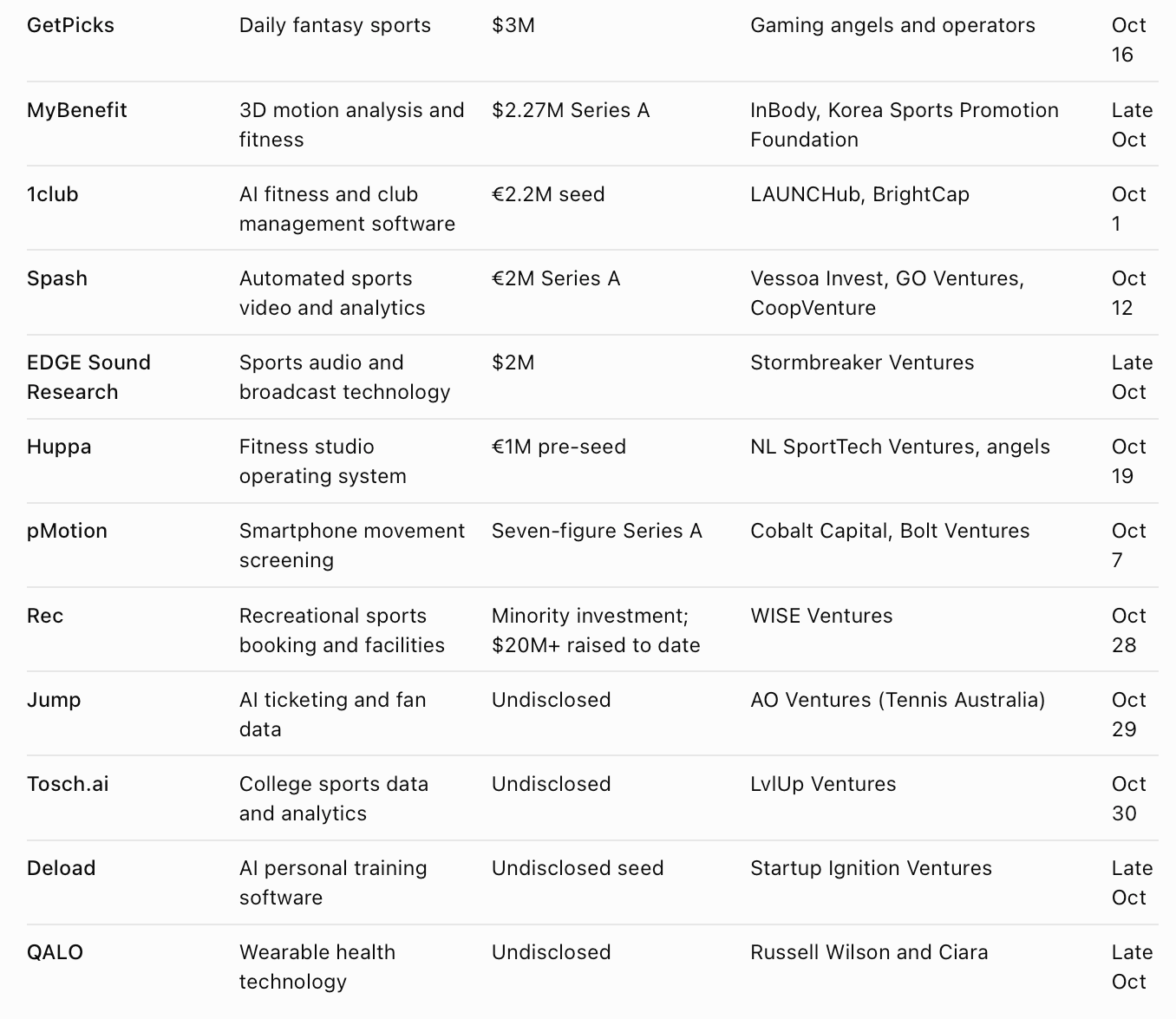
Our review identified 23 reported startup investment transactions spanning prediction markets, athlete performance, AI, wearables, biomechanics, sports analytics, fitness software and emerging sports properties.
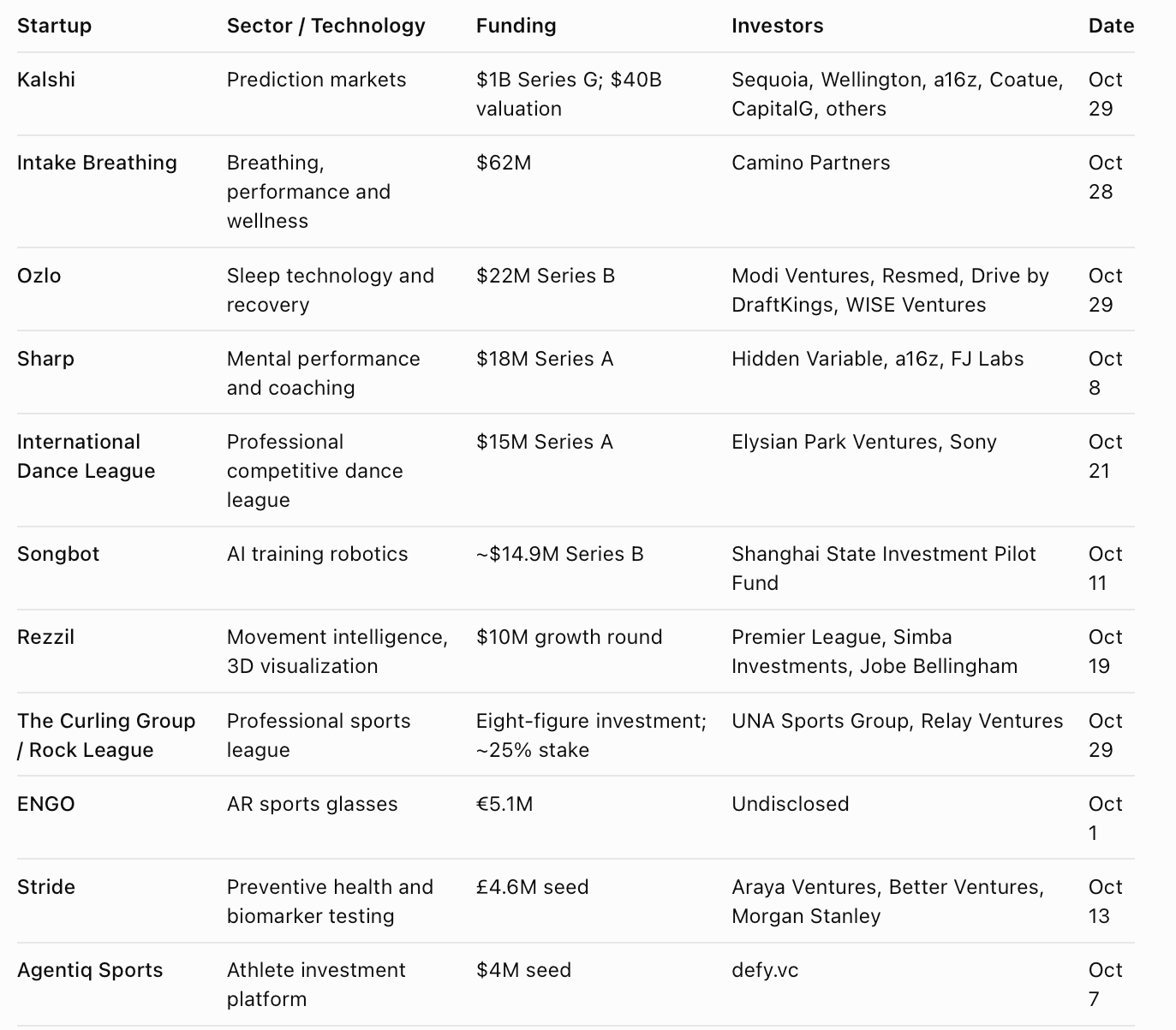
Upside Analysis
Several transactions deserve particular attention.
Kalshi’s financing stands out because of its size and the growing relationship between prediction markets and professional sports.
In athlete performance, Intake Breathing, Ozlo and Sharp attracted significant investments, suggesting interest in technologies and services related to breathing, sleep, wellness and mental performance.
Rezzil, MyBenefit and pMotion represent another area of interest: the use of technology to better understand human movement, training and physical assessment.
Meanwhile, companies such as 1club, Deload and Jump illustrate the growing application of AI to fitness operations, coaching and fan engagement.
Where Did Investors Allocate Capital in October 2026?
Upside sector analysis | 23 reported startup investment transactions
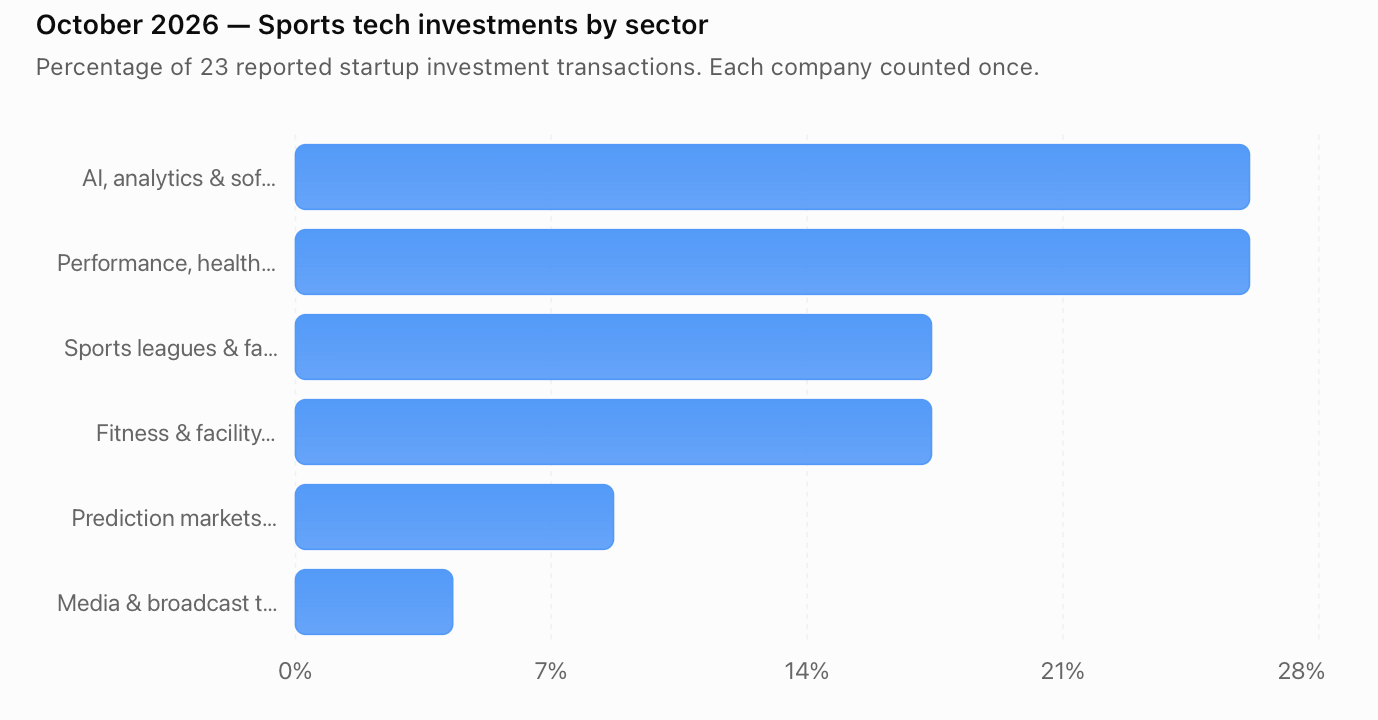
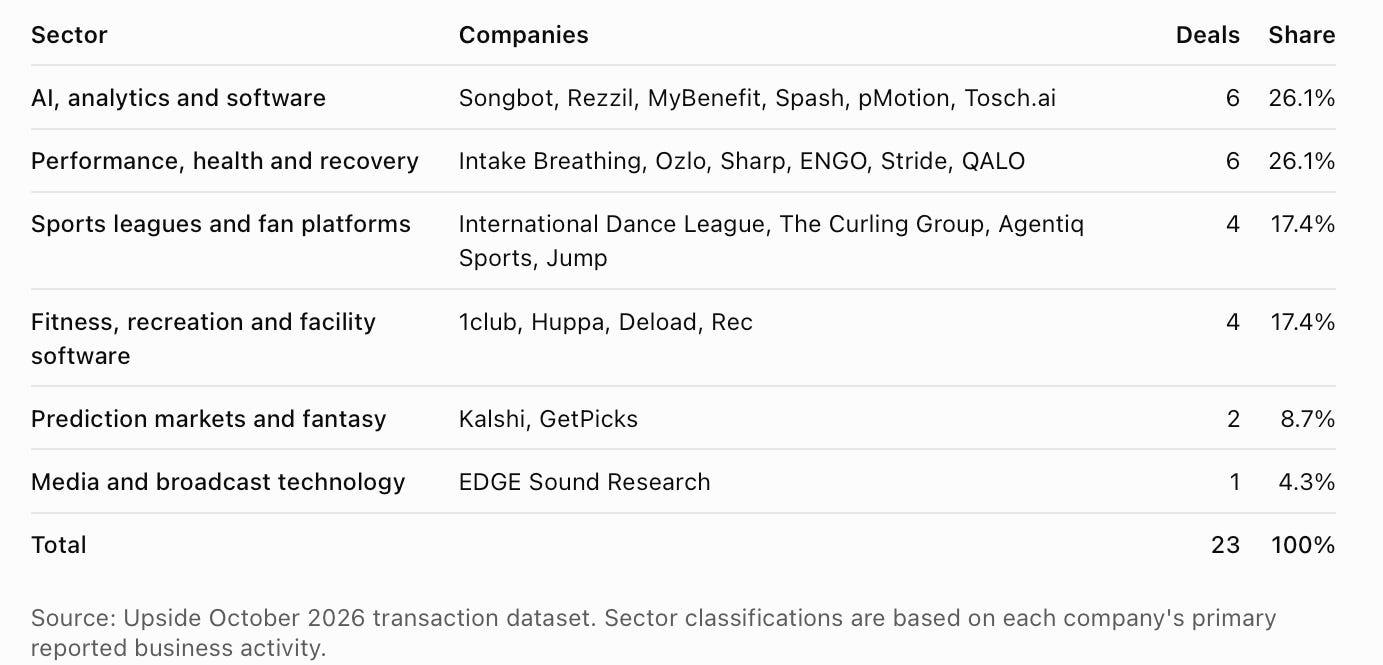
One of the most interesting questions is which sectors of sports technology attracted the greatest number of investments.
To answer this, we classified each of the 23 startup transactions into one primary business category.
The following percentages represent the share of reported startup investment transactions, not the percentage of total funding dollars.
1. Investment distribution by primary sector
2. How many funded startups focused on AI, wearables and other technologies?
Because some companies operate across several technology categories, we also analyzed specific technologies represented in the funding announcements.
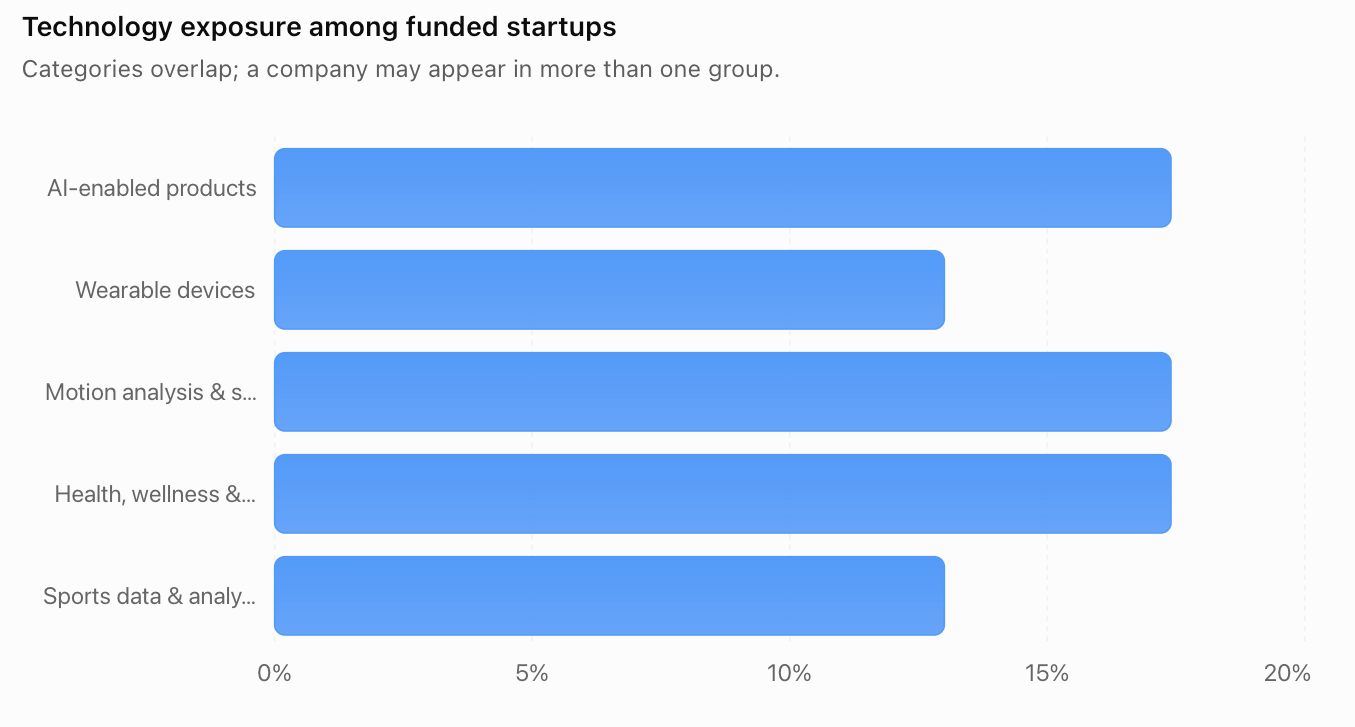
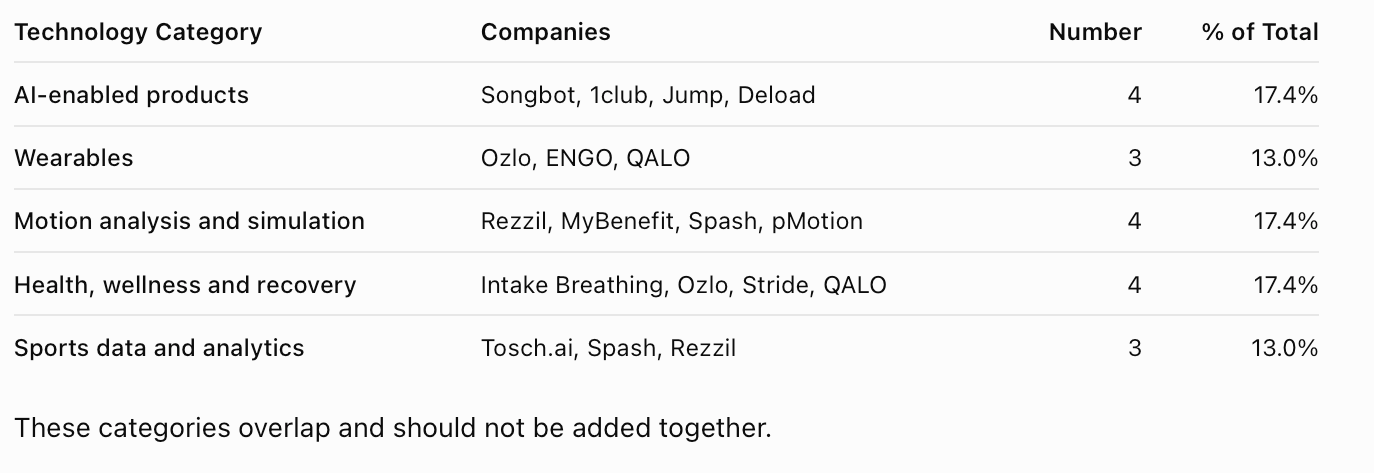
The AI percentage is conservative because several other companies may use machine learning or AI within their platforms without being explicitly classified as AI businesses in the supplied descriptions.
3. Where did the most money go?
The distribution of funding dollars differs considerably from the distribution of startup investments.
Kalshi’s reported $1 billion funding round accounted for the overwhelming majority of the disclosed funding in the supplied dataset.
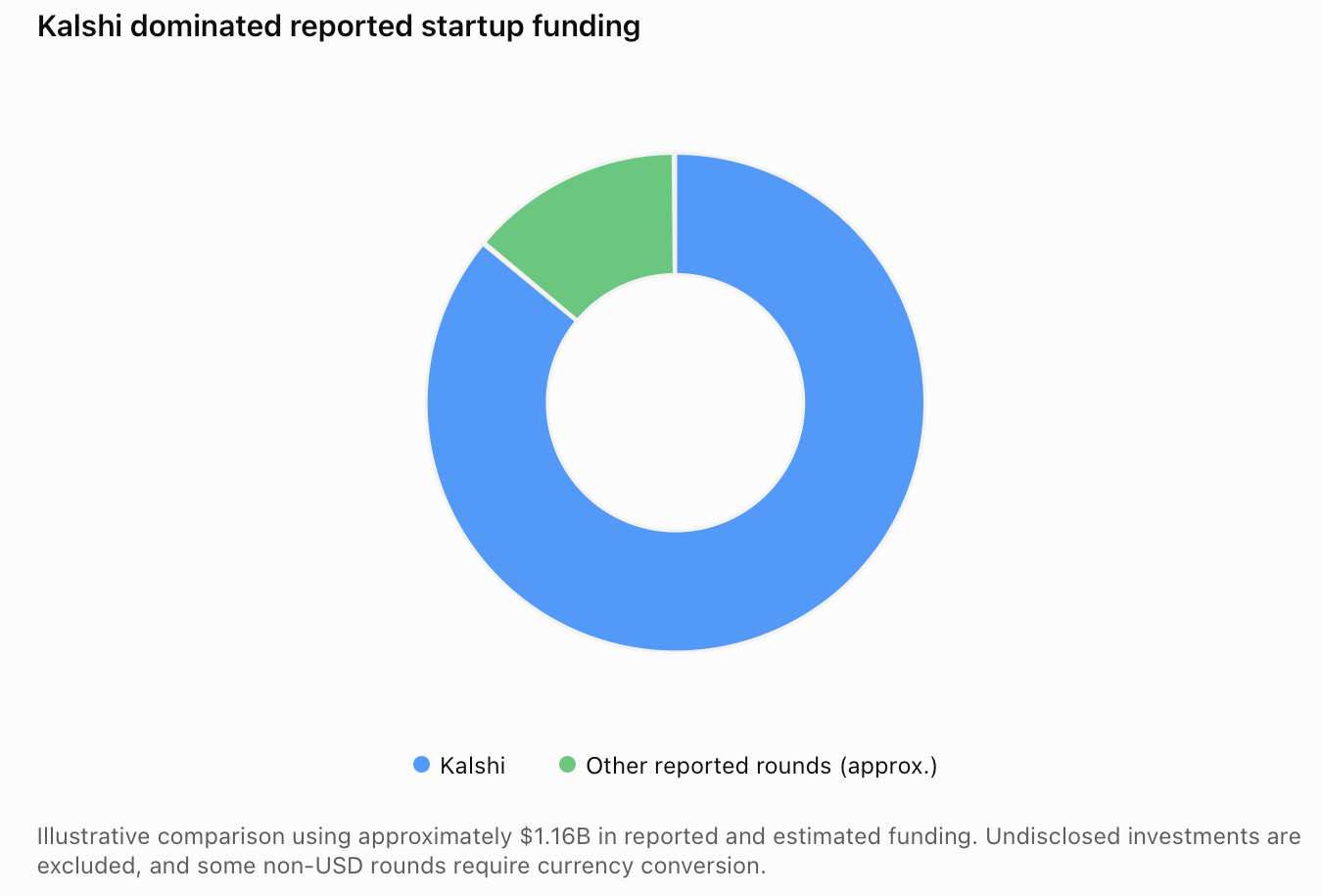
This highlights an important distinction: prediction markets attracted the largest amount of reported capital, but not the largest number of startup investments.
Excluding Kalshi, the largest disclosed funding rounds included Intake Breathing ($62 million), Ozlo ($22 million), Sharp ($18 million), International Dance League ($15 million), Songbot (approximately $14.9 million) and Rezzil ($10 million).
4. Five investment trends that stand out
1. AI is expanding across multiple sports technology sectors.
AI is increasingly being applied to training, robotics, sports analytics, fitness management and fan engagement.
Investors appear interested in companies using AI to improve efficiency, automate processes and create new commercial opportunities.
2. Athlete health, wellness and recovery remain attractive.
Funding for Intake Breathing, Ozlo and Stride illustrates continued interest in breathing, sleep, recovery and preventive health.
For professional teams, these areas are relevant to athlete monitoring and performance management, although funding does not establish product effectiveness.
3. Biomechanics and movement intelligence are gaining attention.
Investments in Rezzil, MyBenefit and pMotion, together with the acquisition of Move AI assets, illustrate interest in motion capture, movement analysis and assessment technologies.
4. Software platforms remain important.
Companies such as 1club, Huppa, Deload and Tosch.ai represent opportunities to digitize workflows and deliver scalable services.
5. Sports properties are attracting investment alongside technology companies.
International Dance League and The Curling Group show that investors are also pursuing emerging sports formats and new league models.
5. What this means for sports tech founders
For founders, the message is clear: investors are interested in innovation, but they increasingly need to understand how that innovation translates into commercial value.
A startup developing an AI platform needs to demonstrate that it solves a meaningful problem. A wearable company must show that its data are reliable and useful. A recovery technology needs credible scientific validation.
The strongest opportunities are likely to come from companies combining differentiated technology, customer demand, recurring revenue and strong execution.
Professional Sports Teams as an Asset Class
One of the biggest developments in sports investment is the continued growth of institutional capital flowing into professional teams.
Sports franchises are increasingly viewed as long-term investment assets with opportunities for appreciation, media-rights growth, sponsorship revenue and international expansion.
1. NFL: Record valuations and private equity expansion
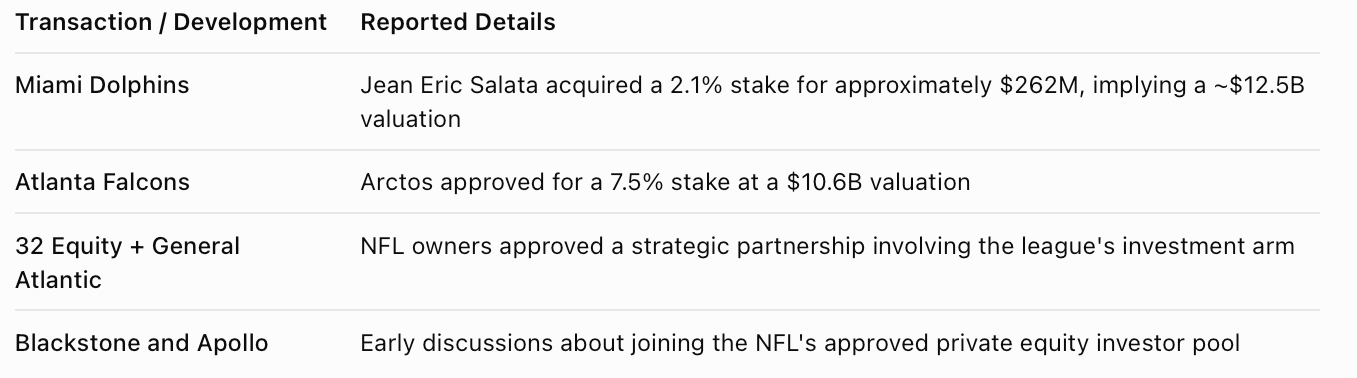
The Miami Dolphins and Atlanta Falcons transactions illustrate how NFL franchise valuations continue to rise.
The increasing participation of institutional investors could also expand the pool of capital available for minority ownership transactions.
2. NBA and WNBA
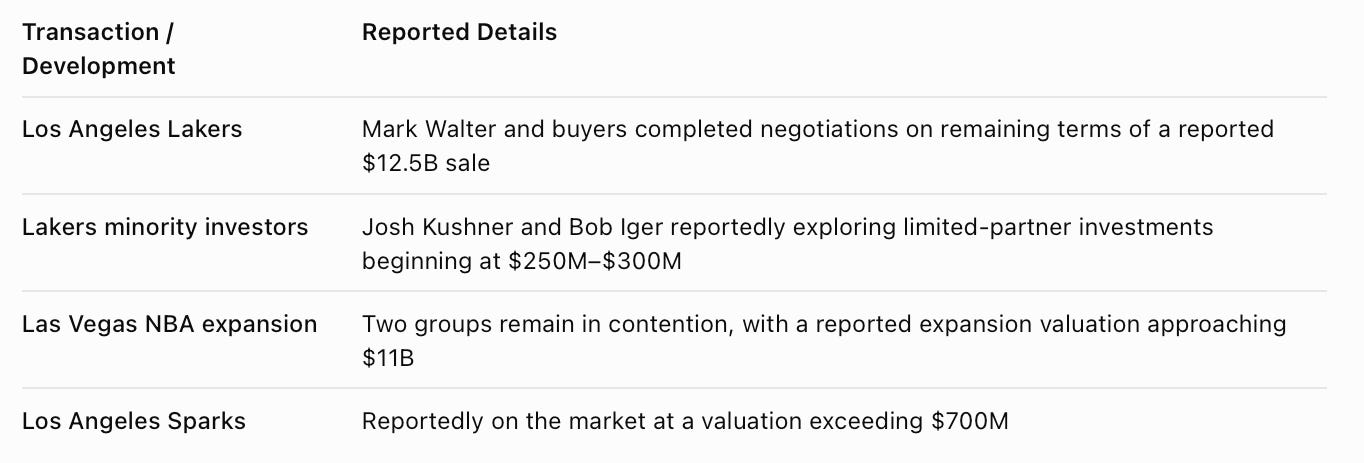
The NBA’s international growth ambitions and continued franchise valuation increases make it an attractive market for investors.
Women’s basketball also represents an increasingly important investment opportunity, with rising commercial interest and reported valuations.
3. MLB and NHL
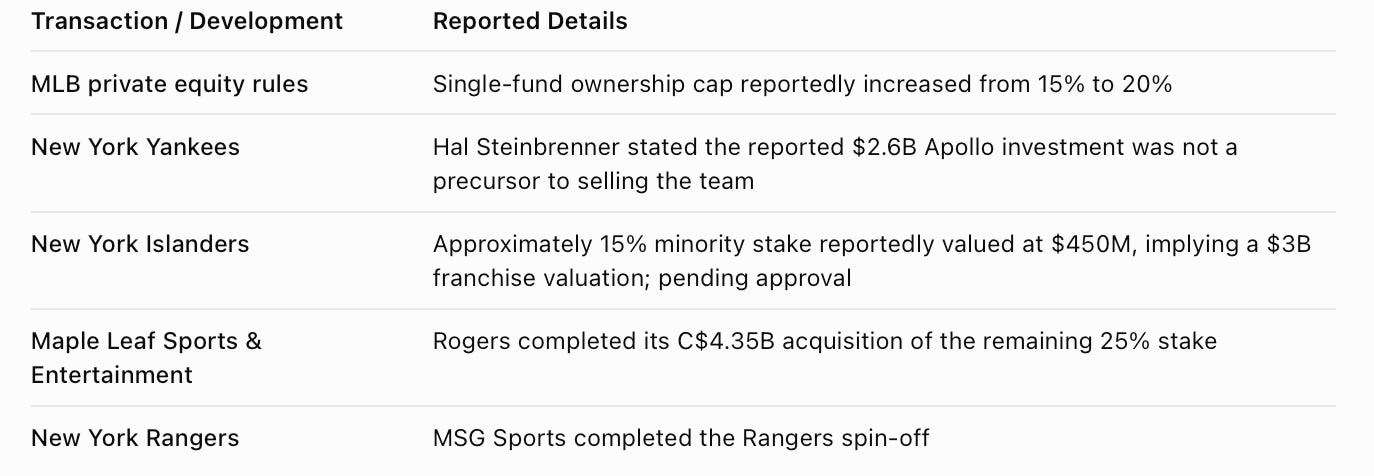
These transactions illustrate continued investor interest in established professional sports properties.
4. Women’s Soccer: NWSL Valuations Continue to Rise

The reported Columbus expansion fee of $205 million, involving Haslam Sports Group, is particularly noteworthy.
It represents a substantial increase compared with Denver’s earlier $110 million expansion fee.
Atlanta’s reported $165 million fee further illustrates growing demand for NWSL franchises.
The league is also exploring additional expansion opportunities, including teams 19 and 20.
5. Global Football and Emerging Sports Properties
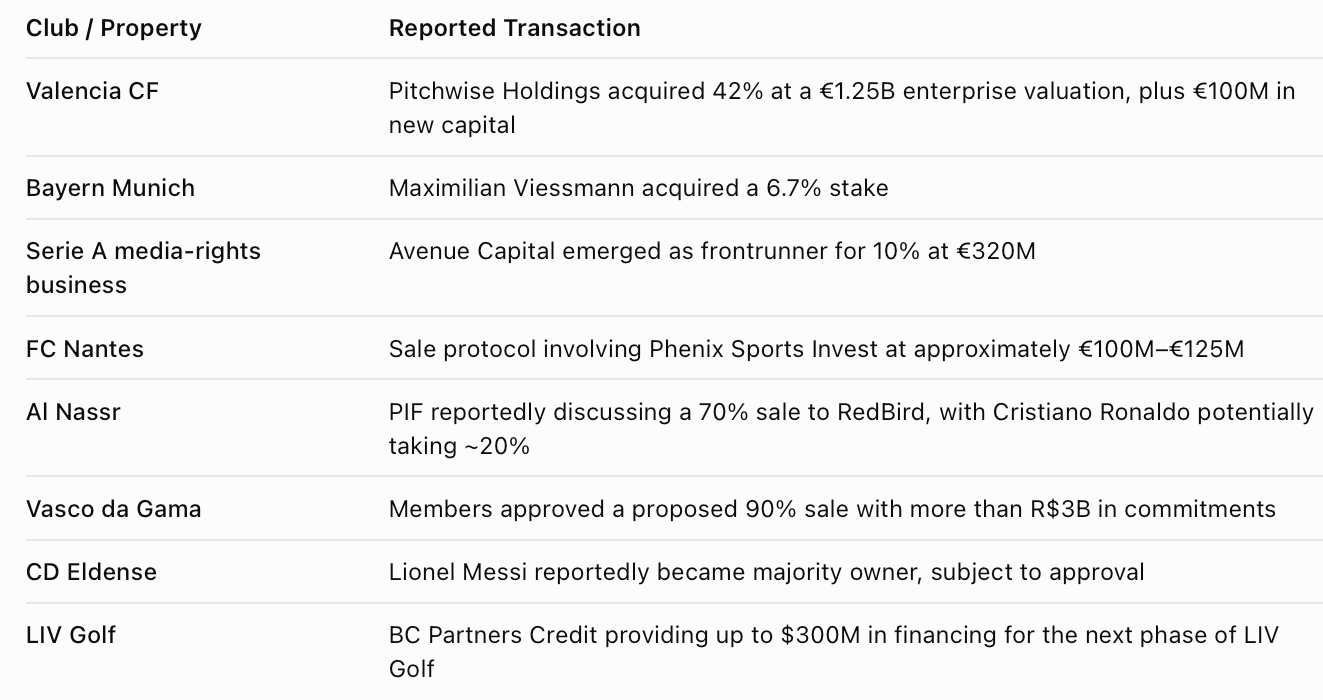
European football remains an attractive market for international investors because of its global audience, commercial opportunities and potential for value creation.
At the same time, investment structures and regulatory environments differ considerably between leagues and countries.
6. Market Signals
Several developments suggest that professional sports investment is becoming more institutionalized.
Goldman Sachs counted 192 institutional investors in professional teams in 2025, according to the supplied report.
Navigate reported that buyers paid approximately 20% above Forbes valuations across 41 team sales.
Macfarlanes also highlighted a trend toward fewer transactions but larger deal sizes.
Taken together, these indicators suggest increasing competition for premium sports properties.
However, rising valuations do not eliminate investment risk. Media-rights economics, operating losses, financing costs, league regulations and liquidity constraints remain important considerations.
What the October Investment Activity Means for the Sports Industry
For Sports Tech Startups
The market continues to offer opportunities across multiple technology categories, but founders must demonstrate more than an innovative concept.
Investors are likely to evaluate customer traction, revenue growth, product differentiation, management quality and the ability to scale.
For companies selling to professional sports teams, long sales cycles and limited customer budgets remain important challenges.
A successful pilot with an NBA, NFL, NHL, MLS or European soccer team can be valuable, but it does not automatically translate into sustainable revenue.
For Investors and Venture Capital Firms
October’s transactions illustrate the importance of distinguishing between investment categories.
Prediction markets, professional sports franchises, software platforms and athlete performance technologies have very different business models, risk profiles and valuation drivers.
Investors should assess each opportunity based on its fundamentals rather than applying a single sports tech investment thesis to every company.
For early-stage sports technology, I believe management quality, communication, customer demand, execution and capital efficiency deserve particular attention.
For Professional Sports Teams
The continued investment in AI, biomechanics, wearables and recovery technologies creates opportunities for teams to evaluate new solutions.
However, teams should not assume that a startup’s fundraising success proves its technology works.
Before adopting a new solution, performance and medical departments should assess its scientific evidence, reliability, workflow integration, athlete experience and potential return on investment.
For the Broader Sports Industry
We are seeing the continued convergence of sports, technology, media, finance and entertainment.
Sports teams are becoming institutional investment assets, while technology companies are developing new ways to monetize data, improve performance and engage fans.
This convergence could create more partnerships, acquisitions and investment opportunities over the next several years.
Conclusion: What October 2026 Tells Us About the Future of Sports Tech Investment
October 2026 highlighted the growing maturity and diversity of the global sports technology investment landscape.
On one side, we saw major financing rounds and strategic acquisitions, including Kalshi’s reported $1 billion investment, Teamworks’ acquisition of Atrium Sports and continued consolidation in movement analysis.
On the other, investors continued backing earlier-stage companies developing solutions in AI, athlete performance, sleep, recovery, biomechanics, fitness software and fan engagement.
Our analysis of the 23 reported startup investment transactions shows that AI, analytics and software, together with performance, health and recovery technologies, represented more than half of the month’s identified startup investments by deal count.
Wearables, movement intelligence and sports data platforms also attracted interest, while prediction markets dominated the disclosed funding totals.
Meanwhile, the continued rise in professional sports franchise valuations illustrates the growing role of institutional capital in the sports industry.
Looking ahead, I expect several trends to remain important: greater use of AI, continued investment in athlete health and performance, further consolidation of sports technology platforms, and increasing pressure on startups to demonstrate meaningful commercial results.
As I become more involved in the sports tech venture capital ecosystem, I believe one of the biggest challenges for investors will be identifying companies that combine innovative technologies with strong management, sustainable business models and genuine market demand.
For founders, raising capital is an important milestone, but it is not the ultimate objective.
Building a successful, scalable and financially sustainable business remains the real goal.
At Upside, we believe the future of sports technology will be shaped not simply by how much money is invested, but by how effectively innovation translates into better performance, smarter decisions, stronger businesses and improved experiences for athletes, teams and fans.
You may also like:

