
Today we have the honor of interviewing Dr. Gregg Steinberg, a professor of sports psychology at Austin Peay State University (APSU). He has worked with professional athletes across the world.
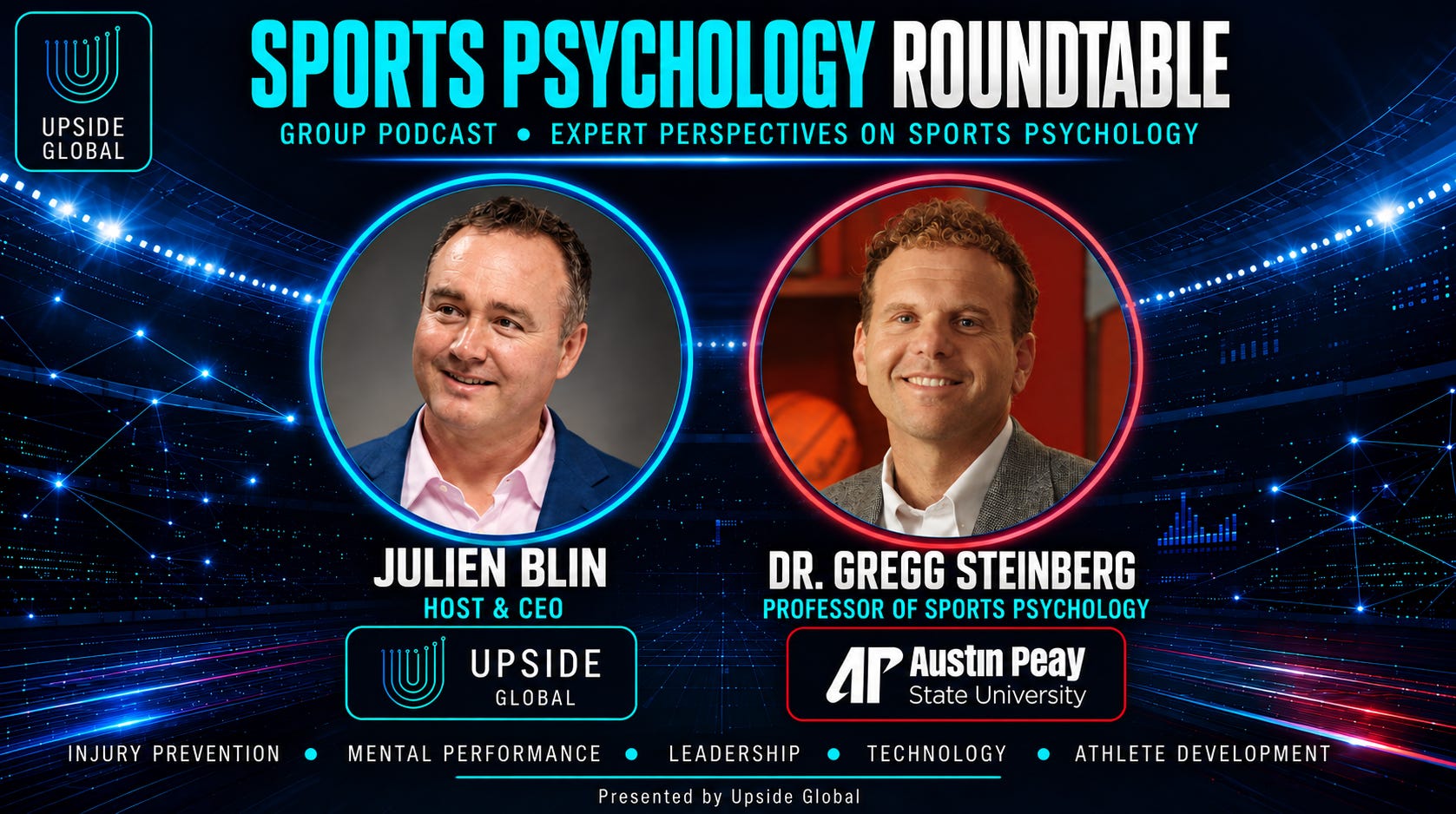
Dr. Gregg Steinberg is a Professor of Sports Psychology at Austin Peay State University (APSU) and an expert in performance psychology and mental preparation. Drawing on his own background as a competitive tennis player, he has dedicated his career to understanding what enables athletes to perform at their best under pressure. Steinberg has worked with professional and collegiate athletes, including PGA Tour golfers and tennis players, helping them improve confidence, focus, emotional control and performance under pressure.
His approach combines academic research with practical strategies such as meditation, breathing techniques, pre-performance routines and emotional regulation. A central theme of his work is what he calls “emotional toughness”—the ability to manage fear, anxiety, confidence and other emotions so athletes can consistently access their abilities when the pressure is highest.
You can watch the video interview below by clicking on the Youtube link. You can also listen to the audio interview by clicking on the link at the top of the page:
📝Show Notes: During our interview with Gregg we discussed his journey from competitive tennis into sports psychology, his role as a Professor at Austin Peay State University, and his experience working with professional and collegiate athletes, including golfers and tennis players. We explored what he calls “emotional toughness” and why managing emotions, rather than simply developing mental toughness, can be critical to performing under pressure.
Gregg also shared practical approaches he uses with athletes, including meditation, breathing techniques, trigger words, pre- and post-performance routines, and learning how to reset after mistakes. We discussed the importance of understanding each athlete individually, learning to embrace pressure rather than fear it, and focusing on the process instead of tying self-worth to winning and losing. Finally, Gregg shared his perspective on the future of performance psychology and how AI, wearables and physiological data could help athletes and practitioners better understand how the body responds to pressure.
Here are the best quotes from the interview with Gregg:
1. Your journey into performance psychology
Gregg’s interest came from seeing firsthand that talent alone did not determine who won in tennis:
“There were a lot of players that had more talent than me, but they would lose, and there were other players that I had more talent than, and they would beat me. I wanted to discover what was that secret sauce to winning and performance.”
“What I wanted to study was what was the differentiator between what made the greats great, and how could they raise their game?”
His “orange” analogy is probably one of the strongest quotes from the entire interview:
“If I squeeze this orange, what comes out? Orange juice. Why does orange juice come out? Because that’s what’s inside. What have you put inside? If you put in fear and negativity and doubt, that’s what comes out when you get squeezed.”
“All the great players put in the right juice, the right mental juice, the right emotional juice. When they get squeezed—that’s how they raise their game.”
And his core philosophy:
“The differentiator between the greats and the good, because everyone has talent, is that the best ones have emotional talent. They have emotional toughness.”
“Most people think it’s mental toughness. Really, it’s emotional toughness—their ability to manage their anxiety, their fears. Even their confidence is an emotion.”
2. His role at Austin Peay State University
One of Gregg’s central themes is translating academic research into practical tools athletes can actually use:
“I think a lot of sports psychologists out there maybe do it intuitively, but I take the research—what the research says—and then apply that to the real world.”
He used golf routines as an example:
“The research says you need to have a consistent routine that has the exact time. If you have the exact time, let’s say 13 seconds, every time, you’re going to be a better player.”
“When you’re consistent, it relaxes you, it creates a rhythm.”
“I try to take the research and then apply that to my applied work.”
3. Working with elite tennis players and golfers
Gregg sees many of the fundamental principles of performance psychology as universal rather than sport-specific:
“If the performance principle applies to golf, tennis, football, baseball, it’s a true principle. It shouldn’t just apply to one sport, and it should also apply to life.”
“Performance psychology is not just about golf or tennis. It’s about life.”
A major skill across both golf and tennis is learning when to switch concentration on—and when to switch it off:
“With tennis, you have to let go between points because if you’re thinking about all the bad shots between points, your heart rate goes up.”
“Same thing with golf. You can’t, after the shot, walk to the next shot thinking about what you did, your score. Your heart rate’s going to go up and eventually your energy is going to be depleted.”
This may be the best summary:
“You’ve got to learn to turn it on and then turn it off. You’ve got to be totally focused on that moment. And then when that moment’s off, the shot’s off, you’ve got to learn to turn it off.”
4. How do you actually prepare an athlete mentally?
Gregg emphasized that there isn’t one universal approach:
“Every player’s unique. So you have to understand their uniqueness first. What’s blocking them? What’s causing these problems? But even more importantly, their strengths.”
Rather than only diagnosing problems, he asks athletes to identify what happens when they’re performing exceptionally well:
“A lot of times I ask my players, ‘Tell me a time when you were in the zone. What did it feel like? Was there anything specifically that happened beforehand? What were your thoughts during?’”
“Usually we find patterns. We find patterns of why they played their best.”
“Ultimately, you’ve got to figure out what you do well and focus more on that than what’s blocking you.”
And different athletes require different optimal emotional states:
“Kobe liked to keep his emotions more flatline. Michael Jordan liked to go up and down. Tiger Woods liked to go more up and down. You’ve got to figure out what gets you to play at your best.”
“You’ve got to figure out what makes you tick. And when you figure that out, that’s how you can perform your best under pressure.”
He also gave several concrete techniques.
On meditation:
“I teach all my players meditation.”
On breathing:
“You focus in for four seconds, and then focus out for six... it really relaxes you.”
And on developing a trigger word:
“You use a word like ‘relax’ or ‘cool’ or ‘smooth.’ Now that word gets associated with that relaxed response.”
Perhaps most importantly, he stressed that mental preparation happens before the pressure arrives:
“Most of it’s done off the course, off the court. You do it at home so that when you get to the competitive situation, you’re mentally ready.”
5. Mental toughness and the future of performance psychology
Gregg’s main differentiator for athletes who consistently perform under pressure is their relationship with pressure itself:
“Pressure affects everybody differently. Some people embrace it. And I think that’s really the secret.”
He calls this:
“Turning pressure into pleasure.”
And:
“They thrive on the pressure. They want to take that last shot. They want to have that putt to win the tournament. They have to thrive and love pressure, and embrace it.”
His closing answer provided perhaps the clearest summary of his entire philosophy:
“If you ask me what’s the secret sauce to playing your best under pressure, you have to love the pressure. You have to love the competition. You have to thrive in the moment, and you have to move your ego out of the equation.”
“You can’t evaluate yourself on whether you win or lose. You have to evaluate yourself on: Did I have a great attitude? Did I try my best?”
“If you win, great. If you lose, great. But as long as you put yourself on the line, boom, it’s okay.”
AI + the future
Gregg was cautious about predicting exactly where AI will go, but sees a particularly interesting opportunity around physiological data and wearables:
“AI is going to have a big impact on performance psychology.”
“When you’re using a wearable, when you’re under pressure, what’s your heart rate? How is it different than when you’re playing with your buddies?”
“Knowing more of your physiology—I think if AI could tap into our physiology more, I think that’s what’s going to take sports psychology to the next level.”
You may also like:
⚾ Upside MLB Group Video Chat with Lindsay Shaw (Guardians), Zach Brandon (Arizona Diamondbacks), Josh Kozuch (Baltimore Orioles) on Mental Performance

Today we have the honor of interviewing a group of MLB practitioners that are experts in mental performance and preparation.