
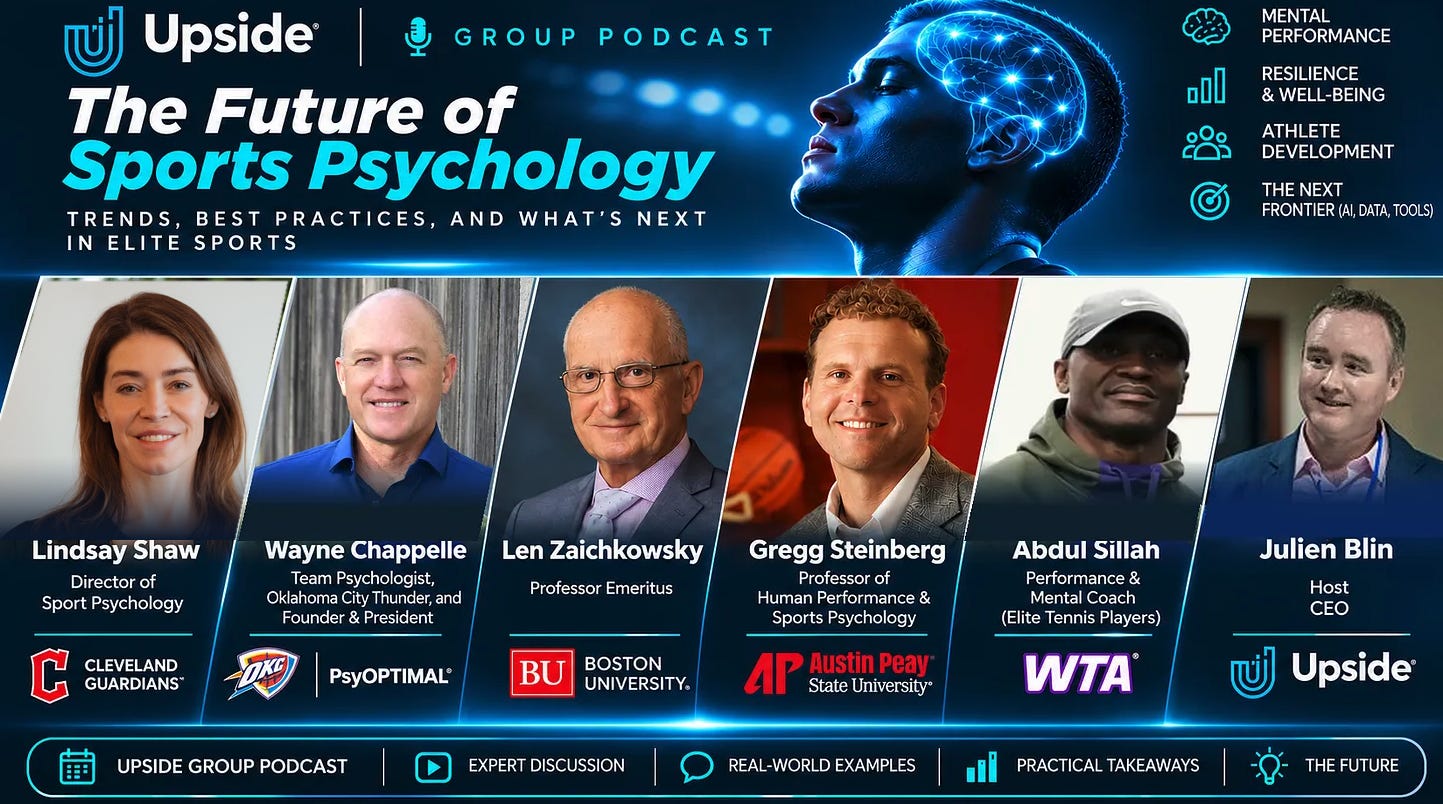
This week we have the honor to interview again a group of sports psychologists and mental preparation experts to talk about the best practices and latest trends in sports psychology.
Lindsay Shaw, Director of Sport Psychology, Cleveland Guardians (MLB)
Wayne Chappelle, Team Psychologist, Oklahoma City Thunder (NBA), and Founder & President, PsyOPTIMAL
Len Zaichkowsky, Professor Emeritus, Boston University. He has worked with many teams, such as the Canucks and Penguins in the NHL, Real Madrid in Laliga, the Spanish national soccer team, and others.
Gregg Steinberg, Professor of Human Performance and Sports Psychology, Austin Peay State University (APSU). He has worked with pro tennis players and golfers.
Abdul Sillah, a high-performance and mental coach for elite tennis players (Serena Williams, Naomi Osaka, Sloane Stephens, Bianca Andreescu)
Here are the topics that we covered during the video interview:
Q1. How does mental preparation differ by sport?
Q2. What are the biggest psychological challenges in each sport?
Q3. What techniques actually work—and does it depend on the sport?
Q4. How should teams and athletes measure mental readiness?
Q5. What will sports psychology look like in 5–10 years?
You can watch the video interview below by clicking on the Youtube link. You can also listen to the audio interview by clicking on the link at the top of the page:
Here are some of the best quotes of our conversation with Len, Lindsay, Abdul, Wayne, Gregg:
1. How does mental preparation differ by sport?
LINDSAY SHAW
“There is an everyday-ness about baseball. There’s 162 games or maybe longer if you go to the postseason. The mental preparation is different when compared to the Olympic Games, and it flexes in accordance with the perceived importance of the outcome.”
“One of the best ways to prepare for pressure is a lot of simulations. A simulation is only an approximation of what you’ll really encounter, but athletes can get pretty good at feeling what that feels like and learning to work with themselves effectively.”
WAYNE CHAPPELLE
“In the NBA, you can have a bad game, wait 48 hours, because you’re gonna be playing again. In football, you have a bad game, you can potentially stew on it for an entire week.”
“The challenges from a mental health perspective can be extraordinarily different across all. But I agree with what Greg and Lindsay were saying, and that is simulation and visualization, absolute key components to it.”
GREGG STEINBERG
“One of the secret sauces of the mental game is visualization. I’m always harping on visualization.”
“One of the key factors with golf that relate also to baseball is this thing called energy management. During the round, you gotta learn to manage your energy. You gotta learn when to turn it off and then peak at the right moment.”
ABDUL SILLAH
“The goal is figuring out what’s blocking them from actually achieving their goal.”
“You have to be mentally tough. The situation is much different from before because now you have many endorsements, and they have all these expectations for every athlete.”
LEN ZAICHKOWSKY
“We have a responsibility in our roles to teach the athletes, the coaches, and in fact, throughout the whole organization, to manage the stressors in their lives, whether it’s on the field, on the ice, or the pitch, or their day-to-day living.”
“Visualization is a fundamental mental skill, as is breathing, of course. And the reason for that is to get the body to stay calm and focused and flexible at the same time.”
2. What are the biggest psychological challenges in each sport?
LEN ZAICHKOWSKY
“I spent so much of my time in Pittsburgh with the Penguins teaching them skills to make quicker decisions, ‘cause they’re just microseconds.”
“Teaching fast decision-making is important. I taught NHL players and coaches to use “Scanning” or “Shoulder checking” to speed up accurate decision-making”.
“We don’t focus enough on how do we train the brain to make quicker decisions and more accurate decisions.”
Note: Len recommended three books on attention, focus, and performance under pressure: Performing Under Pressure: The Adaptive Science of Peak Performance by Robert Nideffer (Buy on Amazon), Intentional Attention: The Science and Practice of Focus Under Pressure by Justin Anderson (Buy on Amazon), and Scanning: How to Train It and Develop Game Awareness by Kevin McGreskin (Buy at SoccerTutor).
He highlighted these books as valuable resources for understanding attention control, improving focus under pressure, and developing better awareness and decision-making in sports.
LINDSAY SHAW
“My limited experience with golf and tennis is, like, traveling internationally. If you’re lucky you have a team. But often you don’t. It’s really lonely.”
“You’re dealing with jet lag and changes in cultures and missing your family of origin, or just a lot of isolation. So that can introduce different stressors that don’t actually have to do with how you’re performing on the court.”
ABDUL SILLAH
“In tennis, it’s that loneliness. They have no one on there, so when things go up and down, you have to figure it out on your own, by yourself.”
“They get angry, they get frustrated, and they throw the rackets down. They don’t know how to bring themselves back. So if they make a mistake, they stay back there, and by the time they realize it, the set is over.”
WAYNE CHAPPELLE
“Half the battle is being able to really connect to the social and team dynamics, and connect with the guys in such a way in which you’re cohesive not only off the court, but also on the court.”
GREGG STEINBERG
“When you have all these other stressors which diminish your energy, you gotta learn energy management when you’re playing, and you gotta be really attuned to your energy.”
3. What techniques actually work—and does it depend on the sport?
WAYNE CHAPPELLE
“What I like to do is have somebody visualize themselves in the storm and underneath the highest pressure situations that would create a tremendous amount of sympathetic nervous system arousal.”
“By the time the situation hits, they’ve already been there in their mind. They’ve already addressed it. They’ve already been desensitized to the fears, and they fall to the level of their training and their rehearsal more than anything else.”
GREGG STEINBERG
“I teach all my players to meditate because I think that’s a key skill. It’s a fundamental skill for life, it’s a fundamental skill for health.”
“The goal is all the mental preparation really has to be off the course, off the court, and then you bring it onto the court.”
“A lot of times I have to give them a system, like a post-shot routine, where they brush off and then they basically think about, visualize the next shot, and they say, ‘Next shot.’”
LINDSAY SHAW
“Your technical coach teaches you what to do with your body. And often as you’re developing as an athlete, no one tells you what to do with your mind.”
“You can put sensors on the head and the body and show the physiological data to the athlete and say, ‘This is where it is and this is where we want it to be.’”
“You don’t want to go into a competition thinking, ‘I hope I now do this for the first time ever.’ That’s way too much risk.”
ABDUL SILLAH
“We have days that we call situational drills. I’ll make sure that I put them in that situational drill and then go over it over and over.”
“In the midst of all this battle, when something has gone wrong, you have to quiet the noise. You have to quiet everything and just focus.”
LEN ZAICHKOWSKY
“You’ve always gotta be searching, looking to see where the ball was, where the opponent was, where their teammates were.”
“Once we’ve taught them some of the decision-making skills, then you can execute. That’s the last step in decision-making. So to search, and then decide, and then execute.”
4. How should teams and athletes measure mental readiness?
LINDSAY SHAW
“There’s a lot of danger in collecting data and then making speculations about what that means for performance.”
“Athletes have to really trust the team that the data’s not going to be used against them, that somehow it’s not going to come back to interfere with contract discussions.”
“It depends on the individual’s baseline. It depends on how fatigued they are, how much caffeine they’ve had, what is their cognitive load over the last seven days, what was their sleep like last night.”
ABDUL SILLAH
“I think now we are, as professionals, relying too much on metrics. Because I believe we should learn how to balance that. Because human beings are human beings.”
“You’re never gonna measure the heart of a human being one day in a situation.”
GREGG STEINBERG
“The technology, I think, which is really important is it allows you to become self-aware.”
“If you’re aware of your heart rate going up, then you’re more aware of trying to get it down so that you can manage your energy.”
LEN ZAICHKOWSKY
“If we can get them to be more self-aware of their mind-body, it’ll help them replicate those great performances.”
“Technology’s helping a bit. Heart rate variability is kind of one distant measure, but far from necessary and essential to share with an athlete or coach.”
Wayne Chappelle: Wayne left the conversation before the mental-readiness measurement question, so there is no direct answer from him to extract for this section.
5. What will sports psychology look like in 5–10 years?
LINDSAY SHAW
“A sport psychologist or a mental performance consultant can be super effective when they’re in the environment, and they can contribute to that integrated system that’s supporting the athlete.”
“Human beings always need the privacy of a relationship with a real person.”
“AI can help me consider things that I hadn’t considered or some new technology intervention that I’m just not aware of. That’s awesome, and I want to incorporate that in the way that I work.”
“It’s a supplemental tool. It’s not a replacement of me being with a person and hearing the things they have to say.”
GREGG STEINBERG
“We are seeing, I think, maybe the last 10 years, sports psych has really boomed in the sense of people appreciating mental health.”
“I can see it even accelerating in the future. The trend is going up, and I think it’s accelerating.”
“If technology enhances self-awareness, then it’s great. And I think that should be the goal.”
LEN ZAICHKOWSKY
“Training programs have improved dramatically during this time, which has been a positive influence on the field.”
ABDUL SILLAH
“I don’t think AI can replace us. You need the human side of things.”
“If you actually care for them, show that you care for them and you want them, as a human being, to do better, not just in the arena itself, but just to be a better human being.”
You may also like:
⚾ Upside MLB Group Video Chat with Lindsay Shaw (Guardians), Zach Brandon (Arizona Diamondbacks), Josh Kozuch (Baltimore Orioles), Len Zaichkowsky on Mental Performance

Today we have the honor of interviewing a group of MLB practitioners that are experts in mental performance and preparation.
⚾ Upside MLB Group Video Chat with Lindsay Shaw (Guardians), Zach Brandon (Arizona Diamondbacks), Josh Kozuch (Baltimore Orioles) on Mental Performance

Today we have the honor of interviewing a group of MLB practitioners that are experts in mental performance and preparation.