
Today we have the honor of interviewing Tyler Sauter, Founder, CTO, and Isaiah Anderson, CEO, co-founders of DetecFit, a leading fitness tech startup based in Chicago.
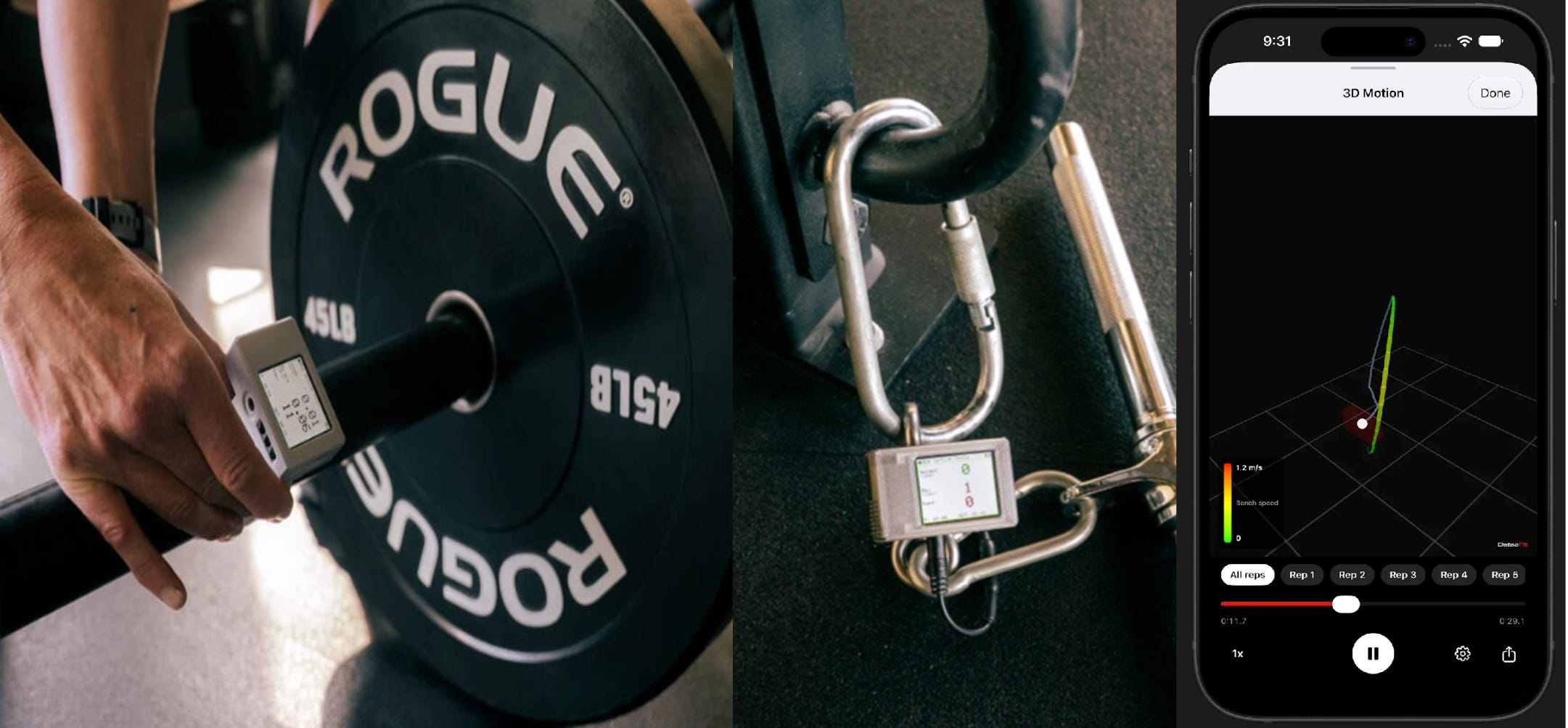
DetecFit is a Chicago-based sports technology startup founded by brothers Isaiah Anderson (CEO) and Tyler Sauter (Founder & CTO), developing an innovative, portable solution for strength assessment and velocity-based training (VBT). Its flagship device, Arrow, combines isometric strength testing and movement velocity tracking in a single device, enabling athletes, coaches and sports performance practitioners to measure strength, movement speed, range of motion and time under tension. One of its key differentiators is its interactive 3D movement replay, which captures detailed movement data at 300 data points per second, allowing coaches to analyze exercises, monitor progress and provide actionable feedback.
The technology supports strength and conditioning, remote coaching, athlete monitoring and return-to-play assessments following injury. Unlike traditional VBT solutions, DetecFit aims to offer a more affordable, versatile and portable platform suitable for professional teams, individual trainers, gyms and athletes. The company is currently testing its technology while developing a smaller wearable device, expanded sensor integrations and a centralized team dashboard. DetecFit is also preparing to raise $2 million to support its next phase of growth.
You can watch the video interview below by clicking on the Youtube link. You can also listen to the audio interview by clicking on the link at the top of the page:
Here is a look at the DetecFit’s VBT device and 3D rep replay mobile app:
Here is a short video of the DetecFit team going over Arrow for their Pilot release.
📝Show Notes: During the interview with Isaiah and Tyler, we discussed their backgrounds, the inspiration behind launching the company, and how their innovative Arrow device combines velocity-based training (VBT) and isometric strength testing into a single portable solution. We explored the technology’s main applications in strength and conditioning, athlete monitoring, remote coaching and return-to-play assessments, as well as its unique capabilities, including interactive 3D movement replay and real-time performance data.
We also discussed the current state of the VBT market, DetecFit’s competitive advantages, the benefits for teams and practitioners, and the importance of making advanced performance technology more accessible and affordable. Finally, Isaiah and Tyler shared insights into their business model, feedback from trainers, their plans to develop a smaller wearable device and team dashboard, and their upcoming $2 million fundraising round to support the company’s next phase of growth.
Here are the best quotes from the interview with Isaiah and Tyler:
1. Your Background
What experiences led you to create DetecFit?
Isaiah Anderson, CEO:
“We both are lifelong athletes, both played multiple sports growing up. [...] Every day we go to the gym, there was no great tangible way to show what we do.”
“Wearables today really miss out on the strength training portion.”
Tyler Sauter, Founder & CTO:
“I’ve been a software engineer my whole career, which is about 10 years of experience now doing a lot of workflow automation and building backend data pipeline solutions.”
“We were just thinking, what is the way to track this that isn’t a video, and isn’t just a notebook?”
2. Your Company & Product
What does DetecFit do, and what problem does it solve?
Isaiah Anderson:
“We use a lot of VBT calculations to kind of give that progress. But one thing that we do also have is a 3D set replay.”
“You can really replay that entire set and see the time under tension, see the range of motion, see how fast it was moving, kind of in a very interactive, viewable dashboard.”
Tyler Sauter:
“Instead of doing the calculations on device and then wirelessly sending only [...] the average speed [...] we’re sending 300 data points a second of exactly what that accelerometer is reading.”
3. Main Use Cases
How can teams, coaches and athletes use DetecFit?
Tyler Sauter:
“Training is really where we started and built it [...] You actually called out a great use case as well, which is that remote coaching capability.”
“Return to play. That’s huge. It’s even better if you have the baseline before the injury, and then the injury happens, and then you can measure as you’re returning.”
“We do have real-time alerts that are all configurable to thresholds.”
Isaiah Anderson:
“Not only can we do VBT on barbells, but we can do VBT [...] on a wearable form factor Or if they’re more interested in isometric, then it’s the same device that can do that capability.”
4. VBT Market & Trends
What trends are shaping the VBT market, and where are the gaps?
Isaiah Anderson:
“A lot of vendors in VBT today are guided towards a lot of the practitioners and a lot of the top gyms in the country and in the world.”
“Our benefit again is that two in one, not just doing VBT, but also strength collection as well.”
Tyler Sauter:
“In the current market it’s really focused on this kind of enterprise pricing model that isn’t accessible for individual consumers or individual one-on-one trainers.”
“We’re trying to pass those cost savings onto the consumer and access lower and lower spend levels of teams.”
5. Benefits for Teams
What are the main performance and operational benefits?
Tyler Sauter:
“Premium tracking outside of their own strength facility, so portability is huge.”
“It really enables remote coaching. The quick and easy way to do return to play. This is something you can have on the sidelines.”
“We’re working on hooking this up to a wide, wide variety of additional sensors.”
6. Competitive Advantages
What differentiates DetecFit from other solutions?
Tyler Sauter:
“They’re compressing all of the rep information into a single data point, whereas we’re providing the entire data stream.”
“We do have a screen which allows offline use and without having to use apps, and the optional force sensor input.”
Isaiah Anderson:
“They’re only fixed to one exercise or maybe a few. We can really take that multi-exercise approach.”
7. What Teams and Trainers Like About the Product
What feedback are you receiving?
Isaiah Anderson:
“Our trainers are already loving it as they can show and say, ‘Hey, look, on the first set you went a lot lower. Let’s recreate that arc in this next set.’”
“That’s what 3D Replay really unlocks, is not just this speed number [...] Actually having those 3D replays that we’re collecting shows that someone was actually doing the exercise that they say they were doing.”
Tyler Sauter:
“For one of our trainers, there was a great story of an avid tennis player that had to have elbow surgery.”
He explained that measuring the athlete’s force and movement speed during rehabilitation improved her confidence in her recovery.
8. Business Model
How does DetecFit structure its pricing and packages?
Isaiah Anderson:
“Right now we’re still very early, still in the testing stages. So I’d say for price, we’re doing it case by case basis based on how many are needed.”
“We don’t really have a full-fledged price that we’re sharing yet.”
“What we want this to be is really [...] what implementation does this coach or this gym want?”
9. Plans for the Next 12 Months
What are the company’s main priorities?
Isaiah Anderson:
“We’re trying to kick off a raise end of October, early November.”
“Since we are moving to a more consumer-friendly, smaller wearable, I think that is our entry point to just the average lifter.”
When asked about the fundraising target, the founders confirmed:
“Two million.”
Tyler Sauter:
“We’re releasing Android later this week in beta to some of our Android users.”
“We just recently solved up to five simultaneous device connections to a single phone.”
“We have our much smaller wearable that’s in electrical engineering design review right now.”
The founders also discussed plans for a consolidated team dashboard, additional sensor connectivity and organization-level data aggregation.
You may also like:
💪 Upside Analysis: Velocity Training Vendor Ecosystem: Key Drivers, Challenges, Use Cases, Vendors, Recommendations to Teams

Velocity-based training (VBT) represents a paradigm shift in strength and conditioning—from static percentages to dynamic, real-time feedback. By measuring the speed at which an athlete moves a load (typically a barbell), coaches can infer intent, fatigue, neuromuscular readiness, and training adaptations. VBT allows practitioners to move beyond guesswo…