

Introduction
This Thanksgiving weekend, three major sporting events will capture the attention of sports fans around the world: France versus South Africa in the inaugural Nations Championship rugby final, Arsenal versus Manchester City in the English Premier League, and San Antonio Spurs versus Boston Celtics in the NBA.
Beyond their sporting significance, these three matchups illustrate the ongoing transformation of the global sports industry. International rugby is experimenting with new commercial competition formats, European soccer continues to attract significant investment from billionaire owners and institutional investors, while the NBA is accelerating its global growth through multibillion-dollar media rights agreements, rising franchise valuations, next-generation arena infrastructure and the emergence of international superstars such as Victor Wembanyama.
The Wemby effect is particularly fascinating, as it demonstrates how an emerging global superstar can help transform a franchise’s commercial positioning, attract new international audiences and create significant opportunities across sponsorship, broadcasting, merchandise and fan engagement. It also reinforces the strategic and economic importance of athlete availability, individualized performance management and career longevity.
Technology is playing an increasingly important role across all three sports, from artificial intelligence, markerless 3D motion capture, advanced biomechanics and athlete monitoring to injury prevention, rehabilitation, immersive broadcasting and fan engagement.
At Upside, we take a closer look at the history, economics, technological evolution and future opportunities associated with these three major sporting events, highlighting their implications for professional sports organizations, performance and medical practitioners, sports technology startups and investors.
This weekend’s major sporting events

1. France vs. South Africa — Nations Championship Final

Date: Sunday, November 29, 2026
Location: Allianz Stadium, Twickenham, London
Competition: Inaugural Nations Championship Grand Final
France and South Africa will compete for the first-ever Nations Championship title this Sunday. The two teams already faced each other earlier this month, with France securing a narrow 21–19 victory over the four-time world champions.
Despite dealing with numerous injuries, France managed to qualify for the final, demonstrating the importance of squad depth, player development and effective physical preparation.
1.1. Key moments in history
France and South Africa have developed one of the most compelling rivalries in international rugby, bringing together two nations with strong domestic rugby cultures and distinct sporting philosophies.
Some of the most significant historical moments include:
1995 Rugby World Cup: South Africa defeated France 19–15 in the semifinal before winning its first Rugby World Cup title.
1998: France recorded a historic 15–10 victory over South Africa in Cape Town.
2007 Rugby World Cup: South Africa secured its second world championship on French soil.
2019 Rugby World Cup: South Africa defeated England in the final to secure its third world title.
2023 Rugby World Cup: South Africa eliminated host nation France 29–28 in an extraordinary quarterfinal at the Stade de France, before winning its fourth world title.
November 2026: France defeated South Africa 21–19, setting the stage for another major showdown at Twickenham.
The 2023 World Cup quarterfinal was particularly significant. France entered the tournament with strong expectations of winning its first Rugby World Cup, only to be eliminated by a South African team that demonstrated exceptional tactical adaptability and composure under pressure.
The 2026 Nations Championship final therefore represents another opportunity for France to establish itself as a leading contender ahead of the 2027 Rugby World Cup in Australia.
1.2. Economics: The transformation of international rugby
The creation of the Nations Championship represents an important attempt to increase the commercial value of international rugby outside Rugby World Cup years.
The biennial competition brings together 12 national teams, including the Six Nations countries, the Rugby Championship countries, Japan and Fiji. The inaugural edition concludes with six matches over three days at Twickenham.
Historically, international rugby has relied heavily on the Rugby World Cup, Six Nations, Rugby Championship and traditional international test matches to generate commercial revenues. The Nations Championship introduces a more structured global competition with meaningful sporting consequences.
The economic opportunities include:
Broadcasting rights: A more attractive international competition for broadcasters and streaming platforms.
Sponsorship: Opportunities for global brands to reach audiences across Europe, Africa, Asia and Oceania.
Hospitality and ticketing: Multiple high-profile fixtures at a single venue create premium hospitality opportunities.
Sports tourism: International supporters traveling to London generate additional spending across hotels, restaurants and transportation.
Merchandising: Increased opportunities to monetize national team brands and competition-related products.
The French rugby ecosystem also benefits from the commercial strength of the Top 14, while South Africa has leveraged its Rugby World Cup success and participation in European club competitions to increase its international visibility.
However, the financial success of the Nations Championship will depend on whether it can generate sustainable audiences, attract long-term sponsors and distribute commercial revenues in a way that benefits participating rugby unions.
1.3. Impact of technology on international rugby
Rugby has become an increasingly important market for sports technology companies because of the physical intensity of the sport and the need to manage collision exposure, player fatigue and injury risk.
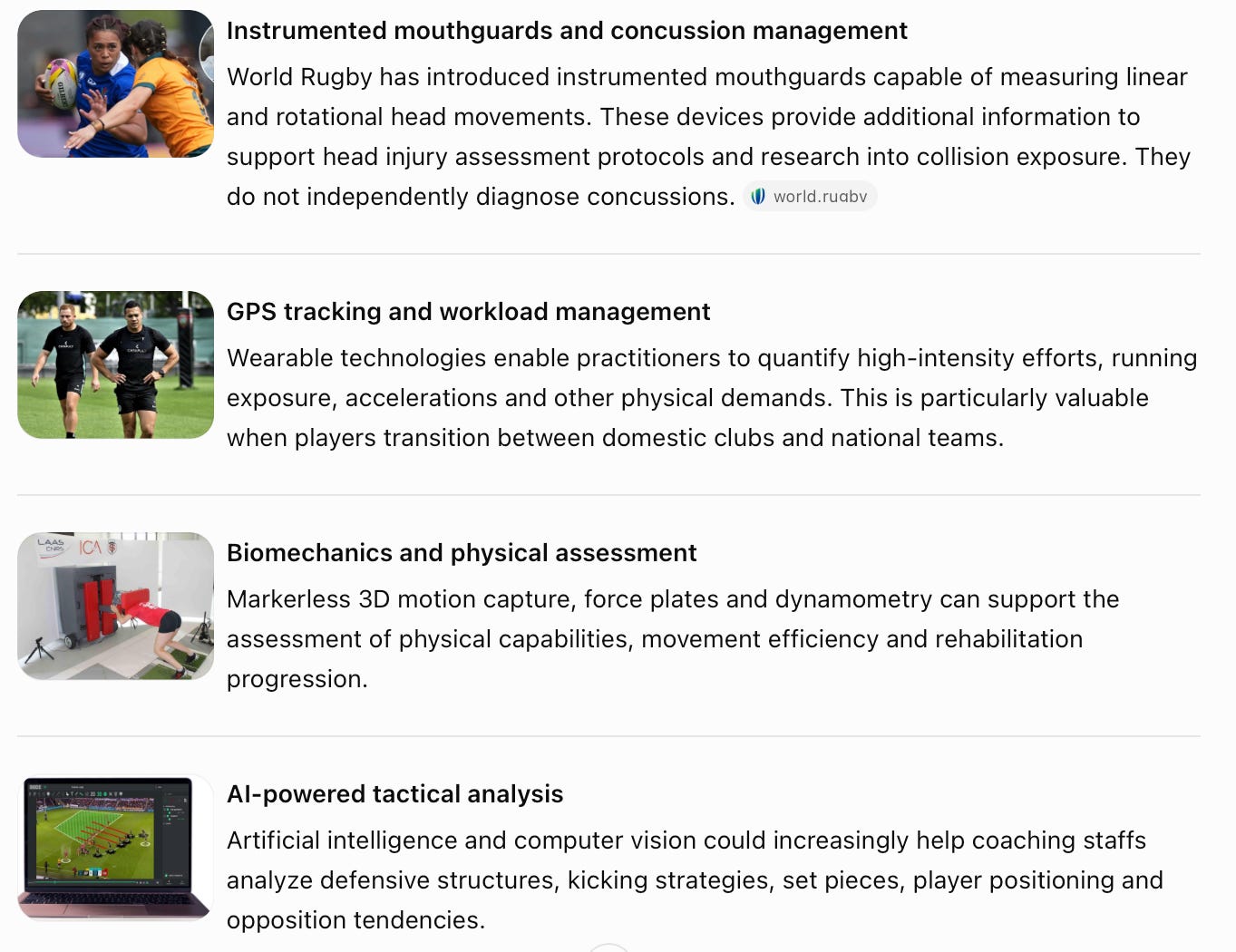
Another important opportunity is the integration of medical and performance data between national teams and domestic clubs. International rugby players operate across different organizations throughout the year, making interoperability and communication particularly valuable.
1.4. Future trends
At Upside, we expect several developments to shape international rugby over the next five years.
Greater commercialization of international competitions: More emphasis on commercially valuable fixtures, centralized sponsorship and international media distribution.
Expansion into emerging rugby markets: Increased interest in staging major events in North America, Asia and the Middle East.
More sophisticated head-impact monitoring: Continued improvements in instrumented mouthguards, impact analytics and player safety protocols.
AI-powered athlete management: Greater use of individualized athlete profiles, automated reporting and decision-support systems.
Increasing pressure on performance departments: More complex coordination between domestic clubs and national teams as competition demands evolve.
Growth ahead of the 2031 Rugby World Cup in the United States: Opportunities for rugby technology vendors, investors, broadcasters and commercial partners to establish a stronger presence in North America.
The 2027 Rugby World Cup in Australia and the 2031 edition in the United States will represent two major milestones in the international expansion of rugby.
1.5. Conclusion
Sunday’s final represents much more than a sporting confrontation between two rugby powerhouses. It is also a test of a new commercial model for international rugby.
South Africa has demonstrated the importance of squad depth, tactical innovation and physical preparation, while France benefits from a strong domestic rugby infrastructure and a talented player development ecosystem.
The long-term challenge will be to balance commercial growth with athlete welfare. For sports technology companies, this creates opportunities in concussion management, biomechanics, workload monitoring, recovery, rehabilitation and AI-powered performance analytics.
2. Arsenal vs. Manchester City — English Premier League
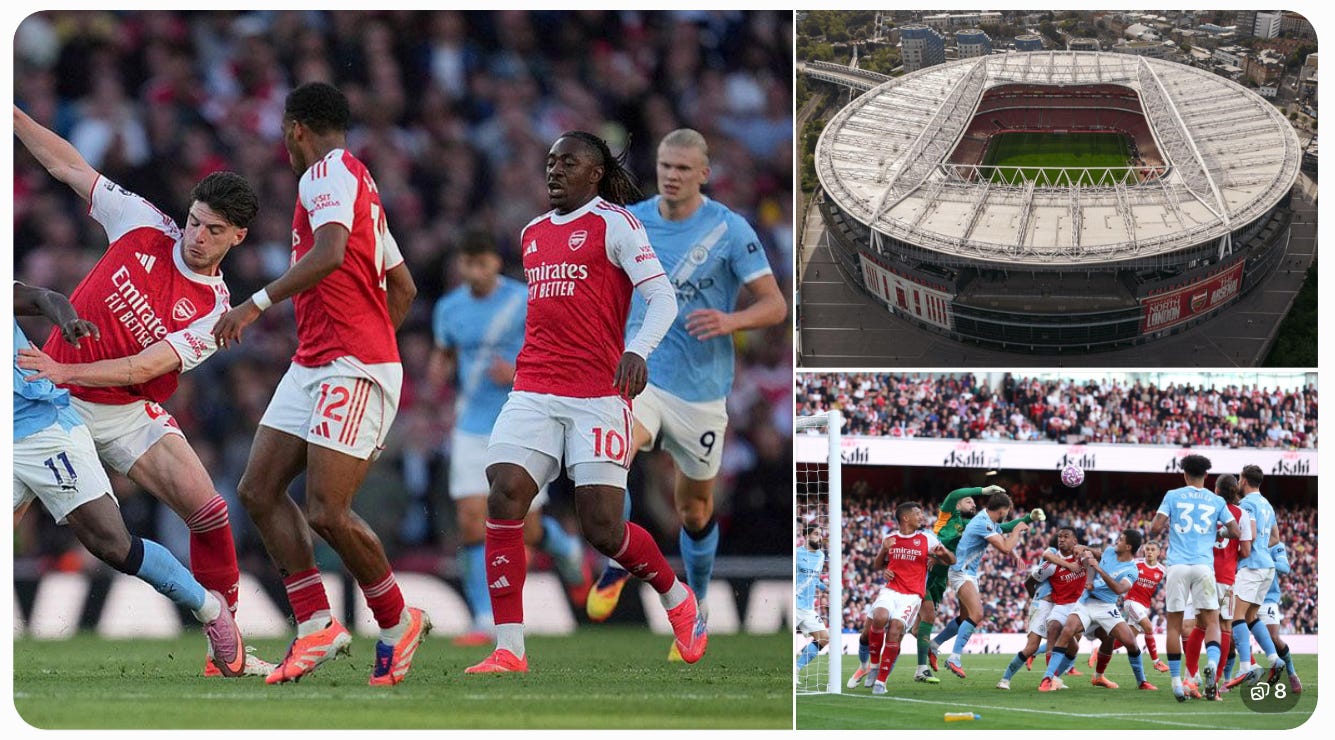
Date: Sunday, November 29, 2026
Location: Emirates Stadium, London
Competition: English Premier League
Arsenal and Manchester City have been at the center of several recent Premier League title races. Arsenal enters this weekend as the league leader, although both clubs have experienced challenges following the international break.
Beyond the sporting rivalry, the matchup brings together two of the world’s largest soccer businesses and two different approaches to building globally competitive sports organizations.
2.1. Key moments in history
Arsenal has historically been one of the most successful clubs in English soccer, while Manchester City’s transformation accelerated following its acquisition by the Abu Dhabi United Group in 2008.
Key historical milestones include:
1886: Arsenal was founded, eventually becoming one of English soccer’s most recognizable institutions.
2003–04: Arsenal completed an entire Premier League season undefeated under Arsène Wenger, becoming known as the Invincibles.
2006: Arsenal moved from Highbury to Emirates Stadium, significantly expanding its commercial infrastructure.
2008: Manchester City’s acquisition by Sheikh Mansour’s investment group transformed the club’s financial capabilities.
2012: Sergio Agüero’s dramatic late goal against Queens Park Rangers secured Manchester City’s first Premier League title.
2019: Mikel Arteta, previously part of Pep Guardiola’s coaching staff, became Arsenal’s head coach.
2022–23: Manchester City won the Premier League, FA Cup and UEFA Champions League, completing a historic treble.
2023–24: Manchester City became the first club to win four consecutive English top-flight league titles, finishing just two points ahead of Arsenal.
The recent rivalry is particularly interesting because Arsenal’s rebuilding strategy under Arteta incorporated elements of the tactical and organizational philosophy he experienced at Manchester City, while developing a distinct playing identity.
2.2. Economics: Two of the world’s largest soccer businesses
According to the 2026 Deloitte Football Money League, Manchester City and Arsenal generated more than €1.65 billion in combined revenues during the 2024–25 financial period.
2024–25 annual club revenues
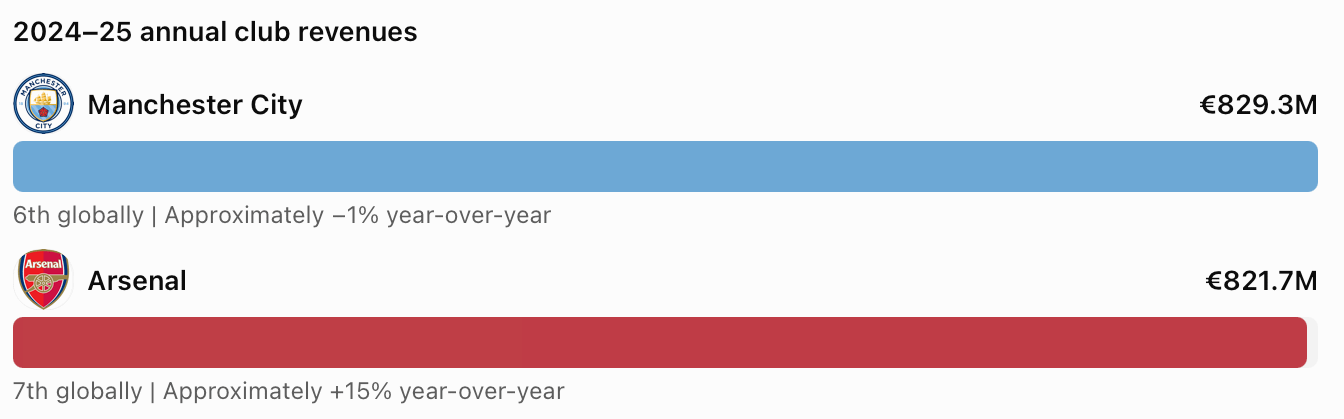
Source: Deloitte Football Money League 2026. Revenues are not equivalent to club valuations or profits.
What is particularly interesting is how Arsenal has narrowed the commercial gap with Manchester City, benefiting from improved sporting competitiveness, participation in the Champions League and significant matchday and commercial revenues.
The clubs nevertheless operate under different ownership models.
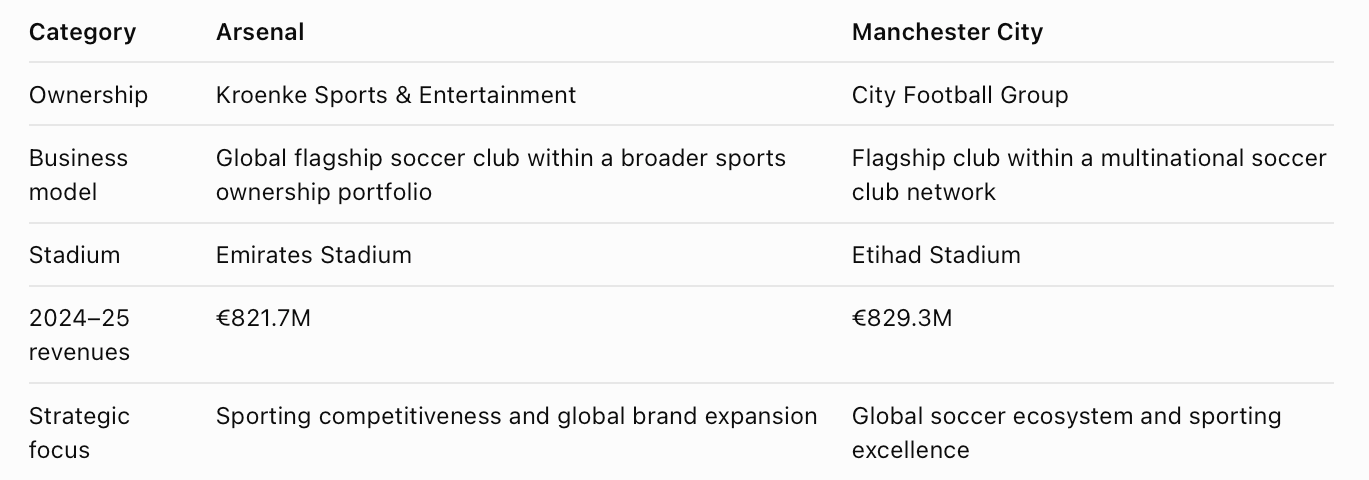
The Premier League’s commercial infrastructure is a major contributor to both clubs’ financial strength. Its domestic broadcasting agreements covering the four seasons from 2025–26 through 2028–29 are valued at approximately £6.7 billion.
Champions League participation, merchandise, global sponsorship agreements, premium hospitality and international fan engagement create additional commercial opportunities.
For both organizations, sporting performance has a direct impact on financial performance. Winning trophies and qualifying for major international competitions can increase broadcasting distributions, sponsorship value and matchday revenues.
2.3. Impact of technology on elite European soccer
The financial resources available to leading Premier League clubs allow them to invest heavily in sports science, medical infrastructure, data analytics, recruitment technologies and fan engagement platforms.
AI-powered scouting and player recruitment
Clubs are increasingly capable of combining historical performance data, video analysis, positional metrics and predictive analytics to identify players who fit their tactical systems. Given the financial risks associated with multimillion-dollar transfers, technology can help recruitment departments conduct more comprehensive due diligence.
Semi-automated offside technology
In April 2025, the Premier League introduced semi-automated offside technology developed in collaboration with Genius Sports and PGMOL. The technology uses computer vision and advanced player tracking to support officiating decisions and improve the speed of offside reviews.

Sports performance and injury prevention
With players participating in domestic league games, European competitions and international fixtures, performance departments face increasingly complex workload management challenges.
GPS tracking, force plates, dynamometry, markerless 3D motion capture, thermography and physiological monitoring can provide practitioners with additional insights into physical preparation, recovery and rehabilitation progression.
AI-powered tactical analysis
Computer vision and machine learning can help analysts evaluate pressing strategies, defensive positioning, passing opportunities, movement without the ball and opposition patterns. The next generation of tactical platforms could significantly reduce the amount of time coaching staffs spend manually reviewing match footage.
Global sports technology ecosystems
Manchester City’s multinational ownership structure creates an interesting opportunity to evaluate, validate and potentially deploy sports technologies across multiple clubs. For startups, working with a multi-club ownership group could provide a pathway to international expansion, although procurement decisions and technology requirements may vary across individual clubs.
2.4. Future trends
At Upside, we expect several developments to influence the future of Premier League organizations such as Arsenal and Manchester City:
AI agents for performance and medical departments: Automated athlete reports, technology scouting, data interpretation and administrative workflows.
Growth of internally developed AMS platforms: Greater control over proprietary athlete data, software integrations and organizational workflows.
Digital twins and advanced biomechanics: More individualized athlete assessment, physical preparation and rehabilitation modeling.
Multi-club technology partnerships: Opportunities for vendors to deploy solutions across international ownership networks.
Greater financial scrutiny: Increased emphasis on the ROI of player recruitment, sports technology investments and infrastructure development.
Personalized fan experiences: AI-generated content, interactive broadcasts, multilingual commentary and individualized digital engagement.
One of the biggest opportunities for sports technology startups will be helping clubs manage increasingly complex data ecosystems without creating additional operational burdens for practitioners.
2.5. Conclusion
The Arsenal–Manchester City rivalry illustrates how modern elite soccer has evolved into a highly sophisticated industry where sporting success, commercial performance, technology and organizational strategy are closely interconnected.
Arsenal’s recent revenue growth demonstrates how improved sporting competitiveness can accelerate commercial development. Manchester City’s global club network illustrates a different model, built around international scale and shared soccer expertise.
However, financial resources and advanced technologies do not guarantee sporting success. The ability to recruit the right players, develop talent, maintain player availability and execute a consistent sporting strategy remains fundamental.
For sports technology companies, the Premier League represents an attractive but demanding market where scientific validation, interoperability, practitioner adoption and measurable ROI will increasingly determine commercial success.
3. San Antonio Spurs vs. Boston Celtics — NBA Regular Season
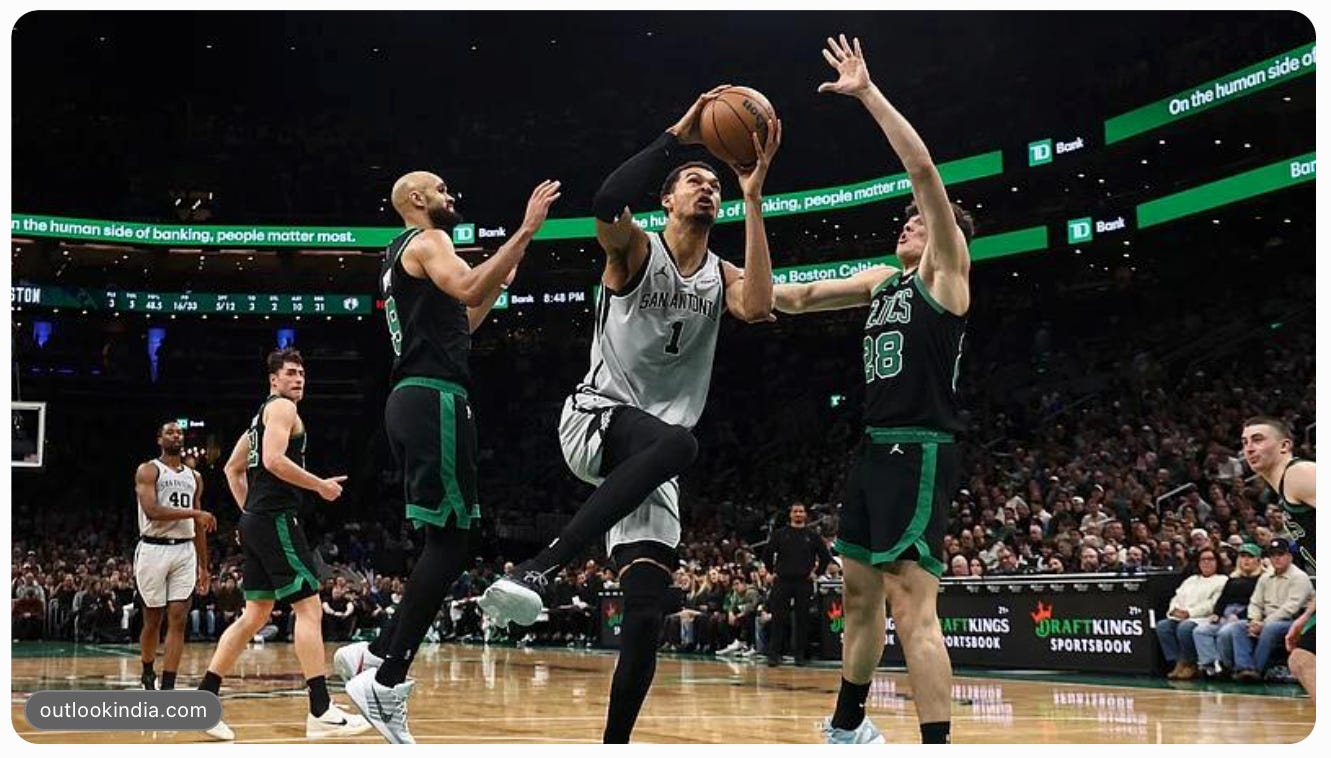
Date: Sunday, November 29, 2026
Time: 4:00 PM ET
Location: Frost Bank Center, San Antonio, Texas
Competition: NBA Regular Season
Sunday’s matchup between the San Antonio Spurs and Boston Celtics brings together two of the most successful franchises in NBA history, but also two different models of sporting and commercial development.
The Boston Celtics represent one of the most established global brands in professional basketball, built around decades of championship success, a loyal fan base and a strong commercial identity. Meanwhile, the San Antonio Spurs have entered a new era led by French superstar Victor Wembanyama, whose emergence has helped transform the franchise’s sporting ambitions, international visibility and commercial potential.
Beyond basketball, this matchup illustrates how superstar athletes, institutional investment, advanced performance technologies and global media distribution are reshaping the economics of the NBA.
3.1. Key moments in history
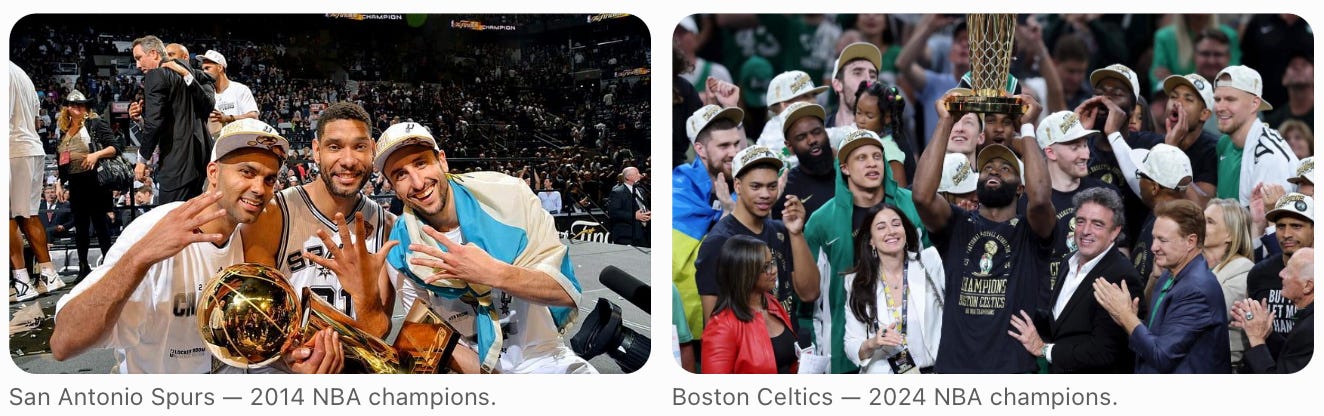
Both organizations have played a fundamental role in shaping the history of professional basketball.
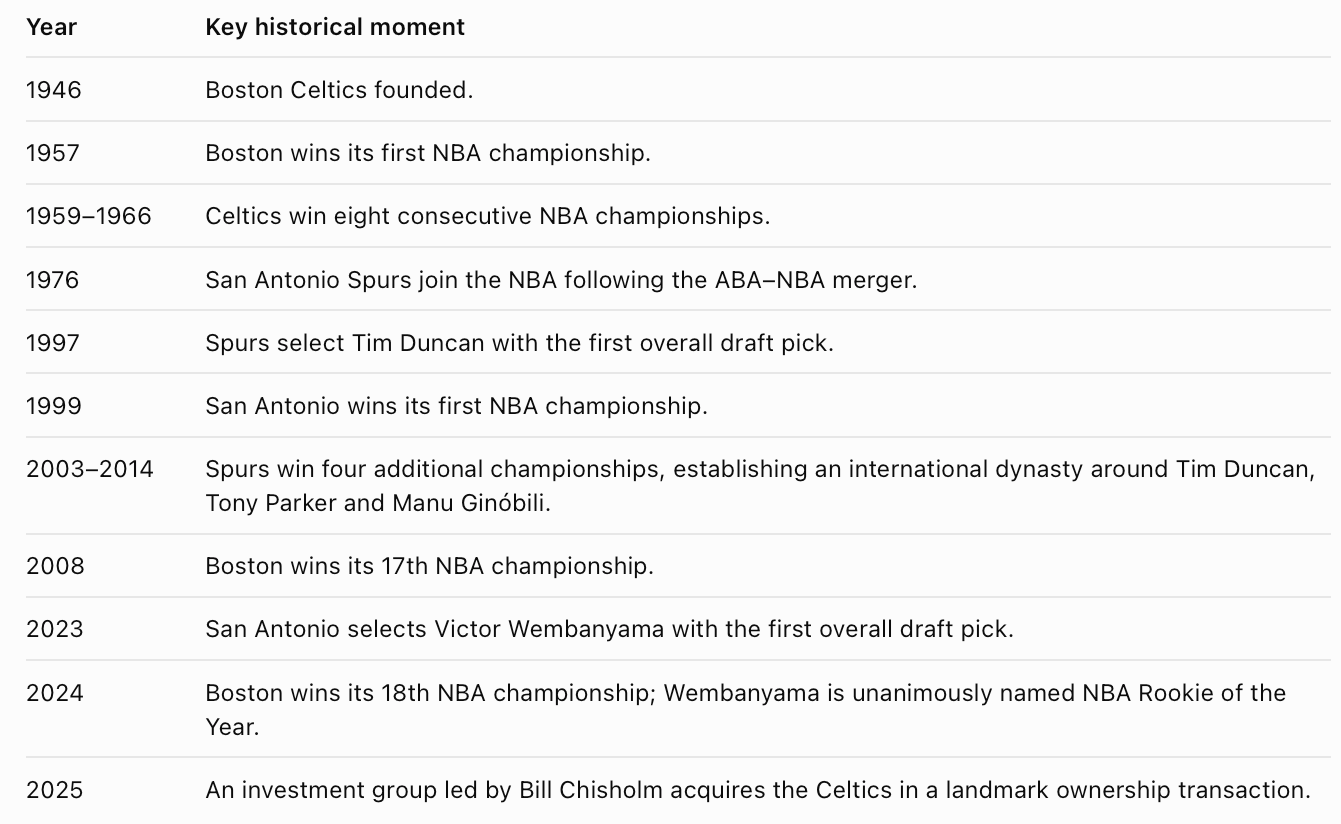
The contrasting histories of these two organizations demonstrate how NBA franchises can build sustainable competitive advantages through different approaches. Boston has capitalized on its championship heritage and global brand recognition, while San Antonio has historically emphasized international recruitment, player development, organizational stability and long-term investment in talent.
3.2. Economics: The rise of multibillion-dollar NBA franchises
The NBA has become one of the most attractive investment markets in professional sports, driven by growing media rights revenues, international expansion, sponsorship agreements and increasing institutional interest in franchise ownership.
According to Forbes’ October 2026 estimates:
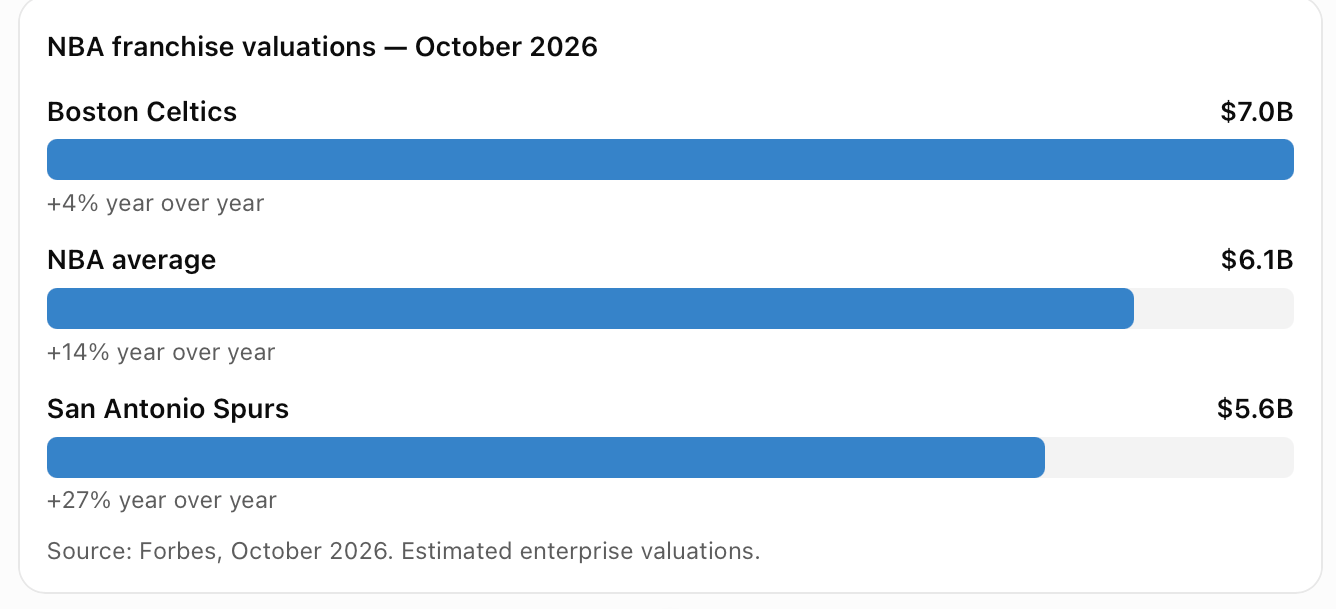
The Spurs’ valuation increased from $4.4 billion to $5.6 billion, representing one of the largest increases across the NBA. Although Wembanyama’s emergence is an important commercial asset, broader league economics, media rights and future arena development also contribute to franchise appreciation.
The Boston Celtics ownership transaction

In 2025, an investment group led by private equity executive Bill Chisholm acquired the Boston Celtics through a transaction whose first stage valued the franchise at $6.1 billion.
The transaction illustrated the increasing willingness of wealthy individuals and investment groups to commit significant capital to established NBA franchises with strong global brands and long-term revenue potential.
3.3. The Wemby effect: From NBA superstar to global commercial phenomenon

Since joining the NBA in 2023, Victor Wembanyama has become one of the most recognizable young athletes in professional sports. Standing approximately 7 feet 4 inches, the French superstar combines exceptional physical attributes with perimeter shooting, ball handling, defensive versatility and mobility rarely associated with players of his size.
His emergence represents a significant sporting and commercial opportunity not only for the San Antonio Spurs but also for the entire NBA.
The commercial impact of Wembanyama
Several indicators illustrate the magnitude of the Wemby effect:
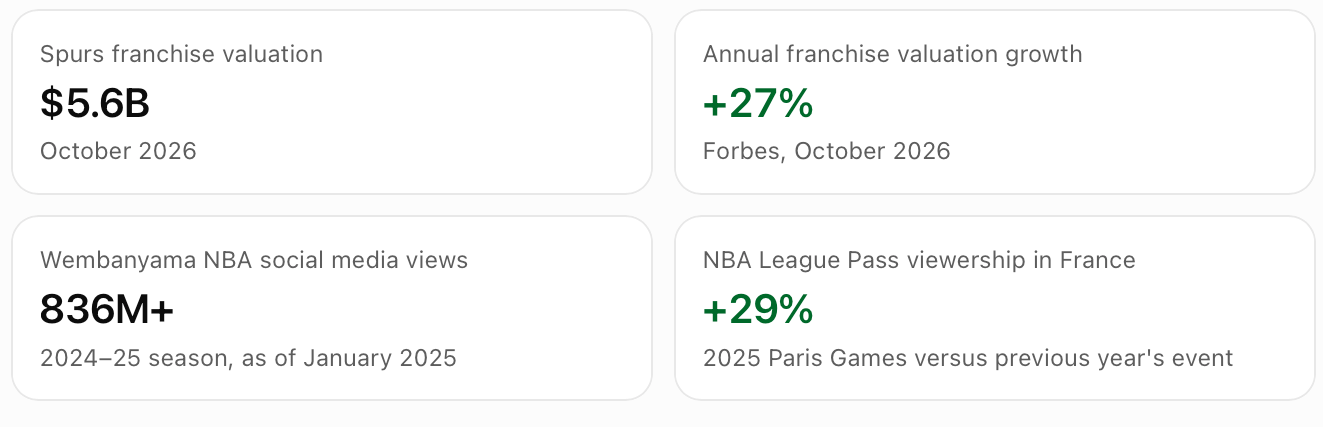
The 2025 NBA Paris Games featuring the San Antonio Spurs and Indiana Pacers demonstrated Wembanyama’s ability to attract international audiences. The opening matchup established a new NBA television viewership record in France at the time.
His popularity is creating significant commercial opportunities across international sponsorships, merchandise sales, premium ticketing, broadcasting, digital content and athlete endorsement agreements.
The impact on NBA television ratings

The 2026 NBA Finals between the San Antonio Spurs and New York Knicks provided another important indication of the commercial potential associated with the NBA’s next generation of superstars.
According to the NBA and Nielsen:
20.6 million viewers: Average television audience across the 2026 NBA Finals, the highest since 1998.
23.8 million viewers: Average television audience for Game 3.
24.5 million viewers: Average television audience for the decisive Game 5.
5 billion social media views: Generated across the first three games of the Finals.
Although these figures cannot be attributed exclusively to Wembanyama, they demonstrate the commercial potential of combining emerging global superstars with competitive teams, major media markets and compelling sporting narratives.
Could Wembanyama become the next global face of the NBA?
As the NBA prepares for the eventual retirement of established superstars such as LeBron James, Stephen Curry and Kevin Durant, Wembanyama represents one of its most promising long-term commercial assets.
His French nationality, distinctive playing style and international appeal could help the NBA strengthen its commercial presence across Europe, Africa and Asia.
Much like Michael Jordan helped accelerate the NBA’s international expansion during the 1990s, Wembanyama could become an important ambassador for professional basketball among a new generation of international fans.
The impact on sports performance and medical departments
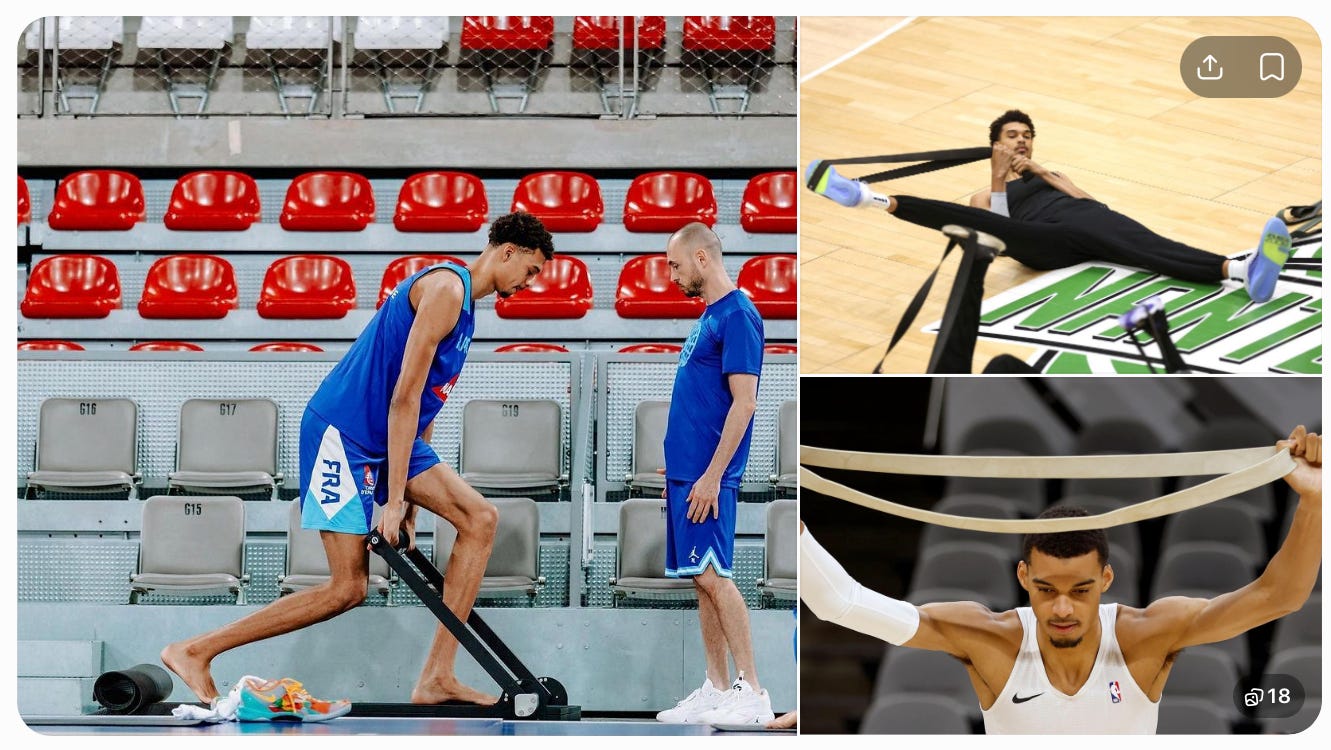
Wembanyama also represents a particularly interesting case study for sports performance practitioners. Managing an athlete with such unusual anthropometric characteristics requires careful consideration of individualized strength and conditioning, movement mechanics, recovery, workload management and long-term physical development.
For NBA performance and medical departments, athletes with exceptional physical profiles highlight the limitations of relying exclusively on population averages and standardized training protocols.
This could create additional opportunities for sports technology companies specializing in:
Markerless 3D motion capture and musculoskeletal modeling.
Individualized strength and force assessments.
Advanced physiological monitoring.
AI-powered workload management.
Sleep and recovery optimization.
Personalized rehabilitation and movement analysis.
The objective is not simply to maximize an athlete’s immediate performance but also to support sustained availability and career longevity.
3.4. The arena, performance center and media rights opportunities
The Spurs’ next-generation arena

The San Antonio Spurs are pursuing a proposed $1.3 billion downtown arena as part of San Antonio’s broader Project Marvel sports and entertainment development.
The new arena could provide additional commercial opportunities through premium hospitality, luxury suites, naming rights, sponsorship activations, concerts, connected infrastructure and immersive fan experiences.
However, the project’s final scope, financing arrangements and development timeline remain subject to change, particularly following revisions to elements of the broader development in October 2026.
Investments in next-generation performance facilities
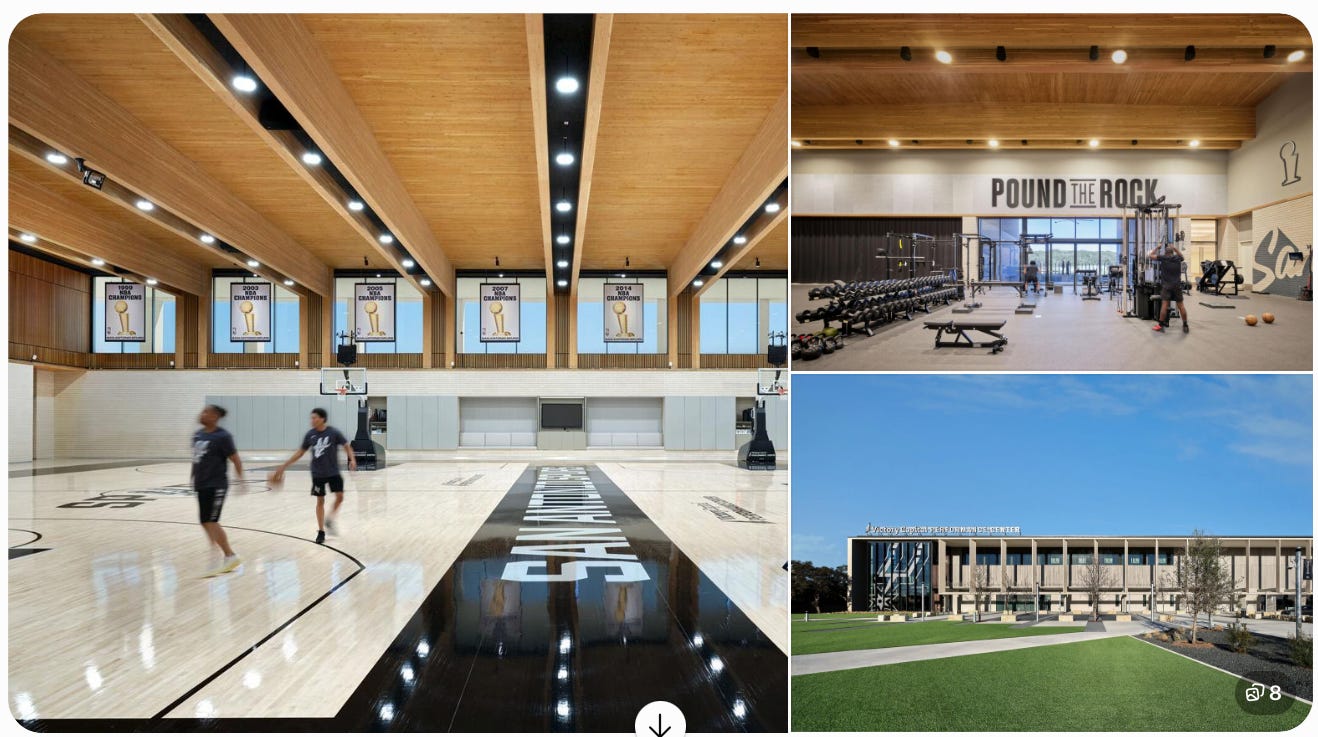
In October 2023, the San Antonio Spurs opened their 134,000-square-foot Victory Capital Performance Center at The Rock at La Cantera.
The facility illustrates how professional basketball organizations are increasingly investing in dedicated infrastructure to support athlete preparation, sports science, medical services, rehabilitation and player development.
For sports technology startups, these investments create opportunities to integrate technologies directly into the daily workflows of performance directors, athletic trainers, strength and conditioning coaches, sports scientists and rehabilitation specialists.
Rather than simply selling standalone technologies, vendors could increasingly be required to demonstrate interoperability, scientific credibility and measurable operational value.
The $76 billion NBA media rights opportunity

The NBA’s new 11-year media rights agreements with Disney, NBCUniversal and Amazon, which began during the 2025–26 season, are reportedly worth approximately $76 billion and extend through the 2035–36 season.
These agreements represent a fundamental transformation of NBA media distribution, combining traditional television broadcasting with streaming platforms and digital content ecosystems.
For NBA franchises, increasing media revenues could provide additional financial resources to invest in player development, performance infrastructure, medical departments and emerging technologies, although those investments will depend on individual ownership strategies and budget priorities.
3.5. Impact of technology on the NBA
The NBA represents one of the most attractive markets for sports technology companies because of its financial resources, global reach, demanding competition calendar and sophisticated performance and medical departments.
Athlete monitoring and workload management
NBA teams face significant operational challenges associated with an 82-game regular season, back-to-back games, extensive travel, multiple time zones and potentially lengthy playoff campaigns.
Wearables, sleep monitoring, heart rate variability assessments, force plates and physiological monitoring technologies can help practitioners better understand how individual athletes respond to competition and training demands.
The challenge is increasingly about translating this information into meaningful decisions rather than simply collecting more data.
Markerless 3D motion capture and biomechanics
Beginning with the 2023–24 season, the NBA partnered with Sony’s Hawk-Eye Innovations to introduce advanced three-dimensional optical tracking technology.
The league’s tracking infrastructure captures player movement and ball positioning in three dimensions, enabling more sophisticated analysis of basketball-specific movement patterns.
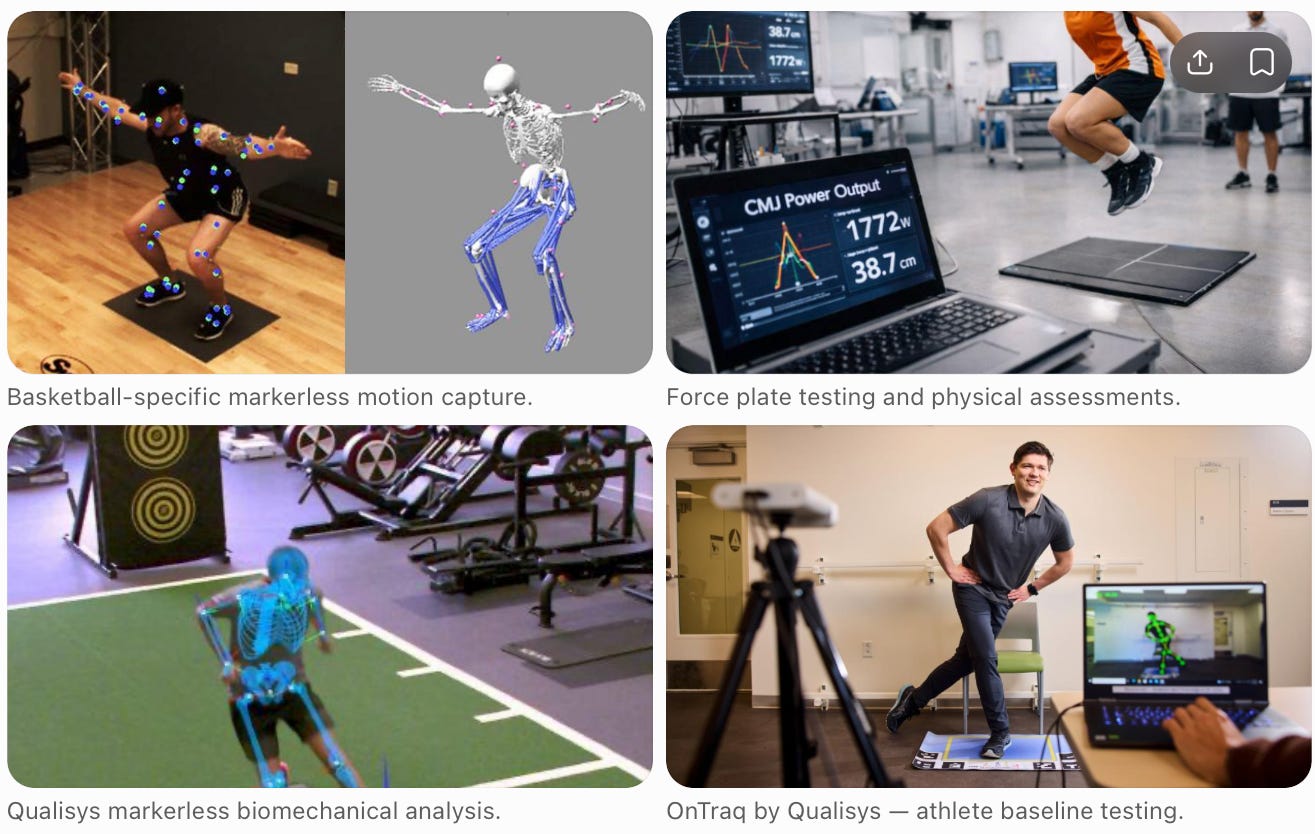
Beyond in-game tracking, innovative solutions such as Qualisys / OnTraq are creating new opportunities for NBA performance and medical departments to integrate advanced biomechanical assessments into their daily workflows.
OnTraq leverages Qualisys’ proprietary Prisma Pose markerless engine to perform athlete baseline testing and ongoing biomechanical assessments without requiring physical markers or wearable sensors.
According to the company, its eight-camera system can assess approximately 20 athletes in 30 minutes, with automated movement detection, individualized biomechanical reports, longitudinal monitoring and force plate integration options.
For NBA performance and medical practitioners, markerless 3D motion capture technologies could provide additional opportunities to evaluate:
Jumping and landing mechanics.
Acceleration and deceleration strategies.
Changes of direction.
Joint mobility and movement asymmetries.
Individual biomechanical profiles.
Longitudinal changes in movement patterns.
Rehabilitation progression and return-to-performance readiness.
For athletes such as Victor Wembanyama, whose anthropometric characteristics are particularly unique, establishing individualized biomechanical baselines and monitoring changes throughout the season could be especially valuable.
Combining markerless motion capture with force plates, dynamometry, thermography and medical assessments could provide practitioners with a more comprehensive understanding of an athlete’s physical status.
We expect solutions such as OnTraq to help accelerate the transition of advanced biomechanical assessments from traditional sports science laboratories into the daily workflows of elite sports organizations.
However, these technologies should support clinical and performance decisions rather than be treated as definitive predictors of future injuries.
OnTraq is highlighted as an example of an emerging technology relevant to basketball, rather than as a confirmed technology currently used by Wembanyama, the Spurs or the Celtics.
AI-powered athlete management systems (AMS)
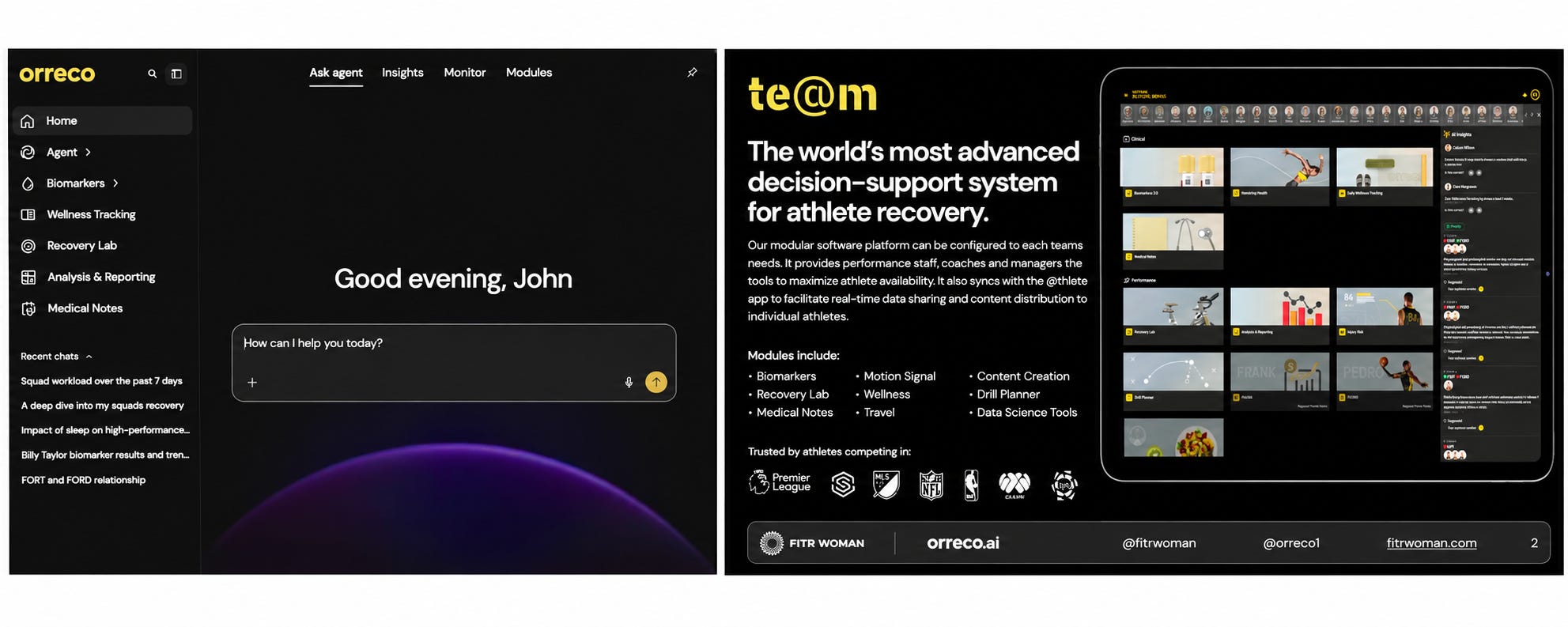
Picture: Orreco’s AMS platform
As NBA organizations collect information from an increasing number of technologies, performance and medical departments face growing challenges related to data fragmentation, interoperability and information overload.
We expect increasing demand for AI-powered athlete management systems and customized internal platforms capable of consolidating information from multiple sources, automating reporting and providing contextualized insights.
Potential applications include automated daily readiness reports, historical injury data analysis, individualized training recommendations and AI assistants capable of answering practitioner-specific questions.
We also expect more NBA teams to evaluate whether building their own internal AMS platforms could provide greater flexibility, data ownership and customization than relying exclusively on third-party solutions.
The ability to integrate into existing daily workflows could become one of the most important competitive differentiators for AMS vendors.
Recovery, rehabilitation and injury prevention

The increasing financial value of NBA players reinforces the economic importance of athlete availability and career longevity.
Technologies operating across localized cryotherapy, compression therapy, blood flow restriction, neuromuscular stimulation, thermography, sleep optimization and advanced rehabilitation could support increasingly individualized athlete care programs.
For performance and medical departments, the opportunity is to combine multiple complementary technologies with clinical assessments, individualized rehabilitation programs and historical athlete data.
Nevertheless, scientific validation, practitioner adoption and appropriate clinical oversight will remain essential to ensuring that these technologies deliver meaningful benefits.
AI-powered scouting and player development
Wembanyama’s emergence also illustrates the importance of identifying international talent before it reaches the NBA.
AI-powered video analysis, computer vision, automated scouting platforms and predictive analytics could help organizations evaluate promising young players across Europe, Africa, Asia and other emerging basketball markets.
The opportunity is not simply to identify the next superstar but also to better understand which athletes possess the physical, technical, tactical and psychological characteristics required to succeed in specific NBA environments.
Immersive broadcasting and fan engagement
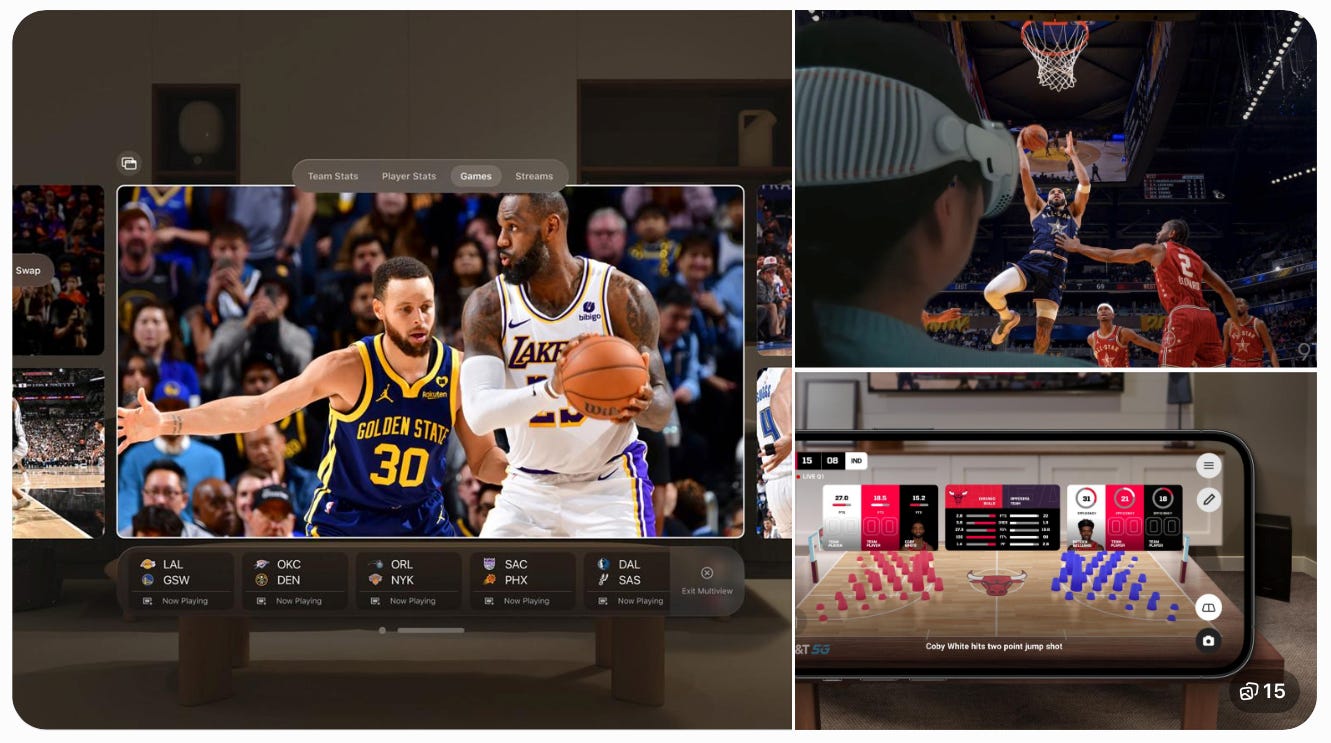
The growing popularity of internationally recognized athletes such as Wembanyama is also creating opportunities for technology companies operating outside the traditional performance and medical ecosystem.
These opportunities include:
Personalized AI-generated highlights.
Mixed reality and augmented reality experiences.
Virtual courtside seats.
Real-time statistical overlays.
Multilingual broadcasting.
Interactive sponsorship activations.
Digital fan communities.
The combination of emerging media platforms and immersive technologies could fundamentally change how international basketball fans consume live sporting events.
3.6. Future trends
Several major developments could accelerate the evolution of the NBA over the next five years.
The emergence of the NBA’s next generation of global superstars

As established stars approach the end of their careers, the NBA will increasingly rely on younger players such as Victor Wembanyama, Luka Dončić, Anthony Edwards and Shai Gilgeous-Alexander to maintain and expand its global audience.
The increasingly international composition of the NBA’s superstar population could also influence where the league organizes international games, develops commercial partnerships and invests in grassroots basketball programs.
The NBA’s European expansion opportunity
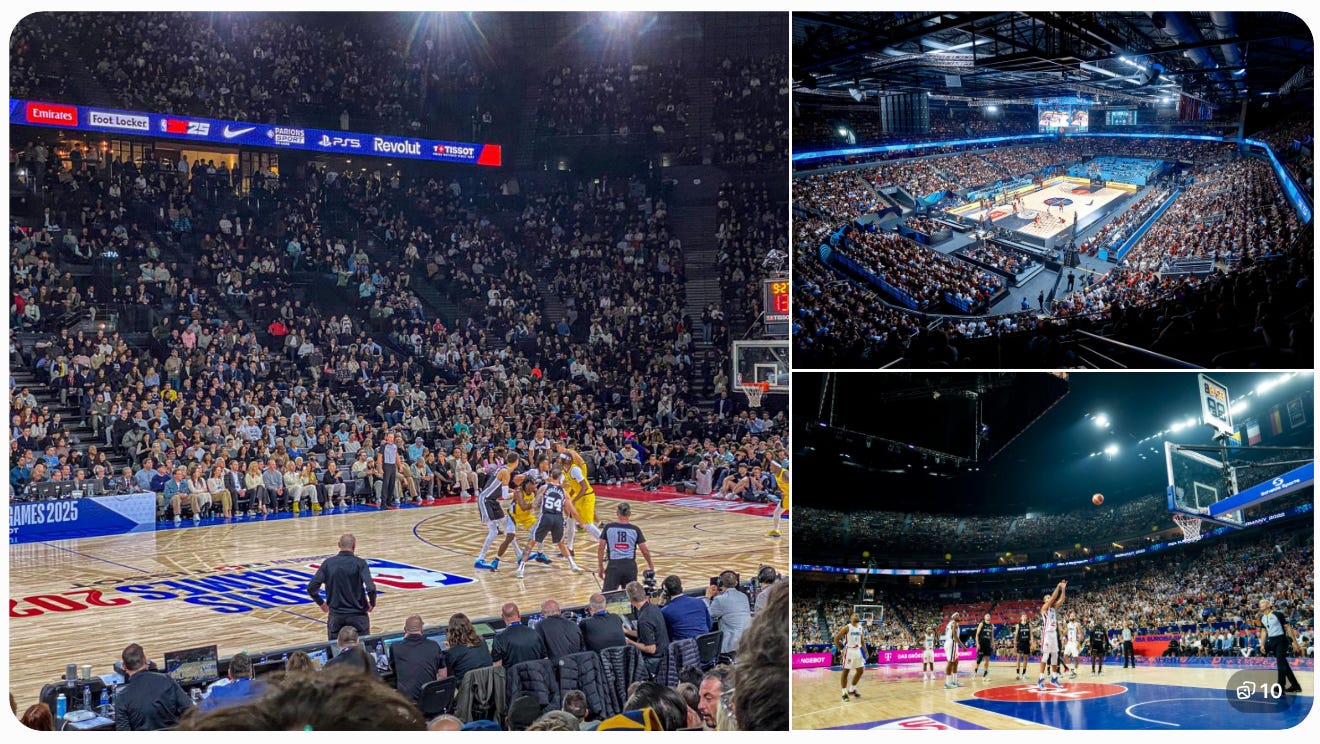
Wembanyama’s popularity reinforces the potential attractiveness of the European basketball market.
As the NBA and FIBA explore the possibility of establishing a new professional basketball competition in Europe, opportunities could emerge across franchise ownership, international sponsorships, broadcasting, player development and sports technology.
For European sports technology startups, such an initiative could potentially provide additional commercial pathways into professional basketball. However, the competition’s eventual structure and implementation remain uncertain.
Increasing institutional investment in NBA franchises
The Boston Celtics ownership transaction and the rapid appreciation of the San Antonio Spurs illustrate the increasing attractiveness of NBA franchises as long-term investment assets.
We expect institutional investors and private equity groups to continue evaluating opportunities across franchise ownership, arena infrastructure, sports media, entertainment properties and sports technology.
However, as valuations reach unprecedented levels, investors will increasingly scrutinize profitability, operating efficiency and sustainable revenue growth.
Greater investments in individualized athlete performance
As the financial and commercial value of elite athletes increases, NBA organizations could place even greater emphasis on personalized performance strategies.
Rather than applying standardized protocols to every player, teams could increasingly leverage historical athlete data, advanced biomechanics, physiological monitoring and AI-powered analytics to develop individualized physical preparation and recovery programs.
Athletes such as Wembanyama highlight why understanding individual movement characteristics and physical responses could become increasingly important.
We expect technologies such as markerless 3D motion capture, thermography, advanced physiological monitoring and AI-powered performance analytics to play an increasingly important role in supporting these individualized approaches.
Growing pressure on sports technology vendors to demonstrate ROI
Despite the continued growth in NBA franchise valuations, performance and medical departments will still need to justify their technology investments.
We expect teams to become increasingly selective when evaluating new technologies, with greater emphasis on:
Scientific validation and peer-reviewed research.
Integration into existing performance and medical workflows.
Interoperability with existing technologies.
Reduction in practitioners’ administrative workload.
Measurable operational and performance-related benefits.
Data privacy, security and ownership.
Long-term financial sustainability of vendors.
Sports technology startups capable of demonstrating tangible value rather than simply providing additional metrics could gain a significant competitive advantage.
3.7. Conclusion
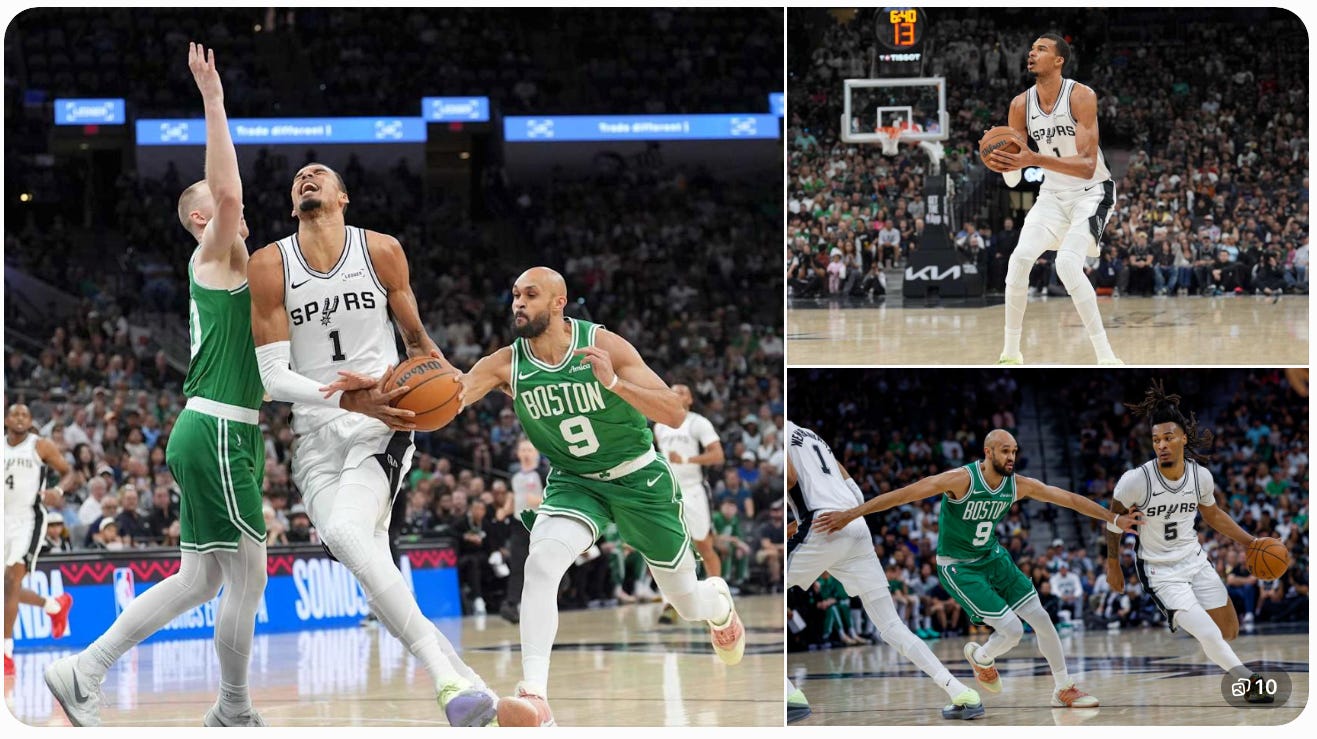
Sunday’s matchup between the San Antonio Spurs and Boston Celtics illustrates both the sporting competitiveness and commercial transformation of the NBA.
The Boston Celtics demonstrate how decades of championship success, strong brand recognition and a loyal international fan base can create sustainable franchise value. The San Antonio Spurs demonstrate how an organization can build a new era of sporting and commercial growth around international recruitment, player development, modern performance infrastructure and an emerging global superstar.
The Wemby effect extends well beyond basketball. Victor Wembanyama’s emergence is creating opportunities across international broadcasting, sponsorship, merchandise, arena development, digital fan engagement and sports performance technology.
For NBA performance directors, athletic trainers, sports scientists and rehabilitation specialists, his unique physical characteristics also highlight the growing importance of individualized athlete management, advanced biomechanics, personalized rehabilitation and long-term career development.
For sports technology startups, the NBA represents a growing market with considerable opportunities across player performance, sports medicine, markerless 3D motion capture, thermography, AI-powered athlete management systems, recruitment, recovery and immersive fan experiences.
Ultimately, the next phase of NBA growth will not be driven exclusively by superstar athletes or increasing media rights revenues. It will also depend on how effectively organizations combine sporting excellence, technological innovation, athlete health and sustainable commercial strategies.
The ability to keep the NBA’s most valuable athletes healthy, competitive and available over the course of their careers could become one of the most important sporting and economic priorities for professional basketball organizations.
4. Comparative analysis: Three sporting events, three different economic models
Although these three sporting events feature different sports and competitions — France versus South Africa in international rugby, Arsenal versus Manchester City in the English Premier League, and San Antonio Spurs versus Boston Celtics in the NBA — they illustrate several common trends shaping the global sports industry.
While international rugby is developing new commercial competition formats, the Premier League is capitalizing on its established global brand and broadcasting revenues, and the NBA is accelerating its growth through multibillion-dollar media rights agreements, rising franchise valuations, international expansion and the emergence of a new generation of global superstars such as Victor Wembanyama.
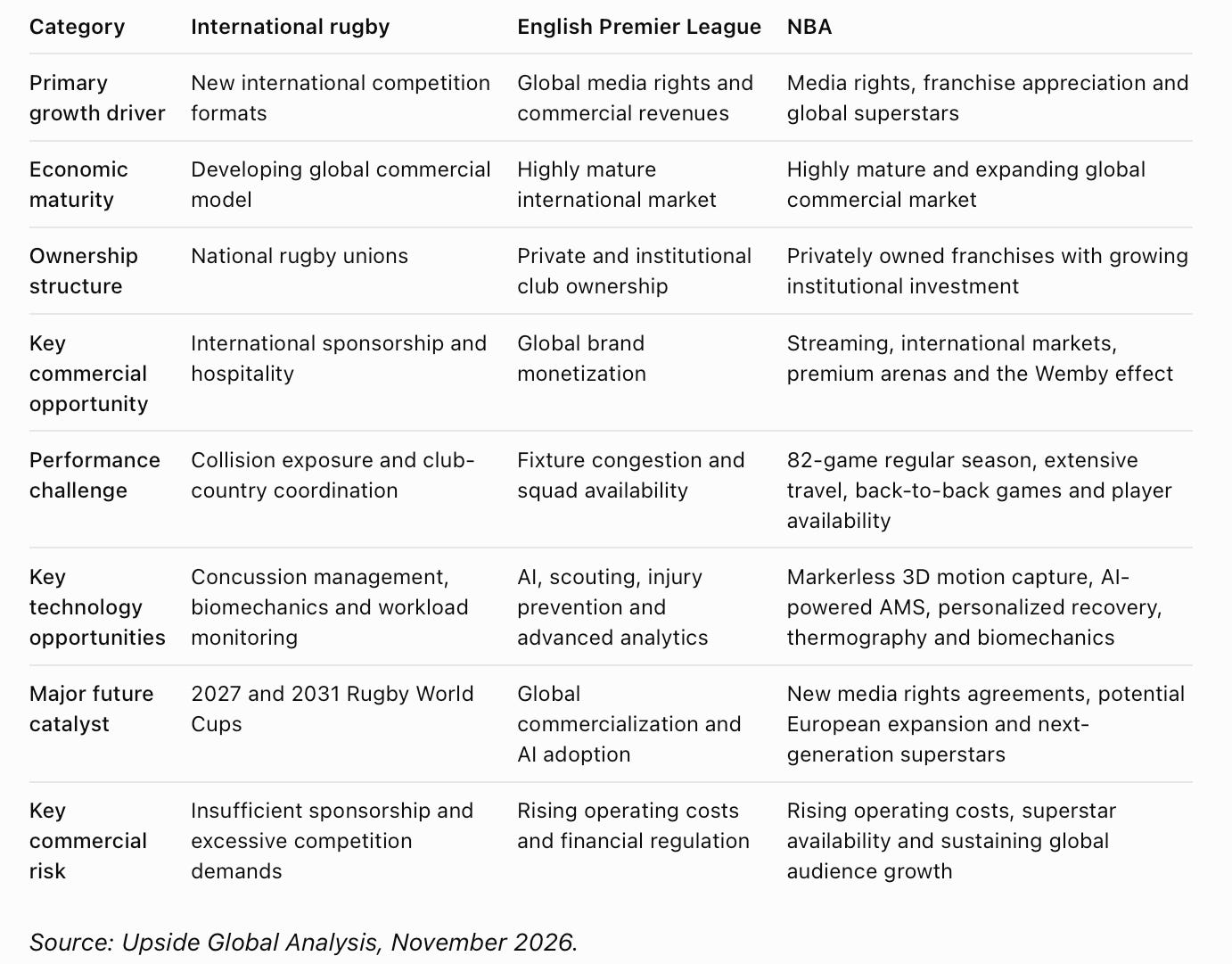
Despite their different economic models, all three sports are increasingly recognizing the strategic and financial importance of athlete availability, technological innovation and international audience growth.
For performance and medical departments, this evolution could translate into greater investments in individualized athlete monitoring, advanced biomechanics, injury mitigation, rehabilitation, recovery and AI-powered decision-making tools.
For sports technology startups, the opportunity will be to develop scientifically validated solutions that address the specific operational challenges of each sport while demonstrating measurable value, seamless workflow integration and a clear return on investment.
Ultimately, the ability to combine sporting excellence, athlete health, technological innovation and sustainable commercial growth will become an increasingly important competitive advantage across all three sports.
5. Key opportunities for sports technology startups
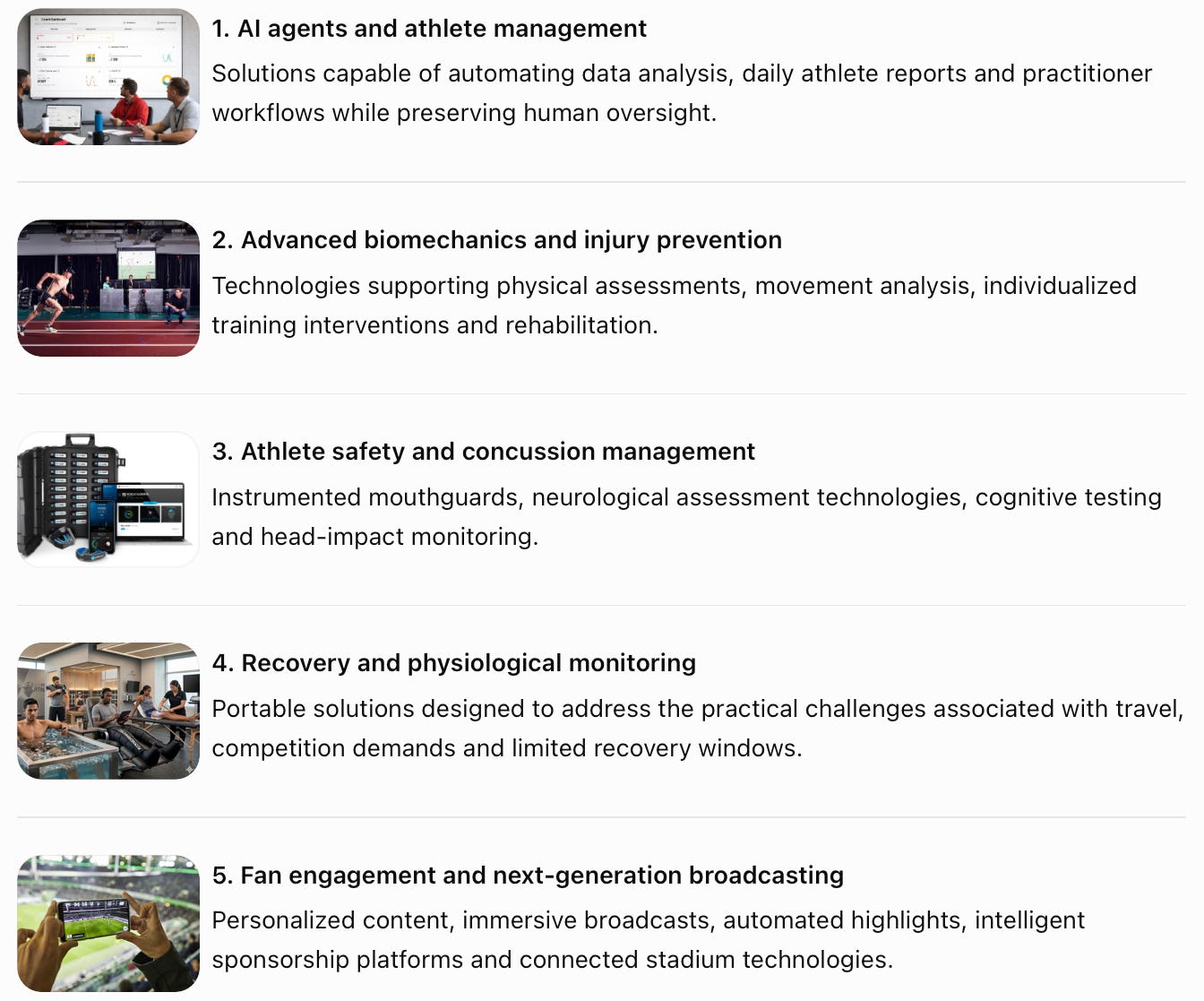
At Upside, we believe these three sporting events highlight five particularly attractive areas of innovation across the global sports industry.
6. Overall conclusion
This weekend’s three major sporting events provide a fascinating snapshot of the evolution of the global sports industry.
France versus South Africa represents international rugby’s ambition to create new commercially sustainable competitions outside Rugby World Cup years. Arsenal versus Manchester City illustrates the financial sophistication and global commercial reach of elite European soccer. San Antonio Spurs versus Boston Celtics demonstrates the continued economic growth of the NBA, driven by rising franchise valuations, multibillion-dollar media rights agreements, investments in next-generation performance facilities and the emergence of global superstars such as Victor Wembanyama.
The Wemby effect also illustrates how an internationally recognized athlete can help transform a franchise’s commercial positioning, attract new audiences, create sponsorship opportunities and accelerate a league’s international expansion. At the same time, it reinforces the strategic and economic importance of individualized athlete management, injury prevention, player availability and career longevity.
Despite their differences, all three competitions face similar strategic challenges: maintaining athlete availability, managing increasingly demanding schedules, growing international audiences, generating sustainable commercial revenues and maximizing the value of technology investments.
At Upside, we believe the next five years will be characterized by greater convergence between sports, technology, entertainment and investment. Professional sports organizations will increasingly operate as sophisticated data-driven businesses, creating significant opportunities for startups, investors and strategic technology partners across artificial intelligence, markerless 3D motion capture, athlete management systems, thermography, advanced rehabilitation, recovery and immersive fan experiences.
However, the human element will remain fundamental. Experienced practitioners, talented coaches, effective leadership, athlete development and organizational execution will continue to determine sporting success. As organizations increase their technology investments, the ability to integrate innovative solutions into practitioners’ daily workflows and demonstrate a measurable return on investment will become increasingly important.
Ultimately, technology can provide a competitive advantage, but it is the ability of sports organizations to translate that technology into better decisions, healthier athletes, sustained sporting success, stronger commercial outcomes and more compelling fan experiences that will differentiate the winners from the losers.
Other Major Sporting Events to Watch This Weekend
In addition to France vs. South Africa, Arsenal vs. Manchester City and Columbus Crew vs. Inter Miami, Thanksgiving weekend will feature several other major sporting events across international rugby, college football, the NFL, NBA and Formula 1.
🏉 International Rugby — Nations Championship
England vs. New Zealand: Saturday, November 28, at 11:40 AM ET. England and the All Blacks will compete for third place in the inaugural Nations Championship.
Ireland vs. Australia: Friday, November 27, at 3:10 PM ET. Two major rugby nations will compete for fifth place.
🏈 NCAA Football — Rivalry Weekend
Michigan vs. Ohio State: Saturday at 12 PM ET. One of the most iconic rivalries in American college sports.
Texas vs. Texas A&M: Friday at 7:30 PM ET. A historic rivalry with potential College Football Playoff implications.
Auburn vs. Alabama: Saturday at 7:30 PM ET. The famous Iron Bowl remains one of the biggest events in college football.
USC vs. UCLA: Saturday at 3:30 PM ET. A historic rivalry between two major California universities.
🏈 NFL — Regular Season
Denver Broncos vs. Pittsburgh Steelers: Friday at 3 PM ET.
Seattle Seahawks vs. San Francisco 49ers: Sunday at 4:25 PM ET. An important NFC West rivalry as teams compete for postseason qualification.
⚽ English Premier League
Everton vs. Liverpool: Sunday at 7 AM ET. The historic Merseyside derby.
Manchester United vs. Brentford: Saturday at 10 AM ET.
Nottingham Forest vs. Chelsea: Friday at 3 PM ET.
🏀 NBA — Regular Season
Miami Heat vs. New York Knicks: Friday at 7 PM ET.
Los Angeles Lakers vs. San Antonio Spurs: Friday at 9:30 PM ET.
Philadelphia 76ers vs. Houston Rockets: Saturday at 8:30 PM ET.
Boston Celtics vs. San Antonio Spurs: Sunday at 4 PM ET.
🏎️ Formula 1 — Qatar Grand Prix
- Qatar Grand Prix: Sunday, November 29, at 11 AM ET.
As the 2026 Formula 1 season approaches its conclusion, the Qatar Grand Prix represents an important opportunity for drivers and constructors to secure valuable championship points. The race also showcases the increasing importance of advanced simulation, real-time telemetry, AI-powered race strategies and driver performance optimization in motorsports.
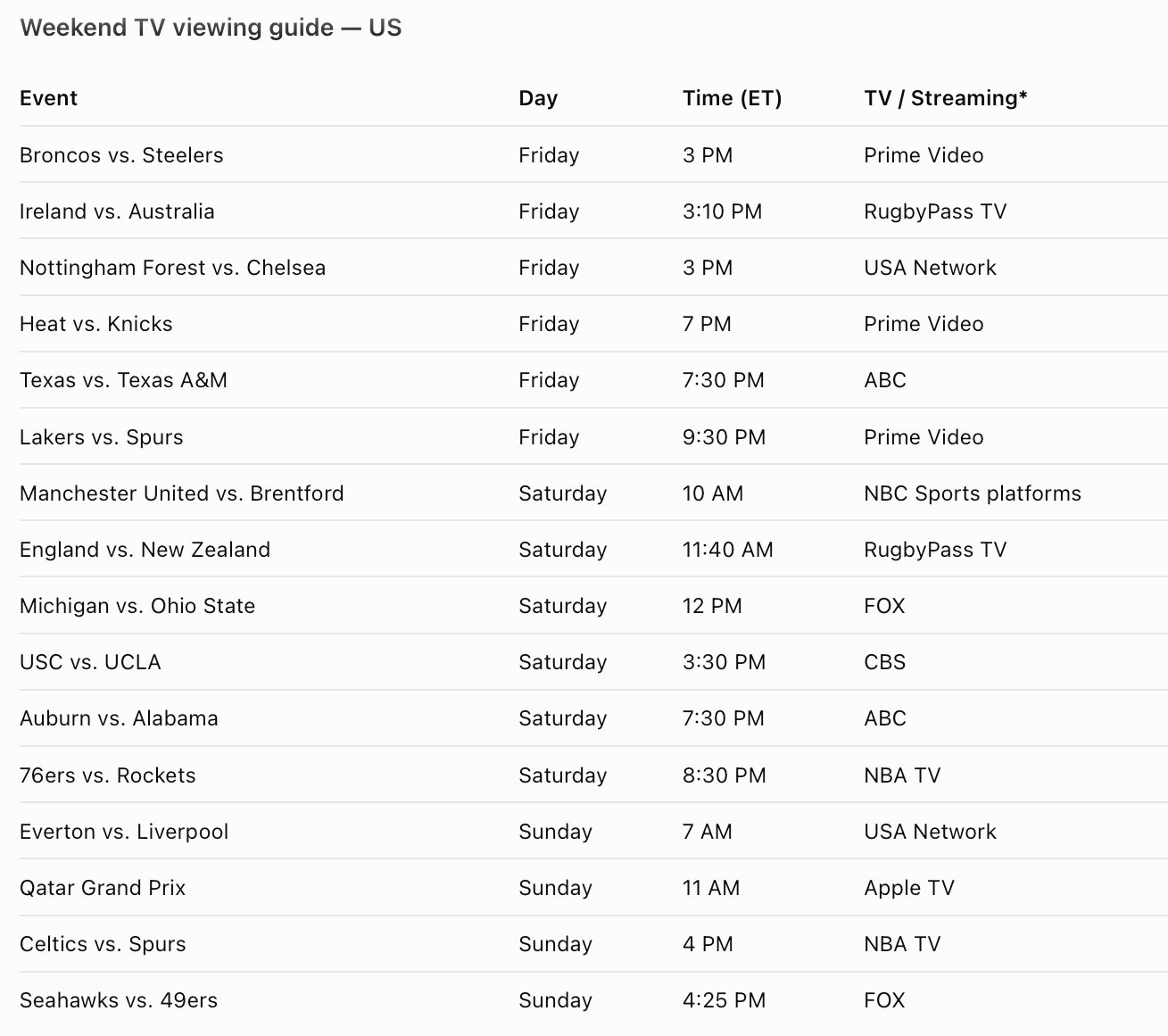
Based on the schedules discussed earlier. Broadcast assignments and starting times should be reconfirmed before publication.
Overall, Thanksgiving weekend promises to be an exceptional weekend for sports fans, with historic rivalries, international championships and important postseason implications across multiple professional and collegiate sports.