

November 14–15, 2026 | Tennis, Women’s Soccer & College Football
Introduction: Three major sporting events, three different business models
This weekend offers an interesting opportunity to examine how professional sports are evolving across three distinct markets: the ATP Finals in Turin, the NWSL semifinals in the United States, and the Texas–LSU college football rivalry.
While these competitions operate under different economic structures, they share several important characteristics. All three are increasingly influenced by media rights, sponsorships, athlete performance technologies, data analytics, and the growing commercialization of elite sports.
The ATP Finals illustrate how individual sports can create premium global entertainment properties. The NWSL semifinals highlight the rapid commercialization of women’s professional sports, while Texas–LSU demonstrates the enormous economic influence of college football in an era of NIL compensation, conference realignment, and revenue sharing.
Beyond the results on the field or court, these events provide a window into the future of sports technology, athlete performance, and sports business.
2026 ATP Finals, Turin, Italy

November 15–22, 2026 | Inalpi Arena, Turin
Key historical moments
First established in 1970, the ATP Finals have become one of the most prestigious events in men’s tennis, bringing together the eight leading singles players and eight doubles teams at the end of the season. Unlike Grand Slam tournaments, the competition uses a round-robin format before progressing to the semifinals and finals, rewarding consistency against the world’s best players.
The tournament has produced some of the sport’s defining achievements, including Roger Federer’s six singles titles and Novak Djokovic’s record seventh championship in 2023. Turin took over as host in 2021 after the event’s successful run in London, helping Italy strengthen its position as a major tennis market.
The 2025 edition was particularly significant. Jannik Sinner defeated Carlos Alcaraz in the final, and the match attracted seven million television viewers in Italy, becoming the most-watched tennis match in the country’s history. The tournament also recorded 229,879 spectators, demonstrating its commercial strength.
Economics: A premium global tennis property

The 2026 ATP Finals feature a record $15.75 million prize pool, with an undefeated singles champion eligible to earn $5.171 million. This illustrates how year-end tennis has evolved into a premium entertainment product with significant financial incentives for players.
The economics extend beyond prize money. Ticketing, hospitality packages, sponsorship agreements, broadcasting rights, merchandise, and tourism all contribute to the event’s commercial value. For Turin, international visitors generate spending for hotels, restaurants, transportation providers, and local businesses.
For sponsors such as Nitto, the event provides access to an affluent international audience, while the tournament’s digital distribution creates additional opportunities for commercial partners. Turin has also secured the right to host through 2027, reflecting the value of maintaining a successful host-city relationship.
Impact of technology
Tennis is among the most data-intensive individual sports, and the ATP Finals provide an excellent environment to demonstrate how technology can improve competition, coaching, and fan engagement.
Electronic line calling and optical ball-tracking systems have transformed officiating and reduced reliance on human line judges. Meanwhile, advanced analytics allow coaching teams to examine serve placement, return positioning, shot selection, movement efficiency, and tactical patterns.
From an athlete-performance perspective, wearable sensors, force plates, motion-capture systems, and video analysis can help practitioners evaluate fatigue, asymmetries, and physical readiness. These tools are particularly valuable at the end of a demanding season, when accumulated physical and mental fatigue may affect performance.
One notable development for 2026 is NTT DATA becoming the tournament’s official AI Consulting Partner and Technology Consulting Partner. The company plans to showcase AI and data-driven applications through a dedicated technology experience in Turin.
Future trends
The next phase of tennis innovation will likely be driven by AI-powered coaching assistants, predictive match analytics, automated video analysis, and more personalized athlete-monitoring systems. AI agents could eventually help coaching teams consolidate performance, wellness, and tactical information into actionable recommendations.
For fans, augmented reality, interactive match statistics, and personalized digital experiences could create new engagement opportunities and sponsorship inventory. However, the greatest competitive advantage may come from combining advanced analytics with experienced coaching judgment rather than replacing coaches with algorithms.
Upside perspective: The ATP Finals demonstrate how technology can simultaneously improve elite performance, enhance broadcasts, and create new commercial opportunities. The challenge for technology providers is proving that their solutions deliver measurable benefits rather than simply generating additional data.
2026 NWSL Semifinals

Washington Spirit vs. Utah Royals FC
Saturday, November 14 · 12 PM ET · CBS / Paramount+
Gotham FC vs. Kansas City Current
Sunday, November 15 · 3 PM ET · ABC
Key historical moments
Since launching in 2013, the NWSL has evolved from a relatively modest professional competition into one of the world’s most commercially significant women’s soccer leagues.
Several milestones have accelerated that growth. The league survived the challenges of its early years, expanded into new markets, and attracted increasingly sophisticated ownership groups. Gotham FC’s first NWSL championship in 2023 demonstrated how quickly a club could transform its competitive fortunes, while the Kansas City Current helped redefine expectations for women’s sports infrastructure with the opening of a purpose-built stadium in 2024.
The 2026 semifinals bring together four clubs with different sporting and commercial stories. Washington and Gotham represent established East Coast markets, Kansas City has become a prominent example of dedicated investment in women’s soccer, and Utah is pursuing a new chapter following its return to the league.
The stakes are substantial: the winners advance to the November 21 championship, with national television coverage providing an opportunity to attract new fans and commercial partners.
Economics: Women’s soccer as a growing investment category
The NWSL’s commercial development is being supported by increased media-rights investment, institutional capital, sponsorship growth, rising franchise valuations, and improved stadium infrastructure.
The league’s landmark four-year media-rights agreements with CBS, ESPN, Amazon Prime Video, and Scripps, announced in 2023, were reported to be worth approximately $240 million in total. This represented a major step forward from the league’s previous broadcasting arrangements.
The semifinals also generate revenue through ticket sales, premium hospitality, concessions, merchandise, and sponsorship activations. For clubs, postseason appearances can strengthen season-ticket demand, sponsor relationships, and long-term brand recognition.
The broader significance is that investors are increasingly evaluating women’s sports teams as long-term media and entertainment assets rather than relying solely on traditional measures of matchday profitability.
However, rapidly rising valuations also create pressure to deliver sustainable revenues, improve facilities, control operating costs, and develop stronger commercial operations.
Impact of technology
The NWSL presents significant opportunities for sports technology companies, particularly in athlete health, injury reduction, recovery, and performance monitoring.
Women’s soccer has become an important area of research into ACL injuries, neuromuscular performance, biomechanics, and return-to-play strategies. While no single technology can eliminate ACL injuries, better screening, individualized strength programs, movement analysis, and workload management may help clubs identify modifiable risk factors and improve rehabilitation processes.
GPS and optical tracking systems can support the monitoring of high-speed running, accelerations, decelerations, and accumulated training loads. Force plates and biomechanical assessment tools can provide additional information during rehabilitation and physical development.
The NWSL is also increasingly relevant to companies developing technologies specifically for female athletes, including menstrual-cycle symptom tracking, pelvic health, nutrition, recovery, and individualized training. Such tools require careful validation and strong privacy protections; cycle data alone should not be treated as a reliable predictor of injury risk.
On the commercial side, computer vision, AI-powered highlights, automated content production, and digital fan-engagement platforms can help clubs reach larger audiences without proportionally increasing production costs.
Future trends
Over the next several years, I expect three developments to become increasingly important.
First, clubs will continue investing in dedicated training facilities, sports science departments, and more sophisticated athlete-management infrastructure. As commercial expectations rise, organizations will face greater pressure to demonstrate the value of their performance and medical investments.
Second, women’s-specific sports technology could become a more established investment category. Startups developing validated solutions for injury rehabilitation, athlete monitoring, recovery, and female health may benefit from increased demand across professional, collegiate, and youth sports.
Third, AI-powered media production and fan personalization could help NWSL clubs increase engagement, improve sponsor activation, and expand their international audiences.
Upside perspective: The NWSL represents an attractive intersection of sports investment and technology innovation. The most promising opportunities may come from solutions that address genuine unmet needs in women’s athlete health while also helping clubs operate more efficiently.
Texas Longhorns vs. LSU Tigers

Saturday, November 14, 2026 | 7:30 PM ET | ABC | Tiger Stadium, Baton Rouge
Key historical moments
Texas and LSU represent two of college football’s most recognizable programs, with national championships, passionate fan bases, and decades of investment in recruiting, facilities, and coaching.
One of their most memorable encounters came in September 2019, when LSU defeated Texas 45–38 in Austin. Quarterback Joe Burrow threw for 471 yards and four touchdowns in a game that helped establish LSU as a national championship contender. LSU went on to complete an undefeated season and win the national title.
Another significant meeting came in the 2003 Cotton Bowl, when Texas defeated LSU 35–20. Although the schools have a long history, their meetings have been relatively infrequent compared with traditional conference rivalries.
Texas joining the SEC in 2024 changed that dynamic. The schools now compete within the same conference, creating more regular opportunities for high-profile matchups.
This weekend’s game is particularly significant because both programs are competing for postseason positioning. Texas enters with a 7–2 record, while LSU is 6–3, making the result important for their College Football Playoff aspirations.
Economics: The enormous business of SEC football
College football has evolved into a multibillion-dollar industry, with major programs operating increasingly sophisticated commercial organizations.
The SEC’s long-term broadcasting agreement with ESPN and ABC has strengthened the conference’s ability to monetize premium matchups. The current SEC media-rights structure, including the package that began in 2024, gives ESPN and ABC extensive coverage of the conference’s football inventory.
For Texas and LSU, the financial benefits extend far beyond broadcasting. A major Saturday night game in Baton Rouge generates economic activity through ticket sales, premium seating, corporate hospitality, sponsorships, merchandise, hotels, restaurants, and transportation.
Tiger Stadium’s capacity exceeds 100,000 spectators, making it one of the largest venues in American college football. The stadium’s scale and LSU’s passionate fan base create an attractive environment for broadcasters and sponsors.
The economics of college athletics have also changed dramatically through NIL opportunities, the transfer portal, and the introduction of direct revenue sharing with student-athletes following the House settlement.
These developments are transforming recruiting, roster construction, and financial planning. Athletic departments must increasingly balance investment in facilities, coaching, performance technology, and athlete compensation.
The broader question is whether the continued growth of media-rights revenues can sustainably support rising operational and athlete-related costs.
Impact of technology
Texas and LSU operate in an increasingly technology-intensive college football environment, where performance departments use a range of systems to monitor athlete readiness, physical development, and injury rehabilitation.
GPS and local positioning systems can help teams evaluate training intensity, high-speed movement, acceleration, and cumulative workloads. Force plates and other biomechanical assessment tools provide objective information about neuromuscular performance and rehabilitation progress.
Computer vision and video analytics have also become important components of football operations. Coaches can analyze formations, opponent tendencies, route combinations, blocking assignments, and player positioning with increasing speed and detail.
AI is creating additional opportunities to automate video tagging, summarize scouting information, and identify tactical patterns. However, human coaches still need to interpret these findings in the context of game plans and individual player responsibilities.
Another important development is the integration of performance, medical, and coaching data. Rather than operating with separate systems for athlete monitoring, strength and conditioning, rehabilitation, and video analysis, programs are exploring ways to consolidate information into more accessible platforms.
This raises an important strategic question: should major college football programs continue purchasing commercial Athlete Management Systems, or invest in developing their own internal data infrastructure?
Future trends
I expect AI agents, integrated data platforms, and individualized athlete development to become increasingly important in college football.
AI agents could help performance departments automatically consolidate daily wellness data, GPS metrics, strength testing results, rehabilitation information, and training schedules. Instead of manually preparing multiple reports, practitioners could receive concise summaries highlighting meaningful changes in athlete status.
AI could also help recruiting and personnel departments evaluate transfer portal candidates, compare player development trajectories, and identify potential roster needs. These applications will require careful consideration of data quality, privacy, and NCAA rules.
Another trend will be the continued professionalization of college athletic departments. As athlete compensation and recruiting expenses increase, universities will face greater pressure to demonstrate measurable returns on their investments in technology, staffing, and performance infrastructure.
The most successful programs may not necessarily be those purchasing the largest number of technologies, but those capable of integrating their tools into efficient workflows that coaches and practitioners actually use.
Upside perspective: Texas–LSU illustrates how college football is becoming increasingly similar to professional sports from both an economic and operational standpoint. For sports-tech startups, major NCAA programs represent a significant market, but vendors will need to demonstrate clear improvements in athlete availability, staff efficiency, player development, or competitive performance.
Comparing the three events: Where technology creates value
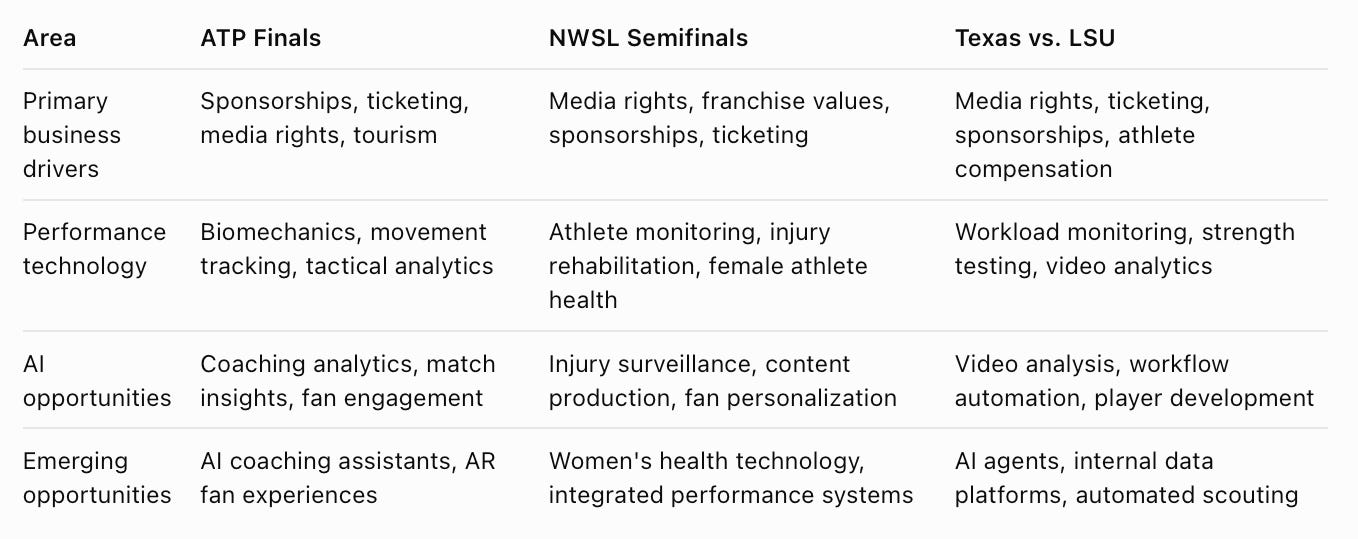
Conclusion: The next phase of sports innovation will be driven by integration and measurable results
The ATP Finals, NWSL semifinals, and Texas–LSU illustrate three different stages of sports business development, but all point toward the same underlying transformation: technology is becoming increasingly important to how sports organizations compete, generate revenue, and engage their audiences.
In tennis, sophisticated performance analytics and premium digital experiences are helping strengthen an already established global commercial product. In women’s soccer, rising investment is creating opportunities for specialized performance technologies, improved medical infrastructure, and more advanced fan-engagement platforms. In college football, growing revenues and athlete compensation are accelerating the professionalization of athletic departments and increasing demand for integrated technology solutions.
From an investment perspective, I see several particularly interesting opportunities in AI agents, biomechanical analysis, injury rehabilitation, athlete-monitoring platforms, and technologies that automate repetitive tasks across performance and medical departments.
However, one important lesson applies across all three sports: collecting more data does not automatically lead to better decisions.
Teams and athletes already have access to an enormous amount of information. The next competitive advantage will likely come from technologies that can integrate that information, identify meaningful insights, and help practitioners act on those insights more efficiently.
For sports organizations, the priority should be selecting technologies that solve clearly defined problems and fit existing workflows. For startups and investors, the opportunity lies in building solutions that demonstrate measurable value, whether through improved athlete availability, reduced administrative workload, better coaching decisions, or stronger commercial engagement.
Ultimately, the future of sports technology will not be determined simply by which organizations adopt AI or advanced analytics first. It will be shaped by those that successfully combine technology, human expertise, and operational execution to create sustainable competitive advantages.
That is a trend worth watching well beyond this weekend’s results.
Biggest sports events to watch this weekend
Saturday, November 14 – Sunday, November 15, 2026 | All times Eastern (ET) | US television
This weekend’s biggest attractions include Texas vs. LSU, Missouri vs. Georgia, NFL Sunday, and the ATP Finals. Here’s the viewing guide I’d prioritize.
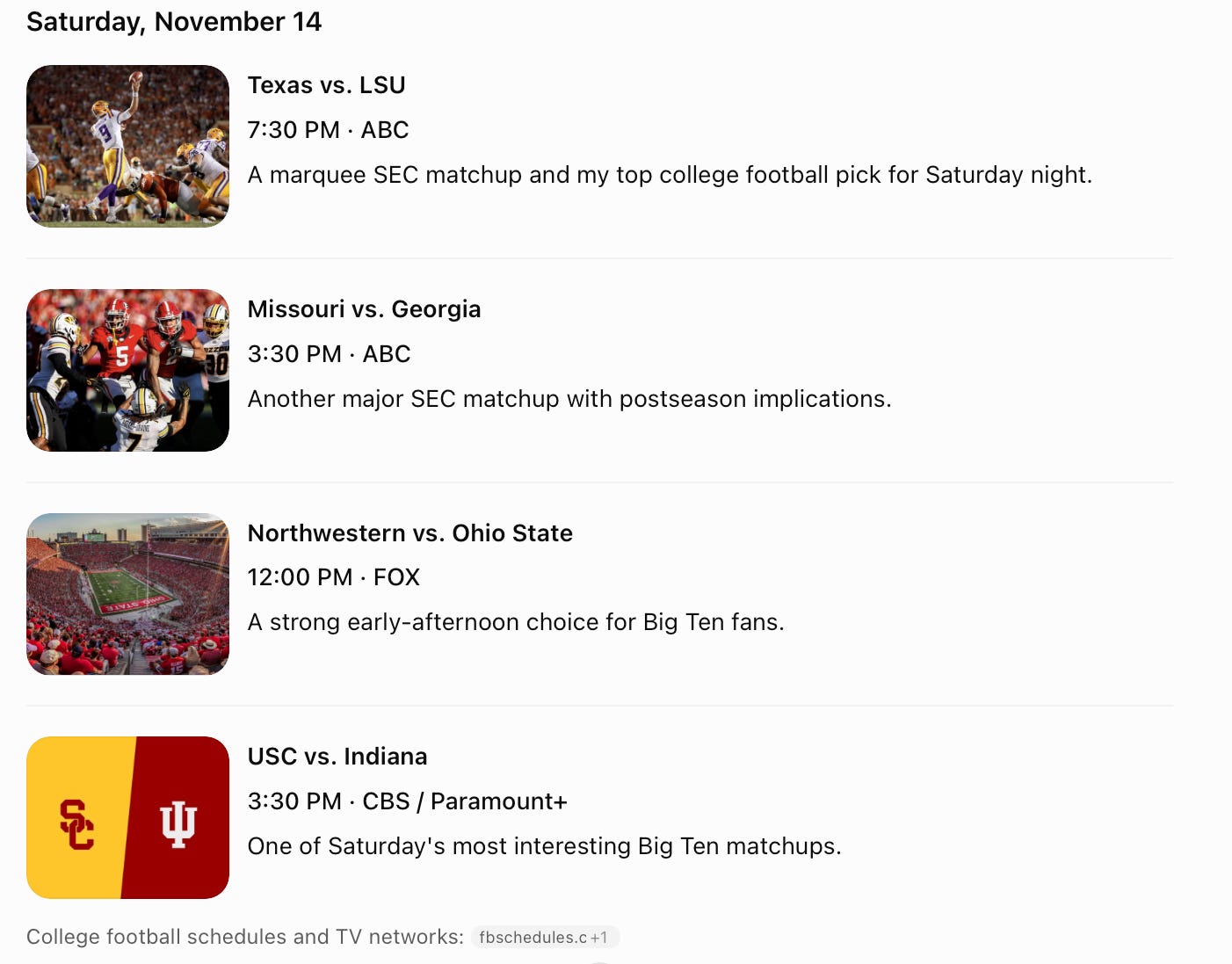

Other major events worth watching

Note that regional NFL broadcasts may differ depending on your TV provider.