
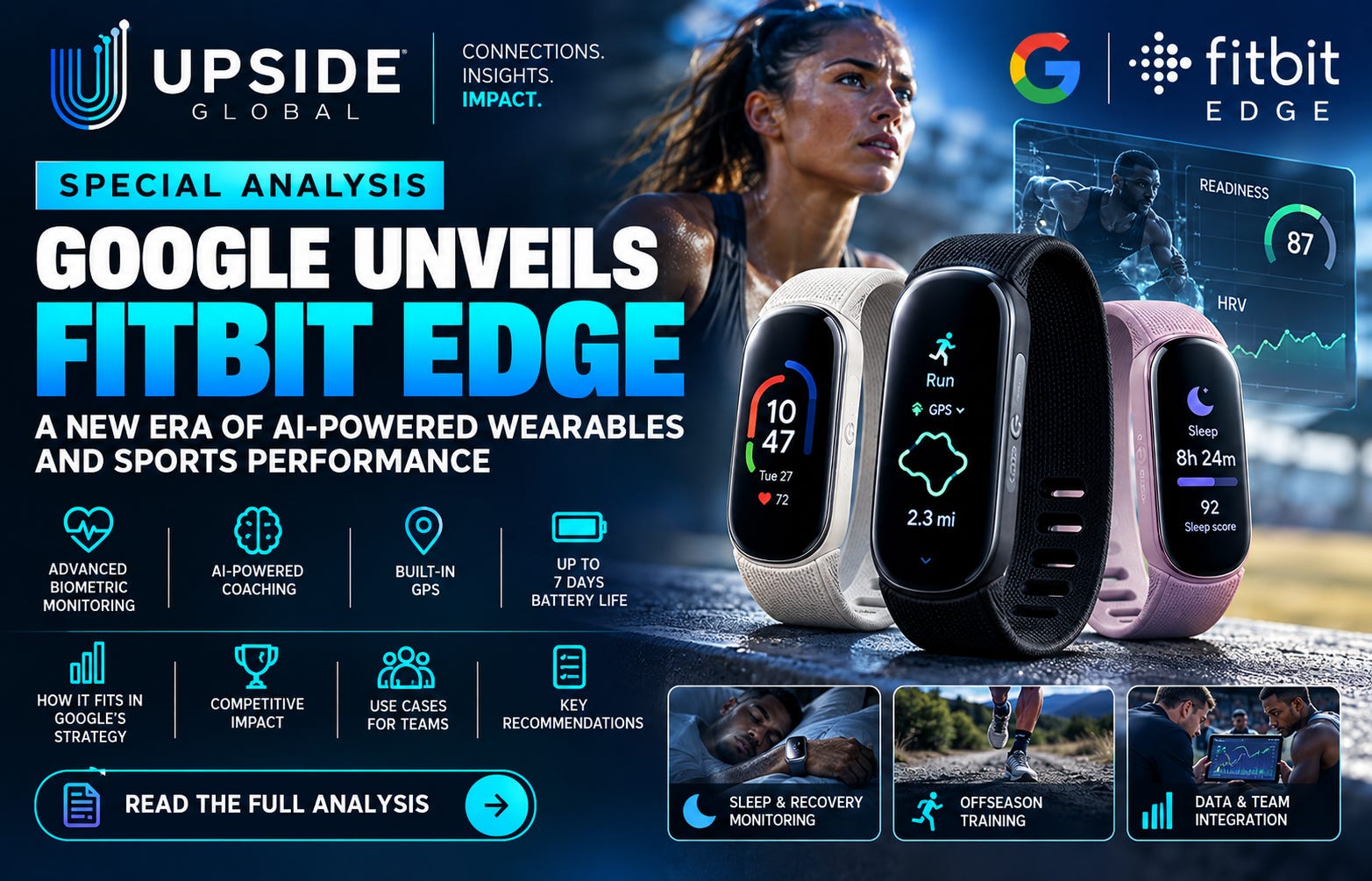
Upside Global | Sports Technology & Market Intelligence | October 13, 2026
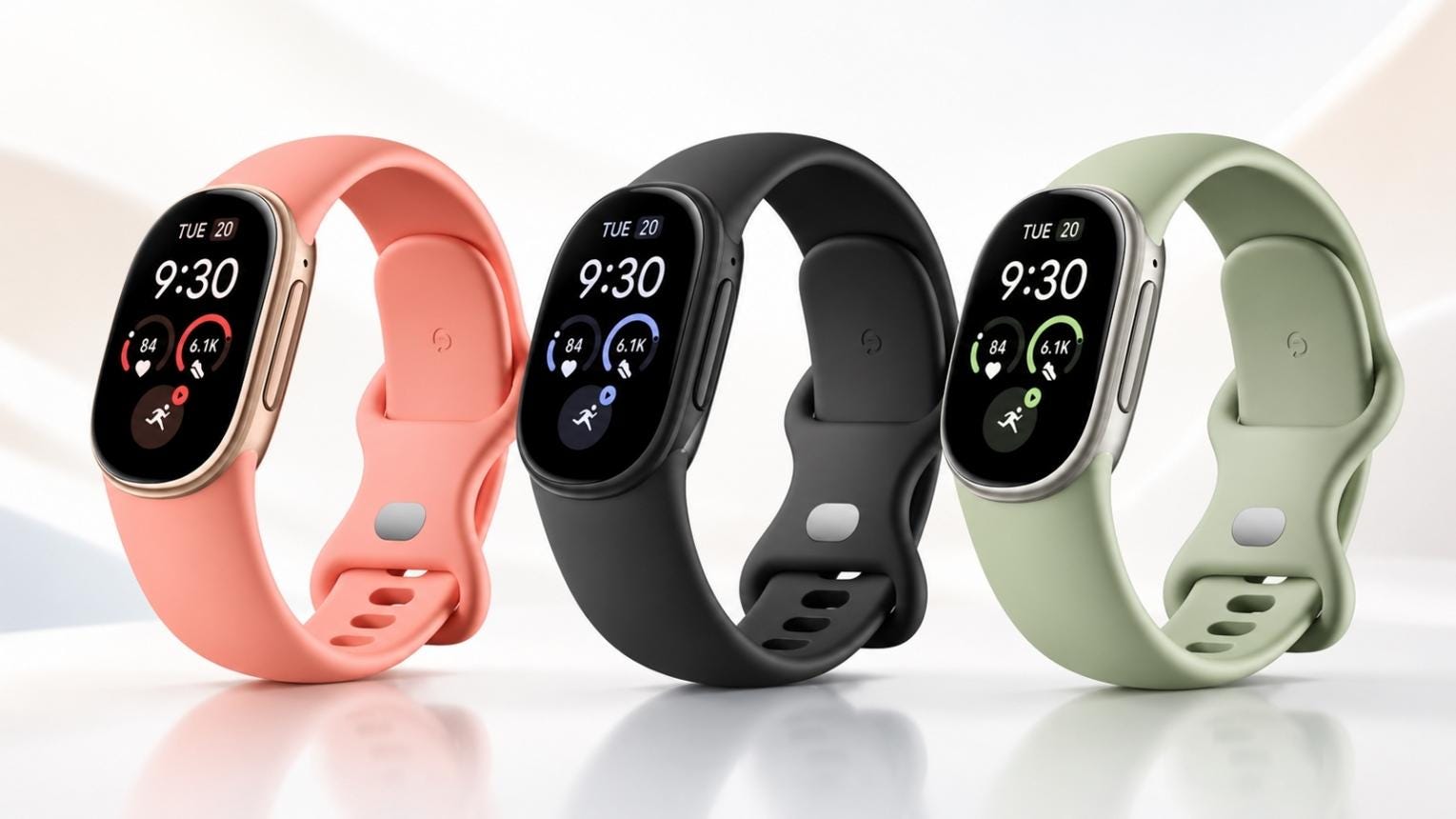
Introduction: Google makes another major move in wearables
On October 12, 2026, Google officially unveiled the Google Fitbit Edge, its latest fitness and health wearable, priced at $179.99 and scheduled to become available on October 27.
The announcement represents more than another hardware upgrade. It reinforces Google’s ambition to combine wearable sensors, artificial intelligence, personalized coaching and longitudinal health data into a connected ecosystem.
Fitbit Edge sits between the minimalist Fitbit Air and the more advanced Pixel Watch 5. It offers an attractive combination of advanced biometric monitoring, built-in GPS, AI-powered health coaching and up to seven days of battery life.
Google is also strengthening its connection with professional sports through its collaboration with four-time NBA champion Stephen Curry, who helped create a special-edition Fitbit Edge priced at $219.99.
The strategic question is no longer simply whether Google can build a competitive fitness tracker. It is whether Google can use its hardware, AI capabilities and distribution to become a major player in the increasingly competitive health and sports-performance technology market.
For professional sports teams, the implications are interesting. Although Fitbit Edge is primarily a consumer device, its combination of affordability, biometric monitoring and continuous data collection could create opportunities in athlete recovery monitoring, sleep management, wellness and offseason training.
However, its usefulness in elite sports will depend on measurement accuracy, data accessibility, athlete compliance and whether its insights can be integrated into existing performance-management systems.
Key features of the Fitbit Edge

U.S. pricing and announced specifications; battery life varies by settings and usage.
A. Advanced biometric and recovery monitoring
Fitbit Edge integrates several sensors and metrics that could be relevant to sports performance and athlete wellness.
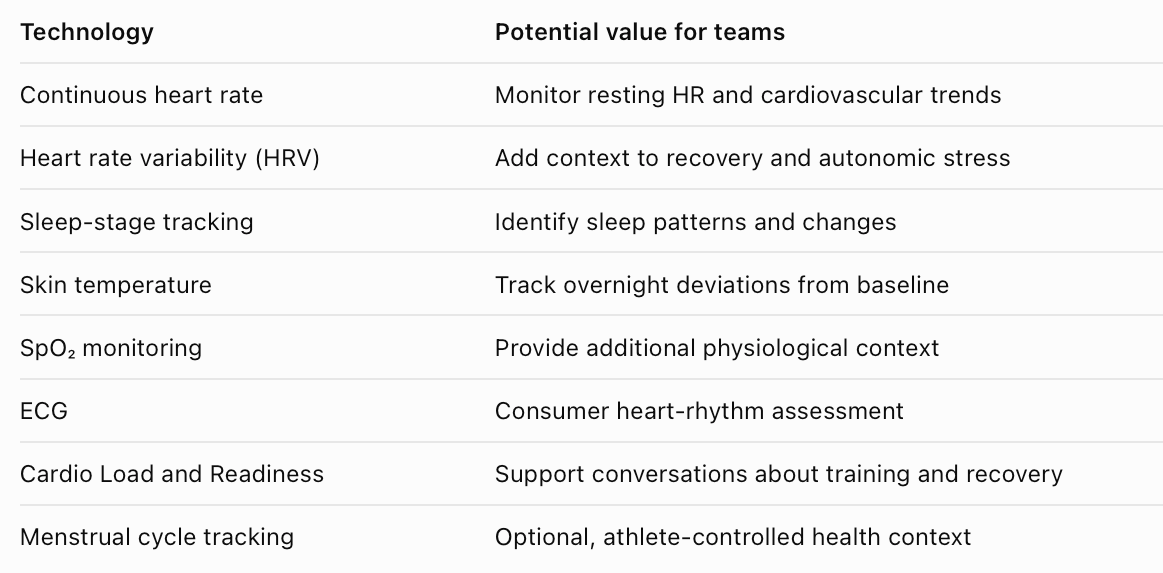
Google has also introduced Health Guardian capabilities designed to identify longer-term trends associated with blood pressure and insulin resistance. These are wellness indicators, not clinical measurements or diagnostic substitutes, and some capabilities are marked as coming soon or subject to regional availability.
Upside analysis: The greatest potential value is not an isolated HRV, sleep or temperature reading. It is the ability to establish individual baselines and identify meaningful changes over weeks or months.
For example, an athlete experiencing consistently reduced sleep duration, elevated resting heart rate and lower HRV could warrant a conversation with the performance staff. These signals are nonspecific, however, and should not independently determine training availability.
B. AI-powered coaching and automatic activity detection
Google is integrating Fitbit Edge into its broader Google Health Coach platform, powered by Gemini.
The system can provide personalized workout suggestions, adjust plans based on user goals and routines, and help interpret changes in health and fitness data.
Google says Fitbit Edge supports more than 50 exercise modes and can automatically recognize up to 100 types of workouts.
This creates an opportunity to move beyond passive data collection toward contextual recommendations.
Upside analysis: AI-powered coaching could become one of the most consequential areas of competition in wearables.
However, consumer AI recommendations should not be confused with individualized training prescriptions developed by qualified sports scientists, strength coaches or medical staff.
C. GPS, display and usability improvements
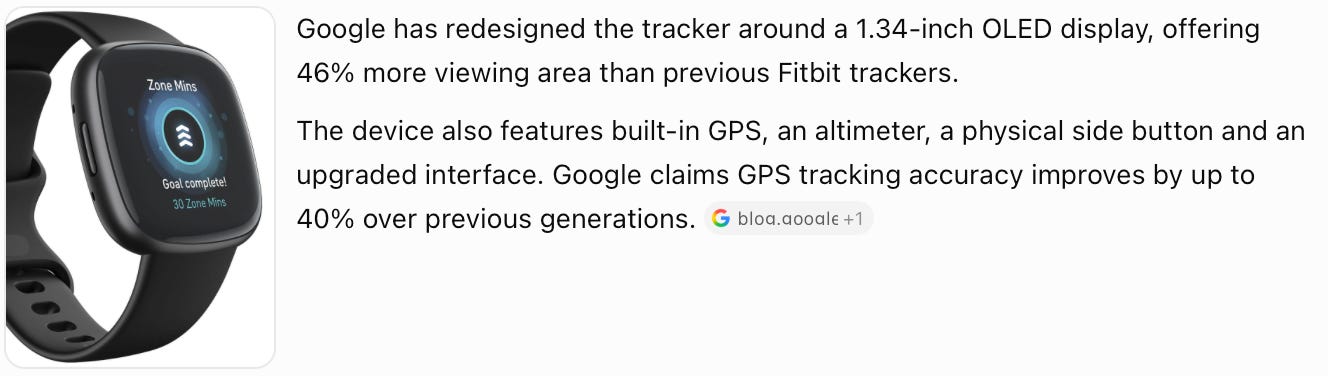
For teams, the integrated GPS could be useful for tracking individual outdoor runs and general activity. It should not be considered a replacement for dedicated team-sport GPS systems from providers such as Catapult Sports or STATSports without sport-specific validation.
D. Battery life, durability and repairability
Fitbit Edge offers up to seven days of battery life under Google’s specified conditions, although using the always-on display can reduce that to approximately two days.
The device also features a replaceable battery, a repairable architecture and water resistance rated to 5 ATM.
These features could matter for professional teams seeking to reduce charging interruptions, hardware replacement costs and gaps in continuous monitoring.
How Fitbit Edge fits into Google’s broader portfolio strategy
Google is building a more segmented wearables portfolio rather than relying on a single device to satisfy every consumer.
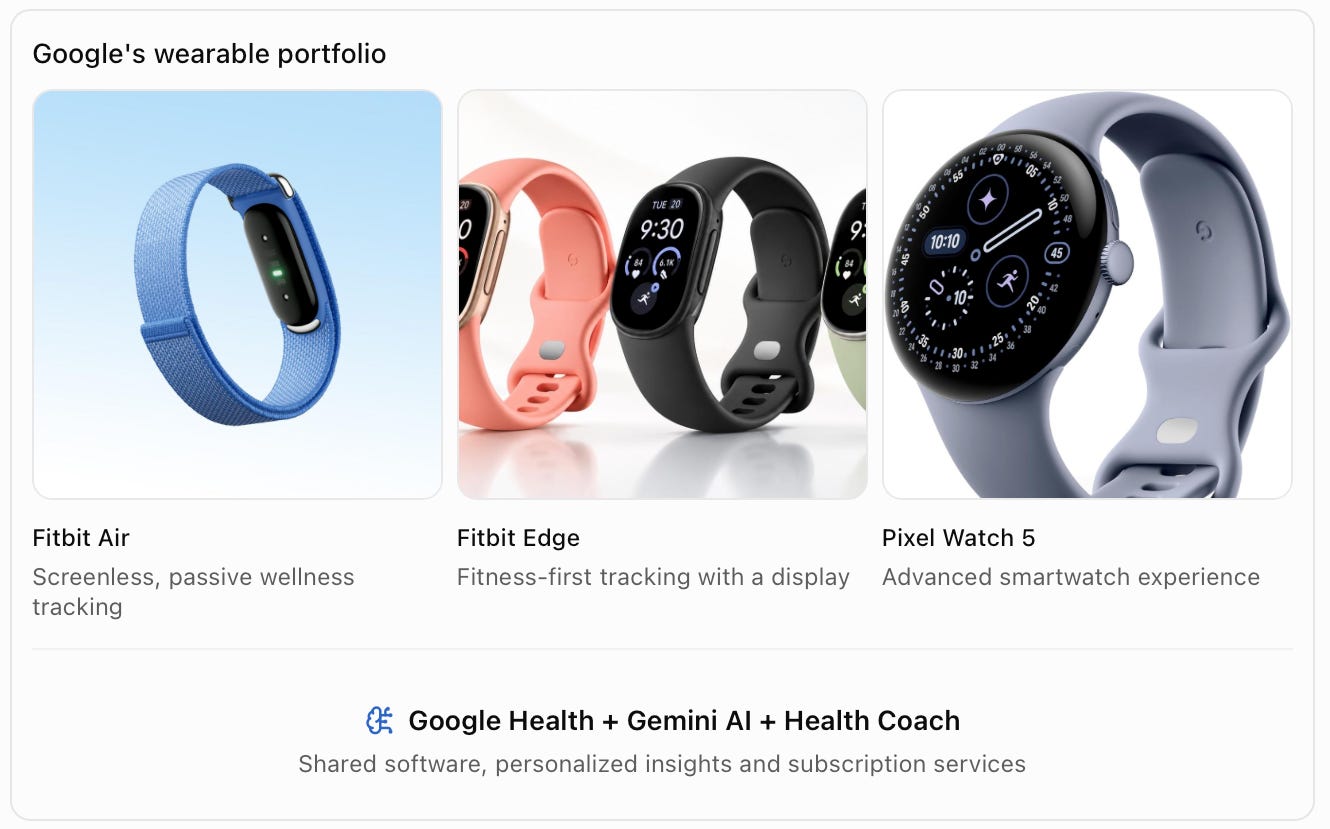
Google’s strategy appears to have four major dimensions.
First, expanding the addressable market. Fitbit Air appeals to consumers who prefer discreet, screenless monitoring. Fitbit Edge targets active users who want visible metrics without a full smartwatch. Pixel Watch serves users seeking more extensive smartwatch functionality.
Second, creating a unified health intelligence platform. Google Health Coach provides a software layer that can connect data from multiple wearable form factors and turn it into personalized recommendations.
Third, increasing recurring revenue opportunities. Google Health Premium provides subscription-based coaching capabilities, potentially expanding revenue beyond the initial hardware sale.
Fourth, using athletes to strengthen credibility. Stephen Curry’s involvement helps Google connect its consumer health proposition with athletic performance, although an athlete endorsement does not establish scientific validation for elite-sport applications.
The bigger strategic opportunity: owning the health intelligence layer
In the longer term, Google’s advantage could come less from the Fitbit Edge hardware itself and more from its ability to combine data, AI models and consumer distribution.
Google can potentially collect longitudinal wellness information, interpret patterns through Gemini-powered services and create increasingly personalized user experiences.
This could reshape competition by making software quality, data integration and actionable insights as important as hardware accuracy.
The key challenge is trust. Consumers and athletes will need clarity about data ownership, privacy, model reliability and how recommendations are generated.
How competitors are likely to react
Fitbit Edge enters an increasingly crowded market dominated by established brands including Apple, WHOOP, Oura, Garmin and Samsung.
At $179.99, Google is positioning the device at a price that could appeal to consumers who want sophisticated health monitoring without purchasing a more expensive smartwatch.
Importantly, the following competitive responses are Upside’s forecasts, not confirmed announcements.
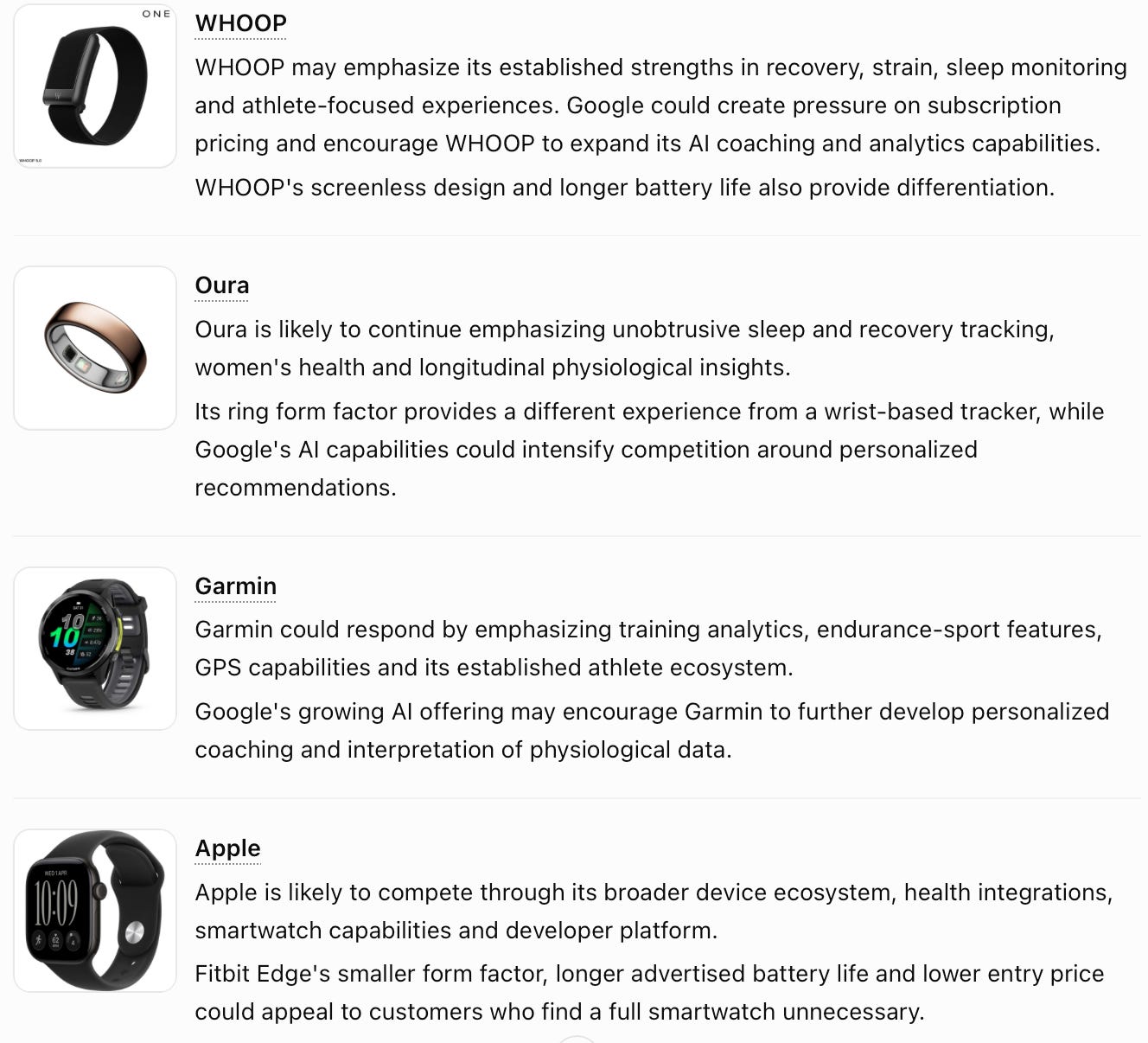
The competitive context is significant. Earlier in 2026, Google’s launch of Fitbit Air had already put pressure on the screenless wearable category, prompting industry discussion about WHOOP’s competitive response.
The next battleground: AI and subscriptions
We expect competition to intensify across four areas:
AI-driven interpretation: Turning raw physiological data into personalized and understandable insights.
Pricing: Offering more health and fitness functionality at accessible hardware and subscription prices.
Ecosystem integration: Connecting wearables with third-party platforms, training applications and health records.
Measurement quality: Demonstrating reliable accuracy across different populations, sports and conditions.
Google has the scale and technical resources to compete aggressively. However, WHOOP, Garmin and Oura retain specialized expertise and established customer relationships that Google will need to overcome.
How professional sports teams could use Fitbit Edge
Although Google has not positioned Fitbit Edge as a dedicated professional team-performance platform, there are several applications worth evaluating.
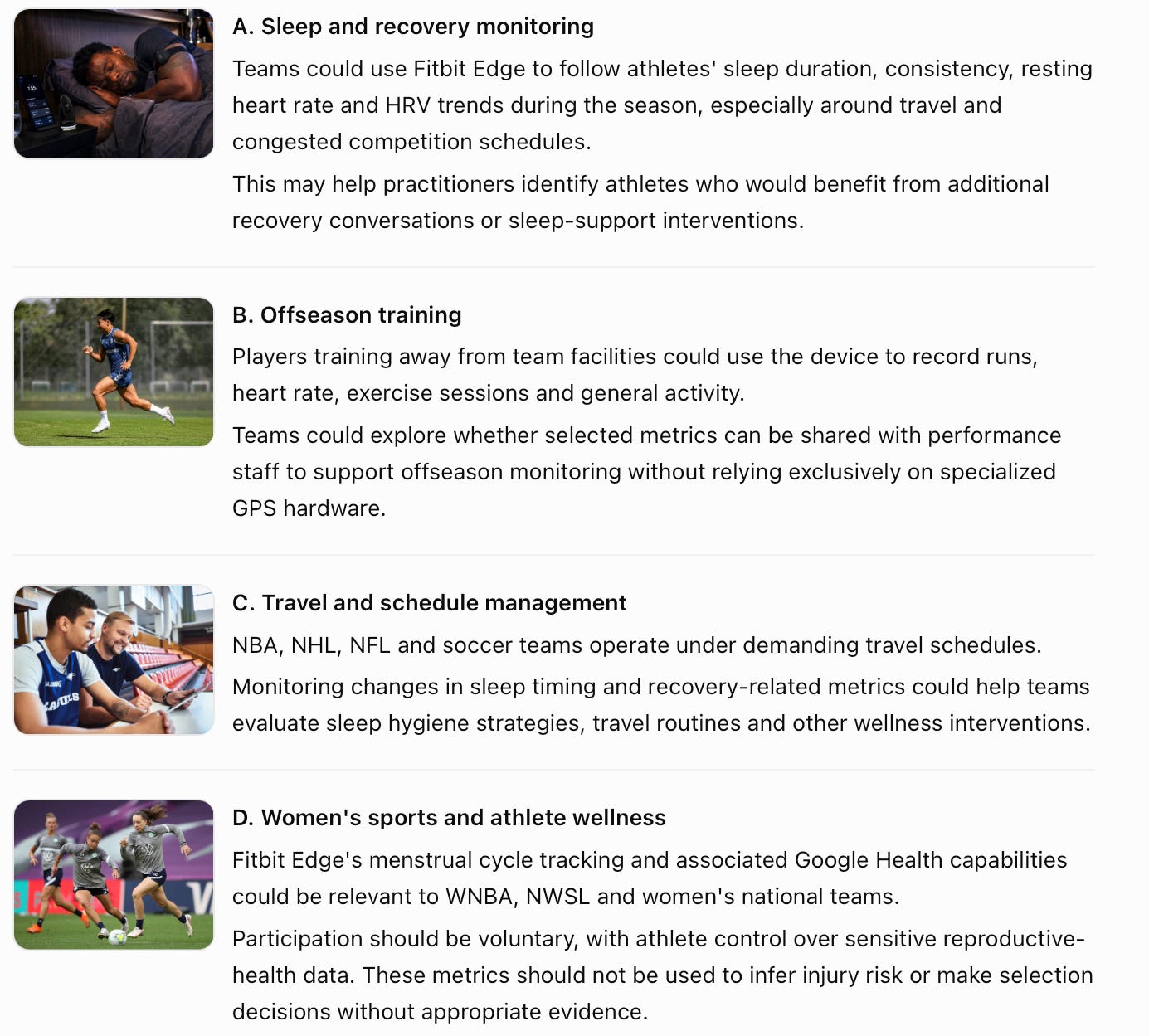
E. Athlete monitoring at scale
One potential advantage of Fitbit Edge is its relatively affordable price.
For example, the upfront hardware cost for a hypothetical deployment would be:

Calculated using the announced $179.99 U.S. retail price, excluding taxes, replacement devices, subscriptions, support and integration costs.
At this price point, teams could consider deploying devices across first-team squads, academy athletes or development programs.
However, the financial comparison should include the total cost of ownership, not just hardware.
An additional question is whether Google will develop enterprise-level dashboards, bulk device management, team-specific reporting and direct integration with athlete management systems.
Without these capabilities, Fitbit Edge may be more practical as an individual wellness device than as a fully integrated team monitoring solution.
Recommendations to professional sports teams
Rather than immediately replacing existing wearables, we recommend a structured evaluation of Fitbit Edge.
Recommendation 1: Conduct a controlled pilot
Start with 10–15 volunteer athletes over a six-to-eight-week period.
Compare Fitbit Edge against the team’s existing devices and measurement protocols.
Focus on heart rate accuracy, HRV consistency, sleep duration, GPS tracking, athlete comfort and data completeness.
Recommendation 2: Evaluate data accessibility before purchasing
This is particularly important.
Google is transitioning from the legacy Fitbit Web API to the new Google Health API, with the legacy API scheduled to shut down on October 30, 2026.
Google’s new API supports modernized data access and integration capabilities, but developer onboarding and access are subject to restrictions.
Teams should confirm whether they can securely access the metrics they need and integrate them into their existing athlete management systems.
Recommendation 3: Assess real-world athlete compliance
Even the most sophisticated wearable has limited value if athletes refuse to wear it consistently.
Teams should evaluate comfort during sleep, charging requirements, compatibility with training routines and willingness to share data.
Recommendation 4: Validate the metrics independently
Do not assume Google’s consumer accuracy claims translate directly to professional athletes.
In particular, teams should examine whether optical heart rate, HRV and sleep metrics perform reliably across different skin tones, movement intensities, environmental conditions and individual physiology.
Compare relevant outputs with established reference methods rather than relying solely on correlations between consumer devices.
Recommendation 5: Protect athlete privacy and autonomy
Biometric information can be sensitive.
Teams should establish clear policies covering informed consent, data ownership, access permissions, retention periods and whether information may be used in employment or selection decisions.
Health-related and reproductive-health data require particularly careful governance.
Recommendation 6: Evaluate AI recommendations separately from sensor accuracy
Even if Fitbit Edge measures certain metrics accurately, it does not automatically follow that its AI-generated recommendations are appropriate for elite athletes.
Teams should test whether the Google Health Coach provides useful, explainable guidance without making unsupported assumptions about readiness, injury risk or recovery needs.
Recommendation 7: Consider complementary deployment
Fitbit Edge could complement rather than replace existing solutions.
For example, a team could continue using Catapult or STATSports for on-field external-load monitoring while evaluating Fitbit Edge for overnight wellness and offseason activity.
This approach may provide more complete athlete context without abandoning existing investments.
Key questions Google still needs to answer
Despite its promising specifications, several questions remain important for professional sports adoption.
Will Google offer dedicated team dashboards, group analytics or enterprise licensing?
How accurately will Fitbit Edge measure HRV, sleep and heart rate in elite athletes compared with reference methods?
Can performance staff access sufficiently granular data through supported APIs?
Will Google provide validated sport-specific algorithms and actionable insights?
How will Google protect sensitive athlete information when AI coaching and third-party integrations are involved?
These questions will ultimately determine whether Fitbit Edge can become a credible option in the professional sports technology market.
Conclusion: The wearable market is becoming an AI ecosystem battle
Google’s introduction of Fitbit Edge is an important development in the evolution of wearable technology.
At $179.99, the device combines a broad set of physiological monitoring features, GPS, AI-powered coaching and a lightweight design at a competitive price.
More importantly, it reflects a shift in Google’s strategy: from selling individual fitness devices toward building a connected health ecosystem that combines hardware, software, data and artificial intelligence.
For competitors such as WHOOP, Oura, Garmin and Apple, the pressure will increasingly extend beyond sensor technology. Companies will need to differentiate through accuracy, user experience, AI-driven insights, interoperability and long-term value.
For professional sports organizations, Fitbit Edge deserves attention, particularly for sleep monitoring, recovery trends, offseason training and broader athlete wellness.
However, Google has not yet demonstrated that Fitbit Edge can replace the specialized systems used by elite teams.Independent validation, enterprise capabilities and data integration remain essential.
The larger industry trend is clear: the future of wearables will not be defined solely by who collects the most data, but by who can transform reliable data into useful, trustworthy and actionable insights.
Our view at Upside: Google’s greatest opportunity may not be selling Fitbit Edge to professional teams. It may be establishing Google Health and Gemini as a foundational intelligence layer across the broader sports-performance and wellness ecosystem.
That is a development every sports technology company—and every professional team’s performance department—should be watching.
Primary sources and further reading
You may also like:
