
1. Introduction
Elite sports has become one of the most data-rich environments in the world. Professional teams now collect information from GPS and LPS systems, force plates, wearables, motion capture, video, medical records, sleep platforms, nutrition systems, psychological questionnaires and performance analytics.
The challenge is no longer simply collecting data. It is turning thousands of disconnected data points into better decisions.
This is where digital twins could represent the next major evolution in sports technology.
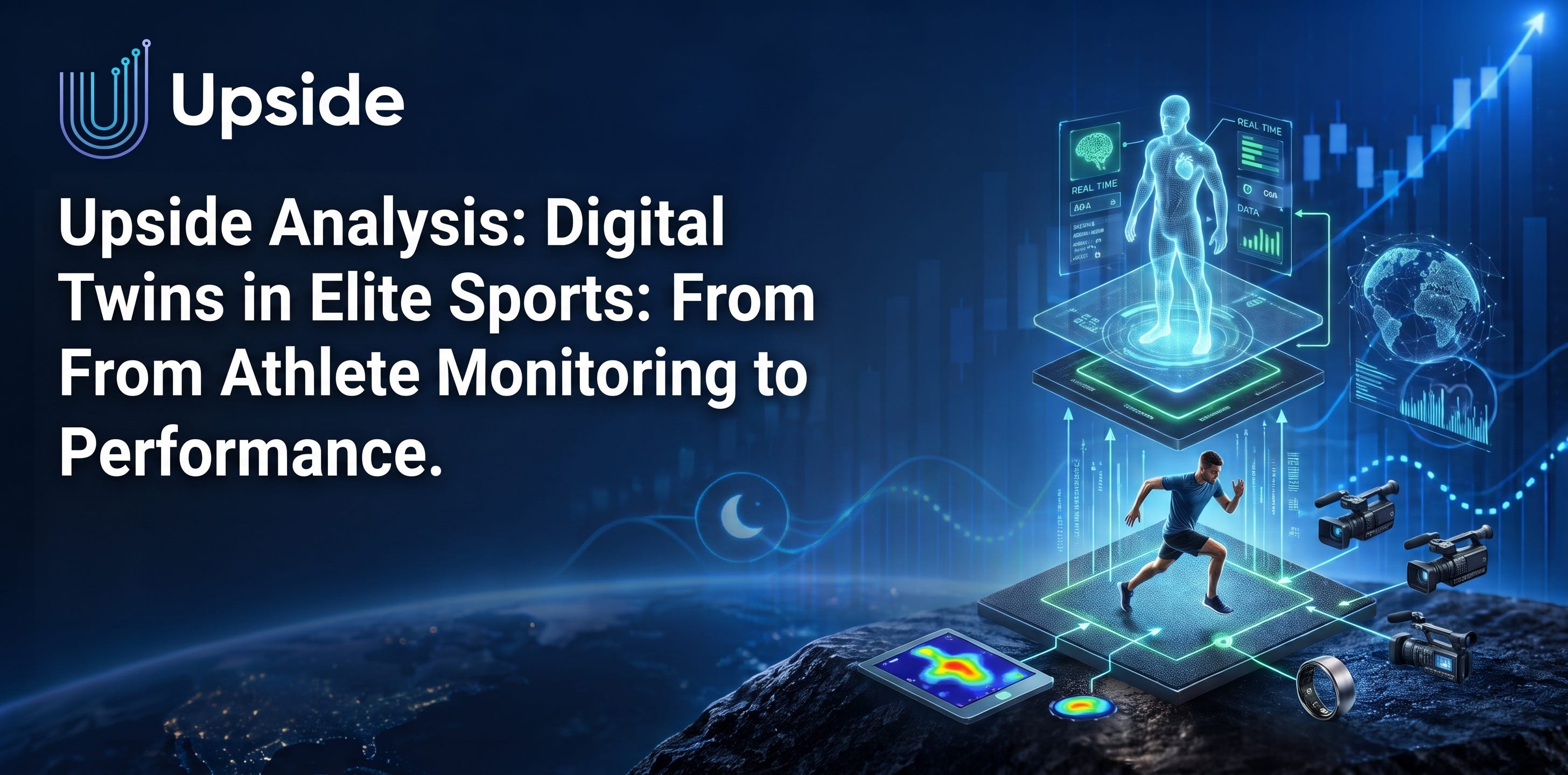
A digital twin creates a dynamic digital representation of an athlete, team, venue or sporting environment. Instead of simply reporting what happened, the objective is to understand why it happened, what is likely to happen next, and what could happen if the team changes something.
Research in sports is still emerging. A 2024 review identified digital twins as an increasingly important technology for sports training, competition management, strategy and tactics, while a 2026 systematic review found that research remains fragmented, with sports applications less consolidated than rehabilitation applications.
The opportunity is therefore significant—but teams should be careful not to label every athlete dashboard or AI model a “digital twin.”
A genuine digital twin should ideally continuously update from the real athlete, model the athlete’s state and enable prediction or simulation of future scenarios.
2. What Is a Digital Twin in Elite Sports?
A digital twin is a dynamic computational representation of a physical athlete or sporting system that is continuously informed by real-world data.
For an elite athlete, that could mean combining:
GPS/LPS
Accelerometry and IMU data
Heart rate and HRV
Sleep and recovery
Force plates
Strength testing
Motion capture
Computer vision
MRI and medical imaging
Injury history
Training load
Match exposure
Nutrition
Environmental conditions
Travel
Psychological/readiness information
Historical performance
The digital twin then uses statistical models, biomechanics, physics, machine learning and potentially generative AI to understand the athlete.
The most advanced version could answer questions such as:
“What is likely to happen if we increase this athlete’s high-speed running exposure by 15% over the next two weeks?”
Or:
“What training intervention gives this athlete the highest probability of being ready for Saturday’s game?”
Or:
“How will this athlete’s biomechanics change after four weeks of strength training?”
This represents a fundamental shift:
Traditional sports analytics: What happened?
Advanced analytics: Why did it happen?
Digital twin: What will happen if we do X?
The ability to simulate interventions before implementing them is one of the defining characteristics of the concept.
3. Major Use Cases
A. Performance Optimization
A digital twin could model the relationship between training inputs and performance outputs.
Inputs
Training volume → intensity → recovery → sleep → strength → nutrition
Outputs
Speed → power → endurance → technical performance → game performance
The system could learn how an individual athlete responds to different training stimuli rather than applying population-level assumptions.
This is particularly important because two athletes can receive the same training stimulus but respond very differently.
B. Injury-Risk Management
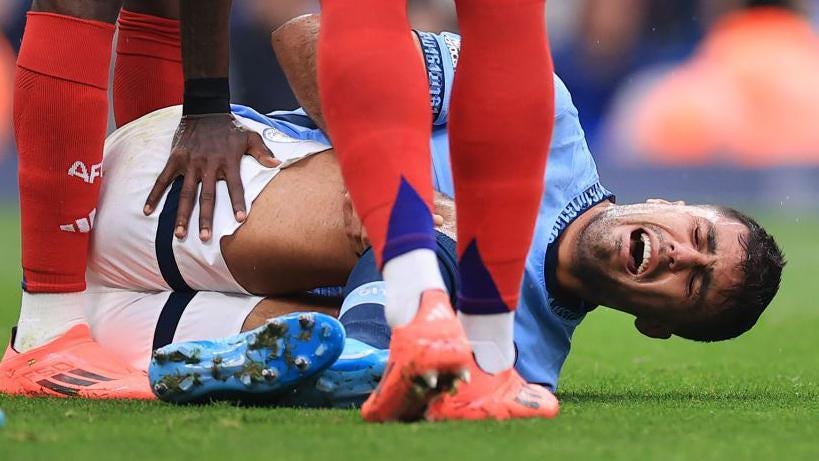
One of the most attractive applications is injury-risk management.
A digital twin could combine:
Previous injuries
Tissue characteristics
Strength asymmetries
Running load
High-speed exposure
Deceleration load
Fatigue
Sleep
Biomechanical changes
Training history
The objective should not necessarily be to say:
“This athlete will get injured.”
That would imply an unrealistic level of certainty.
Instead, the system could identify:
“The athlete’s current state is becoming increasingly different from the conditions under which they have historically tolerated this workload.”
That is a much more useful concept for practitioners.
C. Return-to-Play
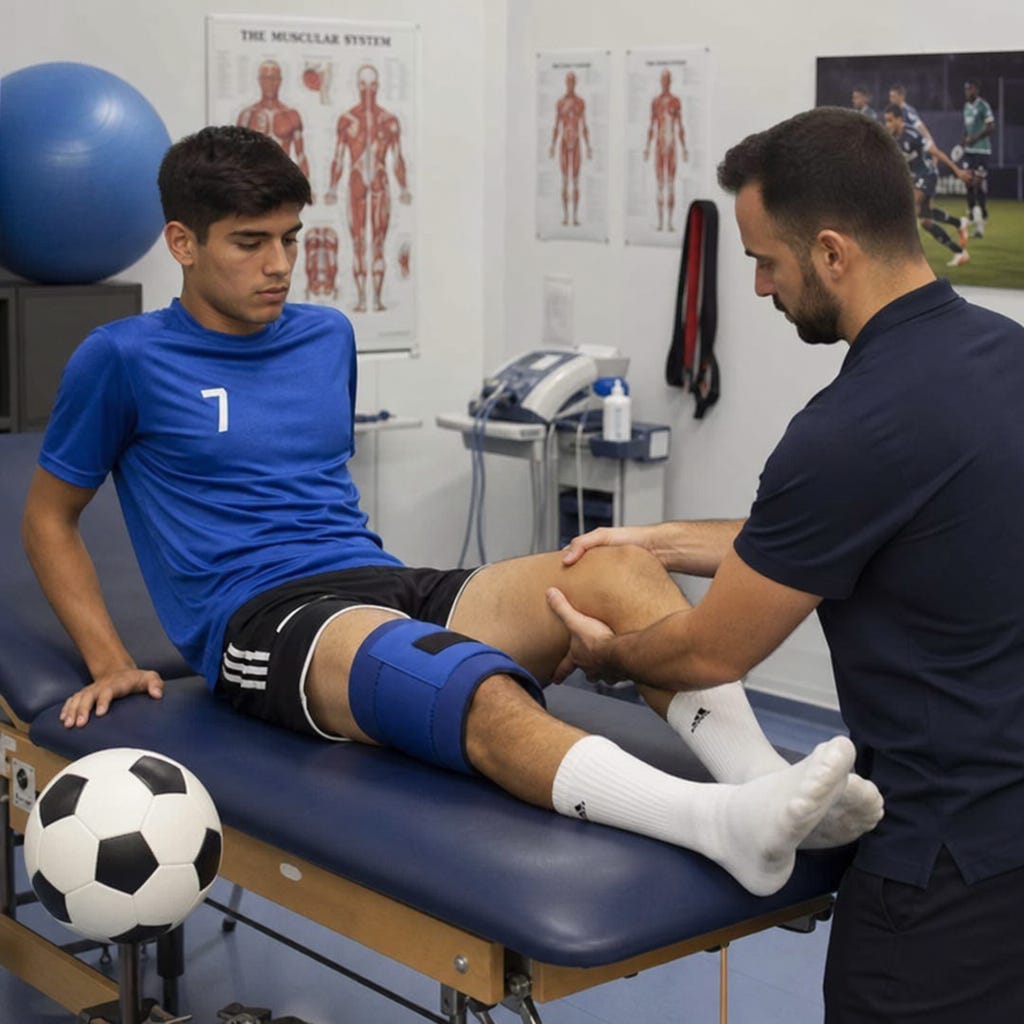
Digital twins could become particularly valuable during rehabilitation.
Imagine a soccer player recovering from an ACL injury.
The digital twin could track:
Strength → force production → asymmetry → running mechanics → acceleration → deceleration → change of direction → training exposure → match demands.
Rather than asking simply:
“Is the athlete medically cleared?”
the performance team could ask:
“How closely does the athlete’s digital profile resemble the demands of competitive play?”
The twin could then simulate increasingly demanding scenarios.
D. Individualized Training
Digital twins could allow teams to move from population-based training prescriptions to individualized prescriptions.
For example:
Athlete A may respond best to high-volume conditioning.
Athlete B may respond better to shorter high-intensity intervals.
Athlete C may need more recovery between high-intensity exposures.
Over time, the digital twin learns each athlete’s response.
E. Biomechanics
Biomechanics is another major opportunity.
A digital twin could integrate:
Motion capture
Computer vision
Force plates
Wearable sensors
Musculoskeletal models
This could create a continuously updated representation of how an athlete moves.
The goal would eventually be to move beyond isolated biomechanical assessments toward a model that understands how movement changes with fatigue, training, injury and competition demands.

F. Tactical Performance
The concept can extend beyond the body.
A team digital twin could model:
Player positioning
Tactical structures
Opponent behavior
Fatigue
Substitutions
Space creation
Pressing
Transition behavior
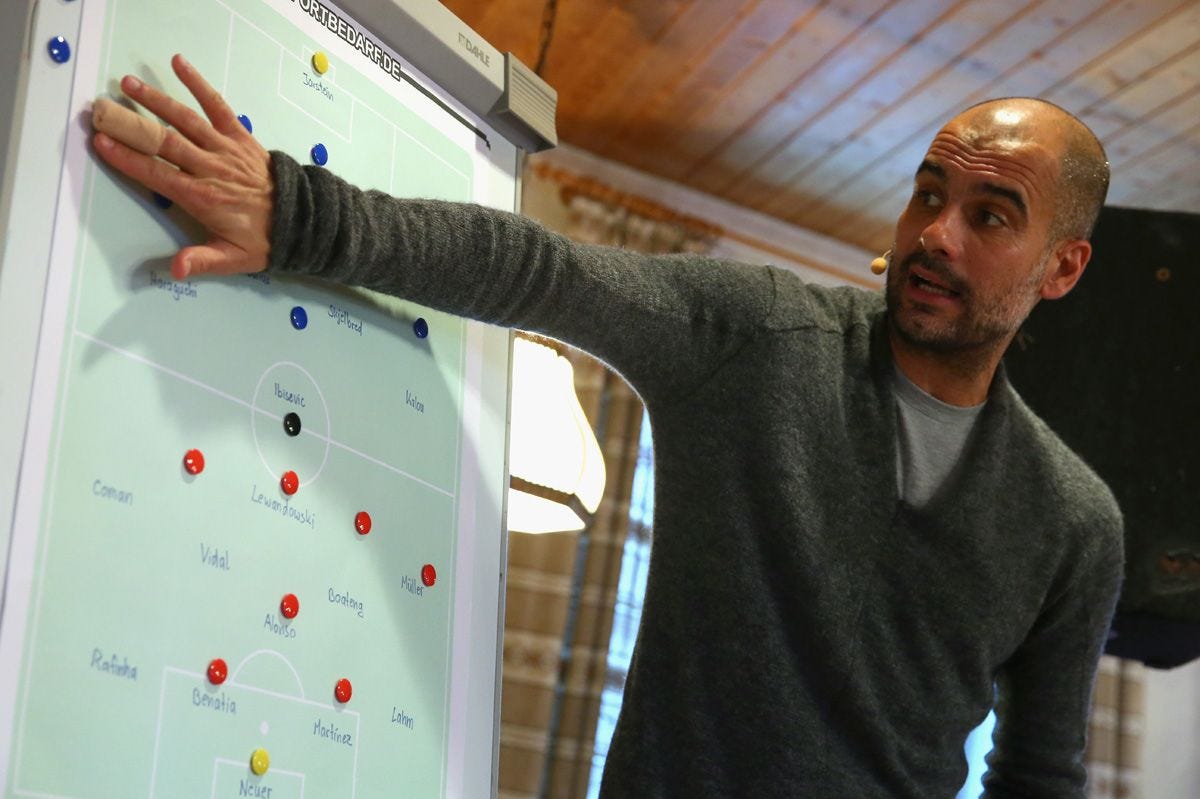
Coaches could potentially simulate:
“What happens if we press higher?”
“What happens if we substitute Player A at minute 65?”
“How does our defensive structure change when this player becomes fatigued?”
This moves the concept from an athlete twin toward a team twin.
4. Case Studies in Elite Sports
The technology is still emerging, so it is important to distinguish between commercially deployed digital twins, research projects and broader digital-twin applications in sport.
Case Study 1: TCS and Des Linden
One of the most compelling real-world examples is the TCS Future Athlete Project involving Boston Marathon champion and two-time Olympian Des Linden.
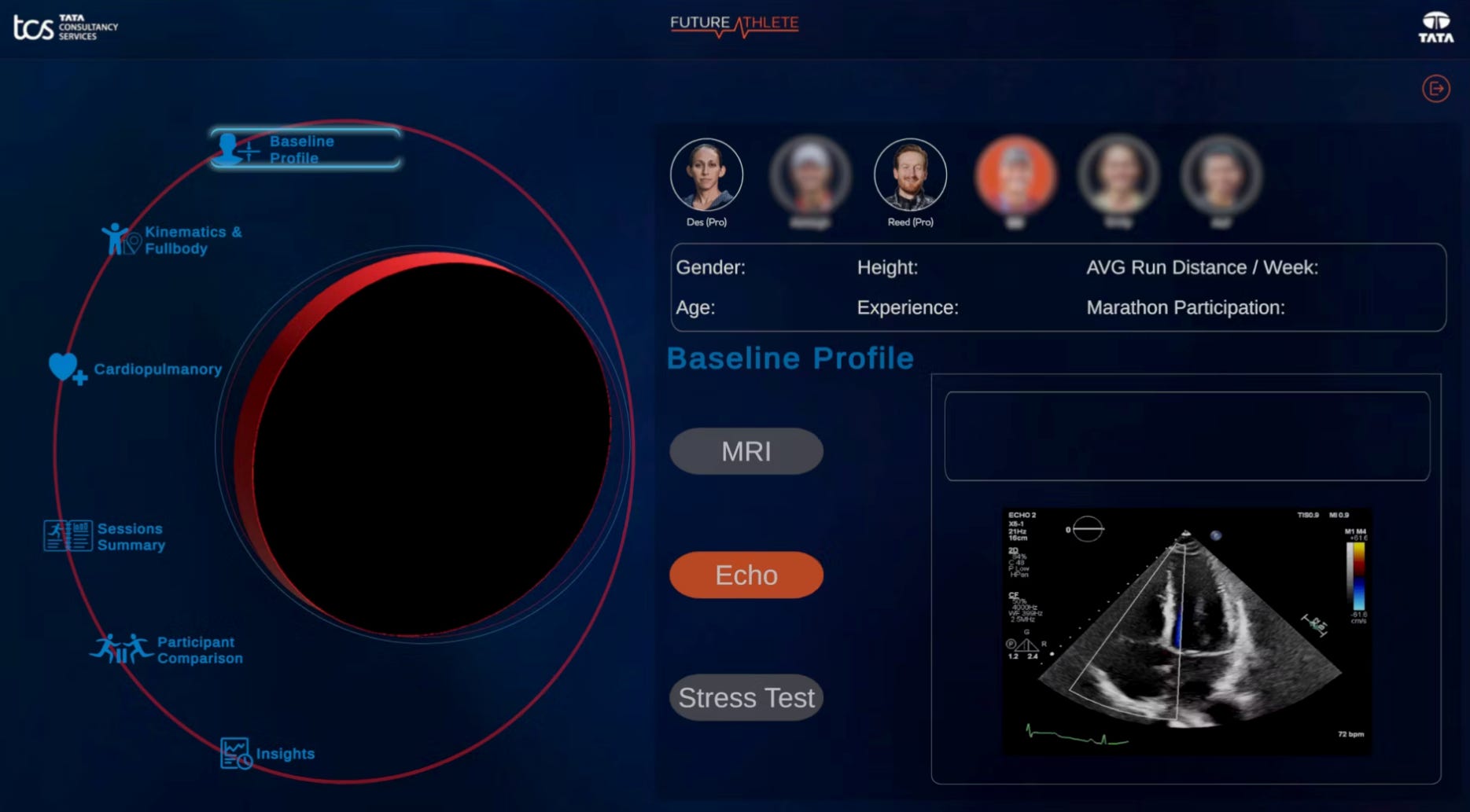
TCS created a digital twin of Linden’s heart using MRI data combined with training and other datasets. The model was designed to help understand how her heart responds to physical demands and potentially simulate different scenarios.
Why it matters: This is an important example because the digital twin isn’t simply a visualization. It attempts to represent an athlete’s underlying physiology.
Case Study 2: Digital Twins in Swimming
Researchers have developed digital representations of elite swimmers using detailed movement and acceleration data.
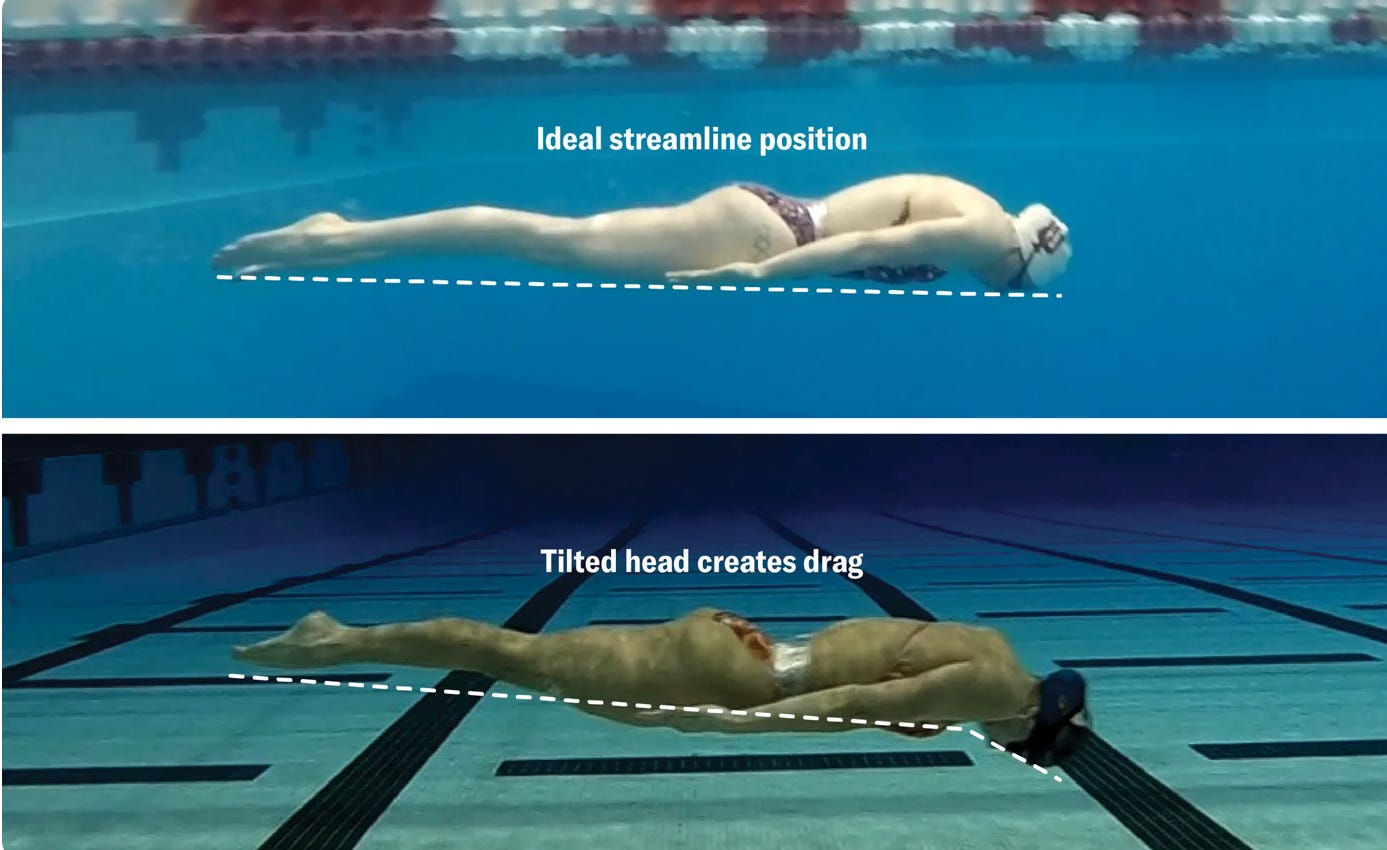
The objective is to understand technique and race performance at a much more granular level.
Swimming is particularly well suited to digital-twin development because movement is highly measurable and performance can be connected to relatively precise biomechanical parameters.
This Summer Olympics at the 2024 Paris Olympics were the first time that nine of the elite swimmers to be guided by their digital twin. Since 2015 teams of researchers at Emory University and the University of Virginia, led by one of us (Ono), have been equipping swimmers with devices called inertial measurement units to record their body’s acceleration, orientation and force. Unlike typical digital video, which records 24 frames per second, these sensors capture information 512 times a second.
While the swimmers go through a battery of tests wearing these sensors on their wrists, ankles or back, the data show the impact on their acceleration from every rotation, splash, pull and kick.
Recently they started using advanced sensors that measure force generated by an athlete’s hands. These high-tech bands measure the pressure differential between the palm and the side of the hand, revealing the direction of the force. What was previously evaluated purely by looking at the swimmer above the water can now be distilled into a series of charts and graphs that show the distribution of force in all the forward, sideways, and upward and downward directions. Force applied in any direction other than forward is wasted force.
With such digital twins, teams, practitioners, and coaches can make recommendations that immediately improve technique, offer suggestions for race strategy and point to long-term aspirational goals—all in pursuit of the optimal race plan.
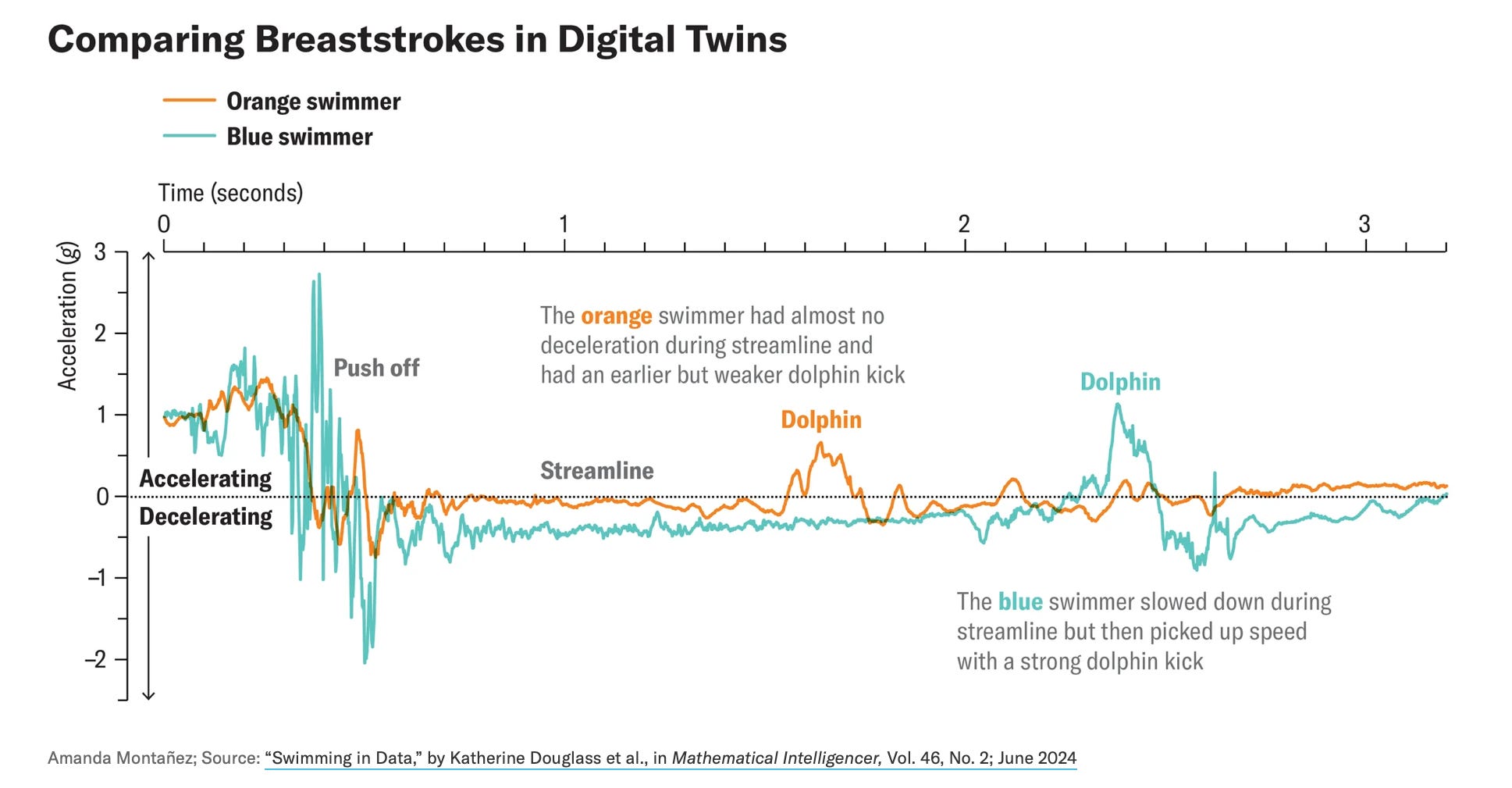
Why it matters: It demonstrates how a digital twin can move from monitoring to technique optimization and scenario analysis.
Case Study 3: Springbok Analytics
Springbok Analytics represents another important direction: the musculoskeletal digital twin.
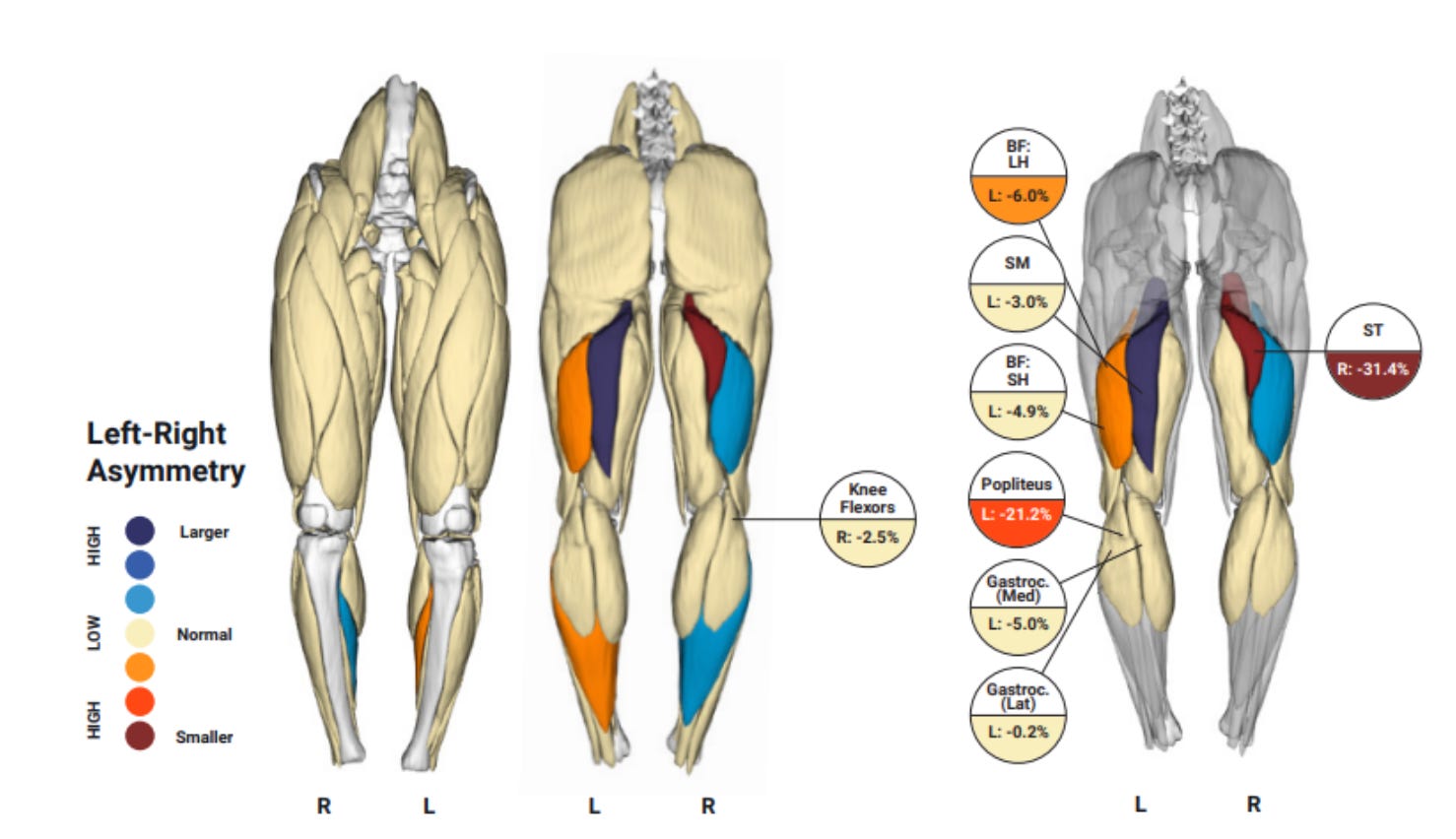
Its technology uses MRI data to create 3D representations of musculature and quantify characteristics such as muscle volume, symmetry and tissue characteristics.
Why it matters: Rather than immediately attempting to model the entire athlete, teams can build highly detailed digital twins of specific biological systems.
Case Study 4: Paris 2024
Digital twins were also used at the Paris 2024 Olympic and Paralympic Games, although in this case the focus was on venues and event operations rather than individual athletes. You can see examples here.
Digital representations of venues can support:
Operations
Security
Transportation
Workforce management
Event planning
Why it matters: It demonstrates that digital twins can extend across the entire sports ecosystem.
Case Study 5: The Open Championship
NTT DATA has used digital-twin technology at The Open Championship to create an interactive virtual representation of the golf course. See full details here.
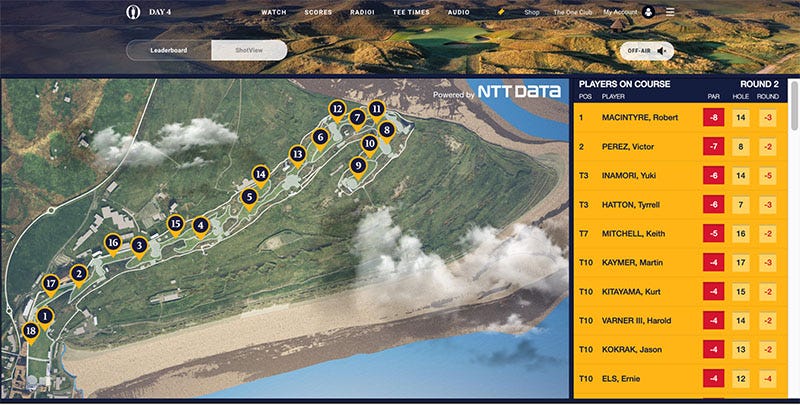
The system combines the digital environment with real-time player and ball data.
Why it matters: The future may involve multiple interconnected twins:
Athlete twin + team twin + venue twin + competition twin.
5. Research Studies on Digital Twins in Sports
The scientific literature is particularly important because there is currently a large gap between the potential of digital twins and the amount of evidence demonstrating their effectiveness in elite sport.
5.1 2024 Review: Digital Twins in Sport
Hliš, Fister and Fister Jr. published an important review of digital twins in sport in Expert Systems with Applications.
The review examined the concept, taxonomies, applications, challenges and practical potential of digital twins in sport.
The authors identified potential applications across:
Sports training
Athlete management
Competition
Strategy
Tactics
Optimization
The paper is useful because it provides one of the clearest frameworks for understanding what a sports digital twin could become.
Key takeaway: Digital twins have substantial potential in sports, but the technology and research ecosystem are still developing.
5.2 2022 Study: Digital Twin in Sport — From an Idea to Realization
Lukač, Fister Jr. and Fister published a study examining how the digital-twin concept could be implemented in sport.
The paper explores the use of athlete data, artificial intelligence and digital representations to support training and performance.
It is important historically because it represents some of the earlier academic work attempting to move the concept from industrial applications into sport.
Read the 2022 study — Digital Twin in Sport: From an Idea to Realization
5.3 2026 Systematic Review: Human Digital Twins in Sports and Rehabilitation
One of the most important recent papers is the 2026 systematic review by Barricelli, Cerutti and Morzenti.
The researchers analyzed 32 studies published between 2019 and 2024.
The findings are revealing:
20 studies focused on rehabilitation.
11 focused on sports.
Wearables, IMUs and vision systems were among the most common technologies.
AI was used in 23 of the 32 studies, or 72%.
Most evaluations involved fewer than 20 participants.
Only two studies reported meaningful user participation during system design.
The authors concluded that the field remains fragmented and needs more human-centered design, transparency and methodological rigor.
Key takeaway: There is a growing scientific foundation, but sports digital twins remain significantly less mature than the concept’s marketing might suggest.
Read the 2026 systematic review
5.4 Research on Musculoskeletal Digital Twins
Another important research direction is the development of digital twins for the musculoskeletal system.
These approaches can combine:
MRI
Biomechanics
Wearable sensors
Musculoskeletal modeling
Rehabilitation data
The goal is to understand individual movement and tissue behavior and potentially personalize rehabilitation.
This could become particularly valuable in professional sports because it moves digital twins beyond external workload toward understanding what is happening inside the athlete’s body.
5.5 Research on Injury Prediction
Researchers have also begun exploring digital-twin frameworks for injury-risk prediction.
These systems attempt to combine biomechanical measurements, workload and machine learning to identify changing injury-risk profiles.
However, teams should be cautious about interpreting early results.
A model demonstrating strong retrospective accuracy does not automatically demonstrate that it can predict injuries prospectively in an NBA, NFL, NHL or professional soccer environment.
This distinction is critical.
5.6 What the Research Says Overall
The research points toward three broad conclusions:
1. The technology is real.
Digital twins are no longer purely theoretical. Researchers and sports organizations are already building specialized versions.
2. The applications are currently narrow.
The strongest research is generally focused on:
Biomechanics
Rehabilitation
Movement
Specific physiological systems
rather than complete whole-athlete digital twins.
3. Evidence is still limited.
There remains a shortage of:
Large datasets
Multi-team studies
Prospective validation
External validation
Longitudinal studies
Randomized trials
Demonstrated improvements in actual athlete outcomes
This creates an important distinction:
A digital twin can be technologically impressive without yet being clinically or performance validated.
That distinction should be central to how elite teams evaluate vendors.
6. Digital Twin vs. Traditional Athlete Monitoring
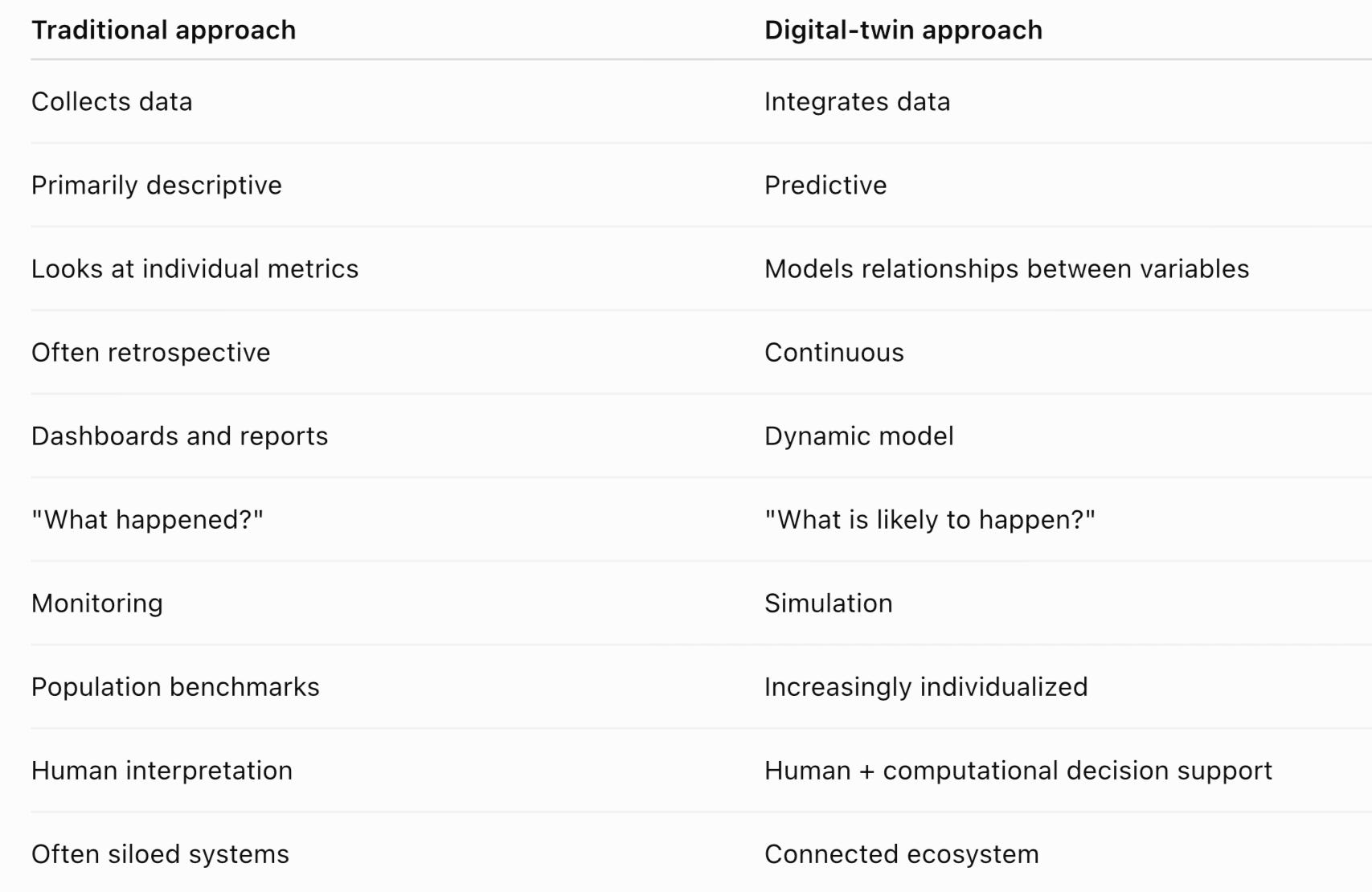
For example, a traditional GPS system might tell a coach:
“The player covered 9.8 km and completed 650 meters of high-speed running.”
A digital twin could potentially interpret this alongside sleep, strength, previous exposure, injury history, biomechanics and upcoming match demands.
The distinction is therefore not simply more data.
It is the transition from:
Measurement → Modeling → Prediction → Simulation → Decision
7. Vendors Specialized in Digital-Twin Development
There is currently no single dominant “digital twin for elite sports” vendor.
Instead, the ecosystem is developing across several layers.
TCS
TCS is one of the most visible companies specifically developing athlete digital-twin applications through its Future Athlete Project.
Strength: Digital twins, AI, cloud and enterprise integration.
Springbok Analytics
Springbok focuses on AI-powered MRI-derived musculoskeletal analysis.
Strength: Musculoskeletal anatomy, imaging and athlete-specific structural data.
Catapult
Catapult isn’t primarily a digital-twin company, but its athlete-monitoring infrastructure could provide important building blocks for one.
Strength: High-volume athlete tracking and longitudinal performance data.
Kitman Labs
Kitman Labs focuses on integrating medical, performance, coaching and athlete data.
Strength: Data integration and athlete intelligence infrastructure.
This layer could be particularly important because a digital twin is only as good as the data architecture underneath it.
NTT DATA
NTT DATA has demonstrated digital-twin technology in sports through applications such as The Open’s digital course and ShotView.
Strength: Real-time data, digital environments, simulation and enterprise technology.
OnePlan / VenueTwin
OnePlan focuses more heavily on venue and event digital twins.
Strength: Venue planning, operations and event management.
8. The Emerging Digital-Twin Stack
I would think about the market as five layers:
1. Data Capture
GPS, wearables, force plates, motion capture, imaging
↓
2. Data Integration
Athlete-management systems and enterprise data platforms
↓
3. Athlete Modeling
Biomechanics, physiological and musculoskeletal models
↓
4. Digital Twin / Simulation
AI, machine learning, physics-based models and scenario simulation
↓
5. Decision Layer
AI assistants + coaches + medical + performance staff
The companies that ultimately win may be those capable of connecting multiple layers rather than simply offering another data-collection device.
9. Future Trends
1. From Single-System Twins to Whole-Athlete Twins
Today’s strongest applications are often narrow:
Heart twin
Muscle twin
Biomechanical twin
The next evolution will be combining these into a whole-athlete model.
2. Multimodal AI
Digital twins will increasingly combine:
structured data + video + imaging + wearables + text + medical records + environmental data.
This is where multimodal AI becomes particularly important.
3. Generative AI Interfaces
Instead of forcing practitioners to navigate dozens of dashboards, a coach could ask:
“Why is this athlete less ready today?”
or:
“What are the three best interventions?”
The AI could query the digital twin and explain the answer.
4. Simulation Before Intervention
This may ultimately be the most valuable capability.
Teams could test:
Training A vs. Training B
Recovery protocol A vs. B
Rehab progression A vs. B
Nutrition strategy A vs. B
Tactical strategy A vs. B
before implementing them in the real world.
5. Team and Squad Digital Twins
The next step after the individual athlete is the team twin.
It could model interactions between:
Individual player states
Tactics
Opponent behavior
Fatigue
Substitutions
Schedule
Travel
Injuries
Eventually, teams could simulate an entire match environment.
6. Digital Twins for Recruitment
A player’s digital twin could potentially be compared with the requirements of a team’s playing style.
For example:
“How would this player’s physical profile translate to our tactical system?”
That could make digital twins relevant to scouting and roster construction, not just performance.
7. Personalized Medicine and Rehabilitation
The convergence between sports science and healthcare is likely to accelerate.
Digital twins could eventually connect:
MRI → biomechanics → rehabilitation → training → competition
rather than treating these as separate processes.
10. Biggest Challenges
There is also a significant amount of hype around digital twins.
The 2026 systematic review is particularly useful here: it found that sports applications remain less consolidated, most studies involve small samples, and user participation in design is limited.
Data Quality
Garbage in = garbage out.
Interoperability
Teams often have 10–30 technology platforms that don’t communicate well.
Validation
A model that works retrospectively doesn’t necessarily work prospectively.
Explainability
A performance director needs to understand why the model is recommending something.
Privacy
An athlete’s digital twin could become one of the most sensitive datasets in professional sport.
Athlete Ownership
Who owns the digital twin?
The athlete?
The team?
The league?
The technology provider?
False Precision
Perhaps the biggest risk is giving coaches a prediction that looks extremely precise but is actually uncertain.
11. Recommendations for Elite Sports Teams
I would not recommend that teams start by trying to build a complete digital twin of every athlete.
Instead, take a staged approach.
Step 1 — Define the Decision
Start with a performance problem:
Reduce hamstring injuries
Improve return-to-play
Optimize workload
Improve sprint performance
Improve recovery
Optimize race strategy
Don’t start with:
“We need a digital twin.”
Start with:
“What decision do we want to improve?”
Step 2 — Build the Data Foundation
Connect the most important datasets.
For example:
GPS + force plates + strength + injury + sleep + training exposure
before trying to integrate 100 different variables.
Step 3 — Build a Narrow Digital Twin
Start with one use case.
For example:
Hamstring Digital Twin
or
ACL Return-to-Play Twin
or
Pitcher Workload Twin
or
NBA Recovery Twin.
Step 4 — Validate It Prospectively
Don’t judge the model based on historical data alone.
Run it prospectively and ask:
Did the model actually improve decisions?
Step 5 — Keep Humans in the Loop
The digital twin should be a decision-support system, not an autonomous coach or medical provider.
The sports scientist, medical team and coach should retain decision authority.
Step 6 — Expand Gradually
Once one digital twin proves useful:
Athlete → Body System → Whole Athlete → Team → Competition Environment
This is much more realistic than attempting to build everything simultaneously.
12. How Teams Should Evaluate Digital-Twin Vendors
I would recommend that teams ask every vendor five questions:
1. Is this actually a digital twin?
Or is it simply an athlete dashboard with AI?
2. Can the model predict future states?
Not just describe historical data.
3. Can it simulate interventions?
Can I test:
“What if we do X?”
4. Is it individualized?
Or is it primarily based on population averages?
5. Has it been validated prospectively?
This may be the most important question.
I would add a sixth:
6. What measurable outcome has improved?
A vendor should be able to connect the technology to a real outcome:
fewer injuries
faster return-to-play
improved performance
better training efficiency
better decision-making
rather than simply:
more data.
13. What I Would Watch Closely
The most interesting development may not be one company creating the perfect digital twin.
Instead, the industry could evolve toward an interoperable digital-twin ecosystem.
For example:
Catapult
→ external workload
Force plates
→ neuromuscular status
Springbok
→ musculoskeletal structure
Medical system
→ injury history
Sleep/wearables
→ recovery
Video/computer vision
→ movement
AI platform
→ prediction
Digital twin
→ integrated athlete model
AI assistant
→ recommendation
This creates a potentially powerful new architecture for elite sports.
14. Conclusion
Digital twins could become one of the most important technological developments in elite sports over the next decade.
But the opportunity isn’t simply to create a 3D avatar of an athlete.
The real opportunity is to create a living computational model of the athlete that continuously learns from real-world data and helps the performance team understand how that athlete is likely to respond to different interventions.
The progression could look like this:
Athlete Monitoring
↓
Integrated Athlete Data
↓
Predictive Analytics
↓
Digital Twin
↓
Simulation
↓
AI Decision Support
↓
Personalized Performance Optimization
The research supports the potential of this model, but it also provides an important warning: the scientific evidence is still developing. The 2026 systematic review found only 32 relevant Human Digital Twin studies across sports and rehabilitation, with sports applications less mature, small evaluation samples common, and substantial gaps in methodological rigor and user-centered design.
For elite teams, therefore, the message should not be:
“Build a digital twin because it’s the future.”
It should be:
“Build the data infrastructure and validation capabilities today that will allow you to create reliable digital twins tomorrow.”
The teams that get this right could move from reactive athlete management to predictive and eventually simulation-driven performance management.
For Upside, this is potentially an important emerging technology category to track. Rather than treating “digital twin” as a single vendor category, Upside could map the Digital Twin Stack in Sports—data capture, biomechanics, imaging, athlete management, AI/modeling, simulation and decision-support—and identify which vendors provide each layer and which elite teams are actually deploying them.
The key question for the next five years is not whether digital twins will exist in elite sports. They already do. The question is whether they can become sufficiently accurate, integrated and validated to influence real competitive decisions.
You may also like:
🔥🥽Upside Chat: Upside Chat with Andy Etches, Founder of Rezzil, a Leading Sports Tech Company Focusing on VR, AR and Data.

This week, we have the honor to interview Andy Etches, Founder of Rezzil, a leading sports technology company focusing on VR, AR and data.
