

How pricing strategies, subscription models, paid pilots, and long-term contracts can determine the success or failure of sports technology startups.
Introduction: Why Pricing Is One of the Biggest Challenges for Sports Tech Startups
Over the past 10 years, I’ve advised numerous sports technology startups, from early-stage companies developing innovative products to more established businesses looking to expand into professional sports. One of the biggest challenges I’ve consistently observed isn’t necessarily the technology, product quality, or even customer interest. It’s pricing, and that’s a tough one.
I’ve seen startups develop impressive solutions, attract interest from NBA, NFL, NHL, MLB, MLS, NCAA, and European soccer teams, and still struggle to turn that interest into paying customers. In some cases, the technology works well, practitioners like the product, and teams recognize its potential value. Yet commercial discussions stall when pricing and contract terms come into play. The startup may be asking too much, offering the wrong subscription model, or failing to demonstrate why the investment makes financial sense for the organization.
Pricing in professional sports is particularly complicated because teams operate with different budgets, organizational structures, procurement processes, and technology priorities. A large NBA franchise may have a dedicated sports science department and substantial technology resources, while a smaller MLS club or NCAA program may operate with a much more limited budget. Even within the same league, two teams can have very different approaches to technology investments. Some organizations are willing to pay a premium for innovative solutions, while others prefer to wait until a product has been validated by several other teams.
For startups, finding the right balance is difficult. Charge too much, and you risk losing potential customers. Charge too little, and you risk undervaluing your technology, hurting margins, and creating a business that cannot scale profitably. The challenge becomes even greater when founders are trying to establish themselves in an industry where relationships, product validation, customer references, and trust play such important roles.
I believe pricing should be treated as a fundamental part of a startup’s product development and go-to-market strategy, rather than something founders figure out once the technology is ready to sell.
How Much Should Sports Tech Startups Charge?
The first question every founder needs to answer is also one of the most difficult: How much is the product actually worth to a professional sports organization? There are several ways to approach this question, and each comes with advantages and limitations.
Cost-based pricing
Under this model, startups calculate the cost of developing, delivering, and supporting their technology before adding a margin. For example, a company selling a recovery device might calculate its manufacturing, shipping, installation, maintenance, and customer support costs before determining a selling price. This approach can help ensure that each sale generates a positive contribution margin, but it does not necessarily reflect the value customers receive.
A product that costs $500 to manufacture might deliver significantly more value to a professional team. Conversely, a product that costs $10,000 to manufacture may be difficult to sell if teams do not perceive enough benefit. Founders need to understand their costs, but those costs should not be the only factor determining what customers pay.
Competitor-based pricing
Another common strategy is to examine what competing products charge and position the offering accordingly. This can be useful when entering an established category such as GPS tracking, force plates, athlete management systems, or rehabilitation technologies, where teams may already have expectations about what similar solutions should cost.
However, founders should be careful about simply copying competitors’ prices. Competing products can differ considerably in functionality, accuracy, service levels, integration capabilities, and ongoing operating costs. A startup offering better usability, more actionable insights, or superior customer support may be able to justify a higher price. On the other hand, a new entrant with limited customer references may need a different commercial strategy to encourage adoption.
Value-based pricing
I believe this is one of the most important approaches for sports tech startups to consider. Instead of focusing exclusively on development costs or competitors, value-based pricing examines the measurable benefits the technology delivers to customers.
Imagine a sports performance platform that automates daily reporting for a team’s performance and medical departments. If five practitioners each save three hours per week, the platform could eliminate approximately 750 hours of administrative work annually, assuming 50 working weeks. If the organization values that time at $75 per hour, the theoretical annual productivity value would be approximately $56,250.

Hypothetical example: five practitioners saving three hours weekly over 50 weeks. This represents time-value, not necessarily realized cash savings.
That does not mean the startup should automatically charge $56,250 per year. The team may not realize those savings as actual cash reductions, and it may be unwilling to pay the full estimated value. However, the calculation provides a starting point for a commercial discussion and helps founders explain why their product deserves a place in the team’s technology budget.
The same approach can apply to technologies that improve operational efficiency, accelerate reporting, reduce equipment requirements, or help teams make better-informed decisions. Startups developing injury-risk or recovery technologies should be particularly careful when making financial claims. They should not promise that their products will prevent injuries or save teams millions of dollars unless those outcomes are supported by credible evidence.
Recommendations for startups:
Understand the customer’s problem and quantify its operational or financial impact.
Calculate the full cost of delivering the product, including support, onboarding, infrastructure, and maintenance.
Benchmark competitors without automatically copying their prices.
Test different price points with real customers before establishing a permanent pricing structure.
Monthly vs. Annual Subscriptions: Which Model Works Best?
Subscription pricing has become increasingly common across sports technology, particularly for SaaS platforms offering athlete monitoring, performance analytics, rehabilitation management, video analysis, and AI-powered applications. However, choosing between monthly and annual subscriptions is not always straightforward because professional sports organizations have different purchasing processes and financial constraints.
Monthly subscriptions: Lower commitment, greater flexibility
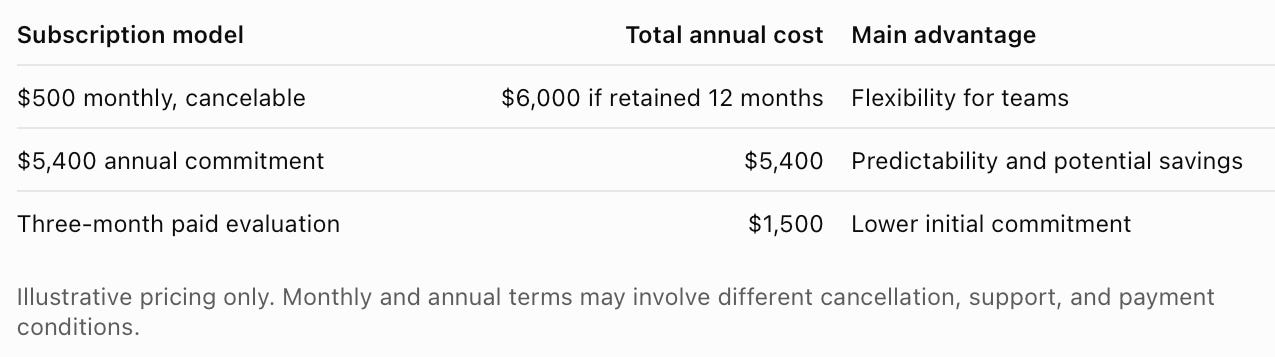
Monthly subscriptions can make it easier for teams to test a new product without committing to a large upfront investment. For example, a startup might offer a platform for $500 per month rather than requiring a $6,000 annual payment. For an organization evaluating several technologies simultaneously, the smaller initial commitment may make the purchasing decision easier, particularly if the product is relatively simple to implement.
The downside is that monthly subscriptions can create revenue uncertainty for startups. Customers may cancel before the company has recovered its onboarding and support costs, while the startup still needs to pay its employees, maintain its infrastructure, and provide customer support. Monthly pricing can also be challenging for products requiring extensive implementation, hardware installation, practitioner training, or integration with existing systems.
Annual subscriptions: More predictable revenue
Annual contracts provide startups with greater revenue visibility and can improve cash flow, particularly when customers pay upfront. They can also encourage teams to evaluate a technology over a meaningful period rather than making a purchasing decision after only a few weeks.
However, annual commitments may create resistance among organizations that have not previously used the product. A startup might therefore offer the same platform for $500 per month or $5,400 annually, providing a 10% discount for the annual commitment. The appropriate discount will depend on the startup’s margins, cash requirements, and customer acquisition costs.
Should subscriptions follow the sporting calendar?
This is another consideration that I believe deserves more attention. Professional sports organizations operate around specific preseason, regular-season, playoff, and off-season cycles, and these schedules often influence when teams evaluate and purchase new technologies.
A team may begin using a performance technology during preseason and evaluate its effectiveness at the end of the season. For that reason, some startups may benefit from aligning contracts with the team’s sporting calendar rather than insisting on a conventional January-to-December subscription. For NCAA programs, this can become even more important because football, basketball, baseball, soccer, and other sports operate on different calendars.
Recommendations for startups:
Offer monthly subscriptions when implementation is simple and customer onboarding costs are low.
Consider annual contracts for technologies requiring significant setup, training, or integration.
Align contract start dates and renewal discussions with teams’ budgeting and competitive calendars.
Use annual discounts selectively rather than sacrificing margins simply to secure longer commitments.
Should Sports Tech Startups Require Long-Term Contracts?
This is one of the most sensitive topics I’ve encountered when speaking with professional teams and sports technology vendors. Some startups push for two- or three-year agreements because they want to secure predictable recurring revenue, reduce churn, and demonstrate commercial traction to investors. From the startup’s perspective, this makes sense, especially when the company is trying to build a more predictable revenue base.
A three-year contract worth $20,000 annually represents $60,000 in total contracted revenue, assuming the agreement is enforceable and not subject to termination provisions that reduce that commitment. For an early-stage company, signing several such contracts can provide financial visibility and potentially strengthen its position when raising capital.
But there is another side to the discussion, and this is where I believe startups need to be careful.
The problem with locking teams into long-term agreements
Professional teams may discover after several months that a technology is not delivering the expected benefits. Perhaps practitioners are not using the platform regularly, the technology does not integrate well with existing systems, or the team has changed its performance philosophy, coaching staff, or internal priorities. If the organization is locked into a three-year contract, it may be required to continue paying for a product that no longer meets its needs.
I’ve spoken with practitioners who are frustrated by these situations. From the vendor’s perspective, the customer signed a contract and should honor its commitments. From the team’s perspective, however, continuing to pay for technology that is not delivering value creates unnecessary costs and can damage the relationship with the vendor.
This is particularly relevant in professional sports, where coaching and performance staff can change frequently. A technology purchased under one Head of Performance may not be considered a priority by the person replacing them. Similarly, a club may adopt a new athlete management system or change its data infrastructure, making some existing technologies redundant.
A more balanced approach
I believe startups should consider more flexible contract structures, particularly when entering the professional sports market. A three-month paid pilot could allow teams to evaluate the product before committing, while a one-year agreement may provide enough time for implementation and a meaningful assessment. More established companies could offer two- or three-year agreements with annual reviews, clearly defined milestones, and appropriate renewal or termination provisions.

Long-term contracts are not necessarily bad. They can be appropriate when vendors must invest significant resources in hardware, installation, integrations, or dedicated personnel. The issue is whether the contract structure reflects the value delivered and the risks assumed by both parties.
Recommendations for startups:
Avoid pushing lengthy agreements before customers have validated the product.
Offer clear implementation milestones and regular performance reviews.
Consider renewal options and clearly defined termination provisions.
Prioritize customer satisfaction and retention over maximizing the initial contract length.
Should Professional Teams Pay for Technology Pilots?
This is probably one of the most common pricing questions I hear from sports technology founders. A startup develops an innovative solution and approaches a professional team. The team expresses interest but asks to test the product before making a purchasing decision, and the founder agrees to provide a free pilot in the hope that it will lead to a commercial contract.
Three months later, the pilot ends. The practitioners enjoyed testing the technology, but the team has not allocated a budget to purchase it. The startup has spent time, money, and resources without generating any revenue, and there is no guarantee that the organization will ever become a paying customer.
I’ve seen this happen repeatedly, and I believe founders need to think carefully about how they structure pilots.
The problem with free pilots
Free pilots can be useful for early product validation, particularly when a startup needs customer feedback, independent evidence of product performance, or a credible reference from a professional team. However, they also create several risks that founders sometimes underestimate.
Teams may not prioritize a product they receive for free, especially when practitioners are already busy and have several technologies to manage. The startup also absorbs the costs of equipment, shipping, installation, training, and customer support, which can become significant if multiple teams are testing the product simultaneously.
More importantly, a free pilot does not necessarily demonstrate willingness to pay. A team may enjoy using a product when it costs nothing but decide against purchasing it once a commercial proposal is presented.
Why paid pilots can be more effective
A paid pilot creates a stronger commercial relationship because both parties have made a commitment. The startup commits to delivering the product and supporting its implementation, while the team commits financial resources and personnel to evaluate it. Although payment does not guarantee conversion, it can help establish clearer expectations and encourage both parties to take the evaluation seriously.
For example, a startup might charge $1,000, $3,000, or $5,000 for a pilot, depending on the technology, duration, implementation requirements, and level of support. These are illustrative price points rather than established industry averages. A simple software platform might justify a relatively inexpensive pilot, while a biomechanics system requiring specialized hardware, installation, and training may need a much higher fee.
Should pilot fees be credited toward annual contracts?
I think this can be an attractive strategy. Imagine a startup offering a three-month pilot for $3,000, followed by an annual subscription priced at $15,000. If the team decides to purchase the annual subscription, the startup could credit the $3,000 pilot fee toward the first-year contract.

This approach provides several benefits. The startup receives some revenue during the evaluation period, the team has an incentive to move forward, and the pilot becomes a structured part of the sales process. However, founders should calculate whether the pilot fee adequately covers their costs and whether crediting it toward the annual contract is financially sustainable.
Define success before the pilot begins
One of the biggest mistakes startups make is launching a pilot without agreeing on what success looks like. Before starting, the vendor and the team should establish the specific problem the technology is expected to solve, the KPIs used to evaluate it, the practitioners responsible for testing it, and the timeline for making a purchasing decision.
It is also important to identify who controls the budget. A practitioner may be enthusiastic about testing a product but lack the authority to approve a purchase. If the startup does not involve the budget owner early enough, even a technically successful pilot may never become a commercial agreement.
Recommendations for startups:
Favor paid pilots when the company is delivering meaningful value and incurring material costs.
Define evaluation criteria, responsibilities, timelines, and purchasing milestones before the pilot begins.
Identify the budget owner and confirm that funding could be available if the pilot succeeds.
Consider crediting pilot fees toward an annual contract when the economics support it.
Should Every Professional Sports Team Pay the Same Price?
Another challenge for sports technology startups is deciding whether to charge every customer the same amount. Should an NBA franchise pay the same price as an NCAA program? Should an NFL team pay more than an MLS club? Should a Premier League organization receive different pricing from a smaller European soccer team?
There is no simple answer because the size of an organization does not always reflect its technology budget, purchasing priorities, or willingness to pay. Some startups assume that professional teams have significantly larger budgets than collegiate programs, but that is not always the case. Certain NCAA athletic departments have substantial financial resources, while some professional clubs operate under tighter constraints.
League-based pricing
Some startups establish different prices depending on the league or level of competition. While this approach can be commercially attractive, pricing exclusively according to the league may be too simplistic and can create frustration when customers discover that another organization is paying substantially less for an identical product.
The problem becomes particularly sensitive because professional sports is a relatively small industry. Heads of Performance, Athletic Trainers, Sports Scientists, and other practitioners regularly communicate with colleagues at competing teams. If two organizations discover that they are paying significantly different prices for the same technology, the higher-paying customer may question the vendor’s pricing practices.
Usage-based pricing
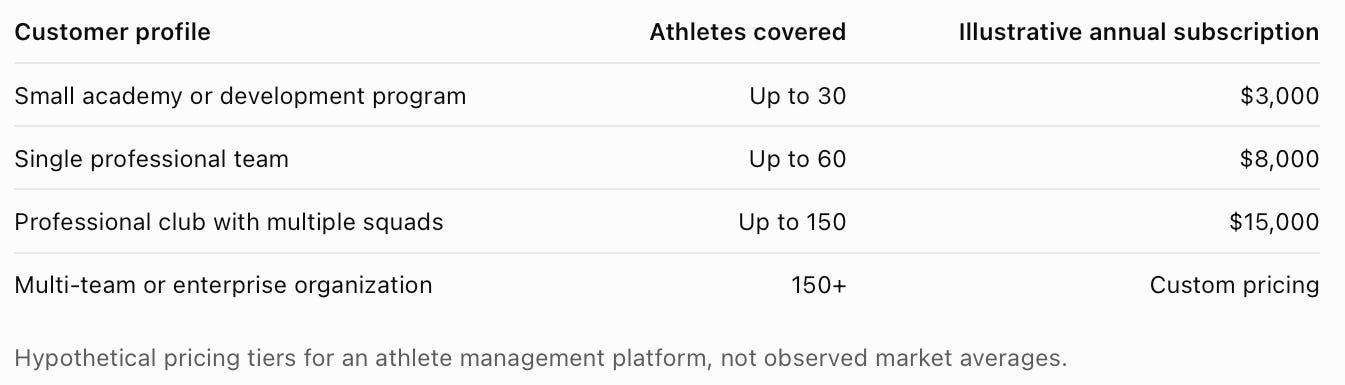
An alternative is to charge according to the number of athletes, users, teams, or facilities. An athlete management platform, for example, could offer a lower-priced subscription for a small academy, a standard package for a single professional team, and an enterprise agreement for organizations managing multiple squads.
This model can be easier to justify because customers understand why a larger deployment costs more. However, the pricing metric must reflect how the product delivers value. Charging per athlete may work well for an AMS platform but may not make sense for a biomechanics system used by only a few practitioners.
Feature-based pricing
Startups can also offer different subscription tiers based on functionality. A basic package might include data collection and standard reporting, while more expensive tiers could offer advanced analytics, AI-generated insights, API access, custom integrations, and dedicated customer support.
This approach allows smaller organizations to purchase essential functionality while giving larger customers the option to pay for additional capabilities. It can also create opportunities to expand existing customer accounts as teams adopt more features or increase the number of athletes and practitioners using the platform.
Ultimately, I believe startups should establish pricing principles that are consistent and explainable. Different prices may be justified by contract length, number of users, service levels, integrations, or hardware requirements, but founders should avoid arbitrary differences based solely on a team’s perceived wealth.
Recommendations for startups:
Establish transparent pricing principles, even when individual contracts are negotiated.
Use objective factors such as athlete count, functionality, service levels, and deployment requirements.
Avoid arbitrary pricing differences based solely on a team’s league or perceived financial resources.
Document discounts and commercial exceptions to maintain consistency across customers.
Hardware vs. SaaS vs. AI: Why One Pricing Model Doesn’t Fit Every Startup
One mistake founders can make is assuming that a pricing strategy that works for one sports technology company will work equally well for another. In reality, different technology categories have very different cost structures, customer requirements, and revenue opportunities.
Hardware companies
Companies selling force plates, recovery devices, wearables, biomechanics equipment, or other physical technologies must account for manufacturing, inventory, shipping, warranties, maintenance, and replacement costs. Some may benefit from selling equipment outright, while others may offer leasing, rental, or hardware-as-a-service models.
For example, a company selling a $20,000 device might offer a monthly lease instead of requiring a full upfront payment. This could make the technology more accessible to teams with limited capital budgets, but it also introduces financing, maintenance, and asset-management considerations that the startup must evaluate carefully.
SaaS platforms
Athlete management systems, performance dashboards, rehabilitation platforms, and video analysis applications often fit recurring subscription models. The challenge is determining whether pricing should be based on users, athletes, teams, facilities, or functionality.
SaaS companies also need to account for customer onboarding, integration costs, cloud infrastructure, and ongoing support. A platform that appears highly scalable may still require substantial human resources to implement and maintain, particularly when serving professional teams with complex data environments.
AI-powered platforms
AI introduces additional pricing considerations because usage costs can vary significantly. An AI assistant used by a professional team’s performance department may generate different costs depending on the number of users, queries, documents processed, and external systems accessed.
A flat monthly subscription may be attractive to customers, but it can become unprofitable if usage grows faster than expected. For this reason, some AI startups may benefit from combining a base subscription with usage allowances or additional charges for advanced functionality. The challenge is creating a pricing model that protects margins without becoming too complicated for customers to understand.
Consulting and service-heavy technologies
Some sports technology companies provide extensive consulting, implementation, data analysis, or practitioner support alongside their products. These services create real costs and should not automatically be included in a low-cost software subscription.
Startups may need to charge separate implementation fees, professional service retainers, or premium support packages. Otherwise, they risk building a business where every new customer requires significant additional work without generating enough revenue to cover it.
Recommendations for startups:
Select a pricing model that reflects the technology’s cost structure and customer requirements.
Consider leasing or subscription options for hardware when financially viable.
Monitor cloud and AI usage costs carefully when offering recurring subscriptions.
Charge appropriately for implementation, integrations, and professional services.
The Hidden Costs That Startups Often Overlook
When founders calculate their pricing, they often focus on product development and delivery costs while overlooking several expenses that can significantly affect profitability. This is particularly relevant in professional sports, where customer acquisition can involve long sales cycles, extensive relationship building, and multiple stakeholders.
Customer acquisition costs
Selling technology to professional sports teams can be expensive and time-consuming. Startups may need to attend conferences, organize demonstrations, travel to team facilities, conduct pilots, and spend months building relationships before securing a contract.
A startup that spends $8,000 acquiring a customer with an annual contract worth $5,000 may struggle to build a sustainable business unless that customer remains subscribed for several years or expands its purchase. This is why founders need to understand not only how much revenue a customer generates, but also how much it costs to acquire and retain that customer.
Customer support and onboarding
Professional sports organizations often require personalized training and ongoing technical support. A product may be profitable on paper but generate limited margins once the startup accounts for implementation, troubleshooting, integrations, and customer success activities.
This can be particularly challenging when a startup serves customers across several countries and time zones. Supporting an NBA team in the United States, a Premier League club in England, and a rugby organization in New Zealand may require additional resources that founders did not initially anticipate.
Technology infrastructure
Cloud hosting, AI inference, data storage, cybersecurity, API services, and software maintenance can all affect profitability. These costs are particularly important for startups processing large volumes of video, biomechanics, wearable, or medical data, where infrastructure expenses may increase as customer usage grows.
Discounts and commissions
Founders may offer substantial discounts to win prestigious customers, particularly when trying to secure their first NBA, NFL, or Premier League reference. While a strategic discount can be justified, repeated discounting can undermine the company’s long-term pricing strategy.
Startups must also account for referral fees, reseller commissions, and business development partnerships when calculating margins. A contract that appears attractive based on its headline value may become significantly less profitable after all associated costs are included.
Recommendations for startups:
Calculate customer acquisition costs and expected customer lifetime value.
Understand gross margins after onboarding, support, hosting, and hardware costs.
Establish clear discount approval policies.
Track profitability by customer segment rather than focusing exclusively on total revenue.
How Pricing Impacts Fundraising and Startup Valuations
Pricing strategy is not just a sales issue. It can directly affect a startup’s ability to attract investment, particularly as the company moves beyond its initial customers and begins raising larger financing rounds.
VCs evaluating sports technology companies want to understand whether the business can generate sustainable revenue, retain customers, and scale efficiently. A startup may have impressive technology and relationships with major professional teams, but investors will eventually want evidence that those relationships translate into profitable commercial opportunities.
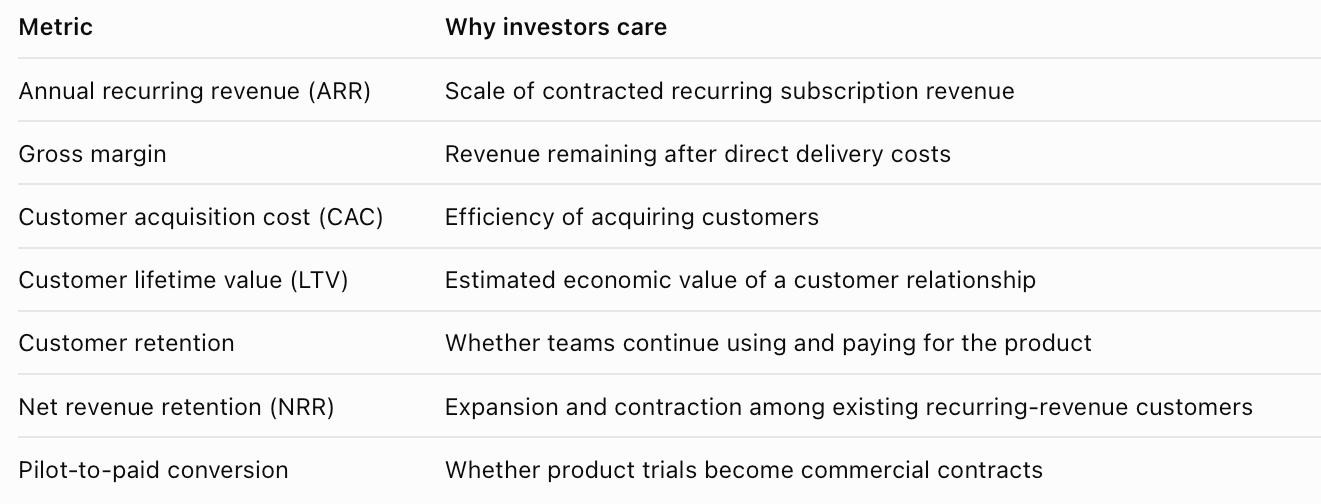
Several metrics are particularly important, including annual recurring revenue, gross margins, customer acquisition costs, customer lifetime value, retention rates, and pilot-to-paid conversion rates. Investors should also examine whether existing customers are expanding their subscriptions or reducing their spending over time.
The importance of revenue quality
A startup generating $500,000 annually from recurring subscriptions may have a very different financial profile from a company generating the same amount through one-time hardware sales or consulting projects. Neither business model is inherently superior, but they require different valuation assumptions and financial analysis.
Recurring software revenue may provide greater visibility into future cash flows, while hardware businesses need to demonstrate healthy product margins, reliable supply chains, and opportunities for repeat purchases. AI startups must also show that their pricing can support potentially variable infrastructure and inference costs.
The danger of underpricing to demonstrate traction
I’ve seen founders become so focused on acquiring prestigious team logos that they offer products at prices that may not be sustainable. Signing an NBA or NFL team can certainly provide credibility and help attract additional customers, but a contract that generates little revenue, requires extensive support, and offers limited expansion potential may not be as valuable as it initially appears.
VCs should examine not only how many teams use a product, but also how much those teams pay, whether they renew, and whether the company can serve them profitably. A startup with 20 paying customers, strong retention, and healthy margins may be more attractive than a company claiming relationships with 100 teams but generating limited recurring revenue.
Recommendations for VCs:
Evaluate how founders determined their prices and whether customers have demonstrated willingness to pay.
Distinguish recurring subscriptions from one-time sales, pilots, consulting revenue, and unpaid deployments.
Analyze customer acquisition costs, retention, gross margins, and expansion opportunities.
Challenge aggressive discounting and assess whether prestigious customer logos translate into meaningful commercial value.
A Practical Pricing Framework for Sports Tech Startups
Based on the challenges I’ve observed working with startups and professional sports organizations, I believe founders should approach pricing as a structured process rather than making decisions based on intuition or individual customer negotiations.
The starting point should always be understanding the customer. Who will use the product? Who controls the budget? What problem is the technology solving, and how does that problem affect the organization’s daily operations? A Head of Sports Performance may recognize the value of a product, but the final purchasing decision could involve a Medical Director, General Manager, CFO, or procurement department.
Once the customer and problem are clearly defined, founders should quantify the value delivered and calculate the true cost of providing the solution. That includes not only product development and infrastructure but also customer acquisition, implementation, training, and ongoing support. Startups should then test different pricing structures with actual customers rather than relying exclusively on surveys or informal expressions of interest.
Six steps to build a sustainable pricing strategy
Understand the customer and budget owner. Identify the practitioners who use the product, the executives who approve purchases, and the budget from which the technology will be funded.
Quantify the value delivered. Determine whether the product saves time, reduces operational costs, improves workflows, or supports better-informed decisions.
Calculate the true cost of delivery. Include hardware, hosting, support, onboarding, integrations, customer acquisition, and maintenance.
Test pricing with paying customers. Use structured pricing discussions, paid pilots, and initial contracts to assess actual willingness to pay.
Choose the right commercial model. Determine whether monthly subscriptions, annual contracts, hardware sales, leasing, usage-based pricing, or a hybrid model best fits the product.
Monitor retention and adjust. Track adoption, renewals, margins, customer feedback, and pricing objections as the company grows.
Example: Comparing three subscription pricing strategies
Consider a hypothetical sports-tech startup selling an athlete monitoring platform to professional teams. Assume the company has 20 paying customers, each subscribed for a full year, with no churn or discounts.
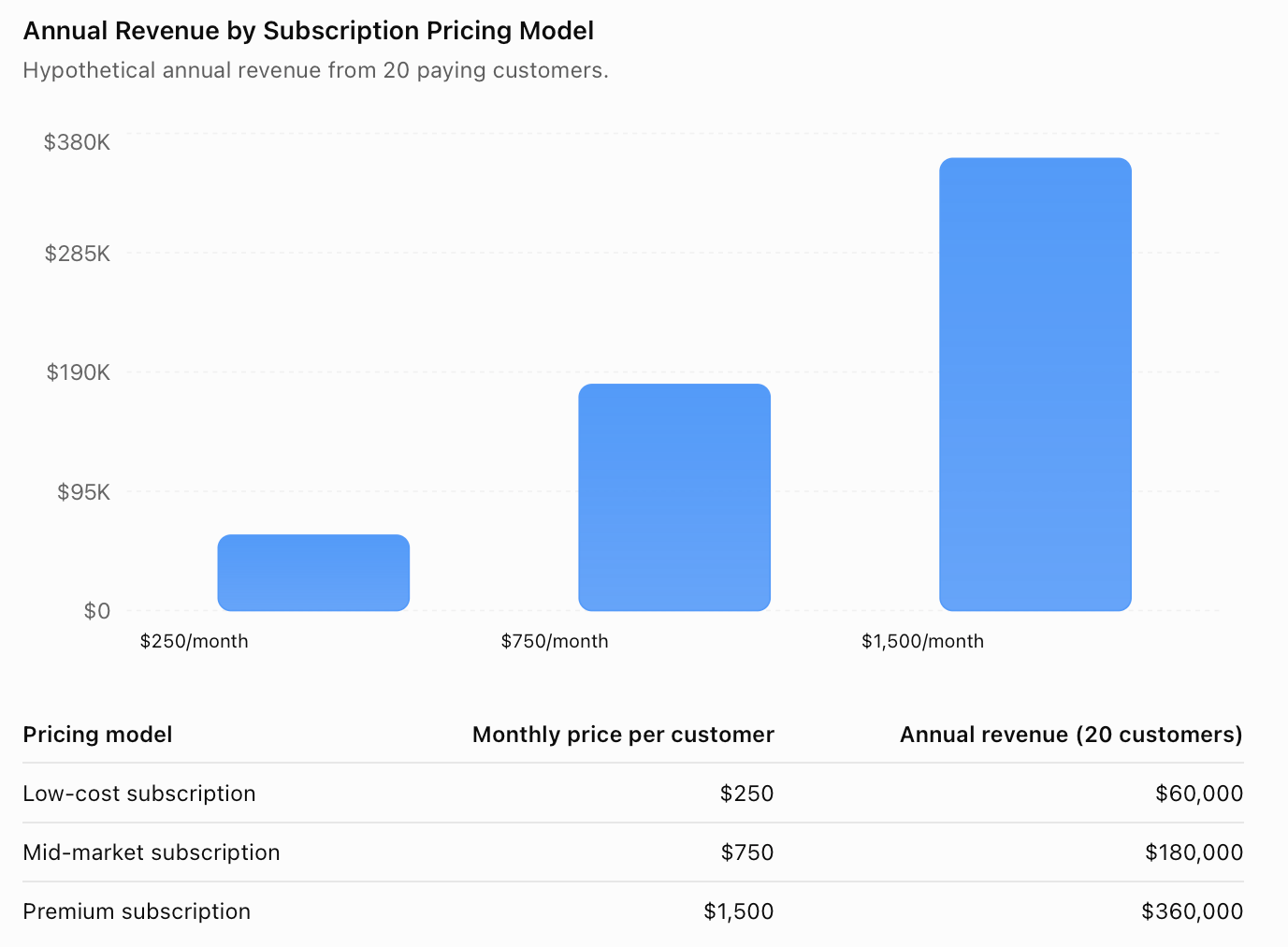
The difference is substantial, but the highest price does not automatically produce the best commercial outcome. At $1,500 per month, the startup may struggle to acquire 20 customers, while at $250 per month, it may attract more teams but fail to cover operating costs.
Founders should also consider whether higher prices affect sales cycles, customer acquisition costs, retention, and support expectations. A premium subscription may generate more revenue per customer but require greater product sophistication, stronger evidence of value, and more personalized support.
The objective is to identify a price that supports sustainable profitability while delivering sufficient value to encourage adoption and retention.
Recommendations for startups:
Identify the users, budget owners, and purchasing decision-makers before setting prices.
Quantify the value delivered and calculate the full cost of serving customers.
Test pricing through structured discussions, paid pilots, and initial commercial contracts.
Monitor customer adoption, renewal rates, margins, and pricing objections, adjusting the model as the business grows.
Recommendations for Sports Tech Founders, Professional Teams, and VCs
Pricing decisions affect not only startups but also the professional teams purchasing their products and the investors financing their growth. Each group has different priorities, but all three benefit from more transparent commercial models, realistic expectations, and a stronger focus on long-term value.
For sports tech startups
Validate pricing early: Do not wait until the product is fully developed to understand what customers are willing to pay.
Avoid excessive free pilots: Use paid pilots where appropriate and define clear evaluation criteria and commercial next steps.
Be careful with long-term contracts: Balance predictable revenue with the need to build trust and demonstrate ongoing value.
Protect your margins: Include the full costs of customer acquisition, implementation, support, and technology infrastructure.
Build consistent pricing principles: Offer flexibility without creating arbitrary differences between customers.
For professional teams
Evaluate total cost of ownership: Consider implementation, training, integrations, maintenance, and renewal costs, not just the initial purchase price.
Define success before purchasing: Agree on measurable objectives and establish how the technology will be evaluated.
Avoid unnecessary long-term commitments: Negotiate contract terms that reflect implementation requirements and expected value.
Review technology investments annually: Identify underused products, overlapping capabilities, and opportunities to improve integration.
Communicate openly with vendors: Provide constructive feedback and work collaboratively to address problems before deciding to discontinue a product.
For venture capital firms
Examine pricing during due diligence: Understand how founders determined their prices and whether customers have demonstrated willingness to pay.
Evaluate revenue quality: Distinguish recurring subscriptions from one-time sales, pilots, consulting revenue, and unpaid deployments.
Analyze customer economics: Review margins, acquisition costs, retention, expansion potential, and support requirements.
Challenge aggressive discounting: Determine whether prestigious customer logos are generating meaningful commercial value.
Support pricing experimentation: Encourage portfolio companies to test pricing models and improve commercial discipline as they scale.
Conclusion: A Great Product Is Not Enough if the Pricing Is Wrong
Over the past decade, I’ve seen the sports technology industry evolve considerably. Teams now have access to more sophisticated wearables, AI platforms, athlete management systems, biomechanics technologies, recovery devices, and performance analytics tools than ever before. Yet one thing has remained consistent: developing an innovative product does not guarantee commercial success.
A startup can build excellent technology, attract interest from major professional sports teams, and still fail to establish a sustainable business if its pricing strategy is wrong. I’ve seen founders underestimate the cost of supporting professional teams, offer free pilots that never convert into paying customers, lock customers into contracts that create frustration, or discount their products so aggressively that they undermine their own margins.
At the same time, I’ve seen teams hesitate to adopt promising technologies because the pricing was too high, the contract terms were too restrictive, or the vendor could not clearly demonstrate the value of the investment. These situations illustrate why pricing is not simply about maximizing revenue. It’s also about building relationships, establishing trust, and creating a commercial model that works for both the startup and the customer.
There is no universal solution. A startup selling hardware will face different challenges from a company offering a SaaS platform or an AI-powered performance assistant. A large NBA organization may have different purchasing requirements from an NCAA program or a smaller European soccer club. However, I believe every sports tech founder should spend as much time validating the commercial model as developing the technology itself.
For investors, pricing discipline should be an important part of evaluating a startup’s long-term potential. And for professional teams, purchasing decisions should be based not only on product capabilities but also on the value delivered throughout the commercial relationship. The objective should be to build sustainable partnerships where both parties benefit and where the technology continues to justify its cost over time.
Customer interest is encouraging, and a successful pilot is promising. But the real test of a sports technology business is whether customers are willing to pay for the product, continue using it, and renew their contracts.
Ultimately, the goal should not be to sell a product at the highest possible price or to sign as many teams as possible. It should be to build a sustainable business that delivers enough value for customers to keep coming back. And that starts with getting the pricing right.
Best,

You may also like:
🍽️ Upside Product Review: I Tested LONU, an AI Digital Coach Built by Former NBA Head Strength Coach Dr. Bill Burgos, and Lost Nearly 10 Pounds in One Month

Introduction: Can an AI Agent Really Change Your Eating Habits?