
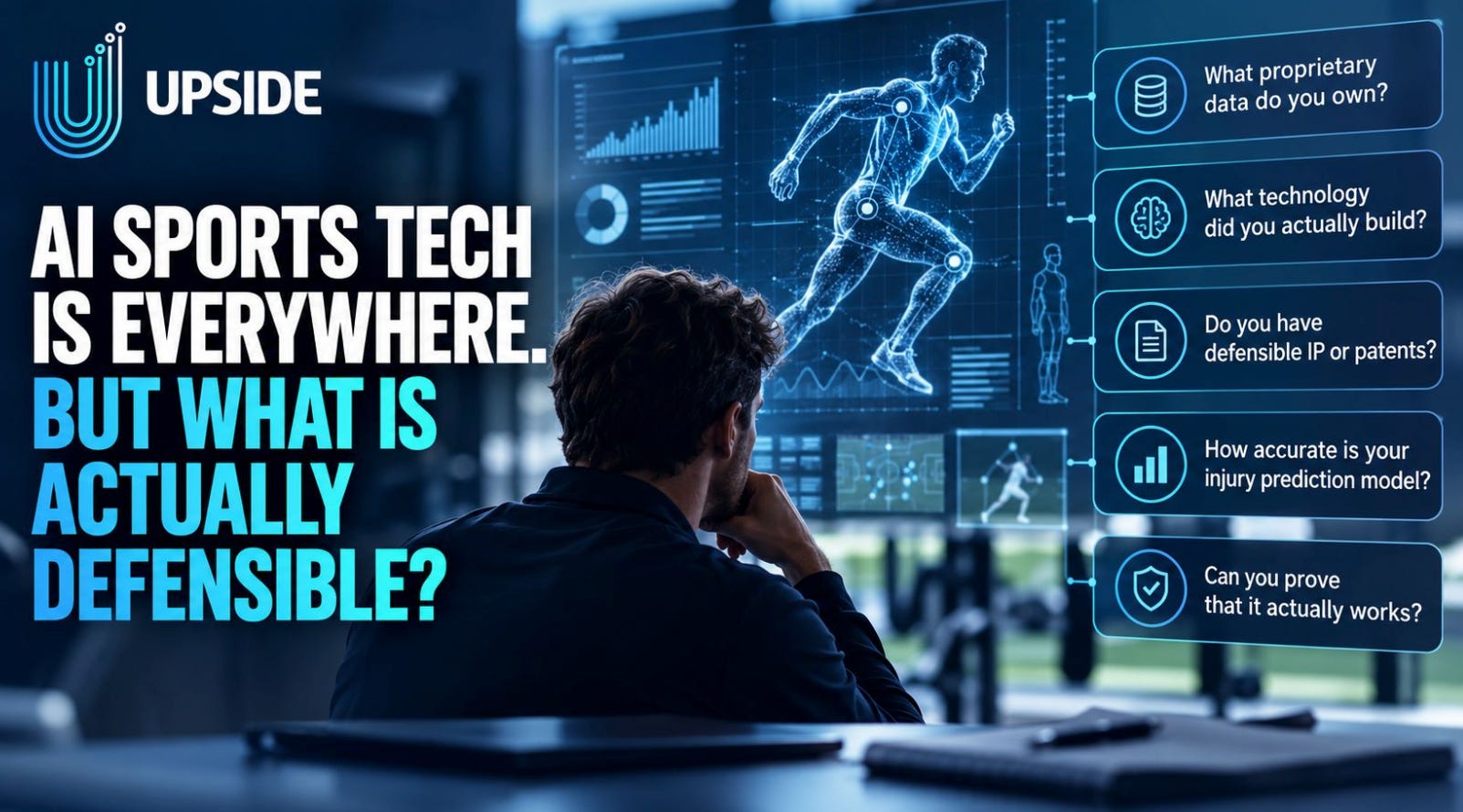
Why proprietary data, intellectual property, scientific validation and domain expertise will determine the winners and losers in the next generation of sports technology.
Introduction: The Explosion of AI in Sports Technology
Over the past several years, I have seen an increasing number of sports technology startups positioning themselves as AI companies.
Every week, it seems that another startup is launching an AI-powered platform promising to transform professional sports.
Some claim they can predict injuries before they happen. Others promise to revolutionize scouting, biomechanics, athlete monitoring, coaching, recovery, performance analytics or tactical analysis.
And while I believe artificial intelligence has tremendous potential to transform professional sports, I am increasingly concerned about something.
Many of these startups are starting to look and sound remarkably similar.
They use similar language, promise similar outcomes and often present similar dashboards.
Almost every company claims to have proprietary algorithms, predictive analytics or an AI-powered platform capable of generating insights that traditional technologies cannot provide.
But how many of these companies actually possess technology that competitors cannot easily replicate?
And how many are essentially building applications on top of commercially available foundation models, third-party APIs and widely accessible datasets?
These are becoming increasingly important questions for professional sports teams, investors and the sports technology industry.
The next phase of AI in sports will not simply be about who uses artificial intelligence. It will be about who has developed something genuinely differentiated, defensible and scientifically validated.
The Problem: AI Is Becoming Increasingly Accessible
One of the biggest changes in the technology industry is that developing AI-powered applications has become significantly easier.
A few years ago, building sophisticated machine learning capabilities often required substantial investment in data science teams, infrastructure, model development and specialized engineering.
Today, startups can access powerful foundation models from companies such as OpenAI, Google, Anthropic and Meta.
They can also leverage cloud computing, open-source machine learning frameworks, pretrained computer vision models and commercially available analytics tools.
This has dramatically reduced the barriers to entry.
A startup can now develop an AI-powered athlete monitoring dashboard, video analysis platform or coaching assistant much faster than was possible just a few years ago.
That is a positive development because it accelerates innovation.
However, it also creates a major challenge: if everyone has access to similar AI capabilities, what makes one sports-tech startup fundamentally different from another?
Consider a hypothetical example.
Two startups offer AI-powered athlete monitoring platforms.
Both integrate GPS data, training loads, wellness questionnaires and historical injury records.
Both use machine learning to identify patterns and provide recommendations to performance practitioners.
Both claim their platform can help reduce injuries and optimize performance.
But one company has spent years collecting unique longitudinal datasets, developing proprietary algorithms and validating its models across multiple teams.
The other uses a commercially available machine learning model trained on a relatively small dataset.
Their marketing materials might look remarkably similar.
Yet the underlying scientific credibility, commercial value and defensibility of these businesses could be very different.
This is why teams and investors need to look beyond the AI label.
What Actually Creates a Competitive Moat in AI Sports Technology?
In venture capital, a competitive moat refers to the advantages that protect a business from competitors and make its position difficult to replicate.
In sports technology, I believe there are six major sources of defensibility.
A. Proprietary Data
One of the strongest potential competitive advantages is access to unique, high-quality datasets that competitors cannot easily obtain.
For example, a company that has collected longitudinal athlete performance data over ten years across multiple sports may have an advantage over a startup relying on publicly available information.
But proprietary data alone is not sufficient.
The quality, consistency and relevance of that data are equally important.
A database containing millions of GPS measurements is not necessarily valuable if it lacks reliable injury outcomes, athlete context or standardized measurement protocols.
Teams and investors should ask:
What proprietary datasets does the company actually control?
How many athletes, teams and seasons are represented?
How were the data collected and standardized?
Does the company have the legal rights to use those data for model training?
Can the dataset be expanded as the business grows?
Are the data representative of the populations where the product will be deployed?
There is also an important distinction between having access to data and owning the rights to use them.
A startup may integrate data from Catapult, STATSports, Garmin or another platform without owning those underlying datasets.
Access to third-party data is not necessarily a competitive moat, especially if competitors can obtain similar access.
B. Proprietary Algorithms and Technology
The second potential moat is the underlying technology.
Many AI startups describe their algorithms as proprietary.
But what does that actually mean?
Does the company own the underlying model architecture?
Has it developed a unique machine learning approach?
Does it use proprietary signal processing, computer vision or feature extraction methods?
Or is it primarily using a commercially available AI model with a customized interface?
There is nothing inherently wrong with using foundation models or third-party APIs. In fact, doing so can be an efficient development strategy.
However, using commercially available AI technology does not automatically create a sustainable competitive advantage.
One question I would ask is:
If I gave the same dataset and problem to another competent AI development team, could they reproduce essentially the same results?
If the answer is yes, the company may need to demonstrate other sources of differentiation.
These could include proprietary data, superior workflow integration, distribution, customer relationships or independently demonstrated performance.
C. Intellectual Property and Patents
Intellectual property can provide another layer of protection.
Some sports-tech companies have developed patented technologies in areas such as wearable sensors, biomechanics, computer vision, physiological monitoring and hardware design.
However, patents should not be treated as automatic proof of defensibility.
Teams and investors need to understand:
What exactly is patented?
Does the patent protect the core technology or a relatively narrow feature?
Is the intellectual property owned by the startup?
How long will the protection remain in effect?
Could a competitor develop a different technical approach that achieves similar results?
Is the technology difficult to reproduce even without patent protection?
Patents can be particularly relevant for companies developing novel hardware, sensors or measurement systems.
For software-based AI companies, proprietary data, technical know-how and distribution may sometimes be more important than patents.
D. Scientific Validation
This is where I believe many AI sports-tech startups need to improve.
A company can have impressive technology, sophisticated algorithms and an attractive dashboard.
But does its product actually work?
And has that been demonstrated through rigorous testing?
For performance technologies, validation is particularly important because teams may use the results to influence training decisions, rehabilitation programs and athlete management.
Scientific validation should include:
Clearly defined performance outcomes.
Transparent methodologies.
Appropriate sample sizes.
Independent testing when possible.
Validation on previously unseen data.
Prospective studies where appropriate.
Evidence that the technology performs consistently in real-world environments.
A startup claiming its AI model is accurate should be able to explain exactly how that accuracy was measured.
And ideally, independent researchers or qualified third parties should be able to reproduce its findings.
A strong marketing claim is not a substitute for scientific evidence.
E. Domain Expertise
Sports performance is an unusually complex field.
Professional athletes operate in environments influenced by training loads, travel, sleep, nutrition, competition schedules, medical history, coaching decisions and individual physiology.
A machine learning model may identify statistical relationships without fully understanding their practical significance.
That is why I believe domain expertise remains essential.
The strongest AI sports-tech companies may be those combining experienced AI engineers with sports scientists, biomechanists, physiologists, medical experts and practitioners who understand the realities of professional sports.
For example, an algorithm might identify an increase in an athlete’s workload.
But an experienced practitioner may know that the athlete is returning from injury, adapting to a new training program or preparing for a particularly demanding competition schedule.
That context matters.
AI should help practitioners make better decisions, not simply generate more data for them to interpret.
F. Integration and Switching Costs
Another potentially powerful competitive advantage is how deeply a technology becomes integrated into a team’s operations.
Professional teams already use multiple technology platforms.
These may include GPS tracking, athlete management systems, video analysis, force plates, strength training equipment, wellness questionnaires and medical records.
A new AI platform that requires practitioners to manually upload information from several systems may create more work rather than solve a problem.
By contrast, a platform that integrates seamlessly into existing workflows may become significantly more valuable.
Over time, integration can also create switching costs.
If a team relies on a platform for daily reporting, longitudinal analysis, athlete monitoring and communication across departments, replacing it may become difficult.
However, integration alone is not necessarily enough.
The platform must continue delivering meaningful value.
AI Injury Prediction: Why an 85% Accuracy Claim Requires Much More Scrutiny
One of the areas where I believe teams need to ask particularly tough questions is AI-based injury prediction.
More startups are claiming that their technologies can predict injuries with impressive levels of accuracy.
Some promote figures of 80%, 85%, 90% or higher.
These numbers sound compelling.
But what does an 85% injury prediction accuracy rate actually mean?
Without understanding the methodology, that number can be misleading.
The Problem With Accuracy as a Standalone Metric
Imagine a hypothetical dataset containing 1,000 athlete observation periods.
Suppose injuries occur during only 50 of those periods.
That means 95% of observations do not involve an injury.
A model that simply predicts no injury every time would achieve 95% overall accuracy.
Yet it would fail to identify every actual injury.
That model would be practically useless for injury prediction despite reporting 95% accuracy.
This illustrates why overall accuracy is often an inadequate metric when predicting relatively uncommon events.
Teams should also evaluate sensitivity, specificity, precision, false-positive rates, false-negative rates and model calibration.
Understanding False Positives and False Negatives
A false positive occurs when a model identifies an athlete as being at elevated injury risk, but the injury does not occur during the defined prediction period.
A false negative occurs when the model fails to identify an athlete who subsequently experiences an injury.
Both can have consequences.
Too many false positives could lead to unnecessary training modifications, reduced playing time or a loss of confidence in the system.
Too many false negatives could create false reassurance.
The trade-off depends on the model’s intended use and the consequences of acting on its predictions.
What Teams Should Ask About Injury Prediction Models
If a company claims its AI predicts injuries with 85% accuracy, I would want answers to the following questions:
1. What exactly are you predicting?
Is the model predicting all injuries, non-contact injuries, hamstring injuries, time-loss injuries or a specific injury category?
2. What is the prediction window?
Does the model predict injury risk over the next 24 hours, seven days, 30 days or an entire season?
3. How was the 85% accuracy calculated?
Is it overall classification accuracy, sensitivity, area under the ROC curve or another metric?
These measurements are not interchangeable.
4. What are the false-positive and false-negative rates?
How often does the model incorrectly flag an athlete, and how many injuries does it miss?
5. How large was the dataset?
How many athletes, teams, seasons and actual injury events were included?
6. Was the model validated on genuinely independent data?
Was testing performed on new athletes and teams, or were training and testing observations drawn from the same individuals?
7. Was the validation prospective?
Did the model generate predictions before the injuries occurred, or was its performance assessed retrospectively?
8. Does it work across different sports and populations?
A model trained on male professional soccer players may not perform equally well with WNBA players, NFL athletes or female soccer players.
9. Does it outperform simpler alternatives?
How does the model compare with established workload measures, logistic regression or experienced practitioners using the same available information?
10. Does using the model actually improve outcomes?
Even a well-calibrated risk prediction model does not automatically reduce injuries.
Teams need evidence that acting on its predictions improves decisions and, ideally, produces better athlete outcomes.
A More Realistic Hypothetical Example
Consider an injury prediction system evaluated across 1,000 athlete observation periods, including 50 periods followed by an injury.
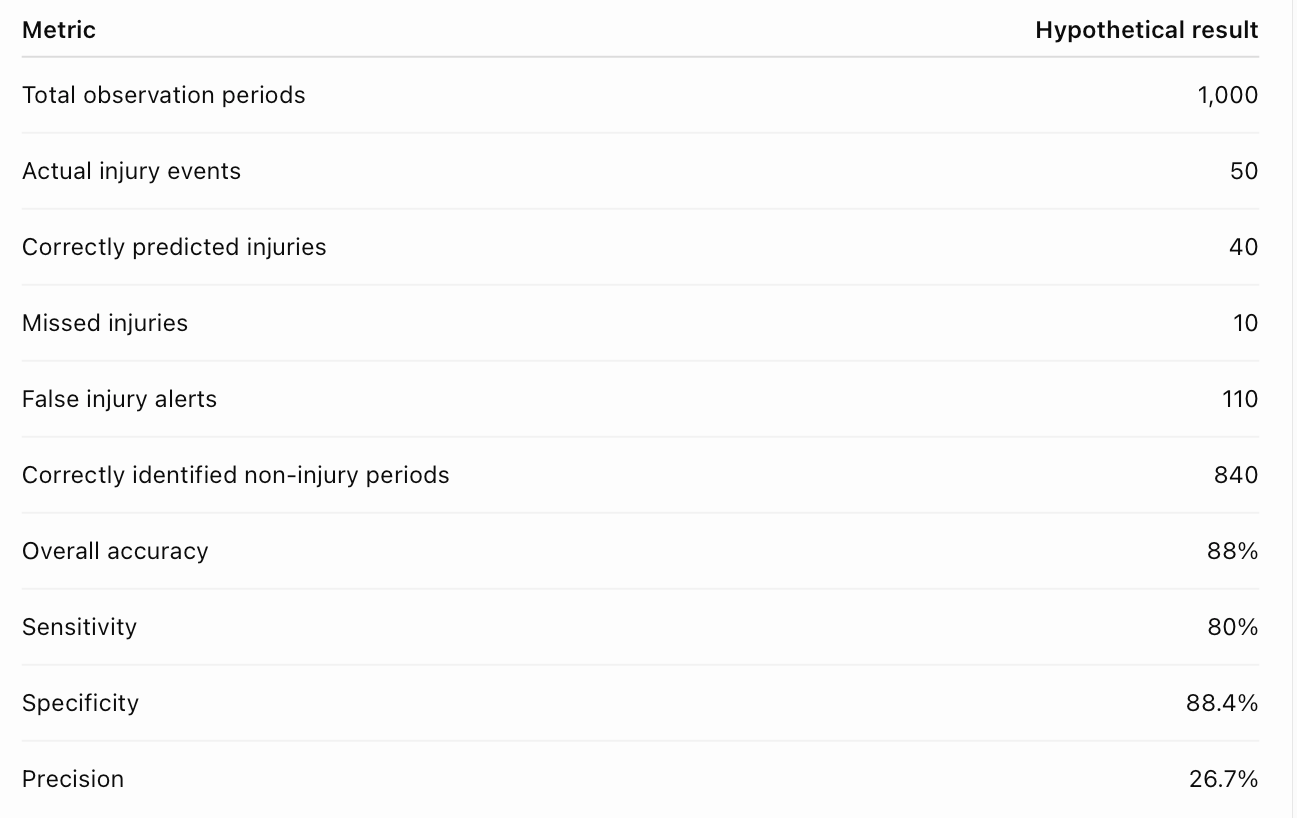
The model achieves 88% overall accuracy.
That sounds impressive.
But only about 27% of its positive injury alerts correspond to an injury in this hypothetical evaluation.
In other words, approximately three out of four positive alerts would be false positives.
This does not necessarily make the model useless. Its value would depend on the consequences of acting on those alerts, the injury types involved and the alternatives available.
But it demonstrates why teams should never evaluate injury prediction technology based on a single headline accuracy figure.
Does AI Actually Outperform Experienced Practitioners?
This may be one of the most important questions in the entire discussion.
Sports scientists, athletic trainers, physiotherapists, strength coaches and medical professionals already make decisions using multiple sources of information.
They consider workload data, athlete feedback, medical history, physical assessments, training schedules and their own experience.
If an AI platform claims to improve those decisions, it should demonstrate incremental value.
That does not mean AI must outperform every practitioner in every situation.
But the company should explain how the technology improves the decision-making process.
For example:
Does it identify meaningful patterns that practitioners might otherwise miss?
Does it reduce the time required to analyze information?
Does it improve consistency across departments?
Does it help identify athletes who require additional assessment?
Does it provide reliable insights earlier than existing methods?
Does it lead to better decisions or measurable operational improvements?
A model that generates similar recommendations to a competent practitioner may still provide value through automation and efficiency.
However, its commercial positioning should reflect that benefit rather than claiming superior predictive intelligence without supporting evidence.
The ultimate objective should not be to replace practitioners. It should be to give them better tools.
The Difference Between an AI Feature and an AI Company
Another distinction I believe investors need to consider is the difference between a company that uses AI and a company whose competitive advantage fundamentally depends on AI.
Many existing sports-tech platforms are integrating AI into their products.
Companies such as Catapult, Hudl and Teamworks have established customer relationships, data integrations and operational workflows.
They can introduce AI features into products that teams already use.
That creates a challenge for startups offering standalone AI capabilities.
Imagine a new company launches an AI assistant that summarizes GPS data and produces daily athlete monitoring reports.
The product may initially attract interest.
But what happens if an established athlete monitoring platform introduces a similar feature directly into its existing software?
The startup may suddenly face competition from a company with a larger installed customer base, established data access and existing procurement relationships.
This is why a useful AI feature is not automatically a defensible standalone business.
Startups need to demonstrate why their capabilities cannot easily be replicated or bundled into an incumbent platform.
Possible answers include unique datasets, specialized algorithms, superior validation, exceptional user experience, proprietary hardware or deep expertise in a specific domain.
Why AI Sports-Tech Startups May Face Increasing Consolidation
As AI capabilities become more widely available, I expect the sports technology industry to experience additional consolidation.
There are several reasons.
First, professional teams generally do not want to manage dozens of disconnected platforms.
They increasingly need integrated solutions that combine information from multiple sources.
Second, established technology providers have incentives to expand their capabilities through internal development, partnerships and acquisitions.
Third, smaller startups may struggle to compete with larger companies that already have established customer relationships and distribution channels.
We have seen examples of this broader consolidation strategy.
Catapult has expanded through acquisitions including XOS Digital, SBG Sports Software, Perch and IMPECT.
Teamworks has also expanded its portfolio through acquisitions across athlete operations, recruiting, nutrition and performance-related software.
These strategies are not exclusively driven by AI, but they illustrate how established platforms can expand their capabilities.
I expect three possible outcomes for smaller AI sports-tech startups:
1. Some will become independent leaders.
Companies with proprietary technology, unique datasets, strong validation and meaningful customer traction may develop sustainable businesses.
2. Some will be acquired.
Specialized AI capabilities could become attractive acquisition targets for larger sports technology companies.
3. Others will struggle to differentiate.
Startups relying primarily on commercially available models and easily replicated features may face pricing pressure, customer churn or difficulty raising additional capital.
The key question is whether a company is building a long-term competitive advantage or simply benefiting from temporary excitement surrounding AI.
What Investors Should Evaluate Before Investing in an AI Sports-Tech Startup
For venture capital firms, family offices and professional sports team owners, AI sports technology presents an interesting investment opportunity.
But the barriers to developing AI applications are falling, and this should influence investment due diligence.
I would focus on seven areas.
1. Technology ownership
What has the company actually built?
Is its core technology proprietary, licensed or primarily dependent on third-party APIs?
2. Data defensibility
Does the company have unique datasets, exclusive data rights or a sustainable mechanism for collecting new proprietary information?
3. Scientific credibility
Have the company’s claims been independently validated?
Are the studies relevant to the customers and athlete populations it intends to serve?
4. Commercial traction
Are teams paying for the product?
Are they renewing their contracts?
Is the technology being used regularly by practitioners?
A pilot program or logo on a website is not the same as a sustainable customer relationship.
5. Competitive differentiation
What prevents Catapult, Hudl, Teamworks or another established provider from introducing a similar capability?
6. Scalability
Can the company expand beyond a limited number of professional teams?
Could its technology serve academies, rehabilitation clinics, universities, healthcare providers or consumer markets?
7. Economic sustainability
How much does it cost to operate the AI platform?
What are the costs associated with data processing, model inference, cloud infrastructure and customer support?
A startup may have impressive AI capabilities but still struggle to build an attractive business if its operating costs are too high.
Investors should evaluate AI sports-tech startups as businesses, not simply as demonstrations of interesting technology.
How Should Professional Teams Evaluate AI Sports-Tech Vendors?
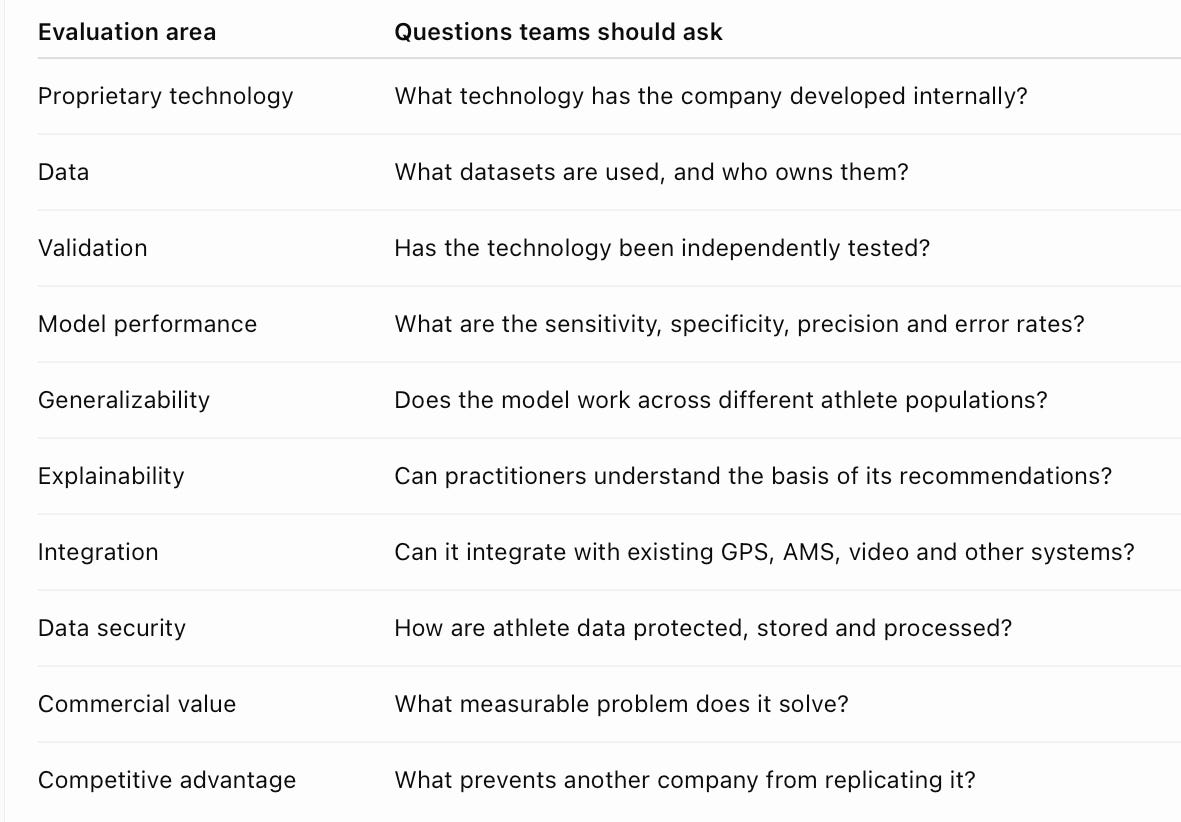
I believe teams should develop a more structured evaluation process for AI-based technologies.
That process should involve multiple stakeholders, including sports science, performance, medical, technology, information security and procurement departments.
Here is a practical framework.
I would also encourage teams to conduct structured pilots before committing to long-term contracts.
A pilot should establish clear success criteria in advance.
For example, if the objective is to improve the efficiency of athlete monitoring, teams could measure the time required to prepare daily reports before and after implementation.
If the objective is injury-risk assessment, the evaluation should use appropriately defined outcomes and statistical measures.
If the objective is video analysis, the team could compare the accuracy and efficiency of the AI system against existing workflows.
Most importantly, teams should involve the practitioners who will actually use the technology.
A platform that looks impressive during a sales presentation may not deliver the same value in daily operations.
The Future: What Will Define the Winners in AI Sports Technology?
Over the next three to five years, I expect several developments to reshape the AI sports-tech market.
A. AI capabilities will become increasingly commoditized
Many capabilities that appear differentiated today may become standard software features.
Automated reporting, natural-language interfaces, basic video tagging and AI-generated summaries could become common across established sports technology platforms.
That will make it harder for startups to charge premium prices for relatively simple AI features.
B. Proprietary multimodal datasets will become more valuable
The ability to combine multiple types of data could become a meaningful differentiator.
For example, a company that can reliably integrate GPS data, video, biomechanics, strength assessments, medical history and relevant physiological measures may generate more useful insights than a platform analyzing one dataset in isolation.
However, combining more data does not automatically improve predictive performance.
The value must be demonstrated through rigorous testing.
C. Independent validation will become increasingly important
I expect professional teams and investors to demand stronger evidence supporting AI performance claims.
Companies may need to provide prospective validation, independent research and more transparent reporting of model limitations.
This could create an advantage for startups that invest early in scientific credibility.
D. AI will become embedded into existing workflows
Rather than requiring practitioners to use separate AI applications, more capabilities will likely become integrated into existing athlete management, video analysis and performance platforms.
The most successful solutions may be those that deliver insights directly within the tools practitioners already use.
E. More specialization could emerge
General-purpose AI platforms may face increasing competition from specialized solutions.
For example, a company focused exclusively on validated biomechanical analysis of a particular movement may be better positioned than a platform claiming to solve every performance problem.
Specialization can create advantages through domain expertise, focused datasets and deeper validation.
F. Trust will become a competitive advantage
Professional sports teams handle sensitive athlete information.
As AI becomes more deeply integrated into medical and performance decisions, teams will increasingly need clarity regarding data ownership, privacy, cybersecurity, model governance and accountability.
Companies that can demonstrate trustworthy data practices and reliable model performance may have an advantage.
Conclusion: AI Alone Is Not a Competitive Moat
I remain very optimistic about the long-term potential of artificial intelligence in professional sports. AI could help teams analyze increasingly complex datasets, automate time-consuming tasks, improve scouting workflows, support athlete monitoring and provide practitioners with better information.
But I also believe the sports-tech industry needs to become more disciplined in evaluating AI claims. Having an AI-powered platform is no longer particularly unusual.
Using a foundation model does not automatically create proprietary technology. A sophisticated dashboard does not prove that the underlying algorithms are accurate.
And claiming 85% injury prediction accuracy means very little without understanding the dataset, methodology, validation process and practical implications.
For sports-tech startups, the challenge is to demonstrate something that competitors cannot easily replicate.
For investors, the challenge is to distinguish genuinely differentiated technologies from businesses built around increasingly commoditized AI capabilities.
And for professional sports teams, the challenge is to determine whether these technologies actually improve decisions, efficiency or athlete outcomes.
In my view, the strongest long-term competitive advantages in AI sports technology will come from a combination of:
Proprietary data: Unique, high-quality datasets with appropriate usage rights.
Intellectual property: Differentiated technology, algorithms and defensible know-how.
Scientific validation: Transparent, reproducible evidence that the technology works.
Domain expertise: Deep understanding of sports science, medicine and professional team operations.
Integration: Seamless connections with existing technology and workflows.
Commercial execution: Paying customers, strong retention and measurable return on investment.
The companies that combine these advantages may be best positioned to build sustainable businesses.
The companies that rely primarily on the AI label may find differentiation increasingly difficult.
Ultimately, the question professional sports teams and investors should be asking is no longer:
“Does this company use AI?”
It should be:
“What does this company have that someone else cannot easily replicate, and can it prove that its technology actually works?”
I would be interested to hear from performance directors, sports scientists, medical practitioners, technology executives and investors:
How are you currently evaluating AI sports-tech companies? And what evidence do you require before trusting their technology?
You may also like:
📚 Upside Analysis: AI Injury Prediction in Sports: Who Ultimately Decides?

In elite sports, the difference between winning and losing often hinges on player health. Injuries can derail a season, affect team strategy, and impact player careers. Teams are increasingly turning to technology for an edge, and AI is emerging as a promising tool for injury prediction. Some startups now claim that, in the near future, AI could predict…
📈 Upside Analysis: Enhancing, Not Replacing: How AI Empowers Practitioners in Elite Sports

Artificial Intelligence (AI) is rapidly transforming elite sports, offering tools that elevate training, recovery, performance analysis, and tactical planning. Yet, one major misconception persists: that AI threatens to replace human practitioners. In reality, AI’s true value lies in its ability to