

How sports-technology companies can expand their markets, adapt pricing, build platforms and avoid common scaling mistakes
A perspective shaped by more than 10 years in sports technology
Introduction
The sports-technology industry has moved beyond its early period of experimentation. Teams, leagues and athletes now operate within increasingly complex technology ecosystems that span performance, medicine, video, recruiting, operations, fan engagement and commercial activity. At the same time, customers expect technology providers to demonstrate measurable value, integrate with existing systems and meet higher standards for security, privacy and reliability. These expectations create significant opportunities for startups, but they also make sustainable growth more difficult.
A product may earn attention because it is innovative, yet innovation alone does not create a scalable company. A startup must determine how to convert early customer interest into repeatable sales, successful implementation, strong adoption and long-term retention. It must then decide whether growth should come from deeper penetration of its original market, expansion through the sports pyramid, entry into new sports or geographies, movement into adjacent industries, platform development, partnerships or strategic acquisitions.
This analysis examines those strategic choices and the conditions required for each one to succeed. It also considers the mistakes that commonly limit sports-tech startups, including expanding before the core business is ready, remaining in a narrow market for too long, failing to adapt pricing and overcustomizing the product for individual customers. The central argument is that growth should be treated as a disciplined sequence in which each stage strengthens the company’s ability to pursue the next.
1. Establish a strong position before pursuing expansion
Before a sports-tech startup considers new verticals or markets, it must establish a strong position within its initial customer segment. Many startups try to become an all-in-one platform before demonstrating that they can solve one important problem exceptionally well. Early focus is usually an advantage because it allows the company to develop expertise, build credibility and give customers a clear reason to choose its product.
The initial problem could involve athlete monitoring, video analysis, medical documentation, recruiting, team operations or fan engagement. Regardless of category, the product should create measurable value by saving staff time, improving communication, increasing athlete availability, reducing risk or helping decision-makers act more quickly.
Customer interest alone is not evidence that a company is ready to scale. Sports organizations often participate in pilots, particularly when implementation costs are low. The stronger indicators are consistent use, conversion to paid agreements, renewals and account expansion. A startup should demonstrate these behaviors before committing substantial resources to another market.
2. Build a repeatable commercial and implementation model
A strong product does not automatically create a scalable company. Founder-led sales can be effective during the early stages, but they become a limitation when every material opportunity depends on the founder’s relationships and direct involvement. The company must eventually document how it identifies qualified customers, navigates procurement, demonstrates value, implements the product and expands accounts.
Sports-technology purchases also involve multiple stakeholders. An athlete, coach or practitioner may use the product, while an athletic director, general manager or procurement department approves the purchase. A practitioner may value better information; a coach may prioritize speed and simplicity; an executive may focus on cost and risk; and an IT department will examine security and integration. The commercial case must address all of them.
Implementation must become repeatable as well. A company cannot scale efficiently if every customer requires a different configuration and extensive custom development. Some flexibility will always be necessary in elite sport, but the core onboarding, training and customer-success processes should become standardized over time.
3. Expand carefully through the sports pyramid
One of the most logical growth strategies for a sports-tech startup is to move through the sports pyramid. A company that begins by serving professional or elite teams may eventually expand into college athletics, high schools, clubs and youth organizations. This can significantly increase the addressable market because the number of potential customers grows substantially below the professional level.
However, a company cannot assume that a product designed for an elite organization can simply be sold to a high school at a lower price. Professional teams may employ specialized analysts, sports scientists, physicians and technology staff who can support sophisticated workflows and detailed configurations. A high school or community club may have fewer employees, limited technical expertise and a much smaller budget.
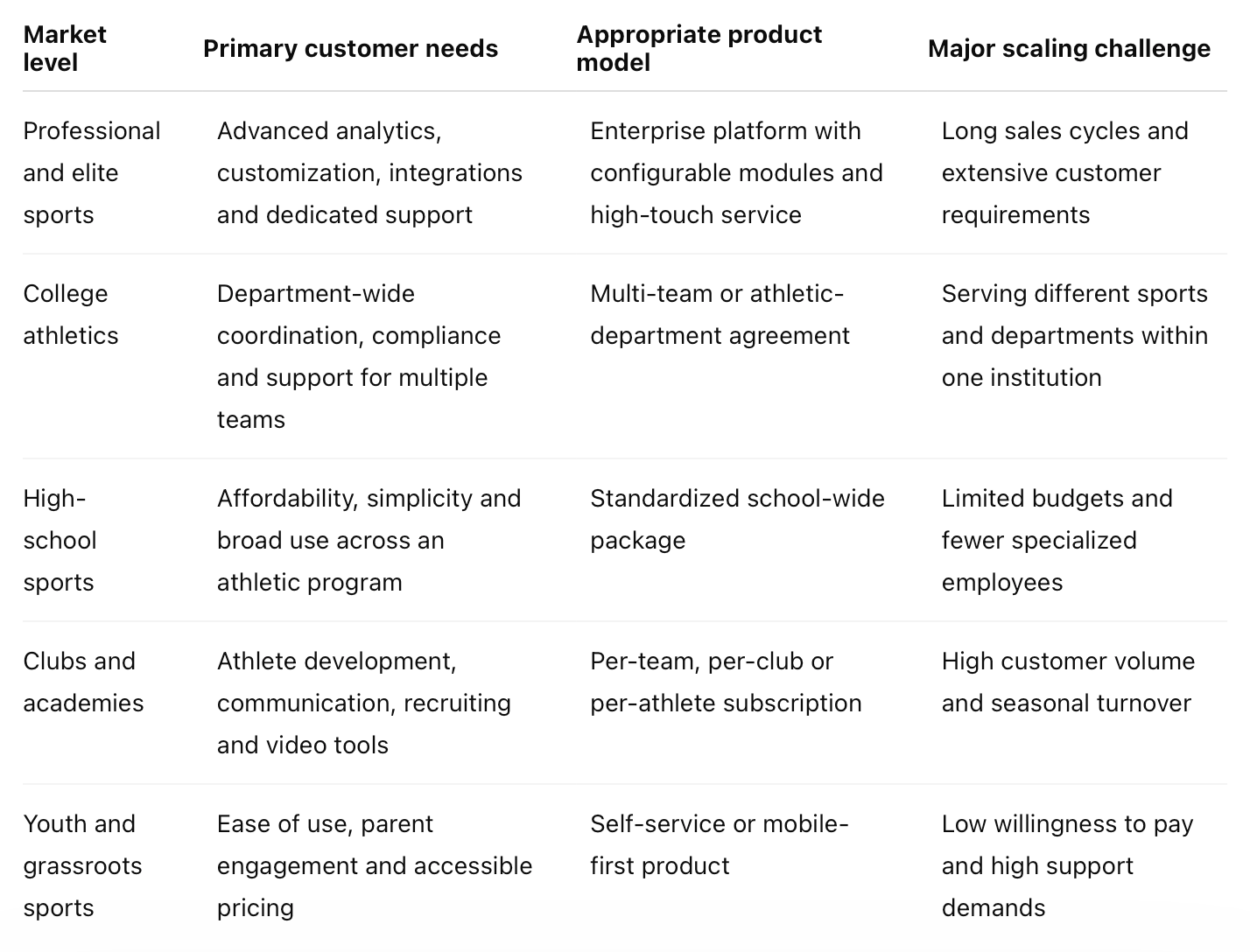
The product, pricing and implementation model must therefore change as the company moves through the sports pyramid.
Source: Upside Global, confidential, 2026
As this comparison illustrates, expansion requires more than lowering the price of the professional product. The company may need to simplify its interface, reduce configuration options, standardize implementation and create self-service onboarding. Its customer-success model must also become more efficient because the high-touch service provided to 50 professional teams cannot be delivered economically to thousands of schools and clubs.
The strategic benefit of serving multiple levels is not limited to customer volume. A platform used throughout the sports pyramid can create familiarity and continuity across an athlete’s or coach’s career. This can strengthen the brand, reduce customer-acquisition costs and make the company part of a broader sports ecosystem.
4. Evaluate opportunities beyond sports
Sports technology is frequently developed in demanding human-performance environments. Elite organizations operate under significant pressure, manage complex medical and performance information and continually search for marginal improvements. The technologies developed under these conditions may have valuable applications outside sports.
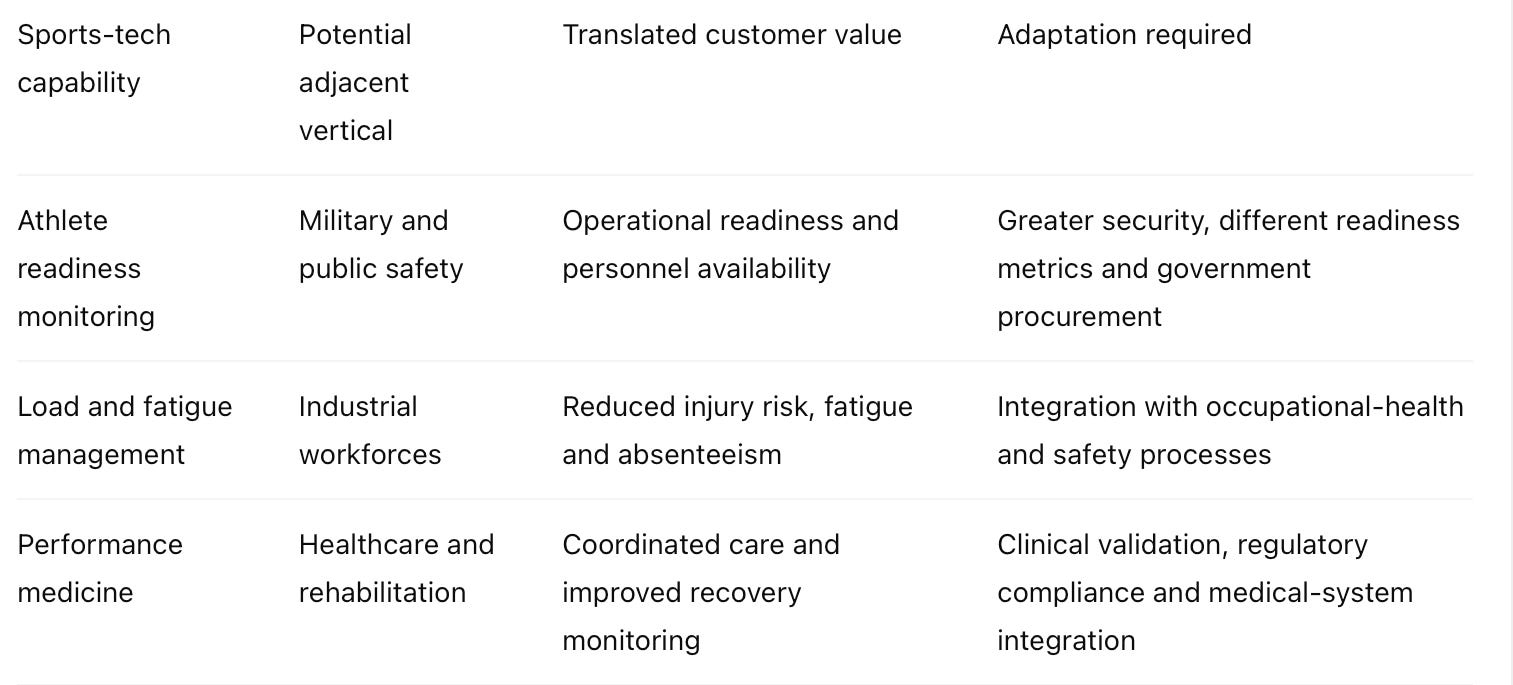
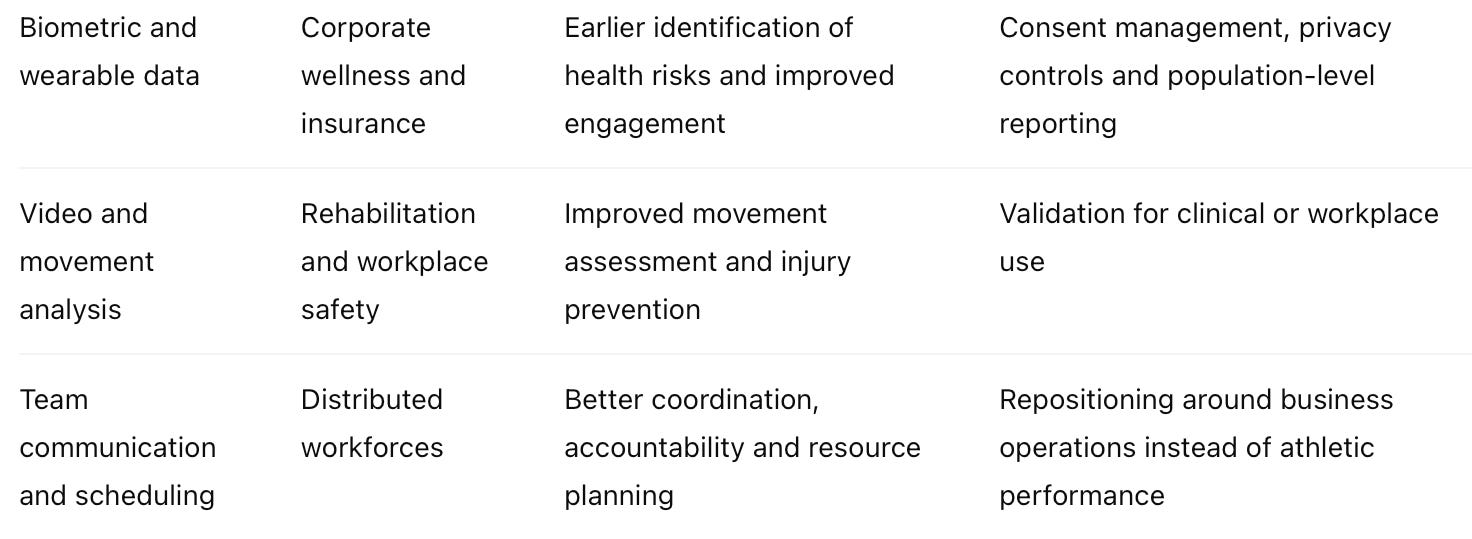
Athlete-monitoring systems can support workforce readiness, while recovery and load-management technology may be relevant to military personnel, public-safety professionals and industrial workers. Performance-medicine platforms may also have applications in healthcare and rehabilitation. The central opportunity is to identify which underlying capabilities can solve similar problems in another industry.
Source: Upside Global, confidential, 2026
Expansion into these verticals can provide access to larger markets, longer contracts and larger customer populations. It can also reduce dependence on the relatively small number of professional sports organizations.
Nevertheless, a startup should not treat a new vertical as a simple extension of its sports business. Healthcare, military and industrial customers have different regulations, procurement processes, security requirements and definitions of value. Athlete availability may need to be translated into workforce readiness, lower absenteeism, reduced injury rates or improved operational performance.
The core technology may remain useful, but the product positioning, evidence and commercial strategy must be rebuilt around the needs of the new market. Successful expansion requires the company to translate its expertise rather than assume that customers outside sports will immediately understand its value.
5. Adapt pricing as the company enters new markets
Pricing is one of the most important and frequently overlooked elements of a sports-tech growth strategy. Many startups establish their initial pricing based on a small number of early customers and continue using the same structure as they enter new segments. This can make the product unaffordable for smaller organizations or unprofitable for the company.
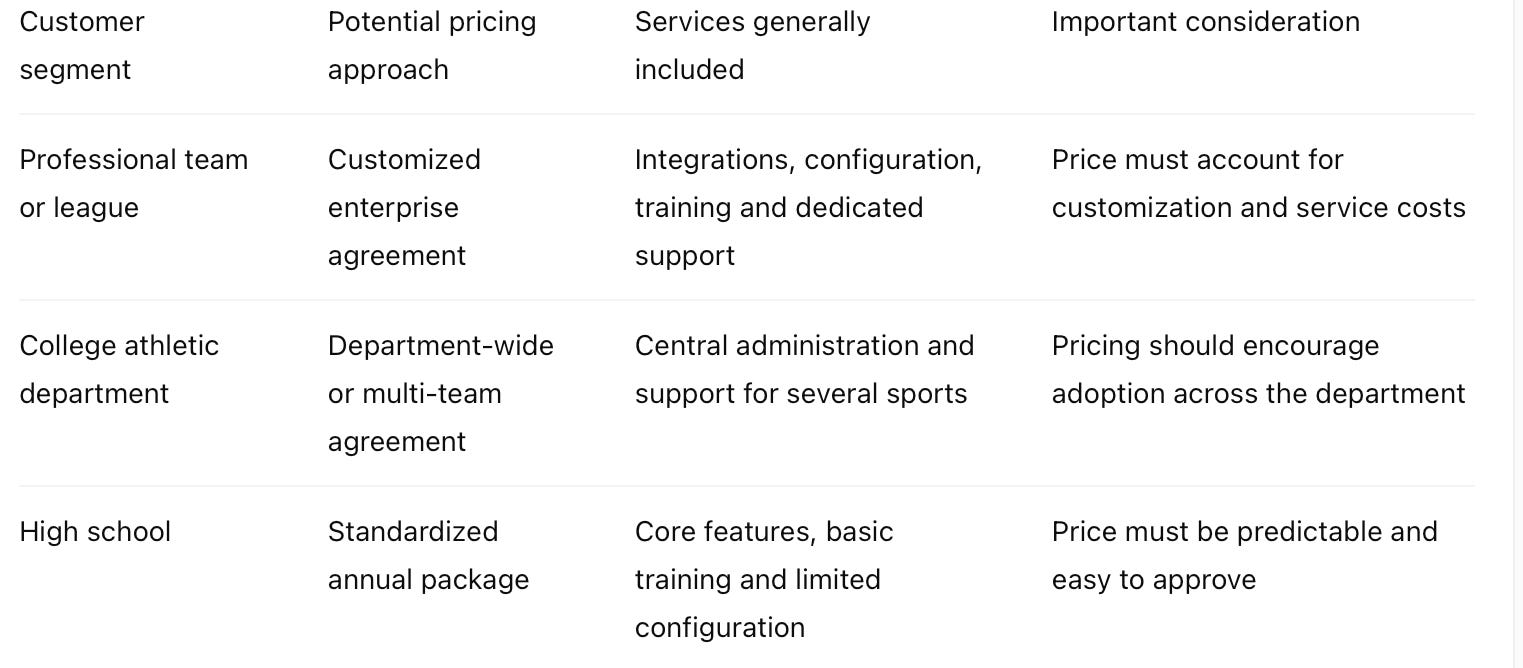
A professional organization, university, high school, club and individual athlete cannot always be served using the same contract model. Each segment has a different budget, buying process, level of technical expertise and need for support.
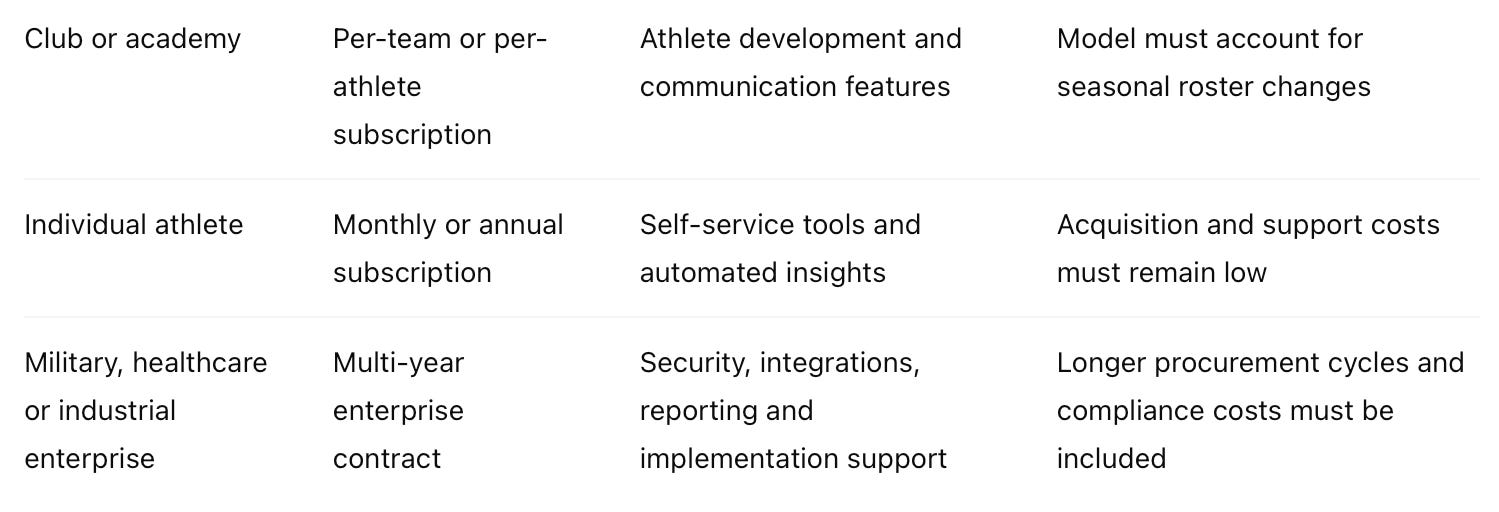
Source: Upside Global, confidential, 2026
Pricing should reflect both the value delivered and the cost of serving the customer. A recognizable professional team may appear to be an attractive account, but it can become financially unproductive if it requires extensive customization and continuous support that are not reflected in the contract.
Conversely, a standardized product serving a large number of smaller organizations can generate attractive margins when onboarding and support are delivered efficiently. The objective is not simply to charge more or less. It is to align the price, product complexity and service model with the economics of each customer segment.
Startups should therefore treat pricing as an evolving strategic tool. As the product matures and the customer base changes, leadership should regularly examine conversion rates, implementation costs, product usage, retention and willingness to pay.
6. Select the appropriate growth strategy
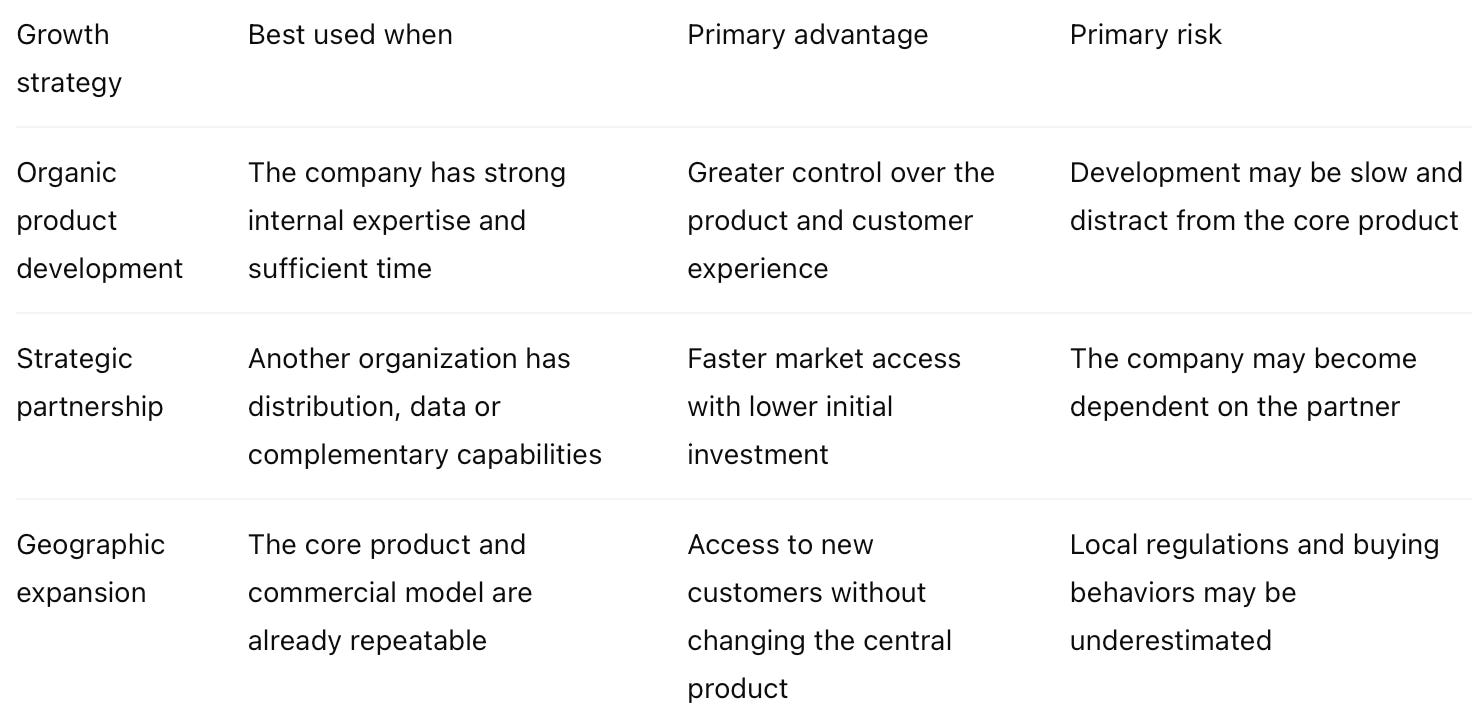
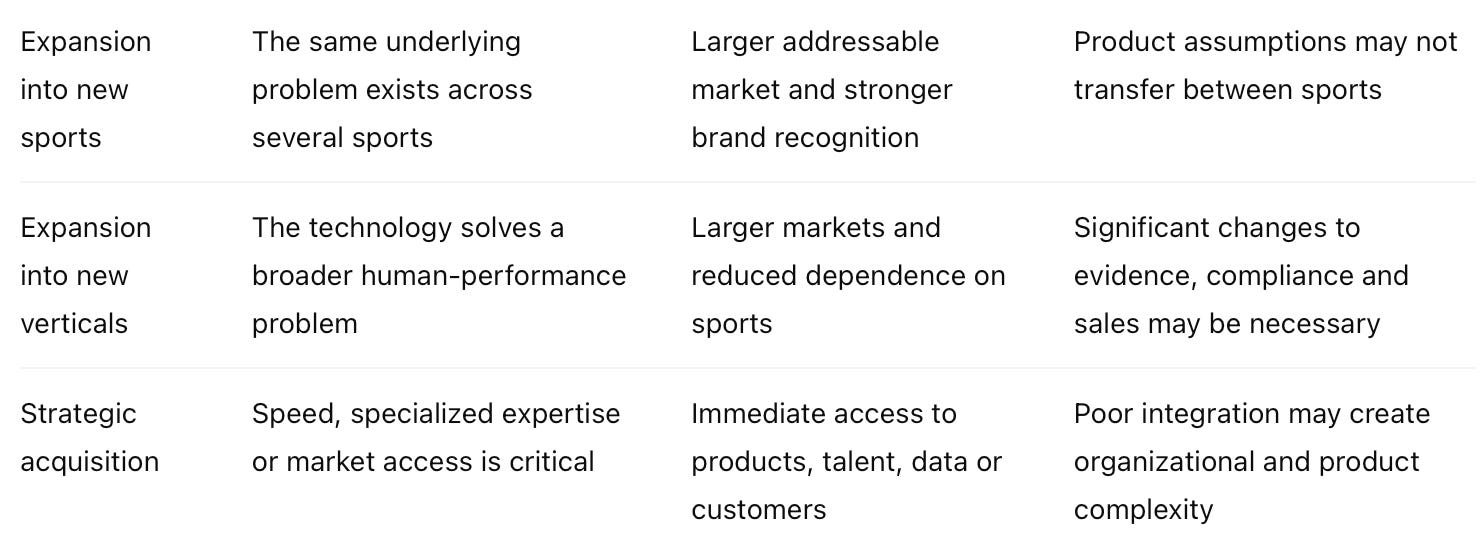
Sports-tech startups can grow through internal product development, partnerships, geographic expansion or acquisitions. Each approach offers different benefits, costs and risks. Leadership should select the strategy that addresses the company’s actual constraint rather than pursuing the option receiving the most attention in the market.
Source: Upside Global, confidential, 2026
Strategic M&A can be particularly effective when an acquisition provides a complementary product, differentiated data, specialized talent, an established customer base or entry into a new market. Companies such as Teamworks have used acquisitions to build a broader platform across team operations, analytics and athlete performance. Orreco has also pursued targeted acquisitions to expand its expertise and capabilities.
However, the completion of an acquisition does not create value by itself. The acquiring company must integrate the products, data, employees and customer experiences. If customers continue to use multiple logins, separate databases and inconsistent interfaces, the company may own more products without offering a genuine platform.
7. Common mistakes that prevent sports-tech startups from scaling
Although every sports-tech startup follows a different path, several mistakes repeatedly prevent promising companies from achieving sustainable growth:
Remaining too narrow for too long. Focus is essential during the early stages, but the number of elite and professional organizations is limited. Once the initial market has been validated, leadership should evaluate whether the company’s capabilities can extend into college, high school, grassroots sports or adjacent industries.
Expanding before establishing a strong core business. Entering several sports, countries or industries before achieving strong adoption and retention can divide the attention of product, sales and customer-success teams. Expansion should build on a repeatable business model rather than compensate for unresolved problems in the original market.
Failing to adapt pricing. A pricing model developed for professional teams may be unaffordable for schools and clubs, while an underpriced enterprise contract may not cover the cost of customization and support. Pricing must reflect the budget, value and service requirements of each customer segment.
Treating every customer request as a product strategy. Building every feature requested by a prominent customer can create technical debt and turn the platform into a collection of customer-specific exceptions. Leadership must distinguish between a broader market requirement and a request that benefits only one organization.
Confusing pilots with product-market fit. Participation in a pilot demonstrates interest, but sustainable demand is better measured through paid conversion, consistent usage, renewal and account expansion.
Selling features instead of outcomes. Customers are less interested in the number of dashboards or algorithms than in whether the product improves athlete availability, saves time, increases revenue, reduces risk or supports better decisions.
Underestimating implementation and customer success. A technically strong platform can still fail if it does not fit naturally into the customer’s daily workflow. Training, onboarding and adoption monitoring should be treated as part of the product experience.
Failing to adapt the product for different segments. A professional product may be too complex for a school or club. Moving into broader markets often requires simplified interfaces, standardized packages and self-service support—not merely a lower price.
Entering new verticals without understanding the new buyer. Healthcare, defense and industrial organizations have different regulations, procurement processes and outcome measures. Startups must adapt their evidence, positioning and go-to-market model.
Avoiding new verticals entirely. Remaining exclusively focused on a small sports market can eventually limit growth. Once the core business is established, companies should identify adjacent markets where their technology and expertise provide a credible advantage.
Overlooking integration and interoperability. A product that cannot exchange data with the customer’s existing systems may become another data silo. Strong integrations can increase adoption and make the product more difficult to replace.
Neglecting privacy, security and governance. Sports-tech products frequently manage sensitive biometric, medical and performance information. Weak data practices can delay enterprise sales, prevent entry into regulated markets and damage customer trust.
Relying too heavily on prestigious customers. A recognizable logo can provide credibility without creating a profitable relationship. High-profile customers should be evaluated according to retention, profitability and strategic value—not brand recognition alone.
Creating partnerships that provide visibility without distribution. The strongest partnerships provide access to customers, shorten sales cycles, improve implementation or make the product more valuable. Publicity alone does not create a scalable commercial channel.
Attempting to become a platform too early. Building several disconnected modules can dilute development resources and create a confusing customer experience. A startup should first become essential within one workflow and then expand into adjacent areas where integration creates additional value.
Final perspective
The sports-tech companies that scale successfully will not necessarily be those with the most features, pilots, partnerships or acquisitions. They will be the companies that solve an important problem, become essential to the customer’s workflow and build a repeatable system for delivering value.
Once that foundation is established, growth can come through movement across the sports pyramid, expansion into additional sports and geographies, entry into adjacent industries, strategic partnerships, platform development or M&A. The correct path depends on the company’s capabilities, resources and market position.
The most important principle is that growth must be sequenced. A startup should first win its core market, demonstrate measurable value and establish a repeatable operating model. It can then identify the next market where its capabilities provide a credible advantage and adapt its product, pricing and go-to-market strategy accordingly.
Sustainable growth is not created by pursuing every available opportunity. It is created by choosing opportunities that reinforce the core business and make the company stronger with each stage of expansion.
If you are a startups looking to get traction with pro teams, raise money, or get guidance on your product, feel free to contact me at julien@upsideglobal.co
Best,

You may also like:
Upside Analysis: The Top 52 Sports Tech Investors (VCs, Family Offices)

In the past 10 years we have worked with some of the most prevalent sports tech investors (VCs, family offices, angel investors..) out there. We have essentially brought deal flow to those investors on a regular basis. Investors are always looking for sports tech startups to invest in. They are looking to invest in startups led by experienced founders, …
⭐ Best Practices On How To Best Create VC Decks & Pitch Sports Tech Startups To VCs

For the past 10 years I have worked and helped many sports tech startups raise money, meaning helped them put together VC decks and connect them with potential investors (VCs, angels, Teams’ VC arms..). Now I never guarantee startups that I can help them raise money. However what I can do is help these startups be best positioned for success with a VC d…
🥉Upside: AI Is Becoming the Entry Ticket—Not the Competitive Advantage.

Yesterday I had a fascinating conversation with one of the leading investors in sports technology.