
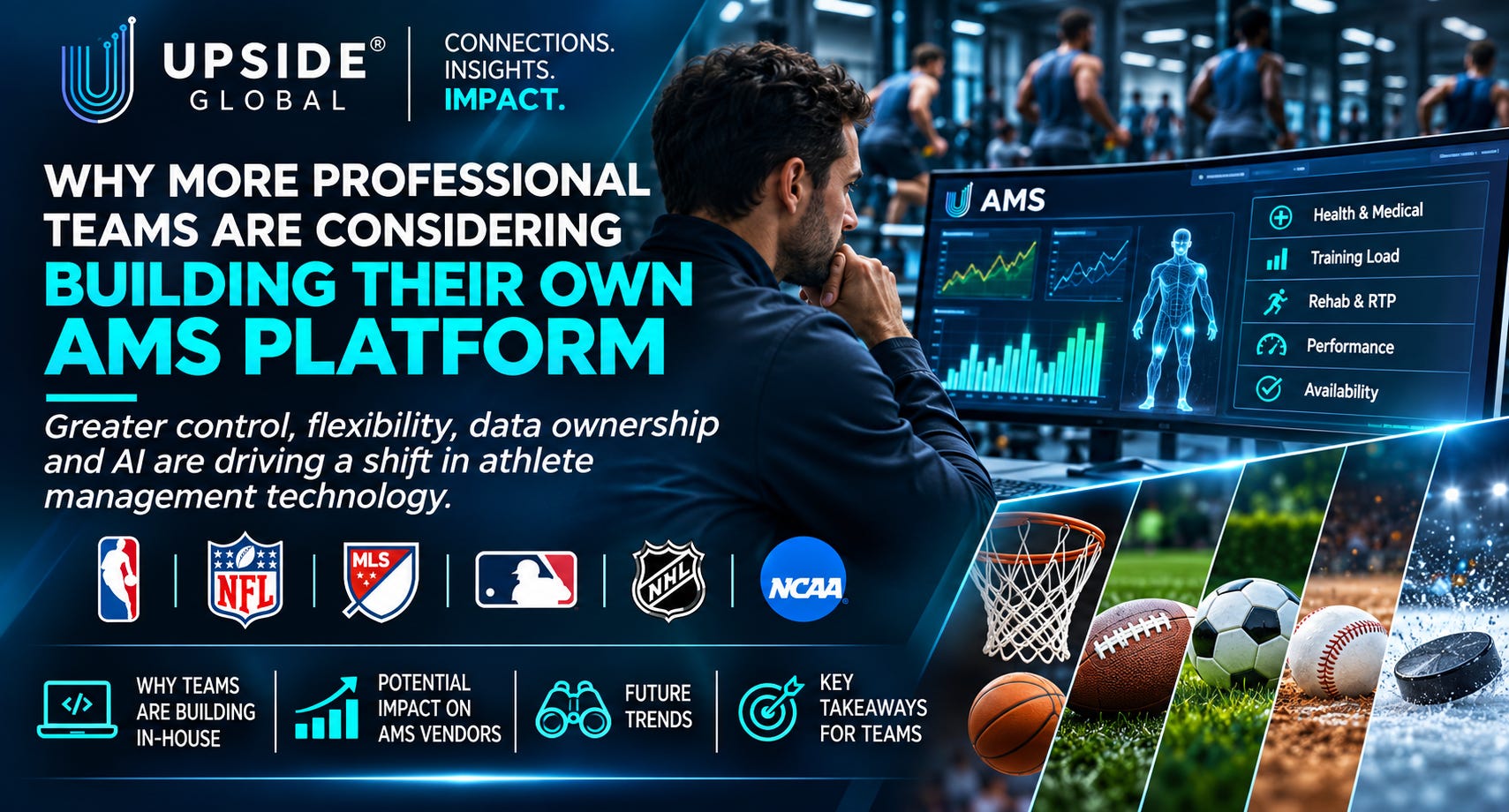
Are traditional AMS vendors at risk of losing control of one of the most important technology platforms in elite sports?
Introduction
For more than a decade, Athlete Management Systems (AMS) have become an essential component of the technology infrastructure used by professional sports organizations. NBA, NFL, MLB, NHL, MLS and NCAA teams increasingly rely on these platforms to centralize athlete health records, training loads, wellness questionnaires, injury histories, rehabilitation programs, performance testing and other critical information.
Companies such as Kitman Labs, Smartabase and Teamworks have helped professional sports organizations move away from spreadsheets, fragmented databases and paper-based workflows toward more centralized digital systems.
However, a potentially significant shift is emerging in the way some organizations think about athlete management technology.
Rather than relying entirely on commercial AMS platforms, some teams are evaluating whether they should develop their own internal systems, integrate multiple specialized applications, or build proprietary analytics and AI layers on top of existing technology infrastructure.
The question is no longer simply which AMS vendor offers the best functionality. Increasingly, it is whether a professional sports organization should own and control more of its athlete management technology, data infrastructure and decision-making tools.
Several developments are driving this discussion, including advances in artificial intelligence, growing frustration with fragmented technology environments, the availability of cloud-based development tools, and the increasing strategic value of proprietary athlete data.
For performance directors, head athletic trainers, rehabilitation specialists, sports scientists and team executives, this raises important questions about cost, security, flexibility, vendor dependence and long-term technology strategy.
It could also have significant consequences for established AMS providers.
Importantly, there is not yet sufficient public evidence to establish that a majority of professional teams are abandoning commercial AMS platforms. The more defensible observation is that the economics and technical feasibility of building proprietary systems are changing, creating new options for organizations that historically depended almost entirely on external vendors.
Why More Teams Are Considering Building Their Own AMS Platforms
There are several reasons why professional sports organizations are reconsidering their reliance on traditional AMS vendors. Although the motivations vary depending on a team’s budget, staffing, league requirements and existing technology infrastructure, the underlying objective is often the same: greater control over data, workflows and the tools practitioners use every day.
1. Frustration with the limitations of commercial AMS platforms
One of the biggest challenges facing sports performance and medical departments is that every team operates differently.
An NBA franchise managing an 82-game regular season has different requirements from an NFL organization preparing for weekly games, an MLB team managing a 162-game schedule, or an MLS club balancing training, international travel and congested fixtures.
Even within the same league, teams can have different philosophies regarding athlete monitoring, injury prevention, rehabilitation and return-to-play protocols.
Commercial AMS platforms must serve many organizations simultaneously. Consequently, some teams find that standardized interfaces and workflows do not always reflect how their practitioners actually operate.
Common frustrations include:
Limited flexibility when creating customized workflows and reports.
Difficulty integrating data from different technologies and vendors.
Too many manual steps when entering, exporting or analyzing information.
Features that are rarely used despite being included in expensive software packages.
Dependence on vendor development schedules for new functionality.
Challenges maintaining consistent workflows when coaching or performance personnel change.
A November 2026 study based on interviews with seven elite strength and conditioning coaches identified fragmented vendor ecosystems, excessive metrics, staffing constraints and turnover as recurring challenges. The researchers found that practitioners often resorted to spreadsheets and custom dashboards to make information usable in daily decision-making. This is qualitative evidence of workflow problems, not proof of a widespread migration away from AMS vendors.
The key issue is that teams increasingly want technology that adapts to their performance philosophy rather than having to adapt their workflows to a software platform.
2. Teams want greater ownership and control of their data
Athlete performance and medical information is becoming one of the most strategically important assets within professional sports organizations.
Teams collect enormous quantities of information, including GPS metrics, training loads, force plate assessments, rehabilitation progress, wellness questionnaires, sleep data, biomechanical measurements and medical records.
Historically, much of this information has been stored and managed through third-party platforms. While commercial AMS vendors typically provide contractual rights governing data ownership and access, the practical ability to extract, integrate and use that data can vary considerably.
For teams, the distinction between legally owning data and having unrestricted operational access to it is becoming increasingly important.
Building proprietary infrastructure can provide several potential advantages:
Greater control over where athlete information is stored.
Ability to combine historical data across multiple technology providers.
More flexibility to develop proprietary analytics and research models.
Reduced dependence on a single vendor’s reporting capabilities.
Greater continuity when changing AMS providers or replacing technologies.
However, owning the infrastructure also means accepting responsibility for cybersecurity, access controls, backups, compliance and ongoing maintenance.
A particularly relevant example comes from Microsoft’s published case study of Action Apps, an AMS provider using Microsoft Power Platform and Azure. Its architecture allows organizations to manage applications and data within their own Microsoft environments, while using customizable modules and AI capabilities. Microsoft reports that the solution has been deployed across 30 teams and 12 leagues. This illustrates a middle ground between traditional vendor-hosted software and entirely self-developed systems.
3. AI and low-code development are lowering the barriers to building customized systems
Until recently, developing an internal AMS platform generally required significant software engineering expertise, substantial investment and ongoing technical support.
Today, organizations have access to cloud databases, low-code development environments, business intelligence tools, AI coding assistants and application programming interfaces (APIs).
Technologies such as Microsoft Power Apps, Azure, Power BI and other cloud development services can make it easier to create customized athlete dashboards, automate reporting and connect existing systems.
For example, a professional team could potentially build a platform that:
Automatically imports GPS, force plate and wellness information.
Generates individualized athlete readiness reports.
Consolidates rehabilitation progress across multiple technologies.
Provides coaching staff with simplified daily availability dashboards.
Uses an AI assistant to answer questions about historical training and performance data.
However, there is an important distinction between building a dashboard and building a production-grade AMS platform. Medical documentation, permission management, data quality, system reliability and longitudinal athlete records remain difficult engineering and governance problems.
This distinction is particularly important for teams considering whether the perceived savings of internal development will outweigh the long-term costs.
4. Teams are investing in proprietary analytics as a competitive advantage
Professional sports organizations increasingly recognize that simply purchasing the same technologies as their competitors does not necessarily create a competitive advantage.
Many teams use similar GPS devices, force plates, tracking systems and athlete monitoring platforms. The differentiating factor may therefore be how they combine, interpret and operationalize the information collected.
A team that develops proprietary analytics could potentially identify patterns in athlete performance, rehabilitation progress or training adaptation that are not immediately visible through standard vendor dashboards.
One relevant example is Maple Leaf Sports & Entertainment (MLSE), which developed an internal rapid-prototyping framework called Protostar. According to an AWS case study, the framework enables MLSE personnel to build and deploy customized performance applications, including tools supporting biomechanics analysis.
This is not evidence that MLSE replaced its entire AMS with a proprietary platform. It does demonstrate how a major professional sports organization can create its own software applications around specialized performance requirements.
The strategic opportunity is clear: teams may increasingly differentiate themselves through proprietary analytics and workflows, even when they continue using commercial systems for their underlying data management.
5. Long-term costs and vendor dependence
Cost is another consideration.
Commercial AMS platforms can involve annual subscription fees, implementation costs, integration charges, training expenses and additional fees for advanced modules or API access.
As organizations adopt more technologies, the combined cost of their performance technology infrastructure can increase substantially.
Building internal tools may appear attractive because teams can prioritize the functionality they actually need and avoid paying for unnecessary modules.
However, the financial comparison is not straightforward.
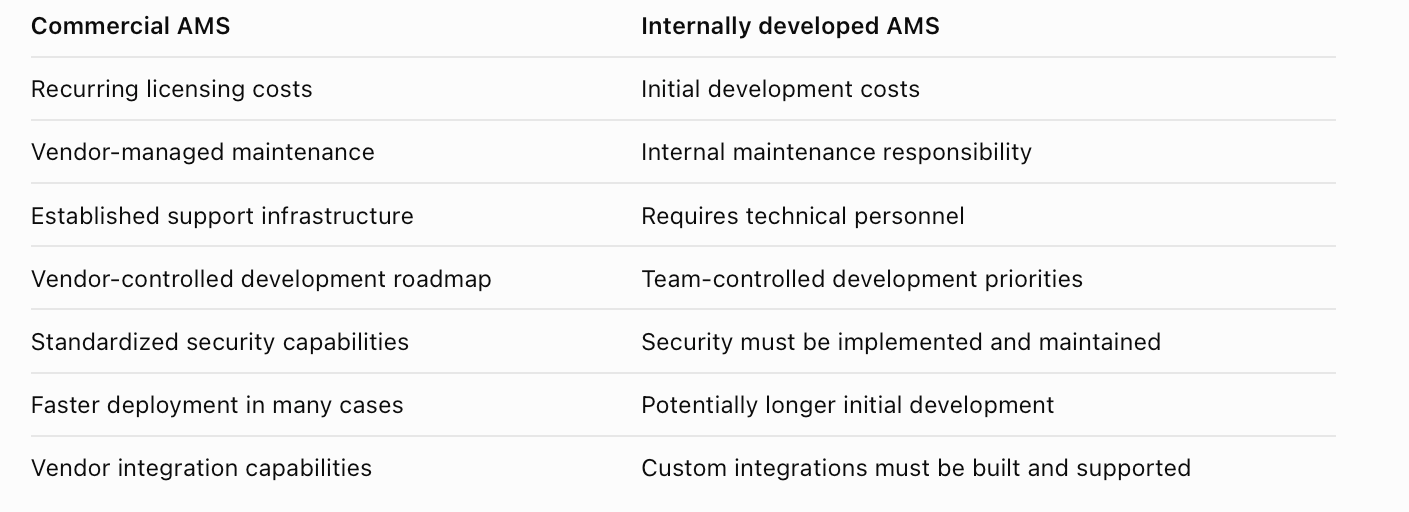
A team may save money on software licensing but spend significantly more on engineers, data infrastructure, cybersecurity and maintenance.
For this reason, the economic case for building an AMS is likely to differ substantially between a major professional franchise with an established analytics department and a smaller club operating with limited resources.
Potential Impact on Traditional AMS Vendors
If more professional sports organizations decide to develop internal applications or proprietary data platforms, established AMS vendors could face several challenges.
However, the outcome is unlikely to be the disappearance of commercial AMS providers. Instead, the market may evolve toward more flexible, integrated and customizable technology environments.
1. Greater pressure on pricing and licensing models
One potential consequence is increased pricing pressure.
If teams can reproduce certain reporting, dashboarding and administrative functions internally, they may become less willing to pay premium prices for standardized software capabilities.
This could encourage AMS vendors to reconsider how they structure their commercial offerings.
Potential changes include:
More modular pricing instead of comprehensive bundled subscriptions.
Greater flexibility around API access and data exports.
Licensing arrangements supporting customized internal applications.
Reduced charges for functionality teams can easily reproduce themselves.
More professional services and consulting support.
This does not necessarily mean that AMS subscriptions will become cheaper across the industry. Vendors providing highly specialized medical workflows, regulatory support or sophisticated integrations may continue commanding premium prices.
The greatest pricing pressure may fall on basic reporting and administrative functionality that can be replicated using general-purpose software tools.
2. APIs and interoperability could become essential competitive features
Historically, AMS platforms have often competed on their ability to centralize athlete information within a single environment.
Going forward, the ability to exchange data securely with other systems may become just as important as the functionality offered inside the platform itself.
Teams increasingly want to integrate information from GPS systems, force plates, wearable sensors, video analysis platforms, electronic medical records and internal analytics tools.
Vendors that restrict access to data or make integration unnecessarily difficult could face growing resistance from technically sophisticated customers.
Some established providers are already responding.
For example, Kitman Labs offers an API for its iP Intelligence Platform that allows authorized organizations to export structured data into their own environments for additional analysis and custom development. Access is offered as a paid add-on, with the available data determined by the licensed modules.
This is an important development because it demonstrates that commercial AMS providers can support proprietary team infrastructure rather than compete directly against it.
The future AMS market may therefore reward vendors that make their platforms easier to integrate, extend and customize.
3. Traditional vendors may need to become technology partners
Another potential shift involves the relationship between AMS vendors and their customers.
Rather than simply purchasing software, professional sports organizations may increasingly expect vendors to help them design, integrate and maintain customized technology environments.
This could create opportunities for vendors offering:
Custom software development.
Data engineering and integration services.
AI-powered reporting and workflow automation.
Proprietary model development.
Cloud infrastructure and cybersecurity support.
Long-term technical partnerships.
This model is already visible in parts of the market.
In a June 2025 Upside interview, Ralph Pethica, CEO of Genetrainer, discussed the growing diversity of AMS approaches, including teams building internally, using generic platforms or relying on spreadsheets.
He also highlighted the technical challenges teams face when attempting to build their own systems, particularly recruitment, staff retention and the ability to maintain software over time.
Genetrainer’s approach includes customized development and support for organizations with their own technical personnel.
This suggests an alternative future for AMS vendors: becoming the technology partner behind a team’s proprietary system rather than insisting that every organization use the same standardized product.
4. AI could challenge traditional reporting and analytics products
AI represents both a threat and an opportunity for AMS providers. As AI agents become more capable of querying databases, summarizing information and generating reports, some of the analytical functions traditionally included in AMS platforms could become easier to reproduce.
For example, practitioners may eventually be able to ask:
Which players have experienced the greatest increase in training load over the past two weeks?
Which athletes are progressing more slowly than expected through rehabilitation?
How does a player’s current performance compare with their historical baseline?
Which players require additional review before tomorrow’s training session?
An AI agent could retrieve relevant information, generate visualizations and prepare summaries without requiring practitioners to navigate multiple dashboards.
However, these systems must be carefully validated. AI-generated outputs can be misleading when data is incomplete, inconsistent or interpreted without sufficient clinical context.
AMS vendors are already investing in this area. In May 2026, Kitman Labs announced My iP, a reporting and visualization capability developed using Google Cloud technology. The product is designed to let organizations create more personalized analytics and reporting workflows within the existing platform.
The competitive question is whether AMS vendors will deliver sufficiently differentiated AI capabilities or whether teams will increasingly prefer to build their own AI interfaces around existing data infrastructure.
5. Vendors still have important competitive advantages
Despite the opportunities created by internal development, commercial AMS vendors retain several advantages that should not be underestimated.
Established platforms often have years of experience developing medical workflows, managing permissions, supporting complex organizations and integrating specialized sports technologies.
They also benefit from experience across multiple teams and sports, allowing them to identify recurring operational challenges that a single club may not encounter frequently.
In its published discussion of NHL customers, Smartabase noted that some teams had attempted to build their own systems but encountered substantial technical debt and operational risk. The company positioned its offering as combining customization with the benefits of an established platform.
This is particularly relevant for medical records and injury management, where reliability, security and continuity are more important than the ability to launch new features quickly.
The greatest risk to traditional AMS vendors may not be losing every customer to internal development. It may be losing control of the most valuable analytics, automation and decision-support layers surrounding their platforms.
Future Trends: How the AMS Market Could Evolve
Over the next three to five years, several developments could reshape how professional sports organizations purchase, build and manage athlete technology.
1. Hybrid AMS architectures could become the preferred approach
Rather than choosing exclusively between commercial and internally developed systems, many organizations may adopt hybrid architectures.
Under this model, teams would continue using commercial AMS platforms for core medical documentation, athlete records and established workflows while developing proprietary applications for specialized analytics, reporting and operational requirements.
A potential architecture could include:
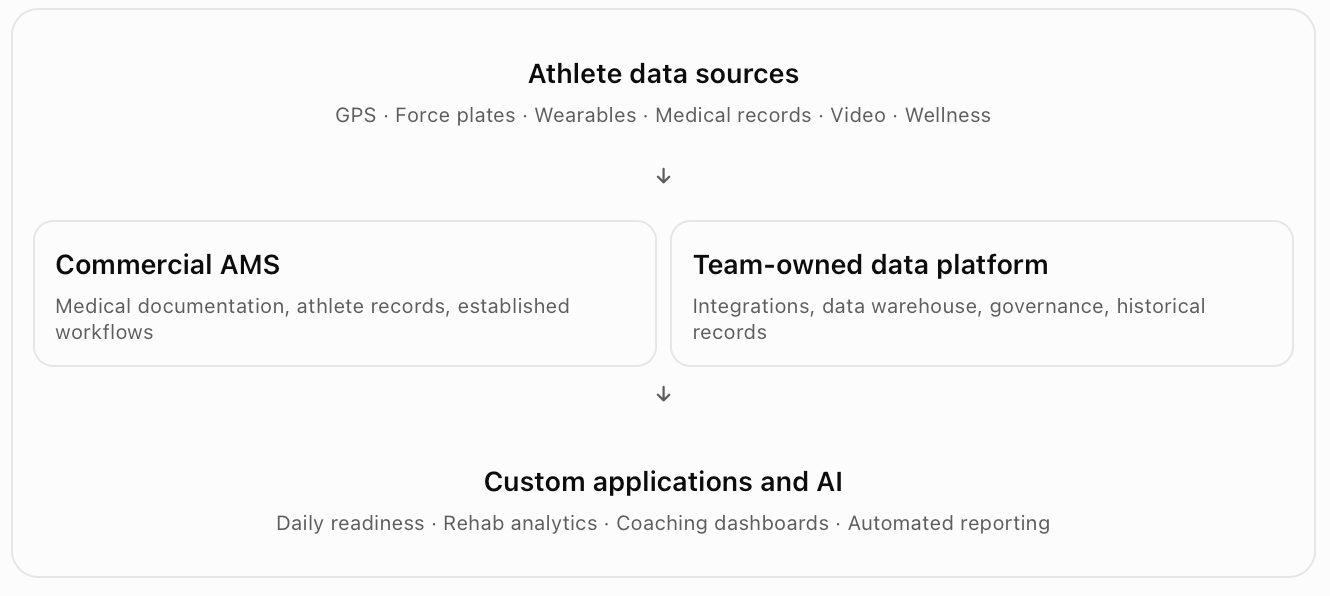
This approach could provide teams with greater flexibility without requiring them to rebuild every function of a commercial AMS.
2. AI agents could become the primary interface for practitioners
Today, practitioners often need to navigate multiple platforms to retrieve information about an athlete.
In the future, AI assistants could provide a unified interface allowing authorized staff to retrieve information across several systems through natural-language queries.
For example, a head athletic trainer might ask an AI assistant to summarize the current injury status of a roster, while a strength and conditioning coach could request individualized training recommendations based on approved performance data.
The challenge will be ensuring that these systems respect role-based permissions, preserve data provenance and distinguish between factual reporting and unvalidated recommendations.
AI should support professional judgment rather than independently make medical clearance or return-to-play decisions.
3. Teams may employ more software engineers and data specialists
As proprietary analytics become more important, professional sports organizations may need additional technical expertise.
This could include:
Data engineers responsible for integrating information across platforms.
Software developers creating customized practitioner applications.
AI engineers developing and evaluating internal agents.
Cybersecurity specialists protecting sensitive athlete information.
Product managers coordinating technology development with performance and medical staff.
However, not every organization will be able to justify building a dedicated software development team.
Smaller clubs and collegiate programs may prefer partnerships with specialized vendors or shared technology services.
4. Data portability and ownership could become major procurement requirements
AMS procurement decisions may increasingly involve detailed technical and contractual evaluations.
Teams may ask vendors to demonstrate how they can export historical records, integrate third-party technologies and support customized workflows.
Important procurement questions could include:
Can the organization export all relevant historical data in a usable format?
Are APIs included in the subscription or sold separately?
Can the team maintain its own data warehouse?
Who controls the data when the vendor contract expires?
What happens to custom integrations when the platform is upgraded?
Can the organization deploy AI tools without exposing confidential medical information?
How are access permissions, audit trails and data retention managed?
The answers could become important differentiators when teams compare commercial AMS providers.
5. The AMS market may become more fragmented before consolidating
The growing availability of low-code development tools, cloud infrastructure and AI could encourage additional startups and specialist providers to enter the market.
Some may focus on medical records, while others specialize in rehabilitation, athlete readiness, biomechanics or AI-powered analytics.
At the same time, larger vendors may pursue acquisitions or partnerships to expand their functionality and integration capabilities.
The result could be a market in which organizations have more technology choices but also face greater complexity when managing multiple systems.
Vendors that simplify this complexity could become particularly valuable.
6. The most valuable AMS providers may become orchestration platforms
Historically, the value of an AMS was often associated with collecting and storing athlete information.
In the future, value may increasingly come from connecting systems, automating workflows and helping practitioners interpret information.
This could transform the AMS from a passive database into an active operational platform.
The most successful providers may be those that can:
Integrate information from a wide range of technologies.
Maintain reliable, structured and accessible athlete records.
Automate repetitive administrative tasks.
Support proprietary team analytics.
Provide secure AI-powered decision support.
Demonstrate measurable improvements in practitioner efficiency and operational performance.
However, improvements in workflow efficiency should not automatically be interpreted as evidence of reduced injury rates or better athlete availability. Those outcomes require separate evaluation.
Conclusion: Will Professional Teams Eventually Replace Traditional AMS Vendors?
The emergence of more accessible development tools, cloud infrastructure and AI is changing the economics of athlete management technology.
Professional sports organizations now have greater opportunities to develop customized applications, establish proprietary data infrastructure and reduce dependence on individual software providers.
For some teams, particularly those with established analytics departments and sufficient technical resources, building internal systems may become an increasingly attractive strategy.
However, replacing an entire AMS platform is considerably more complicated than developing a customized dashboard or AI assistant.
Medical documentation, data security, software maintenance, system integration and long-term operational continuity remain significant challenges.
For this reason, the most likely future is not a complete replacement of commercial AMS vendors, but a shift toward hybrid technology environments in which teams control more of their data and proprietary analytics while continuing to rely on specialized software providers for critical infrastructure.
This evolution could place pressure on traditional AMS vendors to rethink their pricing, integration capabilities, customization options and overall value proposition.
Companies that insist on maintaining rigid, closed platforms may find it increasingly difficult to meet the expectations of sophisticated professional sports organizations. Conversely, vendors that embrace interoperability, flexible development and AI-enabled workflows could strengthen their position.
For performance directors, athletic trainers, rehabilitation specialists and sports scientists, the most important question is not whether an AMS was built internally or purchased from a vendor.
It is whether the technology makes their daily work easier, improves communication across departments and supports better-informed decisions about athlete health and performance.
Ultimately, the future of athlete management may be defined less by who owns the software and more by who controls the data, the workflows and the intelligence built around it.
That is where the next phase of competition in the AMS market could emerge.
Best,
Julien

You may also like:
📚Upside Analysis: The AMS Isn’t Dead—But It’s About to Change

“AMS platforms will go away in the coming years.”