
Objective Data Is Replacing Guesswork in Elite Football Clubs
How a Premier League physiotherapist used OnTraq by Qualisys to guide exercise selection, loading, and return-to-play decisions
This weekend’s World Cup final will test which medical teams made the right call on their player performance and readiness. With two or three days of recovery between matches, performance and medical staff keep answering one question: is this player ready to go again, or is he hiding an unseen movement deficit?
That same question runs through every football club throughout the season. A case shared by a Lead Performance Physiotherapist at a Premier League football club showed how objective movement data answered exactly that.
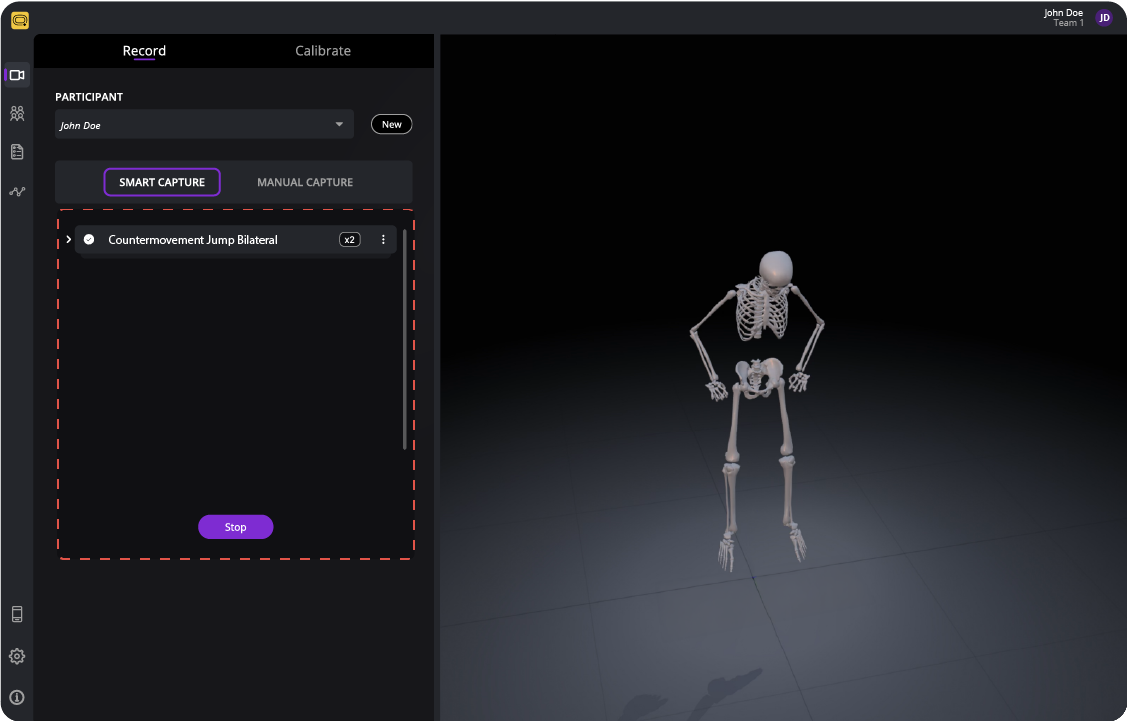
The injury was a syndesmosis sprain, a high ankle sprain, in a first-team player. Before clearing the player, the medical team used OnTraq by Qualisys to measure how he moved through a countermovement jump, comparing his injured side against his healthy one at several points across the recovery.
What the data caught
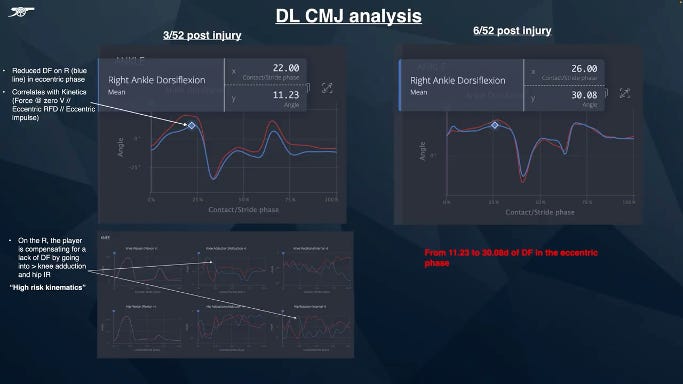
Three weeks after the injury, OnTraq reports flagged a clear difference between the injured and uninjured sides: a deficit in dorsiflexion on the injured ankle during the eccentric phase of the jump, the moment the player absorbs load on the way down.
With limited movement at the ankle, the player compensated by dropping into more knee adduction and hip internal rotation. Those are the positions a performance team wants to catch before progressing someone, because they carry their own risk. Reading the compensation in the full body data, and not only the ankle number, changed how the team judged the player’s readiness.
By the six-week retest the numbers had shifted. Dorsiflexion on the injured side improved from 12 degrees to 30, and the asymmetry between the two legs had resolved. The team had an objective marker for progress in place of a subjective one.
How it shaped the rehab
The OnTraq system provided more than movement data, it helped the team pick the athlete’s exercises. The team tested a lateral step-down against an anterior step-down to see which one demanded ankle bend. The lateral version exposed the deficit; the anterior one hid it. So, the lateral step-down became both the fix and the weekly measure of how the ankle was coming along.
They used the same thinking on load. With a bar held across the shoulders, the player drove more through the ankle. With a medicine ball held out in front as a counterweight, he shifted the load onto his knee and hip and spared the ankle. Early on, when the aim was to protect the ankle, they used the medicine ball. As he got stronger, they moved to the bar to load the ankle on purpose. Every call had a reason the staff could point to on screen.
The difference that gets athletes on track
Most tools tell you where an athlete is; fewer tell you why or let you test a decision before you commit to it. This case is a small example of a broader shift enabled by OnTraq. Teams get movement data precise enough to show the full picture and fast enough to fit into a routine rehab session, driving objective decisions on exercise selection, loading, and readiness.
The full case was presented by a Lead Performance Physiotherapist at a Premier League football club. Watch it here: ontraqbyqualisys.com/what-is-ontraq
You may also like:
🌟INDUSTRY Q&A: OnTraq in elite sport: bringing lab-grade movement data to the training floor

INDUSTRY Q&A: OnTraq in elite sport: bringing lab-grade movement data to the training floor
🎙️ Upside Video Chat with Luis Justiniano and Oskar Lindh at Qualisys, a leading provider of precision motion capture and 3D positioning tracking systems.

Today we have the honor of interviewing Luis Justiniano, a Sales Director - elite sports at Qualisys, a leading provider of precision motion capture and 3D positioning tracking systems. Luis is also joined by Oskar Lindh, Product manager at Qualisys.
Aside from questionnaires or athlete’s RPEs, are you suggesting that they were previously using something subjective?