
This week we have the honor to interview again a group of MLS sports performance executives to talk about the latest trends in the MLS, the world of sports performance and rehabilitation.
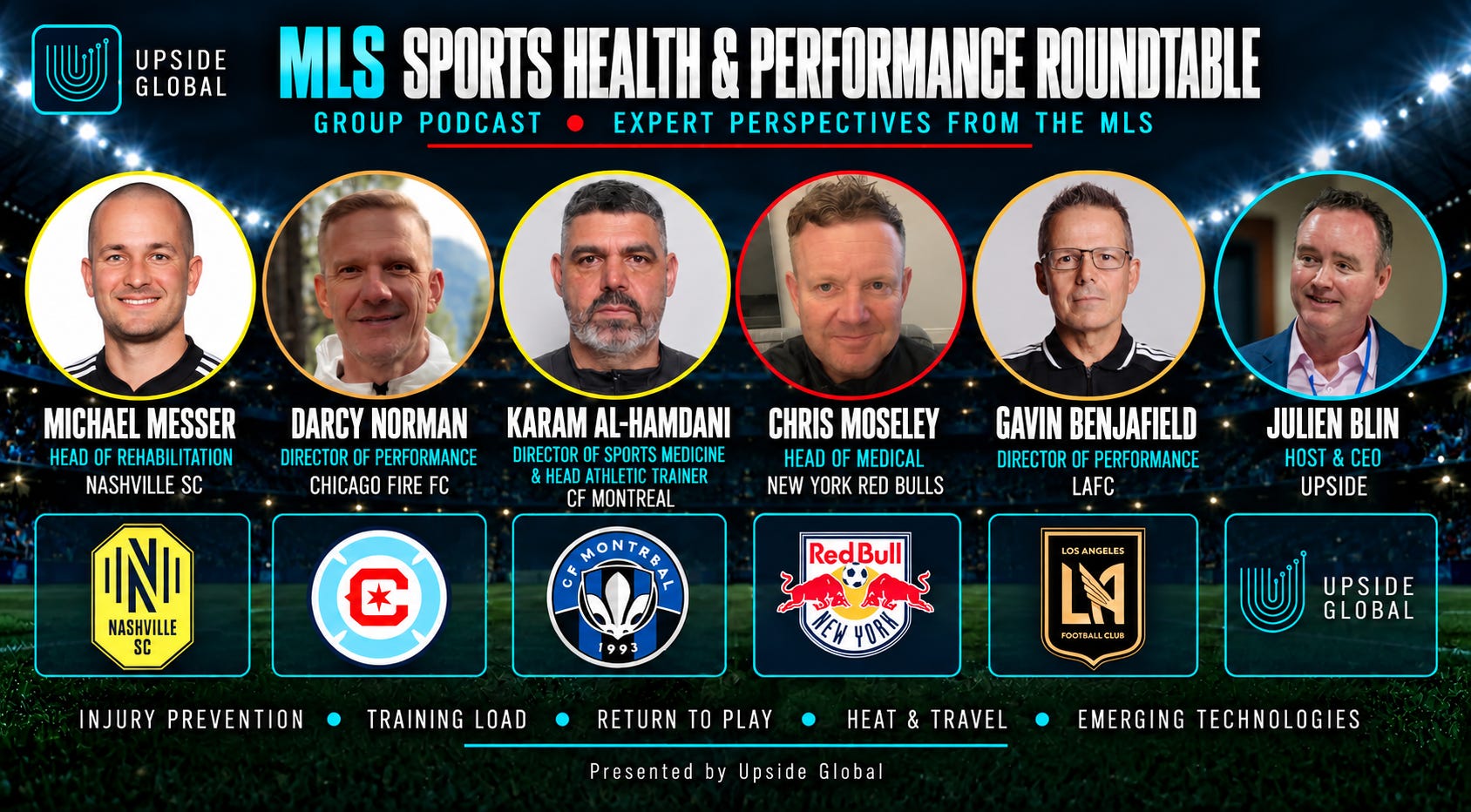
Michael Messer, the head of rehabilitation at Nashville SC (MLS).
Darcy Norman, the director of performance at Chicago Fire FC (MLS).
Karam Al-Hamdani, the Director of Sports Medicine and Head Athletic Trainer at the CF Montreal (MLS).
Chris Moseley, the head of medical at NY Red Bulls (MLS).
Gavin Benjafield, the director of performance, LAFC (MLS).
📝Show Notes: Through this interview, we touched on the following questions and topics:
Q1. The 2026 calendar, congestion & player availability.
2026 has been unlike any previous MLS season, with the World Cup break, players returning from international duty, Leagues Cup and now the final stretch toward the playoffs.
What have you learned about keeping players available through this type of fragmented and congested calendar? Have you changed how you approach training load, recovery, rotation or return-to-play?
Q2. Which data actually change decisions?
MLS teams now have access to GPS, force plates, wellness data, sleep data, biomarkers, medical data, video and many other sources of information.
If you had to identify the 3–5 metrics that actually change decisions in your organization, what would they be? And are there metrics you used to collect that you eventually realized weren’t particularly useful?
Q3. What will the MLS performance department look like in 3–5 years?
Looking ahead three to five years, what will fundamentally change inside an MLS performance or medical department?
Will the biggest changes come from AI, computer vision, automated data collection, biomarkers, advanced imaging, individualized training—or something else entirely? And what parts of the practitioner’s job do you think technology will never replace?
You can watch the video interview below by clicking on the Youtube link. You can also listen to the audio interview by clicking on the link at the top of the page:
Here are some of the best quotes of our conversation with Michael, Darcy, Chris, Gavin and Karam:
1. The 2026 calendar, congestion & player availability
Gavin Benjafield — Director of Performance, LAFC
“There’s still a lot that the league needs to learn, staff needs to learn, coaches need to learn, the entire league needs to learn. It’s not just as simple as flipping a switch. We’ve all gotta change our approach, and we have to learn very quickly.”
Travel was a major theme for Gavin:
“We had hit 30,000 miles of traveling, and that’s a good 10,000 miles more than what we had ever done as LAFC. It almost seems like traveling is becoming even more extensive. Games are then getting pushed into even a shorter timeframe.”
And one of his strongest quotes:
“Within what we have and what we can control, I think that teams that rotate the best and manage their athletes, and the number of minutes, and travel, are going to be the teams that actually win. It may not be the teams that have the best players on paper. It’s gonna be how you manage them.”
Karam Al-Hamdani — Director of Sports Medicine / Head Athletic Therapist, CF Montréal
“Despite all the recovery, all the nutrition, all the sleep that you throw their way, they just come to a point where the gas tank is empty after flying.”
His travel example is particularly powerful:
“We did 13,000 kilometers in a little bit under a week. That’s like a quarter of the Earth’s equator in a little under seven days.”
Chris Moseley — Head of Medical, New York Red Bulls
“It’s all about rest and recovery in between. Little time for coaching... but again, it’s trying to individualize the recovery strategies for your individual players.”
He also highlighted the importance of age:
“We have a quite a young age cohort here at the Red Bulls, and they tend to recover a lot quicker than the older boys.”
Darcy Norman — Director of Performance, Chicago Fire FC
“Instead of having one massive big break, to have two littler breaks throughout the season at Christmas and summer, I think overall is a really good move.”
And on managing the broader challenge:
“The bottom line is, like anything, good planning. Trying to manage it, manage expectations, try and get ahead as much of the stuff as you can ahead of time.”
2. Which data actually change decisions?
Darcy Norman — ADI / mechanical load
On ADI:
“I’ve taken on ADI and the power metrics, and mechanical work, and that’s, in my opinion, been a game changer for us both in the training and the rehab.”
And his challenge to conventional GPS metrics:
“I think we give way too much credence and value to high-speed running. It’s when you look at the physics and do the math, it doesn’t have that big of an impact.”
He also described the metrics they use to identify unusual loading:
“If my rolling max ratio is really high and my equivalent density estimate is really low... this is a very novel stimulus, then that’s a kind of a multiplier of a flag.”
Chris Moseley — data needs context
“Don’t fall in love with the data, ‘cause you could find out what a 16-year-old Romanian kid has had for his lunch off the internet. Everything is there and available. It’s just what you do with the data.”
On wellness questionnaires:
“They can say whatever they want on the wellness questionnaire... but I think it’s getting to know your players, communicating with your players, and just watching them around the building, seeing the body language as well.”
On human + data:
“You have to take that with a pinch of salt. I think it’s getting to know your players, communicating with your players, and just watching them around the building.”
Karam Al-Hamdani — objective vs. subjective information
“We make sure that our players have to come into the infirmary or the training room post-game, or the following days... If there are adjustments that need to be made, we do them... and we make sure that we document these things.”
On wearable data:
“Does it really affect our decision-making processes? Not so much, but we have a sort of a red flag, yellow flag, green flag system.”
Gavin Benjafield — less testing, more useful information
“Because of the density of games, because of the travel that we’re doing, we’re actually testing way less than what we were before.”
“I’m just trying to give the coaches the best possible... what is the readiness? And honestly, sometimes some of that is just my gut feel.”
And:
“It’s more subjective than anything else with a little bit of objective sprinkled in there.”
His vision for the future of data collection is also strong:
“If it’s already there and we don’t have to do an extra layer of testing, that could be a big distinguisher for us.”
Michael Messer — Head of Rehabilitation, Nashville SC
No single technology should drive a decision:
“If all those things are saying the same thing, then that’s a more powerful statement to us than just one piece of data that we’ve collected from some specific technology.”
And:
“It’s more of just an overall holistic approach and trying to use everything that’s available to us than relying on any one singular thing to really impact our decisions.”
3. What will the MLS performance department look like in 3–5 years?
Gavin Benjafield — less data collection, more integration
“I think it’s gonna certainly be about collecting less information and doing more with the information that you actually have.”
He wants technology to operate in the background:
“I’m trying to understand the athlete and everything that we are collecting and trying to collect as much in the background rather than the foreground. And then actually doing like, how does all of this connect? How does this all relate to the athlete?”
And his view of individualized recovery:
“Understanding them better and recovering them better is just gonna allow them to get to the next game 10, 15% more ready.”
Gavin — specialization of rehabilitation
“We should be building our rehabilitation schedules not around the team schedule, but around what’s best for the actual athlete.”
And his prediction:
“In three to five years, I think that we are gonna see separation of a medical performance team and a medical rehab team.”
Michael Messer — rapid growth in specialized rehab staff
“When I came into the league with Nashville, in 2021, I think I was the seventh full-time PT in the league. And just in the time between now and then, I think we’re up close to 30.”
And:
“I’ve also seen several job descriptions of late for return to play specialist, reconditioning specialist within that MLS model.”
His prediction:
“You will start to see more staff members added to the high performance setup within MLS, which will really open a lot of doors to just be able to do more and more specialized care with athletes we’re working with.”
Darcy Norman — AI will remain a tool, not the decision-maker
“The AI stuff, I think it’s just a pendulum. It’s the new sexy toy that everyone’s fired up about, and then they’re gonna realize all the implications.”
And perhaps his strongest statement:
“You’ll need that continued human oversight on everything, for the art that Chris was talking about in it, as well as just the accuracy and consistency of how your systems and structures are put together.”
Chris Moseley — technology cannot replace the “art” of rehabilitation
“The AI explosion... it’s not gonna stop, so we have to embrace it and go with it, but where it’s gonna take us, I’m not quite sure. We need to keep the human element in there as well. We need to keep the artistic element within the game.”
“We’ve got all these objective markers that the players have to hit, but we ask for six objective markers before moving on to a different stage, but then six art as well.”
Chris — communication may matter more than technology
“The communication between the medical staff and the head coach is probably the most important relationship within the club.”
And:
“We sit down, have a round table discussion, we come out with a common decision with the MDT and the coaching staff.”
Karam Al-Hamdani — nutrition and communication remain underdeveloped
Karam raised an important area that wasn’t as technology-focused:
“I feel like there’s one area... that I feel is really untapped and misunderstood. And that’s nutrition.”
And then a broader organizational challenge:
“I find that there is a gap in terms of communication between us and the coaching staff... I hope that gap is gonna get smaller as the years go by, where the coaches have more of an understanding to what we’re trying to bring to the table.”
You may also like:
🔥Upside MLS Video Chat with Mike Messer (Nashville SC), Darcy Norman (Chicago Fire FC), Karam Al-Hamdani (CF Montreal), Jason Han (ex LAFC) On MLS' Next Competitive Edge, Future MLS Athletes & More

This week we have the honor to interview again a group of MLS sports performance executives to talk about the latest trends in the MLS, the world of sports performance and rehabilitation.
🔥Upside Chat with Mike Messer (Nashville SC / MLS), Jason Han (Ex LAFC / MLS) on Biohacking, Shiny Tech Objects, The MLS Evolution, and PSG's Champions League Win

This week we have the honor to interview again a group of sports performance executives to talk about the latest trends in the world of sports performance and rehabilitation.
🔥Upside MLS Video Chat with Mike Messer (Nashville SC), Darcy Norman (Chicago Fire FC), Karam Al-Hamdani (CF Montreal), Jason Han (ex LAFC) On MLS' Next Competitive Edge, Future MLS Athletes & More
This week we have the honor to interview again a group of MLS sports performance executives to talk about the latest trends in the MLS, the world of sports performance and rehabilitation.