
This week we have the honor to interview again a group of MLS sports performance executives to talk about the latest trends in the MLS, the world of sports performance and rehabilitation.
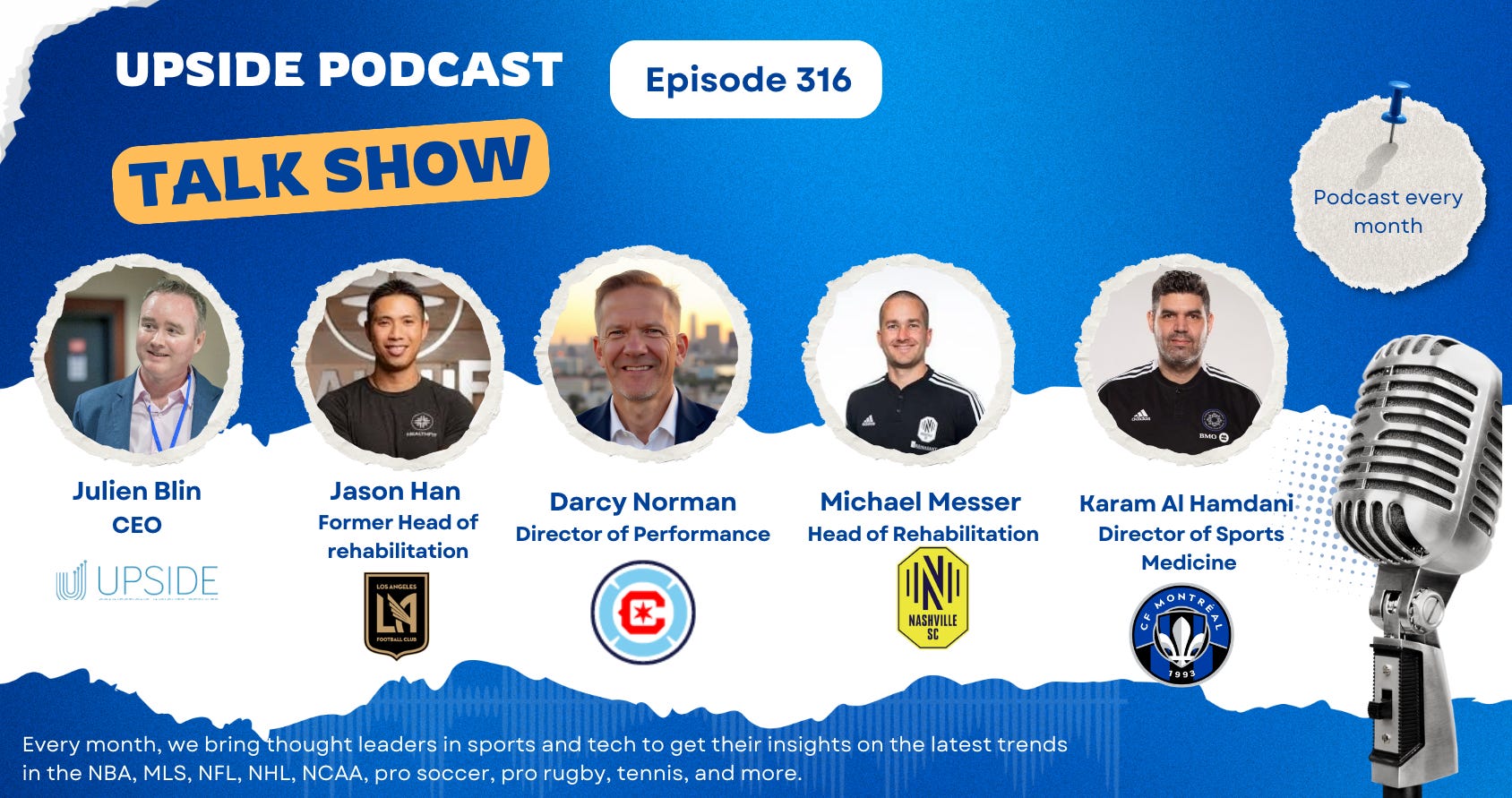
Michael Messer, the head of rehabilitation at Nashville SC (MLS).
Darcy Norman, the Director of Performance at Chicago Fire FC (MLS).
Karam Al-Hamdani, the Director of Sports Medicine and Head Athletic Trainer at the CF Montreal (MLS).
Jason Han, the former head of rehabilitation at LAFC (MLS). Jason is also the head of business development in North America at OneBase health.
You can watch the video interview below by clicking on the Youtube link. You can also listen to the audio interview by clicking on the link at the top of the page:
Here are some of the best quotes of our conversation with Michael, Darcy, Jason and Karam:
🧠 Q1. The Next Competitive Edge in the MLS
Darcy Norman
“I think it’s data and information systems. The groups that are willing to take on the challenge of implementing technology — and more importantly, building the systems and processes around it — are going to have a serious advantage. It’s a ton of work, but if you can get good data and turn it into meaningful information, it allows you to adapt faster to trends, league demands, and the global game. Ultimately, better information leads to better decisions and faster progress.”
“From a pure resourcing standpoint, MLS is still behind Europe. Some clubs here have very small or even non-existent departments compared to what you see overseas. But the teams that recognize this gap and embrace data and technology as a way to create an edge are the ones that will benefit the most.”
Jason Han
“The data is incredible, especially now with AI — you can process information from your own team and across the world at light speed. But we’re in this in-between stage. You can have all the data in the world, but if you don’t have enough people to implement it and build relationships with players, it doesn’t matter. The real competitive edge will come from combining data with the human side — and that requires investment in people.”
Karam Al Hamdani
“I really think the next competitive advantage is the creation of true R&D departments within clubs. You can have the best technology and AI systems, but if you don’t have dedicated people whose job is to interpret that data and turn it into meaningful, actionable insights for players and staff, then data is just data. The value comes from translating it into something usable.”
Michael Messer
“I’m really interested to see what happens after the World Cup in the U.S. It could shift resources, interest, and even the talent pipeline. In the U.S., we’re competing with other sports for top athletes, unlike many European countries. So the next edge might also come from improving our academy systems and attracting better athletes into soccer earlier.”
🤝 Q2. Collaboration Between Departments
Karam Al Hamdani
“Collaboration has evolved massively. When I started, it was basically one trainer, one assistant, and one fitness coach doing everything. Now you have full departments — medical, performance, analytics — all with strong opinions and ideas. The key is constant communication and having meaningful meetings with clear agendas and actionable outcomes. That’s what creates true synergy.”
“You have to be prepared, but also flexible. No matter how much planning you do, there will always be curveballs. So best-in-class collaboration is about preparation, communication, and the ability to adapt in real time.”
Darcy Norman
“As clubs grow, it becomes harder to keep everyone aligned. You might have more expertise, but also more complexity. So you need a really clear mission, vision, and values. Otherwise, you waste time and create friction. Collaboration today is about being interdisciplinary, efficient, and respectful of time — because if not, burnout becomes a real risk.”
Jason Han
“It really comes down to leadership. You can have five or ten smart people in a room, but if no one is truly leading and creating structure, things fall apart. You need clear processes, accountability, and clarity on who is responsible for what. At the same time, you have to stay flexible because in sport, things change instantly.”
Michael Messer
“What you’re starting to see is a better understanding across departments of how each role contributes to the bigger picture. But that only works if there’s strong leadership at the top to align everyone toward a common goal. Whether it’s rehab, performance, coaching, or analytics, everyone needs to be working toward the same vision.”
⚡ Q3. Athlete Fatigue (Physical & Psychological)
Darcy Norman
“Fatigue is a massive question — and I don’t think it’s ever fully solvable. It starts with leadership, culture, and good planning. Monitoring tools help, but they all have limitations. For example, with GPS, we thought we understood workload, but then realized we were missing 30–40% of what players were actually doing.”
“At the end of the day, the most important tool is still communication. Having honest conversations with players — ‘How are you feeling? Are you ready today?’ — is often more valuable than any piece of technology. The data helps guide you, but it doesn’t replace that human interaction.”
Jason Han
“What players do outside the facility is a huge, often untapped part of fatigue management. You can control training, recovery, and protocols inside the building, but you also need to educate players on their choices outside — sleep, activity, lifestyle. Ultimately, it comes down to helping them understand what they truly want and aligning their behaviors with that.”
Karam Al Hamdani
“You can have all the tools — Oura rings, Whoop, questionnaires — but it always comes back to honest conversations. You combine how the player feels physically, how they feel mentally, what the data says, and what you see clinically, and then you make a decision.”
“Fatigue today isn’t just physical — it’s travel, time zones, emotional stress, performance outcomes. You take all of that, mix it together, and try to make the best possible call. But communication is always the key.”
Michael Messer
“For me, communication is always the first line. A simple daily RPE or honest conversation can be incredibly powerful. The challenge is taking all the available data and turning it into a simple, confident decision — especially when that decision might impact training or game selection.”
“There’s so much technology out there, but the real challenge is using it consistently and meaningfully. And ultimately, you need the coach to trust the information you’re presenting if it’s going to influence decisions.”
🔮 Q4. Future of the MLS Athlete
Darcy Norman
“As academies improve and the talent pool grows, the overall quality of the MLS athlete will continue to rise. From a performance standpoint, I’d like to see players become more ‘pound-for-pound’ strong — not necessarily bigger, but more powerful and efficient relative to their body weight.”
“With better players and increased competition, everything speeds up — decision-making, intensity, execution. Players adapt to that environment, and it elevates the entire level of the game.”
Karam Al Hamdani
“I think the future MLS athlete will be smarter and more educated. With better academy systems and more resources in areas like performance and nutrition, players will develop stronger decision-making skills and a deeper understanding of the game.”
Jason Han
“As the quality of teammates and competition improves, the overall level rises. But I think a big shift will be players treating their bodies like precision-managed systems — combining objective data with their internal drive and passion for the sport. That balance will create better athletes.”
Michael Messer
“The level of the athlete will continue to improve across physical, technical, and cognitive areas. Physically, MLS players are not far off globally, but where you see the gap is at the very top end — the elite of the elite.”
“The biggest opportunity for growth is probably on the technical and tactical side — developing smarter players, stronger identities, and more refined styles of play through better academy development.”
You may also like:
🔥Upside MLS Video Chat with Mike Messer (Nashville SC), Darcy Norman (Chicago Fire FC), Karam Al-Hamdani (CF Montreal) On Innovations Needed in the MLS, Recovery Modalities, AI Tools, Apple TV Deal.

This week we have the honor to interview again a group of MLS sports performance executives to talk about the latest trends in the world of sports performance and rehabilitation.


