
This week we have the honor to interview again a group of MLS sports performance executives to talk about the latest trends in the MLS, the world of sports performance and rehabilitation.
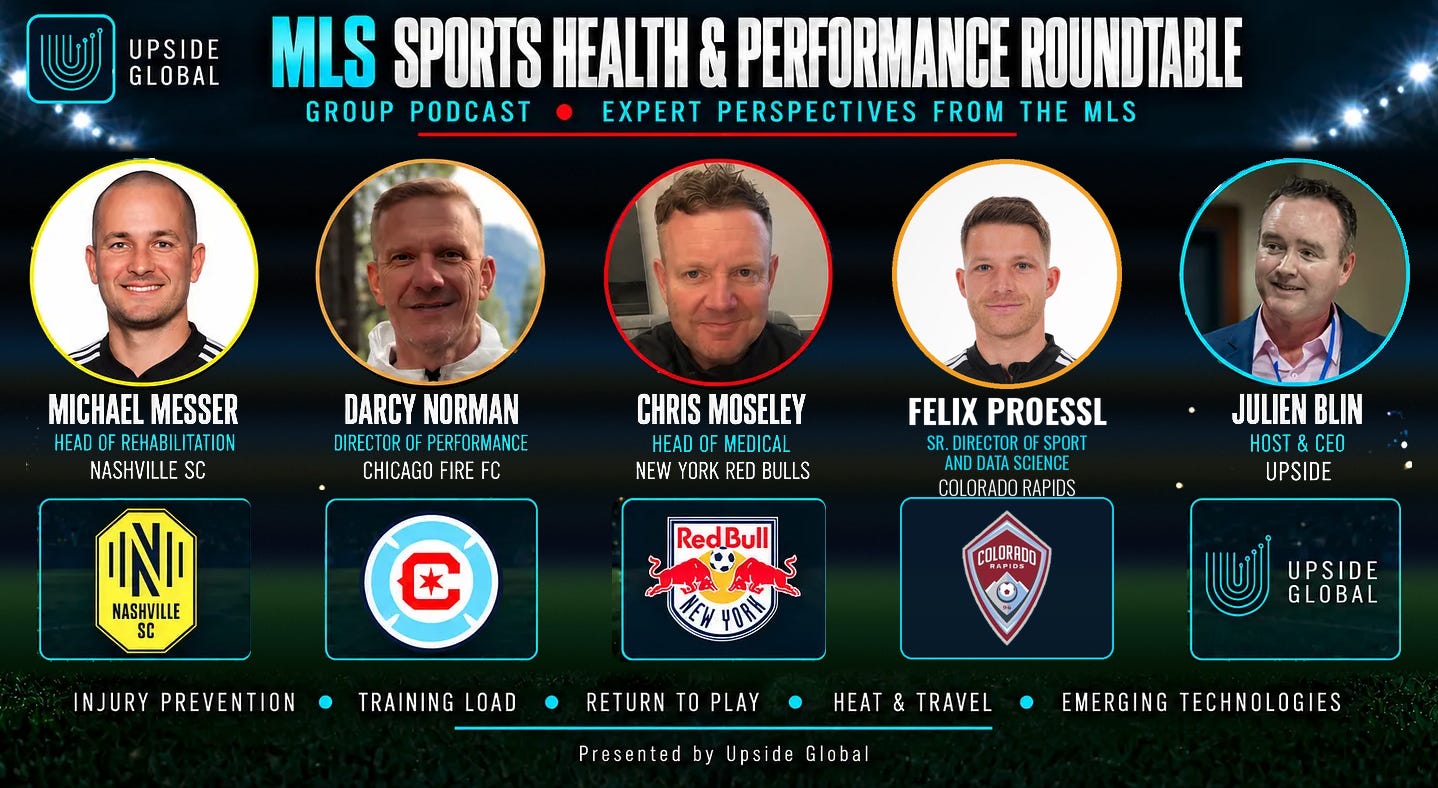
Michael Messer, the head of rehabilitation at Nashville SC (MLS).
Darcy Norman, the director of performance at Chicago Fire FC (MLS).
Chris Moseley, the head of medical at NY Red Bulls (MLS).
Felix Proessl, Sr. Director of Sport and Data Science at Colorado Rapids (MLS).
📝Show Notes: Through this interview, we touched on the following questions and topics:
Q1. End-of-season review: What worked and what didn’t in 2026?
As the 2026 MLS season comes to an end for many clubs, performance and medical departments are reviewing their results.
How do you evaluate the effectiveness of your performance and medical programs over an entire season? Which KPIs matter most—player availability, injury burden, reinjury rates, training availability, or something else?
Q2. Off-season management: How do you keep players accountable?
With many MLS players entering their off-season, teams must balance recovery, physical development, and maintaining fitness ahead of preseason.
How do you individualize off-season programs, monitor players remotely, and ensure they remain accountable when they are away from the club?
Q3. AMS platforms: Build in-house vs. buy from vendors?
We are seeing more professional sports organizations exploring the development of their own Athlete Management Systems rather than relying entirely on commercial solutions.
What is driving this shift? Is it customization, data ownership, integration challenges, cost, or dissatisfaction with existing AMS platforms?
Do you believe the future is in-house development, commercial AMS solutions, or a hybrid model?
Q4. AI agents: How will they transform MLS performance departments?
AI agents are emerging as a new generation of tools capable of automating workflows, analyzing data across multiple systems, and proactively delivering insights.
Where do you see the biggest opportunities for AI agents in your daily operations—automated reporting, injury surveillance, athlete monitoring, rehabilitation tracking, or technology scouting?
Q5. Preparing for 2027: Technology budgets and priorities
As MLS clubs begin planning for the 2027 season, performance and medical departments must evaluate their technology investments and identify areas for improvement.
Are you planning to invest in new technologies next season, or is the priority to better integrate and maximize the tools you already have?
Here are some of the best quotes of our conversation with Michael, Darcy, Chris, and Felix:
1. End-of-season review: What worked and what didn’t in 2026?
Darcy Norman — Chicago Fire FC
“On the player wellness side, it’s really player availability and robustness, improved performance, and career longevity. Everything we do is geared towards that. We benchmark ourselves against the UEFA study on training and match injuries per thousand hours. We also compare return-to-play timelines against research standards based on the diagnosis.”
“We look at joint range of motion and mobility, functional movement screening, strength, power metrics, and GPS data for maximum speeds and power outputs on the pitch. In each of those categories, we want to see whether players are maintaining or improving, rather than declining.”
Chris Moseley — New York Red Bulls
“Player availability is number one. We look at injury recurrence rates, how quickly and safely we can get players back, and what condition they are in when they return to training and playing. Our physical metrics have been very good this year, but we’ve conceded too many goals and haven’t scored enough. Those are things we’ll need to address.”
“I don’t think it’s a matter of predicting injuries. There’s no such thing as prevention. It’s about reducing the risk as much as possible and making the athlete as durable and robust as possible in every scenario.”
Felix Proessl — Colorado Rapids
“We’ve had a new coach this season, so part of our review is understanding how our environment has changed. When we switch from man-to-man to a zonal defensive strategy, what does that mean from a physical perspective? What does it mean for our older players? We need to put physical performance metrics into the context of our playing style.”
Michael Messer — Nashville SC
“Availability is certainly the big thing we look at. But when you start talking about injury burden, you have to be careful. It’s a great metric for the staff when it looks good, but you also have to own it when it doesn’t. Sometimes there are factors outside of our control that drive that number.”
“It’s not as simple as saying another team runs more than us. Is that necessarily a bad thing? If you’re winning games and doing it more efficiently, is it more about playing style? Those are some of the questions we’re trying to understand.”
✅ Recommendations for teams:
Prioritize player availability and injury recurrence: Evaluate player availability, injury burden, reinjury rates, and return-to-play timelines against historical results and relevant research benchmarks.
Measure actual performance improvements: Assess changes in strength, power, speed, mobility, and physical capacity throughout the season, rather than relying exclusively on injury statistics.
Put performance data into context: Consider playing style, tactical changes, player age, match demands, and coaching philosophy when evaluating physical performance.
Identify improvements for 2027: Conduct a multidisciplinary review involving performance, medical, rehabilitation, and coaching staff to identify what worked, what didn’t, and what needs to change.
2. Off-season management: How do you keep players accountable?
Darcy Norman — Chicago Fire FC
“It starts with setting expectations for the next season. How do you want to come back? Do you want to get better? What goals are you trying to achieve? We write the programs, give players opportunities to execute, stay in touch with them, and help them work through any challenges. Ultimately, you want players who are accountable to themselves and the program, so you don’t have to police it.”
“The ramp-up time is going to be tighter, so players need to come in ready to go from the beginning. Our job is to eliminate every possible excuse, make sure they know exactly what they’re doing and why, and get them bought into their individual programs.”
Chris Moseley — New York Red Bulls
“The demands of the game are getting greater. We’re seeing more international training camps during December, so we have to balance rest, recovery, and training loads. Every player leaves the club with an individual program, and we facilitate practitioners to work with them around the world. But there’s a big trust element.”
“The Players Association doesn’t really allow us to track players during their downtime because they’re entitled to rest and recovery. Yet they can go and work with any practitioner they want. We’re trying to gain as much control as possible without imposing on their recovery. It’s a two-way trust process.”
Felix Proessl — Colorado Rapids
“Some players have almost the opposite problem. When you tell them they have ten weeks before preseason, that’s significantly longer than what they’ve experienced before. They’re actually asking us for guidance on how to bridge that time.”
“End-of-season testing helps identify individual deficits, whether that’s strength, body composition, or speed. Those results shape the individualized program, and players know they’ll be retested when they return. That creates buy-in and clarity.”
Michael Messer — Nashville SC
“As staff, the best thing we can do is set players up for success and put mechanisms in place so expectations are clearly explained. With the way the Players Association has things set up, it really comes down to trust.”
“Sometimes players go back to their hometowns for rehabilitation. Our job is to facilitate their care, make sure everyone is on the same page, and ensure they’re where we expect them to be when they return for preseason, rather than having to play catch-up.”
✅ Recommendations for teams:
Create individualized off-season programs: Develop plans based on each player’s end-of-season testing, injury history, physical deficits, and development goals.
Establish clear expectations: Communicate fitness targets, training objectives, and preseason readiness requirements before players leave the club.
Maintain communication without excessive monitoring: Stay connected with players and their external practitioners while respecting their recovery time, privacy, and Players Association requirements.
Prepare players for preseason demands: Balance recovery and physical development, particularly for players attending international camps or returning to a shortened preseason.
3. AMS platforms: Build in-house vs. buy from vendors?
Chris Moseley — New York Red Bulls
“There are trusted commercial platforms out there, and they are secure with the data. But internal systems also have great value because you can build and design them yourself. We have one system across the entire Red Bull group, where every player goes into the system and we can cross-reference players across different countries and continents.”
“Our system is always developing. We’re constantly making suggestions to improve it. It also brings practitioners together from around the world and allows us to share what we consider best practices. It’s not without its glitches, like any system, but we’re always looking to improve it.”
Felix Proessl — Colorado Rapids
“We’re in a hybrid situation at the Colorado Rapids. We have a commercially available AMS that handles the simple, day-to-day use cases requiring manual input from practitioners. But when it comes to larger or more sophisticated datasets, such as time-series data from optical tracking, our AMS isn’t really set up to house that information. So we store it elsewhere and connect the systems.”
“Whether a hybrid model is something other clubs can replicate depends on their resources. If you have several data engineers, that’s obviously an advantage. But if you have very few engineers, or none at all, it’s a different situation. At the end of the day, we’re practitioners because we love being on the pitch helping athletes, not writing code 24/7.”
Darcy Norman — Chicago Fire FC
“We’re similar to Felix, with a hybrid system. We’re still fairly new on our data journey, so a big focus has been getting everyone, from the academy to the first team, entering consistent data every day. Naming conventions, dropdowns, and clean data become really important if you want to run effective analysis later.”
“We’re building our own tools to automate things like programming, planning, and periodization, and then connecting them to the AMS. The goal is to piece the whole system together in a clean way, without redundancy, and make sure we have a good, reliable source of data.”
Michael Messer — Nashville SC
“We started with a commercial AMS and have gradually moved toward more of an in-house system. From a resource standpoint, the in-house system has been more first-team focused. I can see where a hybrid model would be beneficial, especially for the second team and academy while you’re building out the system across the whole club.”
“Teams are going to increasingly define performance in their own way and within their own context. Different clubs will have different definitions of peak performance metrics, and their in-house systems will be built around that.”
✅ Recommendations for teams:
Evaluate a hybrid AMS approach: Consider combining commercial platforms for daily data collection with internally developed tools for advanced analytics, reporting, and club-specific requirements.
Prioritize data quality and integration: Standardize naming conventions, data entry processes, and reporting across performance, medical, rehabilitation, academy, and first-team departments.
Assess internal engineering resources: Before building an AMS in-house, determine whether the club has sufficient data engineers, developers, and technical support to maintain it.
Build around the club’s performance philosophy: Ensure the AMS reflects the team’s playing style, performance KPIs, operational workflows, and long-term objectives rather than forcing practitioners to adapt to a generic platform.
4. AI agents: How will they transform MLS performance departments?
Michael Messer — Nashville SC
“Some of our rehabilitation datasets can become pretty large. I might have data from VALD, Playermaker, VALOR Vision, ADI, and STATSports. I can plug those into an AI agent and ask whether it sees any worrying trends for a player with a particular issue.”
“I’ve certainly seen things using AI that I wouldn’t have picked up manually while sifting through the data. Some of those findings made a lot of sense, and I think it’s an interesting direction that I’ll continue exploring.”
Darcy Norman — Chicago Fire FC
“I see benefits across all the areas you mentioned. The big thing is making sure we have enterprise systems and aren’t just connecting everything without thinking about security. With people using AI more freely, I think the risk of HIPAA and GDPR violations increases considerably.”
“I’ll build something in Claude to solve a problem, feed it some fake data to check that the calculations work, and then hand it over to our data engineering team. They can turn it around very quickly and connect it to our in-house AMS. Things that used to take months can now take weeks or even days.”
“It comes back to data governance as an organization: how you’re handling the data, cleaning it, and connecting everything in the background so it’s repeatable and you’re not getting miscalculations or hallucinations.”
Chris Moseley — New York Red Bulls
“I think the biggest issue is security. A secure in-house system is the best way forward. We need to be careful about how AI agents are being used and where the data is going.”
Felix Proessl — Colorado Rapids
“One thing to be cautious about is the black-box nature of some AI agents. People get excited about getting answers and extracting information from datasets they couldn’t analyze otherwise, but they don’t always have a proper checks-and-balances system in place.”
“AI helps me with coding. Copilot can anticipate commands, clean up scripts, and save a lot of time. I also like using it for brainstorming, challenging my own logic, and looking at a problem from different perspectives. But you still need to understand what you’re doing.”
✅ Recommendations for teams:
Start with practical use cases: Test AI agents for automated reporting, rehabilitation data analysis, performance monitoring, coding assistance, and identifying trends across multiple datasets.
Protect sensitive athlete information: Use appropriately secured enterprise AI environments, establish data access policies, and avoid uploading confidential player information into unapproved AI tools.
Keep practitioners involved in decision-making: Validate AI-generated insights and calculations before using them to influence training, rehabilitation, or return-to-play decisions.
Use AI to improve existing workflows: Explore how AI can automate repetitive tasks, accelerate internal software development, and help performance and medical staff spend more time working directly with athletes.
5. Preparing for 2027: Technology budgets and priorities
Chris Moseley — New York Red Bulls
“Technology evaluation is part of our end-of-year review. What’s worked? What hasn’t? Is the financial investment worth the reward we’re getting? If it isn’t, we look at other strategies that can improve performance and take the club further.”
“If you’ve invested financially in a technology, you have an obligation to review it properly. Did it work? Why did it work or not work? If there’s potential to improve how it’s being used, then explore that. If it’s no longer useful, cut your losses and look elsewhere.”
Darcy Norman — Chicago Fire FC
“For us, the question is: Does this technology improve your decision-making? Is it giving you information or insights that allow you to do better work? If the answer is yes, then it stays. If not, you’re probably going to get rid of it.”
“There’s so much data nowadays, and the costs add up quickly. A platform might cost $30,000 a year, another technology $10,000 a year, and then you have GPS, AMS, force plates, gym technologies, and everything else. When you’re doing that across the whole club, from the first team to the U13s, it’s a significant investment.”
“If you’re locked into a long-term contract for something you’re not using, I think the first step is having a conversation with the vendor. It doesn’t do anybody any good to keep paying for something you don’t use. It’s better to communicate openly and see whether you can part ways amicably.”
Felix Proessl — Colorado Rapids
“Whenever we evaluate a vendor or technology, we look at data hygiene, reliability, and construct validity. Can I actually trust the measurement? Then there’s the implementation piece. Does it fit into our decision-making process and our day-to-day setup?”
“Sometimes it’s better to integrate the technologies you already have rather than invest in something new. Every time you bring in a new tool, people need time to learn it. Ultimately, the people and processes within your organization shape the value of that technology.”
“You can have a great tool that measures exactly what it’s supposed to measure, but if it doesn’t fit your environment or workflow, it may not be useful. You have to consider when information is collected, when it’s delivered, and whether it can actually influence a decision.”
Michael Messer — Nashville SC
“For us, technology discussions usually start in one of two ways: either we have a specific problem we’re trying to solve, or someone in the department comes across something that looks interesting. Ultimately, it’s a group discussion where we evaluate all the factors everyone has mentioned.”
✅ Recommendations for teams:
Conduct a comprehensive technology audit: Review every technology currently used by the club, including GPS, AMS, force plates, rehabilitation equipment, and AI tools. Evaluate usage, reliability, costs, and measurable benefits.
Prioritize technologies that improve decisions: Before purchasing new solutions, determine whether they address a specific problem and provide actionable insights that practitioners can use.
Maximize existing investments: Improve integration, staff training, and adoption of technologies already in place before committing additional budget to new products.
Review vendor contracts and technology ROI: Assess subscription costs, long-term commitments, product development roadmaps, and whether vendors continue to meet the club’s needs. Where appropriate, renegotiate or discontinue underused solutions.
You may also like:
🔥Upside MLS Video Chat with Mike Messer (Nashville), Darcy Norman (Chicago Fire), Karam Al-Hamdani (CF Montreal), Chris Moseley (NY Red Bulls), Gavin Benjafield (LAFC) On Calendar, 5 Yrs Prediction

This week we have the honor to interview again a group of MLS sports performance executives to talk about the latest trends in the MLS, the world of sports performance and rehabilitation.
🔥Upside MLS Video Chat with Mike Messer (Nashville SC), Darcy Norman (Chicago Fire FC), Karam Al-Hamdani (CF Montreal), Jason Han (ex LAFC) On MLS' Next Competitive Edge, Future MLS Athletes & More

This week we have the honor to interview again a group of MLS sports performance executives to talk about the latest trends in the MLS, the world of sports performance and rehabilitation.
🔥Upside Chat with Mike Messer (Nashville SC / MLS), Jason Han (Ex LAFC / MLS) on Biohacking, Shiny Tech Objects, The MLS Evolution, and PSG's Champions League Win

This week we have the honor to interview again a group of sports performance executives to talk about the latest trends in the world of sports performance and rehabilitation.
🔥Upside MLS Video Chat with Mike Messer (Nashville SC), Darcy Norman (Chicago Fire FC), Karam Al-Hamdani (CF Montreal), Jason Han (ex LAFC) On MLS' Next Competitive Edge, Future MLS Athletes & More
This week we have the honor to interview again a group of MLS sports performance executives to talk about the latest trends in the MLS, the world of sports performance and rehabilitation.