
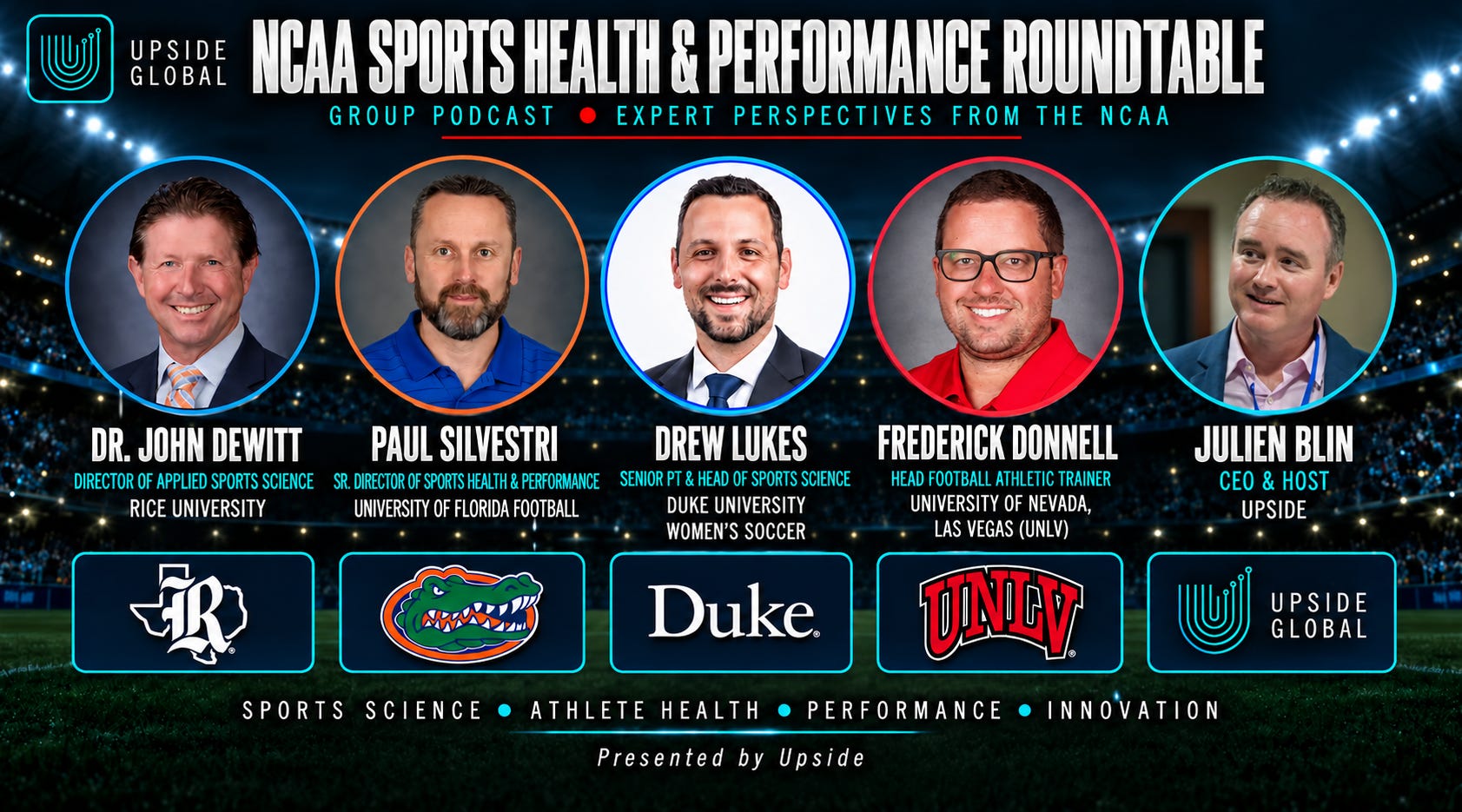
Today we have the honor of interviewing a group of NCAA sports performance experts.
Dr. John DeWitt, Director of applied sports science in the athletic department and a faculty member, Rice University.
Paul Silvestri, Sr director of sports health and performance, University of Florida football.
Drew Lukes, Senior PT at Duke University and the head of sports science, Duke university’s women soccer team.
Frederick Donnell, Head Football Athletic Trainer at the University of Nevada, Las Vegas (UNLV).
📝Show Notes: Through this interview, we touched on the following questions and topics:
Late-season fatigue: How do you keep athletes performing at their best?
Injury management: How does your approach change late in the season?
Recovery: What strategies actually work during the most demanding part of the season?
Postseason preparation: How do you prepare athletes physically and mentally for high-pressure games?
Looking ahead: What lessons from this season will influence your offseason strategy?
You can also watch the full video interview below:
Here are some of the best quotes of our conversation with them:
Q1. Late-season fatigue: How do you keep athletes performing at their best?
With NCAA football and soccer teams approaching the end of their regular seasons or entering postseason competition, practitioners discussed how to manage accumulated fatigue while maintaining strength, speed, and readiness.
Dr. John DeWitt — Rice University
“We’re not trying to build fitness in August. We’re trying to build it in April, May, June, so when we play, we’re ready to go.”
“We won’t reduce sprint exposure. That’s really important to always have some sort of high-speed exposure each week.”
“Our main tool is countermovement jump data, GPS data, and hydration data. Really what we’re looking for is: Are there changes happening within individuals?”
Paul Silvestri — Florida Gators Football
“Our practices, the intensity’s gonna stay the same. It’s the volume or time on field that we do alter.”
“Making sure that we’re not overloading them in the first month or two, and then all of a sudden wanna scale back, because at that point it’s really hard to play catch-up.”
Drew Lukes — Duke Women’s Soccer
“Once you’ve hit the postseason, it’s kinda too late. What you’ve done the first three months are gonna lead up into that.”
“Our goal isn’t to peak in August, but it’s to peak now in November.”
“Volume is probably the biggest thing. Our intensity tends to stay similar, but the volume tends to drop a little bit.”
Frederick Donnell — UNLV Football
“Once we hit the halfway point in the season, coach will tend to trim back practices. A practice that would take about two hours typically may take an hour and 30 minutes.”
“Biweekly, we will do some force plate testing as well, just to see if there’s any fatigue that we may be missing out on the field.”
✅ Recommendations to Teams
Reduce training volume while preserving appropriate intensity. Shorten practices and eliminate unnecessary repetitions while maintaining enough sprinting and high-intensity exposure to preserve physical qualities.
Individualize training loads. Use GPS, force plates, countermovement jumps, and athlete feedback to identify fatigue trends and adjust training for individual athletes.
Build physical resilience during the offseason. Develop strength, conditioning, and speed before the competitive season so athletes are better prepared for late-season demands.
Monitor changes against individual baselines. Focus on meaningful changes within each athlete rather than relying exclusively on team averages or isolated test scores.
Q2. Injury management: How does your approach change late in the season?
The practitioners discussed the challenges of managing injured athletes during important games, balancing medical judgment with performance expectations, and determining when an athlete is truly ready to compete.
Paul Silvestri — Florida Gators Football
“It comes down to doing what’s right. We’re gonna make the best-informed decision.”
“I’ve never really been one to succumb to a pressure scenario. We have the medical decision, and that’s what it is.”
“If you just go off of data, I probably would have had about 30 guys out of practice today.”
Frederick Donnell — UNLV Football
“The data may say, ‘This kid is 100% ready to go,’ but if the kid upstairs is saying, ‘Hey, I can’t go,’ you’re gonna be fighting a losing battle.”
“Our goal by the back half of the season is just to get them to Saturday sometimes.”
Dr. John DeWitt — Rice University
“It’s really more of a ‘what are they available for?’ question versus a yes or no.”
“We want to keep players available, but we know available doesn’t mean necessarily on or off. It means available for what.”
“What we don’t want is something that has an injury single game that now affects three or four more games down the road.”
Drew Lukes — Duke Women’s Soccer
“There’s an art and a science to everything we do.”
“The biggest part comes down to the art piece, and that comes with how do you communicate with the athlete? How do you communicate your decision with the coaching staff, with the strength staff?”
✅ Recommendations to Teams
Combine objective data with athlete feedback. Use monitoring technologies alongside medical assessments, athlete-reported symptoms, and confidence in returning to competition.
Adopt activity-specific return-to-play criteria. Determine what an athlete can safely do rather than simply labeling the athlete available or unavailable.
Improve interdisciplinary communication. Establish clear decision-making processes between medical staff, athletic trainers, sports scientists, strength coaches, and coaching staff.
Protect long-term athlete health. Avoid allowing pressure surrounding important games to override medical decisions or increase the risk of prolonged injury.
Q3. Recovery: What strategies actually work during the most demanding part of the season?
With limited time between games, travel, and academic responsibilities, the discussion explored which recovery strategies provide the greatest practical value.
Dr. John DeWitt — Rice University
“At the end of the day, recovery is really boring. It’s sleep, refuel, eat. You don’t need any more gizmos other than those things.”
“A higher score is not necessarily better.”
“If one person has a WHOOP band, and one person has an Oura ring, and one person has a Fitbit, you can’t really compare those scores across each other because they’re different algorithms.”
“You guys are measuring this stuff. Let’s make sure you’re educated about what you’re actually measuring.”
Paul Silvestri — Florida Gators Football
“We try to educate them about the different recovery modalities and explain to them at least the science behind it.”
“I want them to take ownership in it and really try to buy into it.”
“Some guys may like the cold tub better than the cryo. It’s what makes them feel better at the end of the day.”
The earlier transcript review did not identify substantial additional recovery-modality quotes from Drew Lukes or Frederick Donnell.
✅ Recommendations to Teams
Prioritize recovery fundamentals. Establish consistent sleep, nutrition, hydration, and refueling practices before adding more recovery technologies.
Personalize recovery protocols. Offer evidence-informed recovery options that account for athlete preferences, individual needs, and the demands of competition.
Educate athletes about wearable data. Explain what recovery scores measure, how algorithms differ, and why data from different platforms should not automatically be compared.
Encourage athlete ownership. Help athletes understand the purpose of each recovery strategy and develop habits they can maintain throughout the season.
Q4. Postseason preparation: How do you prepare athletes physically and mentally for high-pressure games?
As teams approach conference championships, bowl eligibility decisions, and NCAA tournaments, the psychological demands of competition become increasingly important.
The practitioners discussed the role of sports psychology, athlete support systems, and the challenges of providing sufficient mental-health resources.
Drew Lukes — Duke Women’s Soccer
“The biggest thing is being able to get them the resources they need, utilize the resources we have.”
“To me it’s about leveraging the experts that we have here, that have gone to school for and know truly how to help individuals navigate those things.”
Frederick Donnell — UNLV Football
“Sports psych has really started to gain a foothold within college athletics, but I still don’t think that it is actually utilized enough.”
“If you asked me that a year ago, I’d be able to tell you we had three sports psychologists that covered 14 programs. Now we’re down to one.”
Paul Silvestri — Florida Gators Football
“When your team is winning and performing really well, how do they handle that success? I think that causes some issues too.”
“It’s an area that’s growing tremendously, and the needs are huge.”
Dr. John DeWitt — Rice University
“That one person can’t cover 400 athletes the right way because there’s just not enough time in the day.”
“We have to provide support for that because it’s actually affecting their play on the field.”
“We have to have this as part of our program, no different than we have a strength coach, or a nutrition coach, or an athletic trainer.”
✅ Recommendations to Teams
Integrate sports psychology into performance programs. Treat mental-performance and mental-health support as essential services alongside sports medicine, nutrition, and strength and conditioning.
Evaluate staffing and access to support. Assess whether sports psychologists and mental-health professionals have sufficient capacity to serve student-athletes across multiple programs.
Improve awareness and referral processes. Educate coaches, athletic trainers, and performance staff on recognizing psychological challenges and connecting athletes with qualified professionals.
Prepare athletes for success and adversity. Provide resources that help athletes manage competition pressure, injuries, setbacks, rising expectations, and the demands of postseason play.
Q5. Looking ahead: What lessons from this season will influence your offseason strategy?
The final discussion focused on how NCAA performance departments can use lessons from the 2026 season to improve athlete development, injury management, and performance programs in 2027.
Paul Silvestri — Florida Gators Football
“We keep taking time away from the periods of time when they can actually work with the strength coaches and concentrate on building their fitness.”
“We need to let these kids get developed physically so that they can take on the rigors of the practice and the season.”
“Let them train so that they can sustain and become more robust.”
Frederick Donnell — UNLV Football
“This year we’ve just had bizarre injuries, mainly contact-based injuries. Hopefully this offseason coming up we can have some more contact prep.”
“It’s a matter of control what we can control.”
“We don’t try to turn water into wine, but just do the best we can do, day by day.”
Drew Lukes — Duke Women’s Soccer
“Usually at the end of the year, I like to take a step back and take stock in what we did, what went well, what didn’t.”
“Being willing to look at what we’re doing and be your own worst critic can be beneficial to push forward and become better.”
Dr. John DeWitt — Rice University
“I’ll typically set up meetings with the performance staff after the season is done and they’ve had a chance to catch their breath.”
“Let’s look at your data. What went well? What didn’t go well? What are some things that sports science can provide you with that will help you?”
✅ Recommendations to Teams
Conduct a comprehensive postseason performance review. Analyze injuries, athlete availability, training loads, monitoring data, and recovery strategies to identify successes and areas for improvement.
Protect time for physical development. Ensure athletes have sufficient opportunities to develop strength, speed, conditioning, and resilience during the offseason.
Review injury patterns and preparation methods. Examine contact-related injuries and other recurring problems to determine whether training progressions or preparation protocols should change.
Establish measurable priorities for 2027. Identify three to five specific improvements in athlete monitoring, injury management, recovery, staff communication, or sports science workflows.
You may also like:
🔥Upside NCAA Group Chat with Paul Silvestri (Florida Gators), Drew Lukes (Duke University), Dr John DeWitt (Rice University), On Athlete Availability, Limited Roster Impact, Data Collection and More

Today we have the honor of interviewing a group of NCAA sports performance experts.
🏈 Upside Analysis: The Top D1 NCAA programs (Teams, Student Athletes)

As we know the NCAA market represents a significant opportunity for sports tech startups to grow their business. But what are the biggest D1 sports program out there in terms of total number of sports teams and student athletes? In this analysis, we analyzed the top NCAA Division I programs involved. Specifically we looked at each institution's athletic…
🎓 🏀Why paying NCAA athletes makes sense..

The NCAA is one of the most powerful college sports leagues in the world. According to data from the U.S. Department of Education that was compiled by USA Today, the 231 NCAA Division I schools with data available generated $9.15B in revenue during fiscal 2015. NCAA coaches make millions, but until now NCAA college athletes have not be allowed to be pai…
📈 Upside Analysis: The Tough Reality For Many Small NCAA Programs

The departure of NCAA coaches from smaller teams, particularly in sports like volleyball, has become an increasing concern. Many coaches are leaving due to inadequate funding, including low salaries, limited resources for training and competition, and lack of investment in sports technology. This exodus threatens the stability and competitiveness of sma…