
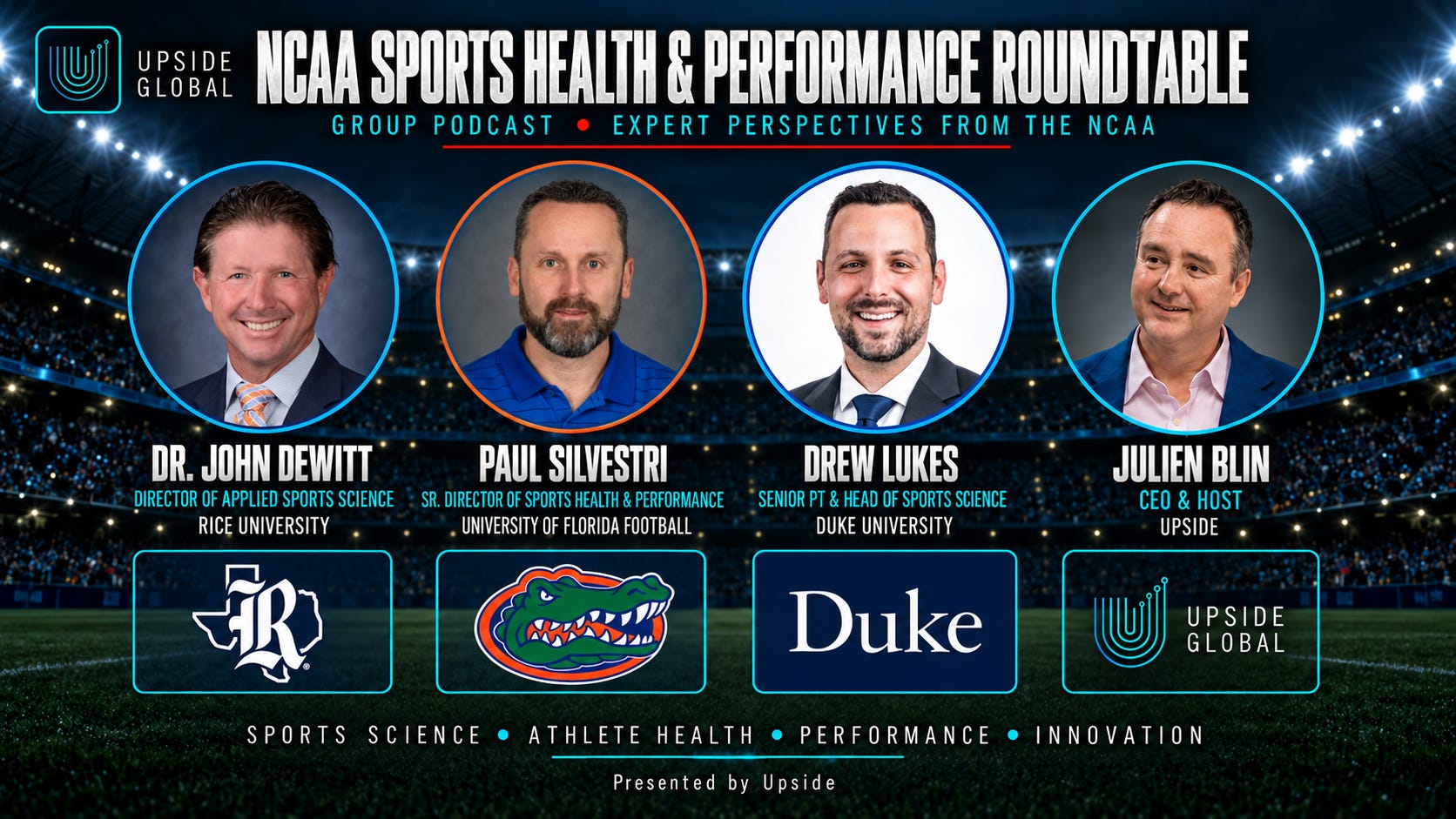
Today we have the honor of interviewing a group of NCAA sports performance experts.
Dr. John DeWitt, Director of applied sports science in the athletic department and a faculty member, Rice University (NCAA team).
Paul Silvestri, Sr director of sports health and performance, University of Florida football (NCAA team).
Drew Lukes, Senior PT at Duke University and the head of sports science, Duke university’s women soccer team (NCAA team).
📝Show Notes: Through this interview, we touched on the following questions and topics:
Optimizing athlete availability
How do you define and measure athlete availability, and how are your medical, performance, coaching and nutrition teams working together to keep athletes healthy throughout the season? When an injury occurs, how do you balance an efficient return to play with the risk of returning too soon?
The effect of roster limits on athlete health
Could smaller roster limits unintentionally increase workloads, reduce recovery opportunities and make injured athletes more vulnerable to losing their positions? How are programs adapting their health and availability strategies following the House settlement?
Are universities collecting too much data?
Are programs measuring athletes because the information changes decisions—or because the technology is available? What information have your programs stopped collecting because it created noise rather than value? What are the top metrics you like to collect on your athletes?
Are we protecting injured athletes after college?
Who should be financially responsible when an athlete develops chronic pain, neurological problems or another long-term condition linked to college participation after eligibility ends?
You can read the full transcript of the podcast interview located at the top of this blog post.
You can also watch the full video interview below:
You can leave a comment by clicking on the button below:
Here are some of the best quotes of our conversation with them:
Q1. Optimizing athlete availability
Drew Lukes
“There’s a difference between return to play and return to performance. My baseline is that the athlete is safe to return to play and begin reintegrating into training and lifts. From there, it becomes a fluid discussion about how much the athlete can do.
There’s no perfect test that can provide 100% reinjury mitigation, but we can establish objective checkpoints that allow us to say, to the best of our ability, that the athlete is safe to begin returning to specific activities.”
Paul Silvestri
“You have to work backward. You need to understand the physical demands athletes will face during the season and ensure that their weight-room and conditioning programs match those demands.
The days of two-and-a-half- or three-hour grinder practices are starting to go away. You can get the necessary work done more efficiently and give athletes the recovery time they need. Eighteen- to 22-year-old athletes will recover well if you allow them to recover—not just physically, but mentally.”
John DeWitt
“At Rice, we define availability as the number of players who are not out or on the limited list relative to the entire team. We can put a number on it, and obviously we want it to be 100%.
Open communication between the medical team, performance staff and coaches is essential to making the best decision for the student-athlete and the sport. We also need to understand whether a decline in a metric such as peak power is expected during the season or greater than expected. That could help us use these metrics more effectively.”
✅ Five recommendations for teams
Establish a consistent definition and measurement of athlete availability.
Distinguish medical clearance to play from readiness to perform at full capacity.
Use objective return-to-play checkpoints while recognizing that no test eliminates reinjury risk.
Align training and practice workloads with competition demands while protecting recovery time.
Maintain continuous communication among medical, performance, coaching and nutrition teams.
Q2. The effect of roster limits on athlete health
Paul Silvestri
“With smaller rosters, you could encounter seasons with a lot of severe injuries, and that could place real stress on the team. You have to practice smart and potentially change how long you’re on the field.
What you do during the week creates your availability to the best of your ability. If you’re consistently losing players during the week, you’re doing something wrong.”
John DeWitt
“Smaller rosters will make some players stay on the field longer unless there is a corresponding reduction in practice time. That may require a philosophical change from some coaches.
One of our football players had a much higher practice load than everyone else. When I asked why, he said, ‘Two of our players are injured, so I’m getting all the reps.’ Programs have to recognize when injuries are causing the remaining athletes—particularly starters—to receive too many repetitions.”
Drew Lukes
“Programs may need to get creative by bringing in practice players. If starters need an additional day off or injuries leave you without enough athletes for an 11-versus-11 session, practice players can take on some of that load.”
✅ Five recommendations for teams
Recalculate workloads when injuries or smaller rosters reduce the number of available athletes.
Monitor whether starters and healthy reserves are absorbing excessive repetitions.
Shorten practices or reduce repetitions when roster depth becomes limited.
Use practice players and other permitted alternatives to preserve training quality.
Ensure roster pressure does not cause athletes to conceal injuries or return prematurely.
Q3. Are universities collecting too much data?
Drew Lukes
“It’s not necessarily about the amount of data you collect. It’s about having someone who can articulate what you’re collecting, why you’re collecting it and what is actually necessary.”
Paul Silvestri
“The first thing I want to know is whether the technology has been verified and researched. Is it true data? Is the technology accomplishing what the company says it is doing?
You can collect almost any kind of data now, but you have to define your goals and determine which data is actually actionable—whether it is being used to reduce injuries, improve performance or accomplish something else.”
John DeWitt
“There are three steps: collect the observation, create insight from the observation and use that insight to make a recommendation. A lot of teams stop after collecting the observation. An observation without insight and recommendation is simply trivia.
Every university should examine what it is spending money and time on but not actually using. A threat schools must recognize is coaches buying technology because they saw someone else using it. The larger questions should be: How will we use it? What will it cost to maintain? What will we get out of it?”
✅ Five recommendations for teams
Define the decision each metric will support before collecting it.
Turn observations into insights and actionable recommendations.
Stop collecting data that does not influence or confirm decisions.
Validate technology claims and conduct annual audits of usage, cost and value.
Give coaches concise recommendations instead of overwhelming them with raw data.
Q4. What are the top metrics you collect about your athletes?
John DeWitt
“I really like force-plate monitoring because it can be used not only to determine someone’s strength and power, but also to measure body weight and changes in performance. That one source of data can be shared across four or five different groups, which makes it very useful.
GPS and accelerometer data are also very important. They are particularly useful for making sure players who are not receiving much playing time are still getting an adequate training stimulus.
GPS tells you what is happening externally, while biomarkers tell you what is happening internally. I think you want to know both so you can determine which dial needs to be adjusted.”
Paul Silvestri
“I agree that force plates and GPS are the two primary technologies. On a different wavelength, we also look at DEXA scan data and body composition and how those measurements change over time.
That information relates to some of the force and performance measurements. It helps us determine whether the athletes’ training is actually making an impact on their body composition.”
Drew Lukes
“I’m a proponent of technology that gives me multiple buckets of information. If one technology can provide several useful types of information, that is usually the best return on our investment.
From a rehabilitation standpoint, I use the isokinetic machine extensively because it provides information about strength, rate of torque development and strength ratios. It is another tool that I rely on heavily.”
✅ Five recommendations for teams
Use force plates to monitor strength, power, body weight and changes in performance.
Track GPS and accelerometer data to understand external load and ensure nonstarters receive sufficient training.
Combine external-load measurements with biomarkers that reflect athletes’ internal responses.
Use DEXA and body-composition data to determine whether training is producing the intended adaptations.
Prioritize versatile technologies that provide several actionable metrics across performance and rehabilitation.
Q5. Are we protecting injured athletes after college?
Paul Silvestri
“You always want to support the athlete who has given their time to the university, to the best of your ability. Ultimately, the goal is to take care of the athletes who put in all that time and effort while they were here.
We’re very focused on exit physicals. Every athlete should receive one and have the opportunity to disclose anything that may be happening as they leave the program. It is difficult to establish a definitive time limit on how long a university remains responsible, even though you want to help the athlete in any way possible.”
John DeWitt
“As we continue evolving toward more pay for play, how many of these injuries are going to be considered workplace injuries rather than college injuries?
Is the athlete an independent contractor, meaning an injury becomes their responsibility, or are they an employee of the university, meaning it becomes the university’s responsibility? Those are the kinds of issues college sports will have to address.”
✅ Five recommendations for teams and universities
Require comprehensive exit physicals and document unresolved medical issues.
Clearly explain the medical coverage and support available after eligibility ends.
Create a process through which former athletes can report conditions that emerge later.
Consider extended coverage for chronic conditions linked to college participation.
Develop consistent policies with input from medical, legal, insurance and athlete representatives.
You may also like:
🔥Upside NCAA Group Chat with Paul Silvestri (Florida Gators), Drew Lukes (Duke University), Dr John DeWitt (Rice University), Elva Salcido (UNLV), On Heat, Practice, Nutrition, Recovery

Today we have the honor of interviewing a group of NCAA sports performance experts.


