
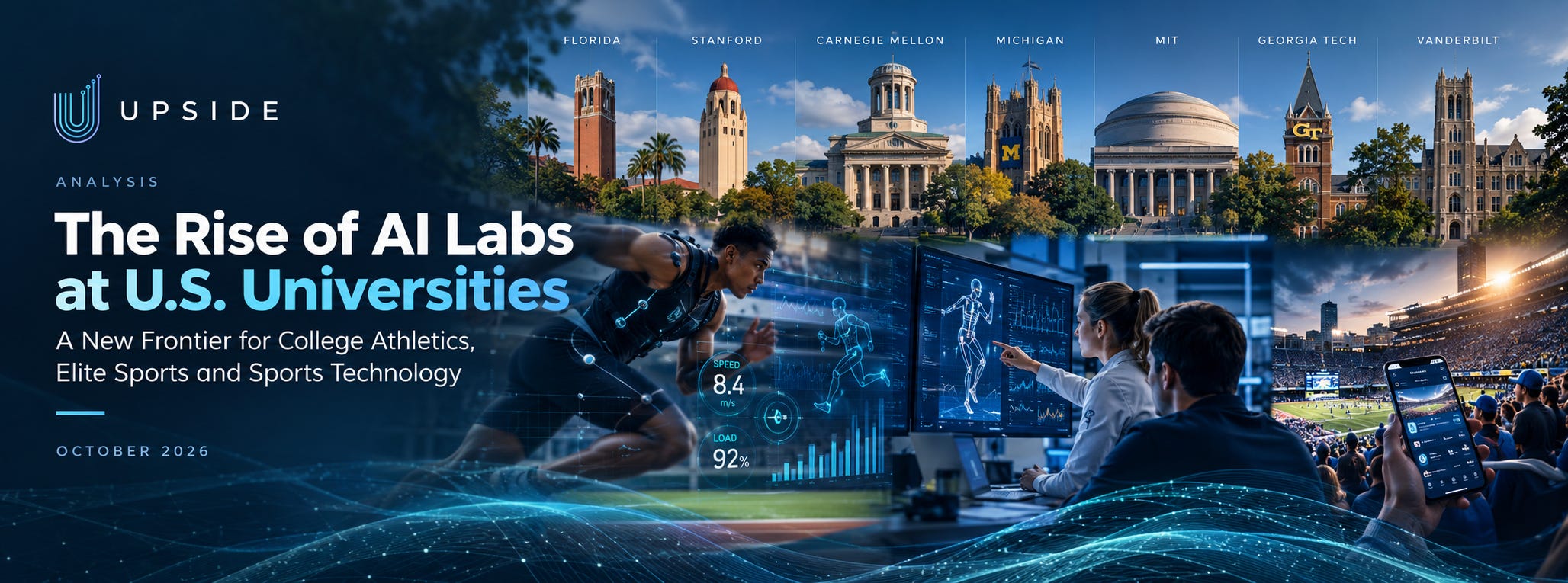
Introduction: Universities are becoming AI innovation hubs
Artificial intelligence is rapidly transforming higher education in the United States. Universities are investing in AI research laboratories, computing infrastructure, specialized faculty, and partnerships with major technology companies such as NVIDIA, Microsoft, Google, Amazon Web Services (AWS), IBM, and OpenAI.
These investments are creating a new generation of AI innovation ecosystems where researchers, students, startups, and corporate partners can collaborate to develop and commercialize advanced technologies.
For the sports industry, this represents a potentially significant shift.
College athletic departments generate enormous amounts of data through athlete management systems (AMS), GPS tracking, force plates, motion capture, video analysis, strength and conditioning platforms, medical assessments, and athlete wellness monitoring.
Yet despite the growing sophistication of these technologies, many teams still struggle to turn the data they collect into actionable insights.
AI laboratories could help bridge this gap.
Imagine a university where its AI researchers work directly with the athletic department to develop algorithms that analyze athlete movement, automate performance reporting, identify potentially meaningful changes in injury-risk indicators, optimize training schedules, or improve recruitment and scouting.
The same infrastructure could also support fan engagement, ticketing, commercial operations, and administrative productivity.
More importantly, these university-based innovations could eventually reach professional leagues such as the NFL, NBA, NHL, MLS, MLB, and European soccer.
The opportunity goes beyond using existing AI products. Universities could become creators, testing environments, and commercial partners for the next generation of sports AI technologies.
This analysis examines the emerging U.S. university AI ecosystem, its partnerships with major technology companies, and the opportunities it creates for athletic departments, professional teams, and sports technology startups.
Leading AI research laboratories and university initiatives in the United States
Not all university AI programs operate in the same way. Some focus on foundational AI research, others on supercomputing infrastructure, while a growing number apply machine learning and data science directly to human performance and sports analytics.
The following institutions are particularly relevant to the sports industry.
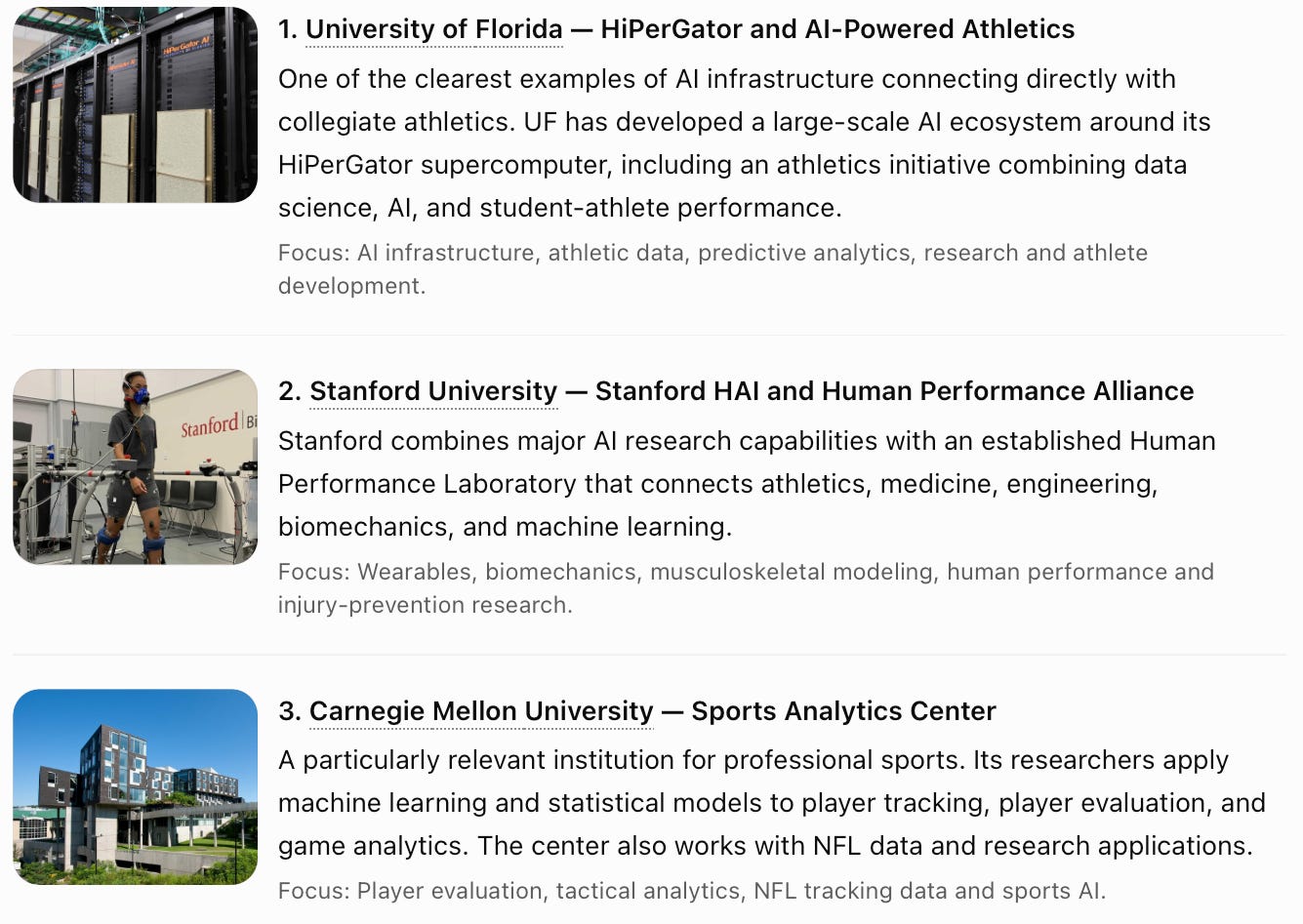
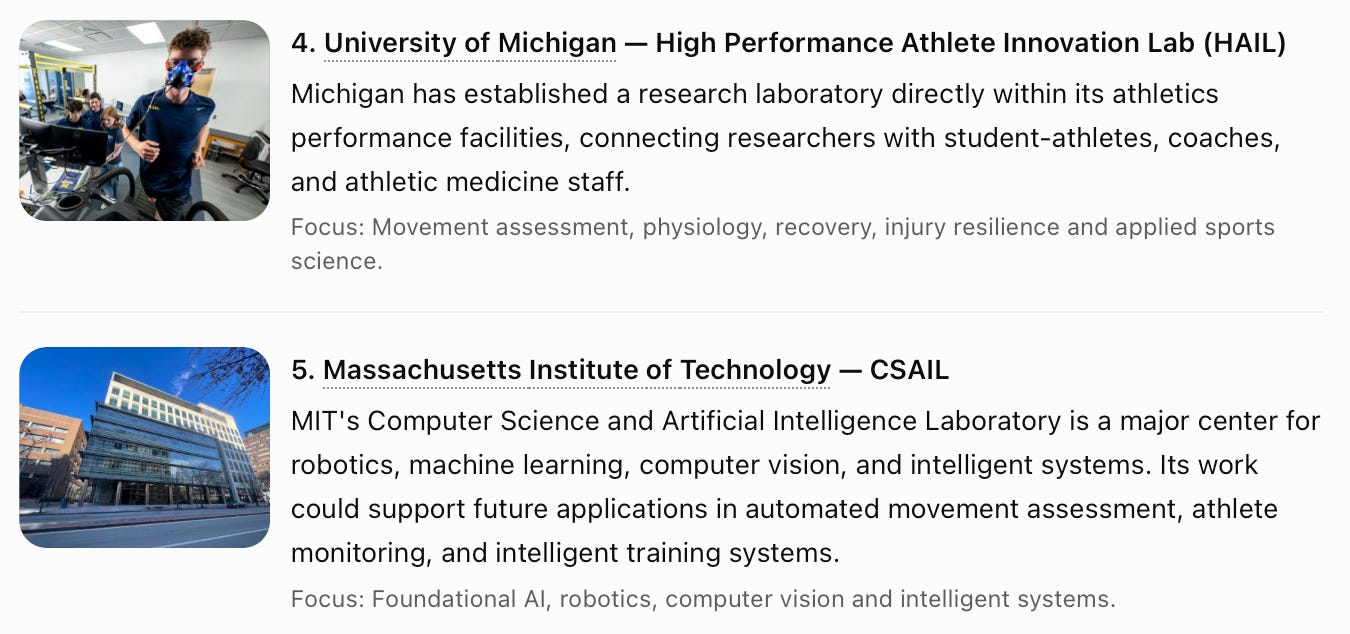
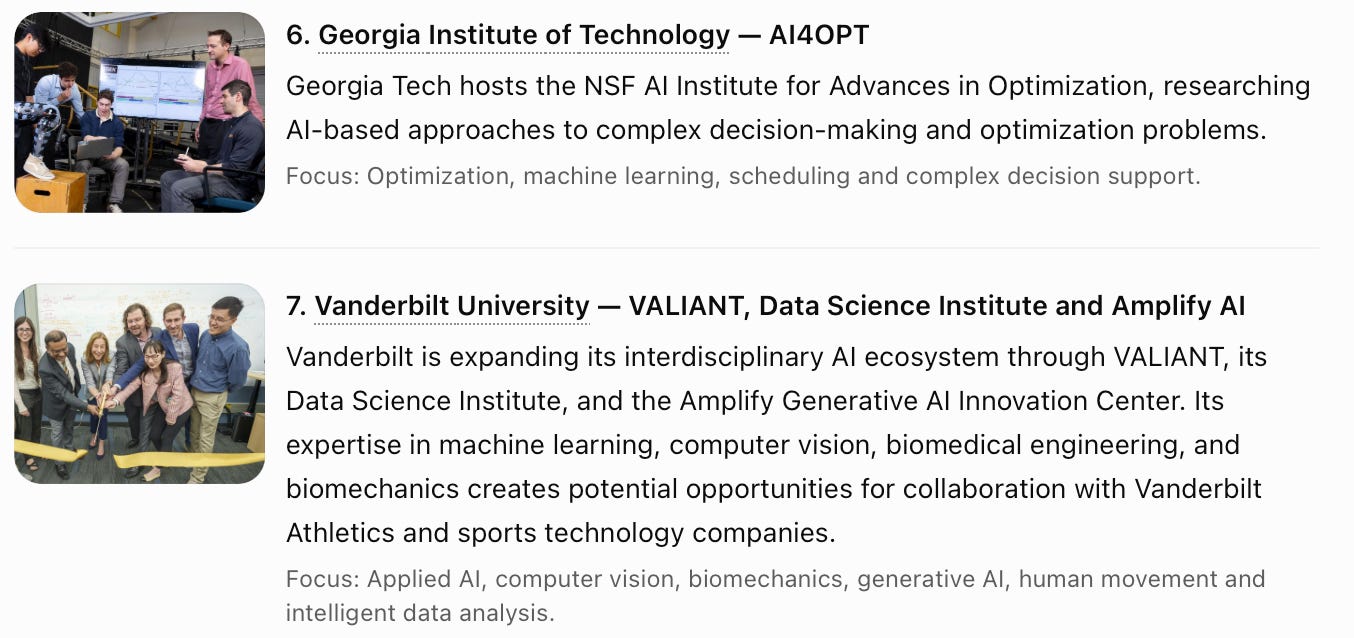
Additional universities worth monitoring include UC Berkeley (BAIR), the University of Washington (AI research and sports analytics), the University of Southern California (ISI and AI research), and Oregon State University (AI and advanced computing).
It is important to distinguish established sports-specific programs from general AI research laboratories. Not every institution listed currently has a dedicated AI partnership with its athletic department. For some, the sports applications described are opportunities rather than announced programs.
A standout example: University of Florida
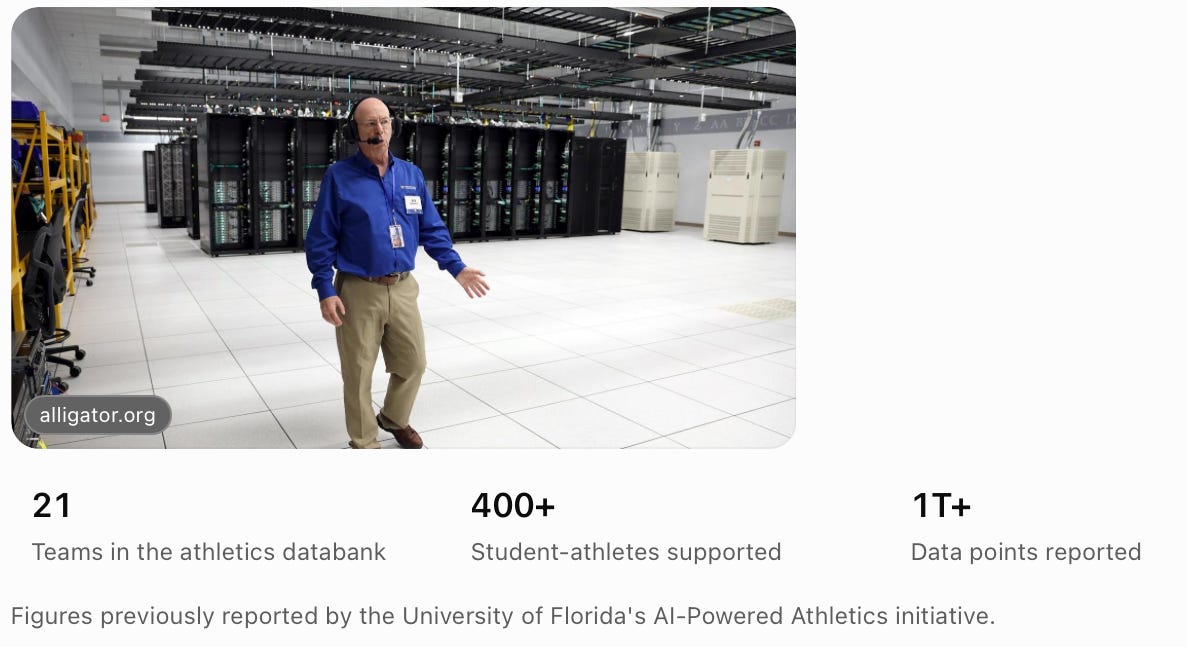
Florida’s AI-Powered Athletics program demonstrates how university-scale computing infrastructure can be connected to sports performance data.
Rather than relying exclusively on individual commercial software products, universities with these capabilities can explore their own analytical models, combine data across multiple sources, and conduct research tailored to the needs of their athletic departments.
Another university to watch: Vanderbilt
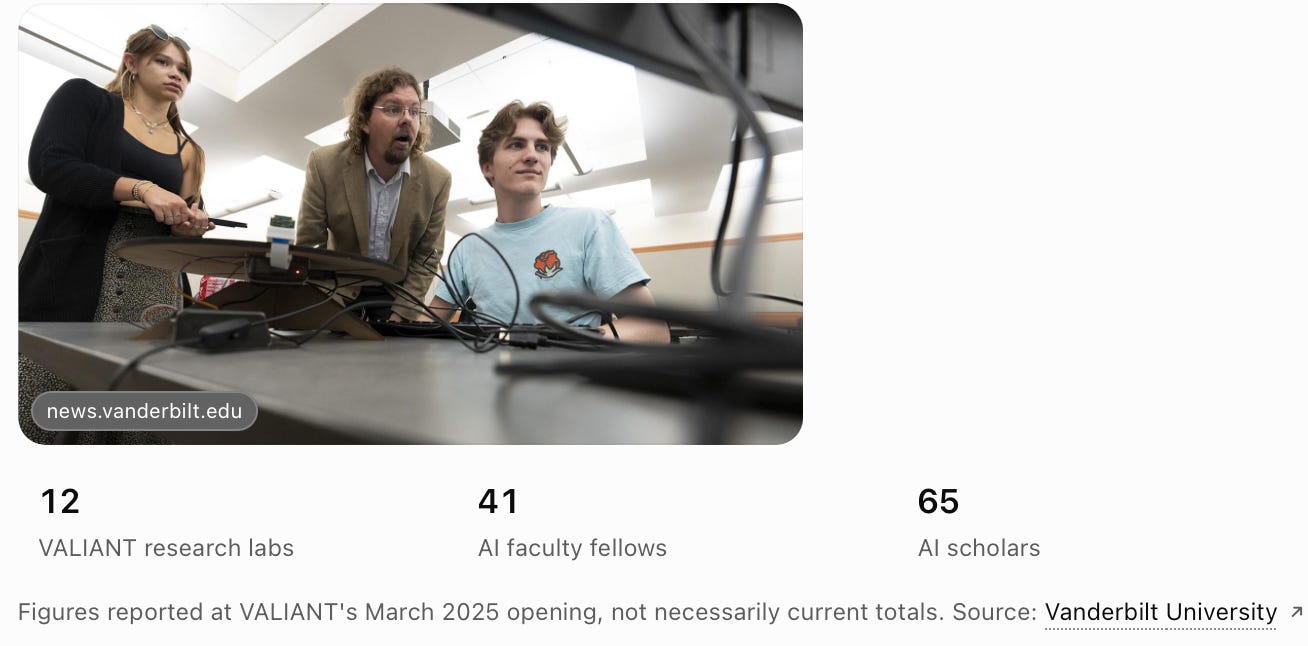
Vanderbilt officially opened the Vanderbilt Lab for Immersive AI Translation (VALIANT) in 2025 to help translate advanced AI research into practical applications.
Its wider AI ecosystem includes:
VALIANT: Research in computer vision, machine learning and related AI disciplines.
Data Science Institute: Applied machine learning, interdisciplinary analytics and data science research.
Amplify Generative AI Innovation Center: Launched in 2026 to support generative and agentic AI applications across the university.
Biomechanics and engineering research: Expertise in human movement and rehabilitation that could complement AI-based analysis.
For sports, Vanderbilt’s most interesting opportunity may be connecting these research groups with its athletics department and external technology companies.
For example, AI researchers could collaborate with sports scientists to investigate athlete movement, training data, injury-related factors, or automated performance reporting.
A startup specializing in computer vision or wearable sensors could also collaborate with Vanderbilt researchers to evaluate its technology.
These are potential applications, not confirmed athletics deployments.
Why it matters: Vanderbilt has many of the ingredients required to become an important sports AI innovation hub. Its next opportunity is to connect those capabilities more directly with the needs of sports practitioners.
Partnerships between universities and major AI technology companies
The emergence of university AI ecosystems is being accelerated by partnerships with leading technology companies.
These relationships can provide access to GPU computing, cloud platforms, AI models, engineering expertise, training programs, research funding, and commercialization opportunities.
Key partnerships and strategic relationships
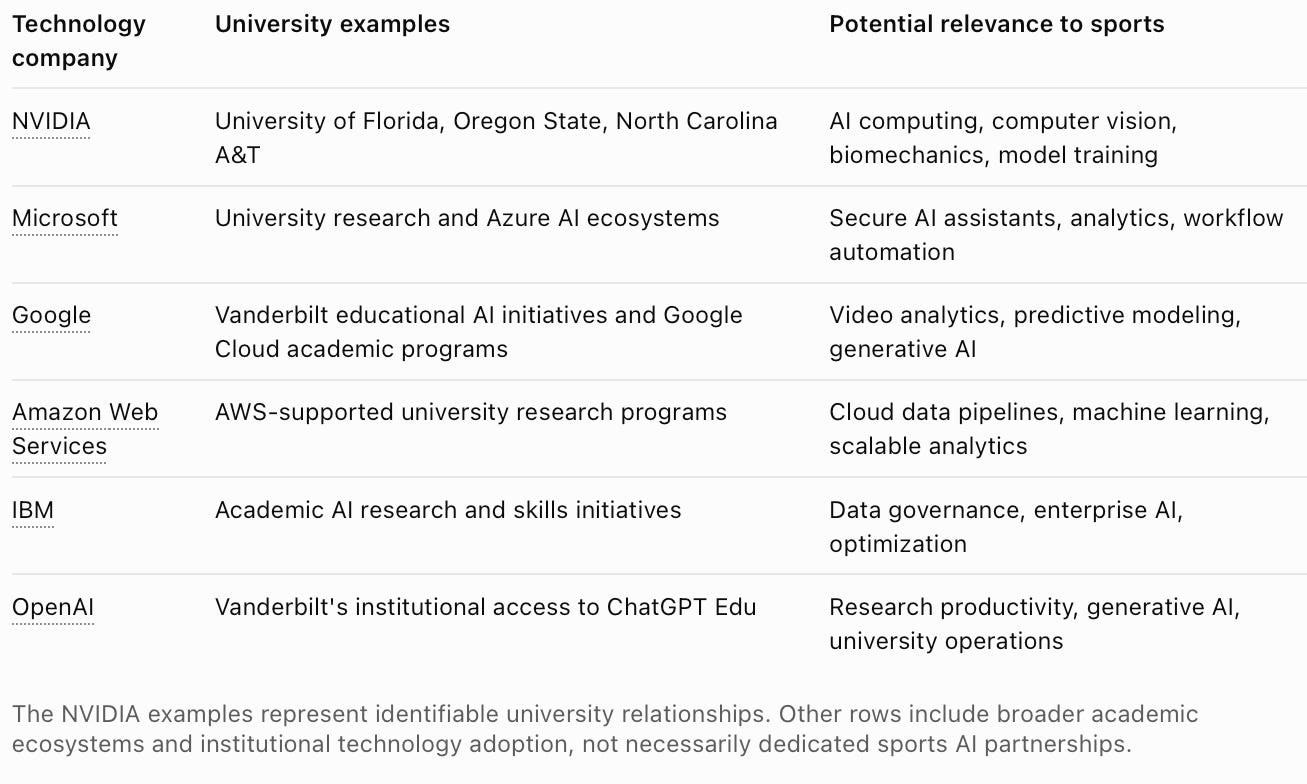
NVIDIA: A particularly important player
NVIDIA’s collaboration with the University of Florida is a notable example of how a technology partnership can help a university develop advanced AI capabilities.
Its HiPerGator infrastructure supports research across multiple disciplines, and NVIDIA has identified university relationships involving Oregon State and North Carolina A&T, as well as broader AI education initiatives.
For athletics, the potential applications are substantial:
Processing large volumes of biomechanical and video data.
Developing computer-vision models for markerless motion capture.
Training sport-specific machine learning models.
Combining historical performance and workload data.
Building AI assistants for coaching, medical, and performance departments.
Creating simulated training environments and digital models of athlete movement.
A critical distinction: access to NVIDIA infrastructure does not automatically mean a university has deployed these applications in its sports programs. The computing capability creates the opportunity; validated use cases and effective collaboration determine the value.
Vanderbilt: Expanding access to generative AI
Vanderbilt has also expanded access to AI technologies through institutional initiatives involving ChatGPT Edu, Amplify, and Google’s educational AI resources.
These initiatives support research, education, and university productivity.
Combined with VALIANT and Vanderbilt’s Data Science Institute, they create opportunities for researchers and university departments to develop practical AI applications.
Potential applications within Vanderbilt Athletics could include automated performance reporting, analysis of authorized athlete datasets, research assistants, and staff productivity tools.
These opportunities should be distinguished from confirmed sports-specific deployments.
My assessment: The most interesting partnerships may ultimately be those that bring together three groups: AI technology companies, university researchers, and athletic departments.
Such collaborations could accelerate innovation while providing researchers with access to meaningful real-world problems and carefully governed datasets.
How AI labs could transform college athletic departments
The most immediate opportunity is to connect academic AI expertise with the practical challenges facing athletic departments.
College teams already invest in sophisticated technologies. However, their performance, medical, coaching, recruiting, and commercial departments often operate with different systems and datasets.
AI could help connect those departments, automate repetitive processes, and produce insights that would otherwise require significant manual analysis.
Seven high-potential applications
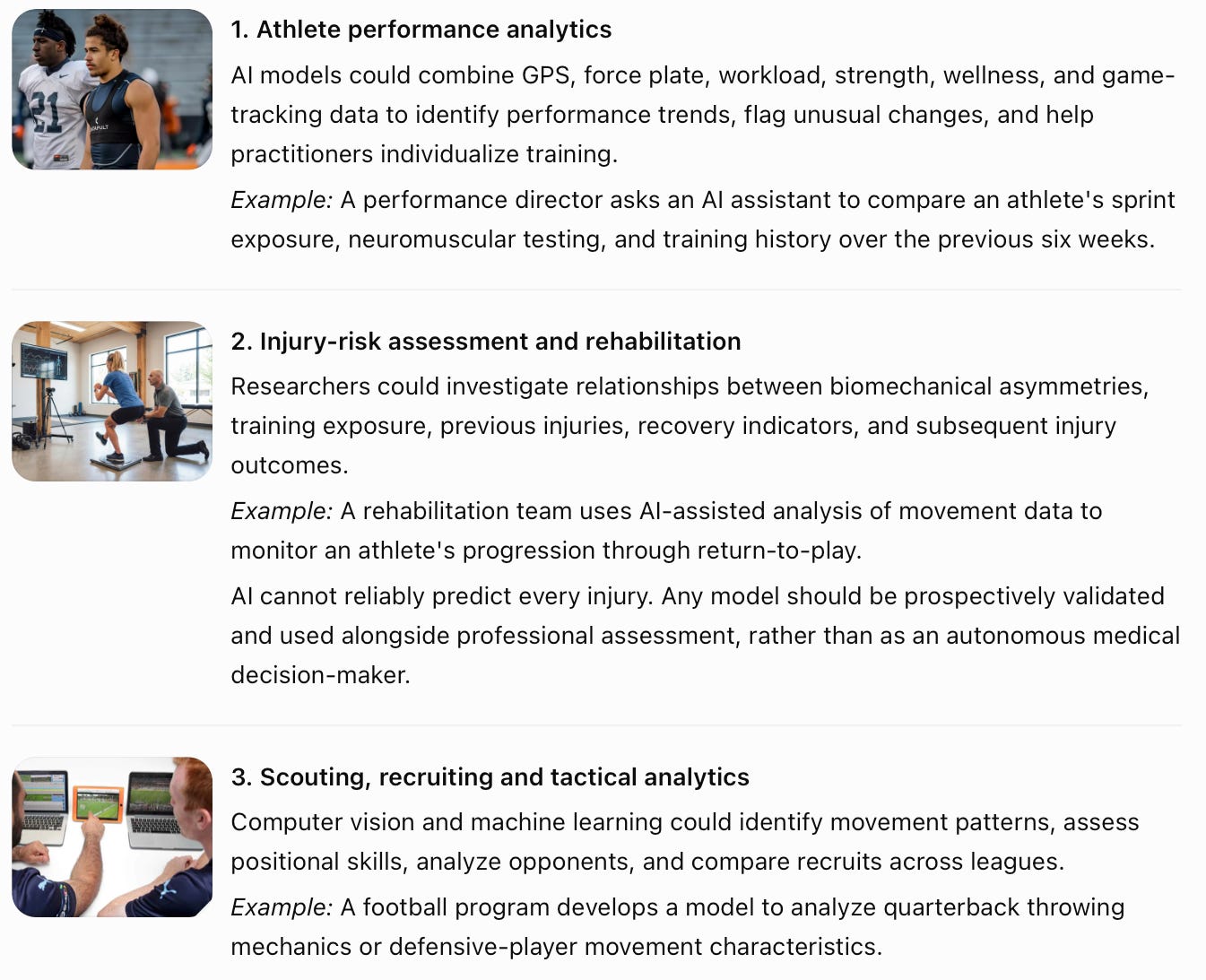
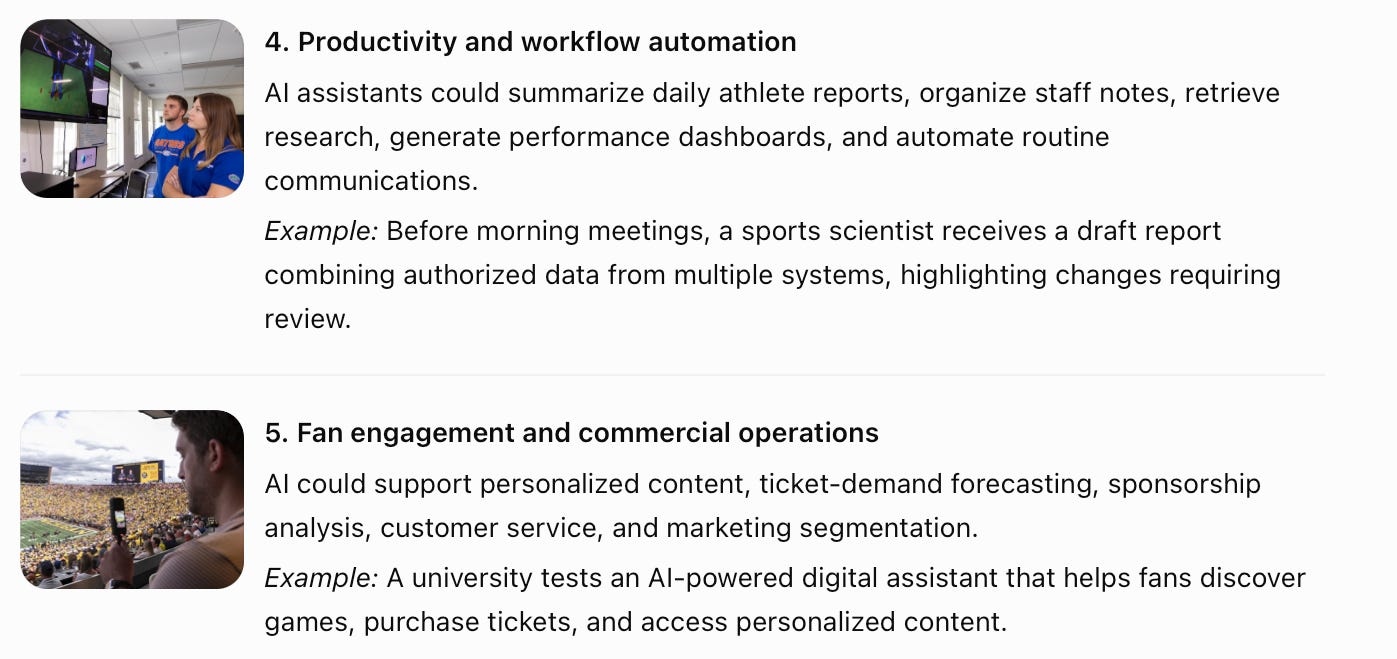
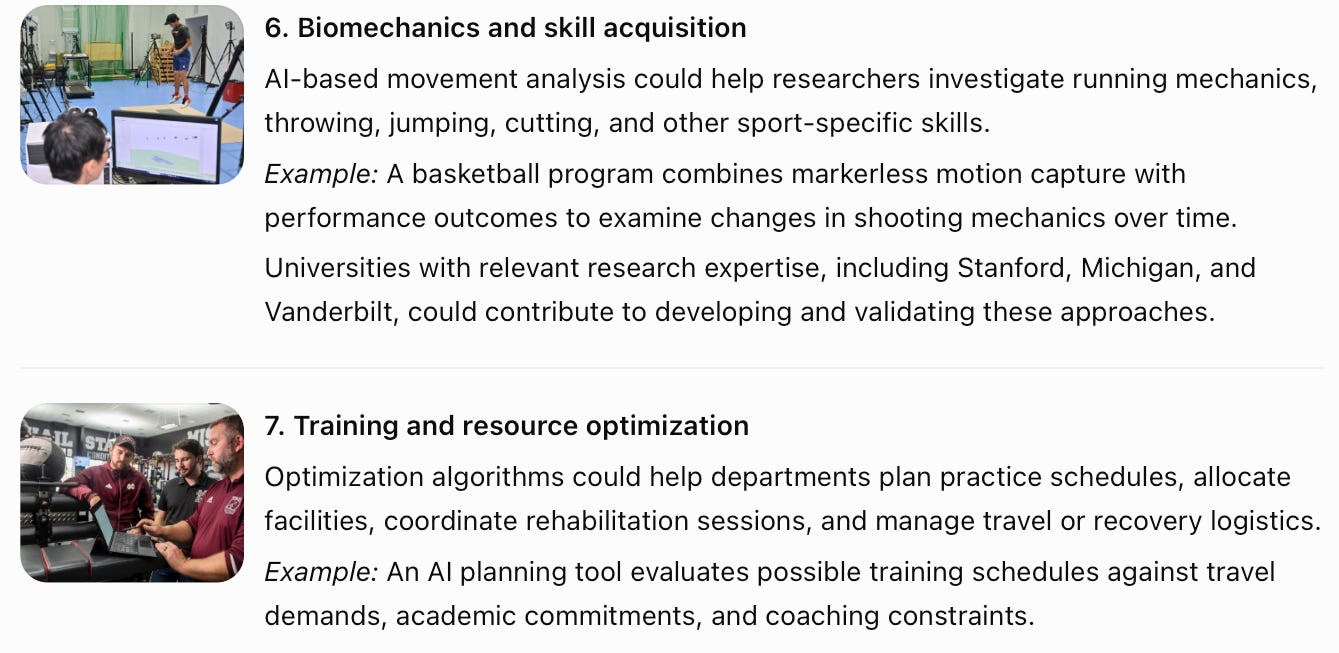
Which applications should athletic departments prioritize?
The following is an editorial assessment of implementation opportunities, not a ranking based on proven commercial results.
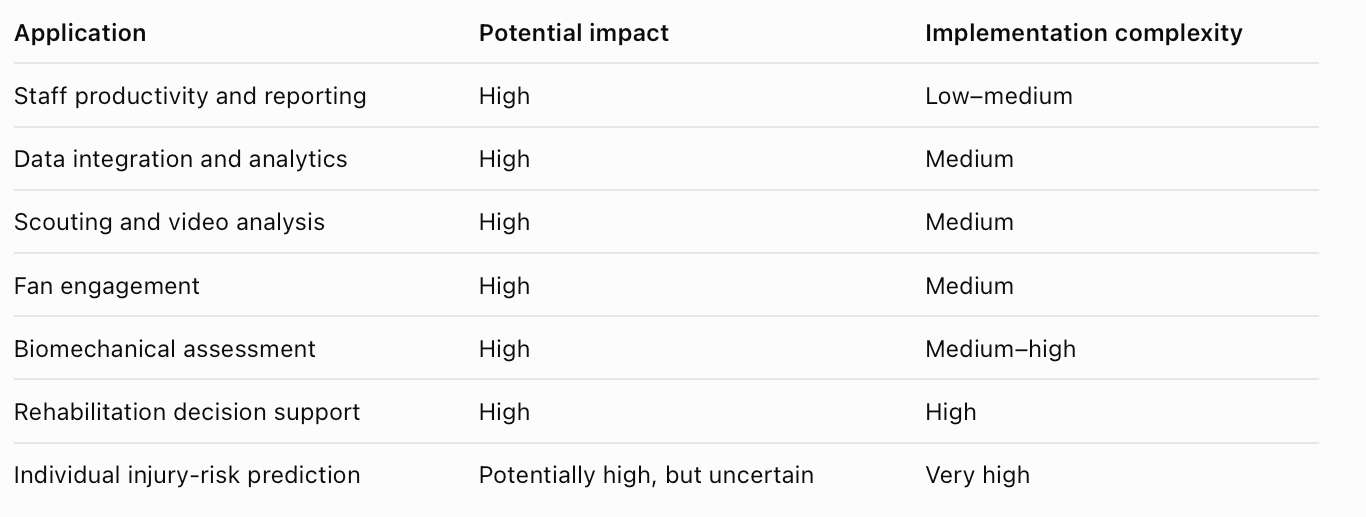
The most practical initial applications are likely to be those that reduce administrative work and improve access to existing data. They generally offer clearer measures of success than ambitious injury-prediction projects.
How university AI labs could accelerate innovation across elite sports
One of the most interesting developments is the possibility that universities become major research and development partners for professional teams.
We already see examples of this model emerging.
Carnegie Mellon’s Sports Analytics Center has worked on applications using NFL tracking data. In April 2026, the university described how its researchers’ analysis would be integrated into the NFL IQ AI chat tool, supporting questions about draft prospects, team needs, and player evaluation.
Stanford’s Human Performance Laboratory similarly demonstrates the value of connecting researchers, sports medicine, engineering, and athletic programs in one research environment.
Vanderbilt represents another potential opportunity. Its AI researchers, biomechanics expertise, and Data Science Institute could collaborate with sports technology companies and professional organizations on movement analysis, performance analytics, or rehabilitation research.
These examples suggest a broader opportunity.
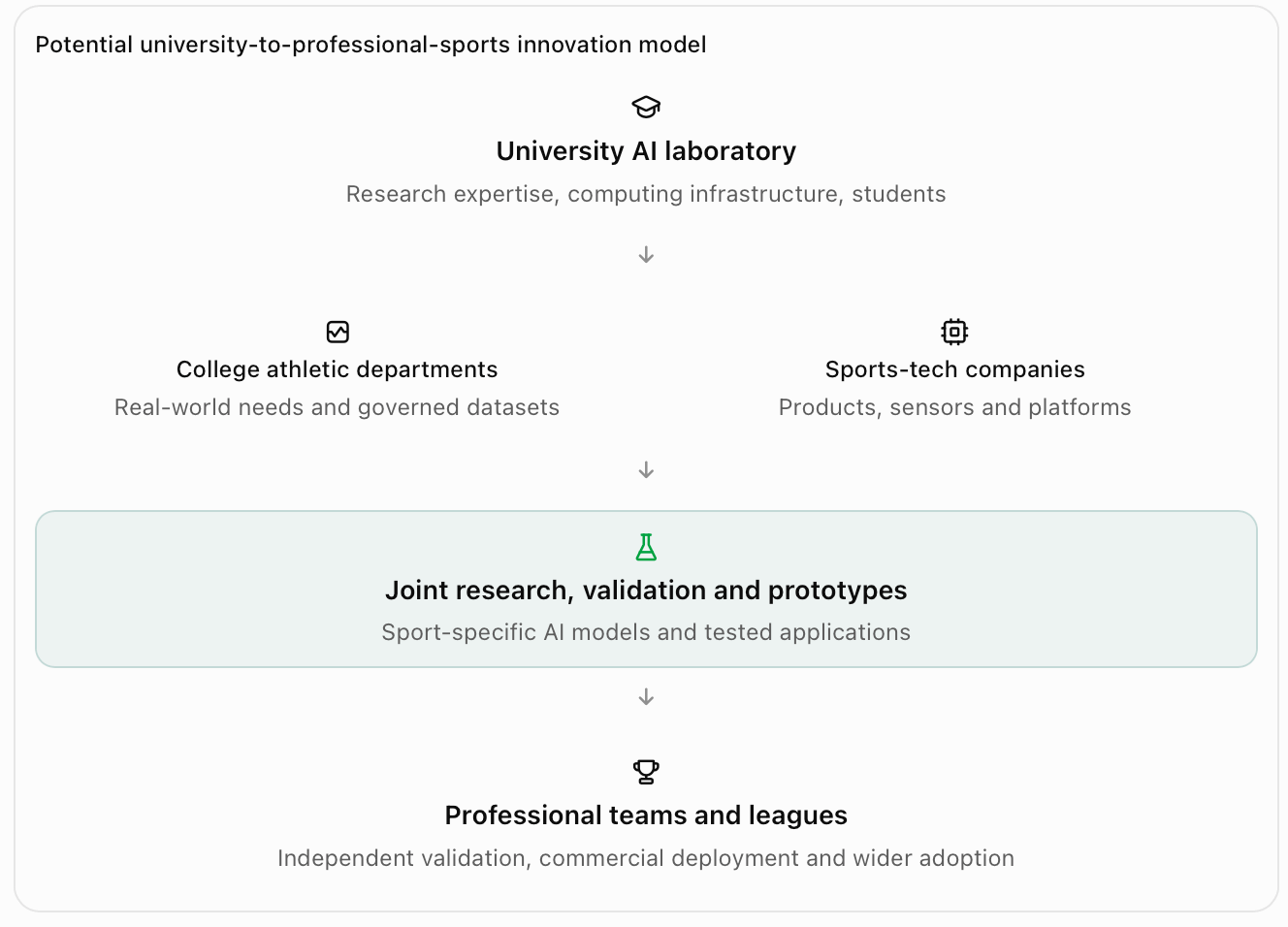
There are four particularly important implications.
First, universities could reduce the cost of early-stage experimentation. Research groups and graduate students may be able to explore ideas that are too speculative for commercial vendors to prioritize, although research still requires funding, governance, and staff time.
Second, they could strengthen scientific validation. Independent university researchers can help evaluate whether new AI technologies actually improve performance, assessment reliability, or workflow efficiency.
Third, they could accelerate the creation of sport-specific AI models. General-purpose models may struggle with the terminology, data structures, and decision-making processes of professional sports.
Fourth, universities could become startup incubators. Research breakthroughs could lead to new products, university spinouts, licensing agreements, and investment opportunities.
This could become especially relevant to professional organizations that lack the resources to maintain large internal AI research departments.
Potential impact on Athlete Management Systems (AMS) and AI sports technology companies
This may be one of the most commercially significant consequences of the expansion of university AI laboratories.
Today, many teams rely on commercial Athlete Management Systems to consolidate performance, medical, and wellness information.
Companies such as ORRECO, Action Apps, Teamworks, Kitman Labs, Genetrainer, operate across different parts of this ecosystem, including athlete data management, performance monitoring, and/or sports operations.
University AI initiatives could influence how these platforms evolve.
A. A potential challenge to traditional AMS business models
Historically, an important part of an AMS platform’s value has been its ability to collect, centralize, visualize, and report athlete information.
But as AI models become more capable of analyzing structured and unstructured data, customers may increasingly expect their software to do more than display dashboards.
For example, instead of manually reviewing multiple reports, a performance director might ask:
Which athletes experienced the largest changes in high-speed running exposure this week?
Which players have incomplete rehabilitation assessments?
What patterns appear in our previous three seasons of hamstring injuries?
Which athlete monitoring variables are most strongly associated with performance outcomes in our own data?
This creates pressure for AMS providers to evolve toward more intelligent decision-support platforms.
However, universities building custom AI tools does not automatically eliminate the need for commercial AMS products. Data quality, permissions, interoperability, reliability, support, security, and workflow design remain essential.
B. Opportunity: AMS companies could partner directly with AI laboratories
Instead of treating university AI labs as competitors, AMS providers could use them as research partners.
Potential collaborations include:
Joint algorithm development: Building and evaluating models for performance, recovery, and workload analysis.
Research validation: Testing whether new AI features are accurate, reliable, and useful to practitioners.
Secure data integration: Developing APIs and privacy-preserving methods for analyzing information across multiple platforms.
AI assistant development: Creating natural-language interfaces to authorized athlete datasets.
Product testing: Running structured pilots with college athletic departments before expanding to professional teams.
Vanderbilt’s Data Science Institute, VALIANT, and applied AI initiatives could potentially provide research expertise for such collaborations, alongside universities such as Florida, Stanford, and Carnegie Mellon.
C. A significant opportunity for sports AI startups
The opportunity extends well beyond AMS providers.
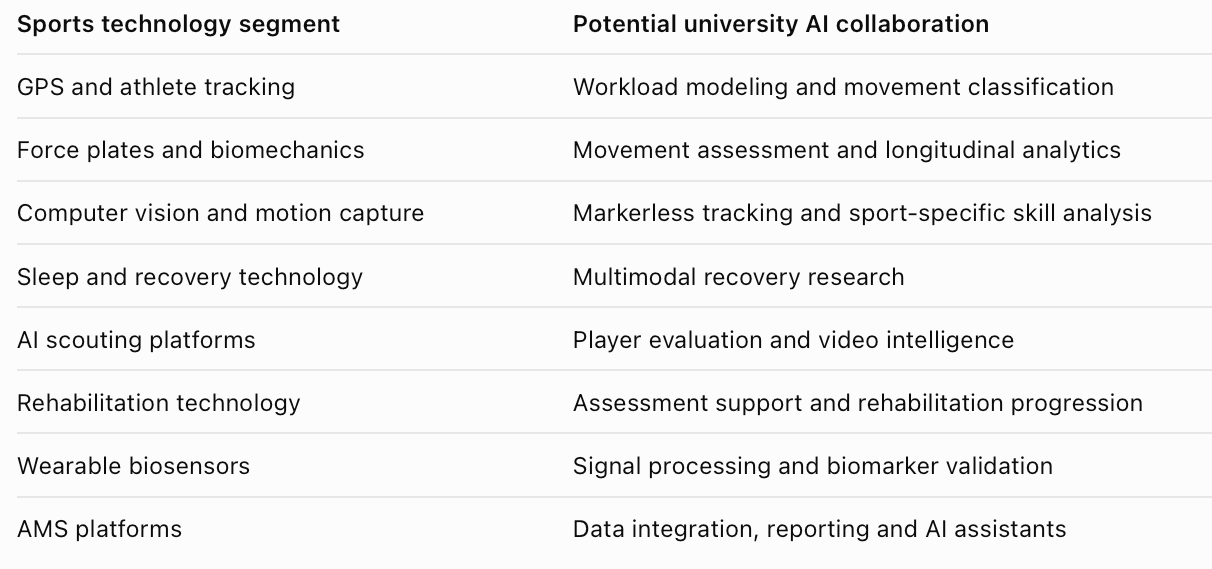
Consider a startup developing markerless motion capture for football quarterbacks.
It could partner with a university’s computer vision researchers, biomechanics department, and football program to study throwing mechanics and develop sport-specific algorithms.
At Vanderbilt, for example, this could involve combining VALIANT’s AI research expertise with biomechanics researchers and, subject to appropriate agreements, athletics practitioners.
The athletic department would gain access to experimental technology, the researchers would gain a meaningful applied research project, and the startup could improve its product while building a stronger evidence base.
This is a potential model, not a claim that such a partnership has been established.
D. Will universities build competing sports AI companies?
Some could.
Universities may develop proprietary algorithms, research software, and intellectual property that can be licensed or commercialized.
However, turning a research prototype into a scalable sports technology business is difficult. Companies must provide customer support, cybersecurity, integrations, continuous product updates, and dependable commercial operations.
Consequently, I expect three models to coexist:
University-developed tools used internally by athletic departments.
University–vendor partnerships that jointly develop and validate commercial solutions.
University spinouts that become independent sports technology startups.
For established vendors, the key is to become a partner in this ecosystem rather than simply another software supplier.
The next competitive advantage: Proprietary sports data and AI expertise
As foundational AI models become increasingly accessible, competitive differentiation may shift toward the quality of proprietary data, domain expertise, validated models, and integration into daily workflows.
This is particularly relevant in elite sports.
A university may have years of information from athlete monitoring, strength and conditioning, medical assessments, and game analysis.
When appropriately governed and analyzed, those datasets can become valuable research resources.
But the value is not simply the number of data points collected.
A large dataset with inconsistent measurements, missing information, or unclear definitions may be less useful than a smaller, carefully curated dataset.
The institutions that could benefit most are those that combine:
High-quality longitudinal data + AI research expertise + practitioner knowledge + robust validation.
Florida’s AI-Powered Athletics initiative provides one example of efforts to connect university AI capabilities with sports datasets.
Vanderbilt’s interdisciplinary AI ecosystem offers another potential foundation, particularly if its research groups and athletic department develop structured collaborations.
There are also important safeguards. Student-athlete privacy, medical confidentiality, consent, intellectual property, NCAA requirements, and commercial data-use restrictions must be addressed before data is used for research or model training.
In particular, medical and performance data should not be made broadly accessible to recruiters, commercial departments, or external vendors simply because a university has built a centralized AI platform.
Recommendations to college teams and professional sports organizations
Based on these developments, I would recommend that athletic departments take a proactive but disciplined approach.
1. Build relationships with your university’s AI researchers
Athletic departments should identify faculty and research groups specializing in machine learning, biomechanics, computer vision, optimization, and data science.
At Vanderbilt, this could involve bringing together VALIANT, the Data Science Institute, biomechanics researchers, and Vanderbilt Athletics to identify opportunities for applied research.
2. Audit existing data and technology infrastructure
Determine what data is available, who controls it, whether vendors support secure exports or APIs, and which datasets can legally and ethically be combined.
3. Launch two or three focused AI pilots
Prioritize applications with measurable outcomes, such as reducing reporting time, improving data retrieval, or increasing the reliability of movement assessments. Avoid beginning with promises of injury prediction.
4. Create partnerships with sports technology vendors
Invite existing AMS, wearable, biomechanics, and analytics providers to participate in collaborative research. Establish clear agreements concerning data ownership, publications, intellectual property, and commercial rights.
5. Establish strong AI governance
Involve medical, legal, IT, compliance, and athlete representatives. Require appropriate consent, access controls, cybersecurity, and human oversight. Evaluate models for accuracy, bias, and performance across athlete populations.
6. Measure outcomes before expanding
Compare AI-assisted workflows with existing practices. Track time saved, practitioner adoption, data quality, decision consistency, and other relevant measures. Expand only when the benefits justify the cost and risk.
A practical 12-month roadmap
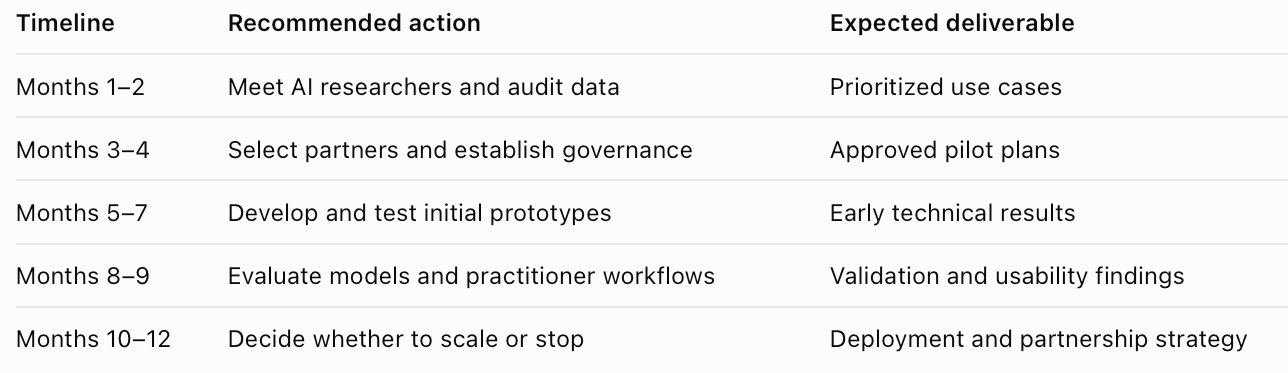
For professional teams, a similar approach could involve partnering with nearby universities rather than building a large internal AI research team.
What this means for the sports technology investment ecosystem
The rise of university AI labs also creates an interesting opportunity for sports technology investors.
Traditionally, investors discover startups through founders, accelerators, venture networks, and industry conferences.
University AI laboratories could become an additional source of promising technologies.
Some of the most interesting companies in the coming years may originate from research projects involving computer vision, biomechanics, wearable sensors, sports analytics, or intelligent training systems.
Investors should pay particular attention to three indicators:
Scientific differentiation: Does the startup have meaningful intellectual property, unique data, or a technically defensible advantage?
Real-world validation: Has the technology been evaluated in relevant sporting environments, with evidence supporting its claims?
Commercial readiness: Can the founding team turn research into a reliable product that teams are willing to purchase and use?
Strong university affiliations can increase credibility, but they are not substitutes for independent validation, customer traction, and execution.
One potentially valuable model would be a university sports AI accelerator connecting research laboratories, athletic departments, sports technology founders, professional teams, and investors.
Stanford’s existing HAI Startup Series provides an example of a broader AI commercialization initiative that offers early-stage companies mentorship and exposure to researchers and business leaders.
Vanderbilt’s expanding AI ecosystem, together with Nashville’s healthcare and technology community, could also provide a foundation for exploring sports-focused AI commercialization initiatives.
Conclusion: Could universities become the next major sports AI innovation centers?
The emergence of AI research laboratories across U.S. universities represents more than an academic trend.
It could reshape how sports organizations develop, evaluate, and adopt technology.
Universities have a potentially powerful combination of assets: AI researchers, computing infrastructure, students, interdisciplinary expertise, athletic departments, and relationships with major technology companies.
Institutions such as Florida, Stanford, Carnegie Mellon, Michigan, and Vanderbilt demonstrate different elements of this opportunity.
Florida provides an established example of connecting AI infrastructure with collegiate athletics.
Carnegie Mellon demonstrates how academic research can contribute to professional sports analytics.
Stanford and Michigan offer strong interdisciplinary human performance research environments.
Vanderbilt, through VALIANT, its Data Science Institute, Amplify, and its biomechanics research capabilities, represents another institution with the potential to connect advanced AI research with collegiate athletics and sports technology innovation.
The next step is connecting these resources more systematically to the needs of coaches, sports scientists, medical professionals, scouts, and athletic administrators.
The implications could be significant.
For college teams, AI could improve operational efficiency, performance analysis, recruiting, and the quality of decision support.
For professional teams, university partnerships could provide access to advanced research capabilities without requiring them to build every technology internally.
For AMS providers and sports technology companies, university AI labs could become important collaborators in algorithm development, product validation, and innovation.
For investors, they could become a source of new companies built around defensible research and real-world applications.
However, success will depend on much more than access to powerful AI models or GPUs. It will require high-quality data, rigorous validation, responsible governance, and close collaboration with practitioners.
My prediction is that over the next three to five years, we will see more structured partnerships between university AI laboratories, college athletic departments, professional sports organizations, and sports technology companies.
The universities that successfully connect their AI research capabilities with their athletic programs could become influential innovation hubs for the broader sports industry.
And the sports technology companies that establish these relationships early may gain a meaningful advantage in developing the next generation of performance and analytics solutions.
Selected research sources and further reading
The following official resources provide useful starting points for examining this emerging ecosystem.
You may also like:
🎙️ Upside Video Chat with Frederick Donnell, Head Football Athletic Trainer, UNLV (NCAA).

Today we have the honor of interviewing Frederick Donnell, the Head Football Athletic Trainer at the University of Nevada Las Vegas (UNLV), an NCAA team.
🔥Upside NCAA Group Chat with Eric Renaghan (University of Miami/NCAA), Drew Lukes (Duke University/NCAA), Dr John DeWitt (Rice University), Brandon DeSantis (James Madison University/NCAA)

This week we had the honor to interview a group of NCAA sports performance experts.
🔥Upside NCAA Group Chat with Paul Silvestri (Florida Gators), Drew Lukes (Duke University), Dr John DeWitt (Rice University), Elva Salcido (UNLV), On Heat, Practice, Nutrition, Recovery

Today we have the honor of interviewing a group of NCAA sports performance experts.
🏈 Upside Analysis: The Top D1 NCAA programs (Teams, Student Athletes)

As we know the NCAA market represents a significant opportunity for sports tech startups to grow their business. But what are the biggest D1 sports program out there in terms of total number of sports teams and student athletes? In this analysis, we analyzed the top NCAA Division I programs involved. Specifically we looked at each institution's athletic…
