
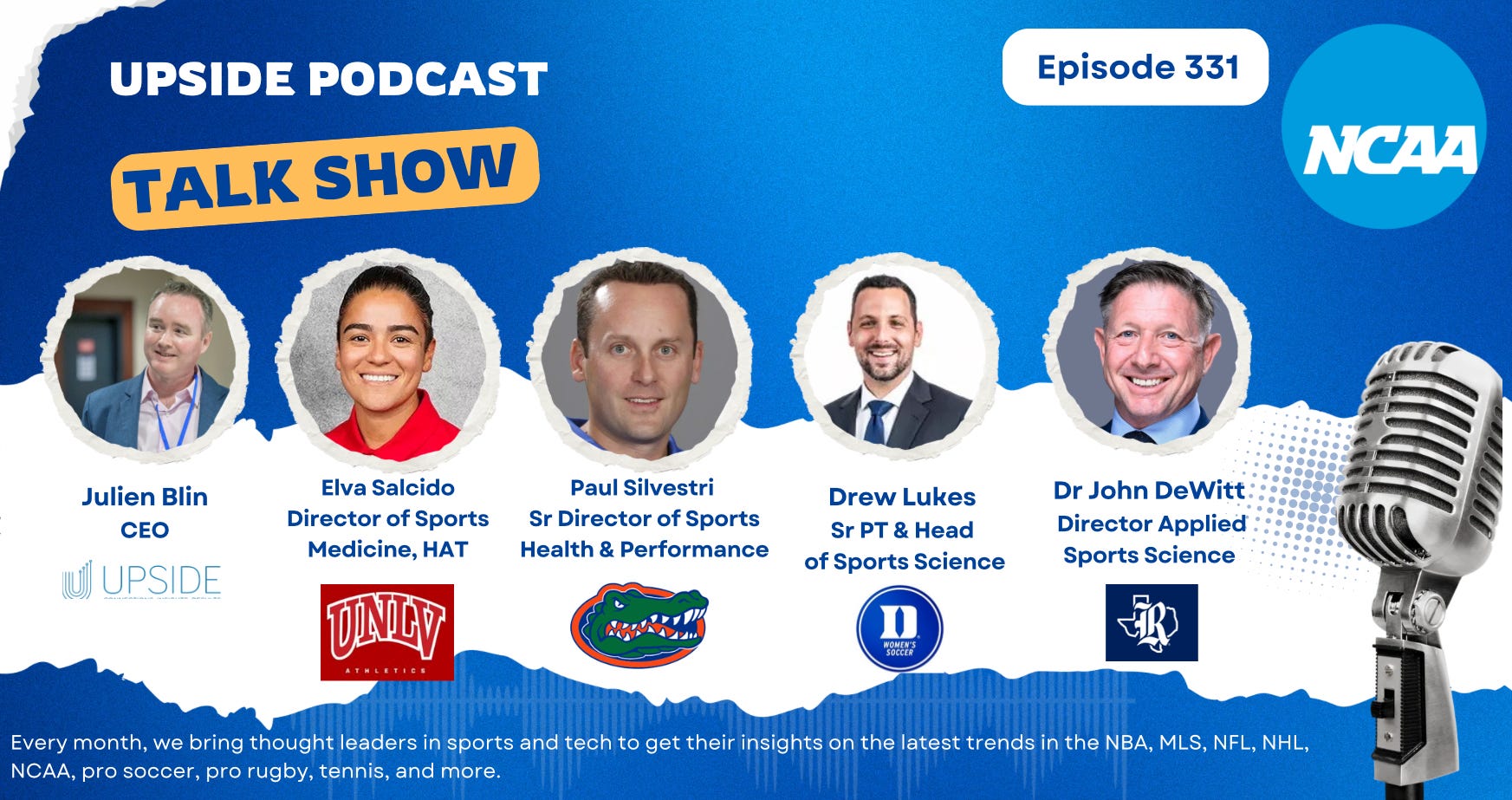
Today we have the honor of interviewing a group of NCAA sports performance experts.
Dr. John DeWitt, Director of applied sports science in the athletic department and a faculty member, Rice University (NCAA team).
Paul Silvestri, Sr director of sports health and performance, University of Florida football (NCAA team).
Drew Lukes, Senior PT at Duke University and the head of sports science, Duke university’s women soccer team (NCAA team).
Elva Salcido, Director of Sports Medicine and Head Athletic Trainer, the University of Nevada, Las Vegas (NCAA Team).
📝Show Notes: Through this interview, we touched on the following questions and topics:
Heat Acclimatization: During training camp, what is your approach to helping athletes adapt to the heat? Which cooling and hydration strategies have you found to be the most effective?
Practice Progression: How do you manage the ramp-up period during training camp? What factors guide the progression of practice intensity, tempo, and workload?
Recovery Optimization: What are your key recovery strategies during training camp to ensure athletes are prepared to perform from one day to the next?
Nutrition: How do you optimize nutrition during training camp? What are the biggest nutritional challenges you encounter, and how do you address them?
Working with Agents: How do you approach communication and collaboration with player agents, particularly regarding logistics, documentation, and maintaining productive relationships?
Interdisciplinary Communication: Successful training camps require collaboration across multiple departments. How do you optimize communication and decision-making among the medical staff, performance team, coaching staff, front office, and general manager to keep everyone aligned?
You can read the full transcript of the podcast interview located at the top of this blog post.
You can leave a comment by clicking on the button below:
Here are some of the best quotes of our conversation with them:
1. Heat Acclimatization
Elva Salcido (UNLV)
“At UNLV, we definitely try to individualize our approach rather than making blanket recommendations. Living in Las Vegas, heat is a daily challenge for us, so it’s important to distinguish prevention from emergency management because those are two completely different situations. We have conversations with coaches ahead of time about predicted wet bulb globe temperatures, practice schedules, shade opportunities, cooling strategies, and making sure cold-water immersion is always available if an emergency occurs.”
“One of the things I always say is, ‘Assess, don’t guess.’ Don’t assume you know why an athlete is cramping or struggling with the heat. We’ll use blood work, urine specific gravity testing, and work closely with nutrition to determine what’s actually causing the issue before deciding on an intervention.”
Paul Silvestri (University of Florida)
“We take a very individualized approach. Every football player completes sweat testing before training camp, and we build individualized hydration plans based on exactly what they’re losing during practice. We also use saliva testing, body-weight monitoring, refrigerated cooling trucks, cool benches, and multiple hydration strategies. The biggest priority is making sure athletes are acclimated to the heat before camp starts. If they’ve been training indoors all summer, training camp becomes a shock to the system.”
Dr. John DeWitt (Rice University)
“We use a phased approach to heat exposure. Football progresses from no pads, to shoulder pads, to full equipment while mandatory hydration testing before every outdoor session helps us identify athletes who may need additional hydration or closer monitoring before practice even begins. Much of what we do is preventative—we’re trying to stay ahead of athletes becoming overheated.”
Heat Acclimatization - Key Recommendations for Teams
Individualize hydration using sweat testing, hydration testing, and body-weight monitoring.
Separate heat illness prevention from emergency response protocols.
Gradually acclimate athletes before training camp through phased exposure.
Monitor environmental conditions (WBGT) and adjust practice schedules accordingly.
Educate coaches and athletes before camp begins.
Use objective testing instead of assuming dehydration or cramping causes.
2. Practice Progression
Drew Lukes (Duke University)
“From the sports science side, it’s really about having a plan. We know when our first matches and scrimmages are, and then we reverse engineer the entire training camp from there. The challenge is balancing the workload with everything coaches need to accomplish technically and tactically. Ultimately, you can build the most meticulous plan in the world, but if everyone isn’t bought into it, the plan becomes meaningless.”
Elva Salcido
“Technology and sports science have significantly helped sports medicine communicate with coaches because now we have objective data to support what we’re seeing clinically. We can connect workload with fatigue, injury trends, or heat stress. Everyone may complete the same practice, but each athlete responds differently. That’s why we rely on tools like RPE to better understand the individual athlete.”
Paul Silvestri
“You have to prepare athletes during the summer for what training camp and competition are going to demand. If you’re expecting players to reach game-level speeds during camp, they need exposure to those speeds beforehand. If the first time they’re running that fast is training camp, that’s when soft tissue injuries happen.”
Dr. John DeWitt
“Sometimes coaches have to realize that an early scrimmage is simply another practice against another team. It shouldn’t cause you to abandon your progression plan. Fortunately, our athletes have already been preparing for weeks before preseason officially begins, so the ramp-up happens before the first official practice.”
Practice Progression - Key Recommendations for Teams
Reverse engineer workload from the first competition.
Build coach buy-in before camp starts.
Prepare athletes during the summer for competition demands.
Combine GPS/workload data with subjective wellness measures like RPE.
Individualize progression for returning or rehabbing athletes.
Don’t let early scrimmages disrupt long-term planning.
3. Recovery Optimization
Paul Silvestri
“There are a ton of recovery modalities available today, but there are no better modalities than hydration, nutrition, and sleep. If those three things aren’t dialed in, athletes aren’t going to recover regardless of how many recovery tools you own. The hardest one to manage is sleep because it’s the only thing we can’t directly monitor once athletes leave the building.”
Drew Lukes
“I wholeheartedly agree. It’s not the coolest or the sexiest thing, but it’s the most effective. Sleep continues to be a struggle, especially with college athletes.”
Elva Salcido
“We’ve tried to educate athletes by gamifying recovery. Different recovery behaviors earn points, helping athletes understand that a protein shake shortly after practice may provide a greater recovery benefit than immediately getting a massage. The goal is to educate athletes on why they’re using each recovery strategy instead of simply following trends.”
Dr. John DeWitt
“There’s not one recovery modality that works for everyone. Some athletes prefer cold tubs, others massage, others naps. The important part is giving athletes options and encouraging them to consistently do something that prepares them for the next day.”
Recovery Optimization - Key Recommendations for Teams
Prioritize sleep, hydration, and nutrition above recovery technologies.
Individualize recovery modalities.
Educate athletes about why recovery matters.
Use recovery technology to complement—not replace—the fundamentals.
Consider gamification to improve athlete adherence.
4. Nutrition
Dr. John DeWitt
“The key is making nutrition available. The easier it is for athletes to grab quality food, the better chance they’ll actually eat it. We spend a lot of time educating athletes to build balanced meals, but we also have to coordinate internally because sometimes nutrition challenges are really inventory and communication challenges.”
Paul Silvestri
“Our nutrition staff are the experts, and that’s where the education should come from. There’s so much nutrition information available today that everyone has an opinion. At the end of the day, athletes need enough calories during training camp. If you’re forcing foods they won’t eat, they’ll under-fuel, lose body weight, and create bigger problems.”
Nutrition - Key Recommendations for Teams
Make quality nutrition convenient.
Let sports dietitians lead education.
Prioritize calorie intake during camp.
Individualize fueling strategies.
Coordinate nutrition recommendations across departments.
5. Working with Agents
Paul Silvestri
“Agents have a job to do just like we do. They’re trying to do what’s best for their athlete, and we’re trying to do what’s best for the athlete too. The key is maintaining open communication instead of becoming adversarial. Rather than saying ‘no,’ let’s talk through the options and build a relationship.”
Elva Salcido
“We’re focused on educating student-athletes about HIPAA, medical release forms, and what information they want shared with their agents. Sometimes agents are very involved and sometimes they’re not, but our goal is maintaining professionalism while making sure the athlete feels supported throughout the process.”
Working with Agents - Key Recommendations for Teams
Build relationships—not conflicts—with agents.
Communicate openly and transparently.
Educate athletes on privacy and consent.
Keep the athlete’s interests at the center of every discussion.
6. Interdisciplinary Communication
Dr. John DeWitt
“The student-athlete should be at the center of all these groups. If nutrition, medical, strength and conditioning, mental health, and coaching aren’t talking to each other, the athlete becomes the integrator—and that’s a problem. Weekly meetings where everyone reviews each athlete help keep every department aligned.”
Drew Lukes
“This is probably the most challenging part of working in high-performance sport. The amount of communication required every day is enormous. If you can do interdisciplinary communication well, you have a good chance of being successful, but it requires constant intentionality.”
Paul Silvestri
“During training camp we meet every day—nutrition, strength, sports medicine—and review workload, hydration, body weight, and performance data before meeting with the coaches. That way we present one unified message to the coaching staff.”
Elva Salcido
“One of my mentors always said it’s about integration, not collaboration. Collaboration means people want to work together. Integration means building systems with shared reports, shared spreadsheets, alerts, and workflows that truly connect departments. That’s what ultimately improves efficiency and athlete care.”
Interdisciplinary Communication - Key Recommendations for Teams
Put the student-athlete at the center of every decision.
Hold regular interdisciplinary meetings.
Share data across departments rather than operating in silos.
Present coaches with one unified message.
Build integrated systems—not just collaborative relationships.
Standardize communication through shared dashboards, reports, and alerts.
You may also like:
🔥Upside NCAA Group Chat with Paul Silvestri (Florida Gators/NCAA), Drew Lukes (Duke University/NCAA), Dr John DeWitt (Rice University), Tyler Friedrich (Stanford University) On the NIL

This week we had the honor to interview a group of NCAA sports performance experts.
🔥Upside NBA Video Chat with Dr Marco Nunez (Ex LA Lakers/NBA), Derek Millender (Cavs/NBA), Ryan Petersen (Chicago Bulls / NBA) on The Life after the NBA, Technology Adoption, Performance Optimization

This week we have the honor to interview again a group of NBA sports performance executives to talk about the latest trends in the world of sports performance and rehabilitation.
🔥Upside NHL Group Chat with Alexi Pianosi (Colorado Avalanche), Chris Stackpole (NJ Devils), Adam Douglas (Penguins)

This week we have the honor to interview a group of NHL sports performance executives to talk about the latest trends in the world of sports performance, load management, sleep/recovery management, rehabilitation and data & wearable tech integration, and mental performance in the NHL.
🔥Upside Chat with Female Sports Experts: Allison Schmitt (Olympic Champion), Ciara Burgi (Las Vegas Aces / WNBA), Byrnadeen (Miami Marlins/MLB) on The Next Big Frontier for Women, and More

Today as part of our continued effort to bring more awareness on female athletes, teams and associated trends related to female athletes, we have the honor to interview a group of female sports performance experts:


