
Today we have the honor of interviewing Frederick Donnell, the Head Football Athletic Trainer at the University of Nevada Las Vegas (UNLV), an NCAA team.
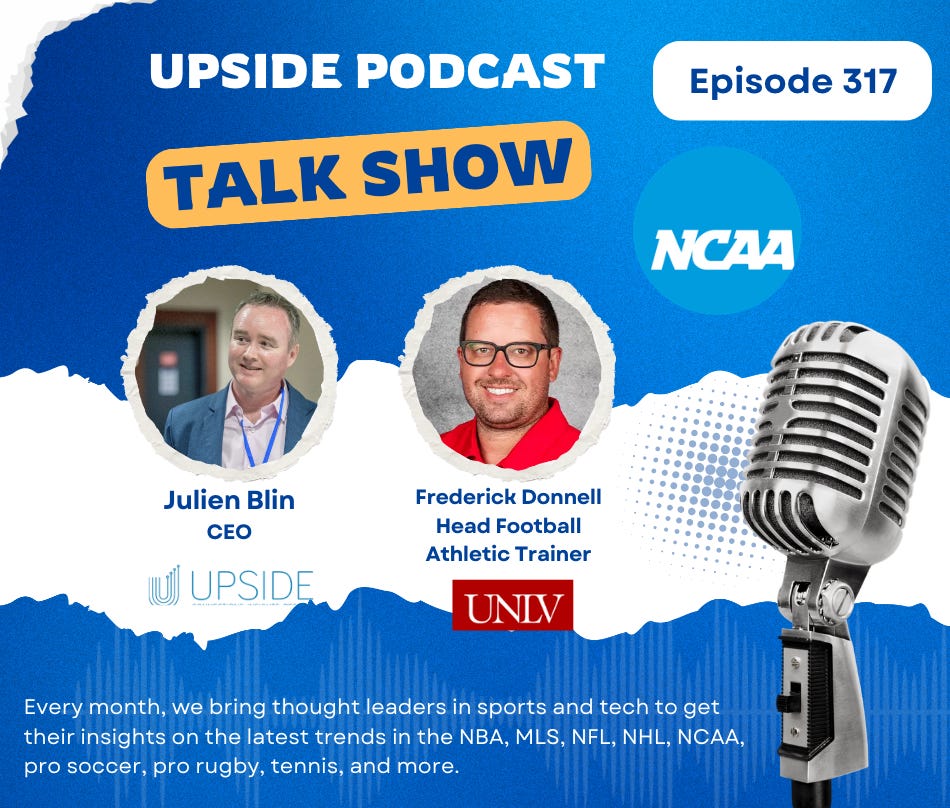
Frederick Donnell is the Head Football Athletic Trainer at the University of Nevada, Las Vegas (UNLV), where he oversees all aspects of sports medicine, rehabilitation, and return-to-play decision-making for student-athletes. He began his career after discovering a passion for athletic training during an internship at Florida Atlantic University, before earning his master’s degree from the University of South Florida. Donnell gained valuable experience across both collegiate and professional sports, including roles with the Atlanta Falcons, Coastal Carolina, and the University of Central Florida.
Known for his evidence-based approach and emphasis on collaboration, he works closely with strength and conditioning staff, coaches, and sports science teams to ensure athlete health, performance, and long-term development, with the ultimate goal of helping players safely reach the next level.
You can watch the video interview below by clicking on the Youtube link. You can also listen to the audio interview by clicking on the link at the top of the page:
📝Show Notes: Through this interview, we touched on:
His journey to the NCAA.
His role at UNLV.
His approach towards training, S&C and innovation.
How he sees the world of S&C evolving in the next 5 years.
How sports medicine and S&C tend to intertwine.
The impact of AI in the world of elite sports.
You can read the full transcript of the podcast interview with Frederick located at the top of this blog post.
Here are the quotes from the interview with Frederick:
Q1. His Background
“Back in undergrad at FAU, I didn’t really know what I wanted to do. I had about a year left and was trying to figure it out, so I ended up interning with the sports medicine staff—and that’s where everything changed. I fell in love with the profession.”
“After FAU, I went to the University of South Florida for my master’s, then spent time with the Atlanta Falcons as a seasonal assistant, Coastal Carolina covering football and baseball, and then four years at UCF before coming here to UNLV.”
“It’s funny because the people I interned under back then are now in top roles in the NFL, and to see everyone grow together in this profession has been really special.”
Q2. His Role at UNLV
“You can almost call me a medical supervisor for the program—I tend to have the final say on whether a student-athlete can participate in practices, games, or workouts.”
“I’m essentially their voice when communicating with the strength staff and coaching staff about what they can and can’t do.”
“I oversee all rehab and treatment, and you can almost consider me the medical director of the staff, especially when it comes to return-to-play decisions.”
“My ultimate goal is to get these guys back on the field in a safe but timely manner—and hopefully help them reach the next level and play on Sundays.”
Q3. His Approach to Training, S&C, and Innovation
“I teach my staff four key points: inhibit, lengthen, activate, and integrate—that’s the foundation of how we approach rehab and training.”
“We want to calm down overactive muscles, improve range of motion, then activate and finally integrate movements that are specific to their sport and position.”
“I’m not going to have a defensive back doing offensive line drills—everything we do is tailored to the individual because that creates purpose and buy-in.”
“Everything we do here is evidence-based—we’re not going to do something the same way for 20 years without adapting to new research.”
“We’re constantly looking at data and using tools like force plates and force frames to make informed decisions instead of just guessing when an athlete is ready.”
Q4. The Future of S&C (Next 5 Years)
“There’s a lot more research now being done in the weight room compared to 20 years ago—back then, people were just repeating the same methods without much data.”
“Now strength and conditioning is becoming much more evidence-based, with smarter programming that avoids overtraining and looks at long-term development.”
“The best programs today are built by professionals who are actually developing structured plans—not just pushing athletes harder for the sake of it.”
“One concern I have is athletes having too much say in their programming—they should have input, but ultimately the experts in the weight room should lead.”
Q5. The Interplay Between Sports Medicine and S&C
“The triangle of communication between sports medicine, strength and conditioning, and coaching staff is absolutely essential.”
“What I communicate to the strength staff and coaches has to be identical—everyone needs to be on the same page.”
“If the strength staff sees progress in the weight room, that needs to be communicated so we can progress the athlete safely.”
“We never want a student-athlete to be confused about what they can or can’t do—that’s why communication is everything.”
Q6. The Impact of AI in Elite Sports
“AI definitely has a role in healthcare, but I’m not worried about a robot taking over my job—it’s more about how it can assist us.”
“If you didn’t write a note, it never happened—so using AI for note-taking and documentation can save a huge amount of time.”
“There are also opportunities to use AI for building rehab programs, which can be very time-consuming.”
“If AI can help us manage our time better—especially in a hands-on profession like ours—that’s where it becomes really valuable.”
“We need to put our egos aside and ask, ‘How can we use AI to be more efficient and better at our jobs?’”
You may also like:
🔥Upside NCAA Group Chat with Eric Renaghan (University of Miami/NCAA), Drew Lukes (Duke University/NCAA), Dr John DeWitt (Rice University), Brandon DeSantis (James Madison University/NCAA)

This week we had the honor to interview a group of NCAA sports performance experts.
🎙️ Upside Video Chat with Tyler Harris, Director of Sports Medicine, St Louis CITY SC (MLS)

Today we have the honor of interviewing Tyler Harris, the director of sports medicine at St Louis CITY SC, an MLS team.


