
Title: No Baseline, No Benchmark - The Gap NFL Teams Can’t Afford
If you don’t know where an athlete started, how do you know they are ready to play?
The question sounds simple. Answering it is one of the harder problems in the NFL. Across five seasons from 2017 to 2022, researchers reviewing 1,275 regular and postseason games counted 4,378 injuries, a mean of 34.42 per 1,000 athlete-exposures per year (Angileri et al., Orthopaedic Journal of Sports Medicine, 2023). Behind that number sit roster decisions, cap hits, and players who do not come back the same.
What happens when monitoring stops
2020 handed the league an accidental control condition. With the preseason cancelled, soft tissue injuries climbed: 88.57 per 1,000 athlete-exposures in 2020-21 against 58.17 in 2018-19, a rise of just over 50 percent. Hamstring, groin, calf, quadriceps and thigh injuries were all significantly higher. The authors attribute it to the missing preseason and the abrupt jump in workload that followed (Cureus, 2022).
The athletes had not changed. What changed was the ramp-up they normally get, and the testing that would have shown who was ready for it.
Baselines are the comparison point
A baseline established in preseason does three jobs. It tracks change through the season, it gives you something to measure a training intervention against, and it sets targets for players working back from injury.
None of that is a new idea. The problem has always been that movement testing is slow, disruptive, and hard to repeat at the frequency that makes it useful.
When a player does get hurt, biomechanical baselines let staff compare current numbers against that athlete’s own starting point rather than a population average. That comparison only works if the baseline was captured, and captured consistently enough to mean something.
The league is already moving this way
The NFL reported a historic low in concussions for the 2024 season: 182 across preseason and regular season, down 17 percent on 2023 and the fewest since tracking began in 2015. Lower-extremity strains continued to fall as well. The league credits helmet improvements, Guardian Caps, rule enforcement, the training camp acclimation period, and its Digital Athlete analytics program.
Different tools are all going in the same one direction. Regular, repeatable measurement at the individual level is where performance and medical staff are heading.
The barrier has always been time
A 53-man roster puts real pressure on a preseason schedule, and testing that takes hours does not get done consistently.
OnTraq by Qualisys runs a full movement assessment across 8 protocols in about 1 minute 40 seconds per athlete, so a group of 20 moves through in roughly 30 minutes. No markers, no wearables, nothing to fit or charge.
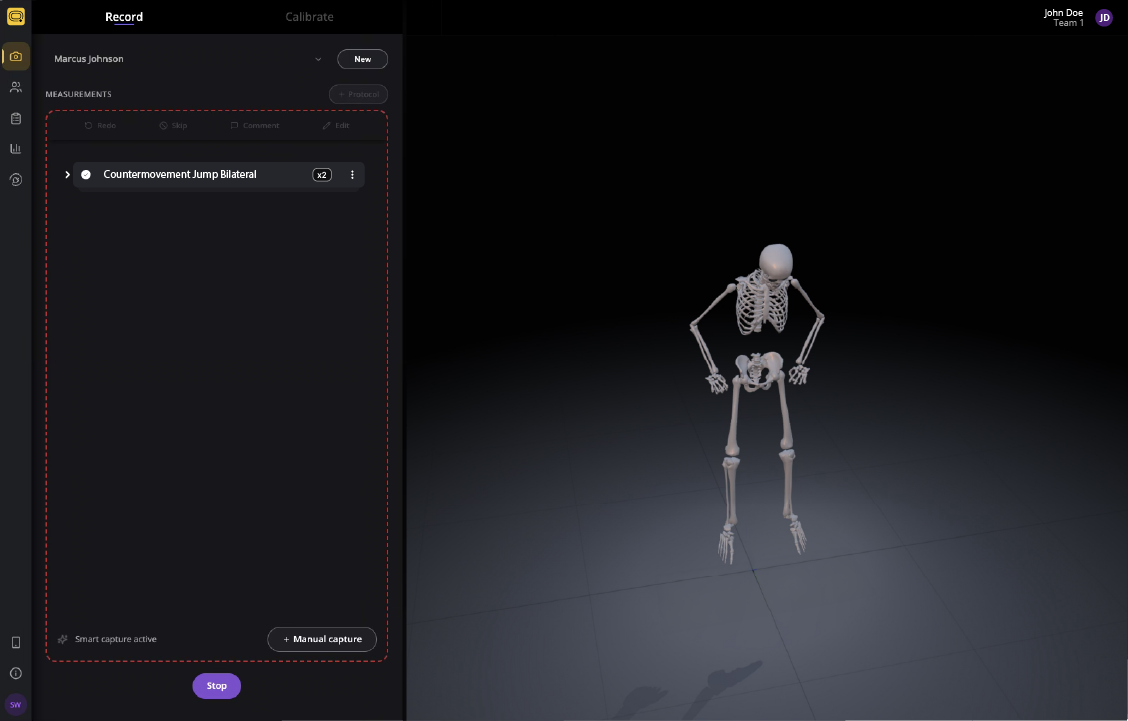
Speed is what people notice first, and it is not what makes the data worth having. Every measure in the report carries the spread across repetitions alongside the mean, so you can see how tightly an athlete repeated the movement before you decide a change is real. Skelify sizes a skeleton to each athlete once instead of re-estimating it every session, which keeps the model between the camera and the number from drifting across a season.
That is what lets you say a difference between September and November belongs to the athlete rather than to the method.
More frequent testing means earlier signals. A movement shift that would go unnoticed between quarterly assessments becomes visible week to week, which is the difference between catching something early and managing it later.
Baselines only help you if you have them.
Want to connect with Qualisys team to learn more about OnTraq? Contact Luis at Luis.Justiniano@qualisys.com
You may also like:
🌟INDUSTRY Q&A: OnTraq in elite sport: bringing lab-grade movement data to the training floor

INDUSTRY Q&A: OnTraq in elite sport: bringing lab-grade movement data to the training floor
🌟Upside Featured Article: Objective Data Is Replacing Guesswork in Elite Football Clubs

Objective Data Is Replacing Guesswork in Elite Football Clubs