
Measuring often, and over several seasons, is what turns movement data into a trend they can act on.
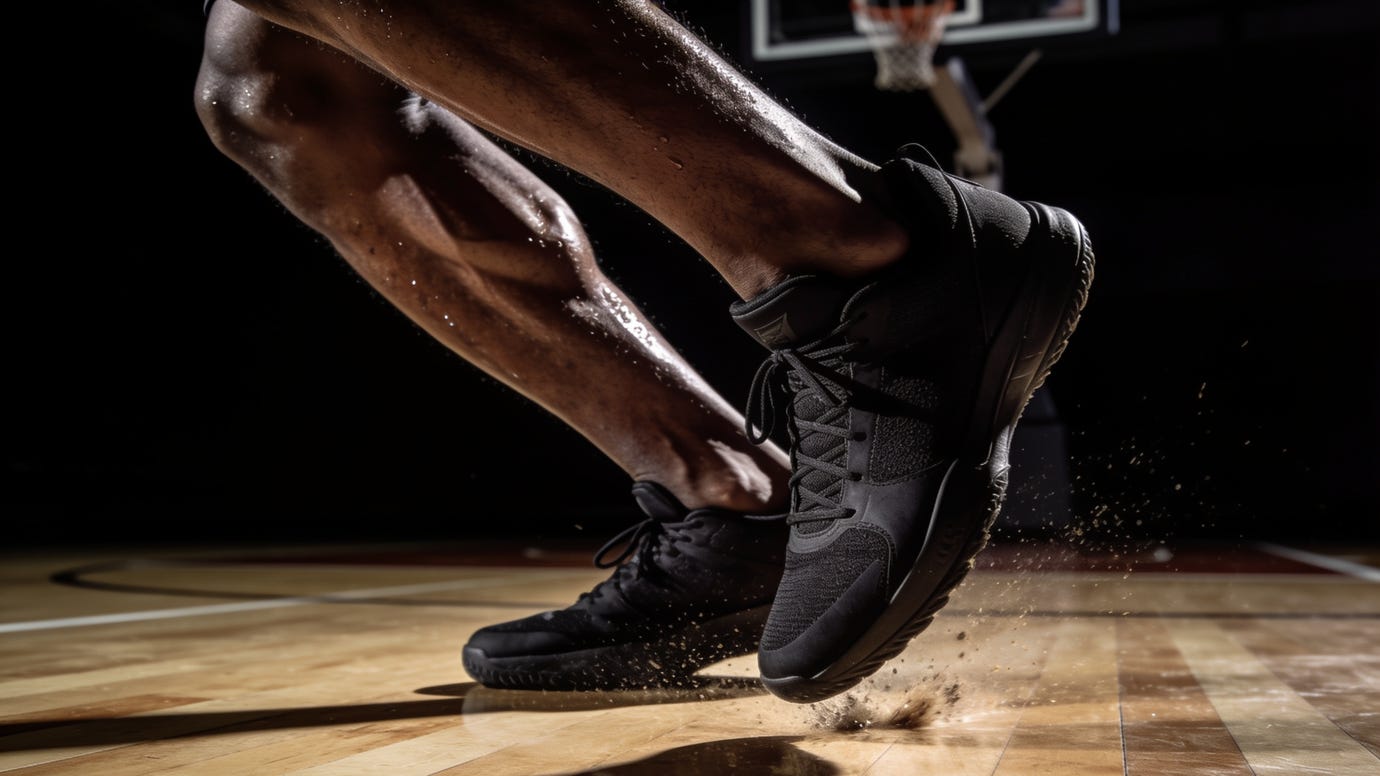
Performance staff in basketball talk about braking – the deceleration phase in which a player slows the body down, and it happens on every drive, closeout and rebound landing.
Dr. Bill Burgos is a former NBA strength and conditioning coach. In an Upside video chat in December 2025, he said: “In basketball, deceleration is arguably more important than acceleration. Anyone can run fast, but not everyone can stop efficiently.” Derek Millender, head strength and conditioning coach of the Cleveland Cavaliers, said in the same chat: “We absolutely train the brakes.”
The lower leg carries much of that load. A 2025 meta-analysis in Sports Medicine found that ankle injuries made up 25.8% of reported basketball injuries. Ankle and knee injuries together made up 41.3%.
One measurement describes one day
Teams track how much work a player does. Minutes are one useful measure of load. They record how long a player was on the court, but they carry no information about how the player moved during that time.
Two players with the same minutes can load the lower leg in different ways. One may land with more knee bend and a longer ground contact. Another may stop on a stiffer leg, or plant off the same foot on most cuts.
A single test shows where a player is on the day it was taken. Several tests, at regular intervals, show the direction and speed of a change. A good measurement taken every few weeks usually tells a team more than a very precise one taken twice a season.
Frequency also sets a standard for the method. It has to be consistent enough that a difference between session four and session nine reflects the player.
Two kinds of measurement
Detailed biomechanical assessment and frequency movement tests answer different questions. A detailed assessment examines technique in depth, under a fixed protocol, with the full set of measures. Optical marker-based motion capture is considered the gold standard method for that work.
A frequency test answers a narrower question. It tells the staff whether anything has changed since the last session, in time for the next training decision. Markerless testing is built for that job, and it does not replace detailed assessment.
A longer history is worth more
Movement data gains value with time. A third season of testing is more useful than a first. The staff can see how a pattern held through heavy load, travel and rehabilitation.
Most professional players arrive from a college program. A department that tests from year one builds several seasons of history on each athlete. It can also baseline a transfer or a freshman in the first week, which matters where players move between programs every year.
Fitting a test into the season
The schedule decides how often a team can test. NBA teams play 82 regular-season games, with back-to-backs and long road trips. The 2026-27 EuroLeague regular season has 38 rounds, including 10 double-round weeks, and most also play in a domestic league.
An in-season test usually has to fit inside the warm-up, in a time slot that is already planned. There’s no time to adhere markers or wearables to the athlete, and the results have to be comparable from session to session, no matter who is operating the test. An individual player should only be compared to his or her own longitudinal data, because an average from a 15-player team mixes very different roles.
How OnTraq runs the test
OnTraq is a markerless movement testing system from Qualisys, which has made motion capture systems for sport science and biomechanics since 1989. Markerless means the system measures 3D movement from video, so players wear no markers or sensors. Eight cameras are set up where the athletes train.
Each player completes 8 movement protocols in about 1 minute 40 seconds. Smart Capture is a patent-pending feature in OnTraq. It detects which movement a player is performing and logs each repetition of that movement automatically.
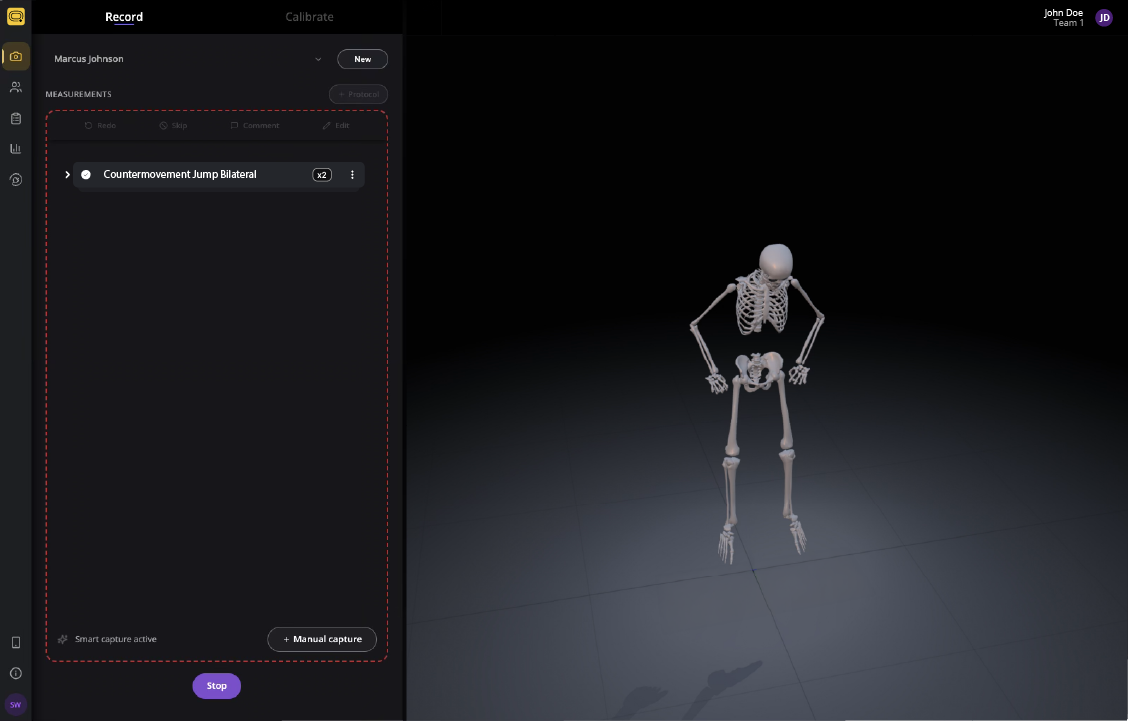
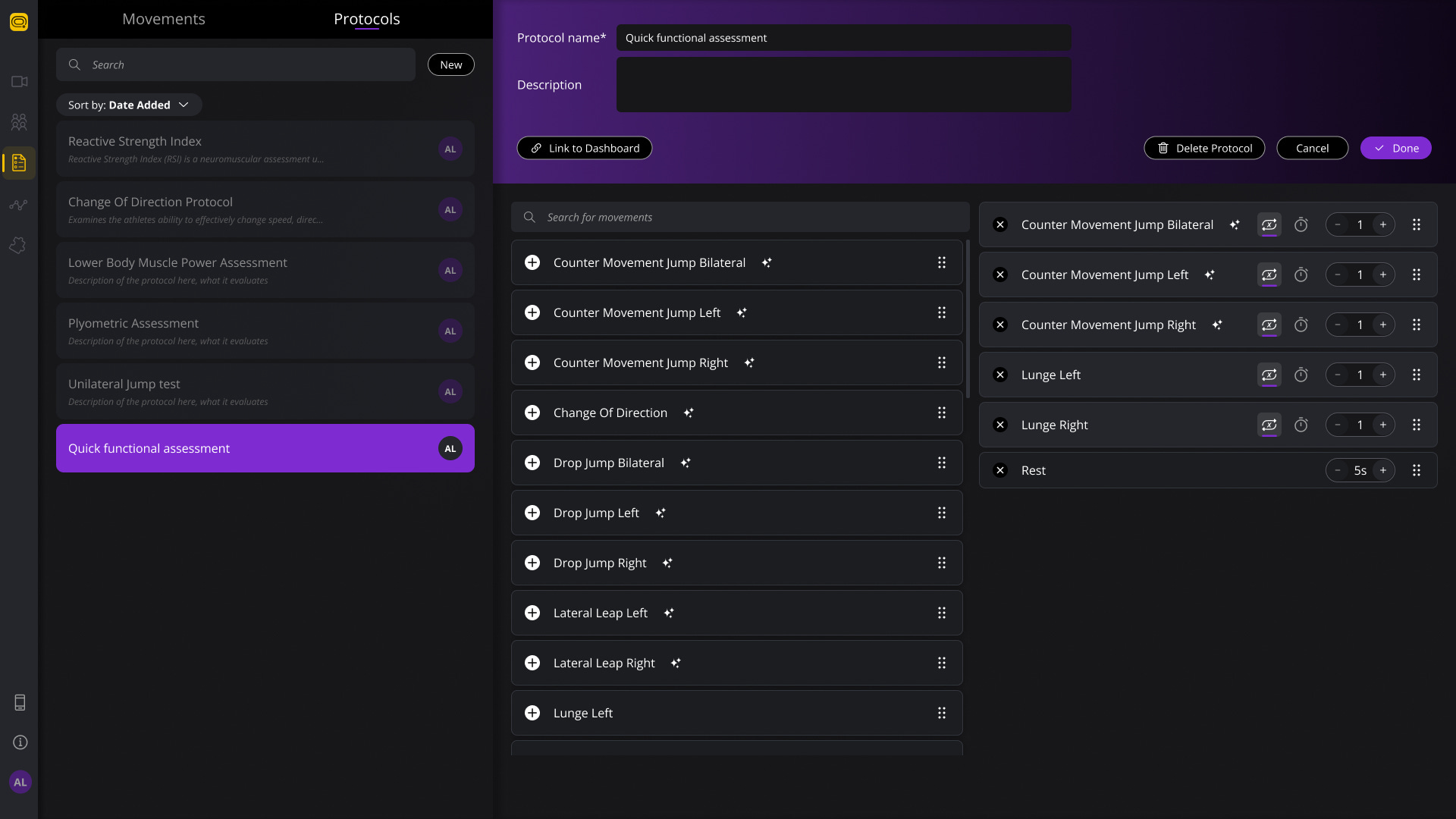
The movement library includes tasks that match basketball actions.
Change of direction, or cutting, mimics the common in-game movement, in which a player plants one foot and pushes off in a new direction.
Lateral leaps reflect defensive slides
Drop jumps and counter-movement jumps test landing from a height and jumping again, as in rebounding.
Staff can build their own protocol from these tasks to effectively monitor the way the athlete moves compared to their baseline. Combine that with ground reaction force, available via integration with the OnTraq system, and it gives the whole picture of the player’s movement patterns associated with their game.
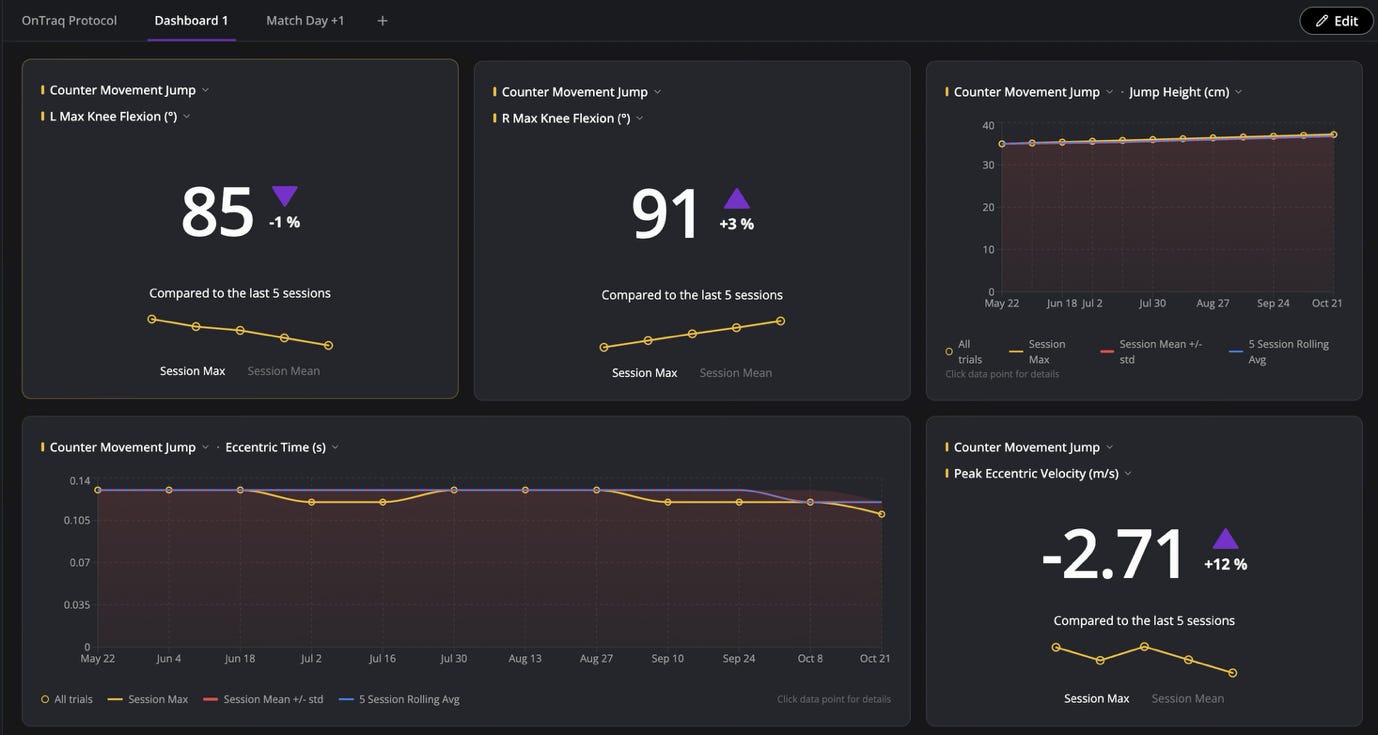
OnTraq’s trend dashboard is where coaches get direct answers. Each metric card names a movement and a metric, for example peak eccentric velocity in a counter-movement jump. It shows the latest value, the percent change compared with the last 5 sessions and a trend line.
The card shows how a player performs against his or her own baseline. A coach can read it and decide on readiness within moments. Sports scientists and physical therapists can open the web report for more detail, where each movement is split into phases.
An upcoming OnTraq webinar demonstrates the trend dashboards, how teams customize protocols and what the output looks like. Sign up for the webinar by clicking on the button below:
Thomas Schneider, Sales Director for OnTraq in Europe, describes the purpose this way: “It’s not there to tell a coach how to coach. It’s there so the question ‘has anything changed since last time?’ has a real answer, fast enough to actually be useful before a decision needs to be made, not after.”
More information about OnTraq is available at ontraqbyqualisys.com.
You may also like:
🎙️ Upside Video Chat with Luis Justiniano and Oskar Lindh at Qualisys, a leading provider of precision motion capture and 3D positioning tracking systems.

Today we have the honor of interviewing Luis Justiniano, a Sales Director - elite sports at Qualisys, a leading provider of precision motion capture and 3D positioning tracking systems. Luis is also joined by Oskar Lindh, Product manager at Qualisys.
🏈 Upside Featured Article: No Baseline, No Benchmark - The Gap NFL Teams Can’t Afford

Title: No Baseline, No Benchmark - The Gap NFL Teams Can’t Afford
🌟INDUSTRY Q&A: OnTraq in elite sport: bringing lab-grade movement data to the training floor

INDUSTRY Q&A: OnTraq in elite sport: bringing lab-grade movement data to the training floor
🌟Upside Featured Article: Objective Data Is Replacing Guesswork in Elite Football Clubs

Objective Data Is Replacing Guesswork in Elite Football Clubs