

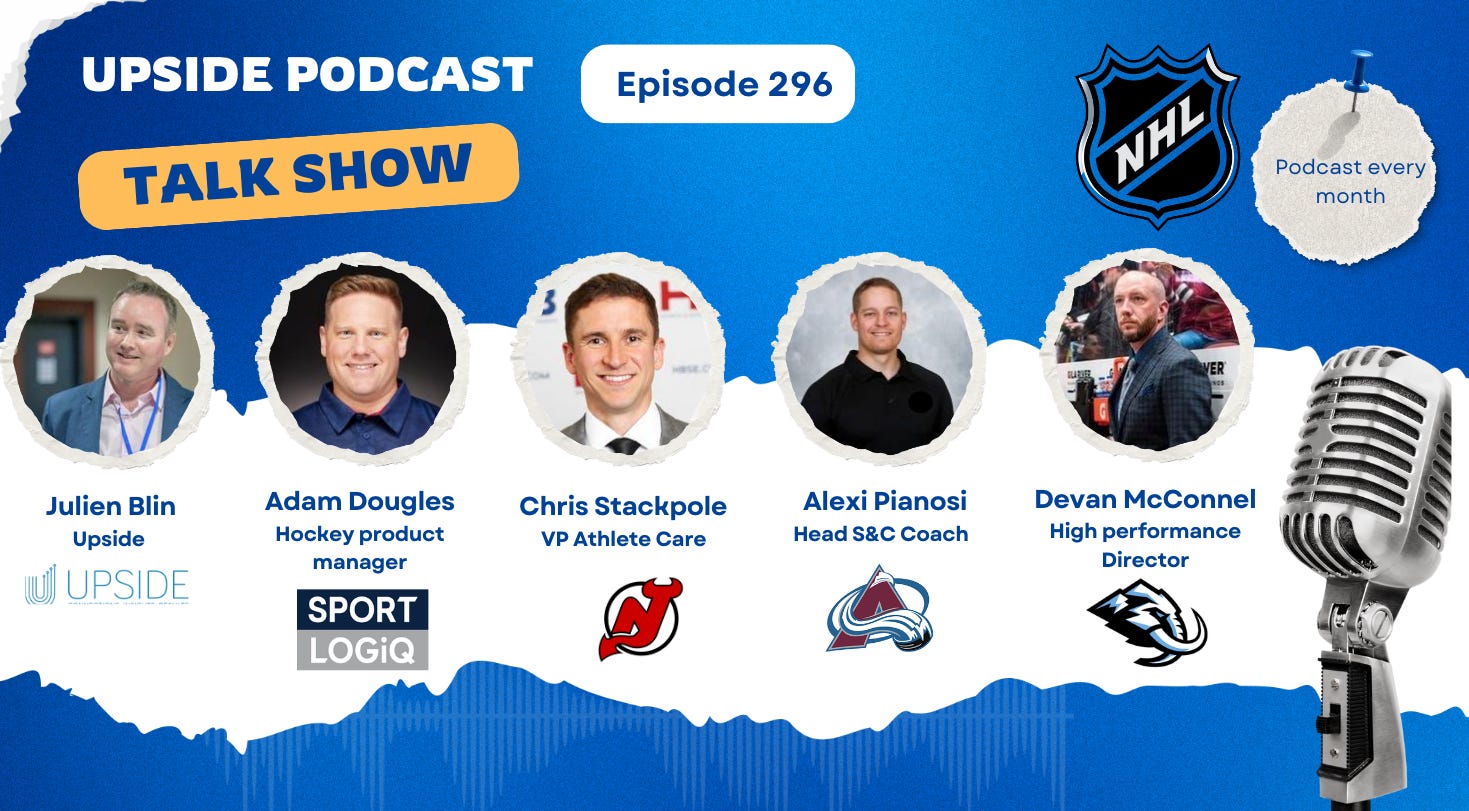
This week we have the honor to interview a group of NHL sports performance executives to talk about the latest trends in the world of sports performance.
Alexi Pianosi, Head S&C coach, Colorado avalanche (NHL Team).
Adam Douglas, Hockey Product Manager, Sportslogiq. Adam is also the former S&C coach for the Pittsburgh Penguins (NHL Team).
Chris Stackpole, VP Athlete Care, NJ Devils (NHL Team).
Devan McConnell, High performance director, Utah Mammoth (NHL Team).
📝Show Notes: Through this interview, we touched on the best practices related to:
Humans’ Intuition and technology: As technology rapidly accelerates, what performance or rehab decision today is still made largely by intuition or experience — and what would you want technology to solve or objectify in the next 3–5 years?
Important metrics: In a data-rich environment, what metric do you wish you had that does not exist yet — but would change how teams monitor readiness or performance?
Return to play: What part of the return-to-play process do you believe will look completely different 5–10 years from now?
NHL player profile: What’s one profile of player you think the NHL will produce more of in the next decade (faster, stronger, smaller, smarter, better conditioned, etc.) and why?
You can watch the video interview below by clicking on the Youtube link. You can also listen to the audio interview by clicking on the link at the top of the page:
You can read the full transcript of the podcast interview located at the top of this blog post.
Here are some of the best quotes of our conversation with Alexi, Chris, Devan and Adam:
1. Humans’ Intuition & Technology
Devan McConnell
“The end stage of return to play still has quite a bit of intuition. As a player gets closer to fully returning, there’s still a layer of the coach’s eye involved — that blend of the performance staff, medical team, coaches, and even the player making sense of what’s going on. We have good data, and we use it, but that final stretch still really relies on practitioner experience and understanding the nuances that the numbers can’t always capture.”
Alexi Pianosi
“One area I’ve always leaned on heavily is subjective movement quality. You watch an athlete go through particular drills and you’re looking at the ankle angle, the knee, the hip — trying to figure out if they’re moving efficiently and absorbing force the right way. Technology can help, but once you start adding force plates, motion capture, and EMG, the complexity ramps up fast. Experienced coaches rely on a trained eye built over hundreds of thousands of reps. Bridging the gap between that coach’s eye and objective measures of movement quality is a major frontier for technology.”
Chris Stackpole
“On the technical side, it would be really interesting if we could tap into the same kind of biomechanical analysis that hockey product companies do behind the scenes. It’s similar to baseball, where pitching mechanics are broken down in incredible detail. We don’t have that level of access at the team level. If we could apply that type of analysis to skating or stick-and-puck skills — especially for younger players who are still developing — it could help unlock skill sets we’re not fully tapping into, even in-season.”
Adam Douglas
“We have all these measurement tools — Catapult gives us hundreds of metrics — and I still feel the biggest gap is technology that can tell me, ‘What am I missing?’ I want something that can run through all that data automatically, compare today against yesterday, and flag what’s different. Then I can bring that to the medical staff or coaches and say, ‘This popped — how do we feel about it?’ I think AI is going to move us in that direction. I want tech that fills in the blind spots.”
2. Important Metrics That Don’t Exist Yet
Devan McConnell
“I’d really like to be able to measure cognitive load or cognitive clarity. We have plenty of tools for CNS fatigue and metabolic readiness, but almost nothing objective on the mental side. For performance and readiness, understanding cognitive load — how sharp someone is, how clearly they’re processing — would be incredibly valuable. It’s the next big area I’d want access to.”
Alexi Pianosi
“We can measure CNS readiness in lots of different ways, but what we’re missing is how that interacts with motivation, emotional wellbeing, or the player’s mental state when they walk into the rink. Some players are exhausted on the second night of a back-to-back yet perform incredibly well — clearly something psychological is contributing. Understanding how the mental and physical side combine into a more holistic definition of readiness would be extremely valuable, even if I don’t know how we’d measure it yet.”
Chris Stackpole
“I’d love to see something that could measure team dynamics or chemistry. We all see teams that overperform relative to their roster talent — but we can’t quantify why. If we had a metric that helped us understand how team cohesion, emotional regulation, leadership characteristics, and interpersonal dynamics influence performance, it could completely change roster-building and player selection. It would help us understand the nuance beyond technical and tactical ability.”
Adam Douglas
“Everyone in high-performance sport is chasing the same thing: a true, holistic readiness score that combines physical, mental, cognitive, emotional — all of it. Right now we only have proxy measures that we interpret the best we can. If someone actually figured out a reliable, scientifically sound way to calculate that, they’d be sitting on an absolute goldmine. Every team in the world would want it.”
3. Return to Play in 5–10 Years
Alexi Pianosi
“I think biomechanics and 3D motion analysis will become a much bigger part of return to play. If you can watch a player skate, pivot, stop, or start and actually see — in real time — where force is going through the kinetic chain, then you can make immediate, actionable coaching adjustments. Most non-contact injuries come down to force exceeding tissue capacity. Real-time movement analysis would help us guide rehab much more precisely. It’s complex, especially in hockey’s environment, but it’s coming.”
Devan McConnell
“Live biomechanics is incredibly difficult in hockey — the environment is chaotic, the rink is big, the equipment interferes with tracking — and it hasn’t been done well yet. But if someone cracks that challenge, it could be enormously beneficial. Baseball can analyze arm action, spin rate, and mechanics because the environment is controlled. If we ever get even part of that capability in hockey, it could really move the needle for return to play.”
Chris Stackpole
“My hope is that in 5–10 years every team is consistently applying modern standards of sports medicine. Too many players still go through the rehab process without timely diagnoses or without access to the right specialists. Some organizations still operate in an old-school way. I’d like to see integrated, collaborative models across performance, medical, front office, and agents — fewer silos, fewer unnecessary surgeries, and better long-term outcomes for players.”
Adam Douglas
“The teams that figure out recovery will be the ones that succeed. Schedule density is only getting worse — 82 games now, 84 soon — and players are going to war every other night. Keeping your best players healthy and recovered is everything. Whoever solves that piece at scale will have a massive advantage.”
4. NHL Player Profile of the Future
Adam Douglas
“The future is already here. Younger players are pushing into the league sooner because they’re more prepared for the pro game than ever before. Five or six years ago, unless you were picked first overall, you weren’t making the NHL right away. Now these young guys are ready. In a salary-cap environment, if you can get elite contributions from entry-level players, you set your organization up for long-term success.”
Devan McConnell
“The differentiator today is cognitive ability. The game is unbelievably fast. The players who succeed are the ones who can process what’s happening at that speed — that’s what separates them now. Physically, everyone is stronger and faster; those margins have shrunk. The next evolution is the brain’s ability to process, decide, and act under pressure. That’s why younger players are excelling earlier — they can see the game differently.”
Chris Stackpole
“I’m curious if the pendulum eventually swings back toward slightly bigger players. The league right now is trending toward smaller, highly skilled, highly mobile players. But there’s only so much faster players can get physically. As everyone’s fitness and speed converge, teams might start looking for different differentiators — and size could come back into play.”
Alexi Pianosi
“Everyone trains now — strength, conditioning, nutrition. There aren’t a lot of untapped physical secrets left, so players are becoming more homogenized physically. What will separate them is how they think the game: how they make plays under pressure, how they adapt as they enter the league, how they learn from veterans. Those who are open-minded and can evolve their understanding of the game will be the ones who stand out.”
You may also like:
🔥Upside NHL Group Chat with Alexi Pianosi (Colorado Avalanche), Chris Stackpole (NJ Devils), Adam Douglas (Penguins)

This week we have the honor to interview a group of NHL sports performance executives to talk about the latest trends in the world of sports performance, load management, sleep/recovery management, rehabilitation and data & wearable tech integration, and mental performance in the NHL.
🔥Upside NHL Group Chat with Alexi Pianosi (Colorado Avalanche), Chris Stackpole (NJ Devils), Devan McConnell (Utah Mammoth) On Data & Metrics, Tech ROI, Emerging Tech, Team Culture

This week we have the honor to interview a group of NHL sports performance executives to talk about the latest trends in the world of sports performance in the NHL.


