
This week we had the honor to interview a group of NCAA sports performance experts.
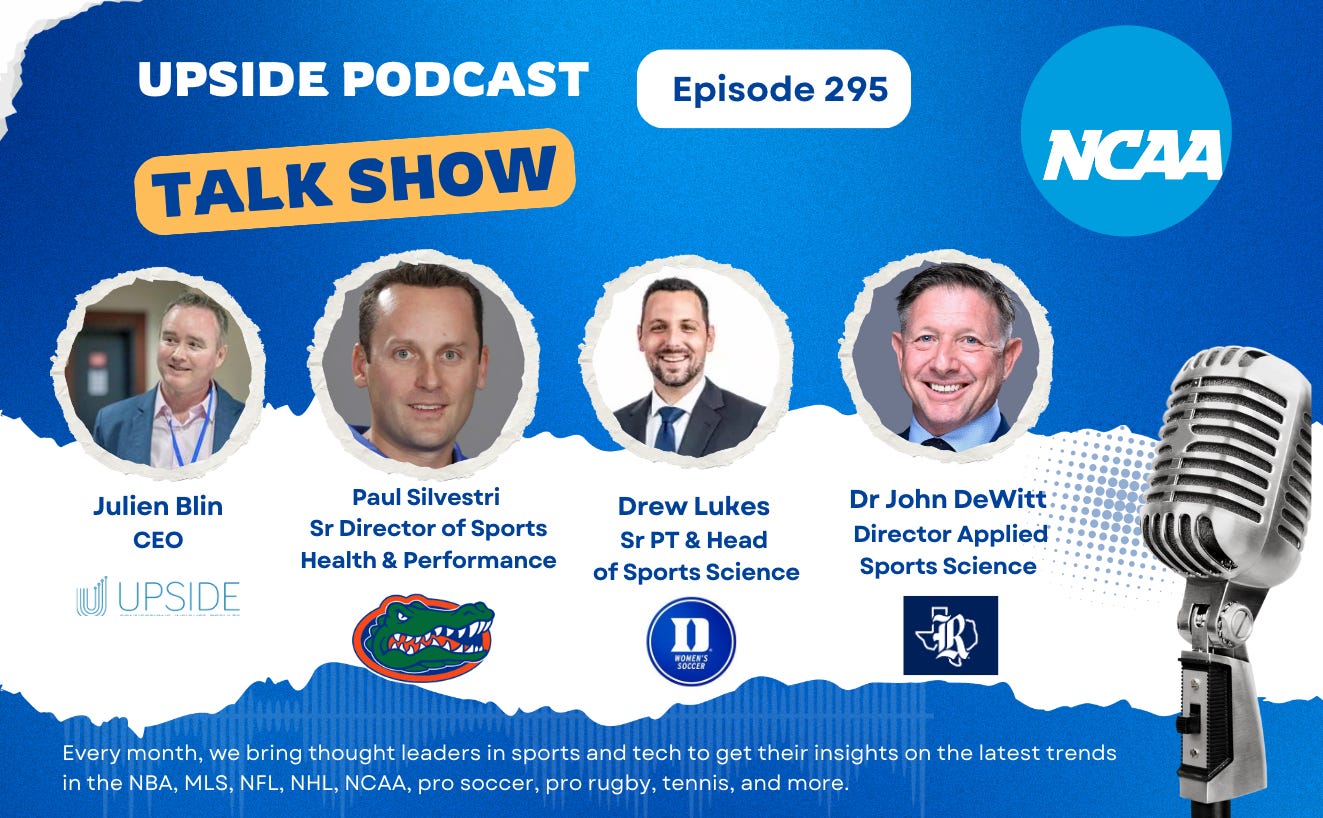
Dr. John DeWitt, Director of applied sports science in the athletic department and a faculty member, Rice University (NCAA team).
Paul Silvestri, Sr director of sports health and performance, University of Florida football (NCAA team).
Drew Lukes, Senior PT at Duke University and the head of sports science, Duke university’s women soccer team (NCAA team).
You can watch the video interview below by clicking on the Youtube link. You can also listen to the audio interview by clicking on the link at the top of the page:
📝Show Notes: Through this interview, we touched on:
Q1. Changing Athlete Development Priorities
Ten years ago, coaches said speed and strength were the priority. What physical or psychological qualities do you believe will define winning NCAA programs in the next 10 years?
Q2. Performance vs. Social Media Stress
Do athletes feel more pressure from performance expectations or social media scrutiny — and how do performance staff help them manage the difference?
Q3. The Biggest “Hidden Performance Gap”
What is one silent performance gap — something most NCAA programs do not track or invest in enough — that you think will become standard in the next two years?
Q4. Data: The Real Limitation
If you could only track three athlete metrics in-season and had to ignore everything else, what would you choose and why?
This quickly exposes what truly matters.
You can read the full transcript of the podcast interview located at the top of this blog post.
You can leave a comment by clicking on the button below:
Here are some of the best quotes of our conversation with them:
✅ Q1 — Changing Athlete Development Priorities
Paul Silvestri
“Availability is going to be key. As roster sizes go down and depth becomes a real issue, durability and resiliency — both physically and mentally — become even more important. The teams that can keep more guys on the field, week after week, are the ones that will ultimately succeed. Obviously talent matters, but if you can’t keep your players available, you’re not giving yourself a chance.”
“We’re really trying to figure out what true resiliency looks like. That means more screening, more specific testing, looking for the leaks in the system — lumbar stability, nerve issues, soft tissue vulnerability. And on the mental side, we’re building a toolbox for athletes so when adversity hits, they know how to handle it without spiraling.”
Drew Lukes
“You’ll never be able to replace speed and strength — those will always be foundational. But as we look toward the next decade, the margins are shrinking. The differences in speed and strength between elite programs are getting smaller, so we’ll have to identify the tiny physiological variables that separate good from great.”
“The question becomes: how strong is strong enough? Do we need players squatting massive weight? Or do we get them to a point where strength no longer limits performance, and we can shift resources toward other qualities that move the needle more? That’s where the field is heading.”
John DeWitt
“Speed and strength aren’t going away. What will change is how targeted we are in developing them. With better technology and better interpretation of data, we’ll be able to individualize training not just to the athlete, but to their specific job on the field — and adjust instantly when coaching systems or demands change.”
“Players are coming in much smarter now. A high school kid might walk in with years of force-plate data, GPS history, even conditioning profiles. In the past, we had almost no baseline on incoming athletes. That shift alone is going to fundamentally change how we develop them.”
✅ Q2 — Performance vs. Social Media Stress
John DeWitt
“NIL deals are increasingly tied to social media following. That means players feel obligated to stay active online, but the same platforms give gamblers and angry fans direct access to them when something goes wrong — an interception, a missed shot, anything. That creates a dangerous conundrum: they need social media for income, but it exposes them to enormous pressure and criticism they’re not equipped to handle.”
“Social media brings positives — brand building, NIL money — but the negatives are becoming more significant. We need to seriously consider how we protect athletes from the darker side of that ecosystem.”
Paul Silvestri
“When the SEC availability report goes out, our guys get bombarded instantly. We didn’t realize how overwhelming it would be until the first report was released. Players were running in with messages from gamblers and fans they had never interacted with before. It’s a massive issue we’re still trying to adapt to.”
“Some of our high-profile guys have completely deleted social media because the comments were wrecking their confidence and bleeding into their performance. They’d check their phones before practice or games and immediately get rattled. It absolutely affects how they play.”
“You want the exposure and the good that comes with social media, but you also have to be mentally resilient enough to face the backlash. That takes training — real mental skills training — because it’s not as simple as ‘just ignore it.’”
Drew Lukes
“Social media can be a very vile and difficult place, especially for high-profile athletes who have thousands of people critiquing their every move. Inside the athletic training room, I want them to know they’re in a safe space — a place where they can drop the armor, speak openly, and decompress even for fifteen minutes. That matters more than people realize.”
✅ Q3 — The Biggest Hidden Performance Gap
Drew Lukes
“The biggest hidden performance gap isn’t collecting more data — it’s having people who actually know how to interpret the data we already gather. We need staff who can translate metrics into meaningful, real-time insights that coaches can act on. Before we go hunting for new hidden variables, we need to get better at integrating staff and extracting value from the tools we already have.”
“There’s so much data out there that it’s easy to drown in it. The real innovation will come from programs that can turn data into clear, actionable decisions, not just dashboards.”
Paul Silvestri
“Sleep and nutrition remain two of the biggest performance gaps in collegiate athletics. We can educate and control a lot inside the building — meals, hydration, supplementation — but once they leave, we lose most of that control. Are they sleeping? Are they door-dashing at 10 p.m.? Are they following the individualized nutrition plans we build from advanced blood testing? That’s where performance is often won or lost.”
“Athletes today are more in tune with sleep monitoring — Oura Rings, WHOOP bands — and sometimes they start competing with each other over sleep scores. That’s encouraging, but adherence outside the building will always be the challenge.”
John DeWitt
“Colleges often buy technology because another team has it or a coach wants it, then hand it to a young assistant coach and say, ‘Figure this out.’ That’s not a sustainable model. The performance gap is investing in personnel who can educate, integrate, and guide the staff on how to actually use the data.”
“The cultural shift is coming from the athletes themselves. When a freshman arrives already using Oura or WHOOP, they bring their own data and their own curiosity — and that changes how we approach education and monitoring.”
✅ Q4 — The Real Limitation: If You Could Only Track 3 Metrics
John DeWitt
“If we’re trying to maintain or improve what we built in the preseason, RSI from the countermovement jump is essential. It tells us about overall performance, and if it drops, we can trace that change down to strength deficits, technique changes, or fatigue patterns. It’s a simple number with a lot of diagnostic power.”
“Peak power from the CMJ gives us explosiveness in the purest form. If that starts trending downward, we know something is off — and it gives us an early warning signal before performance dips in games.”
“Player load from Catapult is critical for understanding periodization. You want your heavy practice days to mimic a game. If player load is too high or too low relative to demand, we can fix it before players break down.”
Drew Lukes
“I want to get better at heart rate metrics — HRV and heart rate recovery — because there’s still so much untapped potential in using them for recovery, fitness, and load management. They give a global picture that can tie together strength, fatigue, and stress patterns.”
“RSI-mod blends performance and recovery into one metric, which makes it incredibly helpful during a long season when you need simple, actionable information.”
“High-speed distance above 90% — not just total distance, but actual exposures — is vital for hamstring health. Making sure players hit those 90% exposures two or three times per week is one of the best ways to reduce soft-tissue issues.”
Paul Silvestri
“NordBord eccentric strength, RFD on the force plate, and eccentric deceleration and braking capacity are the metrics that matter most to us. They help us understand how durable a player is — especially from a soft-tissue perspective — and how fatigue accumulates as the season progresses.”
“Everyone talks about doing too much load, but no one talks about the players who aren’t doing enough to be ready for game demands. The athletes who don’t get enough load during the week are often the ones at risk on Saturday.”
You may also like:
🔥Upside NCAA Group Chat with Paul Silvestri (Florida Gators/NCAA), Drew Lukes (Duke University/NCAA), Dr John DeWitt (Rice University) On Tech Evaluation, the NIL, Team Culture, Adversity, And More

This week we had the honor to interview a group of NCAA sports performance experts.
🔥Upside NCAA Group Chat with Eric Renaghan (University of Miami/NCAA), Drew Lukes (Duke University/NCAA), Dr John DeWitt (Rice University), Brandon DeSantis (James Madison University/NCAA)

This week we had the honor to interview a group of NCAA sports performance experts.


