

Today we have the honor of interviewing Sayawni Lassiter , CEO of Complete Sports, a Boston-based sports technology company founded in 2024 that offers an all-in-one platform for athletic departments and professional teams.

Sayawni Lassiter is a sports technology founder and entrepreneur whose career is defined by the resilience learned on the court and the operational precision honed in finance. A former Division I athlete, she played basketball for three powerhouse programs: Florida State University, Rutgers University, and the University of Rhode Island (URI). Her hoop dreams were ultimately curtailed after suffering three devastating ACL injuries and numerous broken bones, experiences that illuminated a profound, systemic lack of integrated support for athletes managing recovery and daily life.
Throughout her athletic career and navigating her numerous injuries, Sayawni knew early on that her hoop dreams would be long lived. So, she focused on finance, earning a BA in Finance with minors in Business Analytics and Economics, followed by an MS in Financial Analysis. Her educational track culminated in her sitting for the CFA (Charted Financial Analyst) exam, giving her a powerful foundation in data, efficiency, and financial rigor.
However, the systemic problems she endured in college called her back to sports. Her initial vision was a platform designed to help athletes find nearby parks and hills and outdoor exercise locations during COVID, while also helping them hone their mental and nutritional health. This initial focus quickly transitioned into realizing the larger market issue in collegiate and professional athletics: the lack of attention to overall athlete well-being and expensiveness of siloed legacy solutions.
Sayawni then founded Complete Sports to directly address this. Leveraging her financial background to ensure cost-efficiency and her athlete experience to guarantee holistic support, she sought to blend and morph the worlds of operational efficiency (communication, scheduling, forms) and athlete performance/well-being. Today, she leads Complete, providing the single operating system she wished she had—a platform that ensures every athlete and program has a more complete path to success.
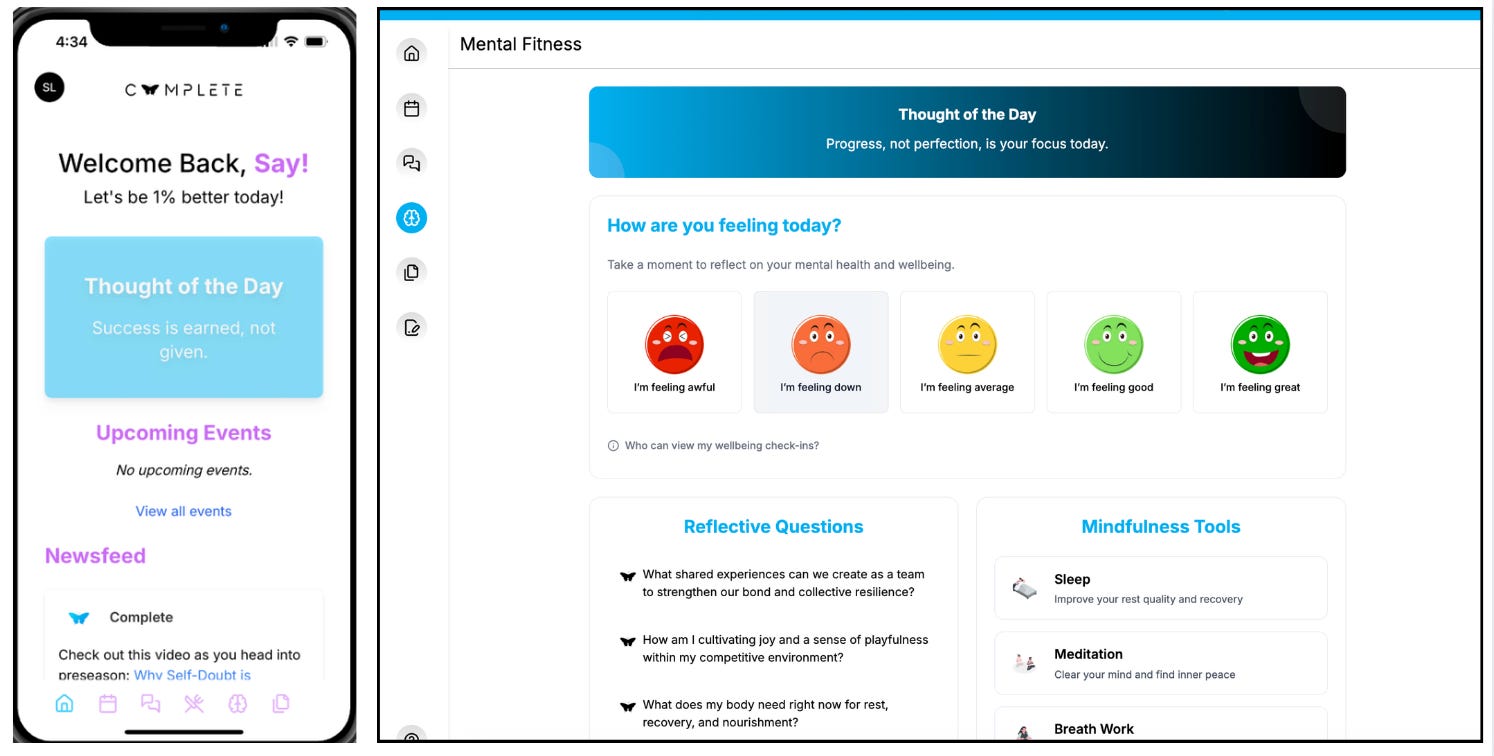
Picture: Complete Sports platform and mobile app
You can watch the video interview below by clicking on the Youtube link. You can also listen to the audio interview by clicking on the link at the top of the page:
📝Show Notes: During this interview we discussed Sayawni’s journey from being a top Division I basketball recruit who endured multiple ACL tears to becoming the founder and CEO of Complete Sports, an all-in-one athlete operations and wellbeing platform designed to fix the gaps she experienced firsthand. She explained how the product blends calendars, communication, nutrition, and mental-fitness tools into a single system that serves both staff and athletes, and she highlighted the fragmented nature of today’s AMS, nutrition, and mental-health markets—where teams often pay high prices for tools that only solve one problem.
We also explored the platform’s main use cases, the benefits of consolidating systems, what teams appreciate most about the product, the company’s competitive advantages in being holistic and cost-efficient, and her flexible subscription-based business model. Finally, she shared her plans for the next 12 months, including raising capital, expanding features such as strength and conditioning and AMS-style availability tracking, and increasing visibility among teams and athletic departments.
You can read the full transcript of the podcast interview with Sayawni located at the top of this blog post.
Here are the quotes from the interview with Sayawni:
1. Background
“I was a top recruit out of high school for basketball and went to Florida State, but everything hit me at once. I tore my ACL as soon as we got back from our foreign trip to Spain and Italy. The next year my grandmother passed away, and the year after that I tore my ACL again—but on the other side, after already tearing it once in high school. That made three ACL tears. Through all that—the physical injuries, the weight gain from being immobile, the mental battles I went through with my knees and losing my grandmother—I started to realize how many inefficiencies existed for athletes who were struggling behind the scenes.”
“Even at high-level programs like ACC or Big Ten schools, the tools we had were glorified calendars and messaging systems. There wasn’t anything to help with easily accessible nutrition tools or mental health resources when things got really hard. That gap became extremely clear to me as I went from school to school and experienced different environments. That’s ultimately where the idea for Complete Sports was really born.”
2. Company & Product
“We’ve built a platform that blends day-to-day operations with athlete performance and wellbeing. On one side you have the tools organizations absolutely need—calendars, communication, forms, scheduling—the things athletic departments will always pay for. On the other side, we’ve integrated the things athletes actually need and want but are usually put on the back burner: nutrition, what we call mental fitness, journaling, meditations, and tools they can access anytime. Instead of everything being siloed and hard to find, we’ve put it all together in one system.”
3. Main Use Cases
“The number one use case teams rely on is the calendar—figuring out where players are, how to schedule meetings, workouts, practices, and everything else. That’s what the staff uses most. But for athletes, the biggest use case is the mental side. They use our guided meditation tools, journaling tools, and other features that help them understand where they are mentally, and how to get from where they are to where they want to be. They finally have something easily accessible on their phones that supports their performance and their wellbeing.”
4. The AMS / Communication Market Trends
“The market is still incredibly fragmented. Everything is getting so expensive, and schools—especially junior colleges, D3s, D2s—are paying $40,000, $50,000, even $100,000 for a platform that only does one thing. Even pro teams are feeling that. That’s why we decided to combine everything into one platform and make it cost-efficient. Technology has evolved to the point where trying to ‘boil the ocean’ isn’t as crazy as people think—it’s actually possible now if you build it intentionally from the start.”
“A lot of AMS platforms give you data but don’t tell you what to do with it. You can tell someone they’re 36% body fat and need to get to 27%, but that doesn’t explain what that number means or how to actually get there. Same with performance: if someone goes from shooting 90% at the free throw line to 75%, they didn’t forget how to shoot. It’s probably a mental spout. Our platform helps teams and athletes understand the ‘why’ behind the numbers and provides actionable steps to improve.”
5. Benefits for Teams
“The biggest benefit is having all your important information in one place so you can make sense of it. Instead of switching between Kitman, NoteMeal, Teamworks, Slack, GroupMe, email, text—it’s all in one dashboard where everyone is on the same system. That reduces friction, improves communication, and saves staff hours of time every week.”
“Another major benefit is consolidation. Even though teams don’t want to put all their eggs in one basket, the reality is they’re already using fragmented tools. We help them consolidate those tools, save money, and reallocate resources toward things that actually generate revenue or enhance the program. And because everything is connected, they can finally understand how their data fits together.”
6. Competitive Advantages
“Our biggest advantage is that we’re holistic and comprehensive. People often ask, ‘Why can’t the big companies just build what you’re building?’ The answer is simple—they haven’t, and they don’t want to. They’ve acquired so many platforms built in silos that it becomes nearly impossible to combine them cleanly. We built everything from scratch with the intention of being all-in-one, which means it actually works together instead of feeling patched together.”
“We’re cost-efficient, intuitive, and focused on turning data into action steps. It’s not just giving athletes and coaches numbers—it’s helping them understand what those numbers mean and what to do next. And we provide all of that within a single ecosystem that makes both athletes and staff feel supported.”
7. What Teams Like About the Product
“Teams love that they can operate like a high-performing organization on one system. Small schools especially—like junior colleges—appreciate that their athletes now have mental tools they can actually use, because at that level the staff wears so many hats. Our platform reduces that burden and gives them structure they never had before.”
“They also love having a sound, unified communication system. Instead of juggling Slack, GroupMe, texts, and emails, everything lives in one place. It makes the entire athletic department feel more organized, aligned, and professional.”
8. Business Model
“We operate on a subscription model—one, three, and five-year options. We can support entire athletic departments or individual teams depending on the need. And we scale based on the level of the organization. Junior colleges may need more hands-on support because they don’t have nutritionists or mental health professionals on campus. Professional teams can input their own information and operate more independently. The model is flexible because every level of sport has different needs and different resources.”
9. Plans for the Next 12 Months
“We’re definitely planning to raise money. We’ve been bootstrapped until now, and we pushed as long as we could, but now it’s time to go faster. A big focus is exposing more teams to what we’re building—because if you don’t know something exists, you won’t even realize there’s another option. Getting our name out there is one of the biggest priorities.”
“We’re also adding new features—like strength and conditioning components, more AMS-style functionality, and tools that let trainers and coaches easily update who’s out, who’s available, and for what reasons. Everything we build is driven by feedback from teams. My goal is to make sure the platform actually aligns with what they need, not just what we think they need.”
You may also like:
🔥Upside: AMS Ecosystem Analysis: Key Trends, Vendors and Recommendations to Teams (2nd Edition)

AMS vendors market analysis: Key Players, Trends, Recommendations to Pro Teams


